
The global drug discovery market size was valued at USD 86.18 billion in 2026 and is estimated to exceed around USD 172.29 billion by 2035, growing at a compound annual growth rate (CAGR) of 7.17% during the forecast period 2026 to 2035. The drug discovery market is experiencing robust growth driven by factors such as increasing research and development (R&D) investments in the pharmaceutical and biotechnology sectors, the rising prevalence of chronic diseases, advancements in artificial intelligence (AI) and machine learning (ML) for drug discovery, and favorable government initiatives supporting drug development.
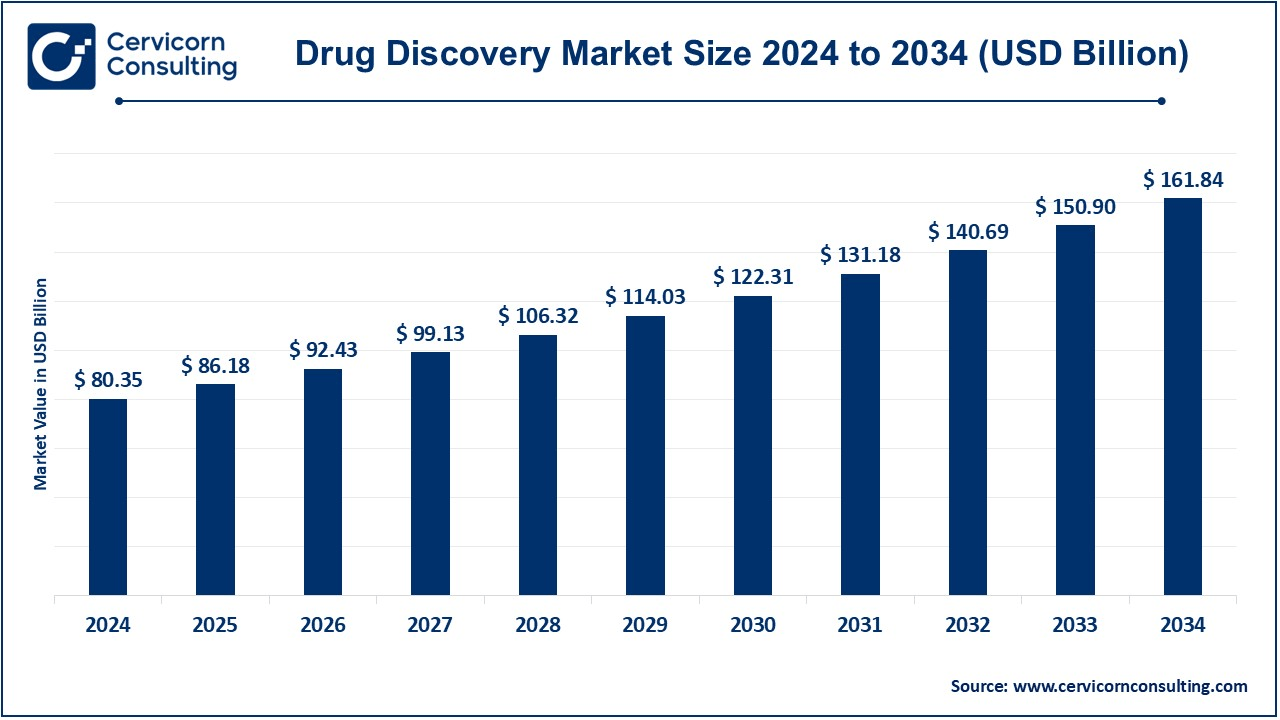
Drug discovery is the process of identifying and developing new medicines to treat diseases by understanding biological mechanisms and targeting specific molecules. It involves multiple stages, including target identification, lead compound discovery, preclinical testing, and clinical trials. Advances in technologies like artificial intelligence, genomics, and high-throughput screening have significantly accelerated the process, enabling faster and more cost-effective development of innovative therapies for various medical conditions.
Insilico Medicine’s AI-Based Target Identification
One of the frequently mentioned examples of real-world AI-based target identification is by Insilico Medicine, an AI-driven drug discovery company that excels in AI-based target identification and drug design. The company utilized its generative AI platform, PandaOmics, for the integrated analysis of large-scale multi-omics and disease biology data to discover a novel therapeutic target, TNIK (TRAF2 and NCK-interacting kinase) associated with fibrotic diseases such as Idiopathic Pulmonary Fibrosis (IPF).
“The AI-powered system successfully identified the priority disease driving target (TNIK) as a high confidence target by integrating genomic, transcriptomic, and pathway-level data thereby significantly shortening the target identification timeline compared to traditional hypothesis-driven target identification.”
Subsequently, this novel target discovery by AI was integrated into the AI-based chemical generative platform (Chemistry42) to design a novel chemical inhibitor targeting TNIK. The integrated AI approach streamlined the drug discovery from target identification to the nominating a pre-clinical candidate within less than 18 months, far faster than the traditional early discovery cycle of 3–5 years.
| Country/Region | Regulatory Authority | Key Focus Areas | Recent Trends |
| United States | FDA (Food and Drug Administration) | Oncology, rare diseases, biologics | Increasing use of accelerated approval & AI-assisted submissions |
| Europe | EMA (European Medicines Agency) | Advanced therapies, orphan drugs | Strong focus on multi-country clinical trials |
| China | NMPA (National Medical Products Administration) | Oncology, biosimilars, novel biologics | Faster approvals & strong domestic biotech expansion |
| India | CDSCO (Central Drugs Standard Control Organization) | Generics, vaccines, clinical trials outsourcing | Increasing participation in global trials & regulatory harmonization |
| Japan | PMDA (Pharmaceuticals and Medical Devices Agency) | Regenerative medicine, oncology | Focus on reducing drug lag via faster approvals |
Report Scope
| Area of Focus | Details |
| Market Size in 2026 | USD 92.43 Billion |
| Expected Market Size by 2035 | USD 172.29 Billion |
| Projected CAGR 2026 to 2035 | 7.17% |
| Dominant Region | North America |
| Fastest Expanding Area | Asia-Pacific |
| Key Segments | Drug Type, Technology, End-user, Region |
| Key Companies | Pfizer Inc., GlaxoSmithKline PLC, Merck & Co. Inc., Agilent Technologies Inc., Eli Lilly and Company, F. Hoffmann-La Roche Ltd, Bayer AG, Abbott Laboratories Inc., AstraZeneca PLC, Shimadzu Corp |
United States
The U.S. is the number one global spender on R&D and in pharmaceutical discovery. A big part of this spend is by large private sector organizations such as Johnson & Johnson, Pfizer and Merck. The U.S. Spend on R&D is in excess of $780 billion annually (across all areas) but a significant amount is invested in the life sciences and biotechnology sector. U.S. Has leadership in early stage innovation, in AI-driven drug discovery startups, and in venture funding to the biotech sector.
China
China has become the largest and fastest-growing R&D hub in the world, recently surpassing the U.S. In total R&D spend. Investment into pharmaceutical R&D is accelerating with high levels of government support and proactive biotech investment policies driving increased spend on the sector. The largest amounts of money are being invested in oncology and cell therapy, and also in the development of biosimilars. China is becoming increasingly important as a source of licensed drug candidates to Western pharma companies.
Germany
Europe's leading R&D country for pharmaceuticals with large contributions from companies such as Boehringer Ingelheim and Bayer. Main areas of investment are industrial biotech, oncology, and chemical-based drug discovery. Germany has a high level of R&D intensity (around 3% GDP-one of the world's highest). Strong linkages with Europe-wide networks of clinical research enhance cross-border innovative activity.
India
India has become one of the most rapidly growing emerging markets for R&D and clinical research outsourcing. Though the absolute level of total R&D spend is not as high as the aforementioned countries, it is growing at a strong rate, supported by robust generics and biotech sectors. Development and manufacture of vaccines, biosimilars and low cost drug development models represent the biggest investment in the sector. India plays a pivotal role as a venue for clinical trials, as well as support for CRO-driven research.
The drug discovery market is classified into several key regions: North America, Europe, Asia-Pacific, and LAMEA (Latin America, Middle East, and Africa). There is a deeper analysis of the regions below:
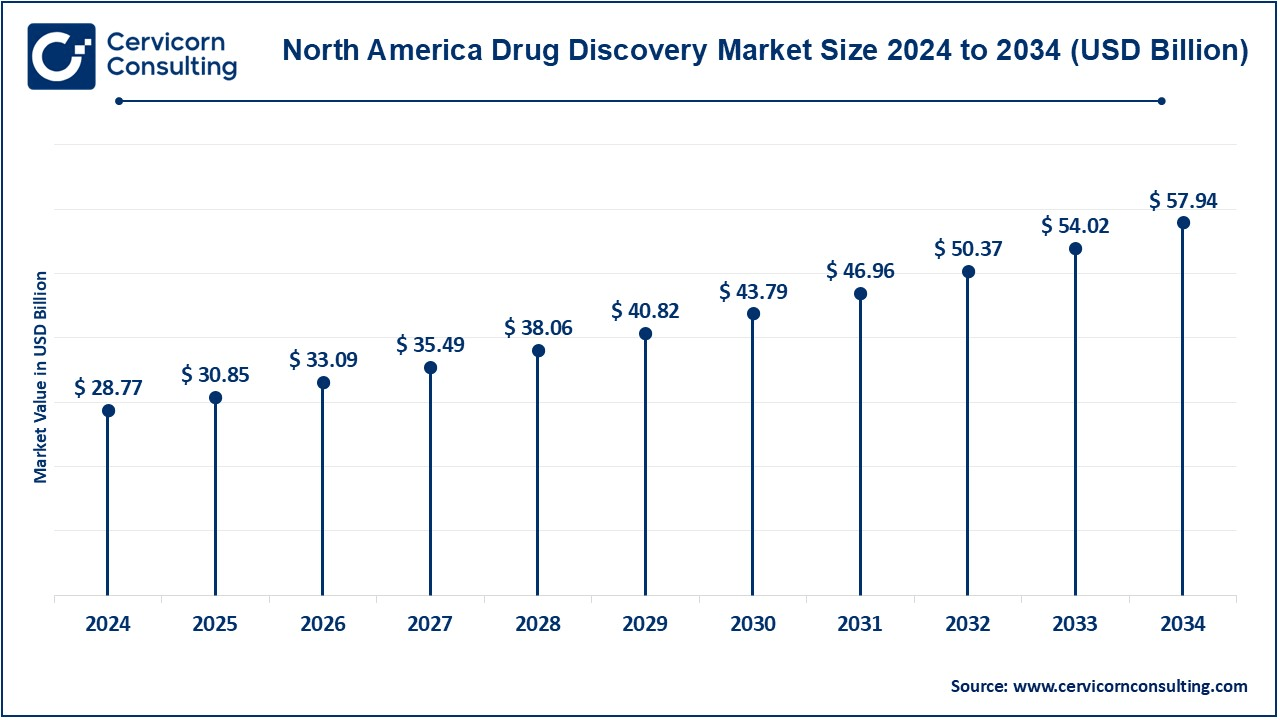
The North America drug discovery market size was valued at USD 30.85 billion in 2025 and is estimated to surpass around USD 61.68 billion by 2035. North America holds the majority share of the market because of high investment in R&D, well-established healthcare infrastructure, and prominent pharmaceutical and biotechnology firms in the region. Increase in the prevalence of chronic diseases such as cancer and diabetes in the U.S. have necessitated more new drugs in the region. The fast-track approval of the FDA along with orphan drug incentives has added to the growth of this market at a high rate. Advanced technologies such as AI are well placed in the region, which enhances the efficiency of drug discovery and hence makes North America a high-value market.
The Europe drug discovery market size was estimated at USD 26.46 billion in 2025 and is estimated to surpass around USD 52.89 billion by 2035. Europe is also holding a significant share. The supporting role comes from EMA, government funding, and a stable pharmaceutical sector. Countries which are more developed in R&D as well as for innovation in the area of biologics and biosimilars tend to do very well in this category; Germany, UK, and Switzerland, for instance, are good examples. The stronger results are brought out through cooperative research between academies and companies. Concentration on precision medicine and therapy for rare diseases, as well as the importance of developing advanced healthcare technologies, would have worked as a steady engager for the growth of the drug discovery sector within the Europe region.
The Asia-Pacific drug discovery market size was reached USD 20.25 billion in 2025 and is estimated to surpass around USD 40.49 billion by 2035. In the recent past, growth in the Asia-Pacific region due to health care and health spending that expands with growing chronic burden across different diseases, though on the anvil are high-activity rapid increases in their respective clinical activities in China, India, and Japan. Favourable conditions are provided by the governments and cost-competitive manufacturing benefits are further sustained through the advancements with high throughput screening. Skilled workforce, improving regulatory frameworks, and so on attract global pharmaceutical companies to set up R&D operations, making Asia-Pacific a huge hub for drug discovery innovation.
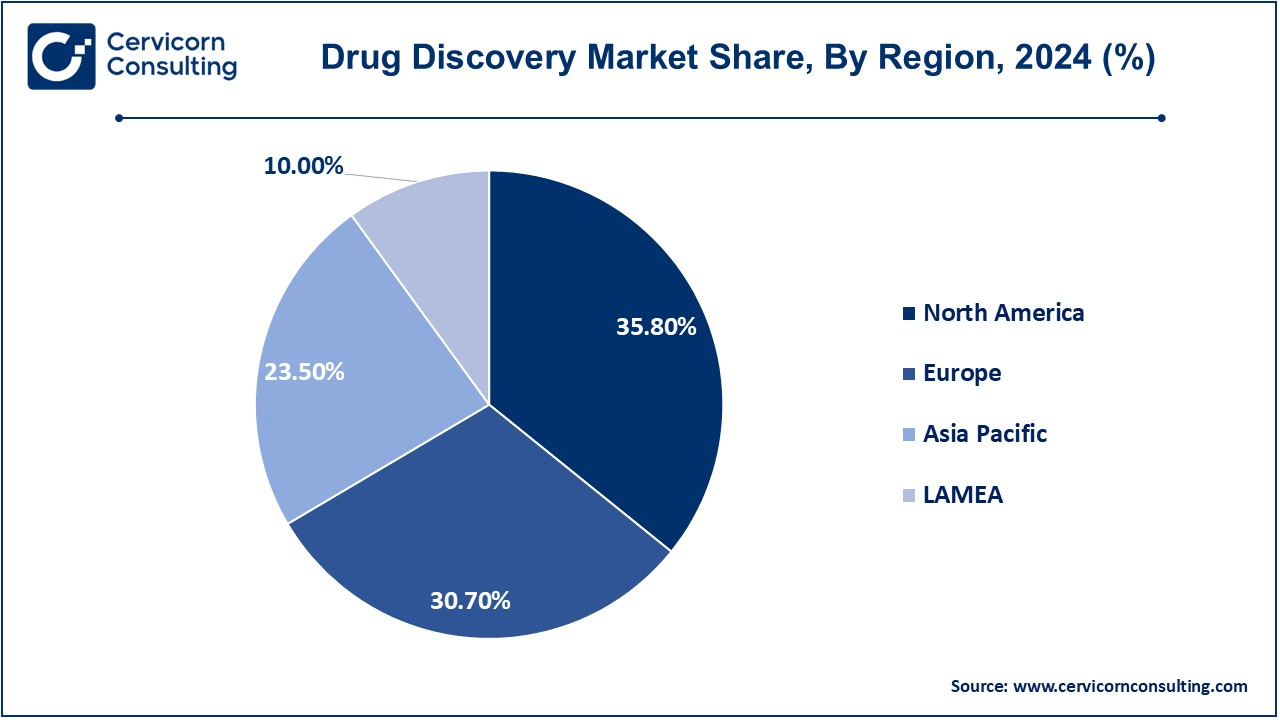
The LAMEA drug discovery market size was valued at USD 8.62 billion in 2025 and is anticipated to reach around USD 17.23 billion by 2035. Improving healthcare infrastructure and increasing access to innovative treatments are driving steady growth in the LAMEA region drug discovery market. Latin America, led by Brazil and Mexico, is increasing investments in healthcare and pharmaceutical R&D. Countries in the Middle East, such as the UAE and Saudi Arabia, are boosting their biotech and healthcare sectors as part of economic diversification. Africa is gradually but surely on the move with initiatives along infectious diseases and global pharma firms collaborations, even though this field still faces limited funding and weak infrastructure.
The drug discovery market is segmented into drug type, technology, end-user and region. Based on drug type, the market is classified into small molecule drugs and biologic drugs. Based on technology, the market is classified into high throughput screening, pharmacogenomics, combinatorial chemistry, nanotechnology ands others. Based on end-user, the market is classified into pharmaceutical companies, contract research organizations and others.
Small Molecule Drugs: The drug discovery market share still stands the strongest since they are well-proven for their efficacy, relatively easy to synthesize, and can easily target intracellular pathways. Their application in treating chronic diseases like cancer, diabetes, and cardiovascular disorders is also extensive because of oral bioavailability and crossing cell membranes. Growth in the generics area coupled with innovative work in synthetic chemistry would add more to the growth in this area. However, the threat of biologic drugs is on the rise as biologics provide better specificity for complex diseases.
Drug Discovery Market Share, By Drug Type, 2025 (%)
| Drug Type | Revenue Share, 2025 (%) |
| Small Molecule Drugs | 22% |
| Biologic Drugs | 78% |
Biologic drugs: They are the fastest growth in drug discovery, driven by breakthroughs in biotechnology and an increased demand for precision medicine. These include monoclonal antibodies, vaccines, and cell therapies from living organisms and treat chronic and rare diseases effectively. It is fueled by rising prevalence rates of autoimmune disorders, cancers, and infectious diseases. Despite the very high cost of the development process, the market penetration would be sustained by innovative platforms and the increasing use of biosimilars as patents for biologic drugs fall. For example, in May 2024, the European Commission approved Opdivo-an antibody drug, though biological, to treat various types of cancers among adults who have unresectable or metastatic urothelial carcinoma.
High throughput screening: In the case of high throughput screening, potential drug candidates become identified much faster compared to other earlier drug discovery tools. This is the capability for researchers to assay thousands of chemicals against a set biological target rapidly by means of automated devices. This type of screening process is extensively followed for lead identification, thereby allowing reductions in time as well as investment in early discovery research. As it combines more with AI as well as robots for efficiency and also accuracy, further increases its utility in the marketplace.
Pharmacogenomics: Pharmacogenomics has turned the science of drug discovery by allowing personalized medications. By comparing genetic differences, it allows anticipating the reaction a person may undergo to drugs with reduced adverse effect and improved effectiveness. Precision medicine and technological enhancements in genomics have driven people to opt for pharmacogenomics, especially concerning cancer, cardiovascular diseases, and neurological disorders.
Combinatorial Chemistry: Combinatorial chemistry represents the very core drug discovery technology since it accelerates compound library syntheses. Screening vast chemical libraries for lead-compounds against selective biological targets expedites identifying candidates. A vital tool applied to optimize drugs in terms of potency and economical benefits, such has rendered it irreplaceable within most pharmaceutical companies' arms. Addition of AI, along with computational chemistry, gives it an extension in value, acting as a mechanism in fast-tracking drugs in accelerated stages.
Nanotechnology: Nanotechnology is revolutionizing drug discovery because it can design nanocarriers for targeted drug delivery. The technology enhances bioavailability and solubility and stabilizes drugs with very poor solubility. Nanotechnology is highly utilized in the treatment of cancer and infectious diseases, among others as in gene delivery. The accuracy of the treatments with low side effects has encouraged this application of nanotechnology in the market.
Other Technologies: Bioinformatics, proteomics, and AI-driven platforms are just a few of the other technologies involved. These other technologies are a major driver for drug discovery in today's world. This would include target identification, data analysis, and predictive modeling to increase more rapid and improved drug development. Advanced adoption is accelerating further with precision medicine as well as more cost-effective drug development solutions.
CEO Statements
Albert Bourla, CEO of Pfizer:
Robert Michael, CEO, of AbbVie.:
Chris Viehbacher, CEO, Biogen:
By Drug Type
By Technology
By End-user
By Region
Chapter 1. Market Introduction and Overview
1.1 Market Definition and Scope
1.1.1 Overview of Drug Discovery
1.1.2 Scope of the Study
1.1.3 Research Timeframe
1.2 Research Methodology and Approach
1.2.1 Methodology Overview
1.2.2 Data Sources and Validation
1.2.3 Key Assumptions and Limitations
Chapter 2. Executive Summary
2.1 Market Highlights and Snapshot
2.2 Key Insights by Segments
2.2.1 By Drug Type Overview
2.2.2 By Technology Overview
2.2.3 By End User Overview
2.3 Competitive Overview
Chapter 3. Global Impact Analysis
3.1 Russia-Ukraine Conflict: Global Market Implications
3.2 Regulatory and Policy Changes Impacting Global Markets
Chapter 4. Market Dynamics and Trends
4.1 Market Dynamics
4.1.1 Market Drivers
4.1.1.1 Discovery of the silico drug
4.1.1.2 Biologics and biosimilars adoption
4.1.1.3 More Contracting with CRO
4.1.1.4 More Contracting with CRO
4.1.2 Market Restraints
4.1.2.1 High Drug Development Costs
4.1.2.2 Intellectual Property Issues
4.1.3 Market Challenges
4.1.3.1 High Attrition Rates in Drug Development
4.1.3.2 Complex Regulatory Approvals
4.1.4 Market Opportunities
4.1.4.1 Growth in Biologics and Biosimilars
4.1.4.2 Orphan Drug Development
4.1.4.3 Growing Investment in Research and Development
4.2 Market Trends
Chapter 5. Premium Insights and Analysis
5.1 Global Drug Discovery Market Dynamics, Impact Analysis
5.2 Porter’s Five Forces Analysis
5.2.1 Bargaining Power of Suppliers
5.2.2 Bargaining Power of Buyers
5.2.3 Threat of Substitute Products
5.2.4 Rivalry among Existing Firms
5.2.5 Threat of New Entrants
5.3 PESTEL Analysis
5.4 Value Chain Analysis
5.5 Product Pricing Analysis
5.6 Vendor Landscape
5.6.1 List of Buyers
5.6.2 List of Suppliers
Chapter 6. Drug Discovery Market, By Drug Type
6.1 Global Drug Discovery Market Snapshot, By Drug Type
6.1.1 Market Revenue (($Billion) and Growth Rate (%), 2024-2035
6.1.1.1 Small Molecule Drugs
6.1.1.2 Biologic Drugs
Chapter 7. Drug Discovery Market, By Technology
7.1 Global Drug Discovery Market Snapshot, By Technology
7.1.1 Market Revenue (($Billion) and Growth Rate (%), 2024-2035
7.1.1.1 High Throughput Screening
7.1.1.2 Pharmacogenomics
7.1.1.3 Combinatorial Chemistry
7.1.1.4 Nanotechnology
7.1.1.5 Others
Chapter 8. Drug Discovery Market, By End-User
8.1 Global Drug Discovery Market Snapshot, By End-User
8.1.1 Market Revenue (($Billion) and Growth Rate (%), 2024-2035
8.1.1.1 Pharmaceutical Companies
8.1.1.2 Contract Research Organizations
8.1.1.3 Others
Chapter 9. Drug Discovery Market, By Region
9.1 Overview
9.2 Drug Discovery Market Revenue Share, By Region 2025 (%)
9.3 Global Drug Discovery Market, By Region
9.3.1 Market Size and Forecast
9.4 North America
9.4.1 North America Drug Discovery Market Revenue, 2024-2035 ($Billion)
9.4.2 Market Size and Forecast
9.4.3 North America Drug Discovery Market, By Country
9.4.4 U.S.
9.4.4.1 U.S. Drug Discovery Market Revenue, 2024-2035 ($Billion)
9.4.4.2 Market Size and Forecast
9.4.4.3 U.S. Market Segmental Analysis
9.4.5 Canada
9.4.5.1 Canada Drug Discovery Market Revenue, 2024-2035 ($Billion)
9.4.5.2 Market Size and Forecast
9.4.5.3 Canada Market Segmental Analysis
9.4.6 Mexico
9.4.6.1 Mexico Drug Discovery Market Revenue, 2024-2035 ($Billion)
9.4.6.2 Market Size and Forecast
9.4.6.3 Mexico Market Segmental Analysis
9.5 Europe
9.5.1 Europe Drug Discovery Market Revenue, 2024-2035 ($Billion)
9.5.2 Market Size and Forecast
9.5.3 Europe Drug Discovery Market, By Country
9.5.4 UK
9.5.4.1 UK Drug Discovery Market Revenue, 2024-2035 ($Billion)
9.5.4.2 Market Size and Forecast
9.5.4.3 UKMarket Segmental Analysis
9.5.5 France
9.5.5.1 France Drug Discovery Market Revenue, 2024-2035 ($Billion)
9.5.5.2 Market Size and Forecast
9.5.5.3 FranceMarket Segmental Analysis
9.5.6 Germany
9.5.6.1 Germany Drug Discovery Market Revenue, 2024-2035 ($Billion)
9.5.6.2 Market Size and Forecast
9.5.6.3 GermanyMarket Segmental Analysis
9.5.7 Rest of Europe
9.5.7.1 Rest of Europe Drug Discovery Market Revenue, 2024-2035 ($Billion)
9.5.7.2 Market Size and Forecast
9.5.7.3 Rest of EuropeMarket Segmental Analysis
9.6 Asia Pacific
9.6.1 Asia Pacific Drug Discovery Market Revenue, 2024-2035 ($Billion)
9.6.2 Market Size and Forecast
9.6.3 Asia Pacific Drug Discovery Market, By Country
9.6.4 China
9.6.4.1 China Drug Discovery Market Revenue, 2024-2035 ($Billion)
9.6.4.2 Market Size and Forecast
9.6.4.3 ChinaMarket Segmental Analysis
9.6.5 Japan
9.6.5.1 Japan Drug Discovery Market Revenue, 2024-2035 ($Billion)
9.6.5.2 Market Size and Forecast
9.6.5.3 JapanMarket Segmental Analysis
9.6.6 India
9.6.6.1 India Drug Discovery Market Revenue, 2024-2035 ($Billion)
9.6.6.2 Market Size and Forecast
9.6.6.3 IndiaMarket Segmental Analysis
9.6.7 Australia
9.6.7.1 Australia Drug Discovery Market Revenue, 2024-2035 ($Billion)
9.6.7.2 Market Size and Forecast
9.6.7.3 AustraliaMarket Segmental Analysis
9.6.8 Rest of Asia Pacific
9.6.8.1 Rest of Asia Pacific Drug Discovery Market Revenue, 2024-2035 ($Billion)
9.6.8.2 Market Size and Forecast
9.6.8.3 Rest of Asia PacificMarket Segmental Analysis
9.7 LAMEA
9.7.1 LAMEA Drug Discovery Market Revenue, 2024-2035 ($Billion)
9.7.2 Market Size and Forecast
9.7.3 LAMEA Drug Discovery Market, By Country
9.7.4 GCC
9.7.4.1 GCC Drug Discovery Market Revenue, 2024-2035 ($Billion)
9.7.4.2 Market Size and Forecast
9.7.4.3 GCCMarket Segmental Analysis
9.7.5 Africa
9.7.5.1 Africa Drug Discovery Market Revenue, 2024-2035 ($Billion)
9.7.5.2 Market Size and Forecast
9.7.5.3 AfricaMarket Segmental Analysis
9.7.6 Brazil
9.7.6.1 Brazil Drug Discovery Market Revenue, 2024-2035 ($Billion)
9.7.6.2 Market Size and Forecast
9.7.6.3 BrazilMarket Segmental Analysis
9.7.7 Rest of LAMEA
9.7.7.1 Rest of LAMEA Drug Discovery Market Revenue, 2024-2035 ($Billion)
9.7.7.2 Market Size and Forecast
9.7.7.3 Rest of LAMEAMarket Segmental Analysis
Chapter 10. Competitive Landscape
10.1 Competitor Strategic Analysis
10.1.1 Top Player Positioning/Market Share Analysis
10.1.2 Top Winning Strategies, By Company, 2024-2025
10.1.3 Competitive Analysis By Revenue, 2024-2025
10.2 Recent Developments by the Market Contributors (2025)
Chapter 11. Company Profiles
11.1 Pfizer Inc.
11.1.1 Company Snapshot
11.1.2 Company and Business Overview
11.1.3 Financial KPIs
11.1.4 Product/Service Portfolio
11.1.5 Strategic Growth
11.1.6 Global Footprints
11.1.7 Recent Development
11.1.8 SWOT Analysis
11.2 GlaxoSmithKline PLC
11.3 Merck & Co. Inc.
11.4 Agilent Technologies Inc.
11.5 Eli Lilly and Company
11.6 F. Hoffmann-La Roche Ltd
11.7 Bayer AG
11.8 Abbott Laboratories Inc.
11.9 AstraZeneca PLC
11.10 Shimadzu Corp