Surgical Devices Market Size and Forecast 2026 to 2035
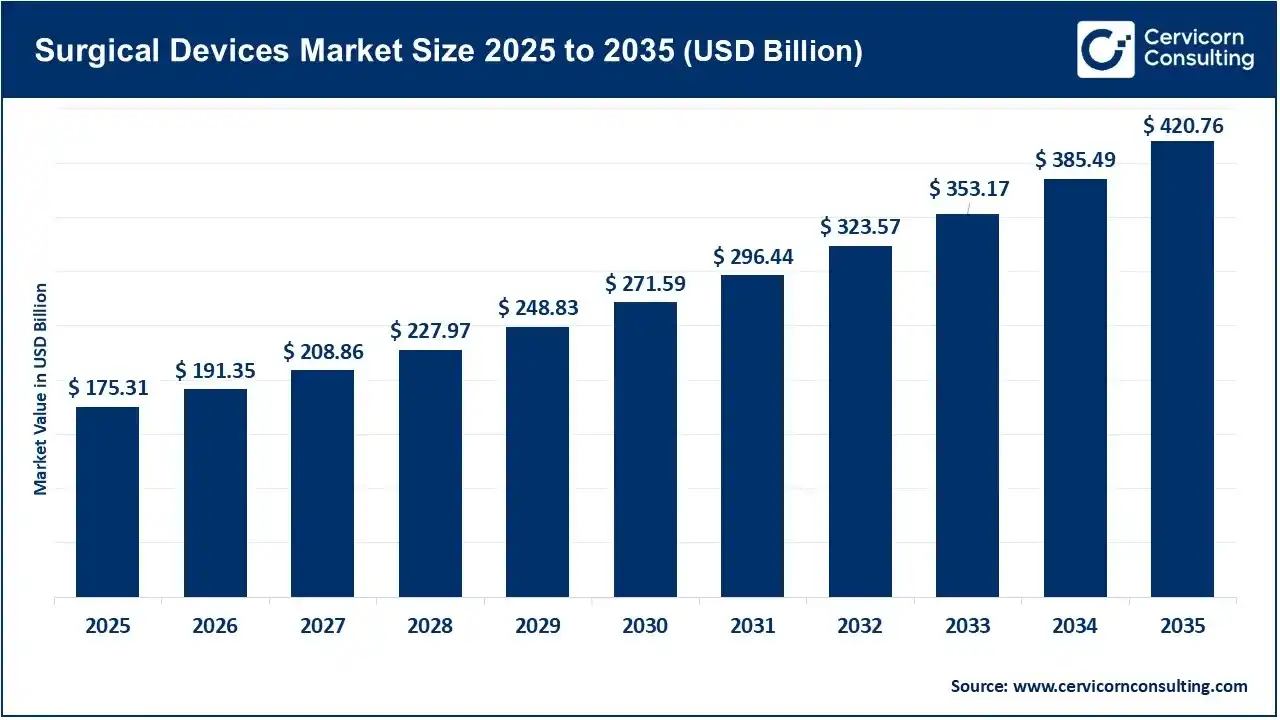
The global surgical devices market size was valued at USD 175.31 billion in 2025 and is expected to reach USD 420.76 billion by 2035, growing at a CAGR of 9.2% during the forecast period of 2026-2035. Day by day, the globe is facing a massive burden of chronic conditions, along with a substantial rise in geriatric populations, fueling the demand for sophisticated surgical devices. At the same time, well-qualified surgeons and patients are actively seeking minimally invasive surgery (MIS), which the market highlights as a major opportunity.
Surgical Devices Market Overview & Key Metrics
- Base Year Market Size (2025): $175.31 billion
- Current Year Market Size (2026): $191.35 billion
- Estimated Year Market Size (2035): $420.76 billion
- Forecast Period CAGR (2026-2035): 9.2%
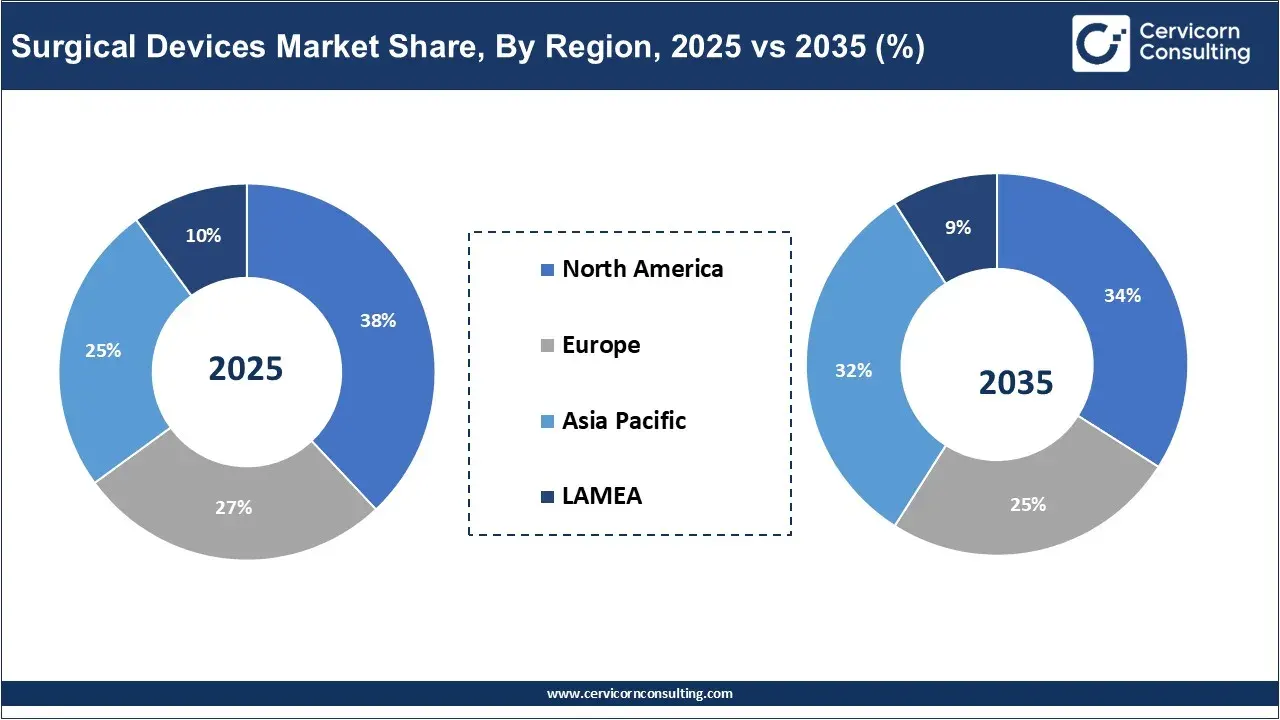
- Leading region: North America (revenue share 38% in 2025)
Report Highlights
- By region: North America has generated revenue share of 38% in 2025, due to well-developed surgical infrastructure, surged adoption of innovative devices, and established healthcare spending.
- By product type: Handheld surgical instruments led the market in 2025 with revenue share of 24%, driven by their expansive use across open, minimally invasive, and specialty surgical procedures.
- By procedure type: General surgery registered dominance in the market in 2025 (revenue share of 30%), supported by its broad range of procedures and significant demand for surgical instruments.
- By technology: Minimally invasive surgery captured revenue share of 42% in 2025, fueled by demand for smaller incisions, shorter recovery times, and minimal hospital stays.
- By end user: Hospitals dominated the market in 2025 with share of 64%, led by their high surgical volumes and widespread range of surgical specialties.
What are Surgical Devices and Their Key Applications Globally?
Primarily, the surgical devices market is defined as the adoption of specialized tools by medical professionals to perform activities like cutting, dissecting, grasping, retracting, and suturing tissues during medical procedures. Nowadays, the ageing population experience severe chronic concerns, which need the use of innovative surgical devices, such as robotic-assisted and autonomous surgery. Alongside this, many healthcare systems are looking to expand telesurgery and remote approaches; thus, they offer 5G-driven and long-distance conduction of chronic procedures. On the other hand, developers are heavily focusing on portable, modular, and affordable capital and endoscopic equipment for expedited patient turnaround.
Global Surgical Procedure Volume and Demand for Surgical Devices
- Cataract surgery volume: Approximately 5.01 million cataract surgeries were performed across the European Union in 2023, equivalent to 1,118 procedures per 100,000 inhabitants.
- Country-level variation in cataract procedures: In 2023, cataract surgery rates ranged from 1,627.3 per 100,000 people in Luxembourg to 389.4 per 100,000 in Romania, highlighting differences in treatment access and procedure volumes.
- Shift toward same-day surgery: In the EU, 93.6% of cataract surgery patients were treated without an overnight inpatient stay in 2023. This reflects demand for surgical instruments, consumables and equipment suited to high-throughput outpatient facilities.
- Growth in minimally invasive procedures: Recent European data show positive growth in keyhole procedures for hysterectomies, inguinal hernia repairs and appendectomies across multiple countries. This supports demand for laparoscopic instruments, trocars, energy-based devices and visualization systems.
- Caesarean section volumes: Poland recorded 431.5 caesarean sections per 1,000 live births in 2023, compared with 203.2 in Denmark and 160.0 in Norway. Such differences indicate varied procedural requirements for surgical instruments, sutures and related consumables across healthcare systems.
- Surgical waiting lists remain significant: In 2024, more than 70% of patients waiting for cataract surgery in Finland and Norway had waited over three months. For hip replacement surgery, median waiting times ranged from 67 days in Sweden and Spain to 667 days in Slovenia, indicating potential pressure to expand surgical capacity.
- Demand for ambulatory surgical equipment: In 2023, same-day procedures accounted for an average of 95% of cataract surgeries and 43% of tonsillectomies across OECD countries with comparable data. This supports demand for compact surgical equipment, procedure-specific instruments and efficient sterilization systems.
What are Key Initiatives Transforming the Surgical Devices Market?
- October 2026: Nami Surgical secured £3.4m in additional funding to strengthen its ultrasonic technology for robotic-assisted surgery, with coverage of a £2m investment from the Scottish National Investment Bank.
- October 2026: The Shenzhen Institute of Advanced Biomedical Robot (Abrobo) joined Jianmin Liu’s team at Changhai Hospital, as it ensured its Panvis Star robotic system via five neurointerventional procedures that cover animal models.
- October 2026: Phantom GI announced a $5 million seed round to foster the progression and first phase of U.S. clinical studies of PercStoma, a minimally invasive alternative to conventional ostomy surgery.
- September 2026: Levee Medical won an NIH SBIR Phase II grant worth nearly $2 million to push research activities spurring its Voro Urologic Scaffold.
- July 2026: KARL STORZ partnered with Moon Surgical and Sovato and emphasized the development of a more open and interoperable robotics ecosystem for the operating room.
Market Dynamics
Growth Drivers
- Accelerating Demand for MIS Measures: To enable smaller incisions, reduced trauma, and rapid recovery times, the global population is driving the use of robotic solutions, endoscopic solutions, and energy-based devices, allowing millions of procedures to be conducted per year.
- A Rise in ASCs: Most countries and their healthcare providers are increasingly moving towards outpatient and ambulatory surgery centers (ASCs) that minimise healthcare spending and support higher turnover for lower-risk and certain activities.
- Ongoing Breakthroughs: In 2026, the surgical devices market is steadily expanding as numerous producers heavily invest in precision-improving innovations, such as diamond-dusted instrument grips, sophisticated surgical visualization solutions, and smart electrosurgical tools to elevate clinical safety and results.
Market Restraints
- High Upfront Investment: To unveil the latest surgical measures, like robotic-assisted systems, requires vast capital costs, with massive spending on maintenance, software updates, and specialised training, creating key hurdles.
- Surpassed Replacement Timelines: Many times, hospitals and surgical centers extend replacement and advancement cycles much longer than the existing one, ultimately delaying faster market adoption.
- Surge in Export Stress: Currently, trade tariffs are emerging as the most popular barrier across the market, as they raise the expense of imported raw materials, electrosurgical components, and disposables. Hence, some export manufacturers face tight profit margins.
Key Opportunities
- Integration in Technologies: In the future, the surgical devices market will have a prominent chance in integrating camera sensor systems by leveraging deep learning and computer vision that find and isolate tissues, blood vessels, and tumors in real-time.
- Impressive Tailored Efforts: The system will widely aim at the implementation of patient-specific anatomical models and implants (PSIs) derived from CT and MRI scans, coupled with 3D-printed titanium implants, expandable cages, and physical organ/tumor models to lower time and operating expenses.
- Focusing on 5G & Cybersecurity: In the coming era, several advances will necessitate instruments evolved with plug-and-play cloud connectivity that connect directly with hospital information systems and meet stricter EU MDR and FDA cybersecurity frameworks. This will also promote 5G-driven and telesurgery settings that enhance remote surgical assistance and latency-free master-slave control units.
Market Challenges
- Pricing-related Concern: The execution of variable, inadequate, or minimal insurance and government reimbursement landscapes for specialized surgical devices is restricting profit margins and slowing down adoption rates.
- Rigorous & Isolated Guidelines: Many of the regulatory frameworks declare complex, multi-region compliance trajectories and emerging device safety approvals, which elevate time-to-market and regulatory stress for developers.
Surgical Devices Market Regional Analysis
What Made North America Dominant in the Market in 2025?
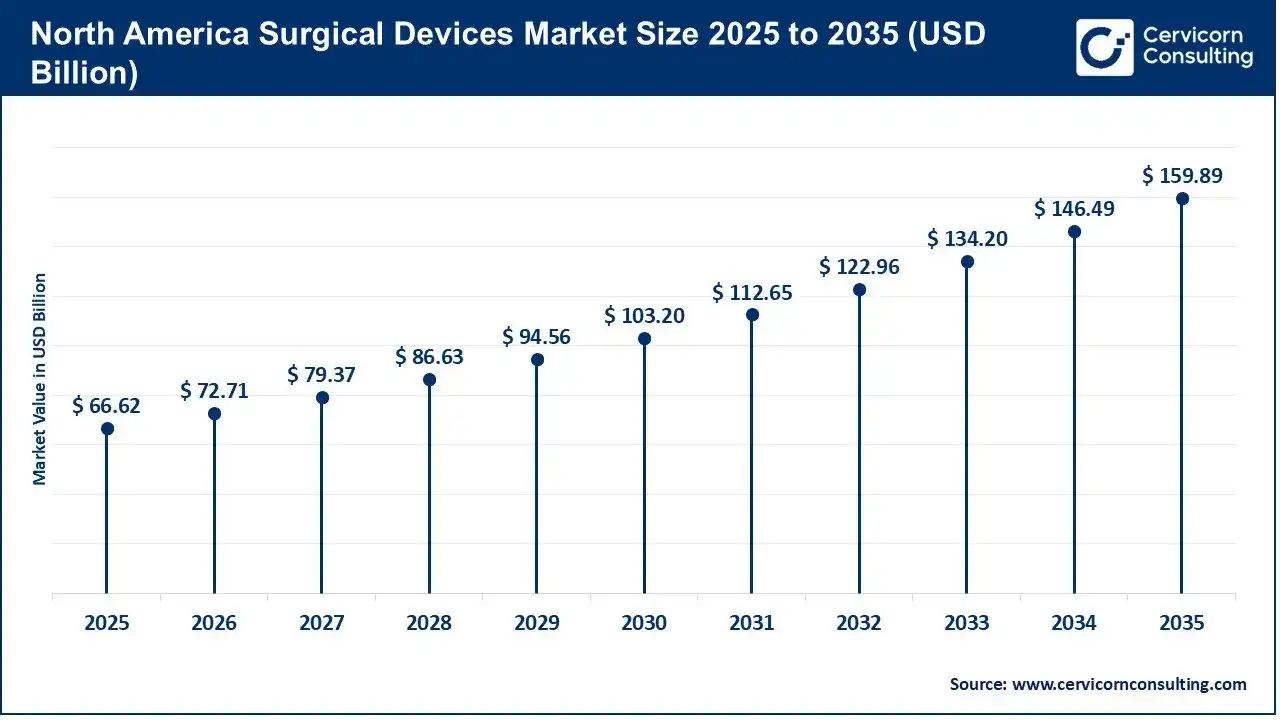
The North America surgical devices market size was valued at USD 66.62 billion in 2025 and is expected to reach USD 159.89 billion by 2035. In 2025, North America accounted for the largest share of 38% of the market because of continuous healthcare investment and the presence of highly modernized surgical infrastructure. Along with an increased use of Medicare-covered procedures, the region has broadened initiatives, including the Ontario Bringing Innovative New Technologies Release, which have expedited domestic placement of digital wound-management tools, AI-enabled screening systems, and specialized non-invasive abdominal wall surgical supports.
United States Market
- The U.S. registered a dominant share in the market in 2025, as the nation reported that nearly >900,000 cardiac surgeries were conducted in 2025. To enhance solutions across such prevalences, the U.S. rolled out Mitral valve repair and Coronary Artery Bypass Grafting (CABG). Besides this, national-level healthcare providers are seeking to explore remote and tele-robotic surgical capabilities and elevate access improvements in specialized cardiac and soft-tissue procedures.
How is Asia Pacific Predicted to be the Fastest-Growing Region in the Coming Years?
The Asia-Pacific surgical devices market size was estimated at USD 43.83 billion in 2025 and is projected to surpass USD 105.19 billion by 2035. Asia Pacific is anticipated to expand rapidly in the surgical devices market during 2026-2035, led by healthcare infrastructure progression, accelerating surgical volumes, and rising access to advanced surgical technologies. According to the experts, the region has been promoting novelty in ingestible and active robotic capsules, like Indiotics' Pillbot for upper endoscopies, with the development of Pill Surgeon for biopsies. This widely uses Asia's local supply chain for micro-scale components, chips, and power management.
China Market
- China is considered a prominent hub of rapidly growing aged populations and chronic diseases in the upcoming years. To overcome these concerns, the country is broadening the adoption of robot-assisted surgery, 3D-printed tools, and AI-powered diagnostic or surgical integration. Alongside this, Chinese surgeons recently completed the world’s first long-distance remote robotic liver surgeries employing the Apstar-6D satellite and also used predictive neural networks to manage latencies exceeding 600 milliseconds.
Surgical Devices Market Segmentation Analysis
Product Analysis
Handheld Surgical Instruments: The handheld surgical instruments segment led with 24% share of the market in 2025, due to wider application in open, minimally invasive, and specialty surgical procedures and greater affordability, with notable simplicity. Also, market leaders stepped into redesigning handles and shafts, coupled with the launch of lightweight, corrosion-resistant, and durable materials in 2025.
Robotic-Assisted Surgical Systems: The robotic-assisted surgical systems segment is expected to be the fastest-growing during 2026-2035, supported by progressions in surgical precision, visualization, and minimally invasive procedures. Eventually, the system has revolutionised AI approaches as real-time surgical assistants and examines live video feeds, segments anatomy, tracks procedure steps, and warns surgeons about risky indications.
Moreover, the electrosurgical devices segment witnessed a lucrative expansion in the market in 2025, driven by its major advantages, including increased precision, control, safety and reduced bleeding concerns. Well-developed nations are promoting the latest smart generators, AI-enabled precision energy delivery, hybrid ultrasonic-bipolar devices, and integrated surgical smoke evacuation systems.
Procedure Analysis
General Surgery: The general surgery segment held a dominant share of 30% of the surgical devices market in 2025, led by its broad range of procedures and growth in organ-specific and regional subspecialties. With a vision of AI solutions, the market is defined by refined evidence-based pathways, customised prehabilitation for frail patients, and smart or sensor-embedded materials.
Orthopedic Surgery: The orthopedic surgery segment is predicted to expand rapidly in the upcoming years because of rising demand for joint replacement, trauma treatment, and advanced surgical techniques. Recent developments unveiled Stryker’s Mako, Smith+Nephew’s CORI, and Johnson & Johnson’s VELYS for consistently refining joint replacements for the hip, knee, and shoulder.
Surgical Devices Market Share, By Procedure Type, 2025 (%)
| Procedure Type |
Revenue Share, 2025 (%) |
| General Surgery |
30% |
| Orthopedic Surgery |
22% |
| Cardiovascular Surgery |
14% |
| Neurosurgery |
9% |
| Gynecological and Urological Surgery |
15% |
| Other Surgical Procedures |
10% |
The neurosurgery segment is anticipated to grow notably during the forecast period, driven by a surge in cases of strokes, traumatic brain injuries, brain tumors, and epilepsy and progressive preoperative and intraoperative strategies. Ongoing efforts are encouraging adaptive DBS systems that facilitate adjustment in electrical stimulation in real time based on active brain signals.
Technology Analysis
Minimally Invasive Surgery: The minimally invasive surgery segment captured the largest share of 42% of the market in 2025, propelled by its benefits, like shorter recovery times and reduced hospital stays, with innovations in robotic measures. In 2025, market players introduced real-time fluorescence imaging and high-definition 3D visualization systems in laparoscopic and robotic-assisted abdominal and gynecological operations, which lower complication rates.
Robotic-Assisted Surgery: The robotic-assisted surgery segment is projected to grow at the fastest rate during 2026-2035, supported by persistent adoption of robotic platforms and advances in surgical control and visualization. Specific breakthroughs are fostering outpatient-focused ASCs, with Intuitive Surgical having extended roughly 8,000 installed da Vinci systems.
Surgical Devices Market Share, By Technology, 2025 (%)
| Technology |
Revenue Share, 2025 (%) |
| Conventional Surgical Technology |
25% |
| Minimally Invasive Surgery |
42% |
| Robotic-Assisted Surgery |
12% |
| Image-Guided Surgery |
8% |
| Energy-Based Surgical Technology |
13% |
The image-guided surgery segment is expected to show significant growth in the surgical devices market, fueled by accelerating patient and clinical preference for less invasive techniques. Especially, solutions such as SurgicalAR by Medivis are revolutionising preoperative CT, MRI, and diffusion scans into real-time holographic guides to trace instruments and preserve neural trajectories.
End User Analysis
Hospitals: The hospitals segment led with 64% share of the market in 2025, driven by their high surgical volumes, widespread range of surgical specialties and expansion into remote settings. In 2025, 3D printing and custom implants acquired major traction to develop patient-specific anatomical bone replicas, surgical drill guides, and personalized prosthetics powered by AI design tools.
Ambulatory Surgical Centers: The ambulatory surgical centers segment is expected to be the fastest-growing in the predicted timeframe, driven by growing demand for affordable surgical care and massive investment in unique service lines. The latest approvals, like CMS clearance for cardiac ablations in ASCs, have sped up the adoption of specialized mapping, navigation, and energy-based ablation tools for same-day discharge.
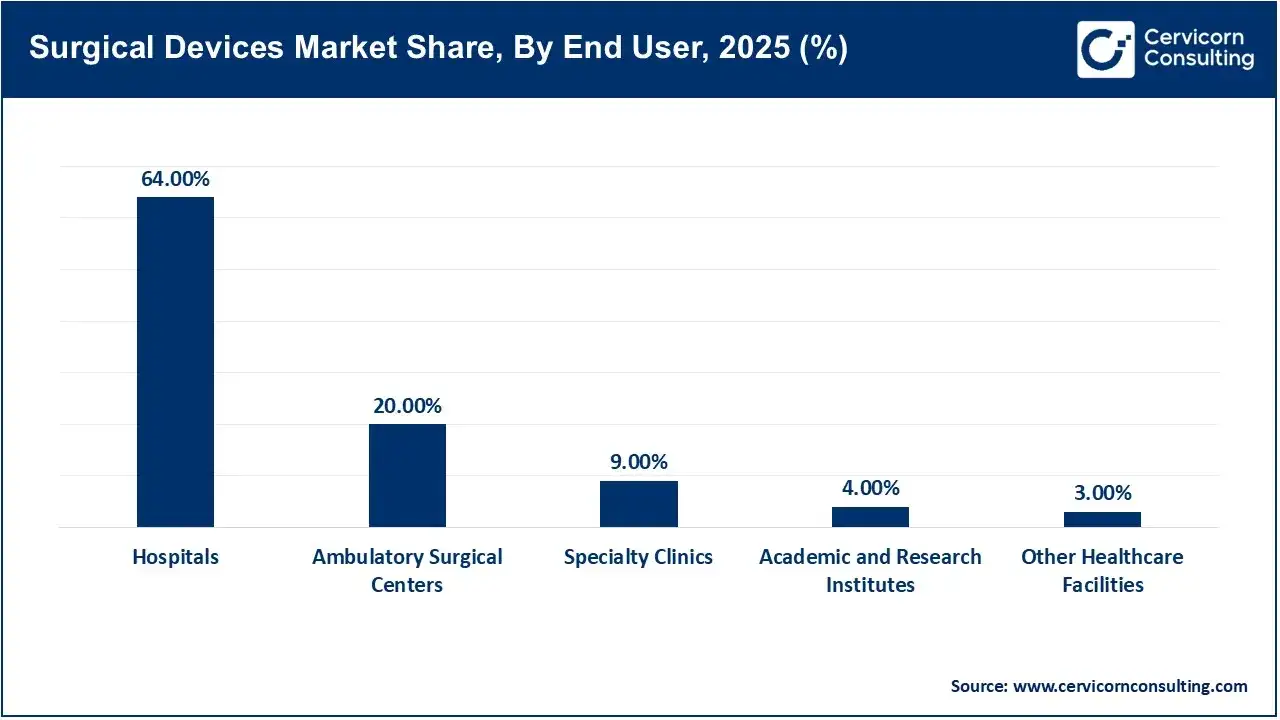
However, the specialty clinics segment registered lucrative growth in the market in 2025, due to broadened technological advances and a substantial rise in financial pressure and emerging staff limitations. Moreover, operating rooms in specialty clinics are pushing integration of real-time imaging, AI-powered navigation, and live data analytics.
Recent Launches
- October 2026: Wockhardt Hospitals Mumbai Central rolled out the Da Vinci X Robotic Surgical System to empower advanced surgical capabilities and reinforce access to robotic-assisted minimally invasive procedures.
- October 2026: Stryker unveiled Mako 4 SmartRobotics™ (Mako 4), the fourth generation of its Mako platform, in India, to foster an integrated clinical and operational experience.
- August 2026: Johnson & Johnson MedTech introduced its next-generation integrated DUALTO Energy System in Korea, which unifies multiple surgical energy modalities on a single platform.
- August 2026: Olympus Corporation (Olympus) launched the ENDOEYE FLEX™ 3D flexible-tip videoscope, compatible with the VISERA ELITE™ III surgical imaging platform to assist more efficient, premium endoscopic surgery.
Leading Players
Segments Covered
By Type
- Soft Tissue Surgical Devices
- Hard Tissue Surgical Devices
- Hybrid Platforms
By Product
- Surgical Sutures and Staples
- Handheld Surgical Instruments
- Electrosurgical Devices
- Surgical Scopes and Visualization Systems
- Surgical Power Tools
- Robotic-Assisted Surgical Systems
- Other Surgical Devices
By Procedure Type
- General Surgery
- Orthopedic Surgery
- Cardiovascular Surgery
- Neurosurgery
- Gynecological and Urological Surgery
- Other Surgical Procedures
By Technology
- Conventional Surgical Technology
- Minimally Invasive Surgery
- Robotic-Assisted Surgery
- Image-Guided Surgery
- Energy-Based Surgical Technology
By End User
- Hospitals
- Ambulatory Surgical Centers
- Specialty Clinics
- Academic and Research Institutes
- Other Healthcare Facilities
By Region
- North America
- Europe
- Asia-Pacific
- Latin America
- Middle East and Africa
