Smart Water Meters Market Size and Growth 2026 to 2035
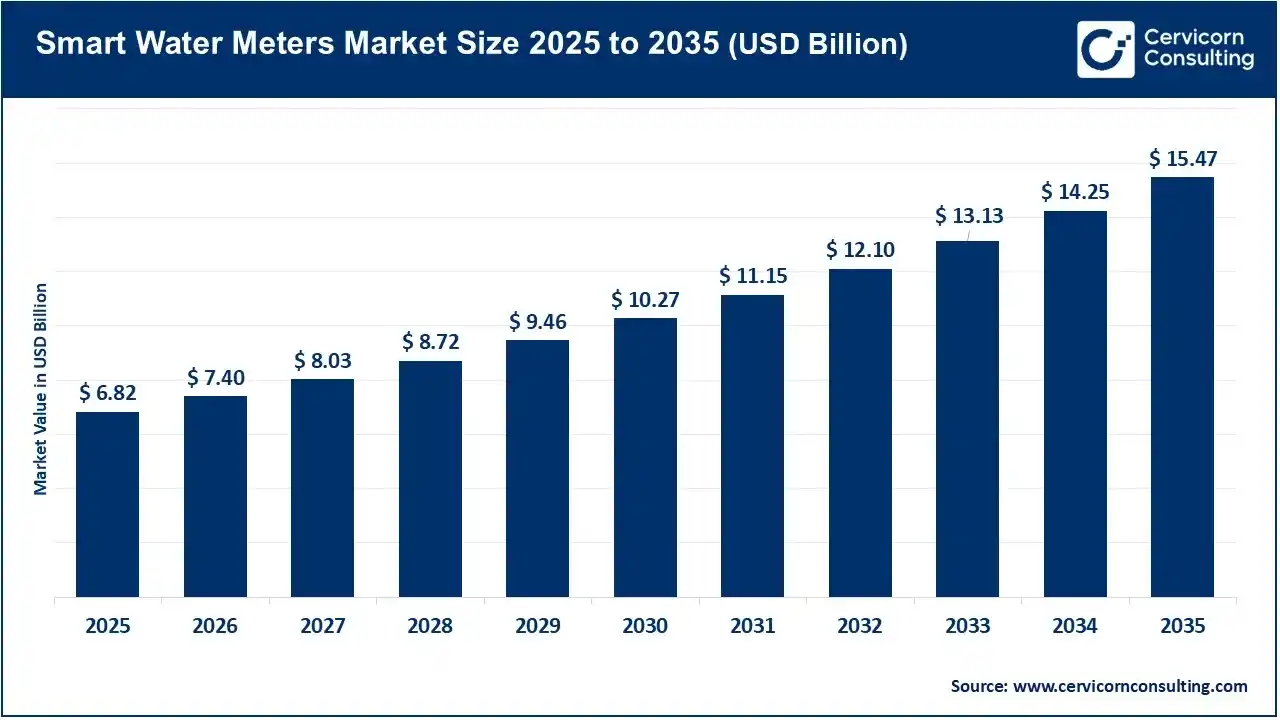
The global smart water meters market size was valued at USD 6.82 billion in 2025 and is expected to exceed around USD 15.47 billion by 2035, growing at a CAGR of 8.6% during the forecast period from 2026 to 2035.
Report Highlights
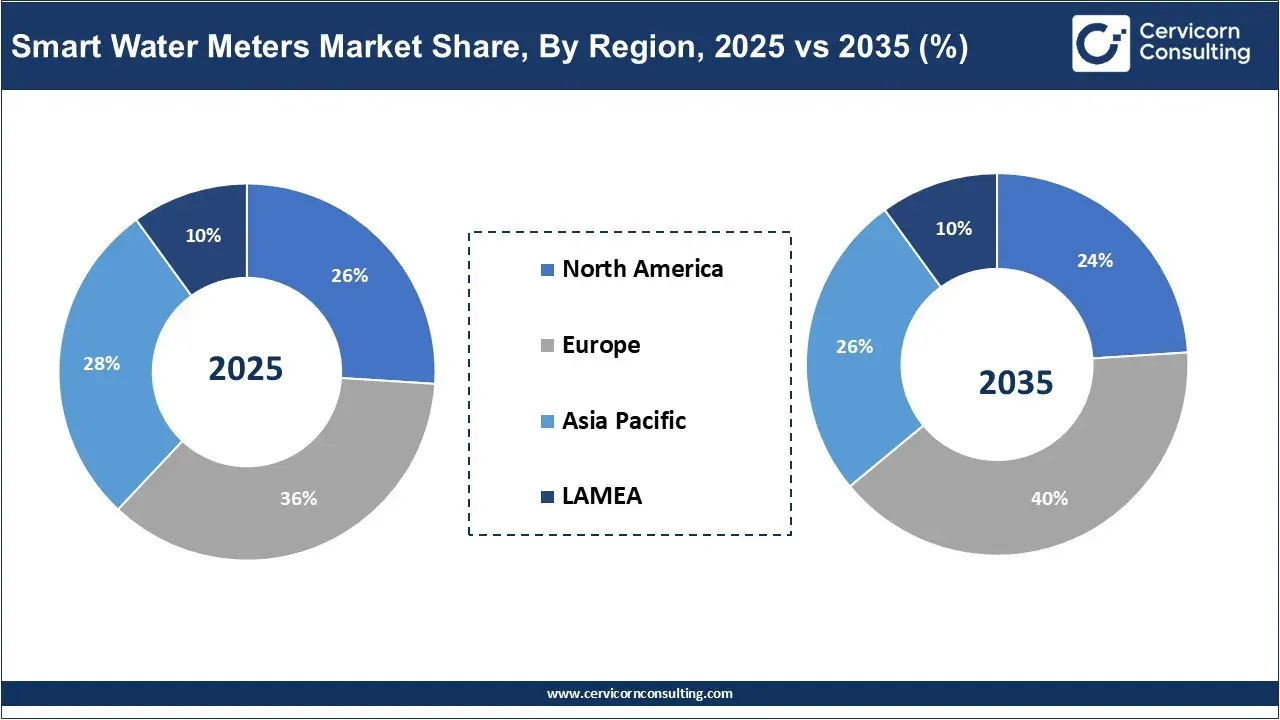
- By region: Europe accounted for a revenue share of 36% in 2025, driven by expanded water efficiency initiatives and smart utility infrastructure.
- By meter type: Mechanical smart water meters with smart modules generated highest revenue share of 42% in 2025, due to the vast installed base of conventional meters being advanced with digital capabilities.
- By technology: Automatic Meter Reading (AMR) registered dominance in the market in 2025 generated revenue share 35% because of well-developed deployments and relatively straightforward implementation.
- By component: Smart water meters dominated the market with revenue share of 58%, as they develop the key hardware of metering installations.
- By application: Residential water management led the market with revenue share of 38% in 2025, fueled by massive customer populations and utility-led meter replacement programs.
What are Smart Water Meters and Their Major Advances in 2026?
First of all, the smart water meters market covers meters that are digital, IoT-enabled devices & offer automated measurement, recording, and transmission of real-time data about water consumption to both utility firms and consumers. Their principle is the utilization of ultrasonic or electromagnetic sensors rather than shifting towards mechanical parts to track water flow with high precision. Among these smart water meters, many breakthroughs have been made, such as execution of meter-as-sensor technology as real-time sensors, which report water pressure, temperature, and acoustic vibrations to record efficiency.
Alongside this, market companies, such as Zenner, have rolled out meters with parallel radio functions to convey data at the same time over several protocols for redundant, zero-drop coverage. Additionally, novelty across the market has explored clip-on optical recognition (OCR) camera modules, enabling existing analog/mechanical meters to be bolstered into smart IoT devices in minutes despite shutting off the water supply.
Smart Water Meter Installation and Deployment Statistics: Global Countries
- North America: By the end of 2025, North America had approximately 98.8 million active water utility AMR and AMI endpoints, including 44.2 million advanced metering infrastructure (AMI) endpoints. Overall connected-meter penetration was estimated at 80–85%.
- Europe: Europe had approximately 91.4 million active water utility AMR and AMI endpoints at the end of 2025, representing around 59% penetration. Of these, 34.9 million were AMI endpoints, accounting for approximately 23% penetration.
- China: Beijing Water Group had installed more than 3.3 million smart water meters by March 2023, covering over 50% of its market. Shanghai Municipal Water Authority had installed 2.04 million smart water meters in 2022 and planned an additional 4.58 million by 2025. The latter is a historical target, not a confirmed completed installation total.
- Hong Kong: By May 2026, approximately 38,000 smart water meters had been installed in new buildings, including 27,000 in private buildings and 11,000 in nine public housing estates. A further 15,000 meters had been installed in existing buildings, covering around 53,000 consumers overall.
- United Kingdom: England's water utilities reported that approximately 11.9% of households had smart water meters in the 2024–2025 reporting period. Adoption varied substantially by supplier, with Anglian Water reporting 47.7% household penetration.
- Australia: South East Water installed 200,000 digital water meters across Melbourne's south-east and the Mornington Peninsula by January 2026. Its six-year programme, valued at AUD 272 million, had helped save an estimated 3.1 billion litres of drinking water by June 2025.
- France: SUEZ reported that 2.8 million water meters had been installed across more than 600 local authorities in France, including Paris, Le Havre and Mulhouse. These installations form part of its connected water management operations.
Country-Level Based Government Initiatives
I. European Nations:
- In 2025, the European Investment Bank funded roughly USD 1.1 billion for smart water infrastructure, specifically in Italy, France, Spain, the Netherlands, and the UK.
- In May 2026, the European Commission announced an EU Action Plan on the digitalisation of the water sector, which consists of a proposed initiative mandating smart water meters across member states.
- Particularly in Greece, Greece’s European Union-funded National Strategic Reference Framework (NSRF) programs have funded over €500 million in smart water meter and telemetry installations that are in the pipeline.
- In the UK, the Mandatory Water Efficiency Labelling Scheme was announced in 2026, which combines smart metering data with consumer product labels to trim per capita consumption.
II. United States:
- Federal law offered US$ 3 billion for advanced metering infrastructure, and California and New York are supporting utilities fast-track full-coverage AMI (Advanced Metering Infrastructure) deployments toward a 2028 target.
III. Asia Pacific Countries:
- In China, the Shanghai Municipal Water Authority outlined and implemented multi-million unit expansions with a focus on installing 4.58 million additional smart water meters by 2025.
- Meanwhile, India is continuously transitioning toward its target of 250 million smart meters, and the Ministry of Power, with DISCOMs, introduced the 'Smart Meter Pakhwada' campaign, which has a two-week door-to-door consumer education and live demonstrations to generate trust and foster adoption.
Smart Water Meters Market Dynamics
Growth Drivers
- Non-Revenue Water Reduction: Water utilities are deploying smart meters to identify unexplained consumption patterns, improve customer meter accuracy, and investigate potential leaks. Better measurement and timely anomaly detection can help reduce losses between water production, distribution, and billed consumption.
- Urban Water Demand: Expanding cities and growing residential, commercial, and industrial water requirements are increasing pressure on utilities to manage consumption efficiently. Smart metering supports more detailed demand monitoring and helps providers identify usage patterns across customer categories and service areas.
- Automated Billing Operations: Manual meter reading can involve labor expenses, delayed billing cycles, and transcription errors. Smart water meters transmit consumption data electronically, enabling utilities to streamline billing, reduce field visits, and provide customers with more timely usage information.
Market Restraints
- High Deployment Costs: Smart metering projects require investment in meters, communication gateways, data platforms, installation, and system integration. Large-scale replacements can be financially challenging for smaller utilities, particularly when existing infrastructure requires substantial upgrades.
- Battery Replacement Constraints: Many smart water meters rely on long-life batteries because meters are installed in underground chambers, remote locations, or difficult-to-access properties. Battery degradation and replacement requirements can increase maintenance expenses and complicate lifecycle planning across extensive meter networks.
- Legacy Infrastructure Integration: Utilities may operate older billing platforms, supervisory control systems, and incompatible communication networks. Integrating smart meters with these systems can require custom interfaces, data migration, and additional cybersecurity measures, extending deployment timelines and increasing project complexity.
Market Opportunities
- Smart City Integration: Municipal smart water meters can be integrated with broader urban management platforms covering electricity, gas, transportation, and environmental monitoring. Shared digital infrastructure can improve municipal data coordination and support more comprehensive resource-management initiatives.
- Agricultural Water Monitoring: Smart metering offers opportunities in irrigation networks, agricultural pumping systems, and shared water distribution infrastructure. Accurate consumption measurement can help farmers and water authorities monitor withdrawals, identify excessive usage, and improve allocation across water-intensive agricultural operations.
- Predictive Utility Analytics: Combining meter readings with pressure sensors, geographic information systems, and historical consumption data creates opportunities for predictive analytics. Utilities can use these tools to identify unusual demand, prioritize inspections, and improve planning for maintenance and network expansion.
Market Challenges
- Cybersecurity and Data Privacy: Connected meters transmit consumption information through digital networks, creating risks associated with unauthorized access, data manipulation, and service disruption. Utilities must secure communications, manage device authentication, and protect customer information throughout the metering system lifecycle.
- Communication Reliability: Underground installations, dense urban environments, remote locations, and physical obstructions can weaken wireless signals. Poor connectivity may delay readings or create data gaps, requiring careful network planning and suitable communication technologies for different deployment conditions.
- Interoperability Standards: Smart water meters from different manufacturers may use incompatible communication protocols, data formats, and management platforms. Limited interoperability can restrict supplier flexibility and complicate the integration of devices across large utility networks, making standards-based procurement and system testing important.
Smart Water Meters Market Regional Analysis
How did Europe Dominate the Market in 2025?
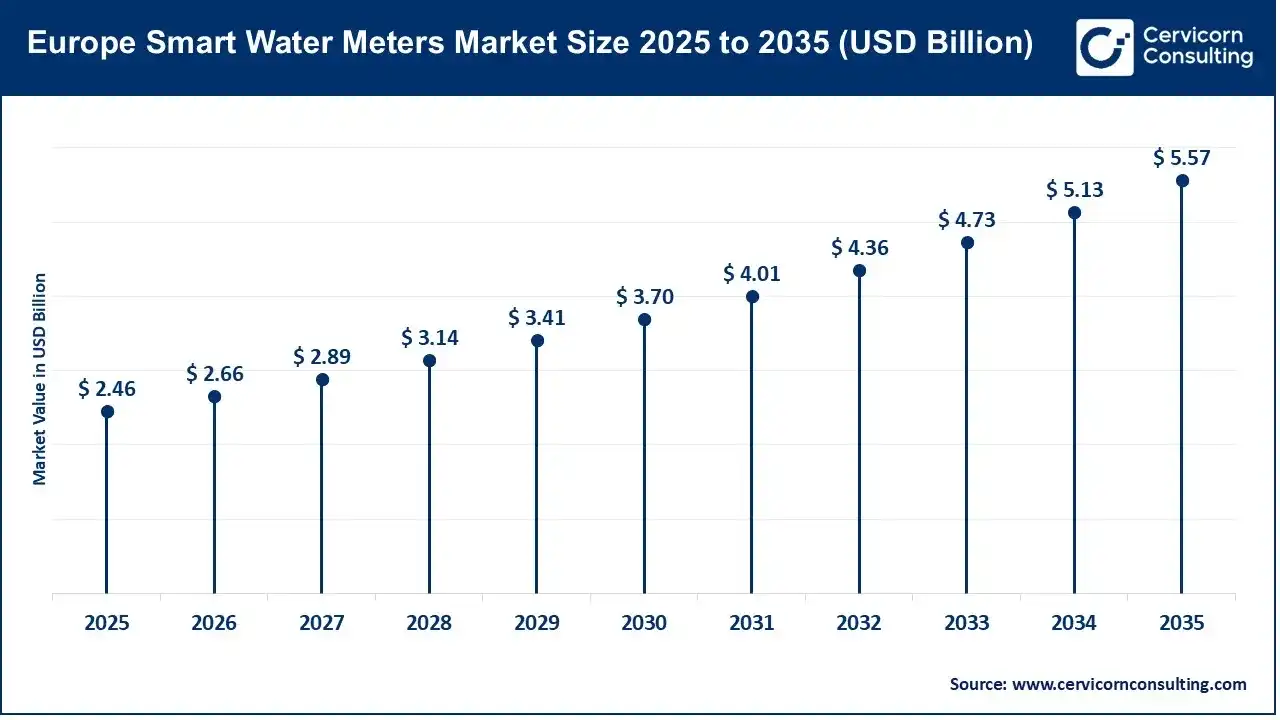
The Europe smart water meters market size was valued at USD 2.46 billion in 2025 and is expected to exceed around USD 5.57 billion by 2035. Europe registered dominance with an 36% share in 2025, as it possesses major water programs and broadened use of smart infrastructure. Along with diversified government initiatives, Europe has enforced some national-level conservation mandates, which force the adoption of more granular, real-time consumption data and non-revenue water (NRW) reduction. Certain studies have shown that EU homes equipped with digital and smart sub-meters have lowered household water consumption drastically.
UK Smart Water Meters Market Trends:
- In the smart water meters market, the UK registered a major contribution due to the emergence of regulatory approvals under Asset Management Period 8 (AMP8, 2025–2030) and surging pressures around drought resilience and leak reduction. In 2025, the regulator Ofwat granted a £2.2 billion plan funding seven rapid smart water meter schemes in the southern half of England, to install 462,000 meters earlier than the end of 2025.
Why is the Asia Pacific Expected to be the Fastest-Growing Region?
The Asia-Pacific smart water meters market size was valued at USD 1.91 billion in 2025 and is anticipated to surpass around USD 4.33 billion by 2035. The smart water meters market in the Asia Pacific is considered to witness rapid expansion in the upcoming years, as the region experiences vast urbanization, water scarcity, and investments in modern water distribution systems. Alongside this, several APAC nations are advancing legacy mechanical pipe and meter networks, coupled with public investments and digital transformation policies. Especially, China is employing NB-IoT and Huawei LiteOS-assisted smart water meter solutions to restrict MCU power consumption.
India Smart Water Meters Market
- To address accelerating urbanisation concerns, the Indian government is enforcing the Jal Jeevan Mission, AMRUT (Atal Mission for Rejuvenation and Urban Transformation), and the Smart Cities Mission to promote the deployment of digital water meters across these urban sectors & offer financial support. Rapid progression of the smart water meters market in India is further impelled by Nashik Municipal Smart City Development Corporation Ltd who started the installation of 13,000 LoRaWAN-based smart water meters for commercial utilities.
Smart Water Meters Market Segmentation Analysis
Meter Type Analysis
Mechanical Smart Water Meters with Smart Modules: The mechanical smart water meters with smart modules segment accounted for a dominant share of 42% in 2025, due to the huge installed base of conventional meters being modernised with digital capabilities and affordability. The need for higher initial investment for full-scale Advanced Metering Infrastructure (AMI) launches pushed smart mechanical module solutions to preserve current mechanical assets and enable wireless data transmission.
Among many meter types, the electromagnetic smart water meters segment captured the second-largest share of the market in 2025, supported by their increased accuracy, shortage of moving parts, and potential to manage premium low-flow rates. Day by day, industrial leaders are widely leveraging these meters to trace resource efficiency, reduce operational spending, and meet environmental requirements.
Smart Water Meters Market Share, By Meter Type, 2025 (%)
| Meter Type |
Revenue Share, 2025 (%) |
| Ultrasonic Smart Water Meters |
32% |
| Electromagnetic Smart Water Meters |
18% |
| Mechanical Smart Water Meters with Smart Modules |
42% |
| Others |
8% |
Ultrasonic Smart Water Meters: The ultrasonic smart water meters segment is expected to grow rapidly in the coming years because of high measurement accuracy, low maintenance requirements, and the absence of moving parts. The market has expansive demand for specialized large-diameter ultrasonic meters (DN50 and above) to control municipal water distribution, industrial processes, and agricultural irrigation.
Technology Analysis
Automatic Meter Reading (AMR): The Automatic Meter Reading (AMR) segment led with a 35% share of the smart water meters market in 2025 and was propelled by advanced deployments and notable expenditure reduction, labor efficiency, and steady digital breakthroughs. This technology increasingly uses walk-by or drive-by mobile collection systems and fixed-network radio waves to record and transmit consumption data.
Advanced Metering Infrastructure (AMI): The Advanced Metering Infrastructure (AMI) segment is estimated to be the fastest-growing during 2026-2035 because of two-way communication, real-time monitoring, and advanced water network management. Additionally, consumers are widely integrating AMI launches with Computerized Maintenance Management Systems (CMMS) to report meter drift, battery life, and network diversity.
Smart Water Meters Market Share, By Technology, 2025 (%)
| Technology |
Revenue Share, 2025 (%) |
| Advanced Metering Infrastructure (AMI) |
28% |
| Automatic Meter Reading (AMR) |
35% |
| Cellular Communication |
16% |
| Long-Range Radio and LPWAN |
15% |
| Others |
6% |
The long-range Radio and LPWAN segment is anticipated to grow significantly in the predicted timeframe and is mainly driven by water lost through leaks and rigorous state, national, and municipal water-saving regulations. This technology also facilitates unexpected signal propagation and allows for reliable communication from water meters.
Component Analysis
Smart Water Meters: The smart water meters segment dominated with a 58% share in 2025, as they are highlighted as a pivotal part in forming the core hardware of metering installations. Specifically, non-mechanical ultrasonic and electromagnetic sensors led this segment, as they can capture micro-leaks and trickle flows, driving further demand for high-resolution acoustic and digital flow transducers.
The communication modules segment reported a lucrative expansion in the market in 2025, supported by accelerating demand for real-time leak determination and remote management. They offer continuous monitoring, resulting in immediate transmission of alerts when abnormal flow, bursts, or leaks are found.
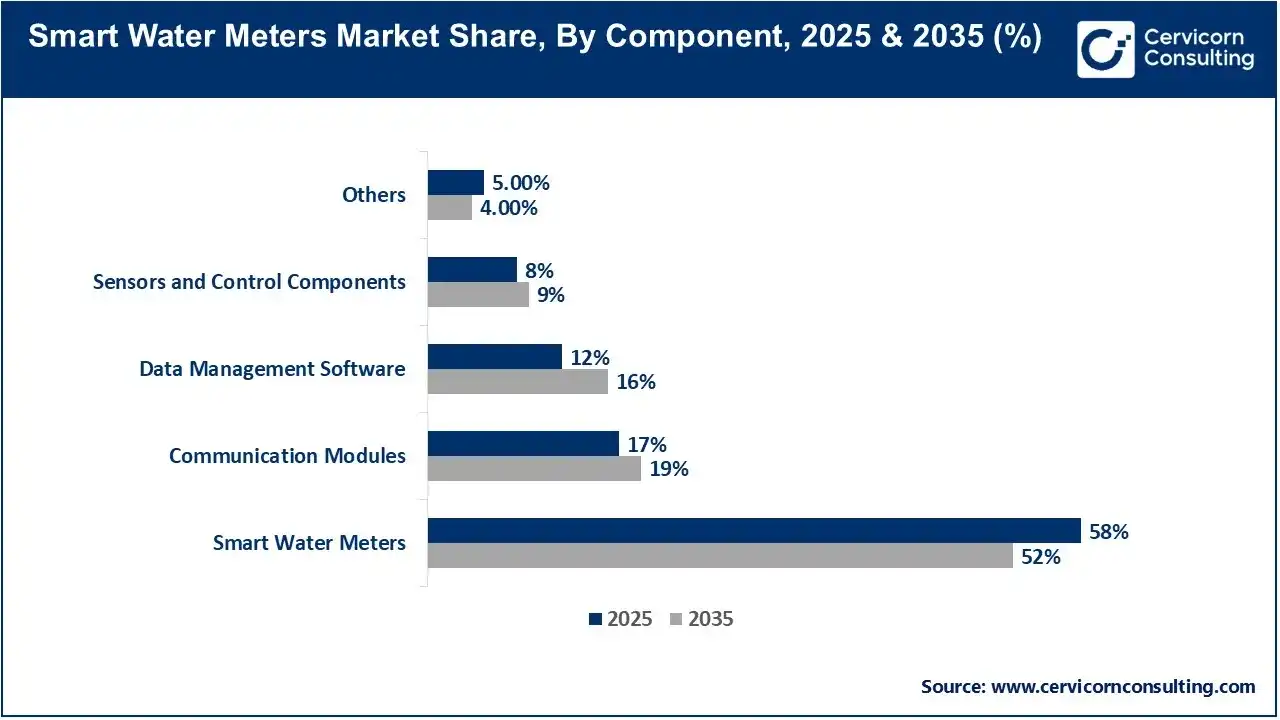
Data Management Software: The data management software segment is projected to expand rapidly in the smart water meters market, due to growing demand for analytics, leak detection, consumption forecasting, and automated billing. Ongoing advances across this segment push the use of machine learning algorithms to evaluate real-time consumption data to find anomalies and reduce random infrastructure downtime by nearly 40%.
Application Analysis
Residential Water Management: The residential water management segment held a major share of 38% in 2025, driven by higher customer populations and broader focus on conservation and regulatory guidelines. Besides this, the global population fostered the adoption of AMI to enable two-way data transmission, interval-based tracking, and a remote approach.
The commercial water management segment is predicted to expand notably during the forecast period, driven by the widespread use by property owners and commercial facility managers to monitor utilization across various tenants, departments, or zones. However, OCR retrofit attachments are supporting commercial buildings in upgrading legacy analog meters into smart transmitters in minutes.
Smart Water Meters Market Share, By Application, 2025 (%)
| Application |
Revenue Share, 2025 (%) |
| Residential Water Management |
38% |
| Commercial Water Management |
17% |
| Industrial Water Management |
15% |
| Municipal Water Utilities |
25% |
| Others |
5% |
Industrial Water Management: The industrial water management segment is expected to witness the fastest growth during 2026-2035, led by expanded targets for water conservation, process monitoring, and efficiency requirements. Along with AMI and cellular/LoRaWAN/NB-IoT connectivity, industries are seeking software, including Schneider Electric’s EcoStruxure Water Advisor, ABB’s AquaMaster+, and Siemens’ SIWA suite, to improve water treatment.
Recent Developments
- January 2026: HPL Electric & Power Ltd. (HPL) launched 'Neeram Pulse', its smart water metering solution designed for accurate measurement and seamless integration with AMR/AMI systems.
- May 2026: X2M Connect Limited obtained a manufacturing license to develop and sell South Korea’s first AI-powered separable integrated smart water meter to maintain connectivity in flooded underground issues.
Key Companies
Segments Covered
By Meter Type
- Ultrasonic Smart Water Meters
- Electromagnetic Smart Water Meters
- Mechanical Smart Water Meters with Smart Modules
- Other Smart Water Meters
By Technology
- Advanced Metering Infrastructure (AMI)
- Automatic Meter Reading (AMR)
- Cellular Communication
- Long-Range Radio and LPWAN
- Other Communication Technologies
By Component
- Smart Water Meters
- Communication Modules
- Data Management Software
- Sensors and Control Components
- Other Components
By Application
- Residential Water Management
- Commercial Water Management
- Industrial Water Management
- Municipal Water Utilities
- Other Applications
By Region
- North America
- Europe
- Asia-Pacific
- Latin America
- Middle East and Africa
