Server CPU Market Size, Growth, Forecast 2026 To 2035
The global server CPU market size was valued at USD 28.50 billion in 2025, estimated to reach at USD 557.49 billion by 2035. The market is observed to grow at a CAGR of 34.6% during the forecast period of 2026-2035.
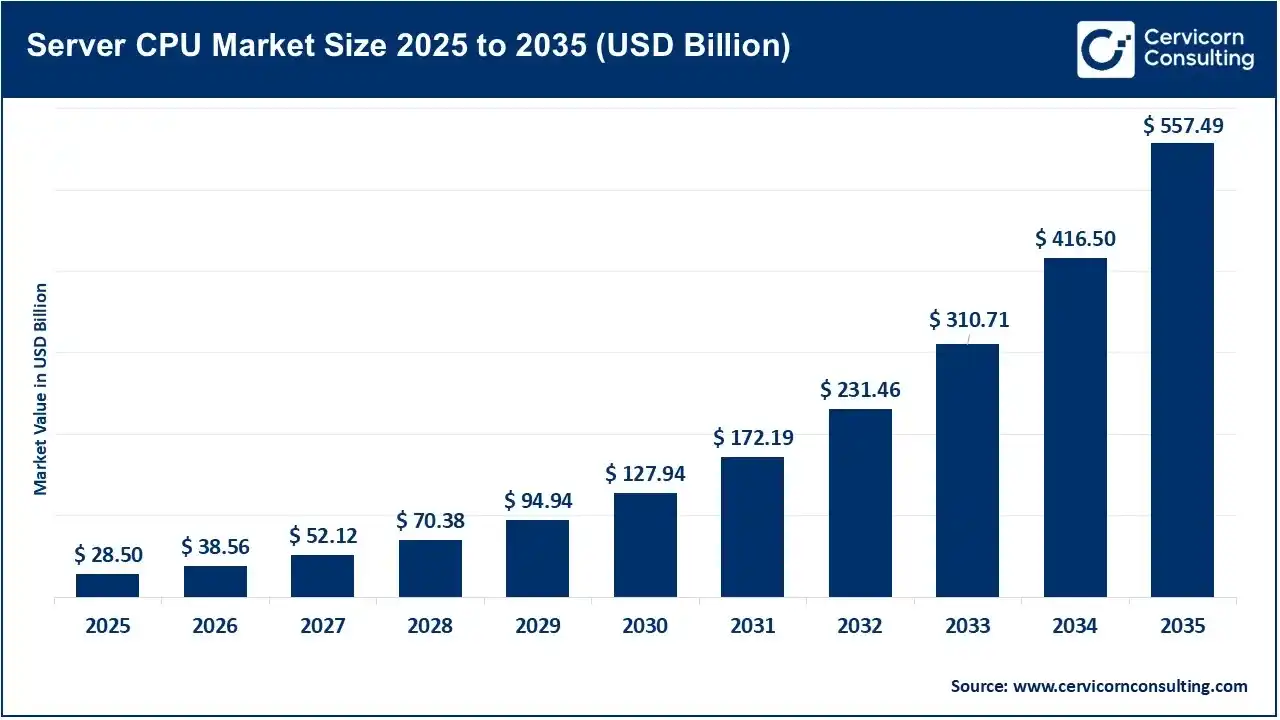
Report Highlights
- By region, North America dominated the server CPU market with a 42% share in 2025, supported by its concentration of hyperscale data centers, cloud service providers, semiconductor companies, and large-scale enterprise computing infrastructure.
- By region, Asia Pacific is projected to grow at the fastest CAGR of 36.6% during 2026–2035, driven by expanding data center capacity, growing digital services, increasing AI adoption, and rising investments in domestic semiconductor and computing infrastructure.
- By CPU architecture, x86 processors held the largest market share of 87% in 2025, reflecting their established presence across enterprise servers, data centers, virtualization platforms, and high-performance computing environments.
- By CPU architecture, ARM-based processors are expected to expand at the fastest CAGR of 48.1% between 2026 and 2035, supported by increasing demand for power-efficient computing, cloud-native workloads, and customized processors for hyperscale infrastructure.
- By server type, the cloud/hyperscale segment accounted for the largest 42% market share in 2025, driven by continued data center expansion, increasing cloud workloads, and the growing computational requirements of enterprise applications.
- By server type, the edge segment is anticipated to register the fastest CAGR of 37.9% during the forecast period, supported by the expansion of connected devices, 5G infrastructure, industrial automation, and applications requiring localized real-time processing.
- By power consumption/TDP, the 100–200W segment captured the largest 48% market share in 2025, reflecting its suitability for balancing processing capability, energy consumption, thermal requirements, and total data center operating costs.
- By power consumption/TDP, the high power (>200W) segment is expected to witness the fastest growth during the forecast period, fueled by increasing computational requirements from AI training, high-performance computing, generative AI, and other intensive server workloads.
- By CPU core count, the 16–64 core segment dominated the market with a 48% share in 2025, supported by its broad applicability across enterprise workloads, cloud infrastructure, virtualization, databases, and general-purpose server applications.
- By CPU core count, the 65–128 core segment emerged as the second-largest category with a 32% share in 2025, reflecting increasing demand for higher parallel processing capabilities across AI workloads, cloud-native applications, analytics, and high-performance computing.
- By application, cloud & virtualization held the largest market share of 35% in 2025, driven by growing server deployment across public and private cloud infrastructure, enterprise virtualization, and increasingly distributed IT environments.
- By application, AI/ML accounted for 18% of the market in 2025 and is expected to witness strong growth, supported by increasing server requirements for generative AI, model training, AI inference, machine learning, and enterprise AI applications.
What is Driving the Shift from Traditional Enterprise CPUs to High-core-count server CPUs?
High-core count server chips have seen the rapid rise and proliferation across cloud computing and super computing systems, this is in particular, in response to three key market trends that data center operators have faced in the past few years including the rise of many new, modern server workload characteristics, power vs performance and compute density.
Historically, enterprise workloads tend to behave in relatively well understood workloads such as, databases and well defined workloads with virtualization, enterprise file serving and web applications. In contrast, modern workloads in cloud, analytics and AI environments are characterized by their many concurrent tasks with high simultaneity.
Global Server Shipments & Capacity Expansion Statistics
- The growth for AI server shipments is projected to be greater than 28% year-on-year in 2026, and a continued double-digit growth rate in 2027.
- In 2025, the world spent over 2X more on AI-related infrastructure, at $318 billion, than in 2024 ($153 billion). This large investment in AI infrastructure fuels demand for server CPUs, accelerators, and memory and network infrastructure.
- Server spending stood at $87.7 billion in Q4 2025, representing nearly 100% of the spending for global AI infrastructure. This signifies compute servers continue to be the leading hardware spending category in AI infrastructure.
- The United States represents more than two-thirds (77%) of all AI infrastructure spending in Q4 2025, and has doubled its infrastructure spending on hyperscale expansion.
- As for China, while it represents a small portion (9.4%) of global spending for infrastructure, it had a decrease year-on-year from restricted access to advanced semiconductor accelerators in high-performance computer processors.
- In the battle for compute, hyperscalers are transitioning to custom servers by having AWS and Google expand the deployment of their self-built, silicon designed, Arm based compute resources, while the utilization of large rack scale AI platforms developed by NVIDIA drives higher demand from servers for infrastructure.
- Among cloud and general compute the, established presence of the 257 data centers in Japan, Australia's 284 data centers, and data from Indonesia's 198, Malaysia's 114, and Singapore's 66 data centers indicate Southeast Asia is a growing region for the data center build-out and this is expected to rise, in large part for server buildout from cloud services and data driven workloads moving into new regions.
Technology Roadmap: The Evolution of Server CPUs Through 2035
| Period |
Technology phase |
Key server CPU developments |
Industry Significance |
| 2025–2027 |
High-core-count transition |
Rapid expansion of CPUs with higher core densities, larger memory bandwidth and improved I/O, alongside continued coexistence of x86 and Arm architectures |
Server CPUs are moving beyond general-purpose computing as AI workloads increase demand for greater parallelism and throughput per watt. |
| 2027–2029 |
AI-optimized server CPUs |
Greater integration of AI acceleration, high-bandwidth memory, advanced interconnects and workload-specific optimization |
CPU design increasingly becomes part of a heterogeneous computing architecture rather than operating independently from accelerators. |
| 2029–2031 |
Rack-scale CPU integration |
CPUs increasingly designed around rack-level performance, memory bandwidth, networking and accelerator coordination |
The CPU becomes an orchestration layer responsible for coordinating accelerators, memory, networking and large numbers of concurrent workloads. |
| 2031–2033 |
Heterogeneous and customized architectures |
Greater adoption of customized CPUs, chiplets, advanced packaging and workload-specific designs |
Hyperscalers and large enterprises are likely to increasingly optimize CPU architecture around their own workload profiles and power constraints. |
| 2033–2035 |
Rack-scale and energy-efficient compute |
Very high core counts, advanced memory architectures, chiplet-based designs and tightly integrated CPU-accelerator platforms |
Performance-per-watt, memory bandwidth and system-level efficiency become as important as conventional single-socket CPU performance. |
Market Dynamics
Driver
Accelerating AI, cloud and hyperscale infrastructure investment
As data centers move more of their workload from AI model training into continuous inference and agentic applications, more CPU activity will need to happen on the client side. As the agent keeps looking for information, the schedule, calling tools and workflows or data processing, there is pressure on higher core counts, memory bandwidth and more I/O, and according to Arm data center owners of AI workload-intensive compute clusters might need 4 more per gigawatt, more cores.
Restraint
Growing architectural complexity and software compatibility requirements
A fragmentation trend in computing is opening up x86, Arm and custom CPU architectures to server designs, causing migration to become more complex with more challenges as the industry aims to optimize software, support migrating workloads and ensure workload compatibility.
Non-x86 revenues in servers reached $58.7 billion in Q12026, equating to 47.9% of worldwide server revenues, but well-entrenched x86 architectures offer greater existing software and enterprise compatibility, which can delay movement among architectures and raise hardware spending when migrating CPU server solutions.
Opportunity
Customized CPUs for hyperscalers and workload-specific computing
The growing adoption of customized processors by hyperscalers creates an opportunity for server CPU vendors to move beyond conventional merchant processors toward workload-specific and system-level solutions. AWS, Google, Microsoft and NVIDIA are already expanding customized or Arm-based approaches, while NVIDIA introduced its standalone Vera CPU Rack in March 2026 and Arm launched its first Arm-designed data-center CPU in the same month, signaling increasing demand for processors optimized around AI infrastructure rather than general-purpose enterprise workloads alone.
Regional Analysis
Why did North America dominate the server CPU market?
The North America server CPU market size was valued at USD 11.97 billion in 2025 and is estimated to reach at USD 211.85 billion by 2035, growing at a CAGR of 33.1% during the forecast period of 2026-2035.
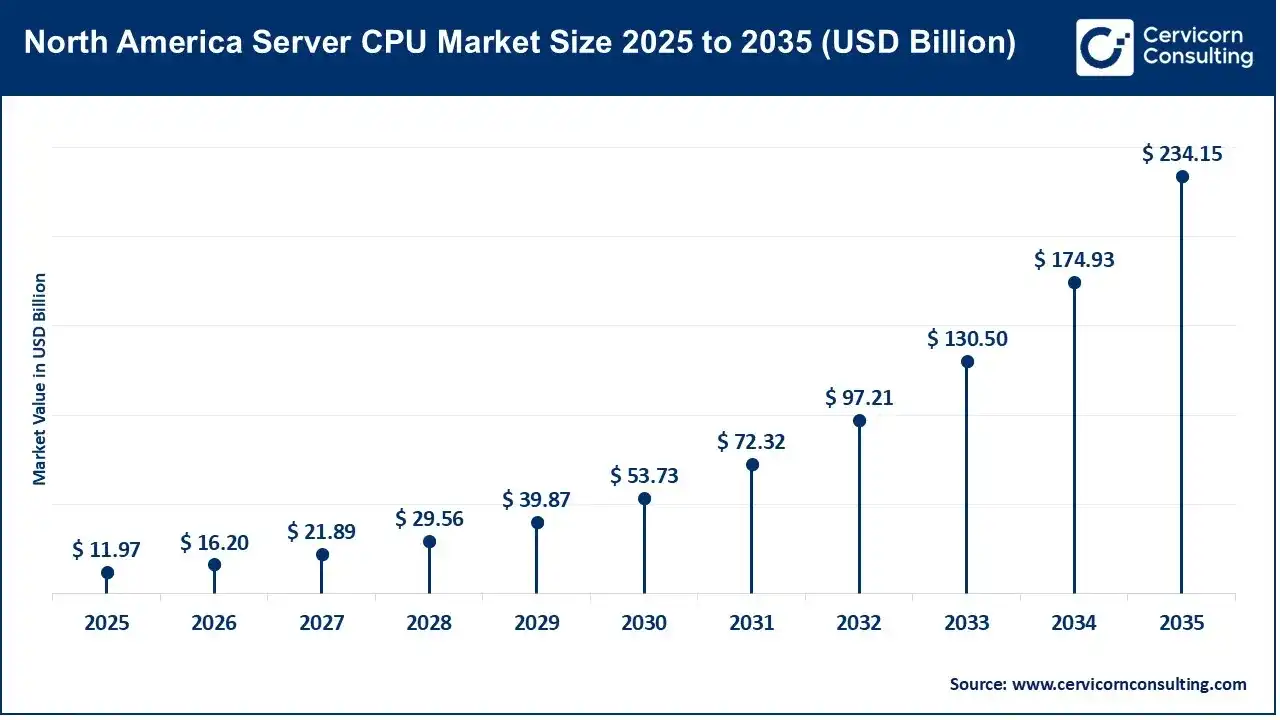
North America dominated the server CPU market with a 42% share in 2025, reflecting the region's highly developed data center ecosystem and concentration of hyperscale cloud providers, enterprise technology companies, semiconductor firms, and AI infrastructure developers. The United States remains the primary demand center, with large-scale investments in AI-focused data centers increasing the requirement for high-performance server processors capable of supporting cloud computing, virtualization, analytics, and accelerated AI workloads.
The presence of major CPU and server ecosystem companies also supports rapid adoption of new processor generations, while continued expansion of hyperscale facilities creates recurring demand for both general-purpose and specialized server CPUs.
Why is Asia Pacific projected to grow at the fastest CAGR?
The Asia Pacific server CPU market size was estimated at USD 9.69 billion in 2025 and is projected to hit USD 217.42 billion by 2035, expanding at a CAGR of 36.6% over the forecast period from 2026 to 2035. Asia Pacific is projected to grow at the fastest CAGR of 36.6% during 2026–2035, supported by rapid data center construction, expanding cloud services, digital transformation, and growing AI infrastructure investment. China, Japan, South Korea, India, Singapore, and other regional markets are increasing their computing capacity as enterprises and governments expand AI, cloud, 5G, e-commerce, and digital services.
The region's semiconductor manufacturing ecosystem is another important advantage, as growing domestic chip production and processor development can strengthen local server supply chains and support the adoption of increasingly customized and energy-efficient CPU architectures.
Top 5 Countries
| Country |
Market position & key demand drivers |
Server CPU market significance |
| United States |
The U.S. is the leading individual market, supported by hyperscale cloud providers, large enterprise data centers, AI infrastructure investment, and major server and semiconductor companies. |
The country remains a critical market for x86 processors while also providing a strong growth opportunity for ARM-based and customized server CPUs as hyperscalers increasingly optimize infrastructure for specific workloads. |
| China |
China has a large and rapidly expanding data center and cloud computing ecosystem, supported by digital transformation, AI deployment, e-commerce, telecommunications, and government-backed computing infrastructure development. |
Demand spans enterprise servers, cloud infrastructure, government computing, telecom networks, and AI systems, making China one of the most important markets for both established x86 processors and emerging domestic CPU architectures. |
| Japan |
Japan's server CPU demand is supported by mature enterprise IT infrastructure, cloud adoption, telecommunications, manufacturing digitalization, and increasing investment in AI and high-performance computing. |
Japan represents a stable high-value market where server CPUs are increasingly required for AI-enabled industrial systems, enterprise modernization, data analytics, and next-generation data center infrastructure. |
| South Korea |
South Korea's strong semiconductor and electronics ecosystem, combined with growing AI and data center investments, is supporting demand for advanced server computing. |
The market is particularly important for high-performance and high-core-count server CPUs used alongside AI accelerators, supporting workloads across hyperscale infrastructure, semiconductor manufacturing, research, and enterprise computing. |
| India |
Increasing investments by global and domestic technology companies are expanding local data center capacity, while government initiatives around digital infrastructure and semiconductor development are strengthening the broader computing ecosystem. |
India offers significant long-term growth potential for server CPUs, particularly across cloud and virtualization, enterprise IT, telecommunications, AI/ML infrastructure, and rapidly expanding edge-computing deployments. |
Segmental Analysis
CPU Architecture Analysis
x86 processors held the largest market share of 87% in 2025, maintaining a substantial advantage because of their mature ecosystem, broad software compatibility, and established deployment across enterprise and data center environments. Intel and AMD processors remain deeply integrated into enterprise servers, cloud platforms, virtualization environments, databases, and high-performance computing systems, allowing organizations to upgrade infrastructure without making significant changes to existing software stacks.
x86 also benefits from decades of optimization across operating systems, enterprise applications, security tools, and virtualization technologies, making it particularly difficult for alternative architectures to displace across legacy and mission-critical workloads.
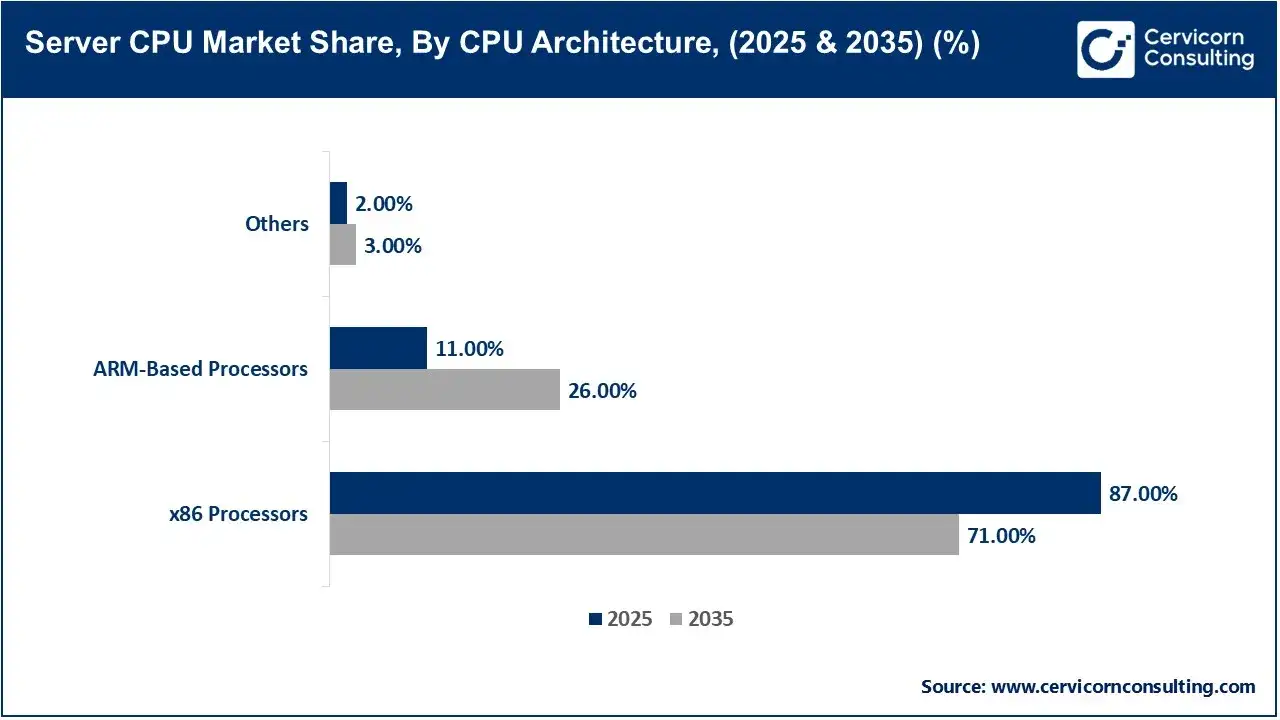
ARM-based processors are expected to expand at the fastest CAGR of 48.1% between 2026 and 2035, as data center operators increasingly prioritize performance per watt, customized computing, and lower operating costs. ARM's energy-efficiency advantages are particularly relevant as power and cooling become major constraints for AI-heavy data centers, while hyperscalers are increasingly developing or deploying internally optimized processors for specific cloud workloads.
The architecture is therefore gaining relevance beyond mobile computing, with applications expanding across cloud servers, AI inference, web services, edge infrastructure, and other workloads where energy efficiency and workload-specific optimization are important.
Server Type Analysis
The cloud/hyperscale portion led the market with a 42% share in 2025, largely due to ongoing investments in massive data centers and increased enterprise migrations of workloads to the cloud. Hyperscale providers have a large need for server CPUs as computing, storage, database, virtualization, networking, AI services and application software platforms, thereby comprising a significant ongoing processor need profile.
Continued expansion of AI infrastructure further bolsters needs as contemporary data centers utilize CPUs not only for traditional compute as well as for data preparation, orchestration, networking, storage management, and interfacing with GPUs and other accelerators.
Server CPU Market Share, By Server Type, 2025 & 2035 (%)
| Server Type |
Revenue Share, 2025 (%) |
Revenue Share, 2025 (%) |
| Enterprise |
32% |
25% |
| Cloud/Hyperscale |
42% |
48% |
| High-Performance Computing (HPC) |
12% |
13% |
| Edge |
8% |
10% |
| Telecom |
6% |
4% |
The edge is likely to be the fastest-growing segment with a 37.9% CAGR in the forecast period as computed resources shift towards location closer to data creation. IoT, 5G, autonomous machines, smart factories, connected automobiles, security cameras and real-time industrial computing is driving higher need for small server and edge computing systems.
Because edge deployment centers are more often constraint based in regard to space, power, heat and connectivity requirements; this opens another segment of CPU needs as CPUs require both the appropriate computational power and attributes for reduced power and flexible deployment.
Power Consumption/TDP Analysis
The largest 48% of the market share for CPUs belonged to the 100-200W segment in 2025. This is important, as a significant part of what most enterprises, clouds, and data centers currently need, falls into this band. CPU makers still have room to place morecoresat manageable power-so as far as total compute is concerned, data center buyers still continue to gauge based on dollar (power-per-dollar rather than perf-per-dollar), which helps.
Server CPU Market Share, By Power Consumption / TDP, 2025 (%)
| Power Consumption |
Revenue Share, 2025 (%) |
| Low Power (<100W) |
22% |
| Medium Power (100–200W) |
48% |
| High Power (>200W) |
30% |
The fastest growing segment (>200W), is seen to grab a notable share. High-performance training workloads-whether for big AI models, HPC, broad data analytics, or large language generation (LLG)-will need ever higher single-processor, performance and system capacity, requiring tightly integrate hardware designs. The high TDPs are also a prerequisite for higher performance and, in some cases, greater per- CPU density (higher number of cores per slice).
CPU Core Count Analysis
The 16–64 core segments grabbed 48% of the market share in 2025, as this market offers a versatile blend of processor capacity, scalability, power needs, and server cost. Processors this range fit many different enterprise applications from web servers, databases, cloud application environments, virtualization solutions and all purpose general calculation and services. This category will be attractive to environments running various diverse applications with little necessity for specialized equipment or processing functionality.
Server CPU Market Share, By CPU Core Count, 2025 (%)
| CPU Core Count |
Revenue Share, 2025 (%) |
| Low Core Count (<16 Cores) |
10% |
| Mid Core Count (16–64 Cores) |
48% |
| High Core Count (65–128 Cores) |
32% |
| Ultra-High Core Count (>128 Cores) |
10% |
The 65–128 core segment emerged as the second-largest category with a 32% share in 2025, reflecting increasing demand for greater parallel processing capacity. High-core-count CPUs are particularly useful for cloud-native workloads, large databases, virtualization environments, analytics, and AI-related workloads that can distribute computing tasks across multiple cores.
The segment is also benefiting from increasing server consolidation, where organizations seek to run more workloads on fewer physical machines to improve infrastructure utilization and reduce data center space requirements.
Application Analysis
Cloud and virtualization captured 35% share of the market in 2025 with further growth in public, private and hybrid cloud deployment models. The fundamental computing layer of virtual machines, containers, databases, enterprise applications, cloud native services are Server CPUs, and higher core count enabled the cloud providers to deploy the additional workloads on one server.
With growing number of Software-defined infrastructure and containerized applications, there is additional demand for processors capable of high utilization, managing numerous concurrent workloads without degrading performance.
Server CPU Market Share, By Application, 2025 (%)
| Application |
Revenue Share, 2025 (%) |
| AI/ML |
18% |
| Cloud & Virtualization |
35% |
| Database & Analytics |
17% |
| General Computing |
15% |
| HPC |
9% |
| Edge Computing |
6% |
AI/ML accounted for 18% of the market in 2025 and is expected to remain one of the strongest sources of server CPU demand as enterprises deploy generative AI, AI inference, machine learning, and data-intensive applications. Although GPUs and dedicated AI accelerators perform much of the computationally intensive model processing, CPUs remain essential for data preprocessing, workload orchestration, system management, inference pipelines, storage coordination, and communication between different components of AI infrastructure.
Top Companies
- Intel- With its Xeon portfolio being adopted across enterprise, cloud, hyperscale, networking, and high-performance computing, Intel continues to be a dominant supplier of server CPUs.
- AMD- The importance of AMD's EPYC server CPU portfolio continues to grow in cloud and data-center workloads, as demands from AI infrastructure begin to favor high-core-count, general-purpose compute.
- Ampere Computing- Ampere is a player with its own take on server processors, focusing on Arm-based processors, designed for power efficiency and cloud-native workloads, making it a key challenger to the traditional x86 architectures.
- Amazon Web Services (AWS)- Through its Graviton product line, it shows the developing importance of hyperscaler-designed Arm CPUs and the vertically integrated server architectures of these giants.
- Arm- Although not a traditional CPU supplier, the architectural and IP licensing company Arm is becoming more significant in servers through its many cloud and hyperscale licensees.
- NVIDIA- The data-center CPU, and Vera CPU platform from NVIDIA indicate the expanding importance of CPUs within an accelerated, and heterogeneous, AI computing infrastructure.
- IBM- Through its family of Power CPUs, IBM continues to be relevant in enterprise, hybrid-cloud, database, and mission-critical computing.
- Huawei- Its Kunpeng family of server processors also supports the push towards a national computing infrastructure, increasing Chinese self-sufficiency for its semiconductor supply-chain.
- Oracle- With its own Ampere-based cloud infrastructure and continued investment in customized cloud compute, it adds another piece in the transition to the Arm-based server paradigm.
- Fujitsu- With its Arm-based A64FX and the related high-performance computing technologies, it possesses a differentiated position in scientific computing, supercomputing and certain niche workloads.
Recent News, Partnerships & M&A
- July 2026 — AMD announced a potential investment of up to $5 billion in Anthropic alongside a major chip-supply agreement, with Anthropic committing to purchase tens of billions of dollars of AMD AI chips and adding 2 GW of computing capacity. The deal illustrates how CPU/GPU suppliers and AI companies are increasingly linking capital investment with long-term compute procurement.
- July 2026 — Intel and AMD reportedly entered longer-term server CPU supply agreements with Chinese customers as demand increased and CPU prices rose; some server CPU prices in China reportedly increased by more than 40% since the beginning of 2026. The development highlights tightening supply and the growing strategic importance of server CPUs in AI infrastructure.
Segments Covered
By CPU Architecture
- x86 Processors
- ARM-Based Processors
- Others
By Server Type
- Enterprise
- Cloud/Hyperscale
- High-Performance Computing (HPC)
- Edge
- Telecom
By Power Consumption / TDP
- Low Power (<100W)
- Medium Power (100–200W)
- High Power (>200W)
By CPU Core Count
- Low Core Count (<16 Cores)
- Mid Core Count (16–64 Cores)
- High Core Count (65–128 Cores)
- Ultra-High Core Count (>128 Cores)
By Application
- AI/ML
- Cloud & Virtualization
- Database & Analytics
- General Computing
- HPC
- Edge Computing
By Region
- North America
- Europe
- Asia-Pacific
- Latin America
- Middle East & Africa