Robotaxi Market Size and Growth 2026 to 2035
The global robotaxi market size was estimated at USD 2.68 billion in 2025 and is expected to be worth around USD 283.47 billion by 2035, exhibiting at a compound annual growth rate (CAGR) of 59.4% over the forecast period from 2026 to 2035. The robotaxi market is growing rapidly as advancements in autonomous driving technologies are improving the efficiency and safety of vehicles. The integration of artificial intelligence, machine learning, LiDAR, radar, and high-resolution sensors is enhancing vehicle perception and navigation, especially in urban areas. These improvements are increasing reliability and helping to build consumer trust. The use of real-time data and the falling costs of hardware are making it easier for manufacturers to deploy robotaxis on a large scale.
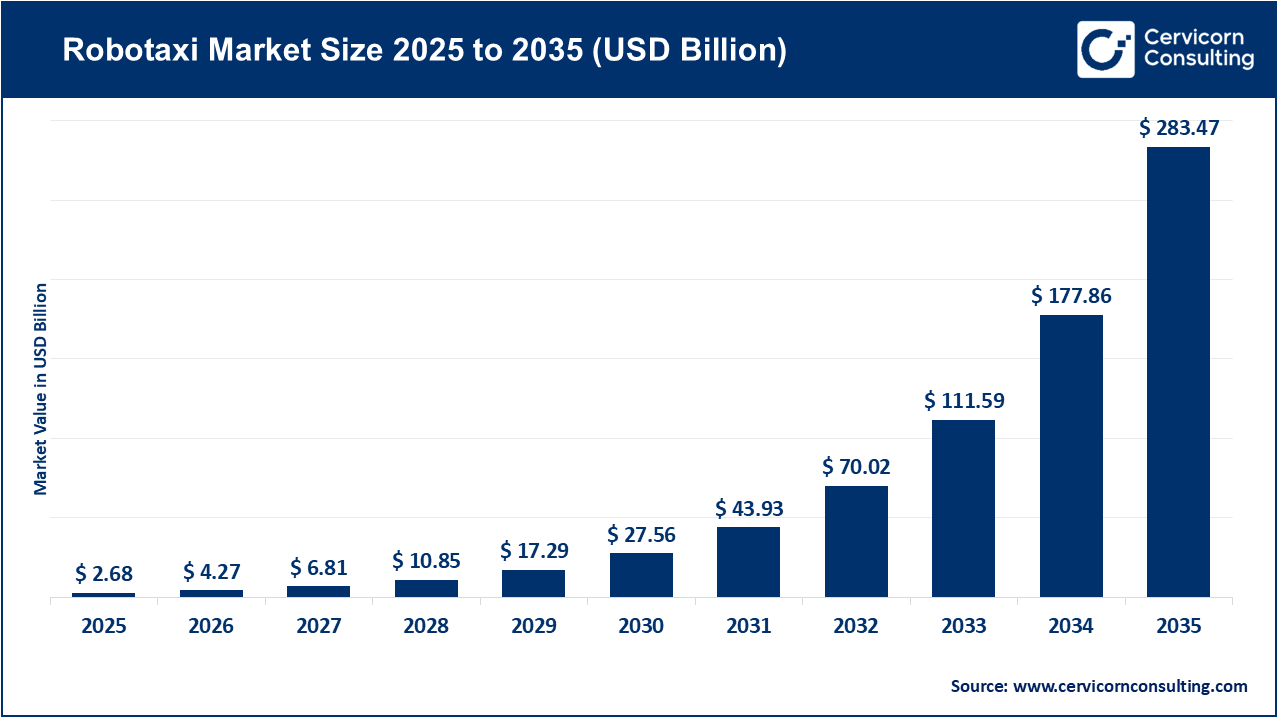
The growth of the robotaxi market is being driven by the shift from pilot programs to large-scale commercial fleets managed by leading mobility and technology companies. Currently, thousands of robotaxis are operating or preparing for commercial use worldwide, compared to about 18 to 20 million traditional taxis and ride-hailing vehicles. Companies such as Waymo, Baidu Apollo Go, and Pony.ai are at the forefront of this market. For instance, Waymo operates around 2,500 autonomous vehicles in several U.S. cities, Baidu’s Apollo Go has over 1,000 robotaxis and has completed millions of rides in China, and Pony.ai has deployed more than 700 vehicles with plans for further expansion. The move toward commercialization is supported by partnerships with automotive manufacturers, government approvals in major cities, and rising investments in autonomous vehicle platforms. As production increases and regulations are established, the availability of robotaxis is expected to rise quickly, and the market is projected to grow significantly by 2030.
Report Highlights
- North America leads the global robotaxi market with 37% share, driven by early commercial deployments, strong regulatory approvals, and large-scale fleet operations in major U.S. cities.
- Asia Pacific accounts for 34% of the global market, supported by high urban ride volumes, government-backed smart mobility initiatives, and large-scale deployments in China.
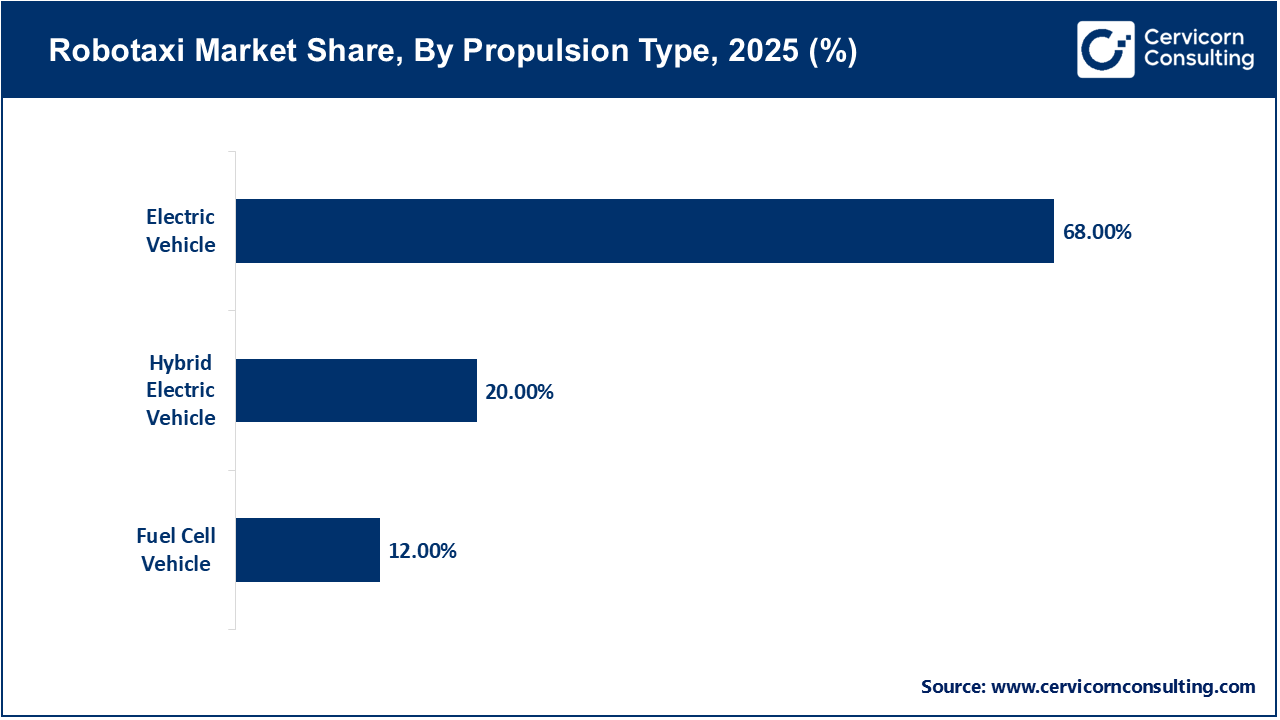
- Electric Vehicles (EVs) dominate with 68% share, as most robotaxi fleets are fully electric to align with urban emission targets and lower operational costs.
- Passenger transport leads with 82% market share, reflecting the primary commercial focus on urban ride-hailing services.
- LiDAR holds 34% share, remaining a critical perception technology for high-accuracy 3D mapping.
- Level 4 autonomy dominates with 91% share, as most commercial robotaxi services operate within geo-fenced urban zones.
What are the Trends and Application Areas in the Robotaxi Market?
Key Trends Shaping the Robotaxi Industry
The robotaxi market is moving quickly from pilot projects to large-scale commercial operations, driven by clear deployment milestones and operational data. At present, several thousand robotaxis are either in operation or in advanced pilot stages worldwide, compared to an estimated 18 to 20 million traditional taxis and ride-hailing vehicles. Leading companies are expanding their service areas and increasing the number of rides. For instance, Waymo operates around 2,500 autonomous vehicles in several U.S. cities and provides hundreds of thousands of fully driverless rides each week. In China, Baidu Apollo Go has deployed over 1,000 robotaxis and has completed millions of rides, while Pony.ai operates a fleet of more than 700 autonomous vehicles across China and the U.S.
Major Market Trends Include:
- Expansion of Fully Driverless Operations: Robotaxi services are now running without safety drivers in certain urban areas in the U.S. and China.
- High Urban Concentration: More than 70% of robotaxi deployments are found in dense cities where the demand for rides is very high, often reaching thousands of trips per square kilometer each year.
- Electrification Integration: Most robotaxi fleets use battery-electric vehicles to meet city zero-emission goals.
- Data-Driven Improvement: Autonomous systems are trained using billions of real and simulated miles, which helps improve AI models and supports safety validation.
- Strategic OEM Partnerships: Autonomous vehicle technology companies are working with global automakers to build vehicles made for fleet use instead of private ownership.
Application Areas of Robotaxis
Robotaxis are primarily deployed in high-demand mobility corridors and structured urban environments where operational efficiency and demand density justify investment.
Primary Application Areas:
- Urban Ride-Hailing Services: Robotaxis function as on-demand mobility solutions comparable to traditional app-based taxis. In major deployment cities, autonomous fleets now complete tens of thousands of passenger trips daily, serving business districts and residential zones.
- Airport and Transit Hub Connectivity: Many deployments prioritize airport routes and central transit corridors, where predictable traffic patterns support safe autonomous navigation. These routes often represent 20–30% of early commercial trips in some pilot cities.
- First- and Last-Mile Mobility: Robotaxis complement public transport systems by covering short-distance urban trips, typically under 10–15 kilometers, which account for a large share of total urban taxi demand globally.
- 24/7 Operations: Unlike human-driven taxis, robotaxis can operate continuously, potentially increasing vehicle utilization rates to 16–20 hours per day, compared with significantly lower averages in traditional taxi services.
- Inclusive Mobility Services: Autonomous taxis are positioned to support elderly and non-driving populations. With over 1 billion people globally aged 60+, demand for accessible, driverless urban mobility is expected to rise significantly.
What is a Robotaxi fleet distribution by countries?
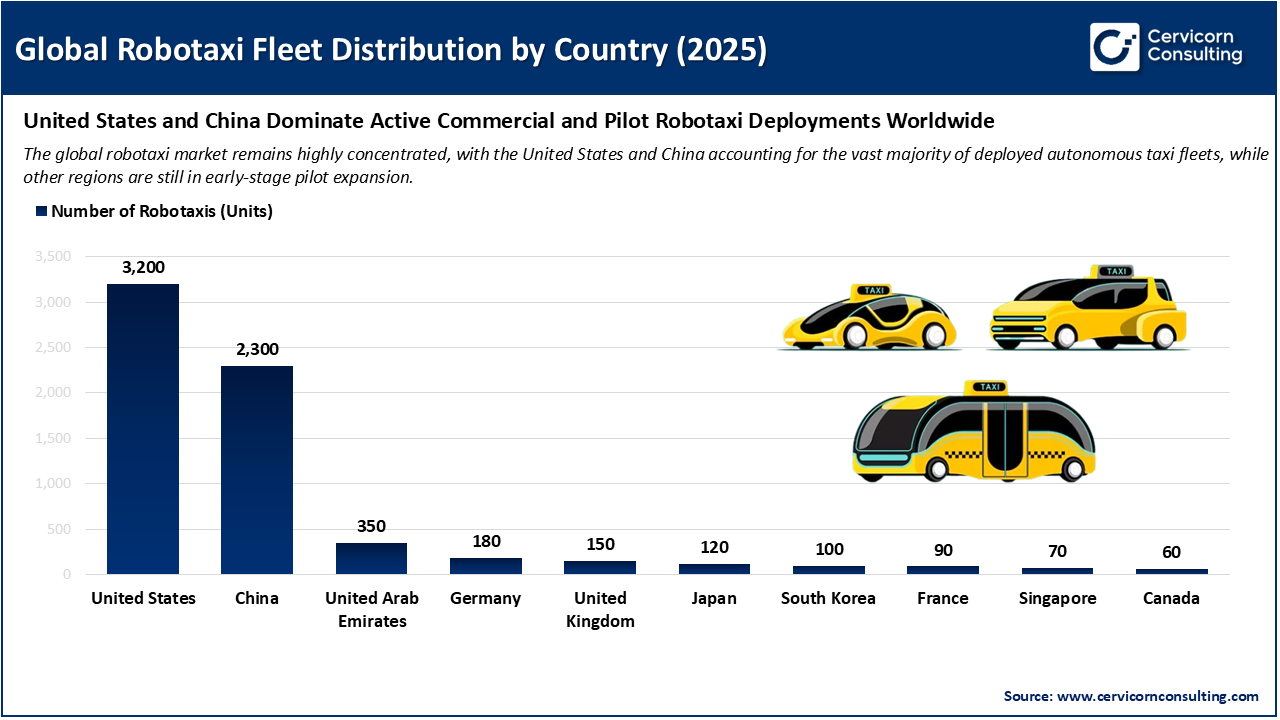
The chart shows that in 2025, the global robotaxi fleet is mainly concentrated in the United States and China, which together make up most of the autonomous taxis in operation worldwide. The United States is expected to lead with about 3,200 units, while China follows with around 2,300 units. This dominance is driven by strong regulatory support, advanced technology, and early steps toward commercialization in both countries. Other countries, including the United Arab Emirates, Germany, the United Kingdom, Japan, South Korea, France, Singapore, and Canada, have much smaller fleets that are mostly limited to pilot projects or small-scale commercial use. As a result, the market remains highly centralized in a few advanced economies, while other regions are gradually increasing their adoption of robotaxis.
Report Scope
| Area of Focus |
Details |
| Market Size in 2026 |
USD 4.27 Billion |
| Market Size in 2035 |
USD 283.47 Billion |
| CAGR from 2026 to 2035 |
59.40% |
| Dominant Region |
North America |
| Fastest Growing Region |
Asia-Pacific |
| Key Segments |
Propulsion Type, Application, Component Type, Level of Autonomy, Region |
| Key Companies |
Tesla Inc., Didi Chuxing Technology Co, Uber Technologies Inc., AutoX, Inc, Aptiv, Zoox, Inc, Waymo LLC, Cruise LLC, Baidu, Lyft, Inc |
Recent Major Milestones
1. Waymo Unveils Sixth-Generation Robotaxi System with High-Volume Production Focus (2026)
Waymo has introduced its sixth-generation autonomous driving system, which is designed for large-scale production and wider deployment. The company plans to manufacture tens of thousands of vehicles each year and aims to expand its fleet to 3,500 robotaxis by 2026, operating in more than 20 cities.
This development marks a shift for robotaxi technology from limited pilot programs to commercially viable, mass-produced vehicles. Large-scale manufacturing is expected to reduce the cost per unit and allow operators to deploy robotaxis across entire cities. The ability to produce at high volumes is likely to drive wider market adoption, encourage partnerships with global manufacturers, and speed up the availability of robotaxis. Furthermore, this progress strengthens supply chain reliability and creates opportunities for expansion into new markets beyond the initial cities.
2. Commercial Fully Driverless Robotaxi Services Launched in Dubai (2026)
Dubai’s Roads and Transport Authority (RTA), together with Baidu Apollo Go and Uber, has started providing fully autonomous ride-hailing services through major platforms in the Jumeirah area. This is among the first deployments of its kind outside China and the United States.
Support from the government and the use of a major global mobility platform indicate a move from testing to actual commercial operations. This development helps demonstrate the reliability of robotaxi services to regulators, raises public awareness, and builds confidence in the market. These factors are important for encouraging adoption in other smart city environments. Dubai’s approach may also encourage other governments to include autonomous mobility in their future urban transport plans.
3. Baidu’s Apollo Go Global Expansion Through Strategic Partnerships (2025–2026)
Apollo Go has formed several global partnerships with Uber and Lyft to expand its robotaxi platform outside China. The company is planning to launch services in the Middle East and Europe, including Germany and the UK.
International partnerships with leading ride-hailing companies significantly increase distribution and market reach. These partnerships allow robotaxi services to access existing user bases, which reduces barriers to adoption and helps operators scale quickly without the need to create new customer channels. Such collaborations also support regulatory cooperation between countries and establish clear commercial models for the global rollout of robotaxi services.
4. Baidu’s Apollo Go Launches Fully Driverless Commercial Robotaxi in Abu Dhabi (2026)
Baidu Apollo Go has launched its largest fully driverless commercial robotaxi service in Abu Dhabi. This represents one of the first large-scale deployments of Level-4 autonomous taxis in the Middle East.
The successful launch of fully driverless services in a major city indicates both technological advancement and regulatory readiness. This achievement demonstrates operational feasibility, increases investor confidence, and provides evidence for the business case in various urban environments. Such milestones are expected to accelerate commercialization, encourage competitors to expand their activities, and prompt policymakers to create frameworks that support autonomous vehicle operations.
Robotaxi Market Regional Analysis
The Robotaxi market is segmented into North America, Europe, Asia-Pacific, and LAMEA. Here is a brief overview of each region:
Why does North America leads the robotaxi market?
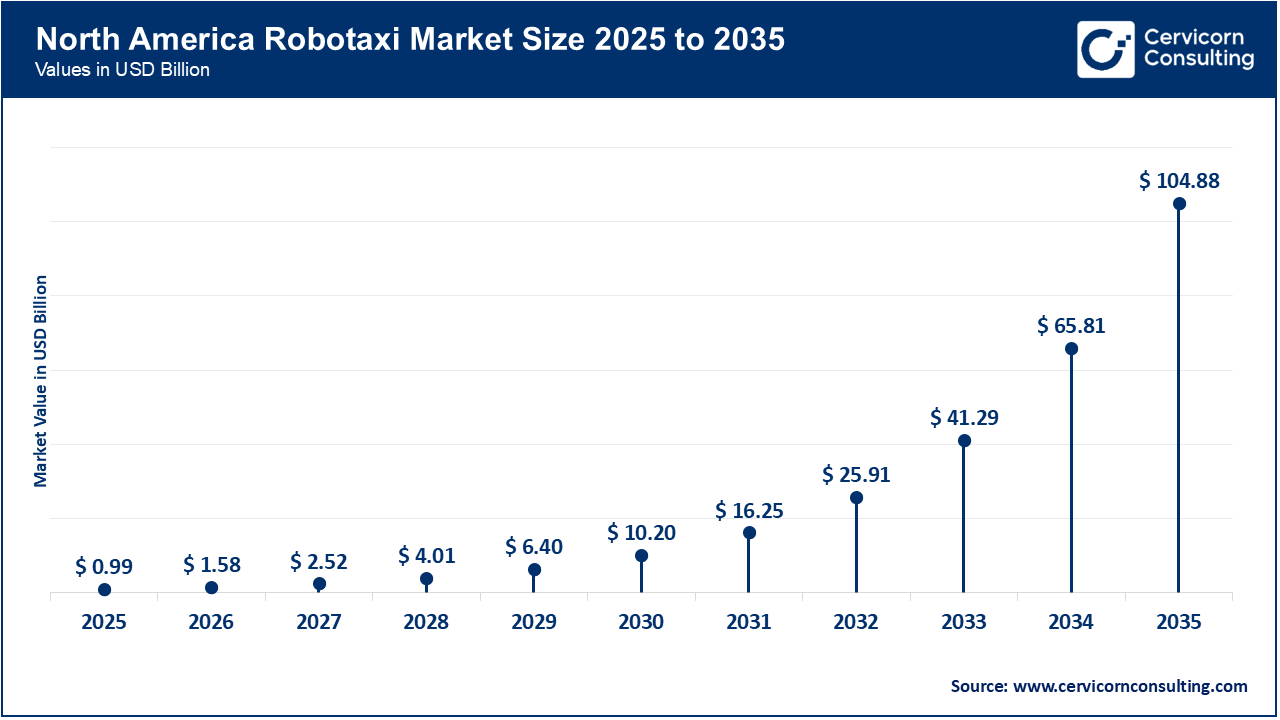
The North America robotaxi market size was valued at USD 0.99 billion in 2025 and is forecasted to grow around USD 104.88 billion by 2035. North America holds a leading position in the global robotaxi market, mainly because of early commercialization, robust regulatory support, and the presence of major autonomous technology companies. The region has moved beyond pilot testing and now operates fully driverless, revenue-generating services in several metropolitan areas. North America has established itself as a center for autonomous vehicle research and development, AI software innovation, and advanced electric vehicle infrastructure, which has resulted in a mature ecosystem that supports the large-scale deployment of robotaxis.
The region benefits from widespread ride-hailing usage, clear autonomous vehicle legislation, and strong venture capital investment. Several U.S. states have introduced policies that allow Level 4 autonomous vehicle operations within specific areas. The combination of electric vehicles and autonomous systems also supports federal and state sustainability goals, which is expected to further drive the adoption of robotaxis.
U.S. and Canada Robotaxi Market: A Quantitative Research
- Waymo operates approximately 2,500+ autonomous vehicles across U.S. cities and delivers hundreds of thousands of fully driverless rides per week.
- Over 10 U.S. states currently allow autonomous vehicle testing or commercial deployment under structured regulatory frameworks.
- California has issued numerous autonomous deployment permits, making it one of the most active AV markets globally.
- The U.S. ride-hailing market completes tens of millions of trips weekly, creating a strong substitution opportunity for autonomous taxis.
- Canadian provinces such as Ontario are supporting AV pilot programs through smart mobility initiatives and public-private collaborations.
Why is Asia-Pacific (APAC) witnessing strong growth in the robotaxi market?
The Asia-Pacific robotaxi market size was estimated at USD 0.91 billion in 2025 and is expected to attain around USD 96.38 billion by 2035. The Asia Pacific region is projected to experience the most rapid operational growth. This expansion is primarily attributed to high-density urban populations, the implementation of smart city projects, and government-supported AI strategies. Countries including China, Japan, and South Korea are increasing the deployment of autonomous taxi services, particularly within designated urban areas. The presence of advanced manufacturing infrastructure, significant domestic demand for mobility, and adaptable regulatory frameworks are key factors that support the growth of robotaxi operations in this region.
The demand for urban ride-hailing services in major Asian cities amounts to millions of trips each day, which creates a substantial opportunity for the adoption of autonomous vehicles. Furthermore, several governments in the region are integrating robotaxis into their long-term strategies for AI and mobility, which is expected to further accelerate the deployment of these vehicles.
China to Act as Global Innovation Hub for Robotaxis
China accounts for a large share of robotaxi fleet deployments globally.
- Baidu Apollo Go has deployed 1,000+ robotaxis and completed over 10 million autonomous rides across more than 15 cities.
- Pony.ai operates 700+ autonomous vehicles and is expanding commercial services in major Chinese urban centers.
- Several Chinese cities have designated hundreds of square kilometers of public road testing zones for Level 4 vehicles.
- Urban ride-hailing demand in cities like Beijing and Shanghai reaches millions of daily trips, supporting scalable autonomous adoption.
China’s cost competitiveness in EV manufacturing and AI hardware production further strengthens its position as a global robotaxi innovation hub.
Japan and South Korea Strengthening Pilot Programs
- Japan is conducting structured urban robotaxi pilots in Tokyo with domestic AV developers.
- South Korea has designated 40+ autonomous vehicle pilot zones, including commercial autonomous taxi trials in Seoul.
- Governments in both countries are investing in 5G connectivity and smart infrastructure to support autonomous fleet operations.
Europe Robotaxi Market: regulated rollouts, strong safety focus and structured pilots
The Europe robotaxi market size was reached at USD 0.56 billion in 2025 and is projected to surpass around USD 59.53 billion by 2035. The robotaxi market in Europe is experiencing steady growth, largely due to the presence of structured legal frameworks and a strong emphasis on sustainable mobility strategies. Countries including Germany, France, and the United Kingdom have begun to implement national laws for autonomous vehicles, which are designed to support the deployment of Level 4 technologies within specific operational areas. In addition, the European Union’s decarbonization targets and electrification mandates are closely aligned with the strategies for robotaxi deployment, as the majority of these fleets are based on electric vehicles. This alignment is expected to further drive the adoption of robotaxis across the region.
United Kingdom — legal clarity and fast-tracked pilots
The UK has enacted the Automated Vehicles Act (2024), accelerating the timeline for commercial firms to initiate driverless vehicle trials beginning in spring 2026. According to government estimates, this sector is expected to generate approximately 38,000 skilled jobs and attract substantial investment. London has emerged as a central location for both supervised and fully driverless trials, with several major international companies preparing to launch pilot programs and initial commercial services. These developments indicate a significant opportunity for growth and innovation within the UK's automated vehicle industry.
Germany — regulatory pioneer and growing city pilots
Germany has revised its national regulations and established specific legal frameworks to support higher levels of vehicle autonomy within defined operational domains. As a result, several cities have begun to implement city-backed Level-4 autonomous vehicle pilots. Munich and Hamburg have become key centers for these initiatives. Munich has attracted international partners for robotaxi testing, while Hamburg commenced a city-supported Level-4 robotaxi pilot in collaboration with Free Now (Lyft) in early February 2026. These advancements demonstrate that Germany is progressing from regulatory preparation to practical municipal deployment of autonomous vehicle technologies.
Europe Robotaxi Market: Quantitative Research
- Germany legalized Level 4 autonomous driving in specific operating areas, becoming a regulatory pioneer in Europe.
- The UK’s Automated Vehicles framework supports commercial autonomous deployments beginning mid-decade.
- Multiple pilot projects are active in cities such as Munich, Paris, and London.
- Europe’s urban population exceeds 450 million people, creating significant long-term mobility demand for shared autonomous transport solutions.
Robotaxi Market Share, By Region, 2025 (%)
| Region |
Revenue Share, 2025 (%) |
| North America |
37% |
| APAC |
34% |
| Europe |
21% |
| LAMEA |
8% |
LAMEA Robotaxi Market: Government-led fast commercialisation
The LAMEA robotaxi market was valued at USD 0.99 billion in 2025 and is anticipated to reach around USD 22.68 billion by 2035. The Middle East, especially the UAE, is becoming a prominent market for robotaxis due to strong government-led strategies. In contrast to other regions where private companies are the main drivers, governments in the Middle East are taking an active role by coordinating partnerships, providing funding, and managing regulatory approvals for autonomous mobility initiatives.
Dubai’s Smart Mobility Strategy targets making 25% of all transportation trips autonomous by 2030, which will help establish the city as a leading example of driverless mobility. Abu Dhabi has already introduced fully driverless commercial robotaxi services in specific areas, demonstrating strong regulatory support and a quick shift from pilot projects to commercial operations.
Recent Developments:
- Dubai targets 25% autonomous transport integration by 2030.
- Fully driverless robotaxi services have been launched in urban districts of Dubai and Abu Dhabi.
- Government-backed partnerships with global AV developers are accelerating phased fleet expansion plans into 2026 and beyond.
Robotaxi Market Segmental Analysis
The robotaxi market is segmented into propulsion type, application, component type, level of autonomy, and region.
Propulsion Type Analysis
Battery-electric vehicles (BEVs) are currently the leading choice for robotaxi deployments. This is mainly because commercial pilot and early-commercial fleets prefer electric platforms to achieve city emissions targets, simplify the integration of drivetrains with autonomous systems, and reduce operating costs through lower energy and maintenance expenses. As a result, major fleet programs and partnerships with original equipment manufacturers are specifying BEV platforms for both robotaxi conversions and purpose-built vehicles. Electric propulsion has therefore become the standard for operators who are deploying fleets at the city level.
Although BEVs are currently dominant, hydrogen fuel-cell electric vehicles (FCEVs) are becoming the fastest-growing segment in certain markets where factors such as range, rapid refueling, or policy incentives are important. For instance, pilot hydrogen taxi projects and regional ride-hail trials are now appearing in Europe and the Baltics. These developments indicate that operators and cities are increasingly interested in fuel cells as a complementary solution for robotaxi fleets that require longer range or higher usage, particularly in regions where investment in hydrogen infrastructure is underway.
Application Analysis
Passenger transport continues to be the leading application for robotaxis, as major operators are prioritizing passenger ride-hailing, airport shuttles, and urban on-demand mobility in their public roadmaps. This focus is primarily due to the higher near-term revenue per mile and the relatively straightforward regulatory requirements associated with these use cases, such as geo-fenced urban zones and airport concessions. As a result, passenger services account for the majority of robotaxis currently in operation or undergoing advanced pilot programs across the globe.
Robotaxi Market Share, By Application, 2025 (%)
| Application |
Revenue Share, 2025 (%) |
| Passenger |
82% |
| Goods |
18% |
Goods delivery and light commercial logistics represent the fastest-growing adjacent application for robotaxis. Autonomous platforms that were initially designed for passenger transport are now being adapted for last-mile delivery and light freight, while some companies are also developing dedicated autonomous vehicles for delivery purposes. This growth is being driven by the increasing demand for contactless delivery, demonstrated cost savings on repetitive short routes, and the expansion of commercial pilot programs. Furthermore, the technological similarities between passenger autonomous vehicles and delivery solutions are supporting the rapid development of goods delivery applications.
Component Type Analysis
LiDAR is widely used in safety-critical robotaxi systems because 3D laser mapping offers accurate and detailed range data. This technology helps improve object detection and localization, especially in complex urban environments such as at night or in areas with low contrast and clutter. Most large-scale operators still use LiDAR together with radar and cameras to ensure redundancy and meet safety regulations.
Robotaxi Market Share, By Component Type, 2025 (%)
| Component Type |
Revenue Share, 2025 (%) |
| LiDAR |
34% |
| RADAR |
22% |
| Camera |
28% |
| Sensor (Ultrasonic & Others) |
16% |
High-resolution camera systems are becoming more common, especially when combined with advanced perception software and a smaller number of higher-quality cameras. This trend is growing quickly because it reduces the total number of sensors and lowers costs, while still improving performance in certain situations. Newer systems are replacing many low-resolution cameras with a few high-resolution ones, along with radar and LiDAR for redundancy. This approach is becoming popular as operators look for ways to produce fleets that are easier and less expensive to manufacture.
Level of Autonomy Analysis
Level-4 autonomy, which involves high automation within a limited area, is currently leading robotaxi deployments. This is mainly because regulators and operators prefer to work within defined and certifiable service areas where safety can be clearly validated. As a result, most public robotaxi services today are operating as Level-4 in specific urban zones, airports, or corridors.
Robotaxi Market Share, By Level of Autonomy, 2025 (%)
| Level of Autonomy |
Revenue Share, 2025 (%) |
| Level 4 |
91% |
| Level 5 |
9% |
Level-5 autonomy, which means full automation anywhere and anytime, is the main focus of research and development, but it is still at an early stage in commercial use. However, investments, simulation testing, and large-scale data collection for Level-5 are increasing quickly. In the near term, the commercial growth of the industry will come from more Level-4 deployments, while advances in Level-5 technology, such as research, chip development, and AI, are attracting the largest long-term investments and resources.
Robotaxi Market Top Companies
Recent Developments
- In June 2025, Tesla, Inc. launched its first robotaxi service pilot in Austin, Texas. The company operated a limited fleet of autonomous Model Y vehicles within a geo-fenced area. This launch signaled Tesla’s move from advanced driver assistance systems to commercial autonomous ride-hailing services. The main goal was to test and validate its Full Self-Driving (FSD) technology in real-world urban conditions.
- In February 2026, Waymo LLC expanded its fully driverless ride-hailing services into more U.S. cities. The company increased its commercial fleet to over 2,500 autonomous vehicles. This expansion was a result of rising weekly ride volumes and was intended to strengthen Waymo’s position as the leading robotaxi provider in North America.
- In May 2025, Baidu expanded its Apollo Go robotaxi services to international markets by forming strategic partnerships in the Middle East and Europe. This move aimed to grow Baidu’s presence in autonomous mobility outside China, using its experience from millions of domestic robotaxi rides.
Market Segmentation
By Propulsion Type
- Electric Vehicle
- Hybrid Electric Vehicle
- Fuel Cell Vehicle
By Application
By Component Type
- LiDAR
- RADAR
- Camera
- Sensor
By Level of Autonomy
By Region
- North America
- APAC
- Europe
- LAMEA