Regulatory Affairs Outsourcing Market Size, Growth Insights 2026 To 2035
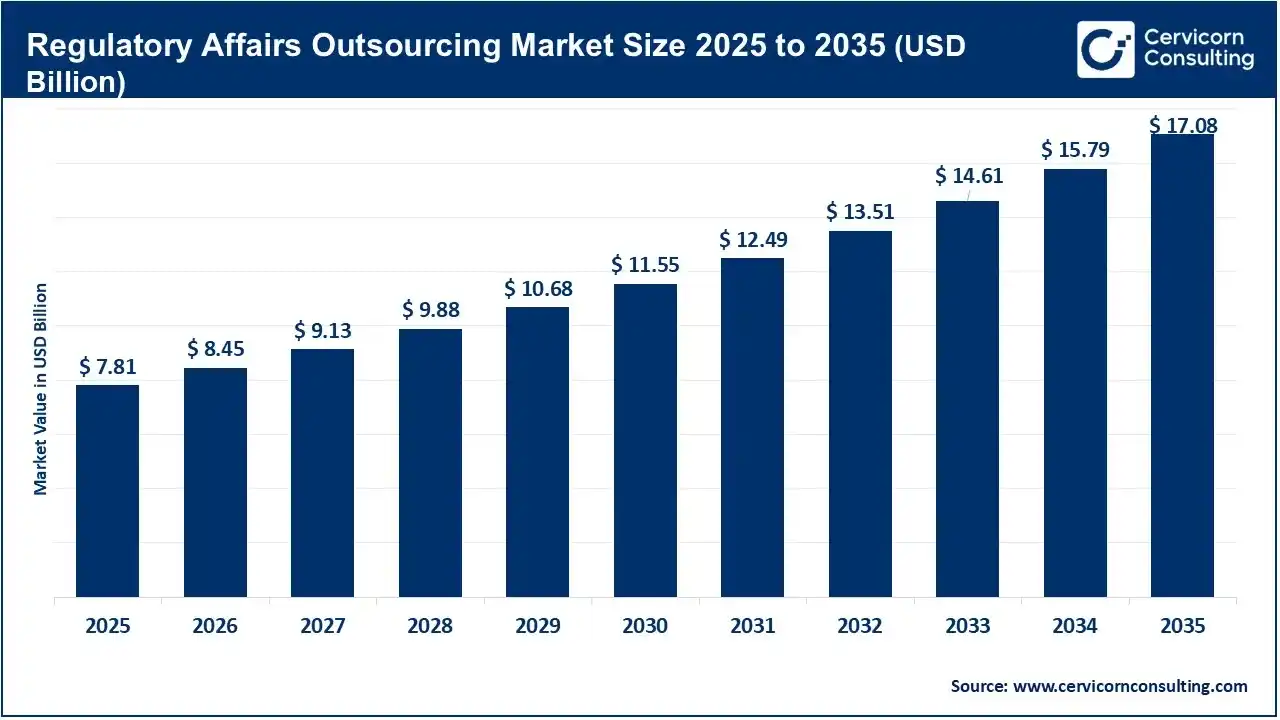
The global regulatory affairs outsourcing market size was valued at USD 7.81 billion in 2025 and is expected to reach around USD 17.08 billion by 2035, exhibiting a compound annual growth rate (CAGR) of 8.1% over the forecast period 2026 to 2035.
The complexity of global regulatory frameworks significantly drives the regulatory affairs outsourcing market, as pharmaceutical, biotechnology, and medical device firms must navigate various submission formats, documentation standards, safety protocols, and post-approval duties across different regions. The pipeline of innovative therapies continues to grow, further elevating the regulatory workload. In 2024, the U.S. FDA’s Center for Drug Evaluation and Research approved 50 new drugs, with 33 (66%) benefiting from at least one expedited pathway, emphasising the need for specialized regulatory strategies, submission support, and agency interaction expertise.
The increasing volume of clinical trials, advanced therapies, biologics, and international product launches encourages companies to outsource regulatory functions, gaining access to expertise without building large internal teams. In 2024, clinical-stage activities represented 54.8% of healthcare regulatory outsourcing, due to the high regulatory demands of trials and submissions. Additionally, regulatory submission outsourcing reached around USD 366 million, highlighting demand for dossier preparation, electronic submissions, and submission management. The growing use of eCTD platforms, regulatory information systems, AI-powered workflows, and cloud collaboration is further enhancing the scalability and efficiency of outsourced regulatory operations.
Report Highlights
- North America represented the largest regional market with an estimated 40.7% share, supported by strong pharmaceutical activity and stringent regulatory requirements.
- Regulatory Submission & Publishing dominated the service type segment with a 22.7% market share, driven by increasing electronic submissions and complex regulatory dossiers.
- Pharmaceuticals dominated the therapeutic-area segment with a 42.8% share, reflecting extensive regulatory requirements throughout the drug lifecycle.
- New Drug Application (NDA) represented the largest submission category with a 19.8% share, supported by innovative pharmaceutical product development.
- Large Pharmaceutical & Biotechnology Companies accounted for 38.6%, supported by extensive product pipelines and international regulatory operations.
- Pharmaceutical Companies dominated end-user demand with a 39.7% share, supported by recurring submission, compliance, and lifecycle-management requirements.
What is Regulatory Affairs Outsourcing?
Regulatory Affairs Outsourcing refers to hiring specialized third-party providers to manage regulatory activities for pharmaceutical, biotechnology, medical device, and healthcare companies. These services can include regulatory strategy, submission preparation, regulatory writing, product registration, regulatory intelligence, labeling, health-authority interactions, and post-approval lifecycle management. Outsourcing allows companies to access specialized regulatory expertise across multiple countries while reducing internal workload and improving submission efficiency.
Recent Milestones
| Year |
Company |
Recent Milestone |
| 2026 |
IQVIA |
Expanded AI-augmented regulatory affairs capabilities, including AI-supported regulatory operations and lifecycle management. |
| 2026 |
Parexel |
Highlighted AI-enabled automation for regulatory submissions to improve authoring, consistency, and submission workflows. |
| 2026 |
IQVIA |
Reported USD 32.7 billion in R&D Solutions contracted backlog at the end of 2025, reflecting strong demand for outsourced life-sciences services. |
| 2025 |
Parexel |
Reported continued expansion of specialized regulatory outsourcing support amid changing regulatory and commercial requirements. |
| 2025–2026 |
Parexel |
Continued global regulatory outsourcing across 110+ countries with more than 1,300 regulatory specialists. |
| 2025–2026 |
IQVIA |
Expanded global regulatory capabilities with 3,300+ regulatory professionals across more than 65 locations. |
| 2025–2026 |
ICON |
Continued offering 50+ regulatory service capabilities, covering clinical trials, strategy, CMC, submissions, labeling, and lifecycle management. |
Regulatory Affairs Outsourcing Market Dynamics
Market Drivers
1. Increasing Regulatory Complexity
Regulatory requirements are becoming more complex across pharmaceuticals, biologics, medical devices, and advanced therapies. Companies increasingly require specialized expertise for submissions, compliance, labeling, and regulatory strategy. In 2025, the FDA’s CDER approved 46 novel drugs, including 34 new molecular entities and 12 biologics, demonstrating the continued flow of innovative products requiring regulatory support. Additionally, 23 of the 46 approvals received Orphan Drug Designation, creating specialized regulatory requirements for rare-disease products. These developments encourage companies to outsource complex regulatory activities.
2. Growth in Clinical Development
Increasing clinical research activity is expanding the volume of regulatory documentation and submissions. Clinical trials are also becoming more complex because of innovative trial designs, endpoints, decentralized approaches, and evolving regulatory requirements. A 2024 analysis examined more than 16,000 clinical trials and found increasing trial complexity over time. The WHO’s global clinical-trial database now tracks registrations through June 2025, covering trials across countries, disease areas, and development phases. This growing complexity increases demand for specialized regulatory outsourcing partners.
Market Restraints
1. Data Security and Confidentiality Concerns
Data security remains an important restraint because regulatory outsourcing involves sensitive clinical, manufacturing, intellectual-property, and product information. Companies must transfer substantial documentation to external providers while maintaining confidentiality and regulatory compliance. Concerns become more significant when projects involve multiple countries with different data-protection and localization requirements. Industry analysis identifies data security and control concerns as major barriers to outsourcing adoption. Smaller biotechnology companies may also hesitate to outsource highly sensitive activities because they have fewer resources for vendor audits, cybersecurity controls, and ongoing oversight.
2. High Outsourcing Costs
The cost of specialized regulatory services can limit adoption, particularly among smaller biotechnology companies and early-stage developers. Complex products often require specialized experts across regulatory strategy, clinical submissions, CMC documentation, labeling, and post-approval compliance. Providers with expertise in multiple jurisdictions may also charge premium fees for highly specialized services. This creates a cost barrier for organizations operating with limited development budgets. Industry research identifies high service costs from specialized regulatory consulting firms as a restraint, particularly in price-sensitive markets.
Market Opportunities
1. Expansion Across Emerging Markets
Emerging markets provide opportunities as pharmaceutical and biotechnology companies expand clinical development and commercialization internationally. Asia-Pacific is particularly important because regulatory harmonization and increasing clinical research activity are creating demand for localized expertise. One market analysis estimated that Asia-Pacific accounted for approximately 41% of global regulatory affairs outsourcing revenue in 2025. Expansion across China, India, Southeast Asia, and other emerging markets creates opportunities for providers offering country-specific submissions, regulatory intelligence, product registration, and local representation.
2. AI and Digital Regulatory Solutions
Artificial intelligence and regulatory technology are creating new opportunities for outsourcing providers to automate documentation and compliance workflows. AI can support regulatory intelligence, document review, submission preparation, data validation, and regulatory information management. The opportunity is particularly relevant as regulatory teams handle increasingly large volumes of documentation. Providers that combine regulatory expertise with advanced analytics and automation can offer integrated services rather than traditional consulting alone. Industry analysis specifically identifies technology-driven regulatory solutions and sophisticated regulatory information management platforms as important growth opportunities.
Market Challenges
1. Regulatory Differences Across Countries
Regulatory harmonization remains incomplete, creating operational challenges for outsourcing providers serving multinational clients. Requirements can differ substantially regarding submission formats, clinical evidence, labeling, product registration, and post-market obligations. Providers must continuously monitor changes across multiple regulatory authorities while maintaining country-specific expertise. The challenge is particularly significant for companies launching products simultaneously across several markets. Industry research identifies the lack of standardized regulatory processes and frameworks across geographies as a major challenge because outsourcing providers must adapt workflows to individual jurisdictional requirements.
2. Maintaining Quality and Knowledge Transfer
Effective outsourcing requires continuous knowledge transfer between pharmaceutical companies and external regulatory providers. Poor communication or incomplete transfer of product knowledge can create documentation errors, inconsistent regulatory strategies, or submission delays. This risk becomes greater when companies outsource critical regulatory functions for long development programs. Research identifies dependency on outsourcing partners and subsequent quality-control issues as key challenges. Companies therefore need strong governance, clearly defined responsibilities, quality-management systems, and continuous oversight to maintain regulatory consistency throughout the product lifecycle.
Regulatory Affairs Outsourcing Market Regional Analysis
The regulatory affairs outsourcing market is segmented by region into North America, Europe, Asia-Pacific, Latin America, and LAMEA. Here is a brief overview of each region:
North America Regulatory Affairs Outsourcing Market: Driven by Complex FDA Requirements, Expanding Drug Pipelines, Biologics Development, Clinical Research, and Growing Outsourcing Adoption
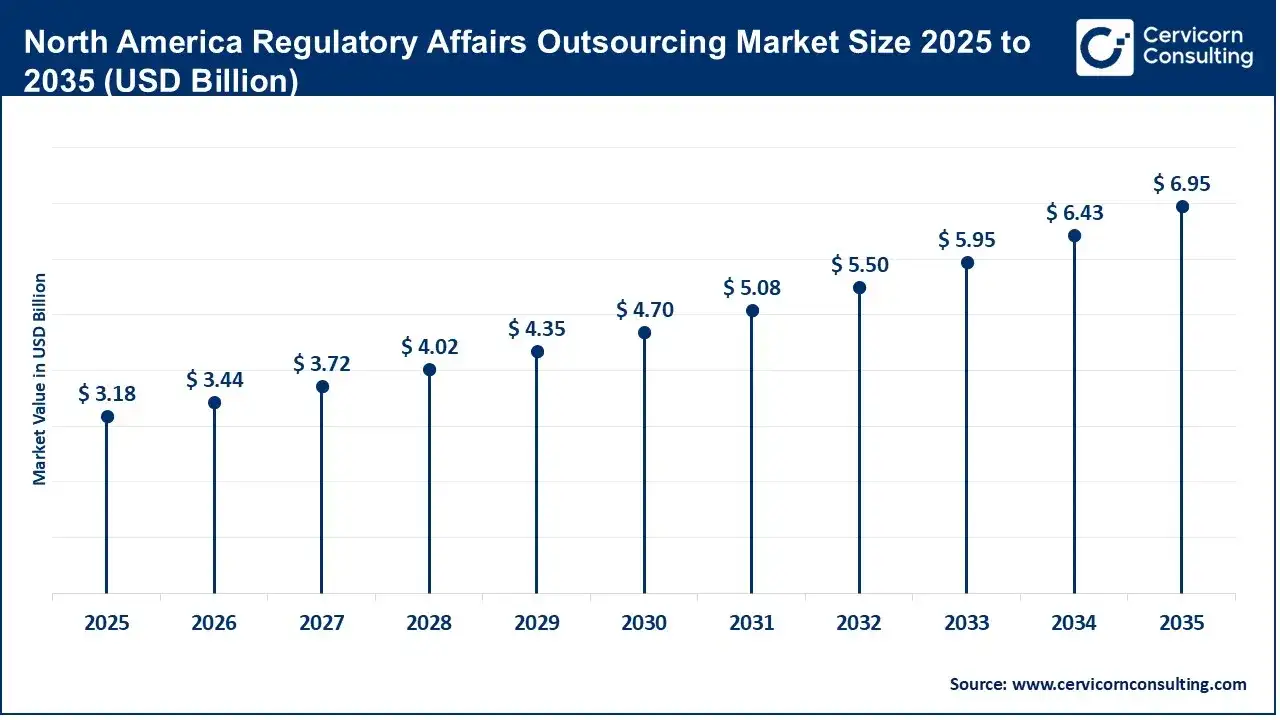
The North America regulatory affairs outsourcing market size was valued at USD 3.18 billion in 2025 and is projected to surpass USD 6.95 billion by 2035. North America is a major region, supported by stringent regulatory requirements, strong pharmaceutical and biotechnology activity, extensive clinical research, and increasing development of complex therapies. The United States represents the largest demand center, supported by the FDA's extensive requirements for drug development, submissions, labeling, and post-approval compliance. In 2025, the FDA approved 46 novel drugs, while 23 received orphan-drug designation, highlighting continued activity in innovative and specialized therapies that require regulatory expertise.
United States: Strong FDA Activity, Innovative Drug Development, Biologics, and Complex Regulatory Requirements Drive Market Demand
- The U.S. remains the dominant North American market because pharmaceutical and biotechnology companies face extensive FDA requirements across clinical development, NDA/BLA submissions, manufacturing, labeling, and post-approval activities.
- The FDA approved 46 novel drugs in 2025, creating substantial demand for regulatory strategy, submission preparation, documentation, and lifecycle-management services.
Canada: Growing Pharmaceutical Development, Regulatory Modernization, and Cross-Border Product Launches Support Market Expansion
- Canada represents an important North American regulatory outsourcing market, supported by Health Canada's requirements for clinical trials, drug submissions, medical devices, licensing, labeling, and post-market compliance.
- Pharmaceutical and biotechnology companies increasingly require regulatory specialists to navigate Canadian requirements alongside U.S. and other international regulatory frameworks.
Asia-Pacific (APAC) Regulatory Affairs Outsourcing Market: Driven by Pharmaceutical Innovation, Regulatory Modernization, Clinical Trial Expansion, eCTD Adoption, and Internationalization
The Asia-Pacific regulatory affairs outsourcing market size was estimated at USD 1.77 billion in 2025 and is projected to hit around USD 3.86 billion by 2035. Asia-Pacific is a rapidly evolving region, supported by expanding pharmaceutical and biotechnology industries, increasing clinical research, regulatory modernization, and growing international drug development. China, India, Japan, South Korea, and Southeast Asian countries represent important regulatory outsourcing markets. Regional authorities are also strengthening regulatory convergence and digital submission systems. In 2025, China expanded eCTD implementation to additional clinical-trial and marketing-authorization applications, increasing the need for specialized electronic submission expertise.
China: Pharmaceutical Innovation, Faster Clinical Approvals, eCTD Adoption, and International Drug Development Drive Market Demand
- China is a major regional market, supported by rapid pharmaceutical innovation and increasing regulatory activity across innovative drugs, biologics, and medical devices.
- China approved 48 first-in-class innovative drugs in 2024, the highest number recorded during the previous five years, increasing demand for regulatory strategy and submission services.
- NMPA introduced a 30-working-day review pathway for eligible innovative-drug IND applications, encouraging faster clinical development and increasing demand for specialized regulatory preparation.
India: Pharmaceutical Manufacturing, Clinical Research, Regulatory Modernization, and Global Product Development Support Market Expansion
- India represents an important outsourcing destination because of its large pharmaceutical industry, expanding biotechnology sector, and growing participation in international drug development.
- Increasing clinical research activity is creating demand for regulatory writing, clinical-trial submissions, regulatory consulting, and product-registration services.
Europe Regulatory Affairs Outsourcing Market: Driven by EMA Regulatory Complexity, Innovative Medicines, Clinical Trial Harmonization, eCTD Adoption, and Growing Compliance Requirements
The Europe regulatory affairs outsourcing market size was accounted for USD 2.41 billion in 2025 and is forecasted to reach USD 5.28 billion by 2035. Europe is a major market, supported by stringent regulatory requirements, a large pharmaceutical industry, innovative drug development, and increasingly harmonized clinical-trial processes. The European Medicines Agency (EMA) recommended 104 medicines for marketing authorisation in 2025, including 38 medicines containing new active substances. The region also has a highly structured regulatory environment covering centralized marketing authorization, clinical trials, pharmacovigilance, labeling, and lifecycle management, creating consistent demand for specialized regulatory outsourcing services.
Germany: Strong Pharmaceutical Industry, Innovative Medicine Development, and EU Regulatory Activity Support Market Demand
- Germany is one of Europe's important pharmaceutical markets, supported by a strong research base, pharmaceutical manufacturing, biotechnology development, and clinical research activity.
- Pharmaceutical companies require regulatory support for EMA submissions, clinical-trial applications, variations, renewals, labeling, and post-approval compliance.
- The increasing development of innovative medicines and biologics is creating demand for specialized regulatory strategy and submission expertise.
United Kingdom: MHRA Modernization, Innovative Medicines, Clinical Research, and International Regulatory Strategies Drive Demand
- The UK remains an important regulatory market following the development of its independent regulatory framework under the Medicines and Healthcare products Regulatory Agency (MHRA).
- Increasing pharmaceutical and biotechnology development creates demand for regulatory consulting, submission preparation, regulatory intelligence, and compliance services.
Regulatory Affairs Outsourcing Market Share, By Region, 2025 (%)
| Region |
Revenue Share, 2025 (%) |
| North America |
40.7% |
| Europe |
30.9% |
| Asia-Pacific |
22.6% |
| LAMEA |
5.8% |
LAMEA Regulatory Affairs Outsourcing Market: Driven by Regulatory Modernization, Pharmaceutical Expansion, Local Manufacturing, Clinical Research, and Regulatory Harmonization
The LAMEA regulatory affairs outsourcing market was valued at USD 0.45 billion in 2025 and is anticipated to reach around USD 0.99 billion by 2035. LAMEA is an emerging region, supported by expanding pharmaceutical manufacturing, healthcare investments, regulatory modernization, and increasing demand for international product registrations. Latin America benefits from established regulatory agencies and growing pharmaceutical production, while the Middle East is investing in healthcare infrastructure and local pharmaceutical manufacturing. Africa presents significant long-term opportunities as regulatory authorities strengthen harmonization and reliance mechanisms. In 2025, seven African national regulatory authorities signed an agreement to strengthen collaboration, information sharing, and reliance on regulatory decisions.
Brazil: ANVISA Expertise, Pharmaceutical Manufacturing, Clinical Research, and International Product Registration Drive Market Demand
- Brazil is one of Latin America's important pharmaceutical markets, supported by its large healthcare system, domestic pharmaceutical industry, and established regulatory framework.
- Pharmaceutical and biotechnology companies require regulatory support for clinical trials, product registrations, manufacturing changes, labeling, and post-approval compliance.
Saudi Arabia: Healthcare Transformation, Local Pharmaceutical Manufacturing, and Regulatory Modernization Create Opportunities
- Saudi Arabia is becoming an important Middle Eastern regulatory market as healthcare transformation programs encourage pharmaceutical manufacturing and investment in life sciences.
- Companies entering the Saudi market require expertise in Saudi Food and Drug Authority requirements covering medicines, biologics, medical devices, registration, and post-market activities.
Segmental Analysis
The regulatory affairs outsourcing market is segmented into service type, therapeutic area, regulatory submission type, company size, end user, and geography.
Service Type Analysis
Regulatory Submission & Publishing dominates because pharmaceutical and biotechnology companies handle large volumes of complex regulatory dossiers. Outsourcing providers support dossier compilation, electronic publishing, submission validation, and document lifecycle management. The growing adoption of electronic submission systems is increasing demand for specialized publishing capabilities. Companies also outsource these activities to improve submission accuracy and reduce administrative workloads. The need becomes greater when products are submitted simultaneously to multiple regulatory authorities with different technical and formatting requirements.
Regulatory Affairs Outsourcing Market Share, By Service Type, 2025 (%)
| Service Type |
Revenue Share, 2025 (%) |
| Regulatory Strategy & Consulting |
15.8% |
| Regulatory Submission & Publishing |
22.7% |
| Regulatory Writing & Documentation |
20.4% |
| Regulatory Intelligence |
10.6% |
| Product Registration & Maintenance |
13.2% |
| Regulatory Compliance & Remediation |
11.1% |
| Others |
6.2% |
Regulatory Intelligence is among the fastest-growing segments as regulatory requirements continue evolving across major pharmaceutical markets. Providers track guideline changes, safety requirements, submission procedures, and regulatory decisions for clients. Artificial intelligence and automated monitoring tools are improving the speed of regulatory intelligence activities. The increasing globalization of drug development further supports demand because companies need continuous visibility into country-specific regulatory changes. Outsourcing enables organizations to access dedicated regulatory intelligence specialists without developing large internal monitoring teams.
Therapeutic Area Analysis
Pharmaceuticals dominate the therapeutic-area segment because conventional drug development involves extensive regulatory requirements from discovery through post-market commercialization. Pharmaceutical companies require support for clinical trial applications, marketing authorization submissions, labeling, regulatory correspondence, and lifecycle management. Large product portfolios also generate recurring regulatory workloads. Increasing international commercialization means companies must coordinate regulatory requirements across several jurisdictions. These factors make pharmaceuticals a major source of demand for outsourced regulatory strategy, documentation, submission management, and compliance services.
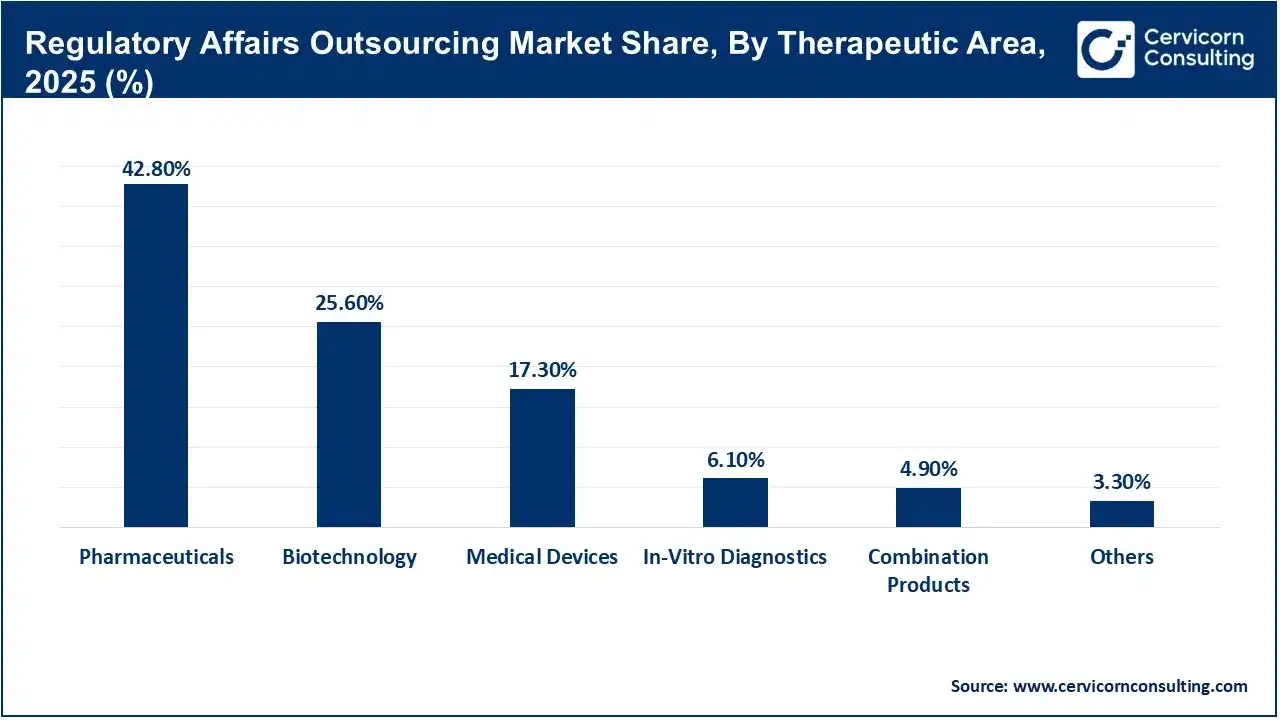
Biotechnology is the fastest-growing therapeutic area because biologics and advanced therapies involve highly specialized regulatory requirements. Developers increasingly require expertise covering biological characterization, manufacturing processes, clinical evidence, and long-term safety considerations. Cell and gene therapies can require additional regulatory interactions because of their innovative development approaches. Many biotechnology companies also operate with smaller internal regulatory teams. Outsourcing therefore provides access to specialized professionals with experience in complex biologics submissions, regulatory strategy, clinical development, and commercialization planning.
Regulatory Submission Type Analysis
New Drug Application (NDA) dominates because it represents a critical regulatory milestone for innovative pharmaceutical products seeking approval in the United States. NDA submissions require extensive clinical, pharmacological, manufacturing, safety, and labeling documentation. Preparing these submissions requires coordination among regulatory, clinical, medical, and manufacturing teams. Outsourcing providers help organize and compile complex documentation while supporting submission publishing and regulatory interactions. The continuing development of innovative medicines therefore sustains demand for specialized NDA preparation and submission-management services.
Regulatory Affairs Outsourcing Market, By Regulatory Submission Type, 2025 (%)
| Regulatory Submission Type |
Revenue Share, 2025 (%) |
| Investigational New Drug (IND) |
12.7% |
| New Drug Application (NDA) |
19.8% |
| Abbreviated New Drug Application (ANDA) |
10.4% |
| Biologics License Application (BLA) |
13.6% |
| Clinical Trial Application (CTA) |
14.9% |
| Marketing Authorization Application (MAA) |
12.2% |
| Medical Device Submissions |
8.1% |
| Post-Approval Submissions |
8.3% |
Clinical Trial Application (CTA) is among the fastest-growing submission types because multinational clinical trials increasingly require regulatory approvals across numerous jurisdictions. Each country can have different documentation, timelines, ethics requirements, and regulatory procedures. Outsourcing providers help sponsors prepare localized applications and manage amendments throughout clinical development. Increasing decentralized and technology-enabled clinical trials are also creating additional regulatory considerations. These factors are encouraging pharmaceutical and biotechnology companies to use external specialists for CTA preparation, submission coordination, and regulatory communication.
Company Size Analysis
Large Pharmaceutical & Biotechnology Companies dominate because they typically manage extensive product pipelines and regulatory operations across multiple countries. Their portfolios generate continuous requirements for clinical submissions, marketing authorizations, manufacturing changes, labeling updates, and post-approval activities. Even companies with substantial internal regulatory departments outsource specialized or high-volume activities. Outsourcing can provide additional capacity during major product launches or submission periods. Global operations also require access to regulatory specialists familiar with different jurisdictions, submission procedures, and health-authority expectations.
Regulatory Affairs Outsourcing Market, By Company Size, 2025 (%)
| Company Size |
Revenue Share, 2025 (%) |
| Large Pharmaceutical & Biotechnology Companies |
38.6% |
| Mid-Sized Pharmaceutical & Biotechnology Companies |
27.4% |
| Small & Emerging Biopharma Companies |
21.7% |
| Medical Device Companies |
12.3% |
Small & Emerging Biopharma Companies represent the fastest-growing company-size segment because emerging developers often have limited internal regulatory resources. Many focus their available capital and personnel on research, clinical development, and product innovation. External regulatory specialists can provide expertise without requiring companies to build large permanent departments. Outsourcing is particularly valuable during first-in-human studies, pivotal trials, marketing authorization preparation, and international expansion. The growing number of emerging biotechnology developers is therefore creating additional demand for flexible regulatory outsourcing models.
End User Analysis
Pharmaceutical Companies dominate the end-user segment because regulatory activities are required throughout the entire medicine lifecycle. Companies require support for clinical development, regulatory submissions, product registrations, labeling, manufacturing changes, compliance, and post-market activities. Large pharmaceutical organizations also operate across numerous geographical markets, increasing the complexity of regulatory management. Outsourcing providers can supplement internal teams with specialized expertise and additional operational capacity. This combination of extensive regulatory obligations and international operations keeps pharmaceutical companies as major users of regulatory affairs outsourcing services.
Regulatory Affairs Outsourcing Market, By End User, 2025 (%)
| End User |
Revenue Share, 2025 (%) |
| Pharmaceutical Companies |
39.7% |
| Biotechnology Companies |
24.8% |
| Medical Device Manufacturers |
15.8% |
| Contract Research Organizations (CROs) |
7.6% |
| Contract Manufacturing Organizations (CMOs/CDMOs) |
5.2% |
| Academic & Research Institutions |
4.1% |
| Others |
2.8% |
Biotechnology Companies are among the fastest-growing end users because the biotechnology pipeline increasingly includes complex biologics and advanced therapeutic products. These companies often require specialized regulatory knowledge for clinical development, manufacturing, safety evaluation, and commercialization. Smaller biotechnology organizations may not have sufficient internal regulatory personnel to manage these activities independently. Outsourcing provides access to experienced regulatory professionals and specialized submission capabilities. Increasing development of cell therapies, gene therapies, biosimilars, and other innovative biological products is further expanding regulatory outsourcing requirements within this end-user group.
Top Companies
Segments Covered
By Service Type
- Regulatory Strategy & Consulting
- Regulatory Submission & Publishing
- Regulatory Writing & Documentation
- Regulatory Intelligence
- Product Registration & Maintenance
- Regulatory Compliance & Remediation
- Others
By Therapeutic Area
- Pharmaceuticals
- Biotechnology
- Medical Devices
- In-Vitro Diagnostics
- Combination Products
- Others
By Regulatory Submission Type
- Investigational New Drug (IND)
- New Drug Application (NDA)
- Abbreviated New Drug Application (ANDA)
- Biologics License Application (BLA)
- Clinical Trial Application (CTA)
- Marketing Authorization Application (MAA)
- Medical Device Submissions
- Post-Approval Submissions
By Company Size
- Large Pharmaceutical & Biotechnology Companies
- Mid-Sized Pharmaceutical & Biotechnology Companies
- Small & Emerging Biopharma Companies
- Medical Device Companies
By End User
- Pharmaceutical Companies
- Biotechnology Companies
- Medical Device Manufacturers
- Contract Research Organizations (CROs)
- Contract Manufacturing Organizations (CMOs/CDMOs)
- Academic & Research Institutions
- Others
By Geography
- North America
- Europe
- Asia-Pacific
- LAMEA