
Content
Smart Water Meters Market Set to Expand at 8.6% CAGR Through 2035


Smart Water Meters Market Insights
The global smart water meters market size accounted at USD 7.40 billion in 2026 and is expected to surge USD 15.47 billion by 2035, growing at a CAGR of 8.6% during the forecast period of 2026-2035.
Europe led the market in 2025 because of advanced water efficiency initiatives and smart utility infrastructure. Asia-Pacific is predicted to grow rapidly during 2026-2035, driven by higher urbanization, water scarcity, and investments in modern water distribution systems.
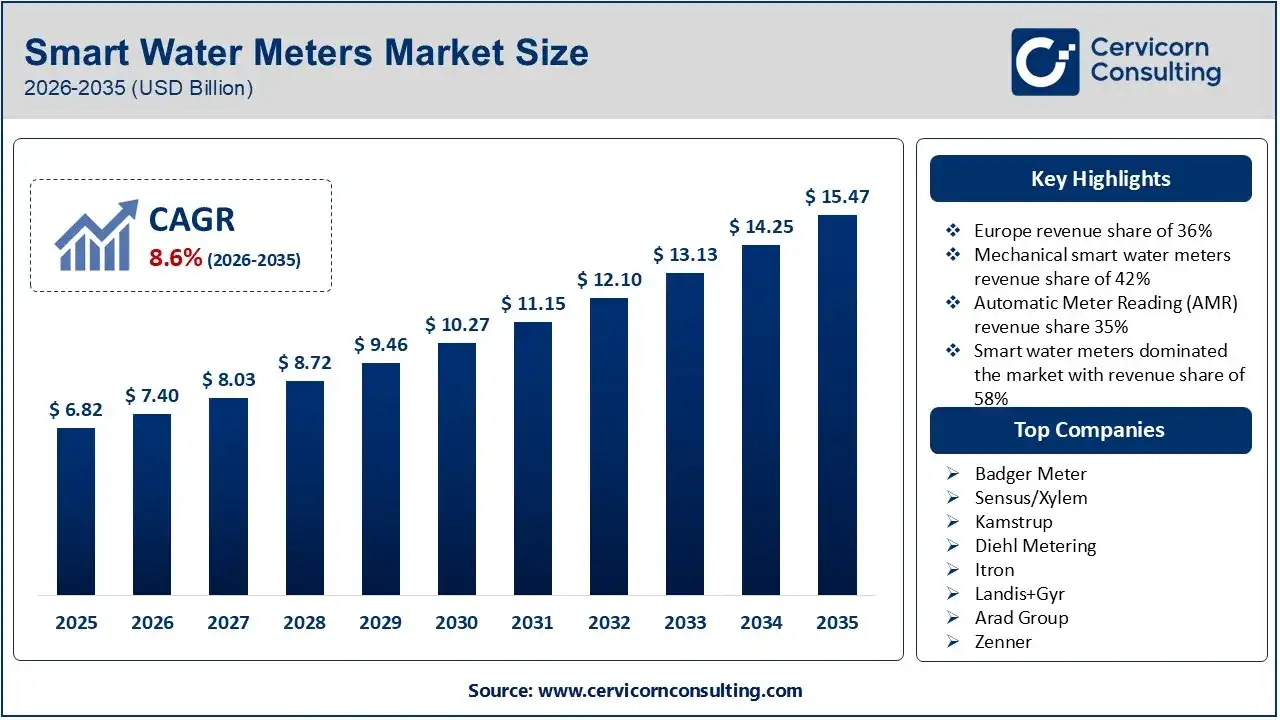
Smart Water Meters Market Overview
The global market covers an electronic device that records how much water you use and automatically shares that data in real time with utility leaders and property owners. The widespread adoption of smart water meters is mainly propelled by a rise in leak detection, prevention of water waste, and property damage. Execution of advanced devices offers two-way communication and remote reading, which removes human meter-reading labour, fuel, and transportation expenses.
Key innovations across the market focus on unification with LoRaWAN, NB-IoT, and cellular networks, enabling meters to send data wirelessly over long distances with battery lifespans reaching up to 15 years. However, gradual launches are fostering novelty in magnetic and Optical Character Recognition (OCR) camera attachments that report directly onto existing analog dial meters without the need for full pipe replacement.
How is AI Transforming the Smart Water Meters Market?
AI acts as a pivotal and revolutionary approach across the market, as AI algorithms assist in leak detection by utilizing real-time flow and pressure data to address micro-anomalies before significant bursts appear. A more specific application of AI solutions is the study of consumption patterns to highlight illegal bypasses, water theft, and meter tampering. However, novel vision-based monitoring tools, such as Aquacup’s AI OCR Smart Water Monitoring Solution, give roughly 99% accuracy in reading and digitizing legacy or mechanical water infrastructure at scale. Simultaneous unveiling of machine learning models that run sensor streams to project asset failure, led by Explainable AI (XAI) to support utility engineers' trust in automated decisions.
Regional Insight
Europe Dominated the Market in 2025
In 2025, Europe held the largest share of 36% of the smart water meters market, driven by continuous government initiatives and broader use of more granular, real-time consumption data and non-revenue water (NRW) reduction. Alongside this, European urban digitisation landscapes have pushed the successful integration of smart water infrastructure with existing smart city grids that enable utilities to investigate data alongside traffic, energy, and environmental parameters. According to a survey, UK water players planned to install or update nearly 10 million smart meters between 2025 and 2030.
Asia-Pacific is expected to be the fastest-growing region
Asia-Pacific is expected to be the fastest-growing region during the forecast period, due to growing investments in modern water distribution systems and breakthroughs in legacy mechanical pipe and meter settings. Specifically, China’s domestic producers, including Ningbo Water Meter and Suntront, are consistently fostering scale-up and broader integration of narrow-band IoT (NB-IoT) solutions, like Huawei LiteOS-assisted smart meters. On the other hand, India’s rapid growth is spurred by many government policies, such as Atal Mission for Rejuvenation and Urban Transformation (AMRUT), the Jal Jeevan Mission and many more, that continuously fund IoT and automated metering infrastructure launches to eliminate acute water scarcity. Alongside this, the Indian market is looking for manufacturing scaling, where leaders, such as HPL Electric & Power Ltd and Genus Power, are emphasizing local manufacturing capacities to supply municipal utilities heading into 2027.
Smart Water Meters Market Segmental Outlook
| Market Segment | Leading Segment | Key Growth Driver |
| By Meter Type | Mechanical smart water meters | Because of the huge installed base of conventional meters being expanded with digital capabilities. |
| By Technology | Automatic Meter Reading (AMR) | Fueled by advanced deployments and the use of walk-by or drive-by mobile collection systems and fixed-network radio waves. |
| By Component | Smart Water Meters | As they evolve into the prominent hardware of metering installations. |
| By Application | Residential Water Management | Propelled by expansive customer populations and utility-led meter replacement programs. |
Emerging Trends
- Exploring Non-Invasive Solutions: Nowadays, many utilities are skipping full-scale, capital-heavy replacements and broadly leveraging cost-effective retrofit alternatives, like camera-based Optical Character Recognition (OCR) attachments and NFC-guided add-ons to digitize analog meters.
- Launch of New Modules: In 2026, Advanced Metering Infrastructure (AMI) is rapidly progressing via affordable NB-IoT, LTE-M, and LoRaWAN modules that allow for two-way communication, real-time alerts, and remote shutoffs.
- Step Toward Non-Magnetic: The globe is fostering wider use of non-magnetic meters that utilizes ultrasonic, optical, or acoustic detection, omitting external magnet-based fraud and enhancing long-term reliability in municipal and industrial launches.
Future Outlook
The smart water meters market will have several significant opportunities; thus, the European Energy Directive (EED) implemented a goal for expansive smart energy and water meter deployment by 2027. In terms of technological advancements, Low-Power Wide-Area Network (LPWAN) solutions, such as LoRaWAN and cellular-based NB-IoT/LTE-M due to their massive expansion and low energy requirements. Prospective advances will also cover improvements in battery and lifespan by using static metering technologies and firmware enhanced for low-power sleep states. In 2027, smart water meters will reliably boost operational lifespans of 15 to 20 years, and this will ultimately eliminate capital investment in battery replacement. However, cloud-based Software-as-a-Service (SaaS) and controlled network infrastructure solutions, like network-as-a-service (NaaS) and metering-as-a-service (MaaS), are showcasing as standard utility requirements that reduce initial capital expenditures (CapEx) and allow third-party providers to handle the data pipelines, compliance, and cybersecurity.
Segments Covered
By Meter Type
- Ultrasonic Smart Water Meters
- Electromagnetic Smart Water Meters
- Mechanical Smart Water Meters with Smart Modules
- Others
By Technology
- Advanced Metering Infrastructure (AMI)
- Automatic Meter Reading (AMR)
- Cellular Communication
- Long-Range Radio and LPWAN
- Others
By Component
- Smart Water Meters
- Communication Modules
- Data Management Software
- Sensors and Control Components
- Others
By Application
- Residential Water Management
- Commercial Water Management
- Industrial Water Management
- Municipal Water Utilities
- Others
By Region
- North America
- Europe
- Asia-Pacific
- Latin America
- Middle East and Africa
Empower your strategy with expert insights, purchase this premium research@ https://www.cervicornconsulting.com/buy-now/3074
Ask here for more details@ sales@cervicornconsulting.com