
Content
Plant Growth Regulator Market Set to Exceed USD 15.34 Billion by 2035


Plant Growth Regulator Market Size and Growth Outlook 2026 to 2035
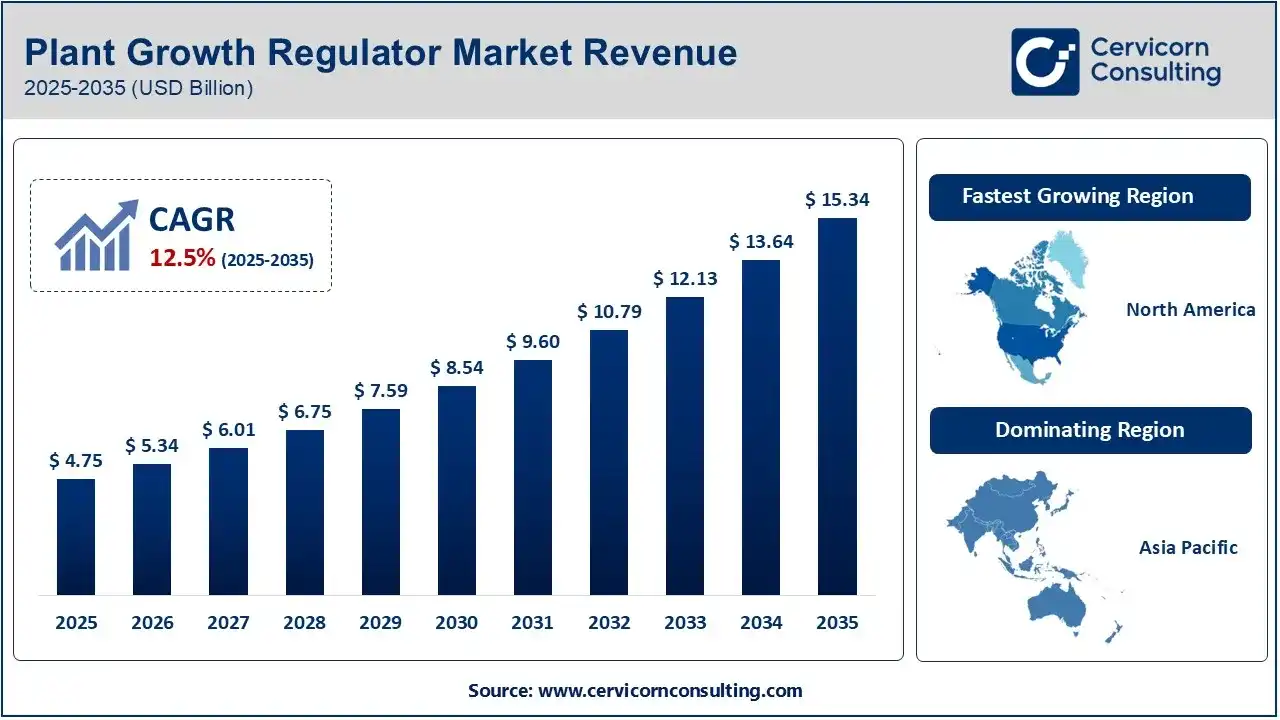
The global plant growth regulator market size valued at USD 5.34 billion in 2026 and is expected to surpass USD 15.34 billion by 2035, growing at a CAGR of 12.5% during the forecast period of 2026-2035.
Asia-Pacific dominated the market in 2025, driven by extensive agricultural activity and a rise in demand for higher crop productivity, while North America is projected to grow fastest during the forecast period, due to ongoing agricultural modernization and accelerating adoption of crop management inputs.
Different plant growth regulators (PGRs) are phytohormones or synthetic organic compounds that manage plant progression, growth, and physiological processes in limited amounts. The worldwide innovations across the market are primarily fueled by a surge in global demand to boost crop yields, enhance fruit size, and harmonise harvests. Gradually rising climate challenges, like drought, salinity, and extreme temperatures, are pushing the use of PGRs to protect plants. Meanwhile, advanced PGRs have expansive applications, such as prevention of pre-harvest fruit drop, regulation of ripening, and extension of post-harvest storage.
Most of the emerging advances are spurring digital solutions, including integrated AI, soil or crop sensors, and data analytics to lower chemical waste and improve application timing. Alongside this, broadened applications of PGRs, like brassinosteroids, jasmonic acid, and salicylic acid, are optimising plant stress tolerance, tissue culture regeneration, and post-harvest fruit quality.
AI Impact
How is AI Governing the Progression of the Plant Growth Regulator Market?
Across this highly digitalized environment, the market is also seeking the execution of generative AI and deep learning models that decode plant DNA shifts and transcription factor binding to estimate how crops respond to particular growth regulators. In addition, rapid activities and a focus on gene editing and biotech integration have encouraged the combination of AI and CRISPR-based tools to create rice and potato types with established hormonal and environmental stress tolerances. Moreover, the exploration of computer vision and AI-enabled imaging systems allows consistent monitoring of meristem dynamics, embryogenesis, and real-time physiological reactions. Simultaneously, AI solutions support guiding the allocation of sophisticated biostimulants and controlled-release compounds to stiffen crops against higher heat, salinity, and drought.
Regional Outlook
Asia Pacific Led the Market in 2025
The plant growth regulator market in Asia Pacific accounted for a dominant share of 38% in 2025, due to a substantial burden of expanding populations, growing demand for food security and notable government programs to elevate eco-friendly farming. With a key presence, China's research activities have addressed complex abscisic acid-gibberellin (ABA-GA) antagonisms and genotype-specific multi-hormonal trajectories across all rice growth phases. Meanwhile, India’s efforts have emphasized tomatoes, papayas, and sapota, aiming at optimal doses of GA₃ (75–200 ppm) to speed up flowering, mitigate unnecessary fruit drop, and increase Total Soluble Solids (TSS).
North America is Expected to be the Fastest-Growing Region
However, North America is predicted to register rapid expansion in the upcoming years, supported by continuous progress in precision agriculture and technology, coupled with a shift towards sustainable formulations. In particular, regional players are broadly advancing integrated GPS, drones, and IoT, enabling farmers to use PGRs with high spatial accuracy, improving growth cycles and lowering waste. On the implementation of the latest landscapes, Health Canada has explained safety and notification pathways for plants with novel traits (PNTs) and advanced agricultural biotechnology, which support safe growth-regulating breakthroughs to reach Canadian farms rapidly.
Plant Growth Regulator Market Segmental Outlook
| Market Segment | Leading Segment | Key Growth Driver |
| By Product Type | Cytokinins | Propelled by their pivotal role in cell division, shoot development, and delaying leaf senescence. |
| By Function | Growth Promoters | Led by their widespread use to assist crop development and productivity. |
| By Form | Liquid | Due to ease of application, constant coverage, and compatibility with foliar spraying. |
| By Crop Type | Fruits and Vegetables | Driven by surged demand for improved fruit setting, size, quality, and shelf life. |
Emerging Trends
- Innovative Regulators: The global research sector is moving towards next-generation molecules, including brassinosteroids to enhance pollen viability, salicylic acid to prevent oxidative stress and fruit drop, polyamines, and jasmonates.
- Blend of Networks: Nowadays, researchers are increasingly advancing mixtures of synergistic PGR networks to improve root architecture and maximize antioxidant defense systems against changing environmental stressors.
- Novelty in Techniques: Recent advances are launching new approaches, like smart nano-formulations, advanced seed priming, and target-specific delivery systems, ensuring that the regulators connect only with designated plant tissues at the actual physiological stage needed.
Future Glimpse
The plant growth regulator market will have notable progression in the prospective era, as numerous farmers are seeking the application of auxins, gibberellins, and cytokinins to enhance crop yields by reducing synthetic chemical inputs and heavy water use. Furthermore, future opportunities will embrace anti-stress regulators, like abscisic acid (ABA) and salicylic acid, which are observing massive adoption to support crops survive drought, high salinity, and increased temperatures. Ongoing expansion of innovative delivery systems will drive seed-applied PGRs and smart release matrices, improving field reliability and mitigating non-uniform outcomes across diverse soil varieties. Additionally, the market is experiencing a strong consumer preference for organic produce and quality fruit or vegetable sizing, which expedites the integration of natural or bio-based PGRs and seaweed extract.
Segments Covered
By Product Type
- Auxins
- Gibberellins
- Cytokinins
- Ethylene-Releasing Compounds
- Abscisic Acid and Other Plant Growth Regulators
By Function
- Growth Promoters
- Growth Inhibitors
- Plant Growth Retardants
- Stress-Tolerance Regulators
- Ripening and Maturation Regulators
By Form
- Liquid
- Water-Soluble
- Powder and Granules
- Other Formulations
By Crop Type
- Fruits and Vegetables
- Cereals and Grains
- Oilseeds and Pulses
- Turf and Ornamentals
- Other Crops
By Region
- Asia-Pacific
- North America
- Europe
- Latin America
- Middle East and Africa
Empower your strategy with expert insights, purchase this premium research@ https://www.cervicornconsulting.com/buy-now/3072
Ask here for more details@ sales@cervicornconsulting.com