
Content
Direct-to-Chip Liquid Cooling Market is Expected to Reach USD 22,734.70 Million by 2035


Direct-to-Chip Liquid Cooling Market Size and Outlook 2026 to 2035
The global direct-to-chip liquid cooling market size was valued at USD 2,202.26 million in 2025 and is expected to reach USD 22,734.70 million by 2035, growing at a CAGR of 24.5% during the forecast period from 2026 to 2035.
North America held a major share of 41% of the market in 2025, driven by rising hyperscale & cloud infrastructure, while Asia Pacific is expected to grow fastest due to the existence of domestic semiconductor ecosystems and ongoing efforts toward sustainability regulations.
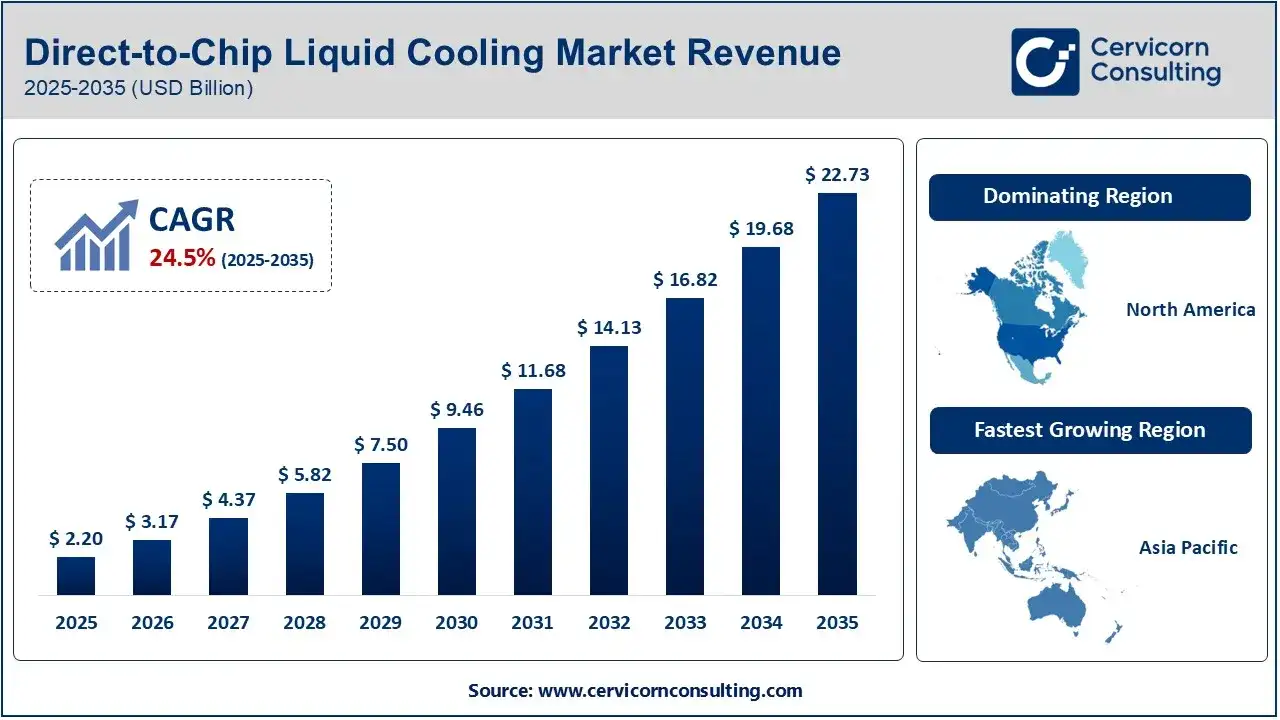
The market encompasses a thermal management approach that eliminates heat from high-power processors and circulates liquid coolant through metal cold plates fixed directly onto chips, including CPUs and GPUs. Steady market growth is primarily propelled by substantial expansion of AI, machine learning, and high-performance computing (HPC), along with rapid and highly efficient heat transfer. Emerging developments are allowing integration of D2C loops with intelligent control software and waste-heat reuse, fueling data center Power Usage Effectiveness (PUE) down below 1.05.
AI Impact
Nowadays, industry leaders are widely promoting the use of AI and generative algorithms that create custom internal channel geometries inside cold plates and will significantly redistribute cooling capacity, reducing average chip temperatures by over 5°C. Additionally, the emergence of AI models evaluates telemetry for drastic adjustment of pump speeds and Coolant Distribution Unit (CDU) output. Furthermore, AI solutions support modelling complex thermodynamic phase transitions to maintain safe case temperatures, although densities scale up to 170–200 kW per rack.
Regional Outline
North America Led the Market in 2025
North America registered dominance with 41% of the direct-to-chip liquid cooling market in 2025, supported by a robust presence of AI platforms and consistent progression of hyperscale and cloud approaches. Recently, CoolIT Systems showcased the industry's first 15 kW cold plate design that provides roughly four times the thermal capacity of earlier single-phase designs and extends the viable pathway for water-based DTC cooling well beyond 2030 for ultra-dense GPUs. However, major U.S. efforts have fostered innovative cold plate designs that join copper microchannels with synthetic diamond bases to achieve up to five times the thermal conductivity of pure copper, and this will allow U.S. facilities to remove energy-intensive chillers.
Asia Pacific is projected to expand at the fastest CAGR
Moreover, Asia Pacific is projected to expand at the fastest CAGR of 26.9% in the direct-to-chip liquid cooling market during the forecast period, driven by growing investments in data centers and emerging government initiatives. In Addition, China, Japan, South Korea, and Taiwan are boosting their local production, cold-plate, and server supply base. Specifically, Chinese operators are strengthening dual-phase immersion cooling pods and large-scale undersea or submerged data center modules.
According to recent announcements, India’s NSE allocated direct-to-chip liquid cooling in its on-premises data centre, highlighting a first for Indian capital markets to control over 80 and scale up to 224 high-density GPUs.
Direct-to-Chip Liquid Cooling Market Segmental Outlook
| Market Segment | Leading Segment | Key Growth Factor |
| By Component | Services | Surging customization, modularization and a lack of a specialised workforce. |
| By Cooling Mechanism | Single-Phase Direct-To-Chip | Due to its simplicity and minimal requirement of capital and operational expenditures. |
| By Heat Capture Configuration | Hybrid | Led by expanding processor heat density and its targeted thermal management. |
| By Rack Power Density | 50 to below 100 kW per rack | Supported by broadened chip power density and increasing need for the elimination of traditional air-cooling concerns. |
| By Processor/Device Cooled | GPUs & AI Accelerators | Driven by accelerating TDP and mandatory requirements from chip vendors, with an emphasis on digital twins. |
| By Data Center Type | Hyperscale & Cloud (Incl. AI Neoclouds) | Fueled by growing next-generation GPU compatibility and progress in sustainable measures. |
| By Deployment Type | New-Build | Because of its modular and reference architectures, along with a focus on full space optimization. |
| By End-Use Industry | IT & Telecommunications | Propelled by a massive rise in globally advanced data centers and strengthening AI-enabled hardware solutions. |
Emerging Trends
- Executing Pre-Unified Approach: Day by day, many OEM server vendors are widely delivering AI-ready infrastructure with direct-to-chip systems pre-installed, which lowers implementation bottlenecks and deployment timelines for hyperscalers.
- Increasing Innovations: The market is increasingly pushing single-phase direct-to-chip systems, along with next-generation two-phase and waterless boiling-fluid solutions, like those from ZutaCore at NVIDIA GTC 2026.
- Exploration of Novel Designs: Global demonstration of microfluidic and 3D-printed manifold designs that insert coolant uniformly across silicon dies to manage exceptional thermal fluxes without suppression.
Future Outlook
The direct-to-chip liquid cooling market is growing notably, which will create key opportunities in the latest AI architectures to exceed 600 kW per rack and make conventional air-to-liquid and standard air cooling physically outdated for high-performance nodes. On the other hand, a substantial transition towards two-phase DTP approaches will boost commercial production and control thermal design power (TDP) rising past 1500W. Many pioneers are seeking hybrid bonding and chip-level integration for excellent thermal resistance, while vendors are pushing the deployment of waterless or low-water-consumption phase-change architectures to reduce PUE (Power Usage Effectiveness) and water waste in data center.
Segments Covered
By Component
- Cold Plates
- Coolant distribution units (CDUs)
- Rack manifolds, quick disconnects & secondary fluid network
- Heat rejection & facility water integration
- Coolants (water-glycol, dielectric fluids)
- Services (design, installation, maintenance, monitoring)
By Cooling Mechanism
- Single-phase direct-to-chip
- Two-phase direct-to-chip
By Heat Capture Configuration
- Hybrid (liquid for processors, air for remaining components)
- Full liquid capture (near-100% of rack heat)
By Rack Power Density
- Below 50 kW per rack
- 50 to below 100 kW per rack
- 100 to below 200 kW per rack
- 200 kW per rack and above
By Processor/Device Cooled
- GPUs & AI accelerators
- CPUs
- Others (memory, network switch ASICs, power electronics)
By Data Center Type
- Hyperscale & cloud (incl. AI neoclouds)
- Colocation
- Enterprise
- HPC & research/supercomputing centres
- Edge & others
By Deployment Type
- New-Build
- Retrofit
By End-Use Industry
- IT & telecommunications (incl. cloud and AI service providers)
- BFSI
- Government & defence (incl. national laboratories)
- Healthcare & life sciences
- Manufacturing & automotive
- Energy & utilities
- Others (retail, media, education)
By Region
- North America
- Europe
- Asia-Pacific
- Latin America
- Middle East and Africa
Empower your strategy with expert insights, purchase this premium research@ https://www.cervicornconsulting.com/buy-now/3097
Ask here for more details@ sales@cervicornconsulting.com