Direct-to-Chip Liquid Cooling Market Size and Forecast 2026 to 2035
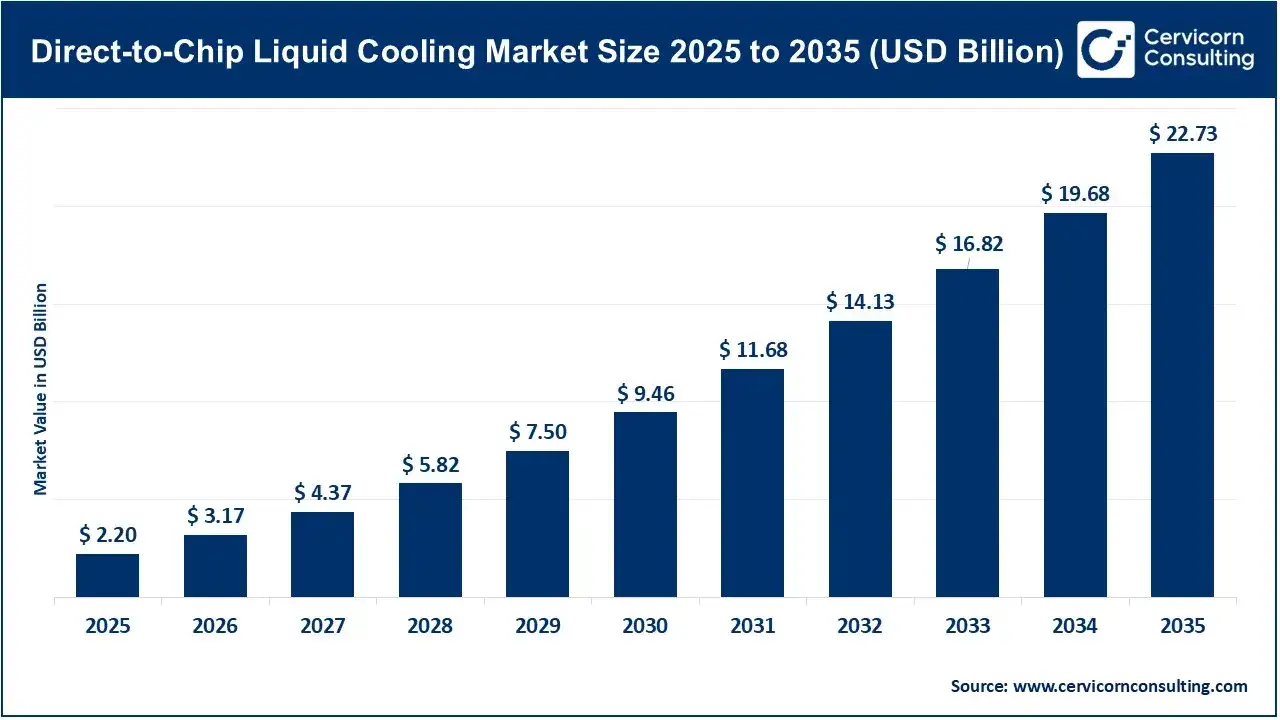
The global direct-to-chip liquid cooling market size was estimated at USD 2.2 billion in 2025 and is expected to exceed USD 22.73 billion by 2035, growing at a CAGR of 24.5% during the forecast period of 2026-2035. Globally, growing AI and high performance computing (HPC) workloads, along with rising chip thermal design power (TDP), are fueling market growth. The market offers substantial energy efficiency and lower power usage effectiveness (PUE), which forces data centers to adopt direct-to-chip liquid cooling approaches.
Report Highlights
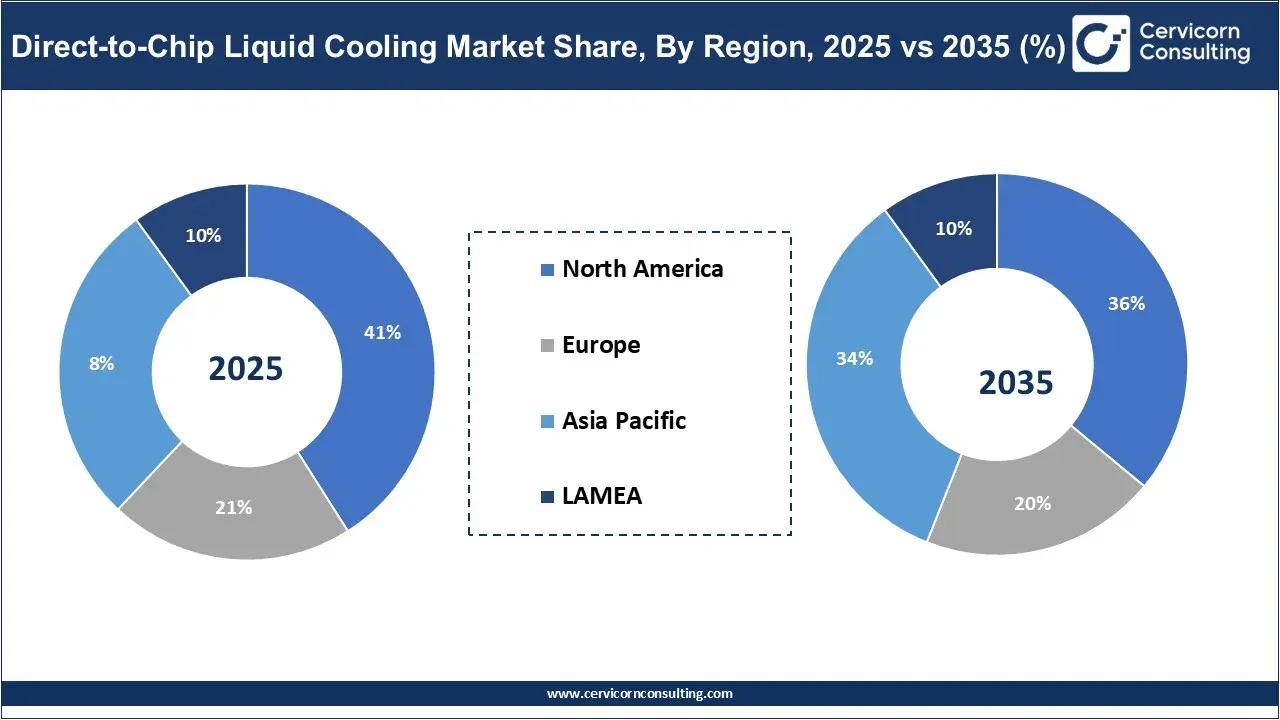
- By region, North America led with a 41% share of the market in 2025, due to surging hyperscale & cloud infrastructure, along with a rise in government and regulatory frameworks.
- By component, services held a dominant share of 25% in 2025, driven by growing demand for customization, modularization, and a lack of specialized staff.
- By cooling mechanism, single-phase direct-to-chip dominated with an 85% share of the market in 2025, as they offer simplicity, robustness, and requires minimal capital and operational investments.
- By heat capture configuration, hybrid was dominant with an 80% share in 2025, supported by increasing processor heat density and the need for targeted efficiency.
- By rack power density, 50 to below 100 kW per rack accounted for a major share of 38% in 2025, powered by higher chip power density and a rise in regulatory and sustainability stress.
- By processor/device cooled, GPUs & AI accelerators led with a 62% share in 2025 because of expanding thermal design power (TDP) per chip and increased demand for superior heat transfer solutions.
- By data center type, hyperscale & cloud (incl. AI neoclouds) dominated with a 52% share of the market, led by soaring latest AI hardware and silicon densities.
- By deployment type, new-build was dominant with a 64% share of the market in 2025, driven by its streamlined infrastructure and widespread advantages, like improvements in ultra-high rack densities.
- By end-use industry, IT & telecommunications captured a 48% share of the market in 2025, propelled by exceptional thermal demand for sophisticated hardware and a major surge in AI factories and data centers.
What is the Direct-to-Chip Liquid Cooling Market?
It is a thermal management technology that fixes metal cold plates directly onto computer processors to circulate a liquid coolant and eliminate heat at the source. Gradual, steady expansion of the market is primarily fueled by accelerating chip power densities to resolve the aggressive rise in heat flux and significant bottlenecks of traditional air cooling. Nowadays, market firms are looking for a necessary engineering standard as artificial intelligence (AI) and high-performance computing (HPC) chip powers grow past 1,000W to 4,000W+ per processor.
Recent Announcements
- November 2026: The National Stock Exchange of India (NSE) deployed Direct-to-Chip Liquid Cooling (DCLC) technology in its on-premises data centre to support its increasing artificial intelligence (AI) workloads and will accommodate up to 224 GPUs as the exchange strengthens its AI computing capacity.
- October 2026: Vertiv deployed India’s first direct-to-chip high-density liquid cooling (HDLC) system at the CLDC Mumbai 01 Data Centre in Airoli, Navi Mumbai, in alliance with CapitaLand India Trust (CLINT).
- September 2026: ZutaCore partnered with Options Technology to facilitate liquid cooling to financial services.
- August 2026: Accelsius placed its commercial IR150, the industry’s first fully integrated IT rack plus CDU, at the EdgeConneX Global Training Center in Houston, Texas.
Direct-to-Chip Liquid Cooling Market Dynamics
Growth Drivers
- Bolstering AI & Gen AI Measures: Nowadays, rapid computing workloads for artificial intelligence, machine learning, and large-scale simulations are experiencing the need for chip thermal design power (TDP) to overcome conventional limitations.
- Reduction in PUE: Gradually advancing data centers face massive regulatory and corporate pressure to lower electricity use and carbon footprints, where DTP liquid cooling dynamically eliminates the energy essentials needed by vast CRAC units.
Market Restraints
- Skyrocketing Retrofit and Deployment Expenses: Advancement across existing data center infrastructure with cold plates, Coolant Distribution Units (CDUs), and specialized plumbing demands huge upfront costs, which makes short-term adoption unaffordable for enterprise and colocation providers.
- Concerns in Air-Cooled Entities: Rigorous development of legacy data centers for air conditioning, where retrofitting them to manage hybrid or full liquid loops requires complex engineering redesigns and operational shifts.
Key Opportunities
- Broadening Over CPUs & GPUs: Day by day, the market is expanding the scope of liquid cooling from main processors to peripheral components inside servers, such as DIMMs, SSDs, PCI, SFPs, and bus bars, which spurs server cooling coverage from 50–70% to roughly 100% via complex cooling loop architectures.
- Novelty in Microchannel: A shift from well-established single-phase cold-plate systems to two-phase direct-to-chip designs and microchannel heat exchangers provides outstanding thermal dissipation for high-density compute nodes.
Market Challenges
- Restricted Standardization: The market is still emerging with design benchmarks, resulting in proprietary and incompatible cold plates, manifolds, and connectors from distinct manufacturers that complicate multi-vendor data center integration.
- Issues Related to Reliability: The rollout of pressurized liquids near high-value electronic components raises continuous anxiety over seal degradation, micro-leaks, and catastrophic hardware damage.
Direct-to-Chip Liquid Cooling Market Regional Analysis
How did North America Dominate the Market in 2025?
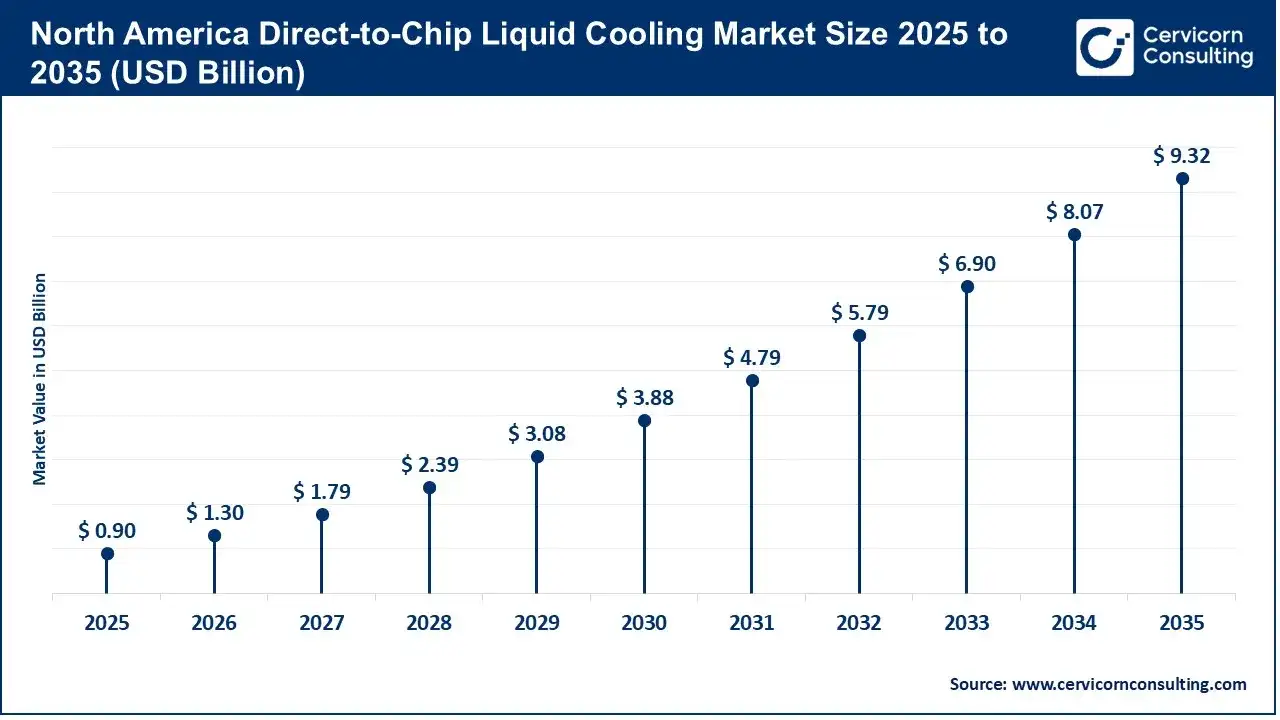
The North America direct-to-chip liquid cooling market size was estimated at USD 0.90 billion in 2025 and is expected to surpass USD 9.32 billion by 2035. North America accounted for a dominant share of 41% in 2025, propelled by wider adoption of liquid-cooled racks by AI campuses and the advanced presence of data centers. Alongside this, enforcement of rigorous energy-efficiency regulations and carbon-reduction targets and broader waste heat recovery integration, is supporting the regional progress. With the evolution of next-generation dielectric fluids, the region has enhanced integration of real-time machine learning and AI algorithms to drastically adjust pump speeds, coolant manifold routing, and heat exchanger performance based on live workload spikes.
United States Market
- The U.S. held the largest share of the market in 2025, motivated by notable growth in high-capacity coolant distribution units (CDUs) and expansive demand for AI-powered measures. The leading companies in the U.S. strengthened local production and manufacturing of high-capacity CDUs, especially in Carrollton, Texas. Besides this, eminent producers integrated thermal engineering directly into microprocessor lids and microchannel designs to lower thermal resistance.
Why is Asia Pacific Projected to Expand Fastest in the Market?
The Asia-Pacific direct-to-chip liquid cooling market size was valued at USD 0.62 billion in 2025 and is projected to hit USD 6.36 billion by 2035. Asia Pacific is predicted to expand at a rapid CAGR of 26.9% in the upcoming years, supported by the widespread AI capacity, particularly in China, Japan, Singapore, Malaysia (Johor), India and Australia. China’s robust hyperscale data centers and the execution of state policies supporting local semiconductor manufacturing. Meanwhile, Japanese electronics and automation firms are intensively joining with global chip designers to combine microfluidic channels and custom cold-plate interfaces straight onto high-TDP processor packages.
Singapore Market
- Recently, Singapore introduced SS 726:2026 that offers technical assistance for direct-to-chip and absorption cooling systems customized to high ambient temperatures and humidity. Alongside this, Nxera placed well-established modern AI compute infrastructure, with direct-to-chip liquid cooling, at its new data centre facility in Tuas.
Direct-to-Chip Liquid Cooling Market Segmentation Analysis
Component Analysis
Services: The services (design, installation, maintenance, monitoring) segment accounted for the largest share of 25% in 2025 and is expected to grow rapidly at a 26.2% CAGR, motivated by growth in modularization and a shortage of a well-qualified workforce. Key advances like the shift towards the latest cold plate, manifold engineering, and predictive maintenance platforms pushed the segmental dominance.
The cold plates segment captured the second-largest share of 24% in 2025, supported by their exceptional thermal conductivity and massive compatibility for present server facilities. Recently, researchers explored integrated AI topology optimization with electrochemical additive production to 3D-print pure-copper cold plates with sub-100 µm microscopic jagged fins.
Cooling Mechanism Analysis
Single-Phase Direct-To-Chip: The single-phase direct-to-chip segment led with an 85% share of the direct-to-chip liquid cooling market in 2025, due to its feasibility and minimal need for upfront and operational expenditures. Most efforts across the industry are boosting this mechanism to assist next-generation processors and compact AI racks surpassing 100 kW to 250 kW.
The two-phase direct-to-chip segment is predicted to expand at 30.9% CAGR during 2026-2035, propelled by its phase-change thermal efficiency and crucial reduction in coolant flow rates. Certain research activities addressed direct-on-die two-phase solutions that minimise case-to-fluid thermal resistance, allowing cooling distribution units (CDUs) to run at higher facility water temperatures (60–70 °C).
Heat Capture Configuration Analysis
Hybrid: The hybrid (liquid for processors, air for remaining components) segment captured a dominant share of 80% in 2025, due to rising processor heat density and their concentrated thermal management. However, execution of retrofitting hybrid direct-to-chip loops enables data centers to operate reliably beyond standard ASHRAE limits, while substantially lowering core CPU temperatures.
The full liquid capture (near-100% of rack heat) segment is projected to witness rapid expansion at a 30.9% CAGR in the upcoming years, driven by broadening cloud plate solutions and challenges in hybrid air-cooling sets. Some solutions are advancing direct water cooling past primary CPUs and GPUs to comprise power supplies, memory, I/O, storage, and voltage regulators, which allows completely fanless, near-100% rack heat capture.
Rack Power Density Analysis
50 to below 100 kW per rack: The 50 to below 100 kW per rack segment dominated with a 38% share of the market in 2025, because of increased chip power density and key replacement of traditional air-cooling approaches. Eventual breakthroughs encouraged modern 50–100 kW deployments that employ a hybrid model where D2C control nearly 80% of the thermal load while complementary air or rear-door components handle the remainder.
Direct-to-Chip Liquid Cooling Market Share, By Rack Power Density, 2025 (%)
| Rack Power Density |
Revenue Share, 2025 (%) |
Revenue Share, 2035 (%) |
| Below 50 kW per rack |
22% |
6% |
| 50 to below 100 kW per rack |
38% |
22% |
| 100 to below 200 kW per rack |
30% |
38% |
| 200 kW per rack and above |
10% |
34% |
The 200 kW per rack and above segment is anticipated to expand at a 37% CAGR during the forecast period, fueled by a higher thermal intensity of next-generation AI and high-performance computing hardware. According to several entities, the deployment of closed-loop, waterless direct-to-chip systems handles up to 200 kW per rack while saving millions of gallons of water per year compared to evaporative towers.
Processor/Device Cooled Analysis
GPUs & AI Accelerators: The GPUs & AI accelerators segment accounted for a major share of 62% of the direct-to-chip liquid cooling market in 2025 & is predicted to expand at 23.9% CAGR, motivated by booming TDP and mandatory requirements from chip entities. Modern D2C deployments are unifying sensor networks with digital twin models and AI algorithms that simulate real-time telemetry from the cooling loops to estimate pump degradation, micro-leaks, and pipe blockages up to 24 hours.
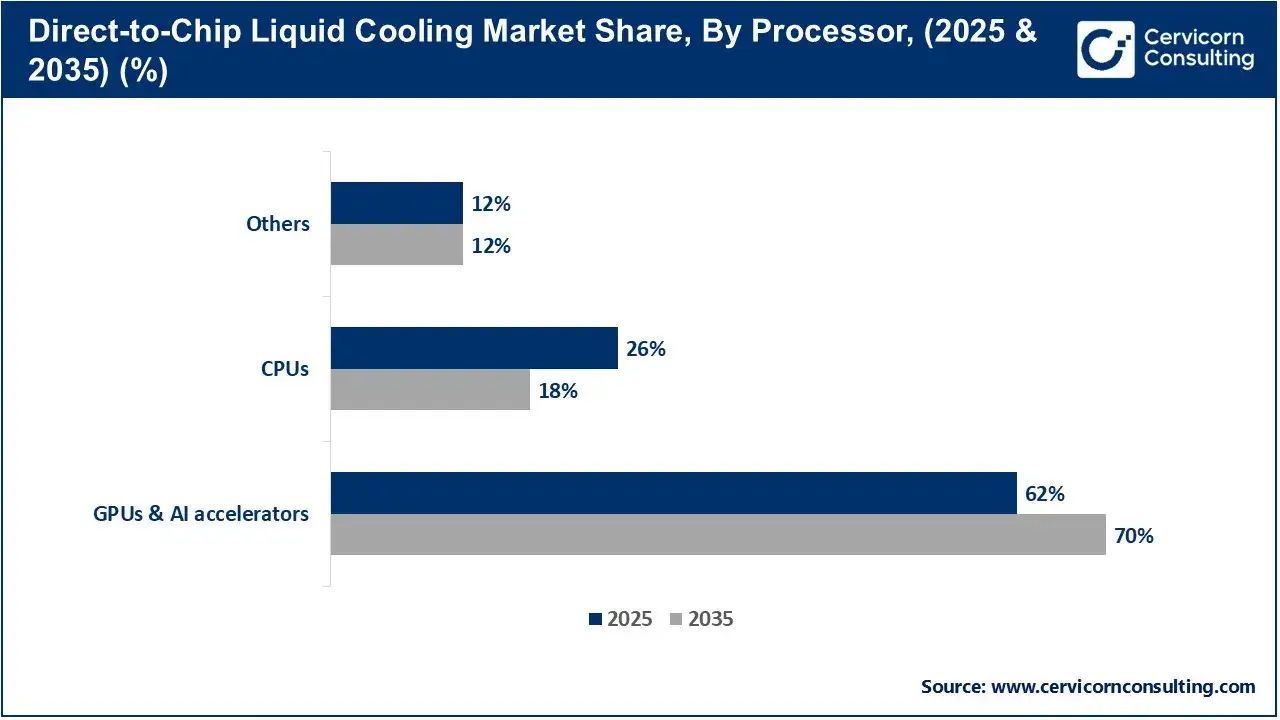
Moreover, the CPUs segment held the second-largest share of 26% in 2025, driven by the physical challenges of silicon and increasing energy limitations. Recently, Microsoft introduced a prototype system that etches hair-thin microchannels directly into the back of the silicon chip by leveraging AI to address chip heat signatures into biomimetic, leaf-vein-style grooves.
Data Center Type Analysis
Hyperscale & Cloud (Incl. AI Neoclouds): The hyperscale & cloud (incl. AI neoclouds) segment led with a 52% share of the market, supported by surging next-generation GPU favourability and stepping into eco-friendly solutions. Ongoing innovations cover deployed intelligent CDUs that offer dynamic flow regulation, real-time differential pressure monitoring, and N+1 pump redundancy.
Direct-to-Chip Liquid Cooling Market Share, By Data Center Type, 2025 (%)
| Data Center Type |
Revenue Share, 2025 (%) |
Revenue Share, 2035 (%) |
| Hyperscale & cloud |
52% |
50% |
| Colocation |
24% |
27% |
| Enterprise |
12% |
10% |
| HPC & Research/Supercomputing Centres |
9% |
6% |
| Edge & others |
3% |
7% |
The edge and other segments are expected to be the fastest-growing at a 32.7% CAGR in the predicted timeframe, fueled by the existence of massive liquid-cooled edge AI and modular data centers. Many centers are focusing on localized AI inference and often cross the critical approximately 75–100 kW rack threshold, which supports cold plates and rear-door or direct liquid loop.
Deployment Type Analysis
New-Build: The new-build segment held the largest share of the market at 64% in 2025, driven by its modular and standardized architectures and full space optimization. In 2025, greenfield deployments explored direct heat-rejection loops that overcome traditional Cooling Distribution Units (CDUs) or move to high-efficiency liquid-to-liquid CDUs and enable higher operating water temperatures and minimal PUE.
The retrofit segment is projected to grow at a rapid CAGR of 23.8% during 2026-2035 because of CapEx savings and reducing embodied carbon. In this era, the industry is implementing two-phase direct-to-chip cooling that showcases substantial thermal gains, coupled with expansive use of warm coolant.
End-Use Industry Analysis
IT & Telecommunications: The IT & telecommunications (incl. cloud and AI service providers) held a 48% share of the market in 2025, due to bolstering AI-assisted hardware and notable failure of traditional air-cooling. Breakthroughs encompass NVIDIA's GB200 NVL72 and GB300 NVL72 architectures, standardized closed-loop direct-to-chip liquid cooling, and diamond-copper hybrid cold plates, supporting prospective emerging AI clusters.
The others (retail, media, education) are estimated to expand at a 24.9% CAGR in the market in the coming years, driven by vast customer data, live inventory updates, predictive behavior analytics, and advanced supply chain solutions. Day by day, universities are employing waterless or closed-loop direct-to-chip solutions to record server waste heat and reroute it into campus district heating systems, coordinating high-performance research with university decarbonization aims.
Latest Launches
- November 2026: GF unveiled the Multi Control Valve, an integrated polymer flow control device to complete its LiquidCore portfolio for direct liquid cooling applications in high-density data centres.
- November 2026: Parameter rolled out the XD Series for RLE Leak Detection, a digital leak-detection platform purpose-built for liquid-cooled data centers.
- November 2026: The Chemours Company introduced Faizeon two-phase liquid cooling solutions, specifically for AI, high-performance computing (HPC), and high-density data centers.
- September 2026: UL Solutions Inc. launched a certification program for liquid cooling subassemblies that emphasize advanced chips, offering more effective cooling in AI data centers and other high-density computing systems.
- June 2026: JetCool unveiled a liquid-cooled version of the Dell PowerEdge XE7745 server to speed up enterprise AI adoption.
Upcoming Prominent Industry Events in 2027
| Event |
Dates |
Focus On |
| ISH 2027 |
15–19 March 2027 |
It is the world's key trade fair for water, heating, and air, and will offer solution fields for water-bearing systems, heat generation, and direct liquid/liquid-to-liquid cooling technologies for next-generation data centers. |
| SEA DCC Summit 2027 |
15–16 March 2027 |
This will consolidate regional players to highlight AI-ready data center thermal management, PUE/WUE optimization, and tropical liquid cooling adoption. |
| Bangkok RHVAC Trade Show |
April 2027 |
It is aimed at high-density thermal management and liquid/immersion cooling to help Thailand's rapid AI infrastructure buildout. |
Key Players
Segments Covered
By Component
- Cold Plates
- Coolant distribution units (CDUs)
- Rack manifolds, quick disconnects & secondary fluid network
- Heat rejection & facility water integration
- Coolants (water-glycol, dielectric fluids)
- Services (design, installation, maintenance, monitoring)
By Cooling Mechanism
- Single-phase direct-to-chip
- Two-phase direct-to-chip
By Heat Capture Configuration
- Hybrid (liquid for processors, air for remaining components)
- Full liquid capture (near-100% of rack heat)
By Rack Power Density
- Below 50 kW per rack
- 50 to below 100 kW per rack
- 100 to below 200 kW per rack
- 200 kW per rack and above
By Processor/Device Cooled
- GPUs & AI accelerators
- CPUs
- Others (memory, network switch ASICs, power electronics)
By Data Center Type
- Hyperscale & cloud (incl. AI neoclouds)
- Colocation
- Enterprise
- HPC & research/supercomputing centres
- Edge & others
By Deployment Type
By End-Use Industry
- IT & telecommunications (incl. cloud and AI service providers)
- BFSI
- Government & defence (incl. national laboratories)
- Healthcare & life sciences
- Manufacturing & automotive
- Energy & utilities
- Others (retail, media, education)
By Region
- North America
- Europe
- Asia-Pacific
- Latin America
- Middle East and Africa
