
Content
Biometric Payment Market Set to Triple by 2035


Biometrics Payment Market Size and Growth 2026 to 2035
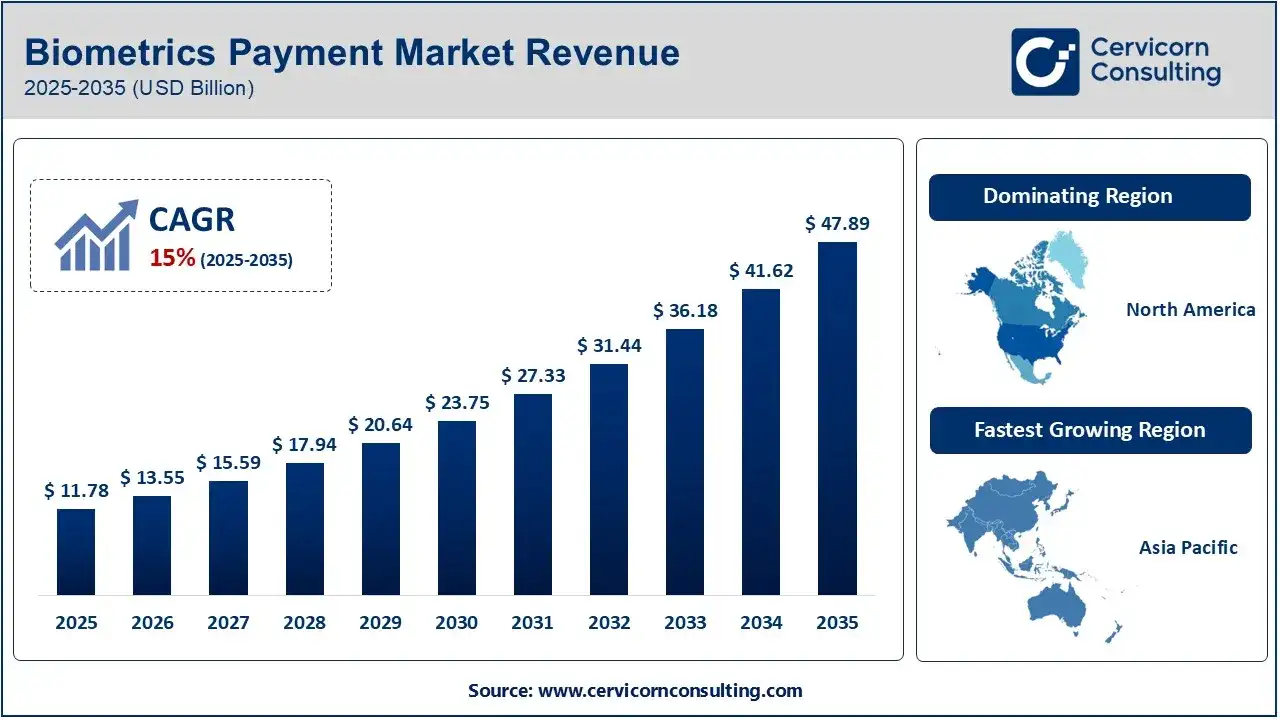
The global biometrics payment market size accounted at USD 13.55 billion in 2026 and is expected to reach USD 47.89 billion by 2035, growing at a CAGR of 15% during the forecast period from 2026 to 2035.
North America dominated the market in 2025, supported by growing cybersecurity threats and accelerating demand for contactless transactions, whereas Asia Pacific is expected to witness rapid expansion in the upcoming years, due to broader smartphone penetration, advanced national incentives, and expansive adoption of super-apps.
Biometrics Payment Market Overview
The market is primarily referred to as a financial transaction that is authenticated by leveraging a customer’s specific physical or biological traits, like a fingerprint, face, iris, voice, or palm vein, rather than a traditional password, PIN, or signature. The worldwide advancements across the industry are prominently fueled by a surge in demand for improved security and fraud prevention by detecting theft, skimming, and unauthorised use. Most of the consumer demands are inclining toward contactless and digital payments, such as tap-to-pay and pay-by-face or pay-by-palm solutions, mainly in retail and e-commerce sectors.
However, eventual breakthroughs are pushing wider adoption of smartphones and wearables with built-in fingerprint readers and 3D facial recognition. This further enables approved mobile wallets and banking apps to work seamlessly.
What are the Main AI Solutions in the Biometrics Payment Market?
Artificial intelligence and its relevant approaches are broadening, with significant prospective growth in the market. Certainly, systems are aiming at a combination of physical traits with secondary characteristics, such as dual-stream CNN (Convolutional Neural Network) periocular mapping to confirm high accuracy in complex lighting or cramped circumstances. Moreover, AI models are widely supporting the analysis of typing rhythms, device interactions, and movement patterns in the background to examine identity consistently across a session. On the other hand, machine vision solutions are offering records of subcutaneous vein patterns from palm streams to develop nonreplicable digital signatures for retail and self-checkout systems.
Regional Outlook
North America Led the Market in 2025
North America captured the largest share of the biometrics payment market in 2025, fueled by broader penetration of smartphone-based enrolment and higher use of battery-less smart card architectures. Specifically, U.S. payment providers are heavily employing facial recognition and biometric software directly in merchant networks, as SoftPoint joined with BigBear.ai to unify Trueface technology into retail payment systems. However, Canada has a massive population of younger demographics aged 18–34, and national incentives are increasingly transforming domestic banking innovation and open banking ecosystems, developing built-in integration points for biometric checks.
Asia Pacific is projected to witness rapid expansion
Asia Pacific is projected to witness rapid expansion during the forecast period, supported by the removal of AI-powered cyber threats and boosting national digital identity landscapes. Countries like China are increasingly investing in palm-vein and palm-geometry recognition systems to allow instant pay and eliminate the need for phones, wallets, and cards. Besides this, India has advanced Biometric Payment Passkeys to overcome traditional OTP workflows for e-commerce and agent-led transactions.
Biometrics Payment Market Segmental Outlook
| Market Segment | Leading Segment | Market Share in 2025 | Key Growth Driver |
| By Biometric Modality | Fingerprint Recognition | 45% | Propelled by broader deployment in payment cards, smartphones, and point-of-sale authentication. |
| By Payment Type | In-Store Payments | 30% | Supported by expansive adoption of biometric point-of-sale terminals and contactless checkout approaches. |
| By Component | Hardware | 42% | Due to the major role of biometric sensors, readers, terminals, and secure payment devices. |
| By End User | Banking and Financial Institutions | 35% | Fueled by a surge in demand for secure customer authentication and fraud prevention. |
Emerging Breakthroughs
- Implementing Eminent 2FA: Many of the regulatory modifications made by agencies, such as the Reserve Bank of India, necessitate robust two-factor authentication (2FA) for digital payments, where at least one factor must be biometric, like live in-app facial or fingerprint scans.
- Exploring Multi-Modal Solutions: Nowadays, authentication engines are integrating convolutional neural networks (CNNs), deep neural networks, and recurrent neural networks (RNNs) for multi-modal biometric data fusion that significantly reduces false-rejection rates in messy, real-world circumstances.
- Transformative POS Systems: Recent developments are shifting towards the latest point-of-sale (POS) systems and enterprise resource planning (ERP) approaches that widely assist in contactless palm recognition and device-bound biometric passkeys.
Future Outlook
The biometrics payment market will bolster novelty in the upcoming years, especially by unfolding remote mobile and e-commerce payments. In such cases, the market will strengthen advanced biometric verification by leveraging facial and fingerprint recognition. In 2027, many financial institutions are introducing integrated, cross-channel biometric authentication systems to protect accounts across mobile, ATM, and online banking. Furthermore, substantial national landscapes are formally seeking to replace legacy security parameters with biometric architecture. There will be another opportunity called voice biometrics, which is used in voice assistants, coupled with innovative systems that examine continuous data variables, including touch pressure, scroll behavior, and device typing cadence. Global eminent air travel firms are looking to leverage facial recognition that allows entry without physical tickets or passports, and also stadium and ticketing turnstiles enable immediate entry via face scanning.
Segments Covered
By Biometric Modality
- Fingerprint Recognition
- Facial Recognition
- Iris Recognition
- Palm and Vein Recognition
- Voice Recognition
By Payment Type
- In-Store Payments
- Online Payments
- Mobile Payments
- ATM and Banking Transactions
- Transit and Access-Linked Payments
By Component
- Hardware
- Software
- Services
By End User
- Banking and Financial Institutions
- Retail and E-commerce
- Government and Public Services
- Transportation and Mobility
- Hospitality and Other Businesses
By Region
- Asia-Pacific
- North America
- Europe
- Latin America
- Middle East and Africa
Empower your strategy with expert insights, purchase this premium research@ https://www.cervicornconsulting.com/buy-now/3077
Ask here for more details@ sales@cervicornconsulting.com