Biometrics Payment Market Size and Forecast 2026 to 2035
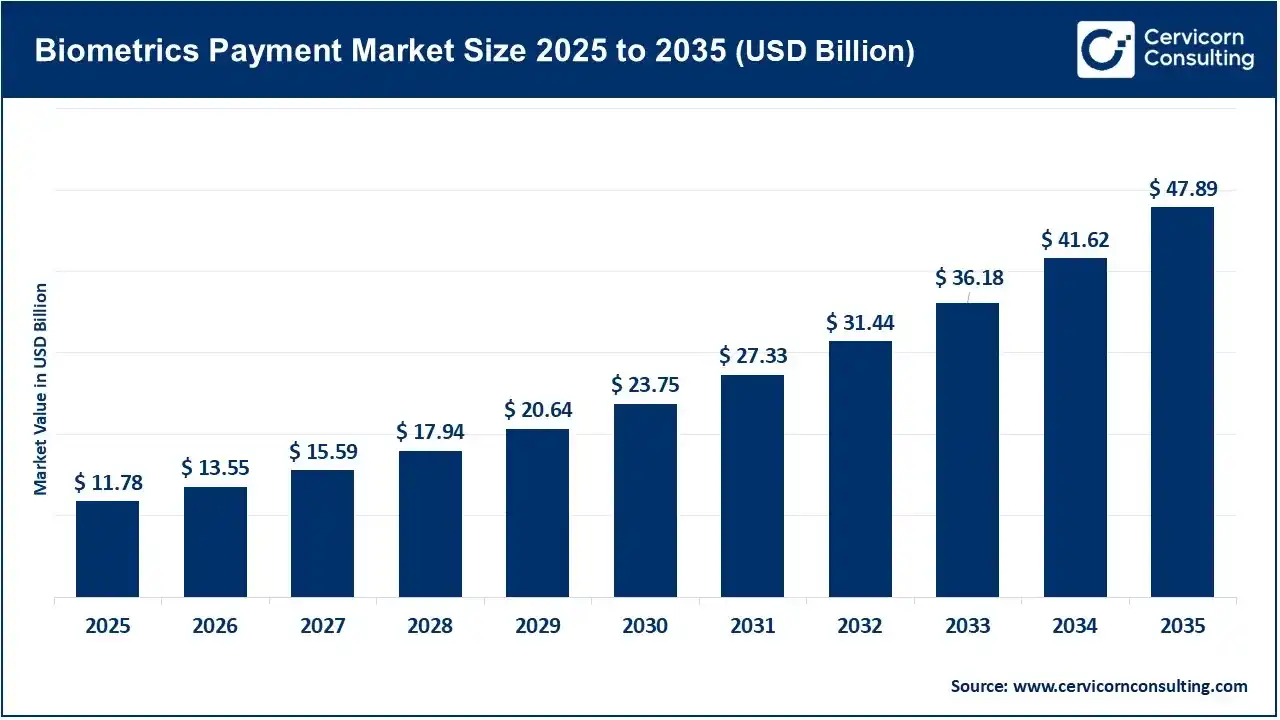
The global biometrics payment market size was valued at USD 11.78 billion in 2025 and is projected to surpass USD 47.89 billion by 2035, growing at a CAGR of 15% during the forecast period of 2026-2035. Globally surging payment fraud and security pressures are driving the overall market expansion. Moreover, the era has been fostering embedded biometric hardware in nearly 60% of smartphones across the globe to enable seamless consumer onboarding.
- Base Year Market Size (2025): $11.78 billion
- Current Year Market Size (2026): $13.55 billion
- Estimated Year Market Size (2035): $47.89 billion
- Forecast Period CAGR (2026-2035): 15%
- Leading Region: North America (revenue share of 34%)
Report Highlights
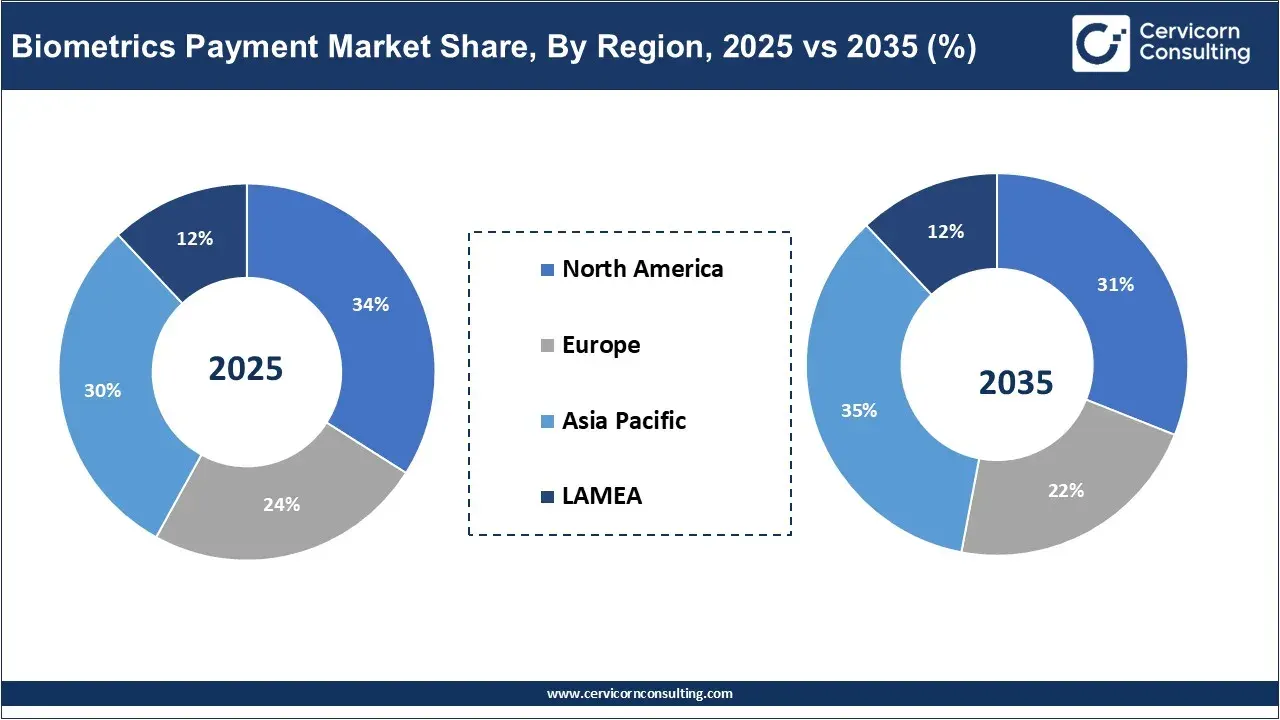
- By region: North America led the market with revenue share of 34% in 2025, driven by a rise in cybersecurity threats and growing demand for contactless transactions.
- By biometric modality: Fingerprint recognition was dominant in the market in 2025 (revenue share 45%), due to advanced deployment in payment cards, smartphones, and point-of-sale authentication.
- By payment type: In-store payments dominated the market in 2025 (revenue share 30%), fueled by the adoption of biometric point-of-sale terminals and contactless checkout solutions.
- By component: Hardware registered dominance in the market with revenue share of 42% because of the pivotal role of biometric sensors, readers, terminals, and secure payment devices.
- By end user: Banking and financial institutions dominated the market in 2025 (revenue share 35%), due to rising demand for secure customer authentication and fraud prevention.
What are the Key Applications of Biometric Payment in 2026?
The biometrics payment market consists of financial transactions that are authenticated by employing a person's unique physical or behavioral traits, like a fingerprint, face scan, or palm vein, rather than a traditional card, password, or PIN. Nowadays, thousands of fraud cases are arising across several areas, boosting the demand for innovative biometric payment solutions.
However, PIN-free credit card payments enable users to complete faster credit transactions via the use of native smartphone biometric checks. Many supermarkets, retail stores, and grocers are forcing the application of biometric point-of-sale terminals with fingerprint or palm recognition to accelerate bulk-buying checkouts, apply member-only discounts, and manage automated age verification.
Recent Steps Taken
- October 2026: TMU Management joined with Travel Ledger to enforce supplier payment protection into the payments platform’s Premium product and support travel suppliers in managing agent insolvency risk while allowing for more flexible credit and settlement terms.
- September 2026: Mastercard and Google Pay collaborated on the early launch of a device biometric card payment experience on Google Pay through eligible issuing banks.
- September 2026: Handwave broadened its agreement with global payments giant Visa to unify Visa’s tokenization and authentication technologies into Handwave’s model for safe, seamless card onboarding.
- May 2026: Five ID raised an additional $6 million to speed up the rollout of its palm biometrics payment system, gaining traction in the UK and Ireland.
Market Dynamics
Growth Drivers
- Demand for Fraud Prevention: Day by day, customers worldwide are facing phishing, identity theft, and skimming due to conventional authentication solutions, such as PINs and passwords. This demands advanced biometric approaches to offer high-accuracy, unique-trait verification and mitigate fraud generation.
- A Surge in Contactless Payments: The global market is experiencing a massive move toward tap-and-go, pay-by-face, and mobile-first checkouts, which eliminates the need to carry physical cards, type PINs, or remember passwords and reduces transaction times, with enhanced user convenience.
- A Rise in Mobile & Other Apps: Many industries are looking for digital transactions by using modern mobile devices and in-app checkouts, which pushes biometrics to facilitate immediate verification.
Key Restraints
- Privacy & Data Issues: The biometrics payment market has several key concerns, including limits in the aggregation and storage of sensitive biological data, which raises concerns about data misuse that could be permanent and irreplaceable.
- Regulatory Difficulties: To operate businesses, leaders must follow rigorous, isolated data-protection and privacy laws, like the EU’s GDPR, which elevate operational and legal stress.
- Higher Expenses Hurdle: Many deployments of biometric point-of-sale (POS) terminals, unique sensors, and encrypted-template architecture require significant upfront expenditure, making expansive adoption complex for small and medium-sized enterprises (SMEs).
Market Opportunities
- Spurring Multimodal Ideas: In the upcoming years, the market will promote joining two or more biological or behavioural traits, and it will bolster security and virtually resolve false rejections or mimicking risks.
- Advancing IoT-Related Integration: Eventually, surging adoption of wearable smartglasses, smartwatches, and connected home appliances will employ native biometric validation for frictionless, invisible in-device micro-transactions.
- Launch of Smart Cards: The advanced industry will have major opportunities in physical credit and debit cards embedded with smaller fingerprint sensors, enabling users to scan their finger directly on the card to authenticate point-of-sale transactions without the requirement of a PIN.
Market Challenges
- Difference in Demographics: In 2026, Gen Z and Millennials are widely using biometric solutions due to higher phone penetration, whereas older generations, like Gen X and Baby Boomers, are hesitating to adopt because of the need to store their biological identifiers with commercial data.
- Advances in Terminal: A rise in true in-store biometric checkouts pushes stores to purchase costly unique terminals equipped with palm scanners, iris readers, or modern biometric cameras.
- Interoperability Barriers: Numerous software and hardware pioneers are going through stringent, diverse local and international requirements. However, the development of one product with several different global validation landscapes demands an expensive and extended testing timeline.
Biometrics Payment Market Regional Analysis
How did North America Register Dominance in the Market in 2025?
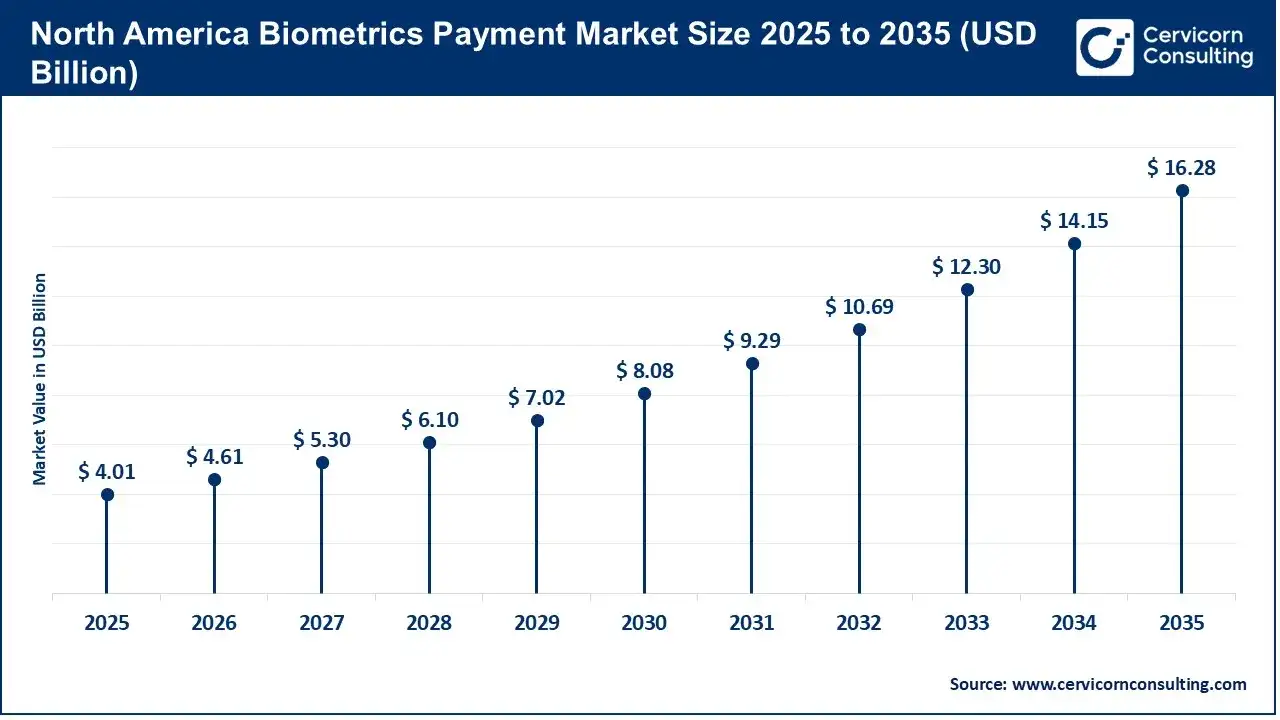
The North America biometrics payment market size was valued at USD 4.01 billion in 2025 and is projected to surpass around USD 16.28 billion by 2035. In 2025, North America captured the largest share of 34% of the market, supported by expansion in smartphone-based enrolment and massive innovations in retail and in-store solutions. The regional consumer base has widely adopted battery-less smart card architectures that are unified with secure element chips and allow contactless EMV fingerprint verification. In addition, North America deployed an advanced platform called the FortressPay Biometric Payment Platform on AWS that especially targets enterprise-level security requirements in the U.S.
United States Market
- In the biometrics payment market, the United States held a dominant share in 2025. Their key focus area was banks and payment networks, which forced trials and initial launches of contactless payment cards equipped with embedded fingerprint sensors. Meanwhile, several national retail and grocery chains strengthened pilot tests for biometric checkouts that are rigorously connected to digital loyalty and wallet accounts.
Why is Asia Pacific Expected to Expand Rapidly in the Market?
The Asia-Pacific biometrics payment market size was estimated at USD 3.53 billion in 2025 and is projected to hit USD 14.37 billion by 2035. In the future, Asia Pacific is considered to be the fastest-growing region in the market, driven by expansive smartphone penetration, advanced national incentives, and wider adoption of super-apps. On September 29-30, 2026, Mobility Payments Asia Pacific 2026 is slated to be held in Hanoi, Vietnam, which emphasises integration of open biometric digital identity with smart city transit systems. At the same time, China introduced WeChat Pay, which uses palm vein payment systems and mainly covers nearly 1,500 7-Eleven convenience stores in Guangdong province and power bank rental stations in Shenzhen.
India Market
- In the coming years, India will be highlighted as a center for digital payment modes. According to some reports, India explored biometric authentication-based Unified Payments Interface (UPI) transactions by leveraging fingerprint sensors or facial recognition. In June 2026, India recorded roughly 611 million transactions alone and expanded past 6.29 billion cumulative transactions by late August 2026. However, the National Payments Corporation of India (NPCI) reinforced the on-device biometric UPI authentication ceiling to ₹10,000 and expanded PIN-free biometric authentication to RuPay Credit Cards on UPI.
Biometrics Payment Market Segmentation Analysis
Biometric Modality Analysis
Fingerprint Recognition: The fingerprint recognition segment dominated the market in 2025, due to expanded suitability in modern smartphones, affordable mobile devices, and specialized POS. During and after COVID-19, the globe promoted e-commerce and contactless digital payments, which pushed remote and touch-free authentication measures.
Facial Recognition: The facial recognition segment is expected to be the fastest-growing during 2026-2035, supported by contactless authentication, smartphone-based payments, and biometric checkout systems. Moreover, the biometrics payment market is seeking embedded AI chips within payment pods that immediately distinguish real human skin and depth from high-resolution silicone masks, 3D projections, or digital screens.
Biometrics Payment Market Share, By Biometric Modality, 2025 (%)
| Biometric Modality |
Revenue Share, 2025 (%) |
| Fingerprint Recognition |
45% |
| Facial Recognition |
28% |
| Iris Recognition |
8% |
| Palm and Vein Recognition |
12% |
| Voice Recognition |
7% |
The palm and vein recognition segment is predicted to witness lucrative expansion in the projected period, driven by its higher security, reduced hygiene concerns, and superior lifetime stability. Exploration of modern palm vein comparison technology processes encrypted templates directly without losing matching accuracy and also allows secure cloud-based and real-time payment authorization.
Payment Type Analysis
In-Store Payments: The in-store payments segment led with 30% share of the market in 2025, fueled by the elevated security, speed and convenience and a surge in contactless commerce. Key solutions, including Apple Pay, Google Wallet, and palm-reading approaches, have integrated biometrics invisibly at the point of sale, allowing consumers to ensure purchases at retail terminals utilizing Face ID, Touch ID, or palm scans connected directly to tokenised accounts.
Online Payments: The online payments segment is projected to expand at a rapid rate during 2026-2035, propelled by accelerating demand for stronger customer authentication and reduced payment fraud. Current leaders are broadening the use of FIDO Alliance passkeys driven by significant networks, enabling users to finish online and mobile checkouts utilising device-level biometrics rather than vulnerable One-Time Passwords (OTPs).
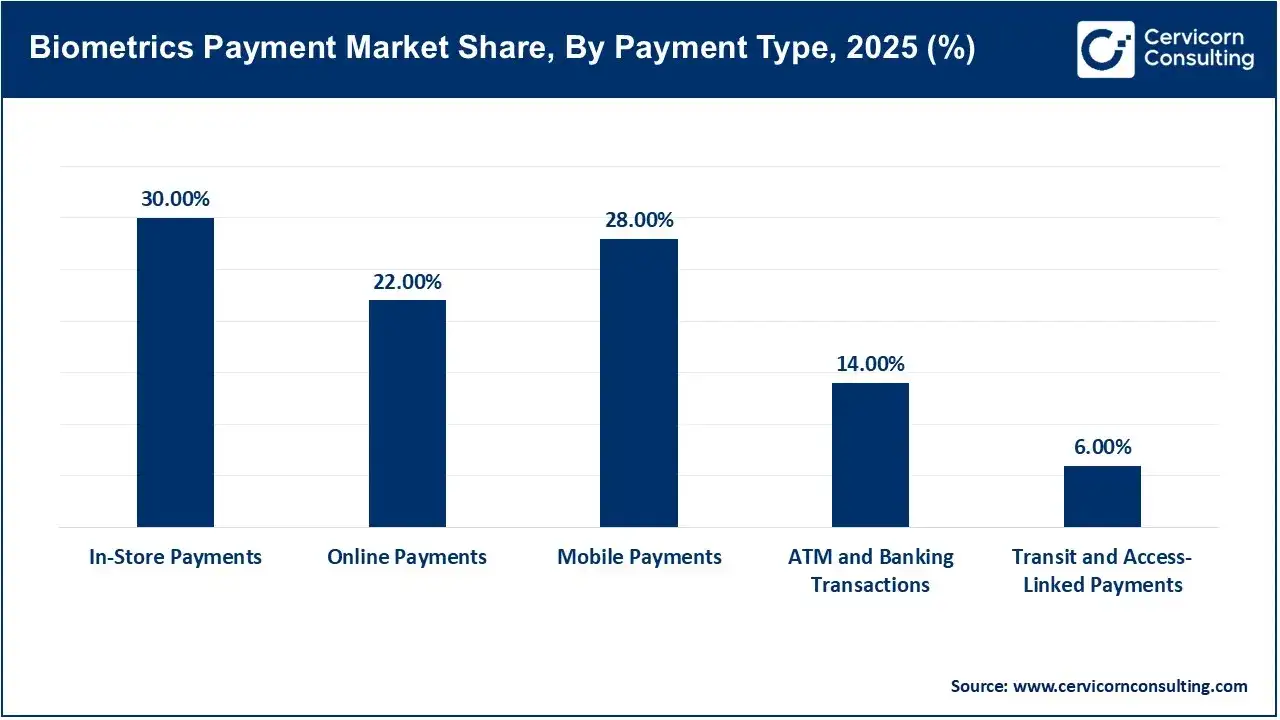
The mobile payments segment is forecasted to grow notably in the coming years because of a rise in smartphone and wearable integration, coupled with accelerated activities. Many of the prominent breakthroughs are spurring AI-powered behavioural analytics, like typing cadence, device handling, and motion dynamics that sync with Zero Trust Architecture (NIST SP 800-207) to trace transactions consistently.
Component Analysis
Hardware: The hardware segment dominated with 42% share of the biometrics payment market in 2025, supported by the major role of biometric sensors, readers, terminals, and secure payment devices and enhancements in biometric card technology. Alongside this, financial institutions allocated unified counter and table payment hardware with 8-inch high-resolution displays, built-in liveness detection, and paired palm or facial scanners for chip, contactless, and 5G connectivity.
Biometrics Payment Market Share, By Component, 2025 (%)
| Component |
Revenue Share, 2025 (%) |
| Hardware |
42% |
| Software |
35% |
| Services |
23% |
Software: The software segment is anticipated to be the fastest-growing in the upcoming years, led by breakthroughs in biometric authentication algorithms, identity verification, and fraud detection. In 2026, the latest biometric applications are employing edge computing to run deep convolutional networks directly on smartphones and point-of-sale (POS) terminals. This further enables facial and fingerprint feature extraction to appear locally in milliseconds.
The services segment registered notable growth in the market in 2025, due to a rise in fraud prevention and the progression of national payment infrastructure integration. In the last year, the National Payments Corporation of India (NPCI), under guidelines from the Reserve Bank of India (RBI), introduced on-device fingerprint and facial recognition authentication for UPI transactions.
End User Analysis
Banking and Financial Institutions: The banking and financial institutions segment held the largest share of 35% in 2025, driven by demand for secure customer authentication and continuous regulatory compliance enforcement. Day by day, banks expanded adoption of passive, continuous multi-modal authentication led by AI to trace behavioural anomalies, device attributes, and location patterns in real time.
Retail and E-commerce: The retail and e-commerce segment is predicted to witness rapid expansion during the forecast period, powered by biometric checkout, faster payment experiences, and demand for convenient customer verification. Technological advancements include modern merchant hardware from providers that offers AI soundboxes and smart pods that foster integrated multimodal and biometric verifications.
Biometrics Payment Market Share, By End User, 2025 (%)
| End User |
Revenue Share, 2025 (%) |
| Banking and Financial Institutions |
35% |
| Retail and E-commerce |
28% |
| Government and Public Services |
12% |
| Transportation and Mobility |
10% |
| Hospitality |
7% |
| Others |
8% |
The government and public services segment held a significant share of 12% in 2025, driven by growth in welfare and social security distribution, and rollout of several national modernisation initiatives. Specifically, the Indian government explored Aadhaar-based Face Authentication in UPI, allowing the public to securely set or reset their UPI PIN directly through real-time government biometric data.
Recent Developments
- October 2026: The European Payments Council (EPC) unveiled SCARLET, an effort to evolve common rules for employing EU Digital Identity Wallets in payment authentication, such as interoperability and liability arrangements.
- October 2026: Revolut launched Revolut Register, a point-of-sale system used to broaden adoption of Pay with Smile, the company's facial recognition payment system.
- October 2026: Walletdoc rolled out Visa Payment Passkeys in South Africa, which allow biometric authentication for online Visa card payments.
- September 2026: Apple Pay was introduced in India, enabling payments via compatible bank cards, Face ID, Touch ID or passcode on compatible iPhones, iPads and Apple Watches.
Leading Players
Segments Covered
By Biometric Modality
- Fingerprint Recognition
- Facial Recognition
- Iris Recognition
- Palm and Vein Recognition
- Voice Recognition
By Payment Type
- In-Store Payments
- Online Payments
- Mobile Payments
- ATM and Banking Transactions
- Transit and Access-Linked Payments
By Component
- Hardware
- Software
- Services
By End User
- Banking and Financial Institutions
- Retail and E-commerce
- Government and Public Services
- Transportation and Mobility
- Hospitality and Other Businesses
By Region
- Asia-Pacific
- North America
- Europe
- Latin America
- Middle East and Africa
