
Content
Automotive Power Inductor Market to Nearly Triple by 2035


Automotive Power Inductor Market Insights
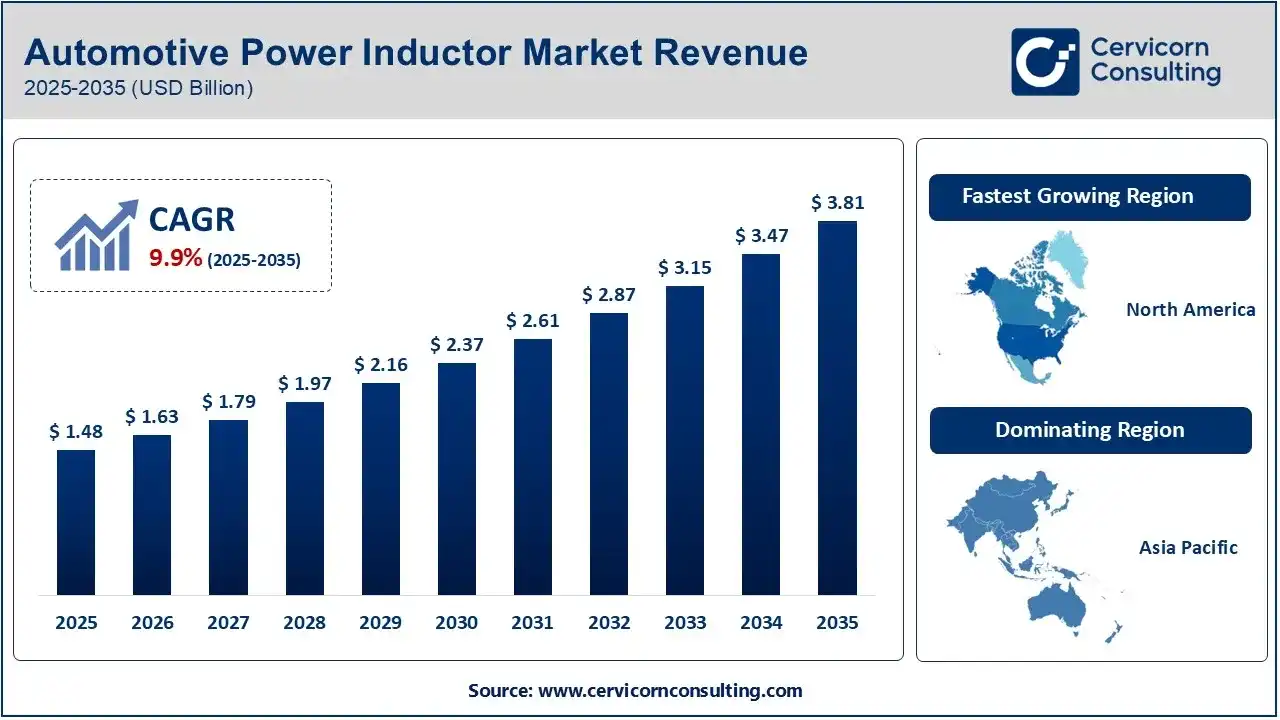
The automotive power inductor market size valued at USD 1.63 billion in 2026 and is expected to surge USD 3.81 billion by 2035, growing at a CAGR of 9.9% during the forecast period of 2026-2035.
Asia Pacific led the market in 2025, due to vast vehicle production and a well-established automotive electronics manufacturing base, while North America is expected to be the fastest-growing region during 2026-2035 because of surging automotive electronics integration.
Automotive Power Inductor Market Outlook
Primarily, the market is referred to the use of component developed from a coiled wire and it stores energy in a magnetic field, regulating current and voltage in vehicle power supply lines, DC-DC converters, and Electronic Control Units (ECUs). The global market growth is mainly fueled by a surge in demand for electric vehicles and hybrid vehicles (xEVs), growth in Advanced Driver Assistance Systems (ADAS), and rigorous demand for robust DC-DC voltage conversion.
Gradually rising trends across the market are widely pushing the utilisation of amorphous and nanocrystalline magnetic structures, along with iron-alloy powders. Moreover, many leading producers, such as Würth Elektronik, are fostering the deployment of lead-frameless round-wire and multilayer technologies. In addition, the worldwide focus is on complying with AEC-Q200 Grade 1 or Grade 2/3 specs, enabling feasible functioning in extreme thermal environments up to 150°C.
Glimpse of AI Applications
An AI-focused era called 2026 is now stepping into AI algorithms, like hybrid Teaching-Learning-Based Optimization (TLBO) and Particle Swarm Optimization (PSO), automating complex resonant tank and magnetic core calculations to reduce component size and slit power losses in EV converters. Alongside this, machine learning models support estimating hot spots and electromagnetic interference (EMI) throughout -40°C to +150°C. The globe is increasingly transitioning toward 48V electrical loads and 800V high-voltage battery platforms, where AI-driven point-of-load DC-DC converters employ high-current, high-withstand-voltage inductors and maintain stability. Furthermore, numerous inductor coil producers are using AI to enhance the supply chain and project growing orders for New Energy Vehicles (NEVs) and automate defect detection.
Regional Overview
Asia Pacific Dominated the Market in 2025
The automotive power inductor market in Asia Pacific captured a dominant share of 44% in 2025, due to a rise in EV adoption, government support for sustainable solutions, and massive domestic investments. China spurs local supply-chain investments in fast-charging inductive hardware, while Japan emphasises the evolution of high-reliability, compact ferrite-based inductors customized for hybrid-electric drivetrains. Side by side, India’s significant engineering and automotive clusters, like L&T (Larsen & Toubro) and other native suppliers, reported increased localization rates to insulate supply chains from foreign material limitations.
North America is Predicted to Grow Fastest in the Coming Years
Meanwhile, North America is forecasted to expand rapidly in the upcoming years, as it is strengthening local supply chain programs and promoting PCB integration. Many United States firms, including Coilcraft and Sumida Corporation, are looking to launch specialised surface-mount device (SMD) power-line and data-line common-mode chokes to control high saturation currents. However, several facilities in Ontario are fostering higher-voltage architectures, as EVs leverage drastically more power inductors to handle traction inverters, onboard chargers, and DC-DC converters.
Automotive Power Inductor Market Segmental Outlook
| Market Segment | Leading Segment | Key Growth Driver |
| By Inductor Type | Shielded Power Inductors | Propelled by their electromagnetic interference control and favourable for automotive power electronics. |
| By Core Material | Ferrite Core | Led by its expansive use in automotive electronic power circuits and exploration of refined MnZn and NiZn formulations. |
| By Vehicle Type | Passenger Vehicles | Driven by their massive production volumes, comprehensive electronic content, and major schemes. |
| By Application | Powertrain and Engine Control | Because of broader use of inductors in automotive electronic control and power regulation. |
Automotive Power Inductor Market Key Trends
- Potential Miniaturization & Integration: Day by day, breakthroughs across the industry are uncovering compact SMD power inductors via replacement of heavy designs and scale-up in passenger cars, etc. The execution of embedded PCB integration lowers physical weight and frees up precious real estate inside dense ECUs.
- Novelty in Materials: Ongoing advances also encourage the progression of nanocrystalline cores and unique ferrite composites to optimise magnetic permeability. In addition, steps are being taken to improve thermal stability due to dense, high-current power modules.
- Supply Chain Efforts: The APAC region remains a production center; in contrast, European and North American automakers are moving towards mandatory localized component settings to prevent cross-border supply chain shocks and support improved, robust, and scalable power inductors via good enough engineering.
Future Outlook
According to many studies, the automotive power inductor market will have several notable opportunities, such as a surge in 800V EV battery platforms that deploy onboard chargers (OBCs) and DC-DC converters. This will further develop a vast open market for high-current, high-voltage automotive-grade power inductors across the globe. Ongoing burst of ADAS and high-compute connected cabins necessitates advanced low-profile, high-frequency filtering components. Moreover, global production leaders are broadening opportunities across the integration of AI-powered simulation tools. These tools have several benefits, such as improved actual inductance values and prediction of thermal performance before prototyping, substantially accelerating the arrival of tailored automotive design. The prospective era will bolster breakthroughs in winding techniques and high-frequency design that enable power inductors to manage megahertz-range frequencies efficiently and significantly lower electromagnetic interference (EMI) and power loss. Certain key innovations across the market have been reinforcing bidirectional charging, necessitating highly sophisticated power management topologies.
Segments Covered
By Inductor Type
- Shielded Power Inductors
- Unshielded Power Inductors
- Multilayer Power Inductors
- Wire-Wound Power Inductors
- Other Power Inductors
By Core Material
- Ferrite Core
- Metal Composite Core
- Powdered Iron Core
- Other Core Materials
By Vehicle Type
- Passenger Vehicles
- Light Commercial Vehicles
- Heavy Commercial Vehicles
- Electric Two-Wheelers and Three-Wheelers
- Other Vehicle Types
By Application
- Powertrain and Engine Control
- Battery Management Systems
- DC-DC Converters and Onboard Chargers
- Advanced Driver-Assistance Systems (ADAS)
- Infotainment and Body Electronics
By Region
- Asia-Pacific
- North America
- Europe
- Latin America
- Middle East and Africa
Empower your strategy with expert insights, purchase this premium research@ https://www.cervicornconsulting.com/buy-now/3070
Ask here for more details@ sales@cervicornconsulting.com