Automotive Power Inductor Market Size and Forecast 2026 to 2035
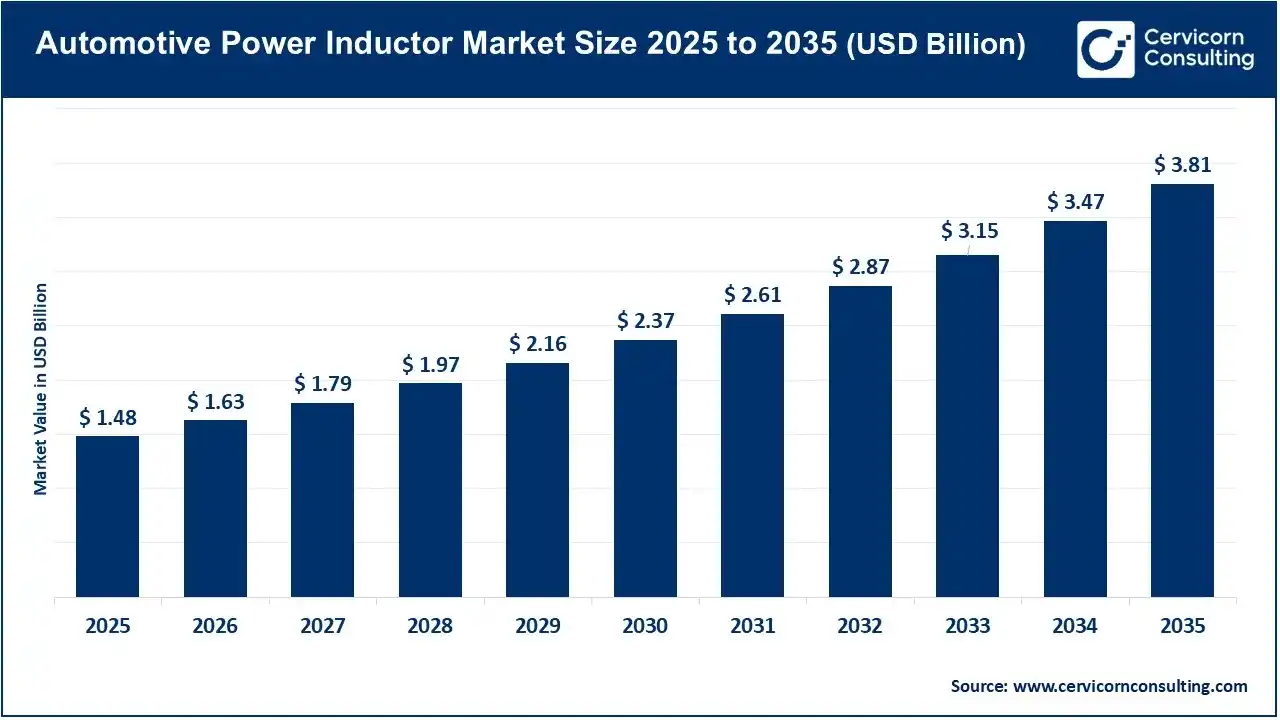
The global automotive power inductor market size was valued at USD 1.48 billion in 2025 and is expected to exceed USD 3.81 billion by 2035, growing at a CAGR of 9.9% during the forecast period from 2026 to 2035.
- Base Year Market Size (2025): $1.48 billion
- Current Year Market Size (2026): $1.63 billion
- Estimated Year Market Size (2035): $3.81 billion
- Forecast Period CAGR (2026-2035): 9.9%
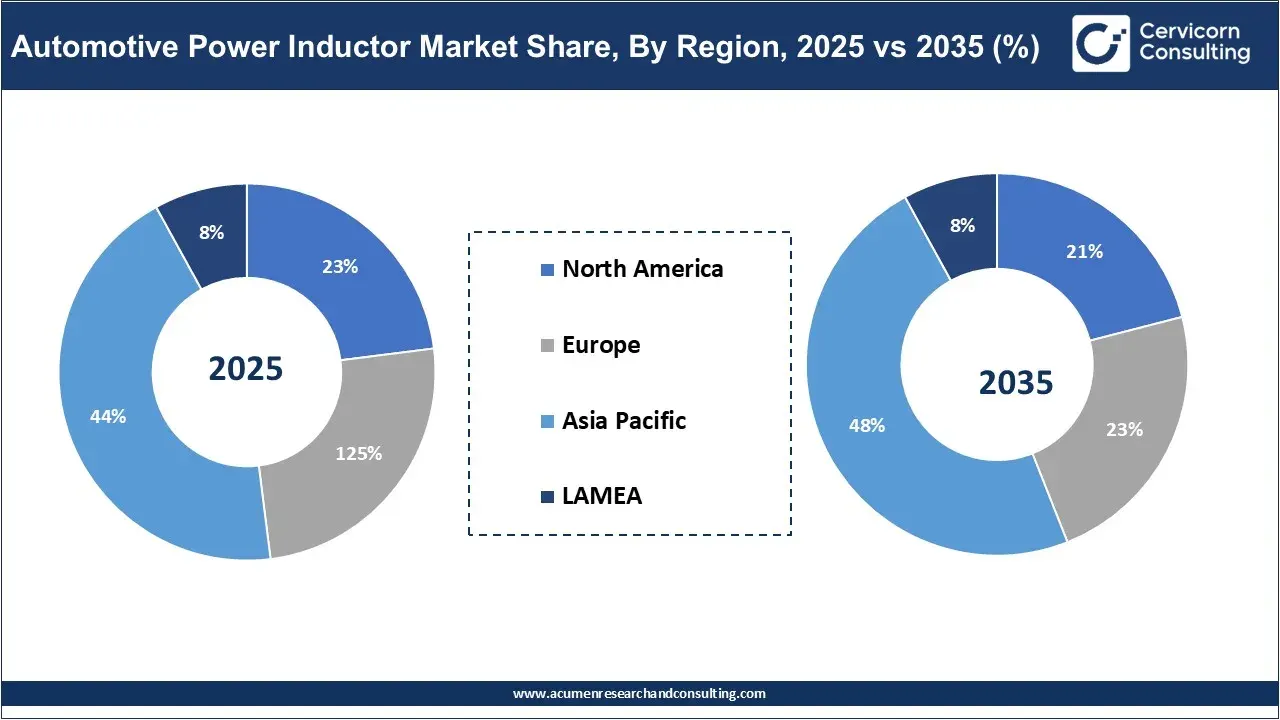
- Leading Region: Asia Pacific (revenue share 44%)
Report Highlights
- By region: Asia Pacific dominated the market in 2025, driven by massive vehicle production and a robust automotive electronics manufacturing base.
- By inductor type: Shielded power inductors led the market in 2025 with revenue share of 34%, due to their electromagnetic interference control and suitability for automotive power electronics.
- By core material: Ferrite core was dominant in the market in 2025 and generated 48% share, supported by its well-developed use in automotive electronic power circuits.
- By vehicle type: Passenger vehicles registered dominance in the market in 2025 with a revenue share of 62%, fueled by their vast production volumes and extensive electronic content.
- By application: Powertrain and engine control dominated the market in 2025 (revenue share 28%), driven by expanded use of inductors in automotive electronic control and power regulation.
What is the Basis Behind the Automotive Power Inductors in 2026?
Primarily, the automotive power inductor market covers a heavy-duty passive electronic component used in modern vehicle electrical systems to store energy in a magnetic field and regulate current changes. Eventual breakthroughs resulted in the launch of electric vehicles (EVs) with 800V batteries and fostered modern driver-assistance systems (ADAS) and infotainment units. However, power inductors are pivotal for DC-DC converters, traction inverters, and Electronic Control Units (ECUs). Along with storage, the market growth is based on principles called Faraday’s Law and Lenz’s Law, which explain the passing of DC and the resistance to AC and the opposing electromotive force (counter-EMF) to changes, respectively.
Automotive Power Inductor Technology Adoption Statistics
- Surface-Mount Technology Adoption: Surface-mount device (SMD) power inductors are widely used in automotive electronic control units, infotainment systems, advanced driver assistance systems (ADAS), and power management circuits because of their compact size and suitability for automated PCB assembly.
- Electric Vehicle Adoption: Global electric car sales exceeded 17 million units in 2024, representing more than 20% of total car sales. Increasing EV production supports demand for power inductors in onboard chargers, DC-DC converters, battery management systems, and auxiliary power supplies.
- Wire-Wound Inductor Technology: Wire-wound inductors are used in automotive power electronics requiring high current handling, low resistance, and efficient energy conversion. Their adoption is particularly relevant to traction-related power supplies, voltage regulators, and DC-DC conversion systems.
- Multilayer Inductor Technology: Multilayer inductors integrate compact conductive and magnetic structures into small components, supporting space-constrained automotive electronics. Their applications include vehicle control modules, infotainment, communication systems, and low-power electronic circuits.
- Metal Composite Core Technology: Metal composite power inductors use magnetic metal powders to support high-current operation and improved saturation characteristics. These components are suitable for automotive voltage regulators, powertrain control electronics, and battery management applications.
- High-Temperature Technology Adoption: Automotive power inductors are increasingly designed for elevated operating temperatures, including component ratings of 125°C, 150°C, and higher in selected product families. These ratings support applications exposed to under-hood heat and demanding power electronics environments.
- AEC-Q200 Qualification: AEC-Q200 defines reliability stress-test requirements for passive electronic components, including automotive power inductors. Qualification testing covers environmental and mechanical stresses, with test requirements depending on component type and applicable specification.
Which Transitions Are Expected by Innovators for Future Advances?
- Seeking SiC & GaN: Gradual surging advances in 400V and 800V EV architectures push the use of Silicon Carbide (SiC) & Gallium Nitride (GaN) technologies, as these approaches indicate higher switching frequencies and increased temperatures.
- Promoting Material Science: Many global leading companies are increasingly utilising composite, metal-alloy powder-core shielded power inductors and also looking for the development of unique automotive ferrite designs that spur continuous, safe operation at temperatures reaching 150°C.
- Pioneering PoC Inductors: In this era, major developers are heavily developing specialized Power Over Coax (PoC) inductors to simplify heavy wiring harnesses and lower vehicle weight.
What are the Catalysts Driving the Automotive Power Inductor Market?
- Surge in Demand for EVs: Specifically, 2026’s customers are widely demanding battery electric vehicles (BECs) and plug-in hybrids, which need complex power conversion systems, like traction inverters, onboard chargers, DC-DC converters, etc.
- Rigorous Standards: Nowadays, leaders are going through mandatory stringent reliability standards, such as AEC-Q200 certification, especially for components to be placed in safety-critical EV and ADAS sub-systems.
- Advancing SMD Packaging: Most of the concentrations include Surface Mount Device (SMD) form, which provides higher saturation current across a strict footprint, with accommodation of tightly packed zonal vehicle architectures.
What are the Common Limitations in the Automotive Power Inductor Market?
- Thermal-Related Concerns: Insertion of power transistors, busbars, capacitors, and inductors can develop intense localized hotspots; coupled with printed circuit boards (PCBs) creates huge ambient temperature fluctuations and ultimately limits industry expansion.
- Space Issues: The execution of EV battery packs and compact electronic control unit (ECU) housings represents highly restricted room for conventional passive components and cooling measures.
- Inclination in High-Voltage Battery: Consistency in 400V to 800v and 1,000V battery platforms requires higher voltage ratings, advanced packaging, and reliable insulation.
Experts Focused Opinion on certain material science
According to our experts, the automotive power inductor market will have expansive opportunities in the materials science sector. This mainly includes the implementation of nanocrystalline alloy composites, such as Fe-based nanocrystalline ribbons. This approach will resolve the difference between high-saturation iron powder and low-loss, high-frequency ferrites, with outstanding thermal stability. Another rollout will unveil R&D activities in carbon nanotube (CNT) coils that discard metal weight by up to 80% and meet high-vibration automotive circumstances. Moreover, the market companies can move toward monolithic wire-wound molding, which overcomes internal air gaps and generates a combined monolithic structure.
Automotive Power Inductor Market Segmentation Analysis
Inductor Type Analysis
Shielded Power Inductors: The shielded power inductors segment captured a dominant share of 34% in 2025, due to their electromagnetic interference control and elevated thermal stability. Alongside this, their significance has broadened because of their necessity in filtering electrical noise and stabilising power delivery in high-vibration, mission-critical areas.
The multilayer power inductors segment is expected to grow notably in the coming years, as they deliver broader reliability benefits in modern automotive electronics, specifically in high-density applications. In addition, the latest automotive architectures and 5G connectivity modules run at increased frequencies, which demand specialized multilayer ceramic and thin-film/multilayer designs to control power integrity and lower noise.
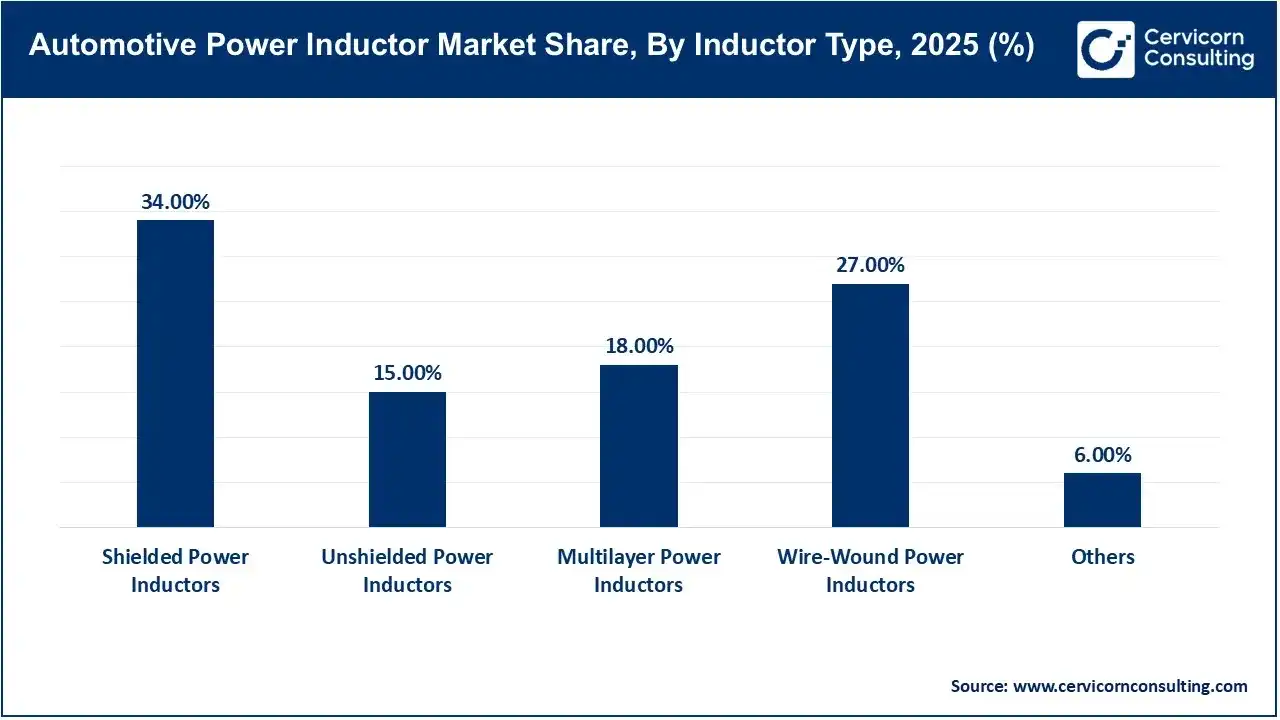
Wire-Wound Power Inductors: The wire-wound power inductors segment is predicted to be the fastest-growing during 2026-2035, driven by demand for high-current handling and efficient power conversion in sophisticated automotive systems. Ongoing developments across the segment consist of using dense shielding and closed-magnetic-circuit designs, with an emphasis on enhancing thermal and high-temperature solutions in wire-wound inductors.
Core Material Analysis
Ferrite Core: The ferrite core segment accounted for the largest share of 48% in 2025, supported by massive demand in growing vehicle electrification and high-voltage platforms. In 2025, producers of this material refined MnZn (Manganese-Zinc) and NiZn (Nickel-Zinc) formulations for a significant reduction in high-frequency core losses and to bolster saturation flux density.
The powdered iron core segment registered a lucrative expansion in the automotive power inductor market in 2025, due to rising adoption of hybrid and electric vehicles, with efforts in advancing powder compositions. 2025’s breakthroughs have addressed the development of insulated carbonyl iron powder (CIP), with phosphating and epoxy-modified bismaleimide resin that drastically optimizes mechanical strength and heat resistance up to 155°C or higher.
Automotive Power Inductor Market Share, By Core Material, 2025 (%)
| Core Material |
Revenue Share, 2025 (%) |
| Ferrite Core |
48% |
| Metal Composite Core |
32% |
| Powdered Iron Core |
14% |
| Others |
6% |
Metal Composite Core: The metal composite core segment is anticipated to expand rapidly during the forecast period, as it has high-current applications, compact designs, and emerging power conversion requirements. Day by day, key suppliers, including Murata, TDK, and Vishay, are strongly encouraging the scale-up of automotive-grade metal power inductor portfolios.
Vehicle Type Analysis
Passenger Vehicles: The passenger vehicles segment led with 62% share of the market in 2025, driven by expansive demand for intelligent systems and transformative performance. According to the expert study, there was roughly 45.5 lakh units of demand reported in India in 2025, as India expanded the PM E-DRIVE Scheme, and alongside this, the global market stepped into integrating 22 to 35 power inductors.
The light commercial vehicles segment is projected to witness significant growth in the upcoming years, due to a rise in the transition toward diversified electrification ideas and the unification of real-time tracking, IoT diagnostics, and advanced driver-assistance systems (ADAS).
Automotive Power Inductor Market Share, By Vehicle Type, 2025 (%)
| Vehicle Type |
Revenue Share, 2025 (%) |
| Passenger Vehicles |
62% |
| Light Commercial Vehicles |
14% |
| Heavy Commercial Vehicles |
10% |
| Electric Two-Wheelers and Three-Wheelers |
11% |
| Others |
3% |
Electric Two-Wheelers and Three-Wheelers: The electric two-wheelers and three-wheelers segment is forecasted to expand at the fastest rate in the predicted timeframe. According to the Press Information Bureau, India reported demand and sales numbers of 12.8 lakh electric two-wheelers and 8 lakh electric three-wheelers in 2025. However, the tier-1 automotive component suppliers are pushing localised passive magnetic and inductor sourcing to maintain low TCO for these vehicles.
Application Analysis
Powertrain and Engine Control: The powertrain and engine control segment dominated with 28% share of the market in 2025, rigorous regulation and broader use of modern internal combustion engine (ICE) and electrified powertrains. Specifically, powertrain and engine-bay modules aim for stringent AEC-Q200 qualification and vibration resistance.
The advanced driver-assistance systems (ADAS) segment is estimated to grow notably because they need multiple Electronic Control Units (ECUs) to process vast real-time data from cameras, radar, LiDAR, and ultrasonic sensors. Many advances across ADAS focus on changing frequencies to boost power conversion efficiency in a narrow space.
Automotive Power Inductor Market Share, By Application, 2025 (%)
| Application |
Revenue Share, 2025 (%) |
| Powertrain and Engine Control |
28% |
| Battery Management Systems |
20% |
| DC-DC Converters and Onboard Chargers |
24% |
| ADAS |
13% |
| Infotainment and Body Electronics |
15% |
Battery Management Systems: The battery management systems segment is expected to be the fastest-growing during 2026-2035, supported by electrification and surging demand for efficient battery monitoring and power conversion. Moreover, the market leaders are seeking Wireless BMS (wBMS) architectures, with a move towards intelligent cell-to-cell balancing solutions.
Automotive Power Inductor Market Regional Analysis
How did Asia Pacific Dominate the Market in 2025?
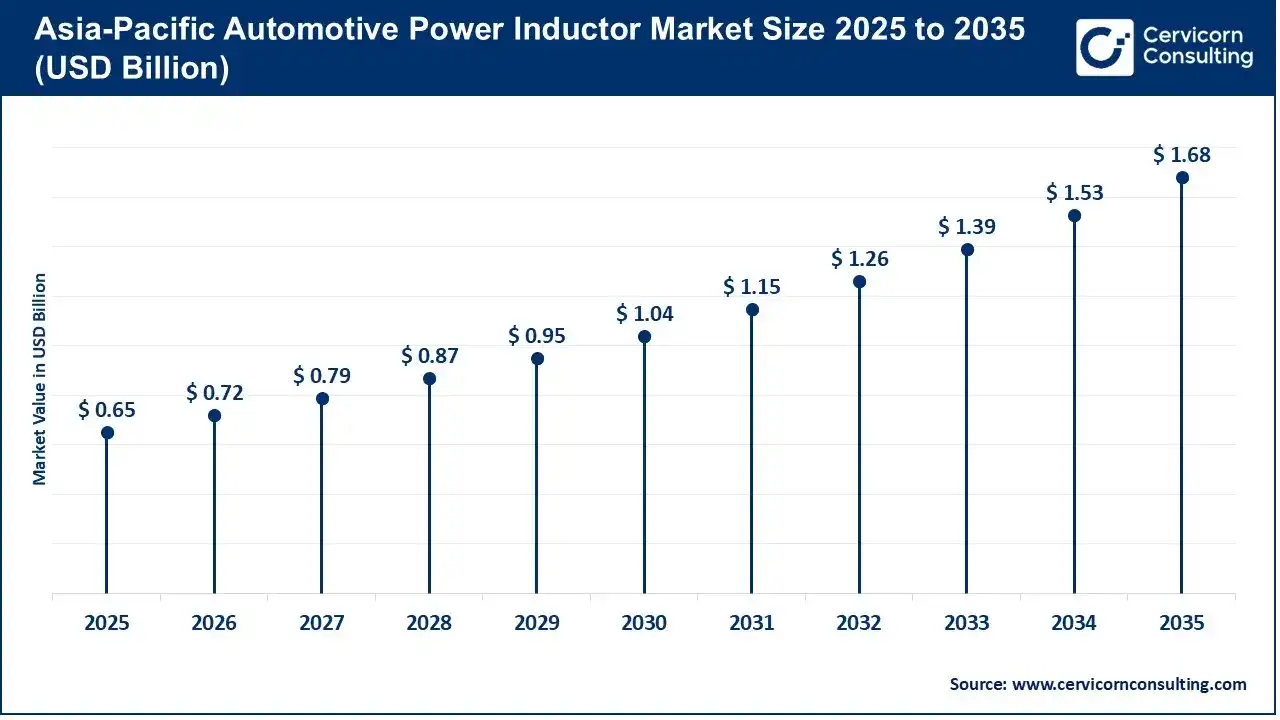
The Asia-Pacific automotive power inductor market size was valued at USD 0.65 billion in 2025 and is projected to surpass USD 1.68 billion by 2035. Asia Pacific held the largest share of 44% of the market in 2025 because it has accelerated demand for EV two- and three-wheelers and the presence of increased vehicle production. Specifically, Chinese suppliers are actively helping several firms, with their higher investment in nanocrystalline and composite iron powder inductors. Meanwhile, India’s market is representing specialized magnetic and inductive solutions, such as Electronica India in Bangalore, to sync with local EV two-wheeler and four-wheeler production lines.
Japan Automotive Power Inductor Market
- Along with a huge demand for EVs, the Japanese design sector has introduced Japanese passenger cars with a higher density of sensors, cameras, and processing ECUs. Along with this, Japan has explored high-current, compact power inductors customised especially for EV power management and ADAS units operating in space-constrained electronic control units (ECUs).
Why is North America Considered to Grow Fastest During 2026-2035?
The North America automotive power inductor market size was estimated at USD 0.34 billion in 2025 and is anticipated to hit USD 0.88 billion by 2035. The North America is projected to expand at a rapid rate in the predicted timeframe, led by electric vehicle production, battery manufacturing, and rising automotive electronics integration. However, the Canadian Semiconductor Council have addressed a major difference between Canada's strong academic EV research and its commercialized power electronics output.
United States Automotive Power Inductor Market
- The United States is forecasted to grow rapidly in the market, as its automotive OEMs are shifting away from distributed Electronic Control Units (ECUs) toward centralized and zone-based computing architectures. Along with this, empowered logistics and engineering assistance forces US automakers to source highly specialized, magnetically shielded, and corrosion-protected inductors.
Briefing on Major Funding in Electric Two- & Three- Wheelers in 2026
- September 2026: Ultraviolette announced an $85 million funding round to strengthen production, evolve new electric vehicle platforms and foster its international expansion plans.
- September 2026: Bengaluru-based electric two-wheeler maker Simple Energy raised Rs 1,750 crore ($182 million) in a Series C funding round to push a new manufacturing facility, elevate production capacity, and broaden its distribution & service network.
- August 2026: River raised $120 million in a Series C funding round to promote production capacity, expand its retail network, and create new electric models for launch.
- August 2026: SKG Investments & Advisory completed a Rs 100 crore fundraise for Omega Seiki Mobility (OSM), an electric three-wheeler manufacturer based in India.
- July 2026: Mahindra & Mahindra's electric three-wheeler business, Mahindra Last Mile Mobility Ltd (MLMML), entered the unicorn club after raising about ₹322 crore in a funding round powered by global steady investment firm Lightrock.
Spotlight on the Future Pipelines of Electric Vehicles in India in 2027
- Honda’s global 0 Alpha (0 α) Series electric SUV is looking forward to its launch at the beginning of 2027.
- Hyundai is seeking the rollout of its electric Sub-4m Compact EV (HE1i) in 2027, as it has in-house NMC batteries and Level 2 ADAS.
- The launch of Maruti Suzuki Electric MPV (YMC) is scheduled for late 2026 or 2027.
- Bentley's first-ever pure electric crossover called Torcal is expected to advance the British ultra-luxury brand's lineup in 2027.
Key Companies
Segments Covered
By Inductor Type
- Shielded Power Inductors
- Unshielded Power Inductors
- Multilayer Power Inductors
- Wire-Wound Power Inductors
- Other Power Inductors
By Core Material
- Ferrite Core
- Metal Composite Core
- Powdered Iron Core
- Other Core Materials
By Vehicle Type
- Passenger Vehicles
- Light Commercial Vehicles
- Heavy Commercial Vehicles
- Electric Two-Wheelers and Three-Wheelers
- Other Vehicle Types
By Application
- Powertrain and Engine Control
- Battery Management Systems
- DC-DC Converters and Onboard Chargers
- Advanced Driver-Assistance Systems (ADAS)
- Infotainment and Body Electronics
By Region
- Asia-Pacific
- North America
- Europe
- Latin America
- Middle East and Africa
