
Content
800G Optical Transceiver Market Size to be Worth Around USD 29.87 Billion by 2035


800G Optical Transceiver Market Size and Forecast 2026 to 2035
The global 800G optical transceiver market size calculated at USD 1.97 billion in 2026 and is expected to reach USD 29.87 billion by 2035, with a CAGR of 35.2% during the forecast period 2026 to 2035.
North America was dominant in the market, driven by the hub of hyperscale data centers and surging investments in AI infrastructure, while Asia-Pacific is predicted to expand fastest in the coming years, due to heavy investments in AI and digital transformation.
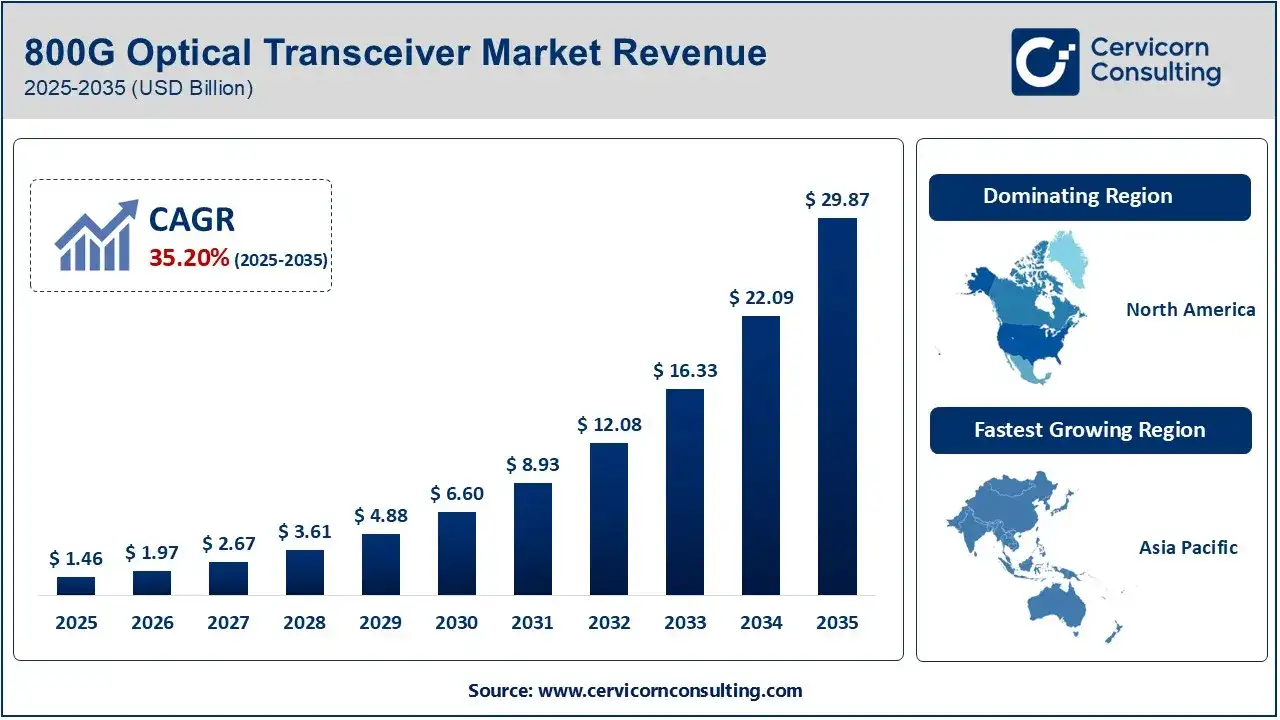
800G Optical Transceiver Market Outlook
Specifically, the adoption of this next-generation, high-speed networking module, which shares and receives data at rates up to 800 gigabits per second (Gbps), i.e., double the earlier 400G modules' capacity. This further shifts high-speed electrical signals from switches, servers, or AI processors into optical signals for fiber-optic communication. The global market is driven primarily by the rapid growth of large-scale AI models, LLMs, and high-performance GPU clusters, which necessitate ultra-high-speed, low-latency interconnections. Alongside this, many key cloud service providers are seeking consistent scale-up of their hyperscale data centers, which ultimately demand vast order books for compact pluggable modules.
Moreover, upcoming innovations are driving the adoption of the latest leaf-and-spine data centre switches that natively support 800G ports, pushing operators to move beyond legacy 400G networks as port speed, density, and thermal design requirements evolve together.
Impressive AI Role
Eventual breakthroughs across the industry have been spurred by AI algorithms, like model training, checkpoint coordination, and data distribution throughout GPU nodes, evolving larger east-west traffic inside data centers. The latest rollouts, such as NVIDIA DGX H100, offer 8 H100 GPUs that need high-speed Top-of-Rack (ToR) switch connectivity, which makes 800G links necessary to mitigate network risks. Another side of AI advances covers Linear-Driver Pluggable Optics (LPO) technology, gaining importance for short-reach AI data center links, as it removes traditional power-hungry DSP (Digital Signal Processing) chips and significantly reduces latency and power consumption.
Regional Outline
North America Led the Market in 2025
North America held the largest share of 40% of the 800G optical transceiver market in 2025, supported by massive investment in digital infrastructure and a substantial rise in hyperscaling, with AI and machine learning solutions. However, the U.S. has uncovered initial commercial launches and production approaches of 1.6T transceivers that are customised for upcoming accelerator clusters. Meanwhile, Canada’s POET Technologies Inc. executed its POET Infinity platform, delivering final design samples of 400G and 800G, coupled with optical transmission.
Asia Pacific is anticipated to be the fastest-growing region
Asia Pacific is anticipated to be the fastest-growing region in the predicted timeframe, led by upgrading data centers, accelerated digital innovations, and broader 5G network launches. Recently hosted programs, including APE Singapore, showcased the expedited adoption of Surface-Mount Technology (SMT)-based manufacturing and extensive advanced packaging integration to control stringent thermal and power limitations for high-density GPU/XPU AI clusters. Besides this, China’s domestic pioneers are intensely boosting single-mode deployment by leveraging Silicon Photonics technology to omit the distance concerns of conventional fibers.
800G Optical Transceiver Market Segmental Outlook
| Market Segment | Leading Segment | Key Growth Factor |
| By Form Factor | 800G QSFP-DD | Fueled by its small size, expansive interoperability, and its capacity to support high bandwidth. |
| By Optical Technology | EML-Based Technology | Supported by its stronger functionality, dependability, and offerings, such as effective signal transmission across many data center and networking applications. |
| By Reach | 100 m–500 m | Due to its compatibility for connections across data center rooms, it also offers a balance between transmission distance and performance. |
| By Application | Data Center Networking | Driven by increasing deployment of high-speed switches, servers, and surging data traffic that need advancing networks toward 800G connectivity. |
Developing Trends
- AI-Driven Integration: Currently, AI Data Center Networking is looking to shift the main demand from conventional north-south video or enterprise traffic to thorough east-west GPU-to-GPU cluster traffic.
- Exploring Silicon Photonics Approach: Roughly 50% of optical transceiver modulators nowadays depend on silicon photonics, enabling tight integration between compute and optics, preventing the physical distance issues of electrical interconnects beyond 100 Gbps, and paving the way for co-packaged optics.
- Transformative Single-Wave 200G: The overall market developments are also unveiling single-wave 200G-per-lane electrical and optical interfaces that improve per-wavelength capacity, lower component count, and reduce cost-per-bit to compete with legacy 400G tiers.
Future Outlook
During 2026-2035, the worldwide progression of the 800G optical transceiver market will foster prominent solutions as edge computing, 5G small cells, and high-reliability aerospace or critical infrastructure sectors need miniaturized, energy-efficient modules. Furthermore, numerous market players are encouraging heavy investment in modern automated assembly, AI-powered laser soldering, and next-generation automated test stations (ATS) to bolster output capacity and resolve backlog. In addition, the industry is spotlighting major opportunities across Linear Drive Pluggable Optics (LPO), Co-Packaged Optics (CPO), and advanced PAM4 DSP architectures. This will collectively further show a significant reduction in the massive power and thermal strains affecting high-density switches.
Segments Covered
By Form Factor
- 800G QSFP-DD
- 800G OSFP
- 800G CFP/CFP2
- Other Form Factors
By Optical Technology
- EML-Based
- Silicon Photonics
- VCSEL-Based
- DML-Based
- Coherent Optical
- Other Technologies
By Reach
- Short Reach, Up to 100 m
- 100 m–500 m
- 500 m–2 km
- 2–10 km
- More than 10 km
By Application
- Data Center Networking
- AI & Machine Learning Infrastructure
- Data Center Interconnect
- Telecommunications
- High-Performance Computing
- Enterprise Networking
- Other Applications
By Region
- North America
- Europe
- Asia-Pacific
- Latin America
- Middle East & Africa
Empower your strategy with expert insights, purchase this premium research@ https://www.cervicornconsulting.com/buy-now/3060
Ask here for more details@ sales@cervicornconsulting.com