Power MOSFET Market Size and Forecast 2026 to 2035
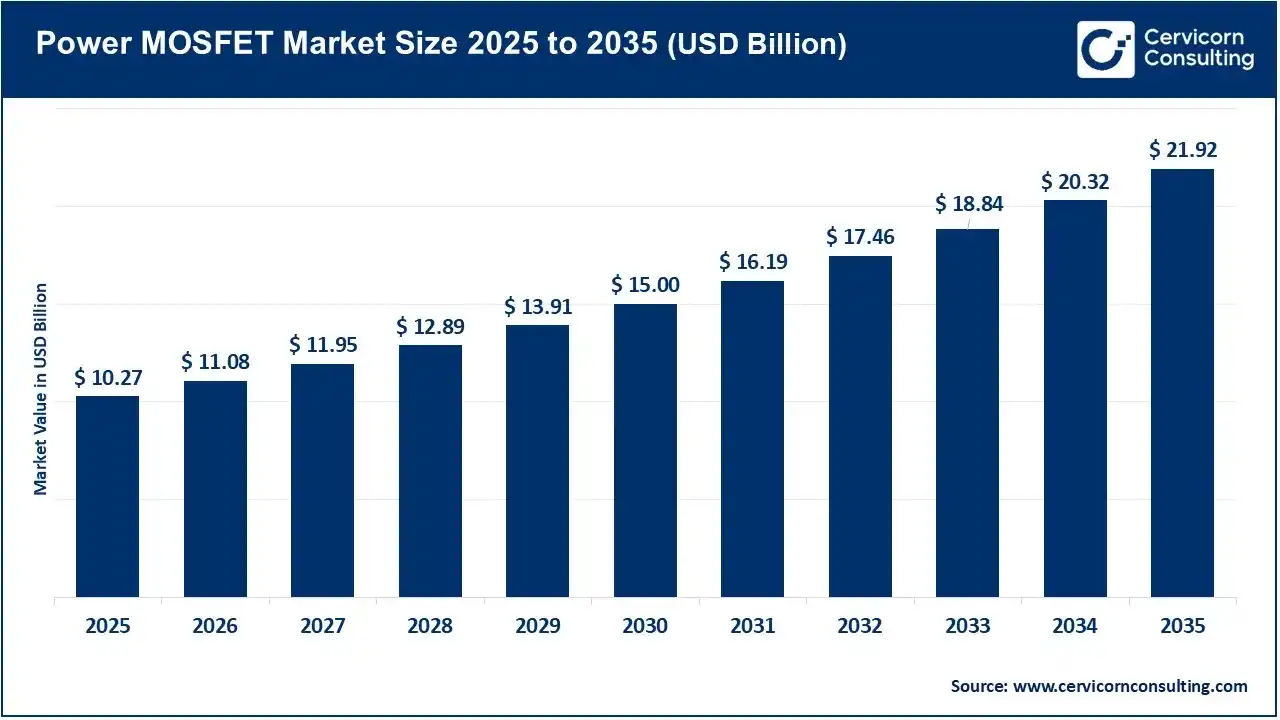
The global power MOSFET market size was valued at USD 10.27 billion in 2025 and is expected to exceed around USD 21.92 billion by 2035, growing at a CAGR of 7.8% during the forecast period of 2026-2035. Alongside ongoing industrial automation, the global market is driven by a surge in electric vehicles and hybrid vehicles, which require high-voltage, low-loss power MOSFETs. However, breakthroughs are driving the adoption of renewable energy and inverters, such as solar PV installations and wind power systems.
- Base Year Market Size (2025): $10.27 billion
- Current Year Market Size (2026): $11.08 billion
- Estimated Year Market Size (2035): $21.92 billion
- Forecast Period CAGR (2026-2035): 7.8%
- Leading Region: Asia-Pacific (revenue share 40%)
Report Highlights
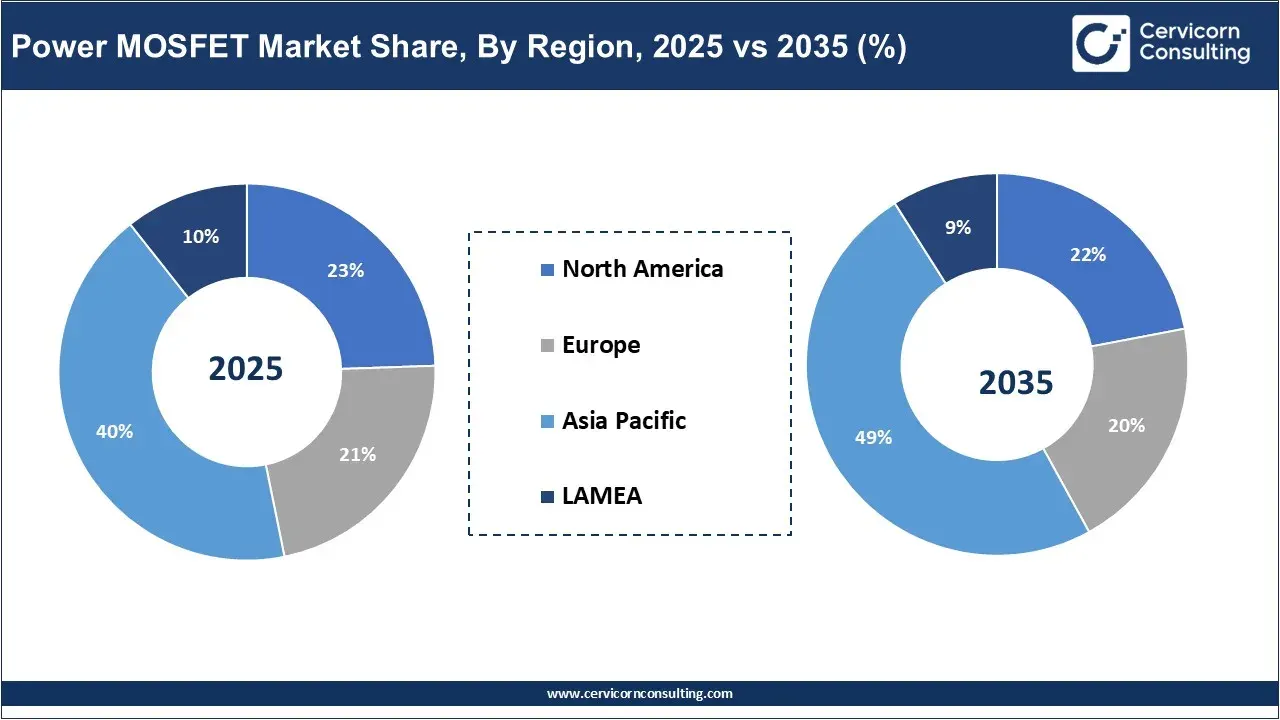
- By region: Asia-Pacific dominated the market in 2025 (revenue share 40%), due to its semiconductor manufacturing hub and large electronics production base.
- By type: Enhancement-mode MOSFETs led the market in 2025 (revenue share 61%), propelled by their broader use in switching and power conversion circuits.
- By material: Silicon registered dominance in the market in 2025 (revenue share 68%) because of its advanced manufacturing base and the widespread use in cost-sensitive power electronics.
- By power rating: Low-voltage power MOSFETs dominated the market in 2025 (revenue share 51%), driven by extensive use in consumer electronics, computing, and low-voltage power management.
- By application: Consumer Electronics led the market in 2025, fueled by massive production volumes and widespread use in power management and switching circuits.
What is the Power MOSFET and Its Major Features?
Primarily, the power MOSFET market refers to the Metal-Oxide-Semiconductor Field-Effect Transistor, a unique electronic semiconductor device that manages high levels of voltage and current and also serves as a rapid electronic switch or amplifier in power electronics. Innovations across the industry are mainly driven by key characteristics of power MOSFETs, such as their high efficiency, which lowers power loss and heat generation during high-current conduction. Along with this, power MOSFETs offer higher frequency, which makes them favourable for high-frequency pulse-width modulation (PWM). Along with simple drive requirements, they indicate a positive temperature coefficient and mirror several MOSFETs easily.
Ongoing Projects
Indian MeitY & POWERGRID Indigenous VSC-HVDC Project
- This project is extended by the involvement of the Indian Ministry of Electronics and Information Technology (MeitY), the Ministry of Power (MoP), and POWERGRID, seeking a collaborative offering of the native design, development, qualification, and validation of Silicon Carbide (SiC) MOSFET-based power modules. This will support establishing a complete local facility for the entire power semiconductor value chain.
Infineon 27 kW PSU Aims at Next-Generation AI Server
- This approach was developed for 800 VDC power distribution systems inside next-generation high-density AI server racks. This fosters the management of vast power delivery demands and a significant reduction in distribution losses as server rack densities rise.
Toshiba’s 80V & 1200V High-Efficiency AI MOSFET Pipelines
- The project is looking forward to commercialising and boosting the manufacturing of highly specialised MOSFET technologies, which are clearly enhanced for AI facilities. This specifically covers 1200V trench-gate Silicon Carbide (SiC) MOSFETs to lower power losses in huge server networks.
Market Dynamics
Key Drivers
- Rise in EV & Automation: Day by day, global customers are increasingly demanding hybrid and electric vehicles, requiring highly efficient power management systems. Many industries are also shifting toward automation, robotic systems, high-capacity power supplies, and bidirectional DC-DC converters that use power MOSFETs.
- Surge in Renewable Energy: The globally expanding importance of sustainable or renewable energy fosters solar power installations, wind power solutions, and energy storage approaches, depending on power MOSFETs & medium-voltage MOSFETs.
- Inclusion of Regulations: As the market inclines towards robust solutions, governments are enforcing rigorous global efficiency benchmarks to lower power usage in appliances, data centers, and power grids.
Market Restraints
- High Upfront Expenses: The implementation of modern semiconductor fabrication, specifically for high-performance or broad-bandgap materials, needs huge initial spending on cleanrooms and equipment and leads to critical stress on profit margins.
- Limitations in Supply Chain & Material: Gradually increasing global trend pressures, logistics challenges, and raw material shortages often result in disruption of entity availability and lead times.
- Rivalry From Options: The power MOSFET market is facing substantial competition from cheap alternatives, like IGBTs (Insulated Gate Bipolar Transistors) and BJTs (Bipolar Junction Transistors), which treat extreme switching speeds as secondary to minimal capital component expenses.
Market Opportunities
- Exploring WBG Materials: The coming era will have a significant opportunity in the adoption of wide-bandgap (WBG) materials, such as Silicon Carbide (SiC MOSFETs) and Gallium Nitride, enabling devices to operate at higher voltages, temperatures, and rapid switching frequencies with minimal thermal losses.
- Transformative 4.0: As the globe is accelerating Industry 4.0, smart factories, and automated machinery, necessitating highly reliable switching components that offer sustained performance in requiring rolling mills, welding systems, and heavy-duty water pump.
- Emphasizing Battery Life: A massive progression in 5G smartphones, laptops, and ultra-portable wearables is strictly demanding highly advanced power management ICs, where power MOSFETs play a vital role to prevent energy loss during rapid switching, directly raising battery runtime.
Market Challenges
- Concerns of Conventional Si: Many of the traditional silicon MOSFETs are facing a growing voltage demand, while to gain low on-resistance and low gate charge for fast fluctuating result as issue and costly.
- Emergence of Stringent Standards: Nowadays, regulatory frameworks are highly forcing stringent regulations, including reliability, thermal performance, and environmental compliance testing to approach safety terms and certification processes extend product arrival period.
- Higher Thermal Pressures: Most of the time, operations under high frequencies, high currents, or linear mode shifts develop major thermal dissipation concerns and probable device damage from thin gate-oxide layers.
Power MOSFET Market Regional Analysis
Why did Asia Pacific Dominate the Market in 2025?
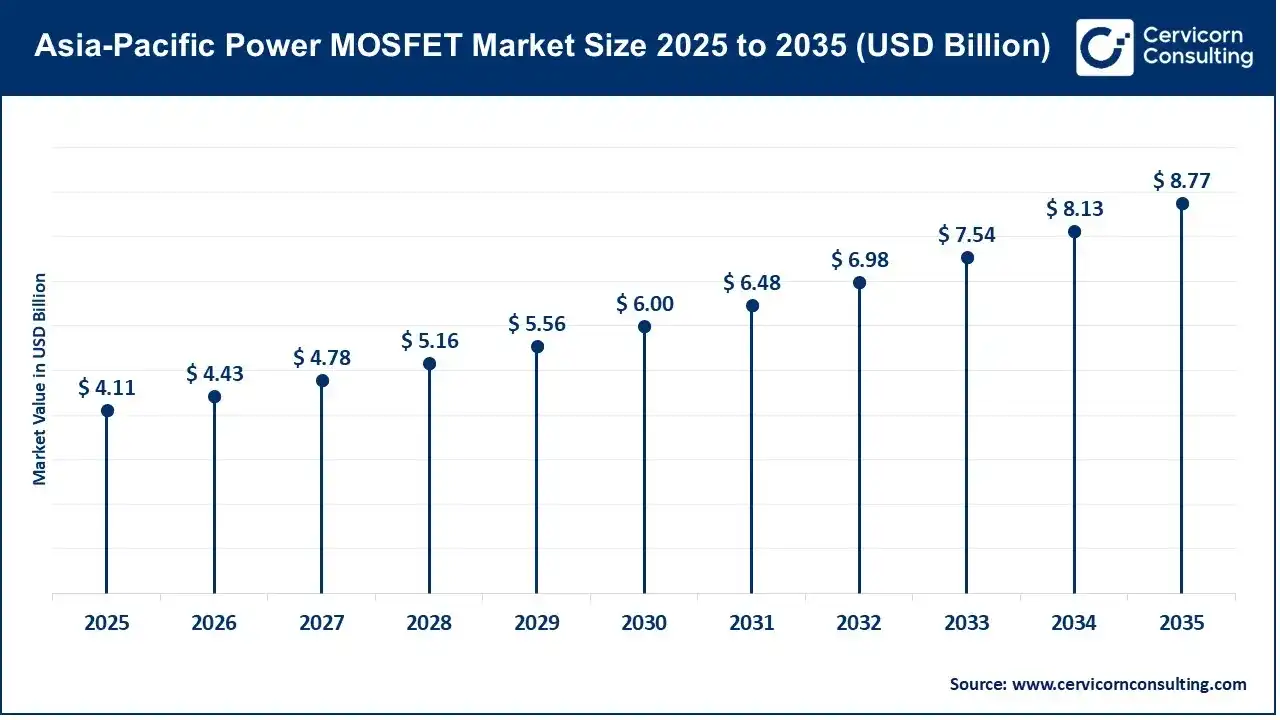
The Asia-Pacific power MOSFET market size was estimated at USD 4.11 billion in 2025 and is projected to hit USD 8.77 billion by 2035. In 2025, Asia Pacific held a major share of 40% of the market, driven by the presence of well-established semiconductor manufacturing hubs. Besides this, China and Japan have noted massive clean-transportation policies and domestic production dominance that expedite the demand for high-voltage and medium-voltage power MOSFETs. Recently, at SEMICON Japan, the Waseda University startup PDS represented the first live, real-time switching demonstration of a packaged p-type diamond MOSFET.
China Market
- In 2025, China was highlighted as a major contributor to the power MOSFET market because of consistency across local production expenses for SiC MOSFETs along with imported IGBT modules. In addition, at the PCIM Expo 2025, WeEn Semiconductors demonstrated ultra-low-resistance 600V super junction MOSFETs that enhance thermal management and efficiency in high-density AI and telecom computing servers.
Why is North America Considered to Grow Fastest During 2026-2035?
The North America power MOSFET market size was valued at USD 2.36 billion in 2025 and is expected to surpass USD 5.04 billion by 2035. North America is expected to expand rapidly in the predicted timeframe, led by immense semiconductor investment, electric vehicle production, and increasing demand for power electronics. The region is gradually seeking the adoption of SiC and GaN MOSFETs and specialized gate driver ICs, coupled with an aim at concentrated distributor inventory buffers and radiation-hardened or high-reliability parts for aerospace, defense, and telecommunications.
United States Market
- Ongoing steps to advance thermal management, including Vishay’s PowerPAK 1521 LR top-cooled SiC package, which significantly reduces thermal resistance and maximises power density in cramped server racks and motor drives. Along with this, U.S. digital innovations are promoting vast computational training and running AI models, requiring renewal of server power supplies and addressing greater demand for ultra-efficient, low-loss MOSFETs.
Power MOSFET Market Segmentation Analysis
Type Analysis
Enhancement-Mode MOSFETs: The enhancement-mode MOSFETs segment held a major share of 61% in 2025 and is predicted to grow rapidly, due to expansive application in switching and power conversion circuits. Also, it supports rising demand for efficient power switching in electric vehicles, data centers, and renewable energy systems. Thousands of producers are pushing consistent growth in AEC-Q101 qualified P-channel enhancement-mode power MOSFETs.
Power MOSFET Market Share, By Type, 2025 (%)
| Type |
Revenue Share, 2025 (%) |
| Enhancement-Mode MOSFETs |
61% |
| Depletion-Mode MOSFETs |
39% |
However, the depletion-mode MOSFETs segment registered notable expansion in the market in 2025, as they serve as default-closed or normally-on switches without the need for gate current or bias voltage at start-up. Alongside this, engineers have shown the monolithic integration of E-mode and D-mode MOSFETs on heteroepitaxial ε-Ga₂O₃ grown on sapphire substrates and enabled direct-coupled FET logic (DCFL) inverters with improved load-to-driver ratios and high noise margin.
Material Analysis
Silicon: The silicon segment accounted for the largest share of 68% of the power MOSFET market in 2025, led by the widespread use in cost-sensitive power electronics and broad demand in surging automotive electrification. By considering its robust performance, iDEAL Semiconductor transitioned its SuperQ® technology into full production and highlighted it as the first prominent architectural shift in silicon MOSFETs in the last 25 years.
Silicon Carbide (SiC): The Silicon Carbide (SiC) segment is anticipated to be the fastest-growing during 2026-2035, as it allows high-efficiency 800V traction inverters, with its higher thermal features. Recent development mainly spotlights a 1-megawatt SiC power module that leverages Aluminum Nitride (AlN) substrates and scaled current capacity from 1100 A to 1400 A with strict threshold voltage matching across parallel dies.
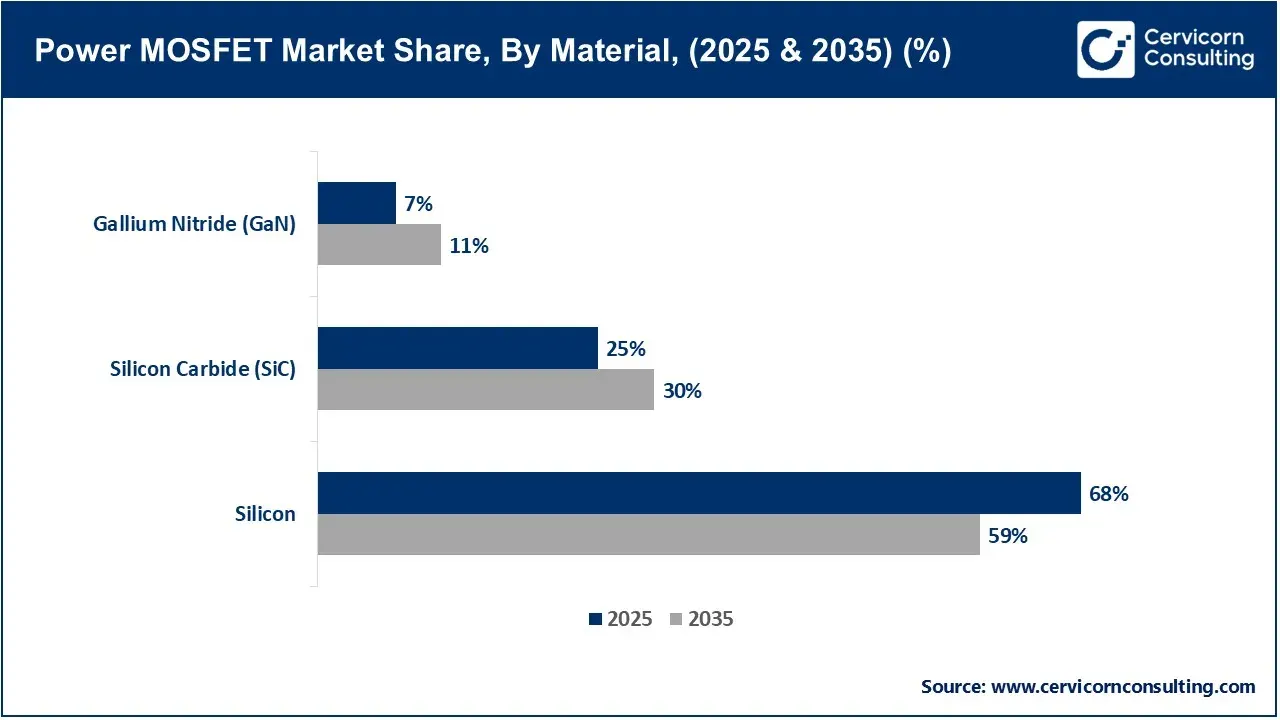
The gallium nitride (GaN) segment is expected to expand significantly in the coming years, due to its wider application in fast-charging and consumer electronics, coupled with a movement towards 48V power systems. According to recent studies, Intel and industry developers have advanced DrGaN and multi-chip automotive co-packaging, while MIT researchers have uncovered unified GaN transistors in ultra-thin single-crystal diamond layers.
Power Rating Analysis
Low-Voltage Power MOSFETs: The low-voltage power MOSFETs segment captured a dominant share of 51% of the market in 2025, driven by expansive applications and a rise in advanced portable devices. In 2025, innovative ideas created advanced ferroelectric-stacked NCFET designs that break the conventional Boltzmann subthreshold swing limit and allow minimal operating voltages, lower static leakage, and high on-state current for strict energy-budget logic and power management.
High-Voltage Power MOSFETs: The high-voltage power MOSFETs segment is projected to witness rapid expansion during the forecast period, propelled by electric mobility, industrial power conversion, and renewable energy applications. Most of the players have presented large-die SiC MOSFETs reaching over 8 kV blocking voltage, which surpasses planar SiC well past legacy limits into grid-scale HVDC and traction.
Power MOSFET Market Share, By Power Rating, 2025 & 2035 (%)
| Power Rating |
Revenue Share, 2025 (%) |
Revenue Share, 2035 (%) |
| Low-Voltage Power MOSFETs |
51% |
46% |
| Medium-Voltage Power MOSFETs |
30% |
32% |
| High-Voltage Power MOSFETs |
19% |
22% |
The medium-voltage power MOSFETs segment registered lucrative growth in the power MOSFET market in 2025 because they offer advances in motor control, energy infrastructure and expansion of GaN. Certain studies have clarified that Level 2 and Level 3 EV chargers led as key consumers of 400V–600V medium-voltage MOSFETs, enhancing high-speed switching with lower heat dissipation.
Application Analysis
Consumer Electronics: The consumer electronics segment led the market in 2025, driven by surging growth of portable devices and expanded expectations for higher battery life. Specifically, producers have strengthened the scale-up of Gen6 Superjunction MOSFET portfolios customised for AI laptop adapters, smart home appliances, and AI-powered smart TVs.
Automotive and Electric Vehicles: The automotive and electric vehicles segment is estimated to grow at the fastest rate during 2026-2035, supported by electrification, onboard charging, battery systems, and auxiliary power conversion. The worldwide automakers are broadening EV platforms to 800V and unveiling 1,200V-rated inverter designs that crucially lower charging times and elevate vehicle range and require high-voltage-rated SiC power modules.
Power MOSFET Market Share, By Application, 2025 (%)
| Application |
Revenue Share, 2025 (%) |
| Automotive and Electric Vehicles |
25% |
| Consumer Electronics |
24% |
| Data Centers and Telecommunications |
18% |
| Industrial Equipment |
20% |
| Renewable Energy and Power Supplies |
13% |
The renewable energy and power supplies segment is predicted to expand notably in the upcoming years, fueled by a focus on reducing fossil fuel dependence and CO₂ emissions and faster launch of utility-scale and commercial energy storage platforms. The latest power modules are widely integrating SiC/GaN dies with improved gate drivers, stray-inductance reduction, and direct-cooled substrates to control severe thermal environments in outdoor solar farms and wind turbine nacelles.
Latest Launches
- September 2026: The Indian government began stakeholder consultations to generate indigenous power semiconductors and modules for the national electricity grid, with a focus on eliminating foreign technology reliance across critical power infrastructure.
- September 2026: ROHM Semiconductor introduced the RS4P063BPHZG, a 100V MOSFET improved for automotive safety functions and protection circuits.
- September 2026: L&T Semiconductor Technologies Limited (LTSCT) rolled out 40 products at SEMICON India 2026 and debuted its first SiC platform and in-house motor controller.
- August 2026: Para Light unveiled ThermaFlat™ SiC MOSFETs to interrupt the thermal barrier in high-power applications.
- June 2026: ROHM Semiconductor launched the AG16xFNxx Series, a lineup of 80V power MOSFETs for 48V power supply systems in automotive applications.
Key Companies
Segments Covered
By Type
- Enhancement-Mode MOSFETs
- Depletion-Mode MOSFETs
By Material
- Silicon
- Silicon Carbide (SiC)
- Gallium Nitride (GaN)
By Power Rating
- Low-Voltage Power MOSFETs
- Medium-Voltage Power MOSFETs
- High-Voltage Power MOSFETs
By Application
- Automotive and Electric Vehicles
- Consumer Electronics
- Data Centers and Telecommunications
- Industrial Equipment
- Renewable Energy and Power Supplies
By Region
- Asia-Pacific
- North America
- Europe
- Latin America
- Middle East and Africa
