Power Management IC Market Size, Growth, Forecast 2026 To 2035
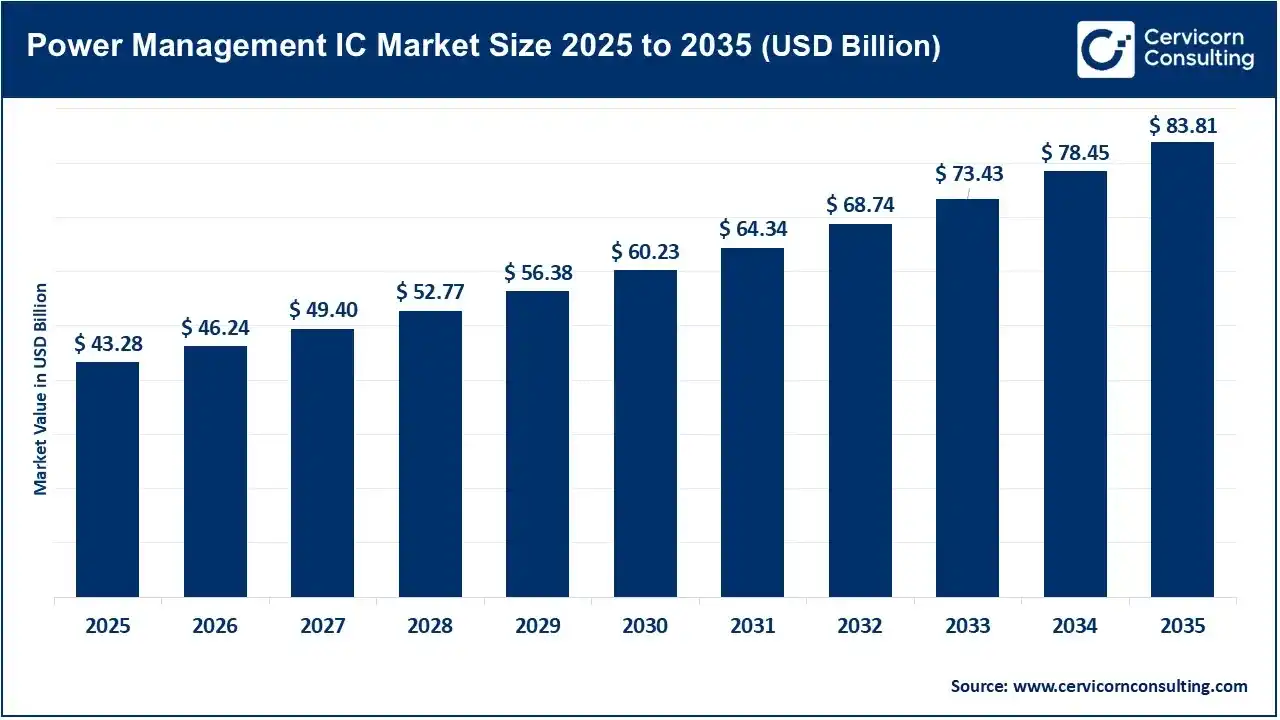
The global power management IC (PMIC) market size was valued at USD 43.28 billion in 2025 and is expected to be worth around USD 83.81 billion by 2035, exhibiting a compound annual growth rate (CAGR) of 6.8% over the forecast period 2026 to 2035. The rapid electrification and digitalization of vehicles are major growth drivers for PMICs, as EVs require sophisticated battery monitoring, voltage regulation, thermal management, and power distribution.
Global EV sales surpassed 17 million units in 2024, while modern battery electric vehicles can incorporate approximately 150–200 power-management ICs per platform, compared with fewer than 80 in conventional vehicles. Increasing adoption of ADAS, infotainment, connected systems, and zonal vehicle architectures is further increasing semiconductor content per vehicle.
Rising demand for smartphones, AI-enabled devices, IoT equipment, data center infrastructure, and energy-efficient electronics is also supporting PMIC adoption. Advanced smartphone processors increasingly use 5 nm, 4 nm, 3 nm and 2 nm technologies, with advanced nodes expected to represent nearly 50% of smartphone AP-SoC shipments in 2025, increasing the need for precise and efficient power delivery. Additionally, demand for faster charging, longer battery life, lower standby power, and higher energy efficiency is encouraging OEMs to integrate more sophisticated PMIC solutions.
Report Highlights
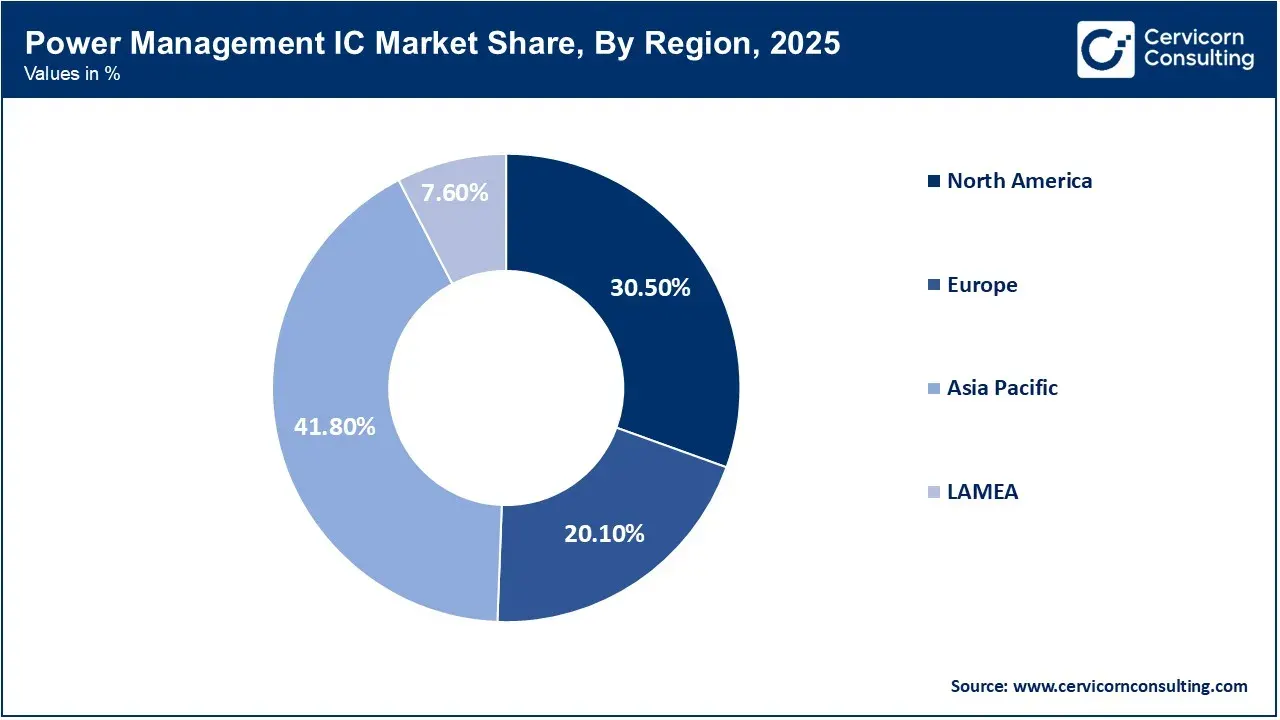
- Asia-Pacific dominated the regional market with 41.8% share, supported by semiconductor manufacturing, consumer electronics production, automotive systems, and industrial applications.
- Voltage Regulator ICs led the product segment with 32.8% share, driven by widespread adoption across consumer, automotive, industrial, and communication electronics.
- Battery Management ICs accounted for approximately 27.0% share, supported by increasing EV production, portable electronics, rechargeable batteries, and energy-storage applications.
- Consumer Electronics Manufacturers dominated end users with 32.5% share, driven by smartphones, laptops, tablets, wearables, and smart-home device demand.
- Automotive OEMs represented approximately 23.8% share, supported by growing EV adoption, ADAS integration, infotainment systems, and increasingly electronic vehicle architectures.
What is a Power Management IC?
A Power Management Integrated Circuit (PMIC) is a semiconductor device that manages, regulates, converts, and distributes electrical power within electronic systems. PMICs integrate functions such as voltage regulation, DC-DC conversion, battery charging, power sequencing, monitoring, and protection into a compact chip, reducing the need for multiple discrete components while improving energy efficiency and system reliability. They are widely used in smartphones, wearables, automotive electronics, EVs, industrial equipment, data centers, and IoT devices.
Power Management IC Market Recent Milestones
| Year |
Company |
Recent Milestone |
Market Significance |
| 2026 |
Microchip Technology |
Launched the MCPF1525 power module delivering 25A per module, stackable up to 200A, for AI and high-performance computing applications. |
Addresses rising high-current power-delivery requirements in AI data centers. |
| 2026 |
Texas Instruments |
Began production at its USD 11 billion Sherman, Texas, 300-mm semiconductor fab, adding approximately 13,000 wafers/month of analog capacity. |
Expands domestic analog and power-management semiconductor manufacturing capacity. |
| 2026 |
Infineon Technologies |
Introduced the AURIX TC4x microcontroller platform with integrated multi-phase PMIC capabilities for 800-V battery systems. |
Strengthens PMIC integration for next-generation EV power architectures. |
| 2025 |
ABLIC / MinebeaMitsumi |
Launched the S-19560B automotive camera PMIC with two DC-DC converters and one LDO in a 2 × 3 × 0.5 mm package. |
Supports smaller automotive camera modules and reduces mounting area by approximately 20% versus competing four-channel solutions. |
| 2025 |
Microchip Technology |
Introduced the MCP16701, integrating eight buck converters, four LDOs, and a controller. |
Can deliver approximately 48% PCB-area reduction versus a discrete implementation, targeting AI, industrial computing, and data centers. |
| 2025 |
Infineon Technologies |
Expanded its OPTIREG PMIC portfolio with the TLF35585 multi-rail PMIC for safety-critical automotive systems. |
Supports increasingly complex automotive ECUs requiring multiple regulated power rails and functional-safety features. |
| 2025 |
Texas Instruments |
Introduced the TPS650352-Q1 PMIC for automotive camera modules, integrating three step-down converters and one LDO. |
Targets growing power-management requirements in surround-view, driver-monitoring, and other automotive camera systems. |
Power Management IC Market Dynamics
Market Drivers
1. Rising adoption of electric vehicles
Vehicle electrification is increasing demand for PMICs used in battery management, voltage conversion, charging, and power distribution. Global electric vehicle sales exceeded 14 million units in 2025, with China representing around 60% of global volume. Battery-management semiconductor content per vehicle also increased from approximately USD 450 in 2024 to USD 620 in 2025, reflecting the growing electronic complexity of electrified vehicles. The transition toward higher-voltage vehicle architectures is further encouraging adoption of advanced PMIC solutions.
2. Expansion of AI and high-performance computing
Increasing AI workloads are creating substantial demand for efficient, high-current power delivery in servers, accelerators, and data-center infrastructure. Modern telecom and computing systems increasingly deploy multi-phase PMIC architectures capable of operating above 92% efficiency, while distributed power architectures can reduce copper losses by approximately 15%. The shift toward workload-intensive AI computing is therefore encouraging manufacturers to develop PMICs offering higher power density, improved thermal performance, faster transient response, and sophisticated digital power-management capabilities.
Market Restraints
1. High design and development costs
Developing advanced PMICs requires substantial investment in semiconductor design, validation, packaging, testing, and qualification, particularly for automotive and industrial applications. Smaller OEMs can face non-recurring engineering costs of approximately USD 3 million–USD 5 million when developing customized solutions. Consequently, some manufacturers increasingly use catalog PMICs to reduce development expenditure and shorten design cycles. This cost barrier can limit customization, discourage smaller companies from entering specialized applications, and constrain adoption of highly integrated PMIC architectures.
2. Supply-chain concentration and wafer constraints
PMIC manufacturing remains exposed to semiconductor-fab concentration, geopolitical risks, and fluctuations in foundry capacity. Utilization at 180-nm and 130-nm production lines declined from 92% in Q1 2025 to 78% in Q3 2025, while reported lead times reached approximately 22 weeks at some foundries. Such capacity constraints can delay product launches, increase wafer premiums, and create uncertainty for automotive and industrial customers that require long-term component availability and qualification stability.
Market Opportunities
1. Growth of IoT and ultra-low-power electronics
Expanding IoT deployment is creating opportunities for PMICs optimized for extremely low standby consumption and extended battery life. India alone was expected to exceed 3.2 billion IoT connections by 2025, illustrating the scale of connected-device deployment. Sensors, wearables, smart-home equipment, and industrial IoT devices increasingly require compact PMICs capable of operating efficiently under intermittent and low-power loads. This creates opportunities for suppliers developing highly integrated, ultra-low-quiescent-current power-management solutions.
2. Emergence of GaN and SiC power technologies
Wide-bandgap semiconductor technologies are creating opportunities for next-generation PMIC and power-conversion architectures requiring higher switching frequencies, improved thermal performance, and reduced losses. In EV applications, emerging 800-V architectures increasingly require advanced DC-DC conversion and high-voltage power-management solutions. Some newer automotive power-conversion systems operate at switching frequencies above 100 kHz and junction temperatures exceeding 175°C, creating opportunities for PMIC suppliers with advanced packaging and wide-bandgap expertise.
Market Challenges
1. Increasing miniaturization and thermal-management requirements
PMIC manufacturers must continuously reduce chip and package dimensions while simultaneously supporting higher power densities. Smaller packages make heat dissipation increasingly difficult, particularly in AI servers, automotive electronics, and compact consumer devices. High-performance systems can require PMICs supporting currents of 200 A in multi-phase power architectures, intensifying thermal and reliability requirements. Managing heat without sacrificing efficiency, switching performance, or operating lifetime remains a major engineering challenge for next-generation PMIC designs.
2. Complex qualification and reliability requirements
PMIC suppliers face increasingly demanding reliability standards as their products move into safety-critical automotive, industrial, and medical applications. Automotive systems may require operation across approximately −40°C to +105°C, alongside stringent lifetime and functional-safety requirements. PMICs must also maintain stable voltage regulation under rapid load changes, temperature fluctuations, and electrical transients. Meeting these requirements increases testing and qualification complexity while extending development timelines, creating challenges for manufacturers seeking to rapidly introduce new power-management technologies.
Power Management IC Market Regional Analysis
The power management IC market is segmented by region into North America, Europe, Asia-Pacific, Latin America, and LAMEA. Here is a brief overview of each region:
Asia-Pacific (APAC) Power Management IC Market: Driven by Electronics Manufacturing, Semiconductor Expansion, EV Adoption, AI Infrastructure, and Industrial Electrification
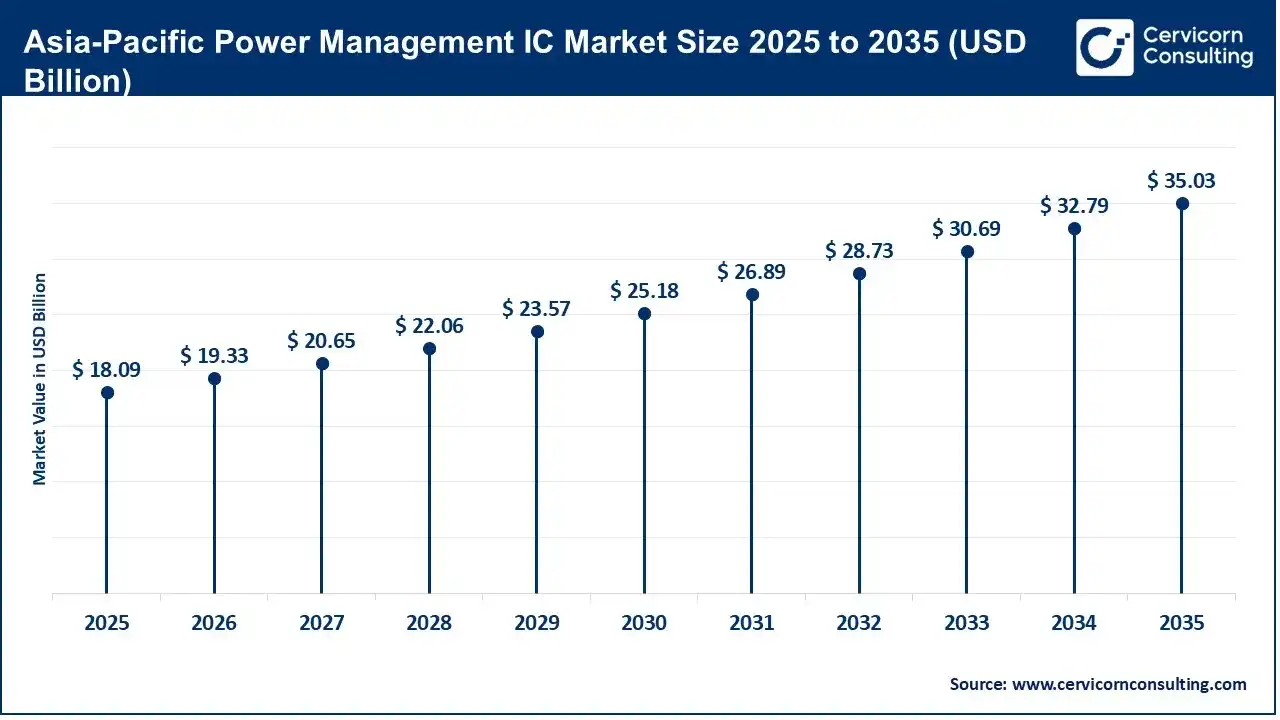
The Asia-Pacific power management IC market size was valued at USD 18.09 billion in 2025 and is expected to exceed around USD 35.03 billion by 2035. Asia-Pacific is the largest and most influential region, supported by its concentration of semiconductor fabrication, consumer electronics manufacturing, automotive production, and rapidly expanding digital infrastructure. The region accounted for approximately 41.8% of global PMIC revenue in 2025, highlighting its substantial contribution to worldwide demand. China, Taiwan, South Korea, Japan, and India form the core regional ecosystem, while Southeast Asia is gaining importance through electronics manufacturing and semiconductor supply-chain diversification.
China: Massive Electronics Manufacturing, EV Production, Semiconductor Self-Sufficiency, and 5G Infrastructure Drive PMIC Demand
- China held the largest country-level share of the global PMIC market in 2025, supported by its extensive consumer-electronics manufacturing base and domestic semiconductor ecosystem.
- China accounted for 50.6% of Asia-Pacific semiconductor industry revenue in 2025, creating a substantial downstream market for voltage regulators, battery-management ICs, and power-conversion devices.
- China's semiconductor equipment spending reached approximately USD 49.3 billion in 2025, reinforcing domestic manufacturing capacity and supporting demand for locally sourced power-management components.
Taiwan: Foundry Leadership, Advanced Semiconductor Manufacturing, AI Hardware, and Electronics Supply Chains Support PMIC Growth
- Taiwan remains a critical component of the Asia-Pacific semiconductor ecosystem, particularly through its concentration of advanced foundry and electronics manufacturing capabilities.
- Taiwan accounted for approximately USD 31.5 billion in semiconductor equipment spending in 2025, reflecting continued investment in advanced manufacturing capacity.
North America Power Management IC Market: Driven by Data Center Expansion, AI Infrastructure, Automotive Electrification, Advanced Electronics, and Semiconductor Innovation
The North America power management IC market size was estimated at USD 13.20 billion in 2025 and is projected to surpass around USD 25.56 billion by 2035. North America is a leading region, supported by strong semiconductor innovation, expanding AI and data-center infrastructure, automotive electrification, industrial automation, and widespread adoption of advanced electronics. The United States represents the principal demand center because of its large technology ecosystem, hyperscale data centers, semiconductor manufacturers, automotive industry, and defense electronics sector. North America accounted for approximately 30.5% of the global PMIC market in 2025, reflecting its strong concentration of high-value electronics and power-management applications.
United States: AI Data Centers, Automotive Electrification, Semiconductor Investment, and Advanced Computing Drive PMIC Demand
- U.S. data centers consumed approximately 183 TWh of electricity in 2024, equivalent to more than 4% of national electricity consumption, creating significant demand for high-efficiency PMICs, voltage regulators, and power-conversion solutions.
- Data-center electricity consumption in the United States is projected to reach 426 TWh by 2030, representing a 133% increase from 2024 and creating substantial opportunities for advanced power-management technologies.
- U.S. electricity demand increased approximately 1.7% annually between 2020 and 2025, compared with only 0.1% annually during 2005–2019, with data centers identified as an important contributor to the increase.
Canada: Automotive Electrification, Data Centers, Clean Energy, and Industrial Digitalization Support Market Growth
- Canada's electric-car sales share reached approximately 11% in 2025, despite sales declining more than 30% from 2024 following the end of the federal iZEV rebate program, maintaining a substantial installed base for automotive power-management applications.
- Canada's expanding data-center and cloud-computing infrastructure is increasing requirements for efficient power conversion, voltage regulation, and thermal-management components.
Europe Power Management IC Market: Driven by Automotive Electrification, Industrial Automation, Renewable Energy, Semiconductor Localization, and Energy-Efficient Electronics
The Europe power management IC market size was recorded at USD 8.70 billion in 2025 and is forecasted to hit USD 16.85 billion by 2035. Europe is a significant and technologically advanced region, supported by strong automotive, industrial, renewable-energy, telecommunications, and semiconductor ecosystems. Germany, France, the U.K., Italy, and the Netherlands represent important demand centers, while European semiconductor companies such as Infineon Technologies and STMicroelectronics strengthen the regional supply base.
Germany: EV Adoption, Automotive Electronics, Industrial Automation, and Semiconductor Investment Drive PMIC Demand
- Germany recorded approximately 850,000 electric-car sales in 2025, representing a 50% year-over-year increase, strengthening demand for battery-management, voltage-regulation, and power-conversion ICs.
- Around 30% of cars sold in Germany in 2025 were electric, demonstrating the country's rapidly expanding electrified-vehicle ecosystem.
- Germany is a major European hub for automotive electronics and industrial automation, supporting PMIC applications across EV powertrains, ADAS, factory automation, robotics, and industrial control systems.
France: Automotive Electrification, Renewable Energy, and Industrial Digitalization Support Market Growth
- France's battery-electric vehicle sales increased by approximately 12.5% in 2025, while BEVs represented around 17% of EU car registrations overall, supporting demand for automotive PMICs.
- France is investing heavily in renewable-energy generation and electrification, increasing requirements for power conversion, energy storage, grid-management, and power-conditioning electronics.
LAMEA (Latin America, Middle East & Africa) Power Management IC Market: Driven by Renewable Energy, Digital Infrastructure, EV Adoption, Telecom Expansion, and Industrial Modernization
The LAMEA power management IC market was valued at USD 3.29 billion in 2025 and is anticipated to reach USD 6.37 billion by 2035. Represents an emerging opportunity in the market, supported by LAMEA expanding telecommunications infrastructure, renewable-energy deployment, data-center investments, electric mobility, and industrial digitalization. Brazil, Mexico, Saudi Arabia, the UAE, South Africa, and other GCC and African economies are becoming important demand centers. The LAMEA PMIC market accounts for 7.6% of global PMIC revenue, with switching regulators representing the largest product category at 26.7% of regional revenue.
Latin America: EV Adoption, Consumer Electronics, Renewable Energy, and Automotive Manufacturing Support PMIC Demand
- Latin America's electric-car sales exceeded 350,000 units in 2025, increasing 75% year over year, creating growing demand for battery-management and power-conversion ICs.
- Brazil accounted for approximately 180,000 electric-car sales in 2025, equivalent to 9% of new-car sales, up from 6.5% in 2024.
- Mexico and Brazil are important PMIC markets because of their consumer-electronics assembly and automotive manufacturing industries, which require voltage regulators, battery-management ICs, DC-DC converters, and other power solutions.
Middle East: Data Centers, AI Infrastructure, Smart Cities, Renewable Energy, and EVs Create High-Value PMIC Opportunities
- Saudi Arabia and the UAE are leading data-center investment across the region, supported by government-backed digital-transformation programs, AI initiatives, and hyperscale cloud deployments.
- The Middle East & Africa data-center construction market is projected to expand at 25.34% annually from 2025 to 2031, creating substantial demand for high-efficiency power-delivery and voltage-regulation components.
- Renewable-energy development is accelerating, particularly solar projects in Saudi Arabia, the UAE, Egypt, and other markets, supporting PMIC demand in inverters, storage systems, and power-conditioning equipment.
Power Management IC Market Segmentation Analysis
The power management IC market is segmented into product type, end user, and geography.
Product Type Analysis
Voltage Regulator ICs are expected to dominate the product-type segment, supported by their fundamental role in maintaining stable voltage across smartphones, laptops, automotive electronics, industrial equipment, and communication systems. Their broad applicability across virtually every electronic architecture sustains high-volume demand. In 2025, voltage regulators are projected to account for 32.8% of the PMIC market, reflecting their widespread integration and importance in protecting sensitive components from voltage fluctuations while improving overall system reliability and energy efficiency.
Power Management IC Market Share, By Product Type, 2025 (%)
| Product Type |
Revenue Share, 2025 (%) |
| Voltage Regulator ICs |
32.8% |
| Battery Management ICs |
27.0% |
| DC-DC Converter ICs |
15.2% |
| AC-DC Converter ICs |
9.1% |
| Motor Control ICs |
5.8% |
| LED Driver ICs |
4.2% |
| Power Factor Correction ICs |
2.7% |
| Others |
3.2% |
Battery Management ICs are projected to record the fastest growth among product categories, driven by expanding electric-vehicle production, rechargeable consumer electronics, portable devices, and stationary energy-storage systems. These ICs provide cell monitoring, balancing, charging control, temperature sensing, and battery protection, making them increasingly essential for lithium-ion and emerging battery technologies. Industry estimates indicate that Battery Management ICs represented 27% of PMIC revenue in 2025 and are forecast to grow at 8.6% annually through 2035, supported by electrification and battery-intensive applications.
End User Analysis
Consumer Electronics Manufacturers represent the dominant end-user segment because smartphones, tablets, laptops, wearables, smart-home products, and other portable devices require multiple PMIC functions for voltage regulation, charging, power sequencing, and energy optimization. High unit shipments and frequent product refresh cycles continue to generate substantial recurring demand. Consumer electronics accounted for approximately 32.5% of PMIC revenue in 2025, reflecting the segment's strong dependence on compact, efficient, and highly integrated power-management solutions to extend battery life and support increasingly sophisticated electronic functionality.
Power Management IC Market, By End User, 2025 (%)
| End User |
Revenue Share, 2025 (%) |
| Consumer Electronics Manufacturers |
32.5% |
| Automotive OEMs |
23.8% |
| Industrial Equipment Manufacturers |
13.5% |
| Telecommunication Companies |
9.6% |
| Data Center Operators |
7.4% |
| Healthcare Equipment Manufacturers |
4.5% |
| Aerospace & Defense Manufacturers |
3.2% |
| Energy & Utility Companies |
3.0% |
| Others |
2.5% |
Automotive OEMs are expected to be the fastest-growing end-user segment as electrification, ADAS, connected vehicles, infotainment, and increasingly distributed electrical architectures increase semiconductor content per vehicle. PMICs are critical for battery management, voltage conversion, power distribution, and functional safety across multiple electronic control units. Automotive and e-mobility applications are projected to expand at approximately 8.9% annually through 2035, making them the fastest-growing major application category. The transition toward EVs and advanced vehicle architectures will further accelerate demand for sophisticated PMIC solutions.
Power Management IC Market Top Companies
Segments Covered
By Product Type
- Voltage Regulator ICs
- Linear Regulators
- Switching Regulators
- Low-Dropout (LDO) Regulators
- Battery Management ICs
- DC-DC Converter ICs
- AC-DC Converter ICs
- Motor Control ICs
- LED Driver ICs
- Power Factor Correction ICs
- Others
By End User
- Consumer Electronics Manufacturers
- Automotive OEMs
- Industrial Equipment Manufacturers
- Telecommunication Companies
- Data Center Operators
- Healthcare Equipment Manufacturers
- Aerospace & Defense Manufacturers
- Energy & Utility Companies
- Others
By Geography
- North America
- Europe
- Asia-Pacific
- LAMEA