Plastic Injection Molding Market Size, Growth, Forecast 2026 to 2035
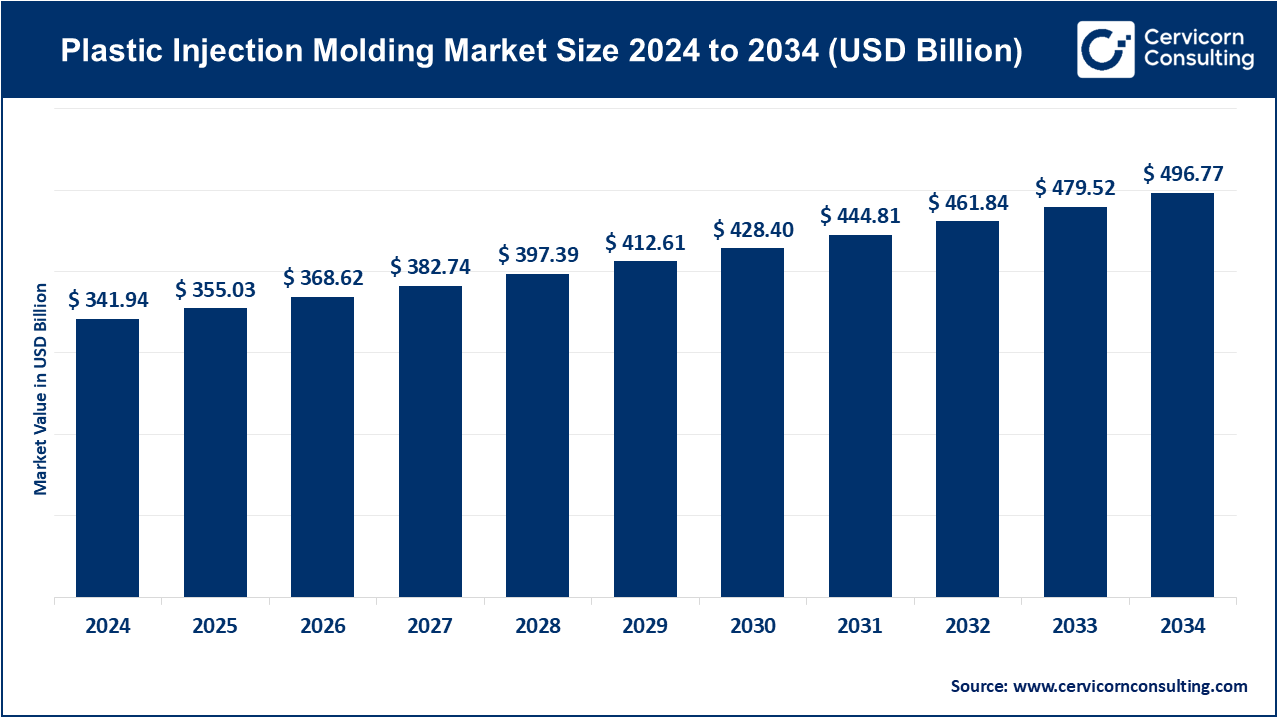
The global plastic injection molding market size was valued at USD 355.03 billion in 2025 and is expected to be worth around USD 514.30 billion by 2035, growing at a compound annual growth rate (CAGR) of 3.78% over the forecast period from 2026 to 2035.
The plastic injection molding market is evolving rapidly, driven by the increasing demand for lightweight, durable, and cost-effective products across various sectors. The automotive industry, in particular, is one of the largest contributors to market growth, as manufacturers increasingly rely on injection molding to create complex components with high precision. Moreover, the growing adoption of electric vehicles (EVs) has amplified the need for efficient production of parts such as battery housings, charging components, and interior features, further driving demand for plastic injection molding. The medical and healthcare sectors are also playing a crucial role in the expansion of the market. With the rise of advanced medical devices, diagnostic equipment, and packaging for pharmaceuticals, there is a heightened need for custom-designed, high-quality plastic components that can meet stringent regulatory standards. In 2021, the United States significantly increased its imports of injection-molding machines, with purchases amounting to USD 822 million from January to October—a 43% rise compared to the same period in the previous year. The total imports for 2021 were estimated to surpass USD 1 billion.
Plastic injection molding is a manufacturing process used to produce parts by injecting molten plastic into a mold. The plastic is first heated until it melts, then injected under high pressure into a mold cavity where it cools and solidifies into the desired shape. This process is widely used to create a variety of products, from small components like bottle caps to larger items like automotive parts. The key advantage of injection molding is that it can produce high volumes of parts with consistent quality and precision, making it an essential process for industries like automotive, electronics, and consumer goods.
Report Highlights
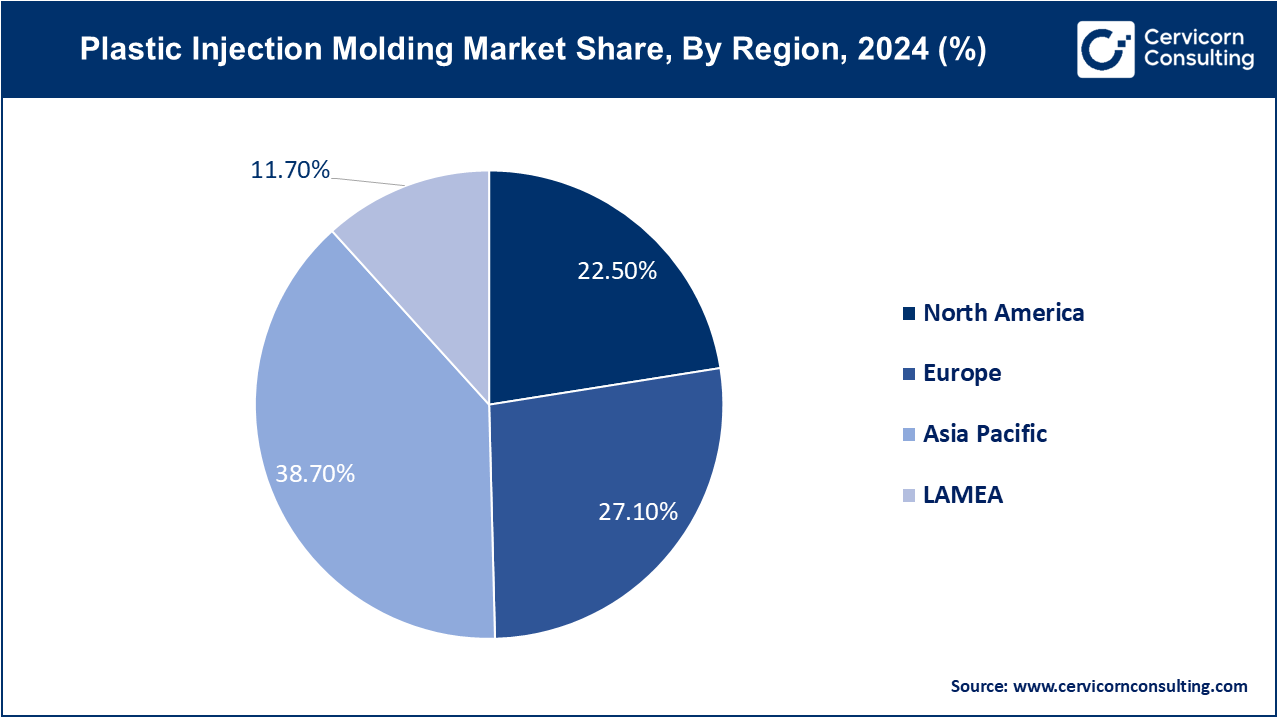
- By region, Asia Pacific dominated the plastic injection molding market with the highest revenue share of 38.7% in 2025, driven by its large-scale manufacturing base, expanding automotive and consumer electronics industries, cost-effective production capabilities, and increasing demand for plastic components across China, India, Japan, and Southeast Asia.
- Europe accounted for a revenue share of around 27.1% in 2025, owing to the strong presence of automotive OEMs, medical device manufacturers, advanced industrial production, and growing adoption of high-performance engineering plastics and sustainable molding technologies.
- By raw material type, the polypropylene segment dominated the market in 2025, due to its lightweight nature, excellent chemical resistance, low production cost, and extensive use in automotive parts, packaging, consumer goods, and healthcare applications.
- By application, the packaging segment held the largest market share in 2025, supported by increasing demand for rigid packaging, food and beverage containers, pharmaceutical packaging, and e-commerce packaging solutions requiring high-volume, cost-efficient production.
Statistics and Investment Landscape (2025-2026)
- Plastics Europe data reported that global production reached 413.8 million metric tons in 2023, and around 54% of the global output came from the Asian continent which strengthens its position on the front lines when it comes to supplying feedstocks for injection molding.
- The plastics-producing countries most dominant globally (54% from Asia) were China with 33% and Europe with 19.3%.
- The global injection molded packaging market accounts for some 40% of all global plastics production, positioning the packaging sector as the largest consumer of injection molded plastics.
- The EU will require all plastic packaging sold on the EU market to be economically recyclable by 2030, driving demand for the latest in recyclable material friendly injection molding equipment.
- The use of plastics in healthcare remains among the most rapidly growing application markets for precision injection molding; driven by growing requirements in disposable devices, diagnostic, inhalation devices, insulin pens, surgical tools and pharmaceuticals.
- Medical-grade plastic component manufacturing, a significant application for cleanroom injection molding, continues to grow.
Top 5 Countries Investing in Plastic Injection Molding
| Country |
Major Investment Drivers |
Recent Developments |
| China |
Expansion of polymer production, EV manufacturing, consumer electronics, packaging |
Continuous investment in high-volume smart manufacturing, electric injection molding machines, and advanced polymer production facilities |
| United States |
Medical devices, aerospace, automotive reshoring, automation |
Investments in cleanroom molding, robotics, Industry 4.0 technologies, and precision manufacturing supported by federal incentives |
| Germany |
Automotive, industrial automation, sustainable plastics |
Significant investments in electric injection molding machines, recycled engineering plastics, and circular economy initiatives |
| India |
Make in India, PLI schemes, packaging, automotive, consumer goods |
Capacity expansion by domestic manufacturers, increasing FDI, and rising investments in medical devices and electronics manufacturing |
| Japan |
Precision engineering, electronics, healthcare |
Continued investment in ultra-precision molding, lightweight materials, and automation technologies for automotive and electronics applications |
Growth Factors
- Rising Demand from the Packaging Industry: Injection molded plastics are widely used in packaging applications, especially in food packaging, as they do not react with food, thus making it durable. The most common applications for these are caps, closures, containers, bottles, and many more. Moreover, the latest innovations in injection molding technology are expected to have a positive impact on the injection molded plastics market growth as the new packaging that is coming into the market is eco-friendly and 100% recyclable. Furthermore, various government bodies are supporting recyclable packaging as it reduces the carbon footprint and thus is expected to boost the market.
- The Expanding Automotive Industry: Because injection molded plastics are versatile, lightweight, and affordable, automakers are using them more and more. These polymers are utilized in a variety of automotive parts, such as engine parts, under-the-hood components, exterior and interior panels. Lightweight materials are being used by automakers for increasing fuel efficiency and lowering emissions in owing to the consumer demand for environmentally friendly automobiles. Furthermore, the demand for injection-molded plastics is projected to soar in tandem with the global automotive industry and thus continue to expand in the future.
- Increased Demand for Consumer Goods & Electronics: Plastic is an ideal material for products in electronics as it is easy to mold and design and can be molded with reduced assembly costs by incorporating self-adhesive tabs that fit together without additional clips, brackets, screws or fasteners. Some of the electronic components where injection molding is commonly used are headphone cables and plugs, LEDs and assemblies, motor housings, electrical relays and switches, sensors, temperature control, inkjet printers, computer boards and casings, cell phone components and covers, electrical wiring, power tool casings and many more.
- Growth in the Construction Industry: The construction industry is expected to grow due to a combination of factors such as government regulations promoting energy-efficient structures and smart building technologies, consumer preference for high-performance materials, and the adoption of new manufacturing technologies. In the construction industry, injection-molded plastics are used to replace a variety of alloys and metals to enhance waterproofing, weight, insulation, UV protection, and cost-effectiveness. In the construction sector, plastic is most frequently used for flooring, pipes, walls, roofs, and insulation.
Recent Trends
- Increasing Automation and Smart Manufacturing: One trend that is evident in the plastic injection molding market is the introduction of sustainable and eco-friendly products. Moreover, every insulation material today is manufactured in a way that minimizes the environmental impact, either from recycled material or using bio-based resources. Global sustainability initiatives appear to be having an impact on this trend, as there is a growing consumer demand for eco-friendly building solutions.
- Innovation in Technologies: Injection molding technologies have been continuously evolving, as evidenced by the increasing inclination towards an integrated approach in product design that prioritizes manufacturability. New technologies such as IoT, automation, and others are being integrated into the existing injection molding technology to monitor operations. For example, BOY Machines, a precision injection molding machine provider, has launched its Status app that enables remote monitoring of injection processes 24 hours a day, 7 days a week using internet-enabled devices.
- Growing Industrialization in Emerging Economies: The market for plastic injection molding is anticipated to be significantly impacted by the rapid industrialization occurring in the emerging markets. Plastic injection molding plays a vital role in producing complex parts in large quantities and at low costs, this industrial activity in turn necessitates the need for efficient manufacturing processes. Since plastic injection molding can work with a wide variety of materials and create complex designs, hence they are very flexible in response to the changing needs of any business. Consequently, the rapid industrialization of emerging economies is further expected to drive significant growth in the market.
Report Scope
| Area of Focus |
Details |
| Market Size in 2026 |
USD 368.62 Billion |
| Expected Market Size in 2035 |
USD 514.30 Billion |
| Growth Rate 2026 to 2035 |
3.78% |
| Leading Region |
Asia-Pacific |
| Key Segments |
Raw Material, Application, Region |
| Key Companies |
ExxonMobil Corporation, BASF SE, DuPont de Nemours, Inc., Dow, Inc., Huntsman International LLC., Magna International, Inc., IAC Group, Kreate, Eastman Chemical Company, INEOS Group, LyondellBasell Industries Holdings B.V., SABIC |
Market Dynamics
Drivers
Increased Government Support and Incentives
- Government incentives and subsidies to promote energy-efficient construction are a major driver of the plastic injection molding market. These efforts include subsidies for the adoption of advanced manufacturing technologies such as Industry 4.0 that increase productivity and sustainability. Investment incentives and grants further encourage local manufacturers to upgrade their facilities, improve competitiveness, and attract foreign investment.
Growing Demand in Houseware Market
- Injection molded plastics are used to manufacture various household goods such as drinkware, cookware, dinnerware, bakeware, cutlery, and dining utensils. The growth of the household goods market is also attributed to the increasing global population. Therefore, the growth of the household goods market is expected to promote the injection molded plastics market growth worldwide.
Restraints
High Initial Costs
- The plastic injection molding market especially for startups and small and medium-sized businesses (SMEs) may face difficulties, owing to high initial investment costs. The substantial costs are also associated with purchasing, installing, and maintaining the pieces of equipment may discourage prospective buyers from making an investment. The cost of operator training and technology upgrades also contributes to the overall burden.
Stringent Regulations
- ASTM standards and ISO regulations are the group of regulations that most influence the market. Regulations in the injection molding market are critical for safety standards, ensuring ergonomics, noise reduction, and overall safety of the machines. The American national standard ANSI/PLASTICS B151.1-2017, addresses the safe use of horizontal clamp injection molding machines (HCIMMs) and vertical clamp injection molding machines (VCIMMs), which help in processing plastic materials and inject them into a mold that is kept closed by the active clamp.
Opportunities
Manufacturing Lightweight and Electrified Vehicles
- High-performance materials like thermoplastic elastomers, which combine the qualities of plastic and rubber and weigh less than steel and other plastic materials, are replacing conventional plastics in automobile technology due to their rapid advancement. Car manufacturers are primarily concentrating on auto components made from various types of thermoplastic elastomers to increase vehicle performance and keep up with the trend of lightweight vehicles, thereby providing an opportunity for electric cars.
Growing Demand from the Healthcare Sector
- The need for various medical devices, like syringes, surgical instruments, and diagnostic tools, is growing as the world's population ages. For instance, one in six people on Earth will be over 60 by 2030, increasing the need for medical devices and healthcare services. Since plastic injection molding is the preferred process for producing accurate, high-volume medical components, this demand would ultimately result in propelling the market growth.
Challenges
Presence of Alternative Technologies
- Extrusion, blow molding, polymer casting, and 3D printing are some of the substitute methods for producing plastic products. 3D printers use layers of plastics to assist in the construction of three-dimensional objects until a completed physical part is produced. The cost of producing a custom part is decreased by the 3D printers because they require less tooling and setup time for a new design than traditional production methods. The production cost per part is continues to drop as there are technological advances in 3D printing, thus creating a bigger market for low- to medium-volume applications.
Environmental Concerns
- Plastics are usually derived from crude oil and typically release large amounts of toxic gases into the environment both during manufacturing and combustion. It turns out that global carbon dioxide emissions are increasing due to the rapid industrialization of developing countries. Several reactive policies and regulations have focused on plastic packaging. Designers and manufacturers of containers and packaging are under pressure to consider the composition and life cycle of their products. Therefore, such increasing environmental concerns and the implementation of strict government policies are hampering market growth.
Regional Analysis
The plastic injection molding market is segmented into various regions, including North America, Europe, Asia-Pacific, and LAMEA. Asia-Pacific has lead the market in 2024 and will also witness strong growth in upcoming years. Here is a brief overview of each region:
What makes Asia Pacific a leader in the plastic injection molding market?
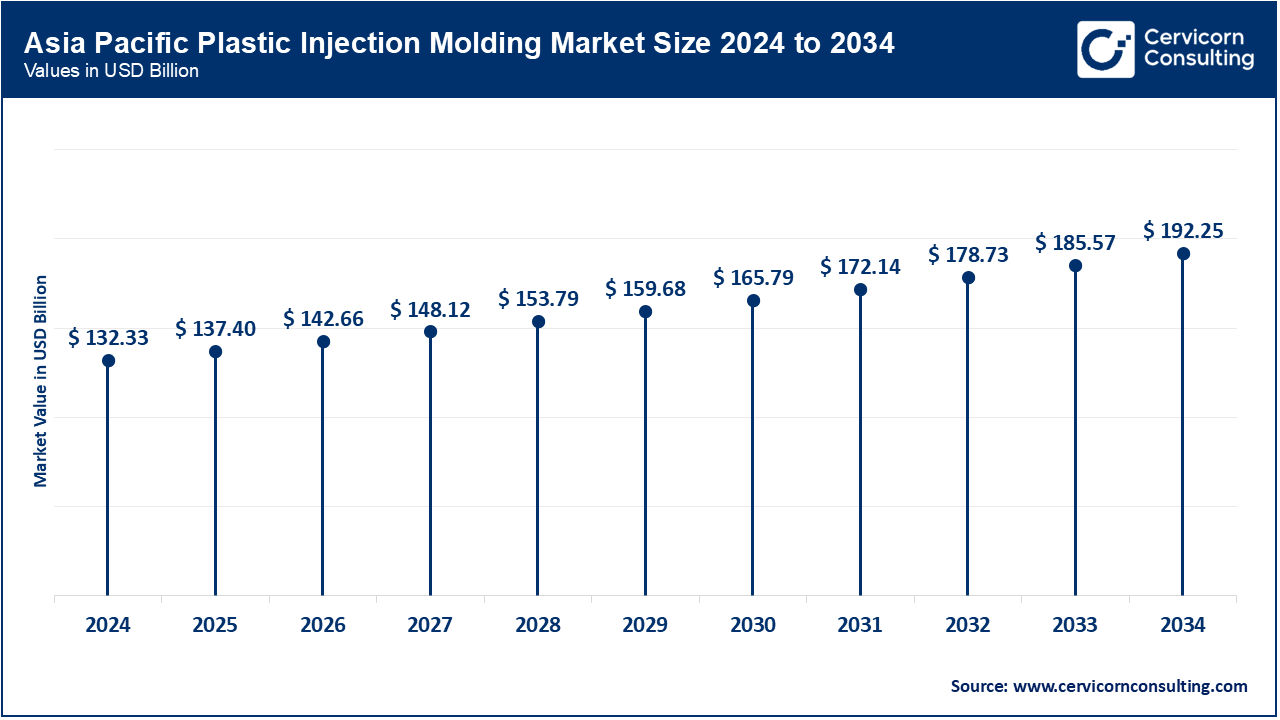
The Asia-Pacific plastic injection molding market size was estimated at USD 136.69 billion in 2025 and is projected to hit around USD 198.01 billion by 2035. Increasing demand for injection molded plastics from packaging and automotive industries is the major driver of the Asia Pacific plastic injection molding market. China is a major consumer due to growing population and rapid urbanization and hence will have a significant impact on the growth of the regional market. Moreover, increasing economic growth in Asia Pacific and consumer inclination towards efficient and smart buildings have led manufacturers to develop high performance products in construction. The region is expected to witness the highest growth globally in this market. China, India and Japan are major countries contributing to this market growth due to demand for healthy food with proper packaging and rising construction activities in these countries.
India Plastic Injection Molding Market Trends
- The Indian plastic injection molding market is experiencing significant growth, owing to swift industrialization, expansion of manufacturing activities and a robust government drive towards self-sufficiency, such as 'Make in India' and the Production Linked Incentive (PLI) schemes.
- The growing demand for plastic components formed by plastic injection molding in the automotive, packaging, consumer goods, healthcare, electrical and electronics, and construction industries are stimulating the demand for injection-molded products in India.
- Expanding middle-class population, rising demand for packed goods, the growing investments in electric vehicles and medical devices production, the increasing establishment of industrial parks, liberal FDI policy, and rise in use of recyclable as well as bio-based plastic material are providing impetus to the market growth.
- The country also accounts for many native injection molding players that can fulfill the demand from its diversified end-use industries.
Why is North America exhibit healthy growth in plastic injection molding market?
The North America plastic injection molding market size was valued at USD 79.53 billion in 2025 and is expected to reach around USD 115.20 billion by 2035. The North America is driven by exponentially increasing demand from the packaging and electronics industries of this region. For example, the US still manufactures sophisticated computer chips that are used in various fields such as medical devices, military equipment, communication technologies, and others. There is also a large manufacturer base in this region, and hence the market is expected to exhibit healthy growth in the near future.
U.S. Plastic Injection Molding Market Trends
- The plastic injection molding market in the United States is supported by superior manufacturing competence, high demand for high-precision engineered plastic components, and consistent high investments in the integration of technologies like automation and Industry 4.0.
- The demand for injection-molded parts is consistently high from end-use industries such as automotive, aerospace, healthcare, medical devices, consumer electronics, and packaging.
- The ongoing rise in adoption of lightweight plastic parts, aimed to enhance vehicle fuel efficiency, the growth of the electric vehicles market, and increasing preference for high-performance polymer as well as environmentally sustainable materials continue to drive the growth of the injection molding market in the United States.
- Reshoring of manufacturing sector in the U.S. along with the integration of robotics in the production process and increasing investments in the production of medical grade plastics are helping to gain further ground in the competitive landscape of the global market.
What factors are driving steady growth in the plastic injection molding market in Europe?
The Europe plastic injection molding market size was estimated at USD 96.57 billion in 2025 and is predicted to surpass around USD 139.89 billion by 2035. The increasing demand for convenient packaging for food and beverages has broadened the vision of packaging product manufacturers. Companies such as Berry Global and Mondi Group are investing a large number of resources in developing innovative packaging products including bottles with novel shapes, easy-to-pour and sturdy caps and closures, and durable containers. These products are mainly manufactured using injection molding plastics, and hence the demand across the European region is expected to grow steadily during the forecast period. Moreover, the use of molded plastics for electronic goods is the other key factor driving the market growth in Europe.
LAMEA plastic injection molding market is growing
The LAMEA plastic injection molding market size was accounted for USD 42.25 billion in 2025 and is anticipated to reach around USD 61.20 billion by 2035. The construction industry in Latin America is growing due to growing population and improved living conditions. Moreover, the demand for molded plastic furniture is gaining traction in the region as it is more affordable as compared to metal and wood alternatives, leading to slow but steady growth of the market. However, the lack of manufacturing infrastructure in the region is a key hindrance to the growth of the market. The demand for molded plastic products such as furniture, consumer goods, and electronic components is growing rapidly in the Middle East, primarily because they are cheaper and have similar physical properties to conventional metal products. Therefore, the Middle East market is expected to witness golden times during the forecast period.
Segmental Analysis
The plastic injection molding market is segmented into raw material, application, and region. Based on raw material, the market is classified into Polypropylene (PP), Acrylonitrile butadiene styrene (ABS), High-density polyethylene (HDPE), Polystyrene (PS), Polyethylene, Polyvinyl Chloride (PVC), Polycarbonate, Polyamide, and Others. Based on application, the market is classified into automotive, packaging, building & construction, electrical & electronics, medical, and others.
Raw Materials Analysis
Based on raw material, the plastic injection molding market is segmented into polypropylene (PP), acrylonitrile butadiene styrene (ABS), high-density polyethylene (HDPE), polystyrene (PS), polyethylene, polyvinyl chloride (PVC), polycarbonate, polyamide, and others.
Polypropylene (PP): Polypropylene is the preferred resin for the automotive and construction industries because it is lightweight and impact-resistant, which are important properties in terms of safety. It is one of the lowest-density plastics and is safe for food containers because it does not leach chemicals into food products. Polypropylene plastic injection molding is used to manufacture various parts and products of all shapes and sizes. Some of the major reasons for the widespread use of polypropylene in injection molding are moisture resistance, high moldability, food-grade availability, excellent food grade, chemical resistance, and low cost.
Acrylonitrile butadiene styrene (ABS): Acrylonitrile butadiene styrene (ABS) has high strength, good toughness, and is easily moldable. ABS is used in numerous applications in automotive parts, packaging, consumer products, industrial parts, and others. It is mainly used for these materials because it has high impact resistance, toughness, and scratch resistance and offers excellent dimensional stability.
High-density polyethylene (HDPE): Typically found in pellet form, high-density polyethylene (HDPE) is a resin that is designed for injection molding applications. It can withstand high impact resistance, stress cracking resistance, and exceptional durability. HDPE is an efficient thermoplastic with strong impact resistance and good tensile strength. This standard plastic is also very moisture-resistant and relatively easy to manufacture using the injection molding process. HDPE is used in many applications but has a high thermal expansion rate.
Polystyrene (PS): Polystyrene (PS) is a standard thermoplastic with an amorphous structure. It has excellent resistance to gamma rays and therefore supports sterilization by radiation. Polystyrene plastics can be either transparent or opaque, and unmodified polystyrene is clear, rigid, brittle, and moderately strong. Additionally, polystyrene is low-cost and supports injection molding. Polystyrene has several advantages that make it an ideal material for applications ranging from injection-molded automotive parts to medical products.
Others: The others include low-density polyethylene (LDPE), polyethylene terephthalate (PET), and polyvinyl chloride (PVC). Low-density polyethylene (LDPE) has good strength in relative to its density and is flexible even at low temperatures. LDPE is odorless, sterile, and waterproof, and can withstand considerable stretching before breaking. LDPE also maintains its structural integrity and has low water absorption. Applications of injection-molded LDPE include hose connections for water supplies. Polyethylene terephthalate (PET/PETP) is a thermoplastic, semi-crystalline polymer with very high dimensional stability, excellent wear resistance, and low coefficient of sliding friction. PET has good chemical resistance and low moisture absorption. PET plastic is well suited for injection-molded parts with high requirements for dimensional accuracy and surface quality. Injection molding of thin-walled and dimensionally stable PET parts such as rings, sliding elements, washers, or bushings improves the durability and running conditions of applications. PVC injection molding is a manufacturing process used to create parts from polyvinyl chloride (PVC), one of the most widely used plastics in the world. PVC does not absorb moisture and has good chemical resistance. Although it is not recommended for high-temperature applications, PVC is considered flame retardant because it is self-extinguishing. Injection molded PVC is used in the healthcare, construction, and consumer goods industries.
Application Analysis
Based on application, the plastic injection molding market is segmented into automotive, medical, packaging, building & construction, electrical & electronics and others.
Automotive: Weight reduction in vehicles is one of the top priorities for automakers to increase fuel economy. Automotive injection molding is a manufacturing process that helps in creating a wide range of automotive parts, including body panels, engine parts, and interior components, through injecting plastic under high pressure. It is one of the most popular processes for mass producing plastic parts because it can quickly and effectively produce large quantities. Some of the frequently used plastics to make injection molded automotive parts are nylon, polypropylene, ABS, and other specialty polymers. The increasing use of plastics as a replacement for metals and alloys in automotive components is expected to drive product demand in the automotive end-use segment and provide tremendous opportunities for injection molded plastics to enter the market.
Packaging: The segment is driven by applications in food and beverage, pharmaceuticals, and retail. The demand for plastic closures and caps is driven by the secular shift in consumer packaging as people have switched from glass and metal to plastic due to the excellent properties of plastic packaging. Many injection molding companies work closely with food and beverage, pharmaceutical, and other manufacturers as these companies contend with government regulations and legal obligations. The packaging segment is also driven by the demand from various other industries such as personal care and beauty, biomedical, and others.
Building & Construction: Purchasing premium building materials, such as injection-molded plastic assemblies and products, is one of the secrets to undertaking successful construction projects. These materials comprise of a range of sturdy polymers, each of which has some unique qualities and that allows it to be used in a variety of construction settings. Injection molded plastics are also used for many purposes throughout the construction industry. Plastics can be frequently used, as building materials for piping, walls, windows, flooring, roofing, and insulation. Additionally, they are molded into assemblies and parts for a range of construction tools, including heavy machinery and portable power tools.
Electrical & Electronics: Electronic components are primarily made by plastic injection molding, these are used for the process because of their flexibility, inert qualities, conductive and non-conductive qualities, and inexpensive assembly. Electronic components are made from raw plastic that are in the form of pellets or granules at first, and are then converted using injection molding. The plastic is melted and then injected into a pre-made shape using an injection molding machine. The plastic part is removed from the mold for direct use or any form of additional finishing after it has cooled. Injection molded plastics are lightweight, durable and inexpensive and are used in countless applications such as coffee makers, irons, blenders, hair dryers and electric shavers.
Medical: Injection molding is used in the medical industry to manufacture small and complex items such as dental implants, prosthetic replacements, endoscopic instruments, implantable components, orthopedic products, and drug delivery devices. Increasing demand for disposable medical items, technological developments, and increasing plastic consumption in healthcare applications are driving industry growth in medical injection molding.
Others: The others segment includes food & beverage, consumer goods, and aerospace. Equipment used in the processing of food and beverages must adhere to safety regulations for its parts and components. GMA compliance and FDA certification are two examples of these. To meet the regulatory standards, plastic injection molded parts for these industries are made from food-grade materials, which are generally non-toxic and BPA-free. There are numerous applications for plastic in the consumer goods section. For most plastic consumer goods, injection molding has long been the go-to manufacturing process because of its speedy and affordable mass production. Certain requirements must be met by aerospace components. They need to be strong, resilient, and light to survive drastic temperature fluctuations. Panels, housings, and chassis parts are the most often injection-molded parts used in aerospace.
Plastic Injection Molding Market Top Companies
- ExxonMobil Corporation
- BASF SE
- DuPont de Nemours, Inc.
- Dow, Inc.
- Huntsman International LLC.
- Magna International, Inc.
- IAC Group
- Kreate
- Eastman Chemical Company
- INEOS Group
- LyondellBasell Industries Holdings B.V.
- SABIC
- Berry Global, Inc.
- Master Molded Products Corporation
- LACKS ENTERPRISES, INC.
- The Rodon Group
- Heppner Molds
- HTI Plastics Inc.
- Rutland Plastics
- AptarGroup, Inc.
- Coastal Plastic Molding, Inc.
Recent Developments
Key players in the plastic injection molding industry are pivotal in delivering a variety of innovative construction solutions, such as prefabrication techniques, sustainable materials, and advanced digital technologies. Some notable developments in the plastic injection molding sector include:
- In April 2024, Benjamin Harp and Tom Rybicki, veterans of the plastics industry, founded Polymer Medical Inc. to provide contract injection molding and assembly services to customers in the life sciences and healthcare sectors. The new company will aim to manufacture essential drug delivery systems, specialty packaging, pharmaceutical disposables, medical disposables such as syringes and medical devices for home healthcare to orthopedics.
- In February 2024, Kreate announced the acquisition of a Georgetown, Texas-based injection molding plastics supplier. The move is expected to significantly increase the company's production capacity and improve its logistics network.
- In January 2024, LyondellBasell, a pioneer in the value chain, announced that it is partnering in a groundbreaking project to transform marine waste from end-of-life products into creative plastics. This partnership involves a well-known German OEM and a specialized recycling company with expertise in mechanical recycling of plastic waste.
These advancements mark a notable expansion in the plastic injection molding market, driven by strategic acquisitions and innovative projects. The focus is on boosting sustainability, enhancing construction efficiency, and broadening product offerings to meet diverse building needs.
Market Segmentation
By Raw Material
- Polypropylene (PP)
- Acrylonitrile butadiene styrene (ABS)
- High-density polyethylene (HDPE)
- Polystyrene (PS)
- Polyethylene
- Polyvinyl Chloride (PVC)
- Polycarbonate
- Polyamide
- Others
By Application
- Automotive
- Packaging
- Building & Construction
- Electrical & Electronics
- Medical
- Others
By Regions
- North America
- Europe
- APAC
- LAMEA