Pharmaceutical Water Market Size and Growth Outlook 2026 to 2035
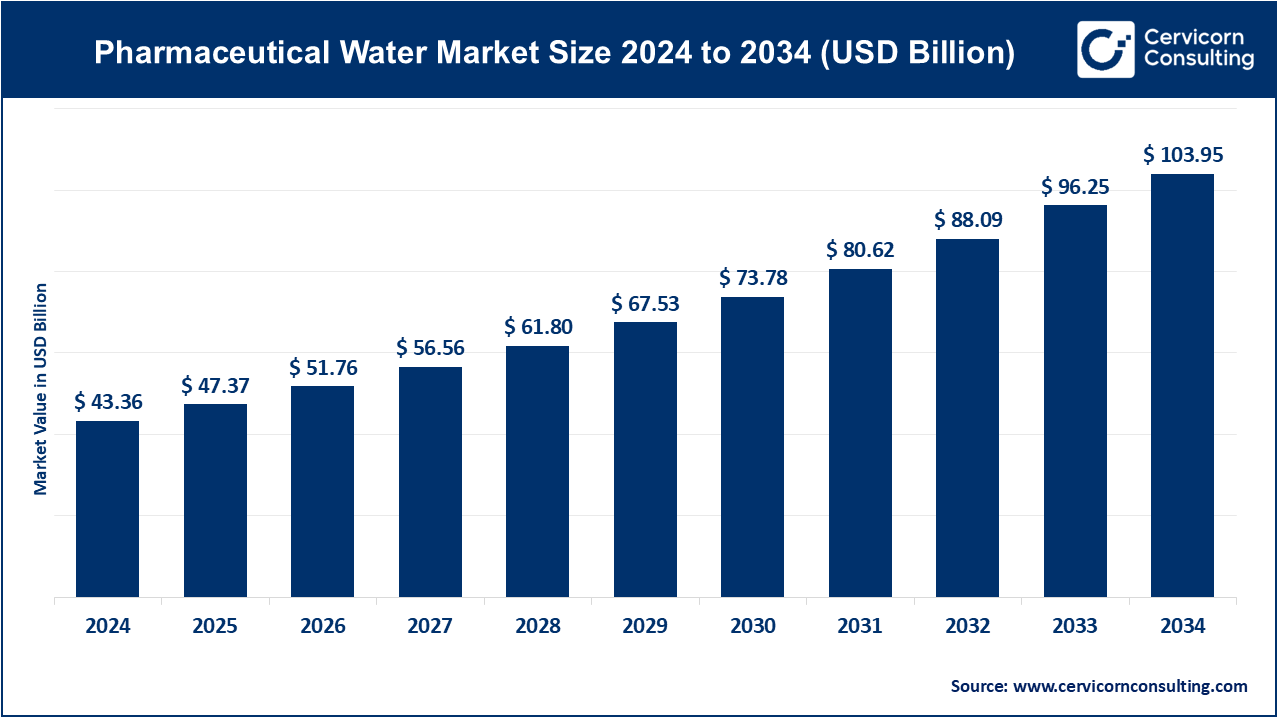
The global pharmaceutical water market size was valued at USD 47.37 billion in 2025 and is forecasted to exceed around USD 111.96 billion by 2035, growing at a compound annual growth rate (CAGR) of 8.98% from 2026 to 2035. The pharmaceutical water market has seen substantial demand due to its essential role in drug manufacturing, formulation, and laboratory applications. With increasing global concerns regarding product safety and the rising production of biopharmaceuticals, water quality has become a crucial focus for pharmaceutical manufacturers. The adoption of advanced filtration and purification technologies has also driven innovation, with companies offering customized solutions tailored to meet stringent regulatory standards for water used in drug production. Moreover, the growing emphasis on regulatory compliance is pushing companies to invest in reliable water treatment systems, fostering market growth. The market is influenced by factors such as technological advancements in water purification systems, government regulations on water quality, and the rising production of injectables, biologics, and vaccines.
Pharmaceutical water is a critical component in the pharmaceutical industry, serving as a raw material, ingredient, and solvent in the processing, formulation, and manufacture of pharmaceutical products, active pharmaceutical ingredients (APIs), and intermediates. It is utilized in various stages, including synthesis, production of finished products, and as a cleaning agent for rinsing vessels, equipment, and primary packaging materials. The quality of pharmaceutical water is paramount, as it must meet stringent standards to ensure the safety and efficacy of pharmaceutical products. Regulatory bodies, such as the U.S. Food and Drug Administration (FDA), have established guidelines for water used in pharmaceutical applications, emphasizing the removal of minerals, organics, and microbes to prevent contamination.
- “Saransh Chaudhary, President at Global Critical Care and Venus Remedies Ltd, and CEO of Venus Medicine Research Centre, advocates for pharmaceutical companies to invest in R&D for water-efficient manufacturing technologies. This approach aims to minimize water consumption in critical processes such as cleaning, cooling, and synthesis, addressing the industry's significant water usage challenges and promoting sustainability.”
- ”General Electric (GE) has launched a water quality monitoring instrument aimed at assisting Indian pharmaceutical companies in meeting global regulatory standards for water quality in manufacturing. This device aims to enhance compliance with stringent quality requirements, ensuring pharmaceutical products meet international standards for safety and efficacy.”
Pharmaceutical Water Market Report Highlights
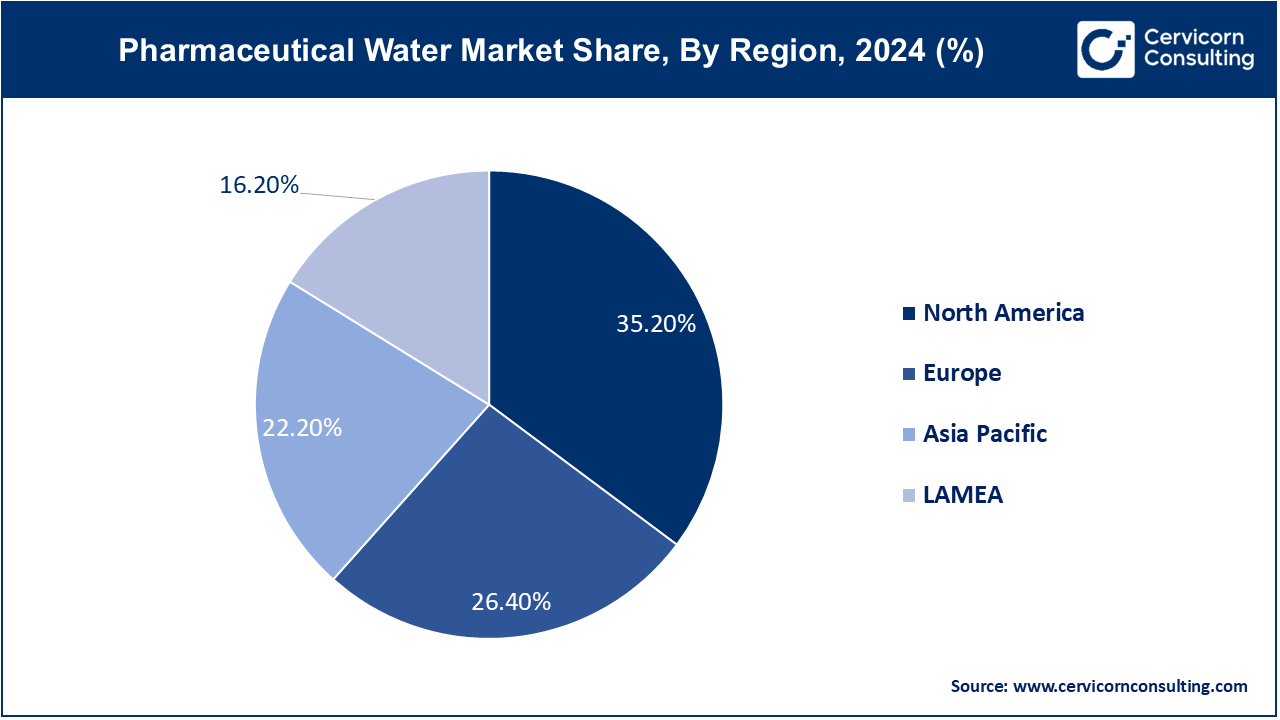
- North America region has captured highest market revenue share of 35% in 2025.
- Asia-Pacific region is experiencing significant growth in the market with revenue share of 22% in 2025.
- Europe region has recorded revenue share of 26% in 2025.
- By type, the water for injection segment has accounted dominating 79.48% revenue share in 2025.
- By application, the cleaning and sterilization segment has achieved highest 36% revenue share in 2025.
- By application, The others segment has generated 30% share in 2025.
FDA Approved Pharma Drug Establishments
- The FDA’s inspection activity, which increased sharply from FY 2022 to FY 2024; also reflects broader enforcement coverage over a growing number of registered facilities.
- While conservatively estimating growth of the total population of drug manufacturing sites overseen by the FDA (including CDER's Site Catalog) from FY 2019 through FY 2024, they anticipated growing by approximately 11-14% over the above 5-year period. This reflects a growing number of drug manufacturing facilities around the world (i.e., both foreign and domestic) that are subject to quality regulation from the FDA.
- As of the end of FY 2023 (October 2022), the FDA reported 14,433 registered drug manufacturing facilities (i.e., establishments) located within the United States, as well as 9,756 foreign facilities, evidencing considerable infrastructure (i.e., size) of regulated drug manufacturing overseen by the FDA.
Major Regulatory Landscape for Pharmaceutical Water
United States
- The main authority that creates pharmaceutical water specifications (such as purified water and water for injection) is the United States Pharmacopeia (USP).
- According to Title 21 of the Code of Federal Regulations Parts 210 and 211 (also known as Good Manufacturing Practice Regulation), the U.S. Food and Drug Administration (FDA) ensures compliance with USP standards for any used in drug manufacturing.
Europe
- The European Pharmacopoeia (Ph. Eur.) establishes legally mandated water quality requirements applicable within the EU and beyond through agreements with other states.
- Compliance is enforced by both EU directives and good manufacturing practice (GMP) requirements by the European Medicines Agency (EMA) and by national competent authorities.
- While the EU also has high-level standards for drinking water, most of these are applicable only to drinking water, rather than to the production of pharmaceutical water.
Japan
- JP establishes the standards of quality for all pharmaceutical waters; it generally aligns with USP/Ph. Eur standards for PW and for WFI.
- PMDA invests time and labor to ensure compliance with the general requirements of the GMP with respect to productions of pharmaceutical products; it is also common for PMDA to reference the JP as a guide when conducting inspections.
Pharmaceutical Water Market Growth Factors
- Increasing Pharmaceutical Production: The expanding pharmaceutical industry worldwide, driven by population growth, aging demographics, and rising healthcare needs, boosts demand for high-quality water in drug manufacturing processes.
- Stringent Regulatory Standards: Strict regulatory requirements mandating the use of purified water and water for injection (WFI) in pharmaceutical manufacturing ensure product safety and quality, driving investment in advanced water purification technologies.
- Advancements in Water Purification Technologies: Continuous innovations in membrane filtration, distillation, and other purification methods enhance efficiency, reliability, and cost-effectiveness, supporting market growth.
- Focus on Quality and Safety: Heightened emphasis on ensuring water purity to prevent contamination and meet pharmaceutical standards, fostering adoption of advanced water treatment solutions.
- Global Expansion of Healthcare Infrastructure: Increasing healthcare investments and infrastructure development globally necessitate reliable water purification systems to support pharmaceutical manufacturing and research activities, fueling market growth.
Pharmaceutical Water Market Trends
- Rising Biopharmaceutical Production: The increasing demand for biopharmaceuticals, including vaccines and biologics, requires large volumes of high-quality water for production and formulation, driving the market for advanced water purification technologies.
- Focus on Sustainable Practices: Growing awareness and regulatory pressures regarding environmental sustainability drive pharmaceutical companies to adopt water reuse and recycling practices, promoting the use of eco-friendly water treatment solutions.
- Emerging Markets Growth: Expansion of pharmaceutical manufacturing capabilities in emerging markets, coupled with improving healthcare infrastructure, increases the demand for reliable water purification systems to support local production needs.
- Integration of IoT and AI: Leveraging Internet of Things (IoT) and Artificial Intelligence (AI) technologies to optimize water treatment processes, enhance operational efficiency, and ensure real-time monitoring and control of water quality in pharmaceutical facilities.
- Collaboration with Academic Institutions: Partnering with research institutions to innovate new water treatment technologies, improve purification efficiency, and develop sustainable solutions that meet evolving regulatory requirements and industry standards.
Report Scope
| Area of Focus |
Details |
| Market Size in 2026 |
USD 51.76 Billion |
| Market Growth Rate |
CAGR of 8.98% from 2026 to 2035 |
| Market Size by 2035 |
USD 111.96 Billion |
| Largest Market |
North America |
| Fastest Growing Market |
Asia Pacific |
| Segment Coverage |
By Type, Technology, Application and Regions |
Pharmaceutical Water Market Dynamics
Drivers
Global Pandemic Preparedness
- Recent global health crises such as COVID-19 have underscored the critical importance of pharmaceutical manufacturing resilience. This heightened awareness drives investments in advanced water purification systems to support rapid vaccine development, production scalability, and global distribution during emergencies.
Increasing Outsourcing Trends
- Pharmaceutical companies are increasingly relying on CDMOs for manufacturing flexibility and cost efficiencies. This trend amplifies the demand for advanced water purification technologies and services across outsourced manufacturing facilities, ensuring consistent quality and compliance with stringent regulatory requirements globally.
Restraints
High Capital Investment
The significant upfront costs of acquiring and installing advanced water purification systems, along with ongoing operational expenses for maintenance and upgrades, can strain the financial resources of pharmaceutical companies. This financial barrier may delay or limit investments in modernizing water treatment infrastructure.
Complex Regulatory Landscape
- Pharmaceutical water treatment must adhere to stringent regulations to ensure product safety and compliance. Navigating diverse regulatory frameworks across different regions requires extensive expertise, resources for continuous monitoring, and adaptation to evolving standards, adding complexity and cost to regulatory compliance efforts.
Opportunities
Advanced Water Purification Technologies
- The opportunity lies in the development and adoption of innovative water purification technologies that offer enhanced efficiency, sustainability, and cost-effectiveness. Technologies such as nanotechnology-based filtration, advanced oxidation processes (AOPs), and decentralized water treatment solutions present opportunities to improve water quality while reducing operational costs.
Expansion in Emerging Markets
- Emerging markets present significant growth opportunities for pharmaceutical water solutions. Rapid urbanization, increasing healthcare investments, and regulatory advancements in regions such as Asia-Pacific, Latin America, and the Middle East offer a fertile ground for expanding market presence and establishing partnerships for localized manufacturing and distribution of pharmaceutical-grade water solutions.
Challenges
Water Quality Variability
- Ensuring consistent water quality standards across different geographical locations and sources can be challenging. Variations in raw water quality, seasonal changes, and potential contaminants require robust monitoring and treatment protocols to maintain pharmaceutical-grade water standards.
Water Scarcity and Resource Management
- In regions facing water scarcity or quality issues, securing adequate and reliable water sources for pharmaceutical manufacturing becomes a critical challenge. Sustainable water management practices, including water reuse and recycling, are increasingly important but may require significant infrastructure investments and regulatory approvals.
Pharmaceutical Water Market Regional Analysis
Why North America is leading in the pharmaceutical water market?
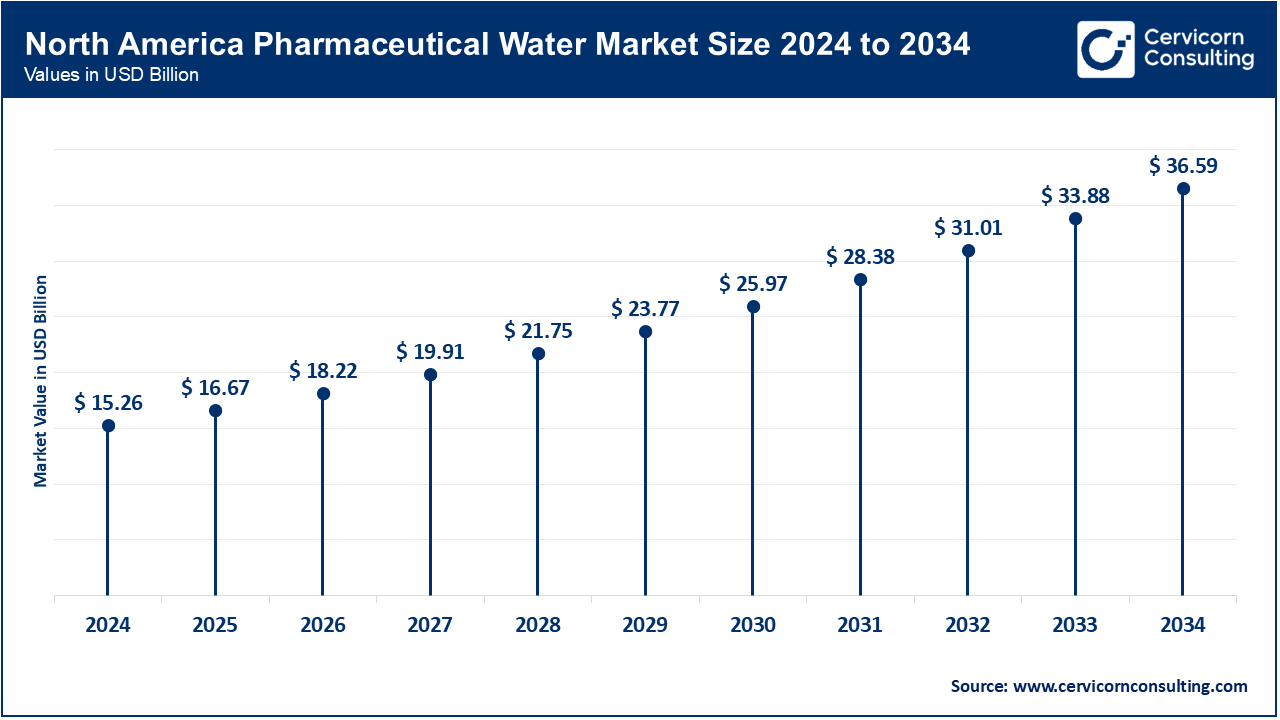
In North America, there is a strong focus on implementing advanced water purification technologies to meet stringent regulatory requirements. North America market size is expected to reach around USD 39.18 billion by 2035 increasing from USD 16.58 billion in 2025. Trends include increased investment in sustainable water management practices and adoption of innovative filtration and disinfection technologies to ensure pharmaceutical-grade water quality.
Why Asia-Pacific is experiencing significant growth in the pharmaceutical water market?
The Asia-Pacific region experiences rapid pharmaceutical industry growth and increasing demand for high-quality water in drug manufacturing. Asia Pacific market size is calculated at USD 10.42 billion in 2025 and is projected to grow around USD 24.63 billion by 2035. Trends include expanding pharmaceutical production capacities, adoption of cost-effective water treatment solutions, and regulatory harmonization efforts to align with international standards, fostering market expansion and technological innovation.
Europe Pharmaceutical Water Market Trends
Europe emphasizes sustainable water use and compliance with strict environmental regulations. Europe market size is measured at USD 12.32 billion in 2025 and is expected to grow around USD 29.11 billion by 2035. Trends include the integration of smart water management systems, such as IoT-enabled monitoring and predictive maintenance, to optimize water usage efficiency and reduce operational costs in pharmaceutical manufacturing.
LAMEA Pharmaceutical Water Market Trends
LAMEA(Latin America, Middle East, and Africa) countries focus on improving healthcare infrastructure and regulatory frameworks to support pharmaceutical manufacturing. LAMEA market size is forecasted to reach around USD 19.05 billion by 2035 from USD 8.05 billion in 2025. Trends include investment in water infrastructure development, partnerships with international manufacturers for technology transfer, and local capacity building in water treatment technologies to enhance market competitiveness and sustainability.
Pharmaceutical Water Market Segmental Analysis
Type Analysis
HPLC Grade Water: High Performance Liquid Chromatography (HPLC) Grade Water is purified to meet stringent quality standards suitable for analytical and chromatographic applications in pharmaceutical laboratories. High Performance Liquid Chromatography (HPLC) grade water segment has captured market share of 20.52% in 2025. Trends include increasing demand for ultra-pure water quality to ensure accurate and reproducible analytical results, driven by advancements in analytical techniques and the need for precise pharmaceutical testing.
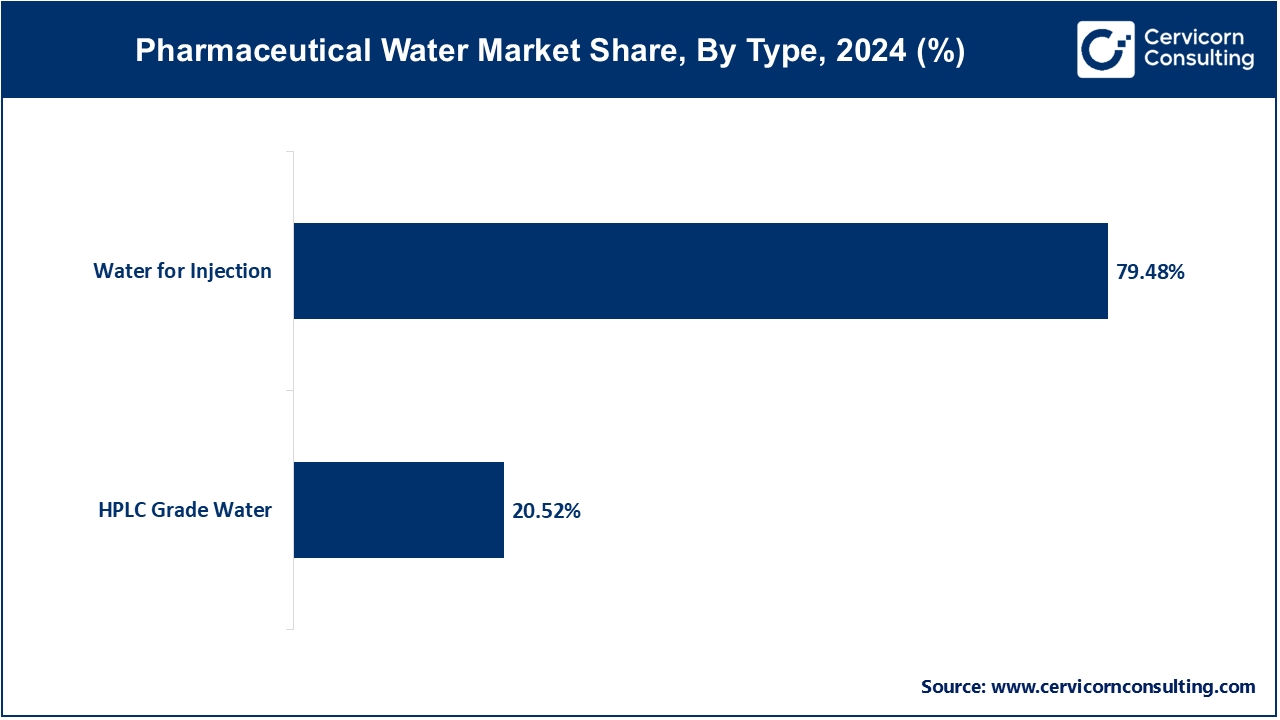
Water for Injection (WFI): Water for Injection is produced using techniques such as distillation or membrane filtration to meet rigorous standards for injectable pharmaceuticals. In 2025 the water for injection segment has covered highest market share of 79.48%. Trends focus on enhancing production efficiency, ensuring compliance with global pharmacopeial standards, and adopting advanced purification technologies to meet growing demand for sterile and pyrogen-free water in parenteral drug formulations.
Technology Analysis
Membrane Filtration: Utilizes semi-permeable membranes to remove particles, microorganisms, and dissolved solids from water, ensuring purity for pharmaceutical applications. Trend: Increasing adoption due to efficiency, scalability, and compatibility with sustainable practices.
Distillation: Involves boiling water to produce steam, which is condensed and collected as purified water. Trend: Essential for producing Water for Injection (WFI) due to reliability and compliance with regulatory standards.
Electrodeionization (EDI): Removes ions from water using ion-exchange membranes and electrical current, producing high-purity water without chemical regeneration. Trend: Growing preference for continuous operation and reduced chemical usage.
UV Oxidation: Utilizes ultraviolet light to disinfect water by disrupting microbial DNA. Trend: Rising use for microbial control in pharmaceutical water systems due to effectiveness and environmental benefits.
Others: Includes technologies like reverse osmosis (RO) for selective filtration and ozonation for disinfection, adapting to specific purity and production needs in pharmaceutical water treatment.
Application Analysis
Drug Formulation and Manufacturing: Drug formulation and manufacturing segment has registered market share of 20% in 2025. Pharmaceutical water is essential in drug formulation and manufacturing processes, ensuring purity and safety of medications. Trends include increasing demand for high-quality water for biopharmaceutical production and stringent regulatory compliance.
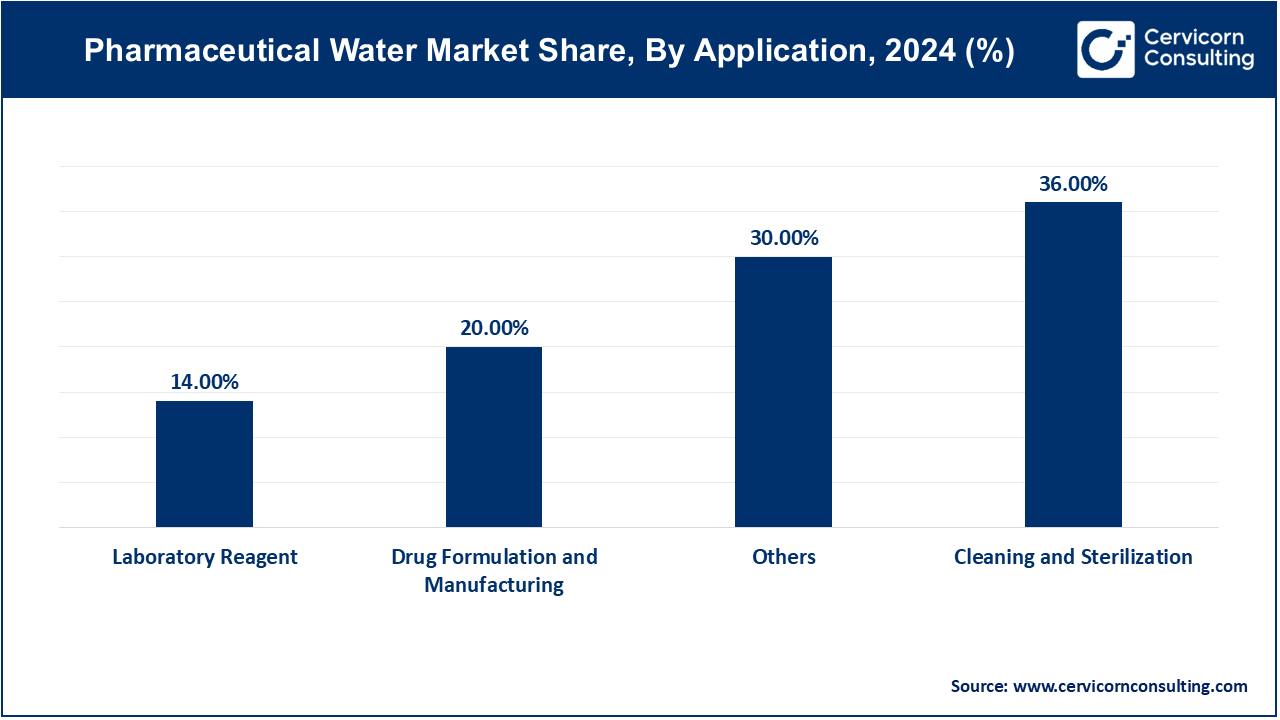
Laboratory Reagent: Laboratory reagent segment has recorded market share of 14% in 2025. High-purity water is critical for accurate laboratory testing and research. Trends focus on advanced water purification technologies to meet precise laboratory requirements and enhance research reliability.
Cleaning and Sterilization: The cleaning and sterilization segment has garnered 36% of share in 2025. Water is vital for equipment cleaning and sterilization in pharmaceutical facilities. Trends emphasize efficient water treatment systems to maintain hygienic standards and reduce environmental impact.
Others: The other segment has accounted market share of 30% in 2025. This segment may include uses like HVAC system maintenance and environmental monitoring, where water quality plays a crucial role in supporting overall pharmaceutical operations and compliance.
Pharmaceutical Water Market Top Companies
- Veolia Water Technologies
- SUEZ Water Technologies & Solutions
- Pall Corporation (now part of Danaher Corporation)
- Merck KGaA
- Thermo Fisher Scientific Inc.
- ELGA LabWater (part of Veolia)
- Pall Medical (now part of SUEZ)
- Barnstead International (part of Thermo Fisher Scientific)
- Aquafine Corporation (part of Trojan Technologies)
- Evoqua Water Technologies
- Siemens Water Technologies (now part of Evoqua)
- MilliporeSigma (part of Merck KGaA)
- Aquatech International Corporation
- Pentair plc
- Watts Water Technologies
Innovative newcomers in the pharmaceutical water market, such as BioPure Technology and PureAire Monitoring Systems, are leveraging advanced technologies like nanofiltration and real-time monitoring for water quality assurance. These companies focus on offering scalable, cost-effective solutions tailored to pharmaceutical manufacturing needs, driving market disruption. Key players dominating the market include Veolia Water Technologies, SUEZ Water Technologies & Solutions, and Merck KGaA. They lead through extensive global reach, comprehensive service offerings, and continuous innovation in water purification technologies. Their established reputations and robust regulatory compliance frameworks solidify their market leadership positions.
Recent Developments
- In 2023, Evoqua Water Technologies has expanded its presence in the Texas market by acquiring the industrial water treatment service business from Kemco Systems, previously operated by Bob Johnson & Associates. This acquisition enhances Evoqua's capabilities in serving pharmaceutical, beverage, and other industries requiring advanced water treatment solutions.
- In 2022, Merck KGaA has launched the Milli-Q EQ 7008/16 ultrapure and pure water purification system, capable of producing Type 1 ultrapure water directly from tap water. The system also offers the option to generate reverse osmosis (RO, Type 3) quality water, catering to diverse laboratory needs efficiently.
- In 2023, Nexus Pharmaceuticals has received U.S. FDA approval for its Sterile Water for Injection, USP in 10mL and 20mL Single-Dose Vials. This approval underscores Nexus Pharmaceuticals' commitment to providing high-quality pharmaceutical products essential for various medical applications.
- In 2022, Evoqua Water Technologies has opened a new manufacturing facility in Singapore to enhance its presence in the Asia Pacific region. This facility aims to localize production and meet growing demand for ultrapure water solutions, particularly in the microelectronics and pharmaceutical sectors.
Market Segmentation
By Type
- HPLC Grade Water
- Water for Injection
By Technology
- Membrane Filtration
- Distillation
- Electrodeionization (EDI)
- UV Oxidation
- Others
By Application
- Drug Formulation and Manufacturing
- Laboratory Reagent
- Cleaning and Sterilization
- Others
By Regions
- North America
- APAC
- Europe
- LAMEA