Perfusion Systems Market Size, Growth Outlook 2026 to 2035
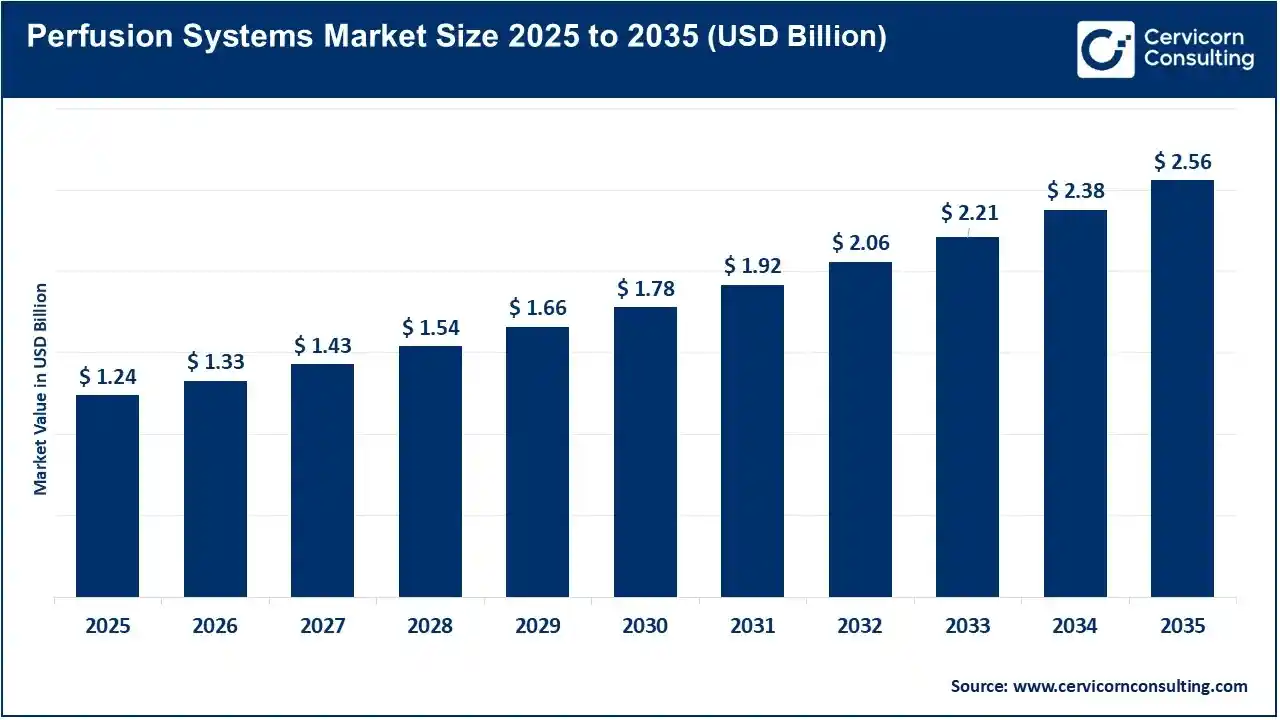
The global perfusion systems market size was valued at USD 1.24 billion in 2025 and is projected to grow from USD 1.33 billion in 2026 to nearly USD 2.56 billion by 2035, registering a CAGR of 7.5% over the forecast period 2026 to 2035. The market is growing due to the rising number of cardiovascular surgeries, increasing organ transplantation procedures, growing demand for extracorporeal circulation technologies, and advancements in perfusion equipment and techniques.
Report Highlights
- By region, North America dominated the market in 2025 with revenue share of 38%, supported by advanced healthcare infrastructure and established cardiac and transplantation facilities.
- By region, Asia Pacific is expected to grow at the fastest rate, driven by expanding healthcare infrastructure and rising adoption of advanced perfusion technologies.
- By product type, cardiopulmonary perfusion systems has generated highest revenue share of 39% in 2025, owing to their extensive use in cardiac surgeries and bypass procedures.
- By product type, ex-vivo organ perfusion systems are expected to grow at the fastest rate, driven by increasing use in organ preservation and transplantation.
- By component, oxygenators dominated the market in 2025 (Revenue Share 20%), supported by their essential role in bypass and ECMO procedures.
- By component, monitoring systems are expected to grow at the fastest rate, driven by rising demand for real-time perfusion monitoring.
- By technology, hypothermic machine perfusion dominated the market in 2025 with revenue share of 24%, supported by its established use in organ preservation.
- By technology, normothermic machine perfusion is expected to grow at the fastest rate, driven by improved organ viability assessment.
- By organ type, kidney perfusion has held revenue share of 32% in 2025, owing to its widespread use in kidney preservation and transplantation.
- By organ type, heart perfusion is expected to grow at the fastest rate, driven by advances in donor-heart preservation.
- By application, cardiovascular surgery has captured revenue share of 30% in 2025, supported by widespread use of perfusion systems during cardiac procedures.
- By application, organ preservation and transplantation are expected to grow at the fastest rate, driven by increasing machine-perfusion adoption.
- By end user, transplant centers dominated the market in 2025, supported by specialized infrastructure and perfusion capabilities.
- By end user, hospitals are expected to grow at the fastest rate, driven by expanding cardiac, ECMO, and transplantation services.
- By automation level, manual/conventional systems has accounted for a revenue share of 48% in 2025, owing to their established clinical use.
- By automation level, AI-enabled/smart perfusion systems are expected to grow at the fastest rate, driven by automation, real-time monitoring, and data analytics.
What Is Driving the Growth of the Perfusion Systems Market?
The perfusion systems market is growing because organ transplants, cardiovascular surgeries, and complicated surgical procedures requiring extracorporeal circulation are becoming more common. The market is expanding due to the rising incidence of cardiovascular diseases, improvements in perfusion technology, and growing use of automated and digitally monitored perfusion systems. Perfusion systems are being used more frequently in hospitals and specialized medical facilities as a result of advancements in healthcare infrastructure and rising demand for sophisticated surgical techniques.
- In August 2025, LivaNova PLC announced the commercial launch of the Essenz Perfusion System in China. The launch expanded the availability of its advanced cardiopulmonary perfusion technology for use during cardiac surgery.
Recent Trends
- Minimally Invasive Cardiac Procedures: Growing adoption of minimally invasive heart surgeries is driving demand for advanced perfusion systems.
- Automated Perfusion Systems: Automation is improving the control and accuracy of blood flow, oxygenation, and temperature during procedures.
- Real-Time Patient Monitoring: Integrated monitoring technologies are enabling continuous tracking of critical patient and system parameters.
- Portable Perfusion Systems: Demand for compact and portable systems is increasing across operating rooms and critical-care settings.
- Growth in Organ Machine Perfusion: Increasing organ transplantation is driving adoption of machine perfusion technologies for organ preservation.
- Personalized Perfusion Strategies: Patient-specific perfusion approaches are gaining attention to support safer and more targeted surgical care.
- Digitalization and Data Analytics: Digital connectivity and analytics are improving perfusion monitoring, documentation, and clinical decision-making.
- Advancements in ECMO Technologies: Technological improvements are expanding perfusion applications into ECMO and other extracorporeal life-support procedures.
Government Initiatives
- In June 2025, the UK government provided initial investment for the Assessment and Recovery Centres (ARCs) programme, which uses ex-situ machine perfusion to assess and preserve donor organs before transplantation. The programme aims to increase the availability of viable organs for transplantation and support specialized organ assessment and preservation infrastructure.
- In September 2025, NHS Blood and Transplant initiated procurement for pilot Assessment and Recovery Centre locations to establish a network using ex-situ machine perfusion technologies for organ assessment and preservation. The initiative is intended to strengthen the UK’s capacity to assess and recover organs for transplantation and encourage wider adoption of advanced preservation technologies.
- In 2025, the U.S. Organ Procurement and Transplantation Network developed a machine-perfusion data collection initiative to improve information on machine perfusion and normothermic regional perfusion and support evaluation of organ transplantation outcomes. The initiative can provide standardized information to support assessment of these technologies and future transplantation practices.
- In January 2026, the Scottish Government reported continued efforts to increase viable organs for transplantation through technologies such as machine perfusion, including normothermic and ex-vivo perfusion at transplant centres. The government also highlighted ongoing support for machine-perfusion activities and related transplantation services.
- In March 2026, the Government of India highlighted continued expansion and regulation of the national organ-transplantation system through NOTTO and the National Registry Portal. The initiative supports greater coordination of transplantation activities and the development of infrastructure surrounding modern organ-transplantation practices.
Market Dynamics
Driver: Increasing Cardiovascular Surgeries
Perfusion systems are becoming more and more necessary as the prevalence of cardiovascular illnesses and cardiac surgeries rises. While more recent technologies with automated controls and monitoring features are increasing surgical efficiency and encouraging broader adoption, these systems aid in maintaining blood circulation and oxygen levels during procedures. Hospitals are also being encouraged to upgrade their perfusion equipment by increased investment in cutting-edge cardiac care infrastructure. Further opportunities for advanced perfusion technologies are being created by the growing demand for safer and more controlled surgical procedures.
Restraint: High Equipment and Operating Costs
Advanced perfusion systems necessitate large equipment, disposable components, maintenance, and specialist staff investments. Smaller hospitals and healthcare facilities with tighter budgets may find adoption more challenging as a result of these expenses. The need for skilled perfusion specialists and routine maintenance can raise the total cost of running these systems.
Opportunity: Expansion of Organ Preservation Technologies
Opportunities for perfusion technologies outside of traditional cardiac surgery are being created by the increasing activity of organ transplants. Before transplantation, machine perfusion can help preserve organs outside the body and give doctors more information. The use of perfusion systems in kidney, liver, heart, and lung transplantation may increase with further development of portable preservation platforms and broader clinical adoption.
- In January 2025, Paragonix Technologies announced the world’s first-in-human use of its KidneyVault Portable Renal Perfusion System. The system enables continuous hypothermic perfusion and real-time monitoring of donor kidneys during transportation, supporting the expansion of machine perfusion in kidney transplantation.
Regional Analysis
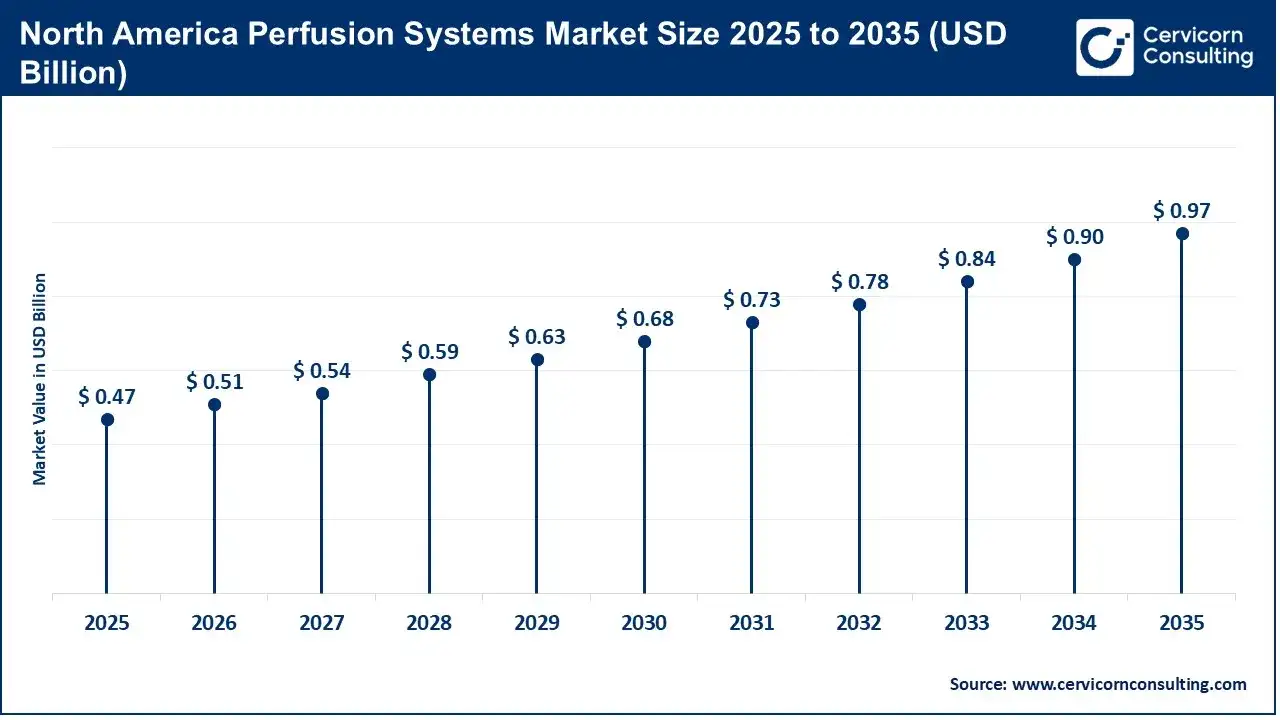
The North America perfusion systems market size was valued at USD 0.47 billion in 2025 and is expected to surpass USD 0.97 billion by 2035. North America dominated the perfusion systems market due to its sophisticated healthcare infrastructure, high cardiovascular procedure adoption rate, and well-established critical-care and transplantation facilities. Advanced cardiac surgery, ECMO, and organ-perfusion technologies are widely available in the region. Market expansion is further supported by high healthcare spending and the existence of significant medical device manufacturers. Regional demand is also being influenced by the growing use of sophisticated, automated perfusion systems. North America's leading position is reinforced by the availability of specialized healthcare professionals and a well-established clinical infrastructure.
The Asia-Pacific perfusion systems market size was estimated at USD 0.31 billion in 2025 and is expected to surpass USD 0.64 billion by 2035. Asia Pacific is expected to be the fastest-growing regional market, fueled by growing transplant activity, a growing burden of cardiovascular disease, and an expanding healthcare infrastructure. Access to cutting-edge perfusion technologies is being improved by increasing investments in hospitals and specialized cardiac and transplant facilities. Major healthcare markets in the region are also seeing an increase in the use of ECMO, cardiopulmonary bypass, and organ-preservation devices. Technological advancements and rising healthcare costs are opening up new market expansion potential. Adoption is anticipated to be further accelerated by growing knowledge and accessibility of cutting-edge medical technologies.
Perfusion Systems Market Share, By Region, 2025 (%)
| Region |
Revenue Share, 2025 (%) |
| North America |
38% |
| Europe |
27% |
| Asia-Pacific |
25% |
| LAMEA |
10% |
Segmental Analysis
Product Type Analysis
Cardiopulmonary perfusion systems dominated the perfusion systems market due to their widespread application in cardiopulmonary bypass and cardiac surgeries. The need for these systems is being supported by the rising number of cardiac interventions and the rising incidence of cardiovascular diseases. These technologies are a vital component of contemporary cardiac care because they sustain blood flow and oxygenation during intricate surgical procedures. The market is becoming stronger due to ongoing developments in automated control technologies, perfusion monitoring, and heart-lung machines. Their leading position is also a result of their well-established clinical use in hospitals and specialty cardiac centers.
Perfusion Systems Market Share, By Product Type, 2025 (%)
| Product Type |
Revenue Share, 2025 (%) |
| Cardiopulmonary Perfusion Systems |
39% |
| Extracorporeal Membrane Oxygenation (ECMO) Systems |
24% |
| Ex-Vivo Organ Perfusion Systems |
14% |
| Cell Perfusion Systems |
9% |
| Isolated Limb Perfusion Systems |
8% |
| Others |
6% |
Ex-vivo organ perfusion systems are expected to be the fastest-growing segment, motivated by the growing use of machine perfusion techniques for organ transplantation and preservation. Before being transplanted, these systems allow organs to be kept outside the body and their viability and functional state to be evaluated. Transplant facilities are being encouraged to use sophisticated perfusion solutions due to the increased emphasis on increasing donor-organ utilization. The expansion of the segment is also being supported by technological developments in normothermic and hypothermic machine perfusion. More growth prospects are anticipated as transplantation activity rises and specialized organ-preservation infrastructure is developed.
Component Analysis
Oxygenators dominated the perfusion systems market because they are crucial to ECMO and cardiopulmonary bypass procedures. By supplying oxygen to the blood and eliminating carbon dioxide during extracorporeal circulation, these parts carry out vital gas-exchange tasks. Consistent demand is supported by their extensive use in critical-care applications and cardiac surgery. Oxygenator design advancements are increasing patient safety, biocompatibility, and efficiency. Their leading position is being further reinforced by the ongoing adoption of extracorporeal and cardiopulmonary support systems.
Perfusion Systems Market Share, By Component, 2025 (%)
| Component |
Revenue Share, 2025 (%) |
| Oxygenators |
20% |
| Perfusion Pumps |
18% |
| Heart-Lung Machines |
16% |
| Cannulas |
11% |
| Reservoirs |
8% |
| Monitoring Systems |
7% |
| Tubing Sets |
7% |
| Heat Exchangers |
5% |
| Cardioplegia Delivery Systems |
4% |
| Other Components & Accessories |
4% |
Monitoring systems are expected to be the fastest-growing component segment, driven by the growing demand for physiological and perfusion parameter monitoring in real-time. Healthcare practitioners can monitor blood flow, oxygenation, pressure, temperature, and other vital parameters during procedures thanks to advanced monitoring technologies. The accuracy of perfusion management is being further enhanced by the increasing integration of digital technologies and automated controls. The need for advanced monitoring solutions is being supported by a growing emphasis on patient-specific and data-driven perfusion strategies. It is anticipated that their integration with intelligent and networked perfusion platforms will hasten the segment's expansion.
Technology / Perfusion Technique Analysis
Hypothermic machine perfusion dominated the perfusion systems market due to its well-established applications in organ transplantation and preservation. The method supports preservation during transportation and transplant preparation while assisting in the maintenance of organs under carefully regulated low temperatures. Adoption is still supported by its proven clinical applications and compatibility with various organ-preservation techniques. The need for hypothermic perfusion technologies is also being driven by growing initiatives to enhance donor-organ utilization. Its market position is further strengthened by the accessibility of proven systems and clinical expertise.
Perfusion Systems Market Share, By Technology / Perfusion Technique, 2025 (%)
| Technology / Perfusion Technique |
Revenue Share, 2025 (%) |
| Hypothermic Machine Perfusion |
24% |
| Normothermic Machine Perfusion |
22% |
| Subnormothermic Machine Perfusion |
10% |
| Pulsatile Perfusion |
14% |
| Continuous Perfusion |
16% |
| Gravity/Pressure-Driven Perfusion |
9% |
| Others |
5% |
Normothermic machine perfusion is expected to be the fastest-growing segment, motivated by its capacity to preserve organs in conditions more akin to those of normal physiological states. In addition to enabling continuous perfusion with oxygenated blood, the technology can offer important insights into organ viability and function prior to transplantation. Normothermic methods are becoming more and more in demand as interest in evaluating previously inappropriate or marginal donor organs grows. Adoption is being aided by technological advancements in monitoring capabilities and perfusion equipment. Segment expansion is anticipated to be accelerated by rising transplant activity and growing clinical research into organ viability assessment.
Organ Type Analysis
Kidney perfusion dominated the organ-type segment due to the high number of kidney transplant operations and the well-established application of machine perfusion for kidney preservation. Perfusion technologies offer opportunities to evaluate organ condition prior to transplantation and aid in maintaining kidney quality during transportation. Adoption is being aided by the growing emphasis on using kidneys from extended-criteria and marginal donors. Clinical applications of hypothermic and normothermic kidney perfusion technologies are growing. The segment's dominant position is also attributed to the well-established kidney transplantation infrastructure.
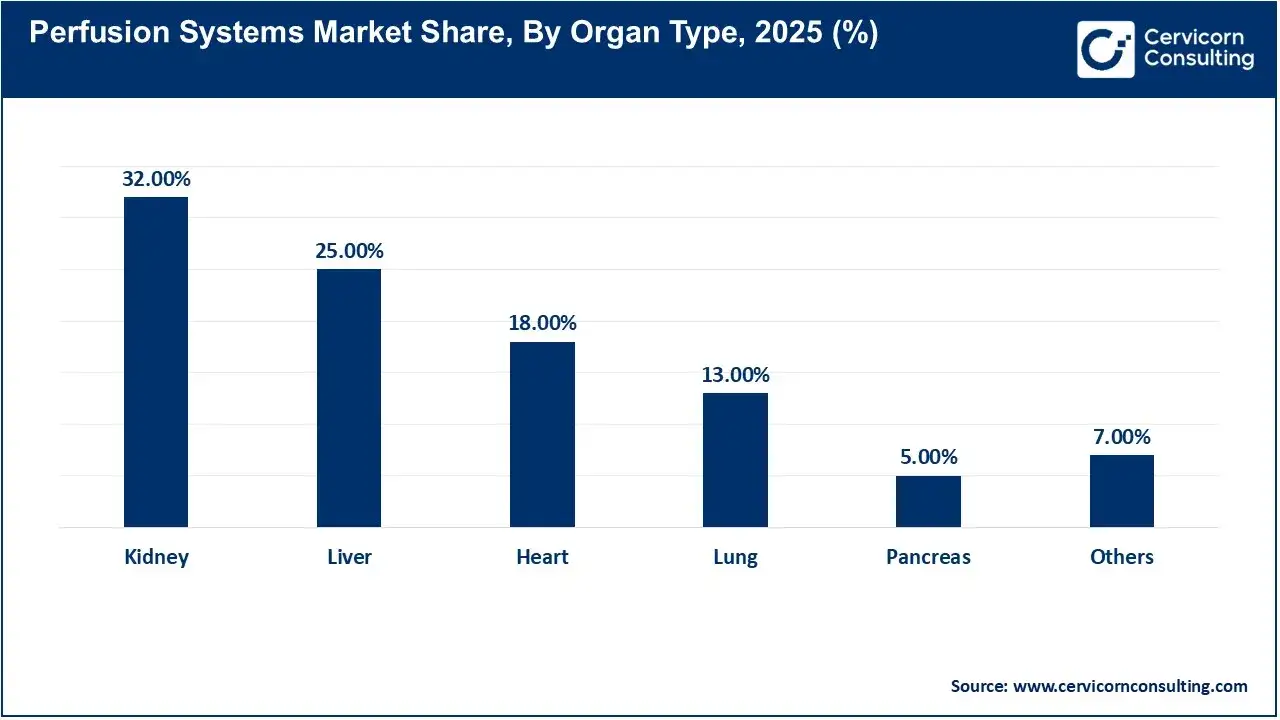
Heart perfusion is expected to be the fastest-growing segment, propelled by developments in technologies that facilitate the evaluation of viability and donor-heart preservation. Opportunities to assess and preserve donor hearts that might not be suitable for traditional preservation techniques can be found through machine perfusion. The development of sophisticated heart-perfusion solutions is being aided by the growing emphasis on increasing the pool of donors. Expanded use across transplantation networks is also being supported by advancements in portable perfusion systems. It is anticipated that increased research and clinical use of heart-perfusion technologies will hasten the segment's expansion.
Application Analysis
Cardiovascular surgery dominated the perfusion systems market because of the widespread use of cardiopulmonary bypass technologies in complex cardiac procedures such as open heart surgery. During surgery, perfusion systems are crucial for sustaining oxygenation and circulation while the heart and lungs are momentarily supported. The market is expanding due to the rising prevalence of cardiovascular illnesses and the ongoing need for cardiac treatments. Procedural capabilities are being further enhanced by technological developments in heart-lung machines and perfusion monitoring. These systems' widespread use in cardiac centers and hospitals supports their dominant position.
Perfusion Systems Market Share, By Application, 2025 (%)
| Application |
Revenue Share, 2025 (%) |
| Cardiovascular Surgery |
30% |
| Organ Preservation & Transplantation |
24% |
| Respiratory Support |
13% |
| Critical Care |
9% |
| Cell & Tissue Culture |
7% |
| Biopharmaceutical Manufacturing |
6% |
| Cancer Therapy / Isolated Limb Perfusion |
5% |
| Research & Drug Development |
4% |
| Others |
2% |
Organ preservation and transplantation are expected to be the fastest-growing application segment, motivated by the growing use of machine perfusion technologies in transplant facilities. These technologies have the potential to enhance organ preservation, facilitate the evaluation of organ viability, and facilitate the use of organs from larger sources. The demand for sophisticated preservation methods is rising due to an increase in transplant activity. More flexibility in organ transportation and evaluation is also being made possible by the development of portable perfusion systems. It is anticipated that segment expansion will be further supported by ongoing innovation in hypothermic and normothermic perfusion.
End User Analysis
Transplant centers dominated the end-user segment due to their extensive use of organ-preservation and transplantation technologies and their specialized infrastructure. To preserve, evaluate, and transport donor organs, these facilities depend more on sophisticated perfusion systems. The increasing use of machine perfusion is driving up demand for specialized tools and monitoring systems. The segment is also being supported by investments in infrastructure for transplant care and an increase in transplantation activity. Their leadership position is also a result of their concentration of specialized clinical expertise.
Perfusion Systems Market Share, By End User, 2025 (%)
| End User |
Revenue Share, 2025 (%) |
| Hospitals |
38% |
| Organ Transplant Centers |
19% |
| Specialty Cardiac Centers |
15% |
| Ambulatory Surgical Centers |
8% |
| Research Institutes |
7% |
| Biotechnology & Pharmaceutical Companies |
6% |
| Academic Institutions |
5% |
| Others |
2% |
Hospitals are expected to be the fastest-growing end-user segment as the use of sophisticated perfusion technologies in critical care, transplantation, ECMO, and cardiac surgery grows. Perfusion systems are becoming more and more in demand as hospital-based cardiac and extracorporeal treatment capabilities grow. This trend is being further supported by the expansion of healthcare infrastructure and the uptake of cutting-edge medical technologies. To offer specialized procedures closer to patients, hospitals are also increasing their capacity. Adoption is anticipated to increase with the increasing integration of automated and digitally connected perfusion systems.
Automation Level Analysis
Manual and conventional systems dominated the automation segment due to their well-established usage in surgical centers and hospitals. Because of their familiarity and compatibility with current clinical workflows, these systems continue to be widely used in routine perfusion procedures. Their wide availability and comparatively well-established operational procedures encourage ongoing adoption. Conventional systems are still used in many medical facilities for routine cardiac and perfusion procedures. Their current leadership position is a result of their established clinical acceptance.
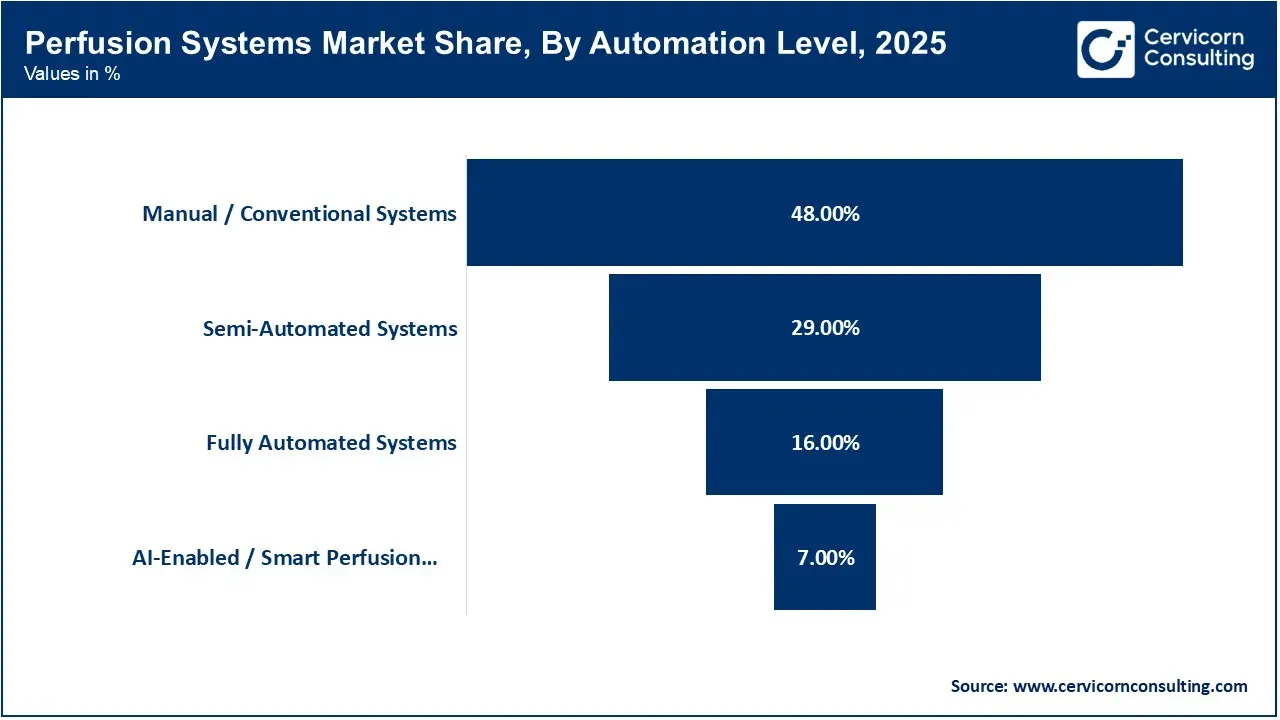
AI-enabled and smart perfusion systems are expected to be the fastest-growing segment, motivated by the growing incorporation of data analytics, automation, real-time monitoring, and artificial intelligence into perfusion technologies. Smart systems can facilitate ongoing evaluation of physiological parameters and assist medical professionals in making better perfusion decisions. Technology advancement in this field is being stimulated by the increasing focus on individualized and data-driven patient care. Their capabilities are being further expanded by integration with linked monitoring platforms. The adoption of smart perfusion systems is anticipated to accelerate with increased investment in intelligent medical technologies.
Recent Developments
- In November 2025, Paragonix Technologies announced a strategic partnership with Gravitas Surgical. The partnership combines Paragonix’s advanced organ-preservation technologies with Gravitas Surgical’s Ex Vivo Lung Perfusion (EVLP) services. The collaboration aims to improve donor-lung preservation and availability, expanding the application of perfusion technology within organ transplantation.
- In March 2026, Vivalyx announced the first-in-human use of its Omnisol® technology in a kidney transplant clinical trial. The first patients received donated kidneys that were machine-perfused using Vivalyx Omnisol®, marking the company’s transition from preclinical development to clinical-stage testing. The development supports further advancement of machine perfusion and organ-preservation technologies for kidney transplantation.
- In October 2025, Terumo Corporation completed its acquisition of OrganOx. The acquisition combines OrganOx’s organ perfusion technology with Terumo’s global medical technology capabilities and is expected to support further development of the OrganOx metra® platform. The development strengthens the application of normothermic machine perfusion for organ preservation and transplantation.
- In March 2026, Bridge to Life announced the first commercial use of its VitaSmart™ Hypothermic Oxygenated Perfusion System at a U.S. transplant center. Duke University Hospital became the first U.S. organ transplant center to implement the VitaSmart™ system following its FDA De Novo clearance. The development demonstrates the transition of hypothermic oxygenated perfusion technology toward broader clinical adoption in liver transplantation.
Top Players
Segments Covered
By Product Type
- Cardiopulmonary Perfusion Systems
- Extracorporeal Membrane Oxygenation (ECMO) Systems
- Ex-Vivo Organ Perfusion Systems
- Cell Perfusion Systems
- Isolated Limb Perfusion Systems
- Other Perfusion Systems
By Component
- Oxygenators
- Perfusion Pumps
- Heart-Lung Machines
- Cannulas
- Reservoirs
- Monitoring Systems
- Tubing Sets
- Heat Exchangers
- Cardioplegia Delivery Systems
- Other Components & Accessories
By Technology / Perfusion Technique
- Hypothermic Machine Perfusion
- Normothermic Machine Perfusion
- Subnormothermic Machine Perfusion
- Pulsatile Perfusion
- Continuous Perfusion
- Gravity/Pressure-Driven Perfusion
- Other Technologies
By Organ Type
- Kidney
- Liver
- Heart
- Lung
- Pancreas
- Other Organs
By Application
- Cardiovascular Surgery
- Organ Preservation & Transplantation
- Respiratory Support
- Critical Care
- Cell & Tissue Culture
- Biopharmaceutical Manufacturing
- Cancer Therapy / Isolated Limb Perfusion
- Research & Drug Development
- Other Applications
By End User
- Hospitals
- Organ Transplant Centers
- Specialty Cardiac Centers
- Ambulatory Surgical Centers
- Research Institutes
- Biotechnology & Pharmaceutical Companies
- Academic Institutions
- Others
By Automation Level
- Manual / Conventional Systems
- Semi-Automated Systems
- Fully Automated Systems
- AI-Enabled / Smart Perfusion Systems
By Region
- North America
- Europe
- Asia Pacific
- Latin America
- Middle East & Africa