On-Grid Battery Energy Storage Systems Market Size and Growth Outlook 2026 to 2035
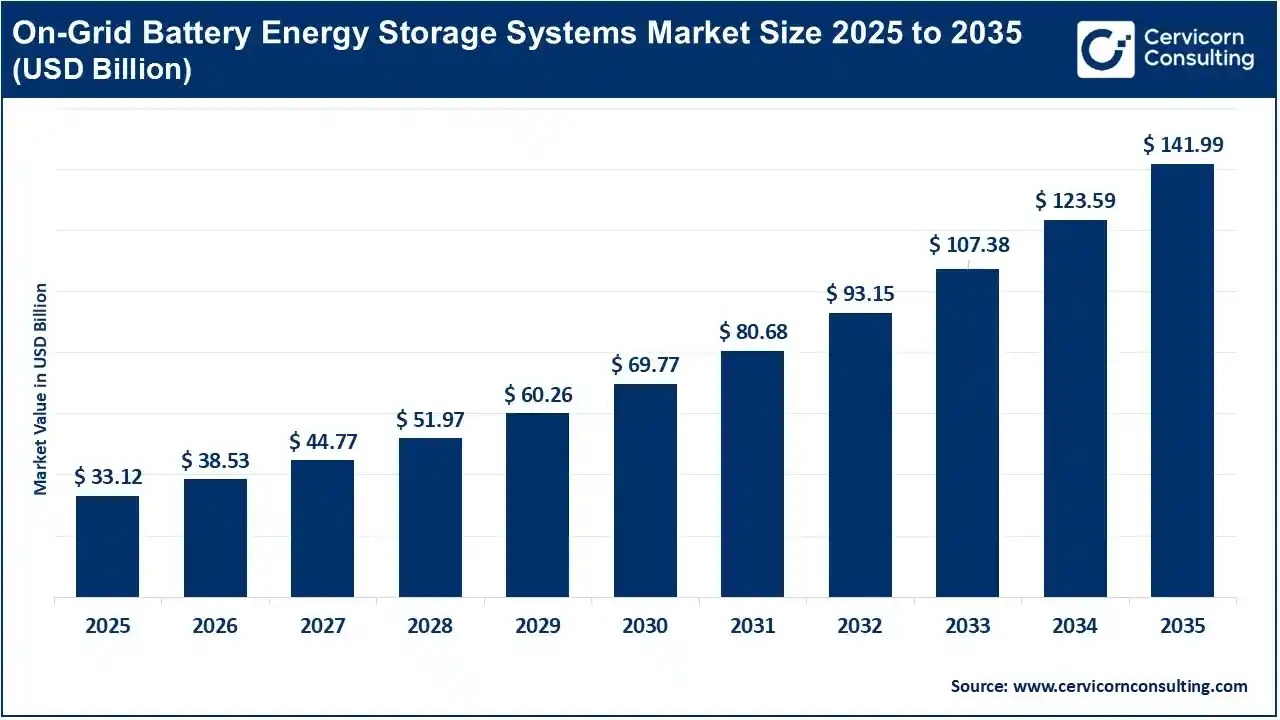
The global on-grid battery energy storage systems market size was estimated at USD 33.12 billion in 2025 and is projected to grow from USD 38.53 billion in 2026 to nearly USD 141.99 billion by 2035, registering a CAGR of 15.6% over the forecast period 2026 to 2035.
The off-grid battery energy storage systems market is expanding as homes, businesses, industrial sites, and remote communities look more and more for dependable and independent power solutions. Demand for battery storage systems that can store excess renewable electricity and provide power when renewable generation is unavailable is being driven by the increasing use of solar and wind energy in places without reliable grid access. Battery technology advancements, better energy management systems, falling storage costs, and the increasing demand for energy resilience and backup power are all contributing factors to market expansion.
- In January 2026, Ola Electric launched its first residential Battery Energy Storage System (BESS), “Shakti,” from its Gigafactory in Krishnagiri, Tamil Nadu. The launch expands the company’s energy-storage portfolio and supports the growing use of battery systems for residential backup and decentralized energy applications.
Report Highlights
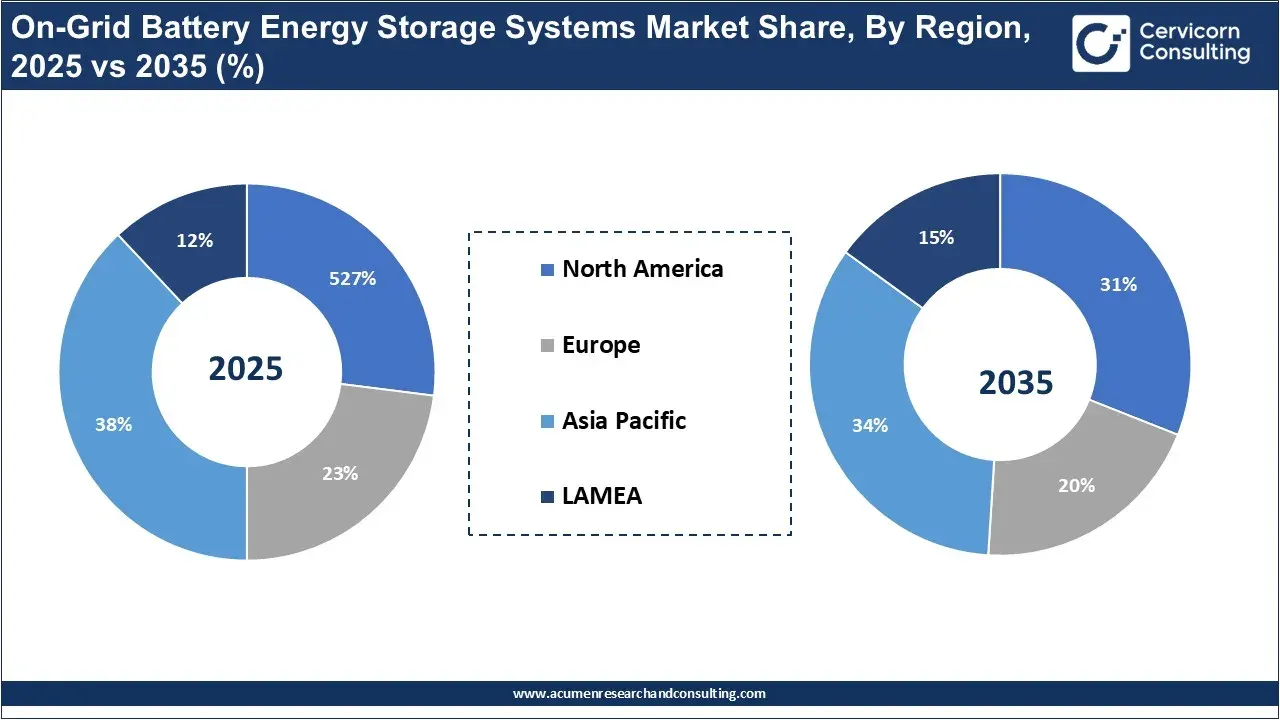
- By region, Asia-Pacific dominated the market in 2025, accounting for a 38% market share, supported by renewable energy integration, grid expansion, and rising battery storage deployment.
- By meter position/deployment, Front-of-the-Meter (FTM) dominated the market in 2025, accounting for an 80% market share, owing to strong demand for utility-scale storage and grid balancing.
- By meter position/deployment, Behind-the-Meter (BTM) was the second-largest segment in 2025, accounting for a 20% market share, supported by growing commercial, industrial, and residential adoption.
- By end user, utility & grid-scale developers dominated the market in 2025, accounting for a 68% market share, supported by large-scale storage deployment and renewable energy integration.
- By end user, Commercial & Industrial was the second-largest segment in 2025, accounting for a 24% market share, driven by demand for reliable power and energy cost management.
- By battery technology, Lithium Iron Phosphate (LFP) dominated the market in 2025, accounting for a 62% market share, supported by its safety, durability, and long cycle life.
- By battery technology, flow batteries were the second-largest segment in 2025, accounting for a 14% market share, driven by demand for long-duration energy storage.
- By energy capacity, 100–<500 MWh dominated the market in 2025, accounting for a 38% market share, owing to strong demand for medium-to-large-scale storage projects.
- By energy capacity, 10–<100 MWh was the second-largest segment in 2025, accounting for a 25% market share, supported by growing medium-scale storage deployment.
- By grid connection level, transmission-connected systems dominated the market in 2025, accounting for a 42% market share, supported by grid balancing and renewable energy integration.
- By grid connection level, distribution-connected systems were the second-largest segment in 2025, accounting for a 28% market share, driven by localized storage and distribution-grid flexibility.
Recent Trends
- Solar-storage integration: Growing use of batteries with solar PV to store excess renewable energy and provide power when generation is low.
- Shift toward lithium-ion: Lithium-ion batteries are gaining adoption due to their high energy density, longer lifespan, and compact design.
- Modular storage systems: Demand is rising for scalable battery systems that can be expanded as energy requirements increase.
- Remote electrification: Off-grid storage is increasingly deployed in rural areas, remote communities, islands, and locations with limited grid access.
- Smart energy management: Advanced monitoring and intelligent energy management systems are improving battery utilization and system efficiency.
- Focus on energy resilience: Households and businesses are adopting storage systems to maintain reliable power during outages and grid disruptions.
- Growth of hybrid systems: Battery storage is increasingly combined with solar, wind, and backup generators to provide more dependable off-grid electricity.
Market Dynamics
Driver – Growing Need for Reliable Power
Off-grid battery energy storage systems are in high demand due to the growing need for reliable electricity in underserved and remote areas. In order to help users maintain a steady power supply, these systems can store electricity produced from renewable sources and supply it when generation is unavailable. Reliable storage solutions are becoming increasingly necessary as rural areas become more electrified and decentralized energy projects grow. Additionally, battery systems lessen the need for diesel generators, especially in areas where expanding conventional grid infrastructure is costly or difficult.
Restraint – High Initial Investment
Off-grid storage system adoption may be hampered by the high initial costs of batteries, inverters, installation, and supporting renewable-energy infrastructure. Households, small enterprises, and isolated communities with few financing options are especially affected by this problem. Maintenance, system integration, and battery replacement can all raise the total cost of ownership. Potential users may decide to postpone investments or stick with traditional backup options due to these financial concerns.
- In August 2025, Larsen & Toubro announced an order for a solar PV project integrated with a battery energy storage system in Bihar. The project incorporates advanced storage In March 2026, Saatvik Green Energy launched Saatvik Power Storage Solutions Limited, a dedicated subsidiary focused on batteries and energy storage solutions. The move reflects the increasing focus of renewable-energy companies on expanding into battery storage. The subsidiary is expected to support the company's expansion into energy-storage applications and complement its existing renewable-energy activities.
Opportunity – Expansion of Renewable-Inte]grated Storage
Opportunities for battery storage systems that can store excess renewable electricity and provide it when generation drops are being created by the expanding use of solar and wind power. For remote communities, businesses, telecom infrastructure, and other off-grid uses, such hybrid systems can provide dependable electricity. Flexible storage options are becoming more and more possible as decentralized energy networks grow. Battery integration with renewable power systems may be further encouraged by the growing interest in clean energy and energy resilience.
- In January 2026, ENGIE announced its first hybrid solar-and-storage project in India, combining solar power generation with battery storage. The project demonstrates the growing opportunity to integrate energy storage with renewable generation for more flexible and dependable electricity supply. Hybrid projects can help manage fluctuations in renewable generation while improving the utilization of clean power. Such developments also highlight the potential for battery storage to play a larger role in India's evolving decentralized and renewable-energy infrastructure.
Regional Analysis
North America On-grid BESS Market
- Market Size (2025): USD 8.94 billion
- Market Size (2026): USD 42.02 billion
- CAGR (2026-2035): 17.40%.
Europe On-grid BESS Market
- Market Size (2025): USD 7.62 billion
- Market Size (2035): USD 28.40 billion
- CAGR (2026-2035): 13.80%
Asia-Pacific On-grid BESS Market
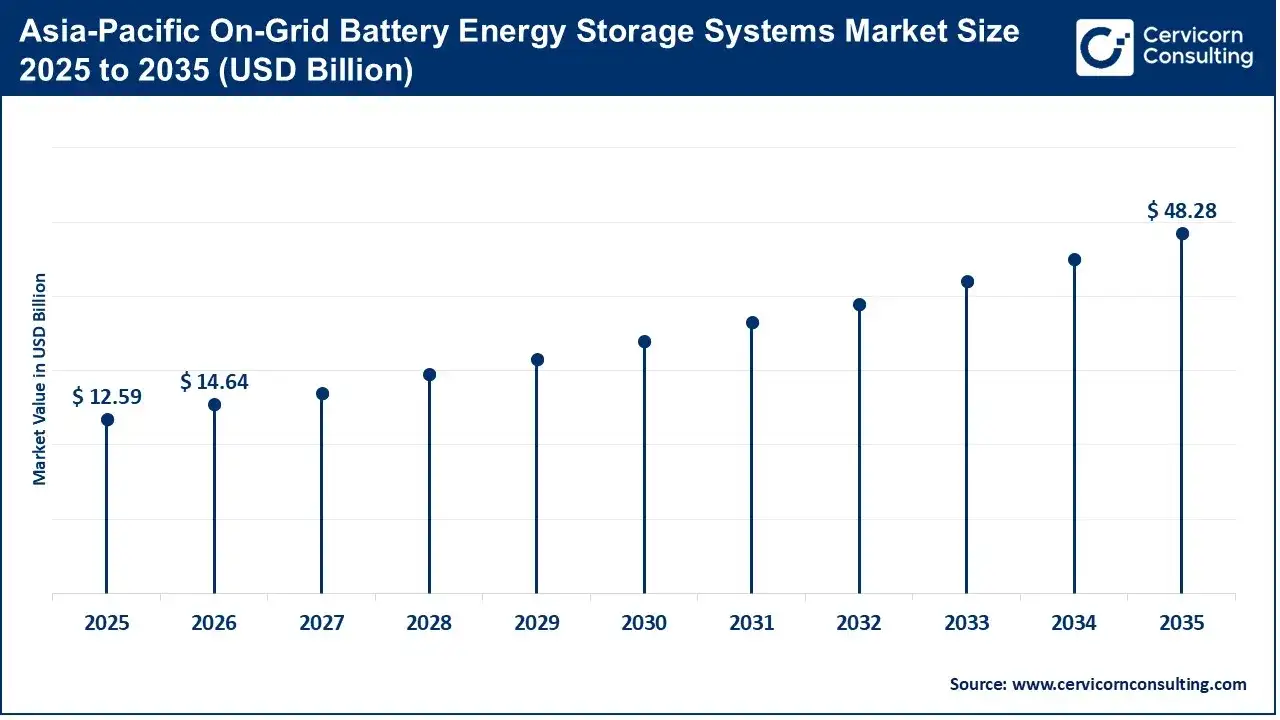
- Market Size (2025): USD 12.59 billion
- Market Size (2035): USD 48.28 billion
- CAGR (2026-2035): 14.20%.
LAMEA On-grid BESS Market
- Market Size (2025): USD 3.97 billion
- Market Size (2035): USD 21.30 billion
- CAGR (2026-2035): 18.50%.
Asia-Pacific dominated the market with a market share of 38% in 2025, supported by growing investments in utility-scale battery storage projects, grid modernization, the quick deployment of renewable energy, and rising electricity demand. In order to control the intermittent nature of renewable energy sources and enhance grid reliability, nations in the region are increasing their energy storage capacity. Battery energy storage systems are becoming more and more in demand in the region due to growing industrialization and the development of large solar and wind projects.
Middle East & Africa is the fastest-growing regional segment, registering a CAGR of 20.9% from 2026 to 2035. Growth is driven by rising investments in renewable energy, energy diversification, the need for grid resilience, and the use of battery storage for solar and wind integration. More opportunities for the deployment of energy storage are being created by the development of utility-scale renewable projects and initiatives to increase electricity reliability. Market expansion is also being supported by a greater emphasis on lowering reliance on conventional power generation.
Segmental Analysis
Meter Position/Deployment Analysis
Front-of-the-Meter (FTM) dominated the market with a market share of 80% in 2025, driven by a high demand for utility-scale storage for ancillary grid services, peak management, grid balancing, and the integration of renewable energy. Large solar and wind farms are increasingly being installed alongside FTM systems to increase grid flexibility and power availability. Their dominance is further enhanced by their capacity to sustain distribution and transmission networks.
On-Grid BESS Market Share, By Meter Position/Deployment, 2025 (%)
| Meter Position/Deployment |
Revenue Share, 2025 (%) |
Revenue Share, 2035 (%) |
| Front-of-the-Meter (FTM) |
80% |
83% |
| Behind-the-Meter (BTM) |
20% |
17% |
Behind-the-Meter (BTM) was the second-largest segment with a market share of 20% in 2025. The adoption of BTM systems for self-consumption, energy management, and backup power is being aided by the expansion of commercial, industrial, and residential energy storage installations. Storage is being used by businesses more and more to control electricity consumption and increase power reliability. Additionally, integration with rooftop solar systems is driving up demand for BTM solutions. Energy cost control, backup power, rooftop solar integration, and increased end-user energy independence are the market's driving forces.
End User Analysis
Utility & grid-scale developers dominated the market with a market share of 68% in 2025. This sector is still being strengthened by the robust implementation of large-scale storage projects for network support, peak management, grid stability, and renewable integration. Battery systems are being used by utilities more frequently to manage variable renewable generation and increase grid flexibility. Large energy storage capacity is becoming even more necessary as utility-scale solar and wind projects grow. The market is driven by the need for flexible power management, growing utility-scale renewable deployment, grid modernization, and rising electricity demand.
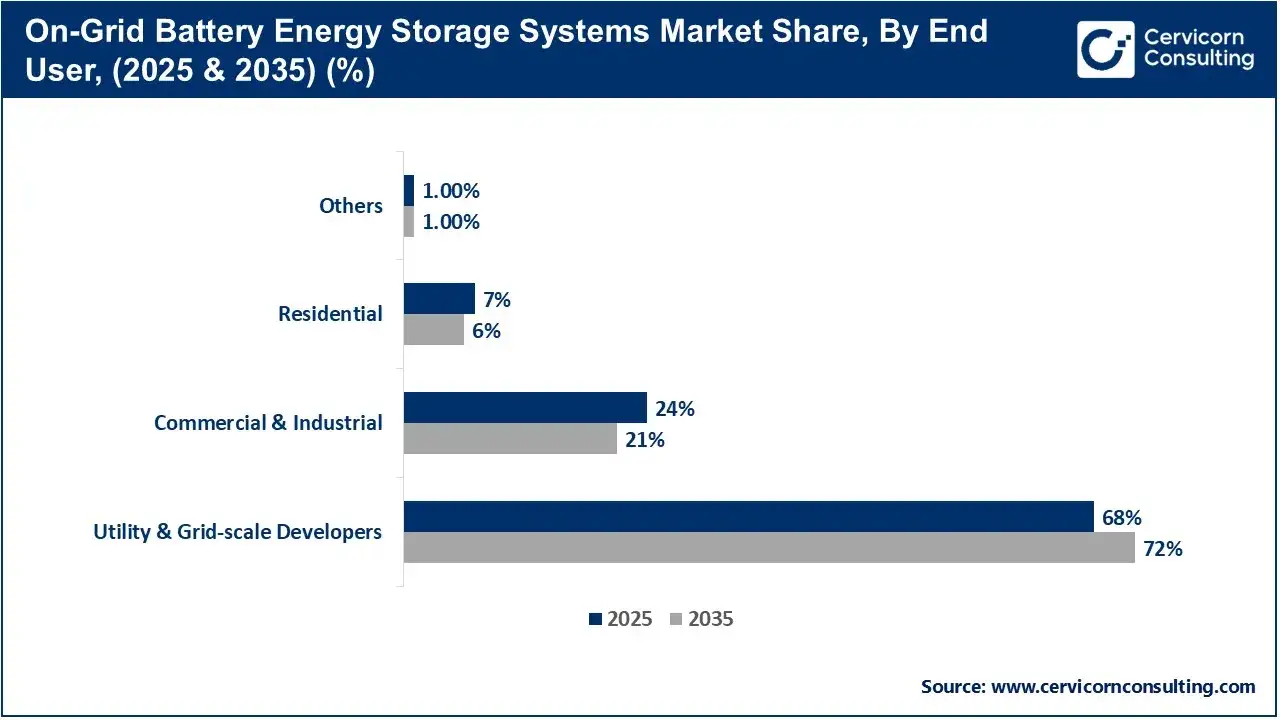
Commercial & industrial was the second-largest segment with a market share of 24% in 2025. Adoption in commercial and industrial facilities is being supported by growing demands for energy cost management, dependable backup power, and integration of on-site renewable generation. To increase operational resilience and lessen reliance on traditional grid supplies, businesses are utilizing battery storage.
Commercial and industrial users are being encouraged to incorporate battery storage due to the increasing deployment of distributed solar systems. Rising electricity prices, the need for more energy efficiency, the need for dependable power, and the integration of renewable energy sources are the market's main drivers.
Battery Technology Analysis
Lithium Iron Phosphate (LFP) dominated the market with a market share of 62% in 2025, making it the biggest market for battery technology. Its long cycle life, durability, safety features, and suitability for large-scale energy storage applications all contribute to its widespread adoption in stationary storage. For utility-scale projects where dependability and operational safety are crucial, LFP technology is becoming more and more popular. Its widespread adoption is further supported by the fact that it is compatible with large battery storage installations. The market is propelled by the growing adoption of utility-scale storage systems, long cycle life, dependable performance, and safer battery chemistries.
On-Grid BESS Market Share, By Battery Technology, 2025 (%)
| Battery Technology |
Revenue Share, 2025 (%) |
| Lithium Iron Phosphate (LFP) |
62% |
| Nickel Manganese Cobalt (NMC) |
7% |
| Other lithium-ion |
2% |
| Flow batteries |
14% |
| Lead-acid |
9% |
| Sodium-based |
5% |
| Others |
1% |
Flow Batteries were the second-largest segment with a market share of 14% in 2025. Their increasing use in stationary energy storage projects is supported by their suitability for long-duration energy storage and applications needing extended discharge periods. Flow batteries can be used in situations where grid balancing and the integration of renewable energy sources call for longer storage times. The technology's capacity to sustain performance over numerous cycles of charging and discharging is another factor fueling interest in it. Growing demand for long-duration storage, grid flexibility, renewable energy balancing, and technologies that can support extended discharge requirements are driving the market.
Energy Capacity Analysis
The 100–<500 MWh segment dominated the market with a market share of 38% in 2025. Demand for medium-to-large-scale storage projects that facilitate grid flexibility, electricity supply management, and the integration of renewable energy sources benefits this market. Numerous utility and grid-support needs can be met by these systems. There is a growing need for storage systems in this capacity range due to the increased use of renewable energy. Growing utility-scale renewable projects, grid balancing needs, the need for flexible power capacity, and the growth of large-scale energy storage facilities are the market's main drivers.
On-Grid BESS Market Share, By Energy Capacity, 2025 (%)
| Energy Capacity |
Revenue Share, 2025 (%) |
| <10 MWh |
12% |
| 10–<100 MWh |
25% |
| 100–<500 MWh |
38% |
| 500–<1,000 MWh |
17% |
| ≥1,000 MWh |
8% |
The 10–<100 MWh segment was the second-largest segment with a market share of 25% in 2025. Demand within this capacity range is being supported by an increase in the deployment of medium-scale storage projects across grid, commercial, and industrial applications. These systems offer flexibility for the integration of renewable energy sources and localized energy management. Their adaptability to projects requiring a moderate amount of storage capacity is encouraging adoption in a variety of applications. Growing needs for backup power, distributed renewable energy integration, medium-scale storage, and localized grid flexibility are driving the market.
Grid Connection Level Analysis
Transmission-connected systems dominated the market with a market share of 42% in 2025. The deployment of large-scale battery systems for network stability, renewable integration, and transmission-level grid balancing supports their strong position. These systems assist in controlling variations in the supply and demand of electricity throughout extensive power networks. Transmission-level storage solutions are becoming more and more in demand as renewable energy becomes more prevalent. Transmission-grid stability, integration of renewable energy, large-scale power balancing, and modernization of electricity networks are the market's main drivers.
On-Grid BESS Market Share, By Grid Connection Level, 2025 (%)
| Grid Connection Level |
Revenue Share, 2025 (%) |
| Transmission-connected |
42% |
| Sub-transmission-connected |
13% |
| Distribution-connected |
28% |
| Low-voltage / Customer-connected |
17% |
Distribution-connected systems were the second-largest segment with a market share of 28% in 2025. Adoption in this sector is being aided by growing demands for distributed renewable generation integration, distribution-grid flexibility, and localized energy storage. Distribution-level battery systems can assist in controlling local grid congestion and variations in electricity demand. Deployment is being aided by the growth of distributed solar and other decentralized energy resources. Growing distributed renewable energy, local grid flexibility requirements, rising electricity demand, and the need to increase distribution-network reliability are the market's main drivers.
Government Initiatives
- In June 2025, The Ministry of Power introduced the 2025 VGF framework to support the development of BESS projects and improve their financial viability. The scheme is intended to encourage investment in storage infrastructure and support greater integration of renewable electricity. It is particularly relevant to battery storage because financial support can help reduce the initial cost barrier for developers.
- In August 2025, The government amended the operational guidelines for VGF-supported BESS projects to refine the implementation framework. The amendment provides greater clarity for projects receiving support through the Power System Development Fund. Such policy adjustments are intended to facilitate smoother deployment of battery storage projects and encourage participation from developers.
- In September 2025, The Ministry of Power further amended the VGF guidelines for BESS projects funded through the Power System Development Fund. The update strengthened the policy framework for supporting battery storage deployment and improving project implementation. It also demonstrates the government's continued focus on making energy storage an important part of India's renewable-energy infrastructure.
- In September 2025, The Electricity Rules were amended to provide greater flexibility in the development, ownership, leasing, and operation of Energy Storage Systems. The change can enable different business models and wider participation in the storage sector. This creates a more supportive regulatory environment for battery storage deployment across decentralized and grid-connected applications.
- In February 2025, The Central Electricity Authority issued an advisory encouraging the integration of energy storage with solar projects to improve the dispatchability and utilization of renewable electricity. The advisory recommended storage alongside solar capacity to help manage variations in renewable generation. This measure is relevant to off-grid and hybrid systems because combining solar generation with batteries can provide electricity beyond periods of sunlight.
- In June 2025, The Ministry of Power approved an expanded VGF scheme supporting the development of additional battery energy storage capacity. The initiative is designed to encourage new storage projects and strengthen India's ability to integrate variable renewable energy. Increased policy support can also create opportunities for battery manufacturers, system integrators, and energy-storage developers.
Recent Developments
- In September 2026, ACME Solar commissioned 66.68 MW of solar capacity and 300 MWh of BESS capacity in Rajasthan. The project combines renewable generation with battery storage, while the company also commissioned the first phase of its FDRE project's BESS component. The development highlights the growing integration of battery storage with renewable power to provide more dependable and dispatchable electricity.
- In September 2026, DTEK secured U.S. DFC financing for a 200 MW/400 MWh battery storage project in Ukraine. The battery systems are being used across six sites and can respond rapidly to grid disruptions, supporting electricity-system resilience. The development demonstrates the role of distributed battery storage in maintaining reliable power during infrastructure disruptions.
- In September 2026, Premier Energies and RCT India announced a joint venture to establish a 12 GWh BESS manufacturing facility in Telangana. The first phase is planned at 6 GWh, with the facility intended to serve commercial, industrial, utility-scale, and international markets. The development strengthens domestic battery-storage manufacturing and expands Premier Energies' activities beyond solar manufacturing.
- In May 2026, Schneider Electric launched its next-generation fully integrated BESS in India. The system combines battery storage with power infrastructure, energy-management software, microgrid controls, and digital intelligence. Its architecture is designed for both utility-scale and behind-the-meter applications, including systems requiring greater energy resilience and flexible power management.
- In November 2025, Adani Group announced its entry into the BESS sector with a 1,126 MW/3,530 MWh project at Khavda. The project uses lithium-ion battery technology and advanced energy-management systems to support renewable-energy integration, peak-load management, and grid stability. The development also marked a major expansion of large-scale battery storage infrastructure in India.
Key Companies
Segments Covered
By Meter Position/Deployment
- Front-of-the-Meter (FTM)
- Behind-the-Meter (BTM)
By End User
- Utility & Grid-scale Developers
- Commercial & Industrial
- Residential
- Others
By Battery Technology
- Lithium Iron Phosphate (LFP)
- Nickel Manganese Cobalt (NMC)
- Other lithium-ion
- Flow batteries
- Lead-acid
- Sodium-based
- Others
By Energy Capacity
- <10 MWh
- 10–<100 MWh
- 100–<500 MWh
- 500–<1,000 MWh
- ≥1,000 MWh
By Grid Connection Level
- Transmission-connected
- Sub-transmission-connected
- Distribution-connected
- Low-voltage / customer-connected
By Region
- North America
- Europe
- Asia-Pacific
- Latin America
- Middle East & Africa