Next-Generation Lithium-ion Battery Market Size, Growth, Forecast 2026 To 2035
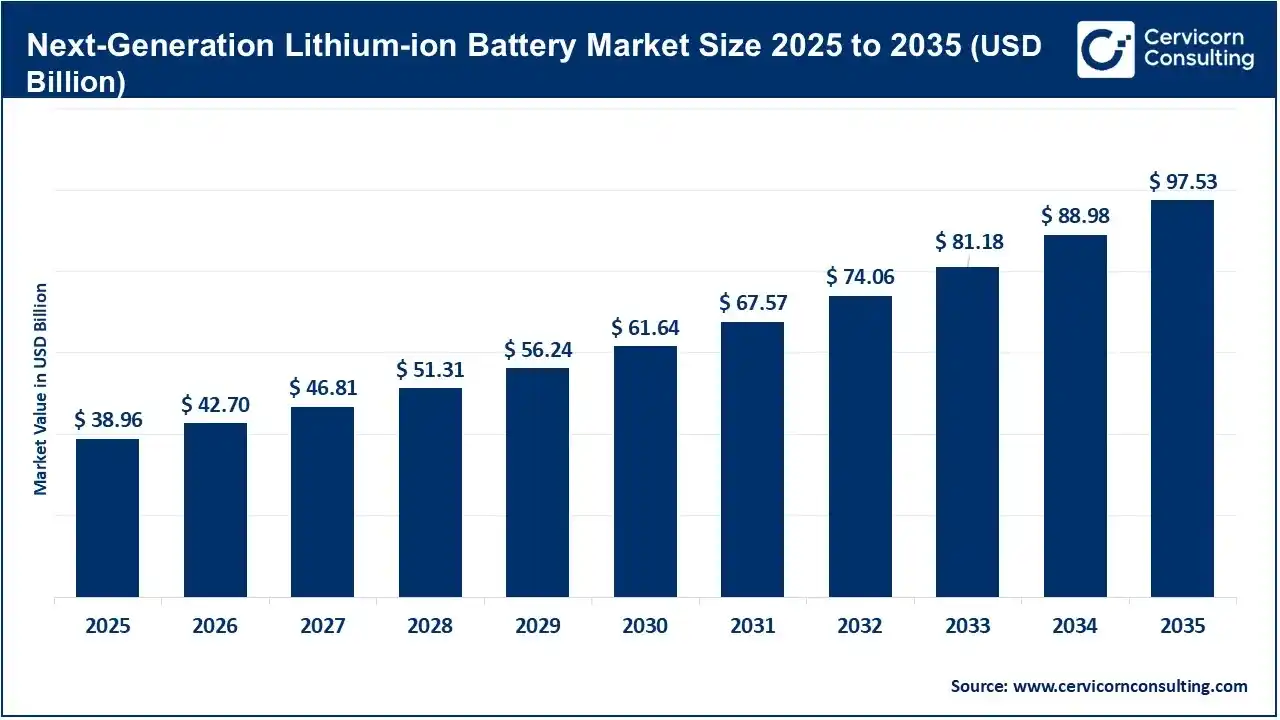
The global next-generation lithium-ion battery market size was valued at USD 38.96 billion in 2025 and is expected to exceed around USD 97.53 billion by 2035, exhibiting a compound annual growth rate (CAGR) of 9.6% over the forecast period 2026 to 2035. The next-generation lithium-ion battery market is being driven primarily by the rapid electrification of transportation, rising demand for higher energy density, faster charging, longer cycle life, and improved battery safety.
Global electric-car sales exceeded 17 million units in 2024, representing more than 20% of new-car sales worldwide, creating strong demand for advanced battery technologies capable of delivering longer driving ranges and shorter charging times. Global EV battery deployment reached approximately 1.2 TWh in 2025, increasing nearly 30% year over year, further encouraging manufacturers to develop advanced Li-ion chemistries, silicon-based anodes, high-nickel cathodes, and improved cell architectures.
Technological advancements in silicon anodes, advanced electrolytes, high-voltage cells, AI-enabled battery management, and ultra-fast charging are further accelerating adoption. Silicon has a theoretical specific capacity of approximately 3,579 mAh/g, substantially above conventional graphite, making silicon-carbon anodes attractive for increasing energy density while maintaining the existing Li-ion manufacturing ecosystem. Meanwhile, average EV battery-pack energy density has increased by around 60% over the past decade, while battery prices have fallen by roughly 75%, improving the commercial attractiveness of advanced battery technologies. The introduction of 1,000-V EV models and charging systems capable of delivering charging times below 10 minutes is also pushing manufacturers toward next-generation cell and pack technologies.
Report Highlights
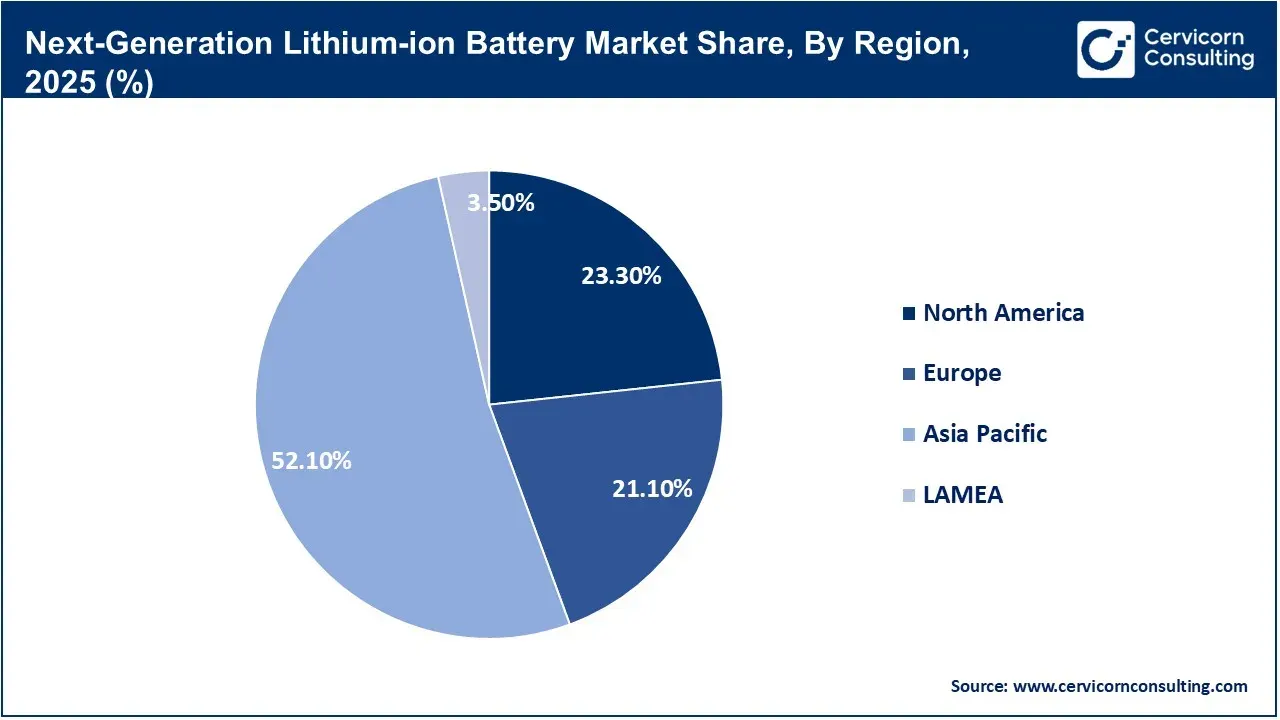
- Asia-Pacific held the largest regional share at 52.1%, benefiting from China's extensive battery manufacturing ecosystem, EV production, and advanced battery-material supply chains.
- Lithium Iron Phosphate (LFP) chemistry accounted for 38.3% of the market in 2025, supported by lower costs, long cycle life, and strong thermal stability.
- Nickel Manganese Cobalt (NMC) chemistry represented 34.7%, maintaining strong demand where higher energy density and longer driving range are critical.
- Electric Vehicles dominated applications with a 55.8% market share, driven by accelerating vehicle electrification and demand for higher-performance battery systems.
- Energy Storage Systems captured 19.7%, supported by renewable-energy integration, grid modernization, and increasing deployment of stationary battery systems. LFP accounted for more than 90% of global stationary storage installations in 2025.
What is a Next-Generation Lithium-ion Battery?
A next-generation lithium-ion battery is an advanced lithium-ion battery designed to deliver higher energy density, faster charging, longer cycle life, improved safety, and better overall performance than conventional Li-ion batteries. These batteries incorporate innovations such as silicon and silicon-carbon anodes, high-nickel cathodes, advanced electrolytes, lithium-metal enhancements, semi-solid/solid-state designs, and improved cell architectures while seeking to retain the scalability of existing lithium-ion manufacturing. Silicon is particularly promising because its theoretical capacity reaches approximately 3,579 mAh/g, compared with roughly 372 mAh/g for graphite.
Next-Generation Lithium-ion Battery Market Recent Milestones
| Year |
Company / Development |
Recent Milestone |
| 2024 |
ProLogium |
Demonstrated a 100% silicon-composite-anode battery reaching 321 Wh/kg and 5–60% charging in 5 minutes. |
| 2024 |
ProLogium & FEV |
Partnered to develop next-generation automotive battery packs using lithium-ceramic technology. |
| 2025 |
CATL |
Developed a lithium-metal battery prototype exceeding 500 Wh/kg with 483-cycle life, addressing the energy-density/longevity trade-off. |
| 2025 |
Silicon-based solid-state research |
Researchers demonstrated a silicon-based all-solid-state cell operating without external pressure, achieving 1,000 cycles with 14.5% expansion. |
| 2025 |
Global EV battery deployment |
EV battery deployment reached 1.2 TWh, increasing almost 30% year over year, strengthening demand for higher-performance battery technologies. |
| 2025 |
Global battery manufacturing |
Global Li-ion battery manufacturing capacity surpassed 4 TWh, growing approximately 30% from 2024. |
| 2025 |
Himadri Chemical & Sicona |
Announced plans for India's first silicon-carbon plant; Sicona's technology targets approximately 20% higher energy density and 40% faster charging when blended with graphite. |
| 2026 |
Silicon-anode commercialization |
Industry research continues shifting toward scalable silicon-carbon composites, prelithiation, coatings, and advanced electrolyte/interface engineering to overcome silicon's volume-expansion challenge. |
Next-Generation Lithium-ion Battery Market Dynamics
Market Drivers
1. Rising Demand for Higher Energy Density
The need for longer driving ranges and compact energy storage is accelerating adoption of next-generation Li-ion technologies. Silicon-based anodes offer theoretical capacities of up to 4,200 mAh/g, compared with about 372 mAh/g for graphite, creating substantial potential for higher energy density. Advanced anode architectures, high-nickel cathodes, and improved electrolytes are therefore receiving significant investment from battery manufacturers and automotive companies seeking greater range without proportionally increasing battery-pack size or weight.
2. Rapid Expansion of Battery Deployment
Growing deployment across electric vehicles and stationary storage is encouraging manufacturers to improve battery performance, reliability, and cost efficiency. Global lithium-ion battery deployment across applications increased more than sixfold between 2020 and 2025, creating a larger commercial base for advanced technologies. At the same time, lithium demand increased by nearly 30% in 2024, demonstrating the rapidly expanding material requirements associated with electrification and strengthening incentives to develop higher-performing battery chemistries and more resource-efficient designs.
Market Restraints
1. Silicon-Anode Degradation and Manufacturing Complexity
Silicon-based anodes remain constrained by substantial mechanical and electrochemical degradation during repeated charging and discharging. Silicon can experience more than 300% volume expansion, causing particle pulverization, electrode structural damage, unstable solid-electrolyte interfaces, and accelerated capacity loss. Overcoming these problems requires sophisticated particle engineering, binders, coatings, electrolyte additives, and prelithiation processes, increasing manufacturing complexity. Consequently, achieving consistent long-term cycle performance while maintaining commercially attractive production yields remains a major restraint for large-scale commercialization.
2. Concentration of Critical-Mineral Supply Chains
Next-generation batteries remain exposed to supply-chain risks involving lithium, nickel, cobalt, graphite, and other strategically important materials. The top three refining countries accounted for approximately 86% of refined supply of key energy minerals in 2024, highlighting significant geographic concentration. Supply disruptions, export restrictions, geopolitical tensions, and price volatility can therefore increase manufacturing costs and complicate procurement strategies. The IEA estimates that a sustained battery-metal supply shock could increase average global battery-pack prices by 40–50%, creating a significant risk for advanced battery manufacturers.
Market Opportunities
1. Advanced Battery Recycling and Circular Supply Chains
Battery recycling presents a major opportunity to reduce dependence on newly mined materials while creating secondary sources of critical minerals. Recycled battery-metal production has expanded rapidly, with recycled-material input rates reaching over 40% for nickel and cobalt and around 20% for lithium in 2023. Furthermore, battery recycling patents increased at an average annual rate of 56% between 2017 and 2022, indicating strong technological innovation. Advanced direct recycling, hydrometallurgical, and material recovery technologies can increasingly support circular supply chains for next-generation batteries.
2. Development of Silicon and Advanced Anode Ecosystems
The transition from conventional graphite to silicon-rich and silicon-carbon anodes creates opportunities across materials, manufacturing equipment, cell design, and battery management technologies. Silicon offers a theoretical capacity roughly 11 times higher than graphite, creating substantial headroom for improving cell-level energy storage. Research is increasingly focused on nanostructuring, composite architectures, surface coatings, electrolyte optimization, and prelithiation to control degradation. Commercialization of these technologies can allow manufacturers to enhance existing Li-ion platforms without completely replacing established cell-production infrastructure.
Market Challenges
1. Scaling Advanced Technologies to Mass Production
Moving next-generation battery technologies from laboratory prototypes to high-volume manufacturing remains a significant challenge. Advanced materials often require new processing conditions, specialized equipment, tighter quality controls, and extensive validation before automotive qualification. The failure of several new battery manufacturing projects to achieve targeted production yields demonstrates the difficulty of scaling complex cell technologies. In particular, the Northvolt experience highlighted the challenges of simultaneously scaling multiple supply-chain stages and reducing cell defect rates to commercially competitive levels.
2. Balancing Performance, Cost, Safety, and Cycle Life
Next-generation batteries must improve energy density and charging performance without sacrificing safety, durability, manufacturability, or cost. Higher-energy chemistries can introduce greater thermal, mechanical, and interface-management requirements, while silicon anodes face conductivity and structural-stability challenges. At the same time, battery manufacturers operate under intense cost pressure: lithium-ion battery-pack prices declined 20% in 2024, increasing pressure on emerging technologies to demonstrate clear performance advantages without creating excessive production costs.
Next-Generation Lithium-ion Battery Market Regional Analysis
The next-generation lithium-ion battery market is segmented by region into North America, Europe, Asia-Pacific, Latin America, and LAMEA. Here is a brief overview of each region:
Asia-Pacific (APAC) Next-Generation Lithium-ion Battery Market: Driven by EV Leadership, Battery Manufacturing Scale, Energy-Storage Expansion, Advanced Cell Development, and Supply-Chain Integration
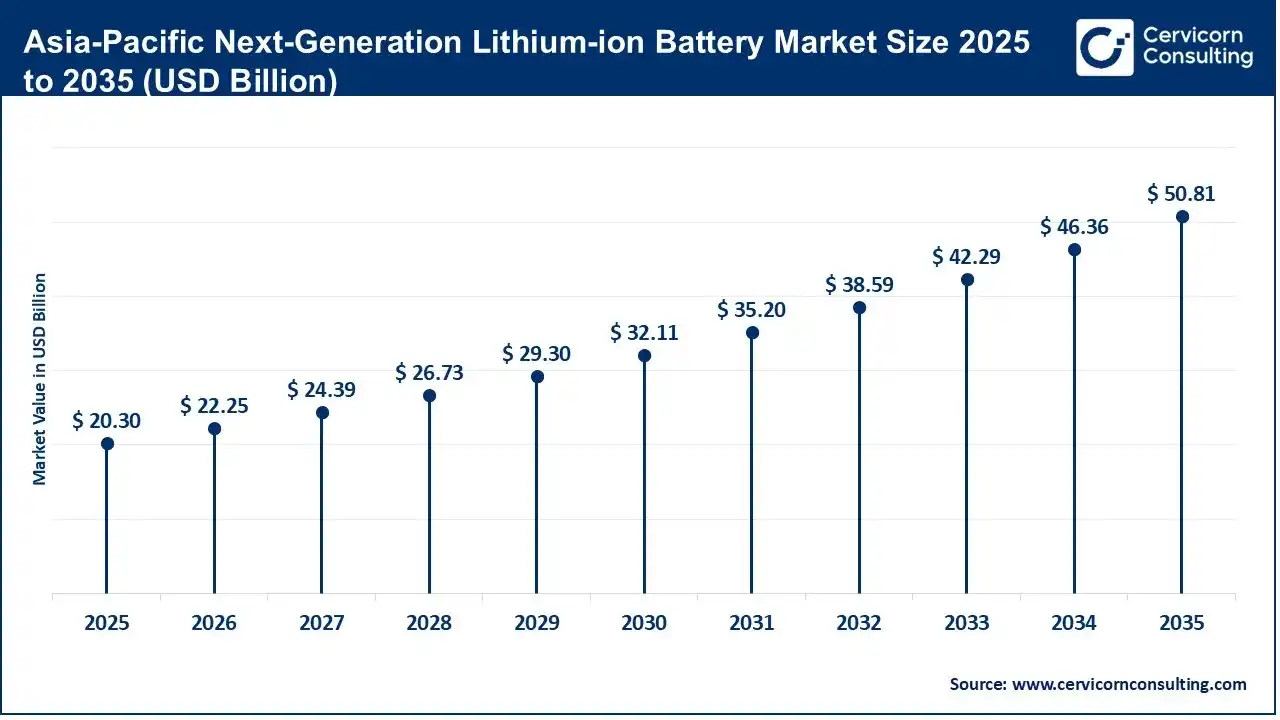
The Asia-Pacific next-generation lithium-ion battery market size was valued at USD 20.30 billion in 2025 and is expected to exceed around USD 50.81 billion by 2035. Asia-Pacific is the dominant regional market, supported by massive electric-vehicle adoption, extensive battery-cell manufacturing capacity, rapidly expanding energy-storage installations, and strong investments in advanced battery technologies. China, Japan, South Korea, and India represent the region's principal demand and production centers, while Southeast Asia is emerging as an important manufacturing hub. China alone accounted for approximately 70% of global battery-cell manufacturing capacity in 2024, giving the region substantial advantages in cost, supply-chain integration, and technology commercialization.
China: EV Dominance, Massive Battery Production, Energy Storage, and Advanced Cell Innovation Drive Market Demand
- China's electric-car sales exceeded 11 million vehicles in 2024, representing more than half of global electric-car sales and creating substantial demand for advanced battery technologies.
- China produced approximately 80% of the world's battery cells in 2024, reinforcing its dominance across cathode, anode, electrolyte, cell, and pack manufacturing.
- Battery-storage additions in China reached approximately 86 GW in 2024, creating significant opportunities for LFP and other long-cycle-life battery technologies.
India: Rapid EV Adoption, Domestic Cell Manufacturing, Energy Storage, and Localization Drive Market Development
- India's electric two-wheeler sales exceeded 1.1 million units in 2024, creating substantial demand for affordable, durable, and high-cycle-life battery technologies.
- India's advanced battery manufacturing ecosystem is expanding under the government's production-linked incentive program, which targets 50 GWh of advanced chemistry cell manufacturing capacity.
- Growing renewable-energy deployment is increasing demand for grid-scale and commercial energy storage, creating opportunities for LFP and other cost-effective next-generation lithium-ion technologies.
North America Next-Generation Lithium-ion Battery Market: Driven by EV Electrification, Grid Storage Expansion, Domestic Battery Manufacturing, Advanced Battery R&D, and Supply-Chain Localization
The North America next-generation lithium-ion battery market size was estimated at USD 9.08 billion in 2025 and is projected to hit USD 22.72 billion by 2035. North America is a strategically important and rapidly developing region, supported by accelerating electric-vehicle adoption, large-scale energy-storage deployment, domestic battery manufacturing investments, and increasing efforts to reduce dependence on Asian supply chains. The United States dominates regional demand, while Canada is strengthening its position through battery-material processing and gigafactory investments. The region is also a major center for silicon-anode, high-nickel, lithium-metal, and advanced electrolyte development. U.S. battery manufacturing capacity reached approximately 1,400 GWh in 2025, demonstrating the rapidly expanding regional production ecosystem.
United States: EV Adoption, Battery Manufacturing Expansion, Grid Storage, and Advanced Technology Investments Drive Market Demand
- U.S. electric-vehicle sales reached approximately 1.6 million units in 2025, maintaining strong demand for higher-energy-density and faster-charging battery technologies.
- The United States added approximately 18 GW of new battery-storage capacity in 2025, supporting demand for durable, high-cycle-life lithium-ion technologies across utility-scale and commercial applications.
- Domestic battery-cell manufacturing capacity exceeded 300 GWh annually in 2025, strengthening opportunities for advanced LFP, NMC, silicon-anode, and other next-generation cell technologies.
Canada: Battery Supply-Chain Development, EV Manufacturing, Critical Minerals, and Clean-Energy Investments Support Market Expansion
- Canada's battery manufacturing ecosystem is expanding through investments in EV and battery plants, including projects targeting more than 100 GWh of annual battery production capacity.
- Canada possesses significant reserves of lithium, nickel, cobalt, graphite, and other critical minerals, providing an important foundation for localized next-generation battery supply chains.
Europe Next-Generation Lithium-ion Battery Market: Driven by EV Electrification, Grid-Scale Storage, Battery Manufacturing Localization, Sustainability Regulations, and Advanced Battery R&D
The Europe next-generation lithium-ion battery market size was accounted for USD 8.22 billion in 2025 and is forecasted to surpass around USD 20.58 billion by 2035. Europe is a strategically important market, supported by electric vehicle adoption, rapid battery-storage deployment, domestic manufacturing initiatives, and efforts to establish a more resilient regional battery value chain. Germany, the UK, France, Italy, Sweden, Hungary, and Poland are important demand and production centers. European battery storage installations reached 36 GWh in 2025, increasing 48% year over year, while total operational battery-storage capacity surpassed 100 GWh, demonstrating rapidly expanding demand for advanced lithium-ion technologies across transportation and stationary applications.
Germany: EV Manufacturing, Battery Production, Grid Storage, and Industrial Electrification Drive Market Demand
- Germany remained Europe's largest battery-storage market, installing approximately 6.6 GWh of new BESS capacity in 2025, despite only 2% annual growth.
- Germany hosts major battery manufacturing operations, including CATL's cell production facility, strengthening local access to advanced lithium-ion cells.
- Strong automotive manufacturing capabilities from Volkswagen, BMW, Mercedes-Benz, and other OEMs are driving demand for higher-energy-density, fast-charging, and cost-efficient battery technologies.
United Kingdom: Grid-Scale Storage, EV Transition, and Battery Technology Development Support Market Expansion
- The UK installed approximately 5.2 GWh of new battery-storage capacity in 2025, representing a 64% increase from the previous year.
- The UK's expanding utility-scale storage sector is creating strong demand for high-cycle-life lithium-ion technologies, particularly LFP-based systems.
LAMEA (Latin America, Middle East & Africa) Next-Generation Lithium-ion Battery Market: Driven by EV Adoption, Renewable-Energy Storage, Battery Manufacturing Localization, Critical-Mineral Availability, and Electrification
The LAMEA next-generation lithium-ion battery market was valued at USD 1.36 billion in 2025 and is anticipated to reach USD 3.41 billion by 2035. LAMEA is an emerging and increasingly attractive market, supported by accelerating EV adoption, renewable-energy expansion, grid modernization, and investments in localized battery supply chains. Latin America is led by Brazil, while the Middle East is driven by the UAE and Saudi Arabia, and Africa is developing around Morocco, Egypt, and South Africa. In 2025, electric-car sales in Latin America exceeded 350,000 units, increasing 75% year over year, while Middle Eastern EV sales reached approximately 75,000 units, growing more than 40%.
Latin America: EV Expansion, Renewable Energy, Battery Storage, and Automotive Manufacturing Support Market Development
- Brazil's electric-car sales reached 180,000 units in 2025, representing 9% of new-car sales, up from 6.5% in 2024, creating strong demand for advanced battery technologies.
- Brazil is becoming an important regional EV manufacturing hub, with BYD beginning local factory operations in 2025, supporting future domestic battery and component demand.
- Brazil, Mexico, Colombia, Chile, and Uruguay are expanding EV adoption through tax incentives, import policies, and charging-infrastructure development.
Middle East: Utility-Scale Energy Storage, EV Adoption, Renewable Integration, and Localization Drive Market Growth
- Middle Eastern electric-car sales reached approximately 75,000 units in 2025, increasing more than 40% year over year, with the UAE remaining the largest regional market.
- Saudi Arabia accounted for approximately 31% of the Middle East and Africa battery market in 2025, supported by large-scale energy-storage and industrial electrification investments.
Next-Generation Lithium-ion Battery Market Segmental Analysis
The next-generation lithium-ion battery market is segmented into battery chemistry, application, and geography.
Battery Chemistry Analysis
LFP is the leading chemistry in the next-generation lithium-ion battery landscape because of its lower cost, strong thermal stability, long cycle life, and reduced dependence on nickel and cobalt. In 2025, LFP accounted for more than 90% of global stationary battery-storage installations, demonstrating its broad suitability beyond electric vehicles. Its improving energy density and compatibility with cell-to-pack architectures are also expanding adoption in mass-market EVs, commercial vehicles, and energy-storage systems.
Next-Generation Lithium-ion Battery Market Share, By Battery Chemistry, 2025 (%)
| Battery Chemistry |
Revenue Share, 2025 (%) |
| Lithium Iron Phosphate (LFP) |
38.3% |
| Nickel Manganese Cobalt (NMC) |
34.7% |
| Nickel Cobalt Aluminum (NCA) |
8.6% |
| Lithium Cobalt Oxide (LCO) |
6.2% |
| Lithium Manganese Oxide (LMO) |
4.6% |
| Lithium Titanate Oxide (LTO) |
3.7% |
| Others |
3.9% |
LFP is also emerging as the fastest-growing chemistry as manufacturers prioritize affordable, durable, and safer batteries. Its demand increased approximately 48% during 2025, supported by rapid deployment in electric vehicles and stationary storage. Adoption is expanding particularly rapidly across China, Southeast Asia, India, and Brazil, where LFP already represented more than half of electric-car battery demand in several markets. Continuous improvements in energy density, charging capability, and manganese-enhanced formulations are expected to strengthen LFP's growth trajectory further.
Application Analysis
Electric vehicles represent the dominant application segment because battery performance directly influences driving range, charging time, vehicle cost, and overall competitiveness. In 2025, EVs accounted for more than 70% of global lithium-ion battery deployment, substantially exceeding other applications. Automakers are increasingly adopting advanced LFP, high-nickel NMC, silicon-enhanced anodes, and faster-charging architectures to improve vehicle economics and performance. This makes automotive electrification the principal demand engine for next-generation lithium-ion battery technologies globally.
Next-Generation Lithium-ion Battery Market, By End User, 2025 (%)
| End User |
Revenue Share, 2025 (%) |
| Electric Vehicles |
55.8% |
| Energy Storage Systems |
19.7% |
| Consumer Electronics |
10.8% |
| Power Tools & Industrial Equipment |
5.1% |
| Telecom & Data Centers |
3.1% |
| Marine |
1.9% |
| Aerospace & Defense |
1.6% |
| Medical Devices |
0.9% |
| Others |
1.1% |
Energy storage systems are the fastest-growing application as renewable-energy penetration increases and electricity grids require greater flexibility, peak management, and backup capacity. Battery storage accounted for more than 15% of global lithium-ion battery deployment in 2025, with LFP particularly well-positioned due to its long cycle life and safety characteristics. Falling battery costs, expanding solar and wind installations, and increasing data-center power requirements are encouraging utilities, commercial facilities, and households to deploy advanced lithium-ion storage systems at increasing scale.
Next-Generation Lithium-ion Battery Market Top Companies
Segments Covered
By Battery Chemistry
- Lithium Iron Phosphate (LFP)
- Nickel Manganese Cobalt (NMC)
- Nickel Cobalt Aluminum (NCA)
- Lithium Manganese Oxide (LMO)
- Lithium Titanate Oxide (LTO)
- Lithium Cobalt Oxide (LCO)
- Others
By Application
- Electric Vehicles
- Energy Storage Systems
- Consumer Electronics
- Power Tools & Industrial Equipment
- Aerospace & Defense
- Marine
- Medical Devices
- Telecom & Data Centers
- Others
By Geography
- North America
- Europe
- Asia-Pacific
- LAMEA