Lubricants Market Size and Growth 2026 to 2035
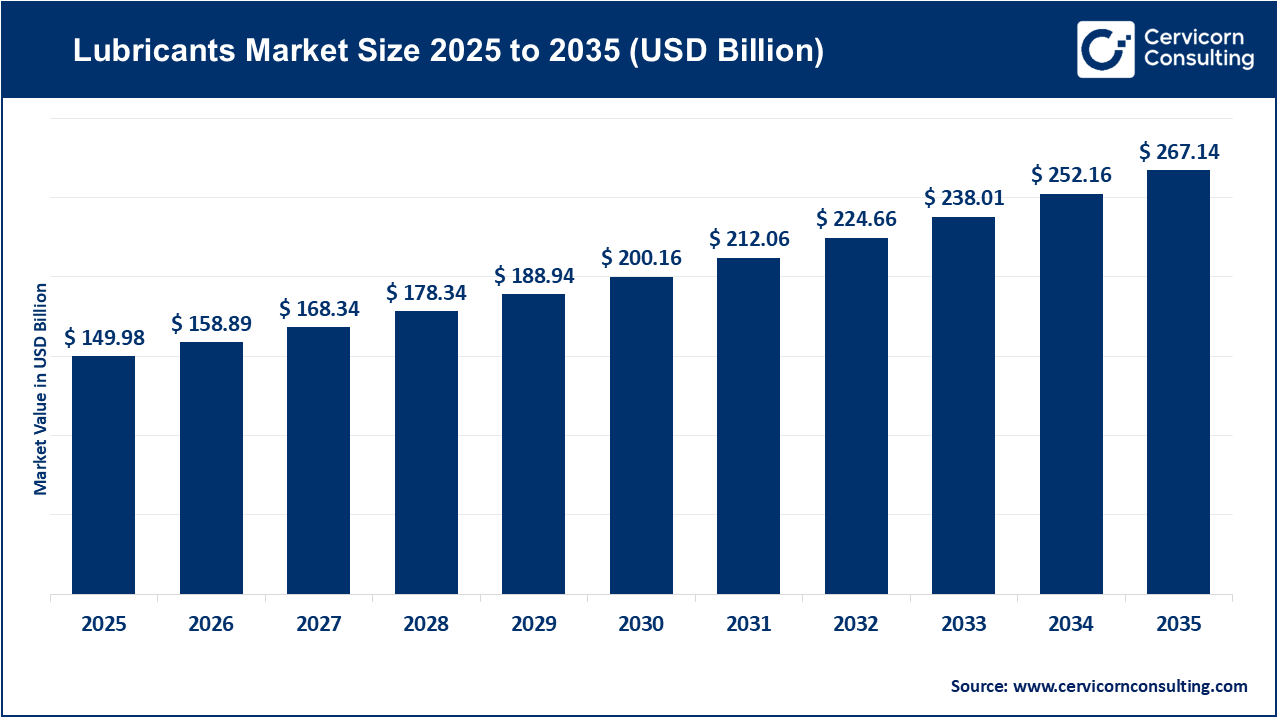
The global lubricants market size was valued at USD 149.98 billion in 2025 and is anticipated to surpass around USD 267.14 billion by 2035, growing at a compound annual growth rate (CAGR) of 6% over the forecast period from 2026 to 2035. The overall rise of demand for lubricants in automotive industry and industrial applications creates potential for the market’s growth. Moreover, the growth of lubricants market is poised due to advancements in lubrication processes; such as automatic lubrication systems, and injector-based lubrication.
Report Highlights
- Asia Pacific led the lubricants market in 2025 with revenue share 45.20%, the dominance is supported by strong automotive production and overall rising demand for synthetic lubricants for industrial applications.
- Europe was considered as the second-largest marketplace in 2025 owing to the rising demand for bio-based lubricants following efficient regulatory compliances.
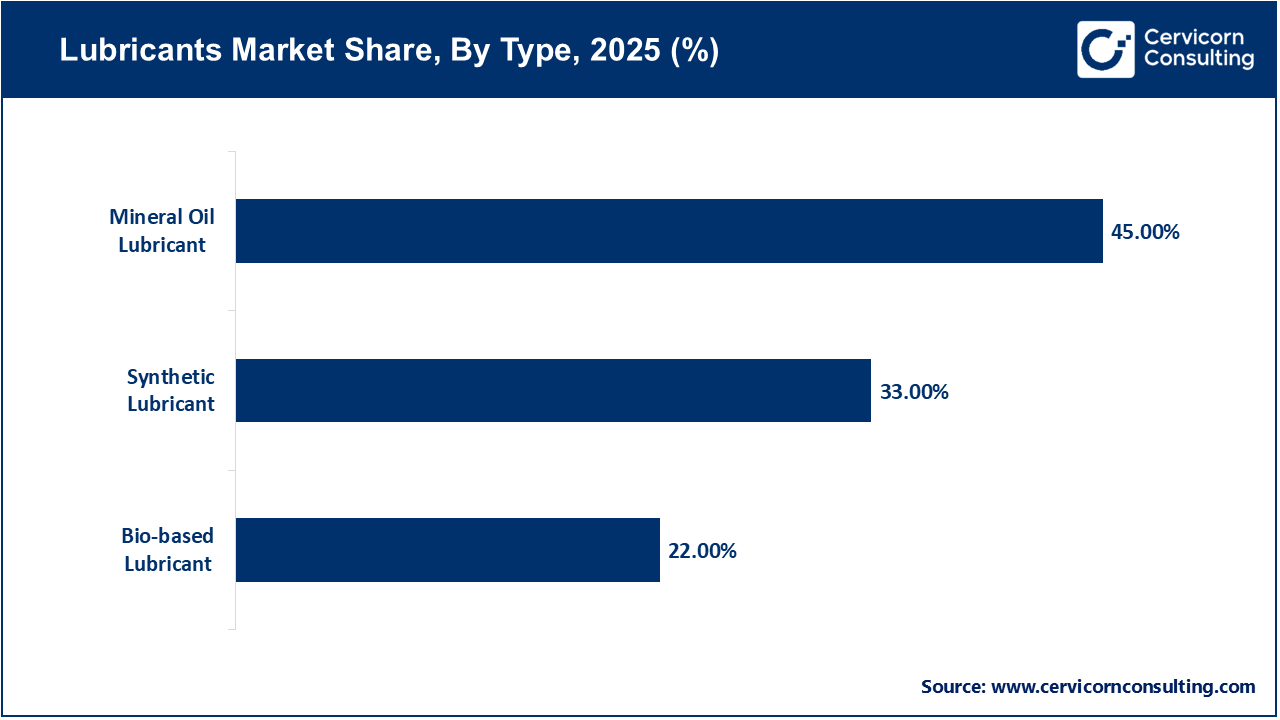
- By type, the mineral oil lubricant segment dominated the market with revenue share of 45% in 2025 owing to its wide-spread availability with cost-effective solutions.
- By type, the bio-based lubricant segment is seen to grow at the fastest rate during the forecast period due to the shift in regulations for industrial lubricants.
- By product, the engine oil segment held the largest share 41% in 2025 considering its mandatory application in vehicles and machinery to beat overheating and corrosion.
- By product, the hydraulic oil segment is seen to grow at the fastest rate in the upcoming years with its booming application in heavy-duty applications in construction and mining industries.
- By end-use industry, the automotive segment led the market in 2025 with 43% revenue share, owing to the overall demand for high-performance engine oils and advancements in bio-based lubricants.
- By end-use industry, the industrial segment is seen to grow rapidly due to the necessity of lubricants in operating high-maintenance machinery in manufacturing and energy sectors.
Lubricants Market Insights
Lubricants is a category of products that is intended to decrease the frictional resistance of a moving surface of machinery and engines; therefore, lubricants include but are not limited to, oil for engines; transmission fluids; hydraulic oils; grease and specialty fluids for use in automobiles, industry, marine, aerospace, and energy. The use of lubricants will improve the efficiency of machines, prolong the life of machine components, and provide mechanical protection for machine components under different working conditions.
With the addition of more than 500 Gigawatts (GW) of renewable energy capacity being added globally by 2023 (International Energy Agency), much of the associated equipment will also require the use of environmentally friendly lubricants, thereby increasing the demand for bio-based formulations.
How Does Boom of Electric Vehicles Create Opportunity for Lubricants Market?
The global expansion of the market for electric vehicles (EVs) is causing the lubricant industry to change its traditional focus away from regular motor oils towards new types of fluids that are designed specifically for use with electric vehicles and for use with electric drivetrains, battery thermal management, bearings, and cooling systems of e-motors. The total size of the EV market will exceed 20% of total new car sales worldwide. As a result of this rapid growth in sales of electric vehicles, automotive original equipment manufacturers (OEMs) need to use more specialized fluids than in the past.
As OEMs increase their production of electric vehicles (estimates indicate that by 2030 there will be roughly 245 million light duty electric vehicles registered), the number of OEM filled specialized fluids used in electric vehicles will also increase in the same manner, thus providing a long-term, meaningful opportunity for lubricant manufacturers to innovate and to achieve long-term growth opportunities.
Top Global Importers of Lubricants (2026)
| Country |
Cause of High Imports |
| Mexico |
Strong industrial and automotive demand, strategic refinery gaps driving external sourcing. |
| Vietnam |
Rapid industrial expansion and infrastructure growth increasing lubricant and base oil purchases. |
| Costa Rica |
Expanding transport and machinery sectors with limited domestic lubricant production. |
| Chile |
Strong mining and heavy machinery demand fueling lubricant imports. |
| Russia |
Large industrial base coupled with lubricant demand beyond domestic refining capability. |
| Colombia |
Growth in transportation and industrial applications increases import dependency. |
Lubricants Market Regional Analysis
Why Asia Pacific to grow as a largest shareholder in lubricants market?
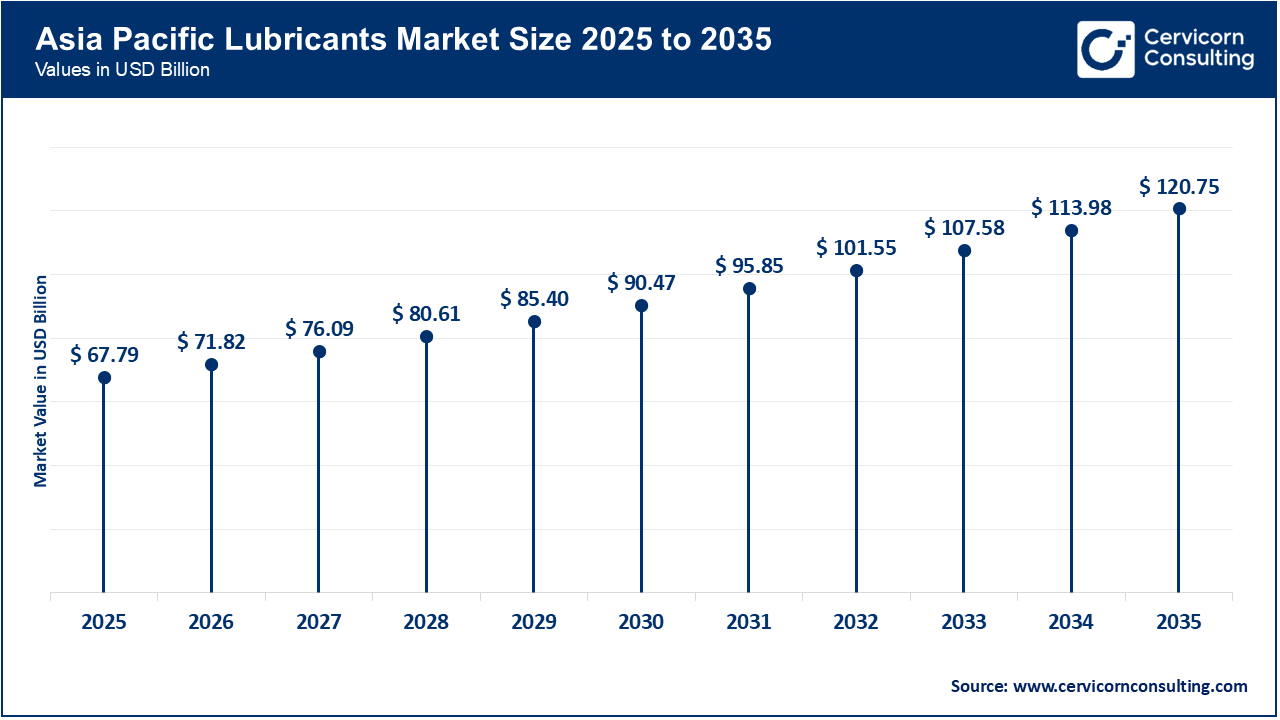
The Asia-Pacific lubricants market size was estimated at USD 67.79 billion in 2025 and is projected to hit around USD 120.75 billion by 2035. Being the dominated region in 2025, Asia Pacific is expected to be the largest user in the world of lubricating fluids, and with the intensity of industrial development, manufacturing volume, the number of vehicles made, and improvement in all forms of finish product distribution (infrastructure) across many of the major economies in Asia including China, India, Japan, South Korea and Southeast Asia, Asia Pacific will continue to be the leading manufacturing region in the world with greater than 50% of the total volume of manufactured products coming out of the region.
According to the United National Industrial Development Organization, China alone contributes nearly 30% of the world's value added to manufactured products. High volume manufacturing leads directly to higher usage of lubricating fluids, primarily in the form of industrial oils, hydraulic fluids, gear lubricants and metalworking fluids used in machinery, automated systems, and production lines. Asia Pacific is also the largest automotive manufacturer in the world.
According to the International Organization of Motor Vehicle Manufacturers, Asia produces over 50% of the world's annual automotive production with China producing over 30 million vehicles each year and India selling over 4 million passenger vehicles in FY2023-2024. Internal combustion engines continue to be the predominant form of vehicle being used in the Asia Pacific vehicle fleet; therefore, recurring engine oil drain intervals will continue to firmly establish volume levels of lubricant consumption in the region.
What to Expect from India’s Lubricants Market by 2030?
According to our experts, India’s lubricants market is expected to witness structurally strong demand through 2030, supported by rising vehicle ownership, expanding industrial automation, and sustained infrastructure investments across manufacturing and construction sectors.
- In India, there are three main parts to the lubricant business; automotive, industrial and marine, and energy. The three major Public Sector Undertakings (PSUs), Indian Oil Corporation Ltd., Hindustan Petroleum Corporation Ltd. & Bharat Petroleum Corporation Ltd.; account for, in volume terms, almost half of the total market.
- The other half consists of multinationals (e.g., Exxon Mobil, BP-Castrol, TotalFinaElf, Shell, Gulf Oil, Tide Water Oil) and many other domestic manufacturers. Therefore, there is great competition in the lubricant industry in India.
- Engineers India Limited has successfully developed the largest underground LPG rock cavern storage facility in India for Hindustan Petroleum Corporation Limited in Mangalore, Karnataka with an 80,000 MT storage capacity.
- Kerosene (SKO) consumption with a volume of 37 TMT registered a growth of 0.2% in Sep 2025 as compared to Sep 2024. SKO consumption during the month is largely constituted by PDS category with a 67% share.
- Total Natural Gas Consumption (including internal consumption) for the month of September 2025 was 5642 MMSCM which was 1.4% lower than the corresponding month of the previous year. The cumulative consumption of 34265 MMSCM for the current financial year till September 2025 was lower by 7.1% compared with the corresponding period of the previous year.
How does regulatory compliance in Europe support the lubricants market?
The Europe lubricants market size was valued at USD 29.40 billion in 2025 and is expected to reach around USD 52.36 billion by 2035. Europe observed the second largest share in lubricants market. Regulatory compliance in Europe serves as an impetus for improving and updating the lubricants sector. Manufacturers must provide high quality and environmentally friendly and performance efficient formulations as a result of regulations like the REACH Regulation and the CLP Regulation that mandate detailed chemical registration, hazard classification, and evaluation. Lubricant manufacturers are therefore compelled to reformulate their products to utilise safer additives with reduced toxicities in order to comply with the requirements of these regulations.
The adoption of stricter technical standards across the lubrication manufacturing industry has also stimulated new innovations in producing lower sulpha, lower ash and biobased lubricants. In relation to the automotive industry, stringent emission standards such as Euro 6 and proposed Euro 7 levels fuel the demand for advanced engine oils compatible with contemporary after-treatment systems such as diesel particulate filters (DPFs). This trend will continue to develop the demand for low SAPs (Sulfated Ash, Phosphorus, Sulfur) lubricants and manufacturers will only approve engine oils of satisfactory specification levels (OEM).
Top Government Initiatives for Bio-based Lubricants & Oils in European Countries:
- European Green Deal: Promotes climate neutrality by 2050 and accelerates the adoption of sustainable and biodegradable industrial products, indirectly supporting demand for bio-based lubricants across transport, marine, and industrial sectors.
- EU Bioeconomy Strategy: Encourages the replacement of fossil-based raw materials with renewable biological resources, supporting innovation, commercialization, and scale-up of bio-based chemicals and lubricants.
- Horizon Europe: Provides large-scale research and innovation funding (2021–2027) for green chemistry, circular economy solutions, and sustainable industrial materials, including advanced bio-lubricant technologies.
- European Ecolabel: Establishes strict environmental performance criteria for lubricants, promoting biodegradable hydraulic oils, greases, and marine lubricants in environmentally sensitive applications.
- REACH Regulation: Mandates chemical safety compliance and restricts hazardous substances, encouraging reformulation toward safer, plant-based, and environmentally acceptable lubricants.
Lubricants Market Share, By Region, 2025 (%)
| Region |
Revenue Share, 2025 (%) |
| North America |
18.40% |
| Europe |
19.60% |
| Asia-Pacific |
45.20% |
| LAMEA |
16.80% |
Why North America hits notable growth in the lubricants market?
The North America lubricants market size was reached at USD 27.60 billion in 2025 and is forecasted to grow around USD 49.15 billion by 2035. North America is seen to grow at a notable rate during the forecast period, driven by sustained industrial activity, advanced automotive fleets, and ongoing energy sector investments. The region’s mature automotive market, with high vehicle ownership and stringent maintenance standards, continues to underpin stable demand for passenger car engine oils, heavy-duty diesel oils, and specialty automotive fluids.
The shift towards environmentally acceptable lubricants (EALs), biodegradable hydraulic fluids, and low-toxicity greases has been accelerated by the regulatory drivers throughout North America, including environmental protection standards and emissions compliance. As electric vehicles transition to new technologies, the growth of certain segments of automotive engine oil has become moderated but has created opportunities to develop new lubricant formulations for electric vehicle gearboxes and thermal management systems.
Lubricants Market Segmental Analysis
Type Analysis
The use of mineral oil lubricant types continued to be the most common type of lubricant used around the world in 2025 because of their wide availability and ease of compatibility with existing machinery and internal combustion engines. The major global source for producing base oil used in lubricants continues to be petroleum refining; however, the majority of the world's liquid petroleum demand was greater than 100 million barrels per day for the refinery portion of the demand (International Energy Agency-IEA data for 2024-2025) with a large percentage of that quantity being turned into base stock used for lubricants.
“The total amount of vehicles produced globally, according to the International Organization of Motor Vehicle Manufacturers was over 90 million vehicles produced in 2023. The majority of these vehicles produced used either a mineral oil or semi-synthetic engine oil.”
During the forecast period, the bio-based lubricants will be the fastest growing segment of the lubricants market due to increasing environmental regulation and sustainability goals across various sectors. For example, the European Union has established environmental directives that promote the use of biodegradable lubricants in sensitive environmental regions such as forestry, marine environments and agriculture.
In addition, the BioPreferred Program administered by the U.S. Department of Agriculture continues to certify bio-based industrial products and encourage the federal government to purchase renewable lubricants. Many organizations are also making corporate commitments to environmental sustainability (i.e. ESG) and are motivated by reducing lifecycle emissions; as a result there is an increasing number of companies offering biodegradable alternatives for lubricants.
Product Analysis
The largest product type in 2025 was engine oil segment, due in large part to the enormous size of the global vehicle population, along with the frequency at which vehicles have oil changes. There is currently over 1.4 billion on-the-road vehicles around-the-world, and most standard gasoline powered passenger vehicles typically require an oil change at running either 5,000 to 10,000 kilometers depending on their specified oil grade and driving conditions.
The average commercial vehicle has even greater frequency of oil changes since they experience a higher level of usage. Although some automobile manufacturers are producing more electric vehicles than traditional internal combustion engine vehicles, 14-18% of total global new vehicle sales in calendar year 2023-2024 were electric vehicles, leaving a huge majority of new automobiles requiring some form of engine lubricating oil. Therefore, the growing base of internal combustion engines continues to ensure that engine oils remain and will continue to be the largest volume consuming segment of lubricants market.
Lubricants Market Share, By Product, 2025 (%)
| Product |
Revenue Share, 2025 (%) |
| Engine Oil |
41% |
| Turbine Oil |
17% |
| Metalworking Fluid |
19% |
| Hydraulic Oil |
23% |
Due to rapid industrialization, infrastructural growth and more automation, hydraulic oil is anticipated to be the fastest expanding segment. The hydraulic system provides a substantial amount of productivity for the large number of different pieces of construction machinery, mining machines, presses used in manufacturing, injectors used in molding and agricultural equipment. The World Bank estimates that the total construction output throughout the globe will increase dramatically until the year 2030, especially in Asian and emerging country economies.
End-use Industry Analysis
The automotive segment accounted for the majority of lubricant usage in 2025 owing to how many people own vehicles and how much they use their vehicles worldwide. OICA estimates that more than 90 million new vehicles were produced globally in 2020 alone with an estimated 1.4 billion vehicles being operable worldwide. The number of electric vehicles worldwide is increasing but still only represents a small percentage of the total vehicle population currently in operation.
Motorization rates also continue to rise in developing countries; for example, there were over 4 million passenger vehicles sold in India during the fiscal year ending 2024 thus contributing significantly to the volume of lubricant consumed during routine service and maintenance of the fleet.
Lubricants Market Share, By End Use, 2025 (%)
| End Use |
Revenue Share, 2025 (%) |
| Automotive |
43% |
| Industrial |
36% |
| Marine |
10% |
| Aerospace |
7% |
| Others |
4% |
The rapid growth of the industrial segment is attributed to many factors: increased production of goods in manufactured form, increased capacity for generating energy, mining operations and expanding infrastructure projects around the world. Many nations are relocating manufacturing activities back to their home countries or expanding the manufacturing capabilities of existing facilities in order to create more resilient supply chains within a country's borders. The construction of renewable energy facilities like hydropower and wind power stations requires specialized lubricants like turbine oil to have long lasting operational lives for the turbines built at each facility.
Lubricants Market Top Companies
Lubricants Market Recent News
- The Shipping Corporation of India (SCI) in September 2025 entered into a memorandum of understanding (MOU) with the Oil Marketing Companies (OMCs) Indian Oil Corporation Limited (IOCL), Bharat Petroleum Corporation Limited (BPCL), and Hindustan Petroleum Corporation Limited (HPCL) to jointly operate a fleet of vessels for international and coastal transportation of petroleum products, petrochemicals, and hydrocarbon products.
- In 2025, Gulf Oil Lubricants India introduced Gulf Syntrac, a fully synthetic premium engine oil range tailored for high-performance motorcycles at India Bike Week 2025, offering advanced ester-technology driven formulations across multiple viscosity grades to deliver superior protection under high temperatures and heavy loads.
Market Segmentation
By Type
- Mineral Oil Lubricant
- Synthetic Lubricant
- Bio-based Lubricant
By Product
- Engine Oil
- Turbine Oil
- Metalworking Fluid
- Hydraulic Oil
By End-use
- Automotive
- Engine Oil
- 0W-20
- 0W-30
- 0W-40
- 5W-20
- 5W-30
- 5W-40
- 10W-60
- 10W-40
- 15W-40
- Other
- Gear Oil
- Transmission Fluids
- Brake Fluids
- Coolants
- Greases
- Industrial
- Process Oils
- General Industrial Oils
- Metalworking Fluids
- Industrial Engine Oils
- Greases
- Others
- Marine
- Engine oil
- Hydraulic oil
- Gear oil
- Turbine oil
- Greases
- Others (Compressor Oil, Refrigeration Oil, Heat Transfer Oil)
- Aerospace
- Gas turbine oils
- Piston engine oils
- Hydraulic fluids
- Others
- Others
By Region
- North America
- Asia Pacific
- Europe
- Latin America
- Middle East and Africa