Liquid Handling System Market Size, Growth and Forecast 2026 to 2035
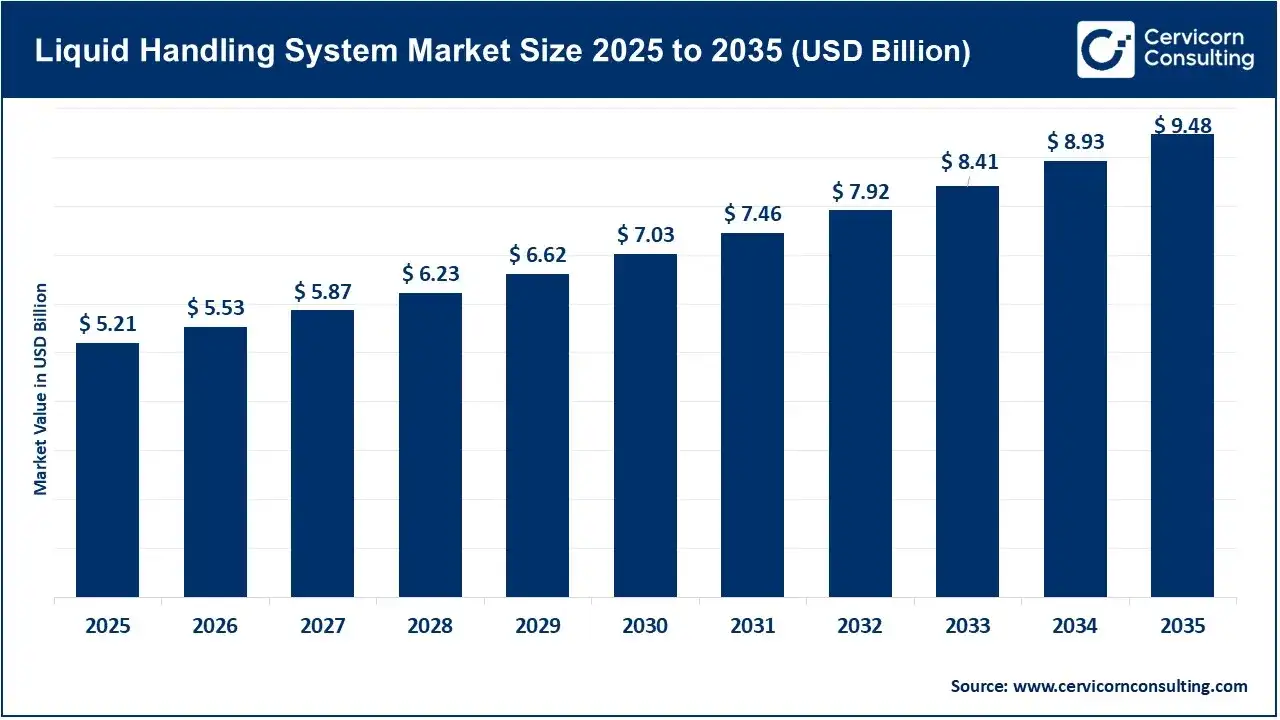
The global liquid handling systems market size was estimated at USD 5.21 billion in 2025 and is projected to grow from USD 5.53 billion in 2026 to nearly USD 9.48 billion by 2035, registering a CAGR of 6.2% over the forecast period 2026 to 2035. The market is growing due to rising demand for efficient fluid management, automation, and process optimization across industries.
Report Highlights
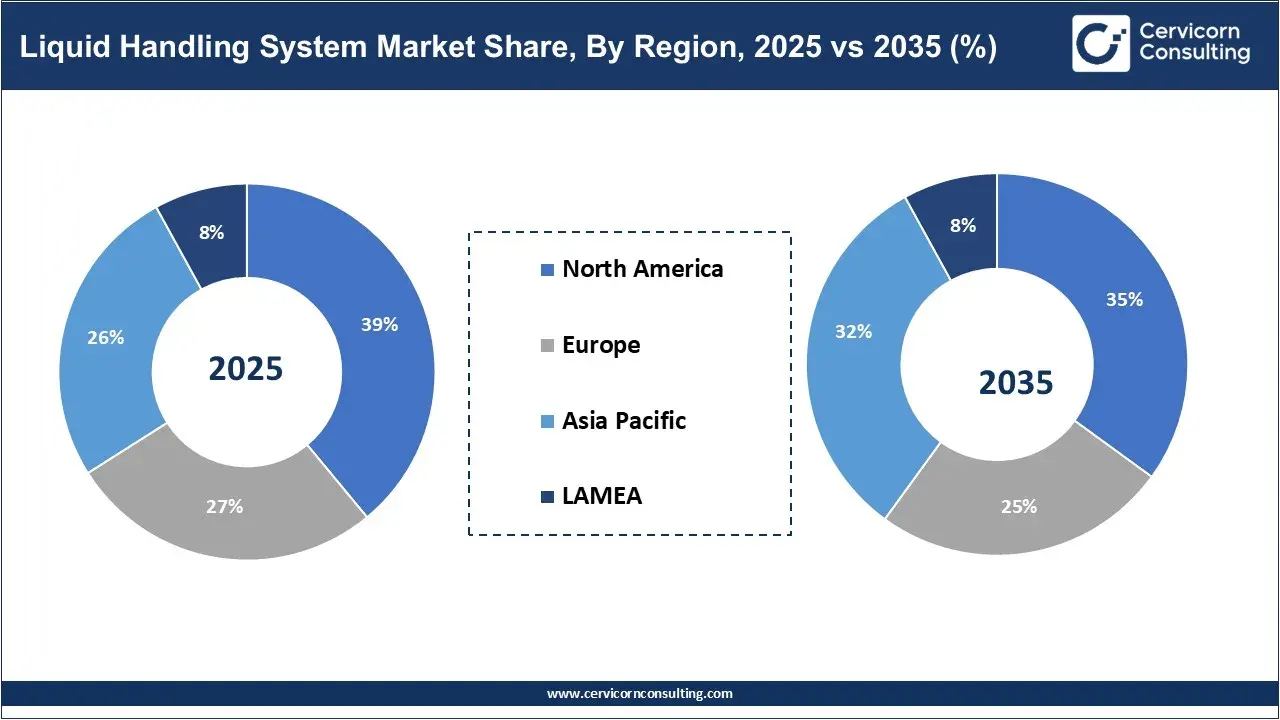
- By region: North America dominated the market and generated revenue share of 39% in 2025, supported by advanced laboratory infrastructure and strong pharmaceutical and biotechnology industries.
- By system type: Automated liquid handling systems accounted for a revenue share of 42% in 2025, supported by growing laboratory automation and demand for efficiency.
- By product: Liquid handling workstations garnered highest revenue share of 25% in 2025, supported by rising demand for integrated laboratory automation.
- By application: Drug discovery & high-throughput screening generated revenue share of 27% in 2025, supported by increasing pharmaceutical R&D activities.
- By end user: Biotechnology & pharmaceutical companies has captured revenue share of 36% in 2025, supported by rising investment in drug discovery and biopharmaceutical research.
What is Driving the Growth of the Liquid Handling System Market?
The liquid handling system market is growing because of the growing need for precise, effective, and automated fluid management in research, pharmaceutical, biotechnology, healthcare, and laboratory applications. The automatic precision is further supporting the adoption of sophisticated liquid handling technologies, along with rising investments in pharmaceutical research, drug discovery, diagnostics, and life sciences.
Latest Trends
- Integration of Robotics and AI: Precise liquid transfer, automated workflows, and improved process monitoring are made possible by the combination of robots, artificial intelligence, and digital technology. These technologies can be used for real-time workflow management. It is anticipated that the use of smart laboratory technology will continue to grow.
- Expansion of Pharmaceutical and Biotechnology Research: The need for sophisticated liquid handling solutions is being driven by an increase in drug development, genomics, diagnostics, and biotechnology research activities. Numerous laboratory procedures used in research and development can be supported by automated systems. Growing funding for biosciences research is opening new commercial expansion prospects. Complex experimental processes can be made more repeatable with the use of liquid handling equipment. The demand for technology is being further supported by the expanding development of sophisticated treatments and laboratory-based testing.
- Growing Need for Precision and Reproducibility: To increase accuracy, reduce sample and reagent waste, and produce reliable findings, laboratories are implementing liquid handling systems. For applications that need consistent laboratory results, precise liquid transfer is especially crucial. The increasing focus on quality and process standardization is supporting technology adoption. More accurate dispensing can lead to more trustworthy experimental outcomes. Automated solutions are being encouraged to replace manual handling procedures due to increasing quality standards across laboratory applications.
Technology Landscape
- Automated Liquid Handling Systems: Automated liquid handling systems are increasingly employed to execute repeated pipetting, dispensing, and sample preparation procedures with great accuracy. By using these solutions, laboratories can decrease manual involvement and increase workflow efficiency. Complex laboratory procedures can be supported by sophisticated platforms that can manage several samples at once. Their expanding acceptance is improving automation across pharmaceutical, biotechnology, and research laboratories.
- Robotic Liquid Handling: Laboratory samples and reagents can now be moved, transferred, and processed automatically thanks to robotic liquid handling technologies. When doing repetitive tasks, robotic platforms can increase consistency while lowering the chance of human error. Laboratories are managing complicated procedures more effectively thanks to integration with automated workstations. Wider usage is being supported by ongoing advancements in robotic arms, pipetting instruments, and control software.
- Cloud-Based and Connected Systems: Cloud-based solutions allow liquid handling equipment to interface with laboratory software and centralized data systems. These systems can facilitate data accessibility, workflow management, and remote monitoring. Coordination between equipment and laboratory procedures can be enhanced by integration with laboratory information management systems. Growing demand for linked laboratories is promoting the development of digitally enabled liquid handling solutions.
Market Dynamics
Drivers
- Growing laboratory automation: Increasing automation in laboratories is reducing manual work and enhancing the speed, accuracy, and consistency of liquid transfer procedures. Laboratory workers can concentrate on more difficult tasks because automated systems can perform repetitive operations with little assistance from humans. This is very helpful in labs that handle a lot of samples.
- Increasing demand for high-throughput testing: Systems that can swiftly and effectively handle multiple samples are in high demand as laboratories process more samples. Laboratories can manage complicated workflows and save processing time by using high-throughput liquid handling technologies. This is particularly significant in drug discovery, diagnostics, and research facilities.
- Need for greater accuracy and reproducibility: Laboratories are being encouraged to replace manual procedures with automated liquid handling systems due to the increasing significance of precise sample preparation and reliable experimental outcomes. Laboratory results can be impacted by even slight changes in liquid transport. Automated systems enhance the dependability of repeated experiments and assist in maintaining constant volumes.
Restraints
- High initial investment: Advanced liquid handling systems necessitate large investments in equipment, software, installation, and maintenance. This can make adoption more difficult. The time needed to realize a return on investment may also be prolonged by high upfront costs. Because of this, several laboratories still rely on traditional manual handling techniques.
- High maintenance and operating costs: Regular maintenance, calibration, component replacement, and professional assistance are necessary for automated systems. These laboratory operations can increase costs. Replacement parts and specialized consumables might raise operational costs even more. This may restrict uptake among end users.
- Complexity of automated systems: To program, operate, diagnose, and maintain advanced liquid handling platforms, specific knowledge may be needed. The efficient use of these technologies may be hampered by a lack of qualified personnel. Employees may also face difficulties operating complex equipment. This may result in longer implementation times and higher training costs.
- Integration challenges: It might be challenging to integrate liquid handling devices with current lab hardware and software. Implementation time and expenses may increase if compatibility problems necessitate further adjustments. Additional technological challenges may arise from variations in laboratory operations and software platforms. These difficulties could deter labs from improving their current infrastructure.
Opportunities
- Expansion of personalized medicine: Growing interest in personalized and precision medicine is increasing the need for accurate sample preparation and testing. Liquid handling systems can support complex workflows involved in molecular diagnostics and individualized treatment research. Increasing research into patient-specific therapies can further expand the use of automated laboratory technologies. This creates opportunities for systems designed for precise and repeatable sample processing.
- Increasing demand in emerging markets: Developing healthcare and research infrastructure in emerging economies is creating opportunities for liquid handling system manufacturers. Increasing investments in pharmaceutical research, biotechnology, and diagnostic laboratories are supporting market expansion. Improvements in laboratory infrastructure are encouraging organizations to adopt modern automation technologies. Local partnerships and cost-effective solutions can further support market penetration.
- Development of compact and flexible systems: There is growing demand for smaller and more adaptable liquid handling platforms that can be used by laboratories with limited space and varying workflow requirements. Manufacturers can target this demand by developing cost-effective and customizable systems. Flexible platforms can serve multiple applications instead of being restricted to a single laboratory process. This can make automation more accessible to smaller research and diagnostic facilities.
Challenges
- Shortage of skilled professionals: Trained staff are needed to operate and maintain sophisticated liquid handling equipment. Implementing and maintaining automated systems may be challenging if there is a shortage of qualified laboratory technicians. Continuous training is also essential as technology and software become more complex. Laboratory operations may become more difficult as a result.
- Workflow standardization: Different testing processes, sample types, and protocols are frequently used by different laboratories. Creating systems that effectively support various workflows while preserving accuracy continues to be a major problem. Manufacturers must offer adaptable solutions that can be tailored for certain uses. Integration across various laboratory conditions may also be more challenging in the absence of standardization.
- Risk of cross-contamination: Inadequate management of equipment, consumables, or procedures can lead to contamination hazards in liquid handling processes involving several samples. To guarantee accurate results, stringent laboratory standards must be upheld. Results from experiments or diagnostics might be impacted by even small contamination. As a result, laboratories require efficient methods for quality control, calibration, and cleaning.
Segmental Analysis
System Type Analysis
Automated liquid handling systems: Automated liquid handling systems dominated the liquid handling system market in 2025, supported by the increasing use of laboratory automation to improve accuracy, uniformity, and processing efficiency. These devices require less manual intervention and allow laboratories to perform repetitive liquid transfer activities with greater precision. Demand for high-throughput screening, drug discovery, and advanced research processes is increasing, which is helping the category even more. Continued integration of robots, software, and smart laboratory technologies is projected to keep the segment's lead.
Fully automated liquid handling systems: Fully automated liquid handling systems are expected to be the fastest-growing segment during 2026–2035, driven by the growing demand for high-throughput, standardized laboratory operations. Laboratories can automate various operations with minimal human participation, increasing efficiency and lowering the risk of manual errors. The industry is also benefiting from increased utilization in pharmaceutical research, genetics, diagnostics, and biotechnology. The continued integration of robots, software, and smart laboratory technologies is likely to drive segment growth.
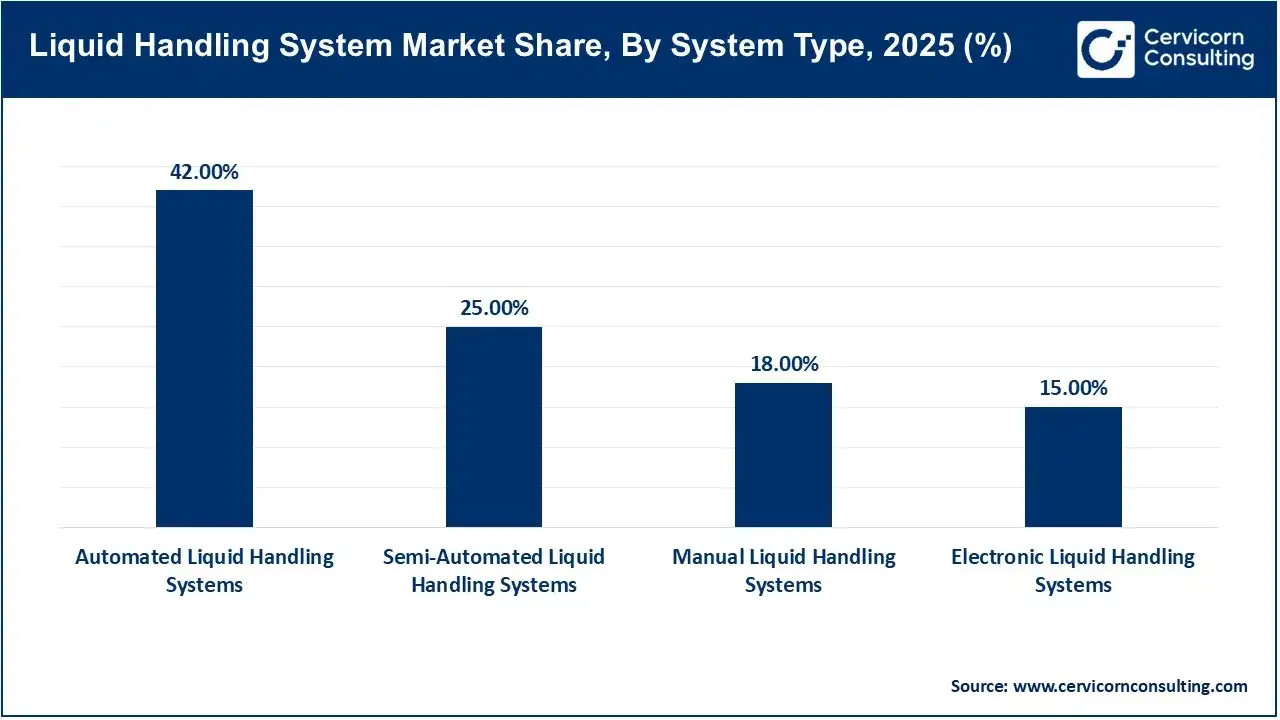
Semi-automated liquid handling systems: Semi-automated liquid handling systems represent another significant segment, supported by the growing demand for increased laboratory efficiency while maintaining some degree of manual control. Laboratories can automate repetitive procedures without transitioning to completely automated workflows. Their very flexible operation and lower investment requirements are also driving popularity. Increased laboratory automation in research and diagnostic institutions is likely to generate new opportunities.
Product Analysis
Liquid handling workstations: Liquid handling workstations dominated the liquid handling system market in 2025, motivated by an increasing demand for integrated systems that can perform several laboratory tests. These workstations enable laboratories to automate pipetting, dispensing, sample preparation, and other repetitive tasks. The segment is being supported further by its use in pharmaceutical, biotechnology, genomics, and diagnostic applications. The segment's leadership position is expected to be maintained as demand for integrated laboratory automation remains strong.
Consumables: Consumables are expected to be the fastest-growing product segment during 2026–2035, driven by the growing use of automated liquid handling systems and the ongoing need for laboratory supplies. Pipette tips, tubes, microplates, and other consumables are necessary for normal sample processing and testing in laboratories. Rising testing numbers and high-throughput laboratory activities are driving up consumption. The increased focus on contamination control and standardized laboratory operations is expected to enhance segment growth.
Pipettes: Pipettes represent another major product segment, supported by their widespread use in pharmaceutical, biotechnology, clinical, academic, and research facilities, contributing to their effectiveness. Manual, electronic, and advanced pipetting technologies allow users to move liquids and prepare samples with precision. The industry is further supported by rising demand for accurate laboratory processes and increased testing activities. More opportunities are projected to arise as ergonomic and electronic pipetting technologies continue to advance.
Application Analysis
Drug discovery & high-throughput screening: Drug discovery & high-throughput screening dominated the liquid handling system market in 2025, motivated by an increasing need to efficiently process huge amounts of chemicals and biological materials. Liquid handling technology allows laboratories to automate sample preparation, dispensing, and screening activities. Increasing pharmaceutical R&D activities, as well as the desire for speedier drug development, are helping to boost the segment. It is expected that continuous investment in drug discovery will help the category maintain its top position.
Cell & gene therapy: Cell & gene therapy is expected to be the fastest-growing application segment during 2026–2035, driven by increased research and development in sophisticated and tailored medicines. Automated liquid handling systems enable laboratories to improve the precision and consistency of complex sample preparation and processing. Growing investment in cell-based research and gene therapies is bolstering the segment. Continued development of scalable and standardized workflows is likely to speed up segment growth.
Genomics: Genomics represents another significant application segment, motivated by the growing popularity of sequencing, molecular analysis, and genomic research. Using automated liquid handling solutions, laboratories can increase sample preparation accuracy and repeatability. Growing genomic research activities, as well as increased use of sequencing technology, are helping to sustain the market. Continued breakthroughs in molecular biology and genomic technologies are projected to boost demand.
End User Analysis
Biotechnology & pharmaceutical companies: Biotechnology & pharmaceutical companies dominated the liquid handling system market in 2025, motivated by the widespread use of laboratory automation in drug discovery, development, testing, and biopharmaceutical research. Automated liquid handling systems can help companies enhance sample processing efficiency and experimental repeatability. Increasing investment in biologics, innovative therapeutics, and pharmaceutical R&D is also helping the segment. The segment's leadership position is expected to be maintained as life sciences research continues to expand.
Contract research organizations: Contract research organizations are expected to be the fastest-growing end-user segment during 2026–2035, driven by the outsourcing of research and laboratory activities. Automated liquid handling solutions enable CROs to manage enormous sample volumes and many research programs more efficiently. Growing demand for outsourced drug discovery and testing services is boosting the segment's growth. The growing emphasis on speedier and more standardized research procedures is projected to drive segment expansion.
Liquid Handling System Market Share, By End User, 2025 (%)
| End User |
Revenue Share, 2025 (%) |
| Biotechnology & Pharmaceutical Companies |
36% |
| Contract Research Organizations |
18% |
| Hospitals & Diagnostic Laboratories |
22% |
| Academic & Research Institutes |
19% |
| Others |
5% |
Hospitals & diagnostic laboratories: Hospitals & diagnostic laboratories represent another important end-user segment, supported by the growing volume of clinical and diagnostic testing. These facilities can automate routine sample preparation and liquid transfer procedures, boosting laboratory efficiency and consistency. The market is also benefiting from the increasing adoption of molecular and specialist diagnostic testing. Continued modernization of healthcare laboratories is projected to provide new prospects.
Regional Analysis
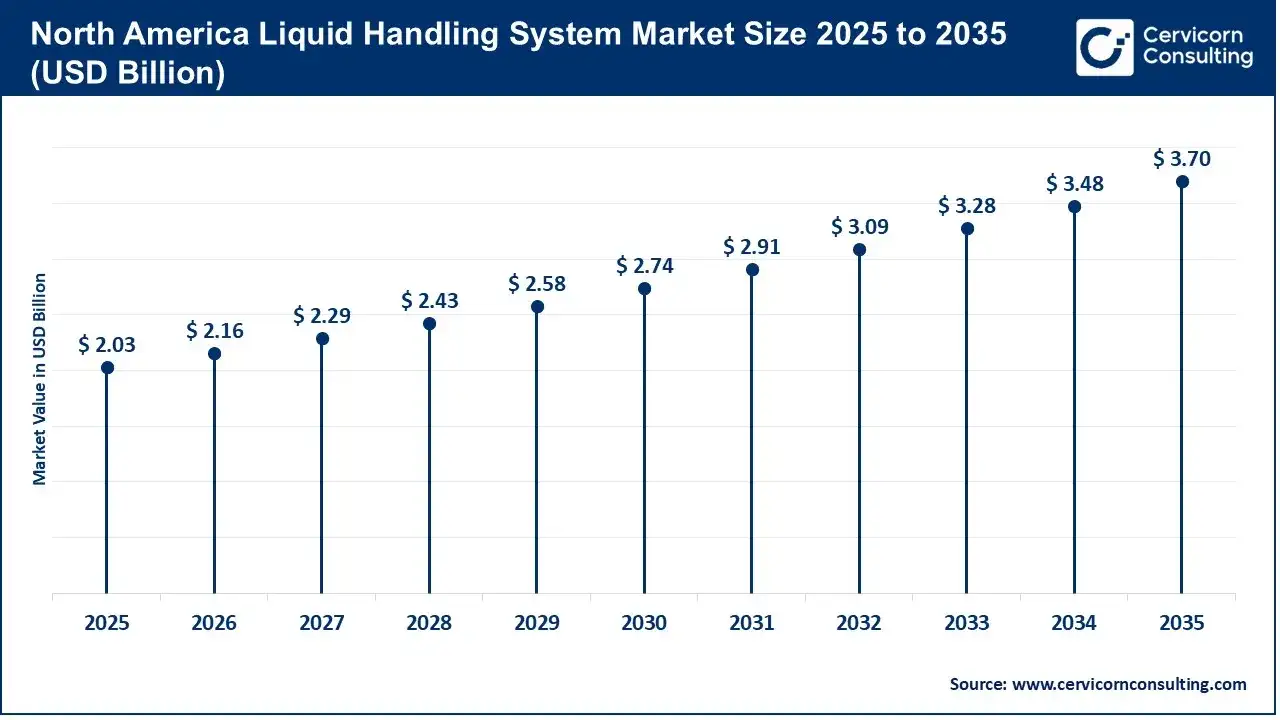
The North America liquid handling systems market size was estimated at USD 2.03 billion in 2025 and is projected to hit USD 3.70 billion by 2035. North America dominated the liquid handling system market in 2025, motivated by the existence of well-established pharmaceutical, biotechnology, healthcare, and research companies. Laboratories can increase workflow efficiency and processing capacity by widely implementing advanced automation technology. Growing investment in drug discovery, genomics, clinical diagnostics, and biotechnology research is boosting the regional market. It is expected that ongoing investment in modern laboratory facilities will keep the region's leadership position.
The Asia Pacific liquid handling systems market size was valued at USD 1.41 billion in 2025 and is anticipated to surpass USD 2.56 billion by 2035. Asia-Pacific is expected to be the fastest-growing regional market during 2026–2035, driven by the growth of the pharmaceutical, biotechnology, healthcare, and research industries. Laboratories in the region are progressively implementing automation to improve research and testing capabilities. Growing investments in healthcare infrastructure, diagnostics, genomics, and drug development are boosting the regional market. The continued expansion of life sciences infrastructure is likely to boost regional growth.
The Europe liquid handling systems market size was estimated at USD 1.35 billion in 2025 and is projected to reach USD 2.46 billion by 2035. Europe represents another significant regional market, supported by well-established pharmaceutical and biotechnology firms, as well as a robust scientific research infrastructure. Laboratories can increase accuracy, reproducibility, and workflow efficiency by implementing automated liquid handling systems. Growing research activities in genomics, precision medicine, and life sciences are also benefiting the region. Continued investment in healthcare research and laboratory modernization is likely to aid regional growth.
Recent Developments
- In October 2026, Agilent Technologies announced the launch of the NovoStation Sample Preparation System, an automated platform designed to simplify and streamline flow cytometry sample preparation. The system automates reagent cocktailing and sample washing, supporting more efficient and standardized laboratory workflows.
- In August 2026, Pillar Biosciences and Hamilton Company announced the commercial release of an automated NGS library preparation method for the oncoReveal Nexus 21 Gene Panel on Hamilton Microlab STAR and STARlet liquid handling systems. The workflow supports automated preparation of up to 96 NGS libraries in a continuous run.
- In March 2026, Takara Bio USA and Hamilton Company announced a development and co-marketing agreement to create automated NGS library preparation workflows using Hamilton Microlab STAR liquid handling systems. The collaboration initially focuses on automating Takara Bio’s SMART-Seq library preparation products.
Government Initiatives
- In January 2025, the Government of India released the Genome India research data from the sequencing of more than 10,000 Indian genomes. The initiative is expected to strengthen genomics and precision-medicine research, supporting demand for advanced sample preparation and automated liquid handling systems.
- In February 2025, the Department of Biotechnology invited proposals for translational research using Genome India data. The initiative aims to encourage research based on Indian genomic datasets, increasing activity in genomics, molecular biology, and related laboratory workflows.
- In September 2025, the Department of Biotechnology supported the expansion of India’s scientific equipment infrastructure through the I-STEM Portal, including the uploading of scientific and analytical research equipment. This initiative promotes better visibility and utilization of advanced laboratory infrastructure across research institutions.
Top Companies
Segments Covered
By System Type
- Automated Liquid Handling Systems
- Semi-Automated Liquid Handling Systems
- Manual Liquid Handling Systems
- Electronic Liquid Handling Systems
By Product
- Liquid Handling Workstations
- Pipettes
- Consumables
- Reagent Dispensers
- Burettes
- Microplate Washers
- Accessories
- Software & Services
By Application
- Drug Discovery & High-Throughput Screening
- Clinical Diagnostics
- Genomics
- Proteomics
- Cell & Gene Therapy
- Forensic Testing
- Environmental Testing
- Food Testing
- Other Applications
By End User
- Biotechnology & Pharmaceutical Companies
- Contract Research Organizations
- Hospitals & Diagnostic Laboratories
- Academic & Research Institutes
- Other End Users
By Region
- North America
- Europe
- Asia-Pacific
- Latin America
- Middle East & Africa
