Internet of Military Things Market Size and Growth 2026 to 2035
The global Internet of military things market size was reached at USD 37.25 billion in 2025 and is expected to be worth around USD 134.06 billion by 2035, exhibiting a compound annual growth rate (CAGR) of 13.66% over the forecast period from 2026 to 2035. The internet of military things (IoMT) market is rapidly transforming modern defense operations as armed forces worldwide accelerate the adoption of interconnected sensors, intelligent devices, and autonomous systems. Additionally, defense forces can achieve real-time monitoring, improved threat detection, and more coordinated mission execution by integrating IoT-enabled devices across air, land, sea, space, and cyber domains. These capabilities are vital to the authorities' goal of executing advanced military strategies such as OODA, which involves gathering large amounts of information promptly and using that intelligence to make quick and accurate decisions based on reliable data from sources to decision-makers.
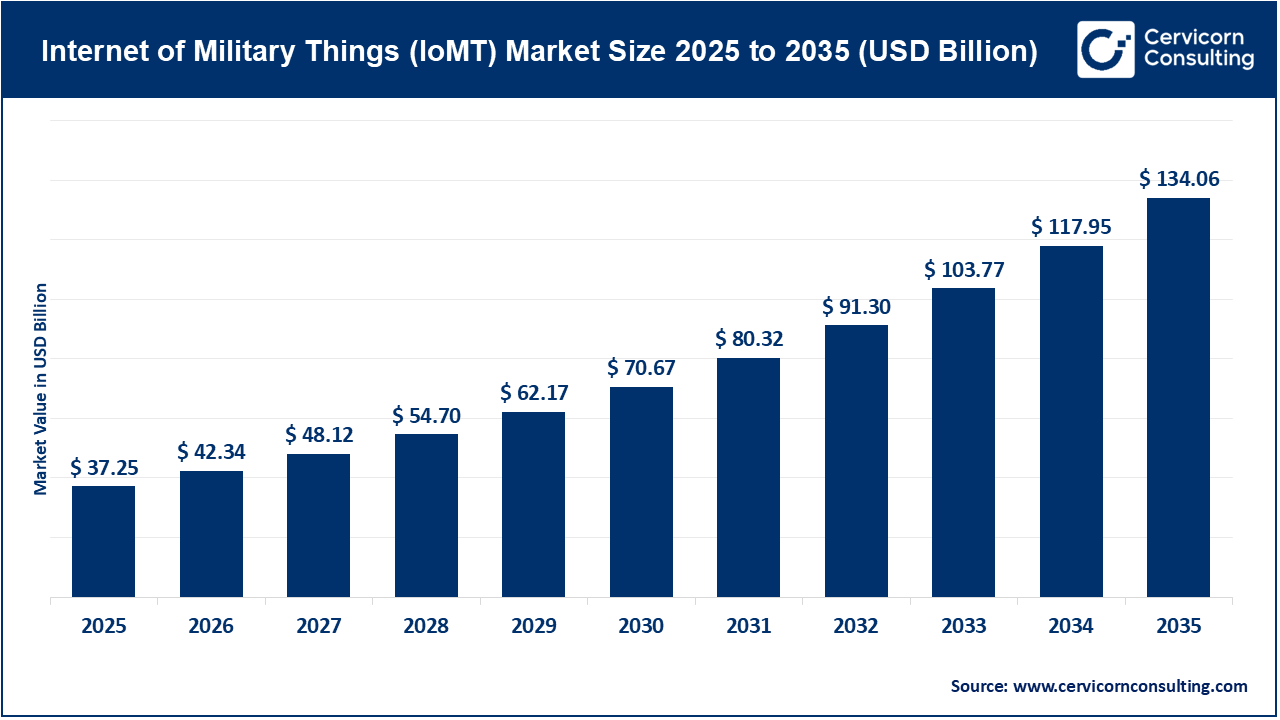
Growing defense modernization efforts, AI-powered battlefield systems, and the proliferation of unmanned platforms like drones, ground robots, and autonomous surveillance systems are among the main factors driving the IoMT market. Recent global military expenditure has exceeded USD 2.2 trillion. As a result, leading nations are heavily investing in resilient communication networks, advancing edge computing, establishing cyber-secure systems, and developing interoperable architectures that connect soldiers with military hardware, sensors, and command centers in real time.
Report Highlights
- North America leads the IoMT market with around 37% share, driven by high defense spending and advanced digital warfare systems.
- Hardware dominates the component segment with nearly 53% share, supported by strong demand for sensors, communication devices, and connected military equipment.
- Sensor technologies hold about 34% share in the technology segment due to widespread use in surveillance and threat detection systems.
- Surveillance & reconnaissance account for roughly 35% share of applications, fueled by increasing deployment of drones and remote sensing platforms.
- Military branches represent nearly 62% share of end users, as armed forces increasingly adopt connected battlefield and asset monitoring systems.
AI-Driven, Secure, and Network-Centric Warfare Accelerates IoMT Adoption
Accelerating the deployment of IoMT systems across all global defence forces due to the convergence of AI, edge computing, and advanced cybersecurity frameworks. With AI-driven analytics, IoMT solutions will enable predictive maintenance for military assets, automated threat detection, and adaptive planning in real-time. Secure, network-centric architectures ensure encrypted data exchange across distributed nodes, even in denied or contested environments. IoMT technologies are emerging as a key component of next-generation defense operations and digitally enabled warfare strategies, as militaries focus more on resilience, interoperability, and information dominance.
Key Statistics
The Internet of Military Things (IoMT) represents a rapidly expanding network of connected sensors, military vehicles, drones, wearable devices, and command systems designed to enhance real-time situational awareness, battlefield intelligence, and operational efficiency. Governments worldwide are investing heavily in digital military infrastructure to create network-centric and data-driven warfare environments.
Defense Spending and Digital Military Investments
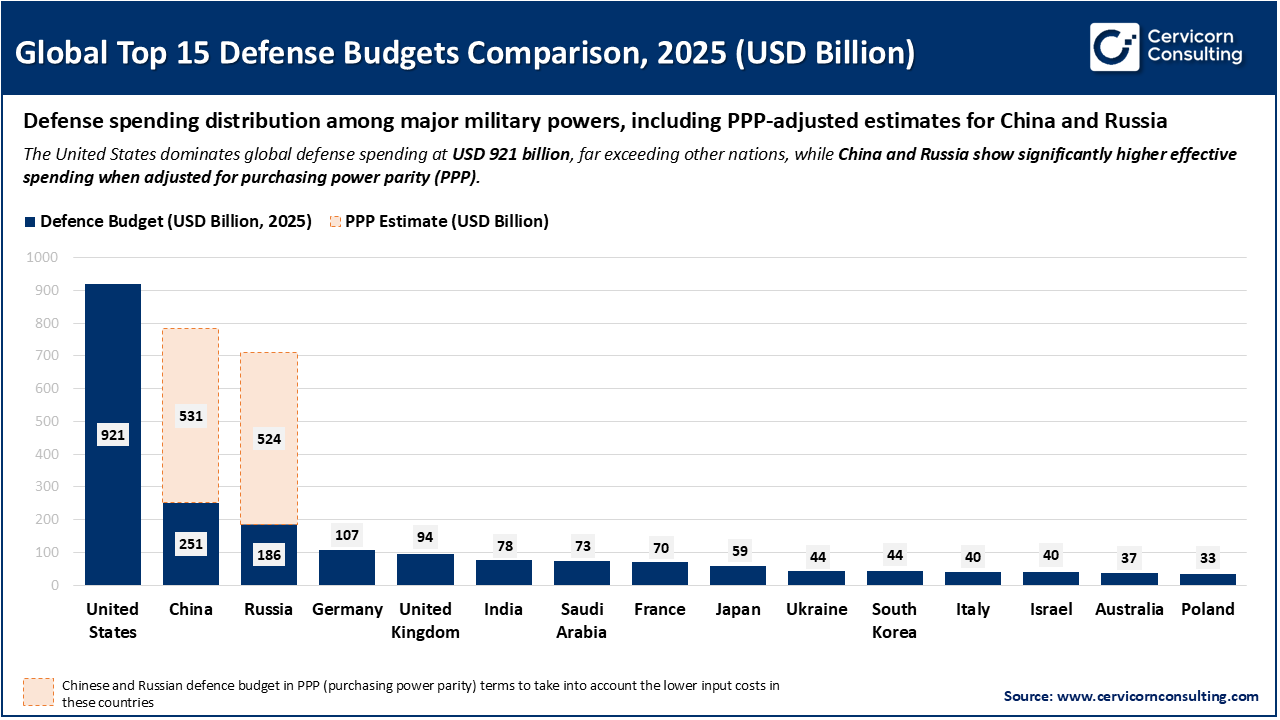
Military forces across the world are allocating increasing portions of their budgets toward digital transformation, artificial intelligence, IoT sensors, and connected defense platforms which directly support IoMT adoption.
- Global military spending surpassed USD 2.4 trillion in 2024–2025, reflecting strong investments in advanced defense technologies.
- The United States accounts for roughly 40% of global military expenditure, enabling large-scale deployment of connected defense systems.
- NATO countries have committed to spending at least 2% of GDP on defense, accelerating adoption of digital command systems and connected military infrastructure.
- Over 70% of modern military modernization programs now include IoT-enabled communication and surveillance technologies.
Connected Military Devices and Sensors
- IoMT relies heavily on a vast network of sensors and connected devices that collect and transmit battlefield data in real time.
- Modern defense forces deploy tens of thousands of connected sensors across land, air, sea, and cyber domains.
- The U.S. Army’s Internet of Battlefield Things (IoBT) concept includes more than 50,000 interconnected sensors and devices in operational scenarios.
- Advanced fighter aircraft can contain over 1,000 embedded sensors that continuously transmit performance and operational data.
- Military vehicles equipped with IoMT systems can generate up to 20–30 terabytes of operational data per mission.
Unmanned and Autonomous Systems
Autonomous platforms are one of the most significant components of IoMT ecosystems.
- More than 17,000 military drones are currently deployed worldwide for surveillance, reconnaissance, and tactical operations.
- Unmanned aerial vehicles (UAVs) account for over 60% of connected battlefield devices in some modern military operations.
- Autonomous naval vessels and underwater drones are increasingly being integrated into smart maritime surveillance networks.
- Military organizations are deploying AI-enabled drone swarms capable of coordinating through IoT communication networks.
Recent Major Milestones
1. Multi-Domain Battlefield Integration Drives IoMT Expansion Across Defense Forces
The increasing focus on multi-domain operations is significantly speeding up the adoption of Internet of Military Things (IoMT) solutions across global defense organizations. Military activities need smooth coordination among land, air, sea, space, and cyber domains, prompting militaries to deploy interconnected sensors, wearable systems, unmanned platforms, and command networks. IoMT enables real-time data integration from dispersed assets to enhance situational awareness, target identification, and mission synchronisation.
By linking soldiers, vehicles, weapons systems, and command centers through secure networks, defense forces can reduce decision-making time and improve operational efficiency. This integration supports data-driven doctrines such as network-centric warfare and the OODA loop, where quick information exchange is essential. As geopolitical tensions rise and military operations grow more complex, multi-domain IoMT integration is rapidly becoming a crucial element of future defence strategies.
2. Proliferation of Unmanned and Autonomous Systems Accelerates IoMT Deployment
The rapid growth of unmanned aerial vehicles (UAVs), unmanned ground vehicles (UGVs), autonomous naval systems, and robotic surveillance platforms is driving strong momentum for IoMT adoption. These systems depend heavily on interconnected sensors, edge computing, and real-time communication to function effectively in contested and remote environments. IoMT frameworks enable autonomous platforms to share intelligence, coordinate movements, and respond dynamically to threats without continuous human oversight.
By 2025, defense forces will use AI-enabled autonomous systems within Iomt networks to carry out intelligence, surveillance, reconnaissance, logistics, and perimeter security operations. As militaries further invest in swarm technologies and cooperative autonomous operations, IoMT connectivity will be essential for providing scalable, resilient, and adaptable unmanned warfare capabilities in the future, ensuring high demand throughout the next decade.
3. Cybersecurity and Resilient Communications Become Central to IoMT Architectures
As IoMT adoption expands, cybersecurity and resilient communication networks have become core priorities for military organizations worldwide. Connected battlefield systems generate massive volumes of sensitive data, making them attractive targets for cyberattacks, electronic warfare, and signal disruption. In light of this, defence organisations are investing heavily in encrypted communication tools, zero trust architectures, and cyber-hardened IoMT designed to operate in areas with little or no connectivity.
Secure satellite communications, mesh networking, and edge-based compute technology form essential components of IoMT ecosystems that ensure operational capabilities during periods of connectivity outages. As cyber threats grow more sophisticated, secure and resilient IoMT architectures are no longer optional but vital for maintaining information superiority and operational readiness in modern conflicts.
4. AI-Enabled Edge Computing Strengthens Real-Time Decision-Making in IoMT Systems
The integration of artificial intelligence and edge computing into IoMT systems is transforming how military data is processed and acted upon in real time. Edge-enabled IoMT devices that operate without centralized data centers can process sensor data locally, resulting in reduced latency and faster decision-making. This capability is crucial for time-sensitive missions such as missile defense, battlefield surveillance, and autonomous navigation.
AI-enabled solutions for IoMT facilitate predictive maintenance and automated threat detection, significantly easing the cognitive load on human operators. As defense organizations focus more on speed, autonomy, and data control, the use of AI and hybrid edge computing will mark a major milestone in IoMT development, reinforcing its role as a core component of digitally driven military operations.
Report Scope
| Area of Focus |
Details |
| Market Size in 2026 |
USD 42.34 Billion |
| Market Size in 2035 |
USD 134.06 Billion |
| CAGR 2026 to 2035 |
13.66% |
| Dominant Region |
North America |
| Fastest Growing Region |
Asia-Pacific |
| Key Segments |
Component, Technology, Application, End User, Region |
| Key Companies |
Lockheed Martin Corporation, Raytheon Technologies (RTX), Northrop Grumman Corporation, BAE Systems plc, Thales Group, Leonardo S.p.A., General Dynamics Corporation, L3Harris Technologies, Inc., Elbit Systems Ltd., Honeywell International Inc., Saab AB, Boeing Defense, Space & Security, Palantir Technologies, IBM Corporation |
Internet of Military Things Market Regional Analysis
The Internet of military things (IoMT) market is segmented into various regions, including North America, Europe, Asia-Pacific, and LAMEA. Here is a brief overview of each region:
Why does North America continue to expand steadily in the Internet of Military Things (IoMT) market?
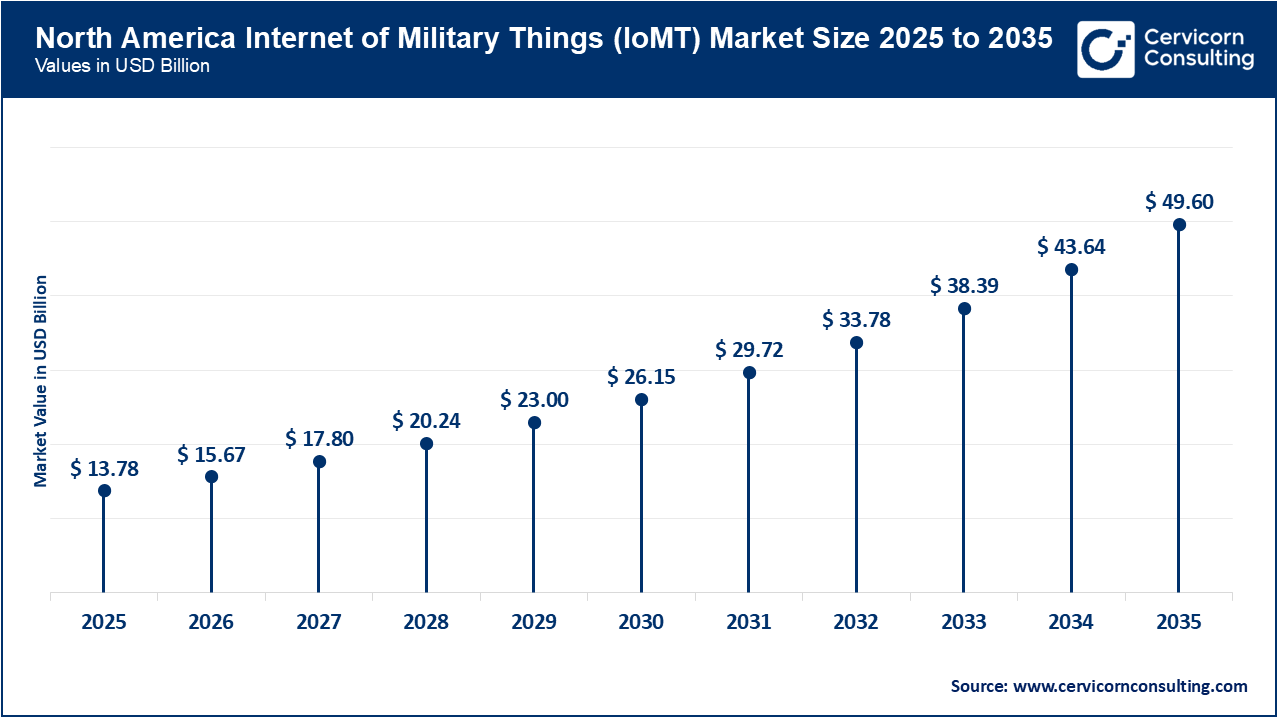
The North America Internet of military things market size was valued at USD 13.78 billion in 2025 and is expected to hit around USD 49.60 billion by 2035. The North America IoMT market continues to expand steadily, supported by high defense spending, advanced technological capabilities, and early adoption of network-centric warfare doctrines. The United States leads the region, driven by large investments in IoMT-enabled ISR systems, AI-powered battlefield management platforms, secure communication networks, and autonomous defense systems.
Additionally, the region benefits from strong collaboration among defense agencies, technology providers, and defense contractors, which accelerates innovation across IoMT hardware, software, and services. Canada and Mexico also contribute by enhancing defense interoperability, border security, and surveillance infrastructure, strengthening North America’s position as a leading IoMT market.
United States to Lead Global IoMT Deployment
The United States represents the largest IoMT market globally due to its extensive defense modernization programs.
- The U.S. defense budget exceeded USD 880 billion in 2025, accounting for nearly 40% of global military spending.
- The U.S. Department of Defense is actively investing in connected battlefield technologies under the Joint All-Domain Command and Control (JADC2) initiative, aimed at linking sensors, platforms, and weapons systems across all military branches.
- Over 20,000+ connected military sensors and IoT-enabled devices are already deployed across U.S. defense operations.
- Companies such as Lockheed Martin and Northrop Grumman are developing IoMT-enabled command and control systems and predictive maintenance solutions for aircraft and armored vehicles.
Canada to Strengthen IoMT Adoption Through Defense Modernization
Canada is steadily adopting IoMT technologies as part of its military modernization strategy.
- Canada’s defense spending reached approximately USD 30–35 billion annually, supporting investments in connected defense technologies.
- The Canadian Armed Forces Digital Campaign Plan focuses on improving interoperability and data sharing across defense platforms.
What factors make the Asia-Pacific the fastest-growing region in the IoMT market?
The Asia-Pacific Internet of military things market size was estimated at USD 11.55 billion in 2025 and is forecasted to grow around USD 41.56 billion by 2035. The Asia-Pacific region has become the fastest-growing market, fueled by rapid defense modernization, increasing military spending, and rising geopolitical tensions across the area. Countries like China, India, South Korea, Japan, and Australia are heavily investing in connected battlefield systems, surveillance networks, unmanned platforms, and secure communication infrastructures to boost operational readiness and situational awareness.
The region’s strong emphasis on domestic defense manufacturing, along with large-scale procurement of IoMT-enabled sensors, drones, and command-and-control systems, continues to hasten adoption. As Asia-Pacific nations enhance multi-domain capabilities across land, air, sea, space, and cyber environments, the region maintains its leadership role and experiences some of the highest growth rates worldwide in IoMT deployment.
China to Act as a Major IoMT Technology Developer
China has rapidly expanded its military digitalization capabilities, making it a key player in the IoMT market.
- China’s defense spending surpassed USD 310 billion in 2025, the second-largest globally.
- The People’s Liberation Army (PLA) is actively developing intelligent warfare systems, integrating AI, IoT sensors, and autonomous drones.
- China is investing heavily in unmanned surveillance platforms, smart naval systems, and connected battlefield infrastructure.
India to Emerge as a High-Growth IoMT Market
India is expected to become one of the fastest-growing IoMT markets due to its large-scale military modernization programs.
- India’s defense budget exceeded USD 80 billion in 2025, ranking among the top five globally.
- The Indian Armed Forces are adopting IoT-enabled soldier systems, connected armored vehicles, and smart surveillance systems along border regions.
- Programs such as Network for Spectrum (NFS) and Defence Communication Network (DCN) are strengthening military connectivity infrastructure.
Japan and South Korea to Advance Connected Defense Technologies
Both countries are investing heavily in digital defense infrastructure.
- Japan’s defense spending reached around USD 55 billion in 2025, supporting investments in IoT-enabled missile defense and maritime surveillance systems.
- South Korea is deploying smart border surveillance systems and autonomous military platforms integrated with IoMT networks.
What are the driving factors of Europe internet of military things (IoMT) market?
The Europe Internet of military things market size was reached at USD 8.57 billion in 2025 and is projected to hit around USD 30.83 billion by 2035. The Europe IoMT market continues to grow, driven by strong defense collaboration frameworks, increasing digital defense efforts, and a greater focus on interoperability among allied forces. Countries like Germany, France, the United Kingdom, and Italy are investing in IoMT technologies to modernize command-and-control systems, improve ISR capabilities, and support joint military operations within NATO frameworks.
Europe’s emphasis on cyber resilience, secure data exchange, and standardized defense architectures is fueling the adoption of interoperable IoMT solutions across various military branches. Additionally, EU-backed defense funding programs and cross-border defense initiatives continue to support steady growth in the regional IoMT market.
United Kingdom to Lead IoMT Innovation in Europe
The United Kingdom is one of the most technologically advanced IoMT markets in Europe.
- The UK defense budget reached around USD 70 billion in 2025.
- The UK Ministry of Defence’s Digital Backbone program aims to integrate data across military platforms and sensors.
- Companies such as BAE Systems and Thales Group are actively developing IoMT-enabled command and control solutions.
Germany to Strengthen Network-Centric Warfare Capabilities
Germany is investing heavily in connected defense systems as part of NATO modernization.
- Germany’s defense spending exceeded USD 60 billion in 2025, with plans to significantly increase funding through the EUR 100 billion defense modernization program.
- The country is developing IoT-enabled battlefield communication networks and predictive maintenance systems for military vehicles.
France to Expand Smart Defense Infrastructure
France is focusing on integrating IoMT technologies across its armed forces.
- France’s defense spending reached approximately USD 55 billion in 2025.
- French defense companies are developing AI-powered battlefield analytics and IoT-enabled reconnaissance systems.
IoMT Market Share, By Region, 2025 (%)
| Region |
Revenue Share, 2025 (%) |
| North America |
37% |
| Asia-Pacific |
31% |
| Europe |
23% |
| LAMEA |
9% |
LAMEA Internet of Military Things (IoMT) Market: Driven by Security Modernization and Border Surveillance
The LAMEA Internet of military things market was valued USD 3.35 billion in 2025 and is anticipated to reach around USD 12.07 billion by 2035. The LAMEA IoMT market is growing steadily as countries in Latin America, the Middle East, and Africa focus on defense modernization, border security, and internal security improvements. In the Middle East, increasing geopolitical tensions and significant military investments are boosting demand for IoMT-enabled surveillance, unmanned systems, and secure communication networks.
Meanwhile, African and Latin American nations are increasingly adopting IoMT technologies to enhance border monitoring, counterterrorism efforts, and disaster response capabilities. As governments aim to improve situational awareness and force coordination with limited manpower, IoMT solutions are becoming essential to regional defense strategies.
Saudi Arabia to Lead IoMT Investments in the Middle East
Saudi Arabia is one of the largest defense investors globally and is rapidly integrating IoMT technologies.
- Saudi Arabia’s defense spending exceeded USD 75 billion in 2025, representing one of the highest military expenditures worldwide.
- Vision 2030 initiatives encourage local defense technology development and IoMT adoption.
Brazil to Expand IoMT Adoption in Latin America
Brazil represents the largest IoMT market in Latin America.
- Brazil’s defense spending reached approximately USD 22–25 billion annually.
- The country is investing in smart surveillance networks for border monitoring and Amazon region security.
Internet of Military Things Market Segmental Analysis
The Internet of military things (IoMT) market is segmented into components, technology, application, end user, and geography.
Component Analysis
Hardware holds the largest share of the IoMT market because of its crucial role in enabling military connectivity and data collection. IoMT deployments depend heavily on physical assets such as sensors, rugged communication devices, wearables, drones, autonomous vehicles, radar systems, and embedded computing units. These components are deployed at large scale across land, air, sea, space, and cyber domains, making hardware investments the primary and biggest cost in IoMT programs.
IoMT Market Share, By Component, 2025 (%)
| Component |
Revenue Share, 2025 (%) |
| Hardware |
53% |
| Software |
29% |
| Services |
18% |
Software is the fastest-growing segment as militaries increasingly focus on data analytics, AI-powered decision support, and integrated command-and-control systems. Growth is driven by demand for battlefield management platforms, sensor fusion software, predictive analytics, and autonomous mission coordination tools. As hardware deployments mature, defense forces are shifting toward extracting actionable intelligence from data, speeding up software adoption across IoMT ecosystems.
Technology Analysis
Connectivity and communication technologies dominate the IoMT market because secure, reliable, and low-latency data transmission are essential for military operations. Tactical radios, satellite communication systems, secure 5G networks, and mesh networking architectures enable real-time coordination among soldiers, platforms, and command centers.
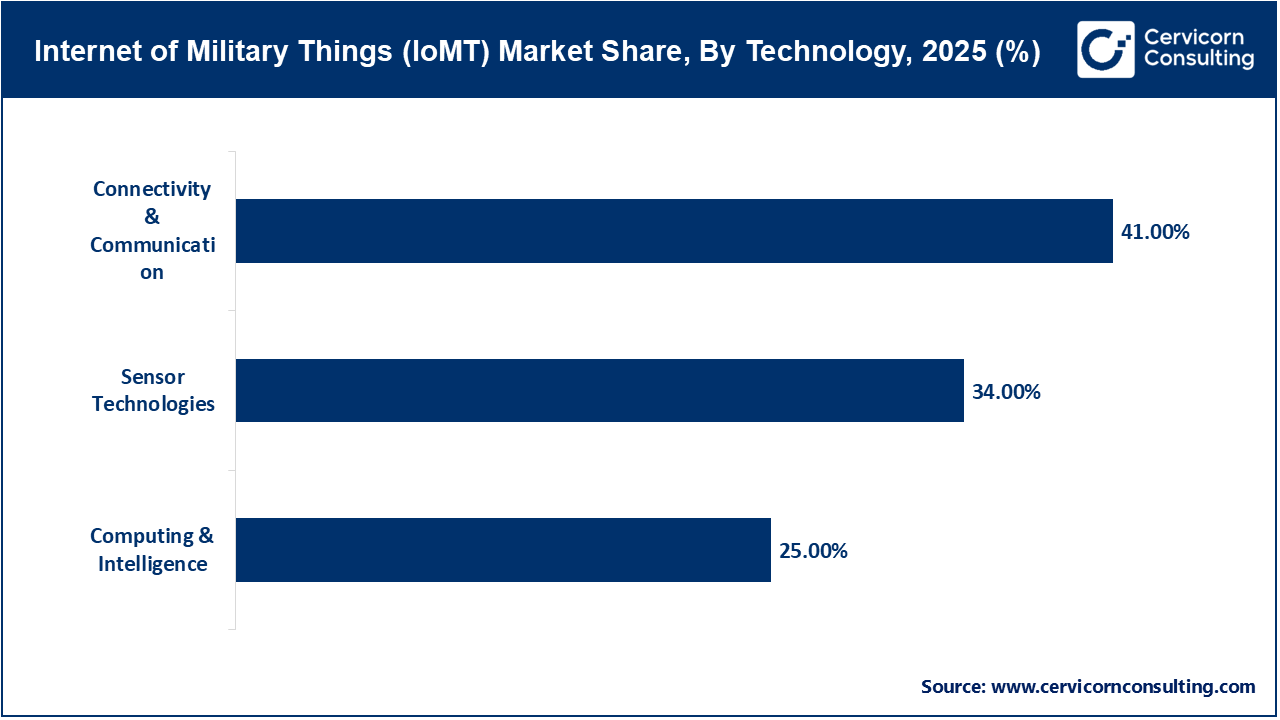
Computing and intelligence technologies are growing rapidly, driven by the integration of AI, machine learning, and edge computing into military systems. These technologies facilitate real-time analytics, autonomous decision-making, and reduce reliance on centralized data centers. Growth is further boosted by the need for quick responses, lower latency, and operational resilience in denied or contested environments.
Application Analysis
Surveillance and reconnaissance applications hold the largest share because of their crucial role in intelligence gathering, border security, and threat detection. IoMT-enabled ISR systems combine sensors, drones, satellites, and ground-based monitoring platforms to provide continuous situational awareness.
IoMT Market, By Application, 2025 (%)
| Application |
Revenue Share, 2025 (%) |
| Training & Simulation |
14% |
| Surveillance & Reconnaissance |
35% |
| Health Monitoring |
11% |
| Fleet & Asset Management |
22% |
| Equipment Maintenance |
18% |
Fleet and asset management is the fastest-growing application segment as militaries aim to improve operational efficiency, reduce downtime, and extend asset life cycles. IoMT solutions support real-time tracking, predictive maintenance, fuel optimization, and performance monitoring of vehicles, aircraft, naval vessels, and equipment. Budget pressures and the need for readiness are driving faster adoption of IoMT-based asset management platforms.
End User Analysis
Military branches account for the largest share of IoMT adoption, driven by extensive use across army, navy, air force, and space forces. These organizations deploy IoMT solutions for combat operations, logistics coordination, ISR missions, and force protection. Large defense budgets, long-term modernization programs, and increasing emphasis on multi-domain warfare reinforce their dominant position.
IoMT Market, By End User, 2025 (%)
| End User |
Revenue Share, 2025 (%) |
| Military Branches |
62% |
| Defense & Government Agencies |
26% |
| Public Safety & Allied Agencies |
12% |
Public safety and allied agencies represent the fastest-growing end-user segment as IoMT technologies expand beyond traditional defense roles. Growth is driven by applications in border security, disaster response, counterterrorism, and joint civil-military operations. Increasing interoperability between military and civilian security networks is further accelerating adoption.
Internet of Military Things Market Top Companies
Recent Developments by Major Companies
Lockheed Martin
- Expanded IoMT-enabled command-and-control and sensor fusion solutions to support multi-domain military operations.
- Invested in AI-driven edge computing platforms to enhance autonomous and real-time battlefield decision-making.
Raytheon Technologies (RTX)
- Advanced development of secure IoMT communication and radar systems for integrated air and missile defense.
- Strengthened cyber-resilient IoMT architectures to counter electronic warfare threats.
BAE Systems
- Introduced IoMT-enabled autonomous and semi-autonomous platforms for land and naval defense applications.
- Increased investment in digital battlefield management and secure data exchange solutions.
Thales Group
- Expanded IoMT-based secure communication and sensor systems for NATO and allied defense forces.
- Focused on interoperable IoMT platforms to support joint and coalition military operations.
Market Segmentation
By Component
- Hardware
- Sensors
- Communication Devices
- Wearable systems
- Connected vehicles & smart weapons
- Software
- Data analytics & management
- Command & control systems
- Cybersecurity/security software
- Services
- Integration & deployment
- Maintenance & support
- Consulting & training
By Technology
- Connectivity & Communication
- Sensor Technologies
- Computing & Intelligence
By Application
- Training & Simulation
- Surveillance & Reconnaissance
- Health Monitoring
- Fleet & Asset Management
- Equipment Maintenance
By End User
- Military Branches
- Defense & Government Agencies
- Public Safety & Allied Agencies
By Region
- North America
- Europe
- Asia-Pacific
- LAMEA