Infrastructure as a Service (IaaS) Market Size and Growth 2026 to 2035
The global infrastructure as a service (IaaS) market size was valued at USD 193.24 billion in 2025 and is expected to surpass around USD 1,038.38 billion by 2035, expanding at a compound annual growth rate (CAGR) of 18.3% over the forecast period from 2026 to 2035. The rapid expansion of global digital transformation initiatives is the primary growth driver of the Infrastructure as a Service (IaaS) market. Across all industries, companies are shifting from "lift-and-shift" migrations to fully cloud-native architectures to improve business performance. In 2025, about 85% of enterprises globally are highly adopting cloud technology. This adoption is driving significant investment in the IaaS model, with organizations allocating a larger share of their IT infrastructure budgets to IaaS compared to non-IaaS spending. This shift supports a remote workforce, improves the customer experience through data-enabled applications, and helps maintain a competitive advantage in an increasingly uncertain global economy.
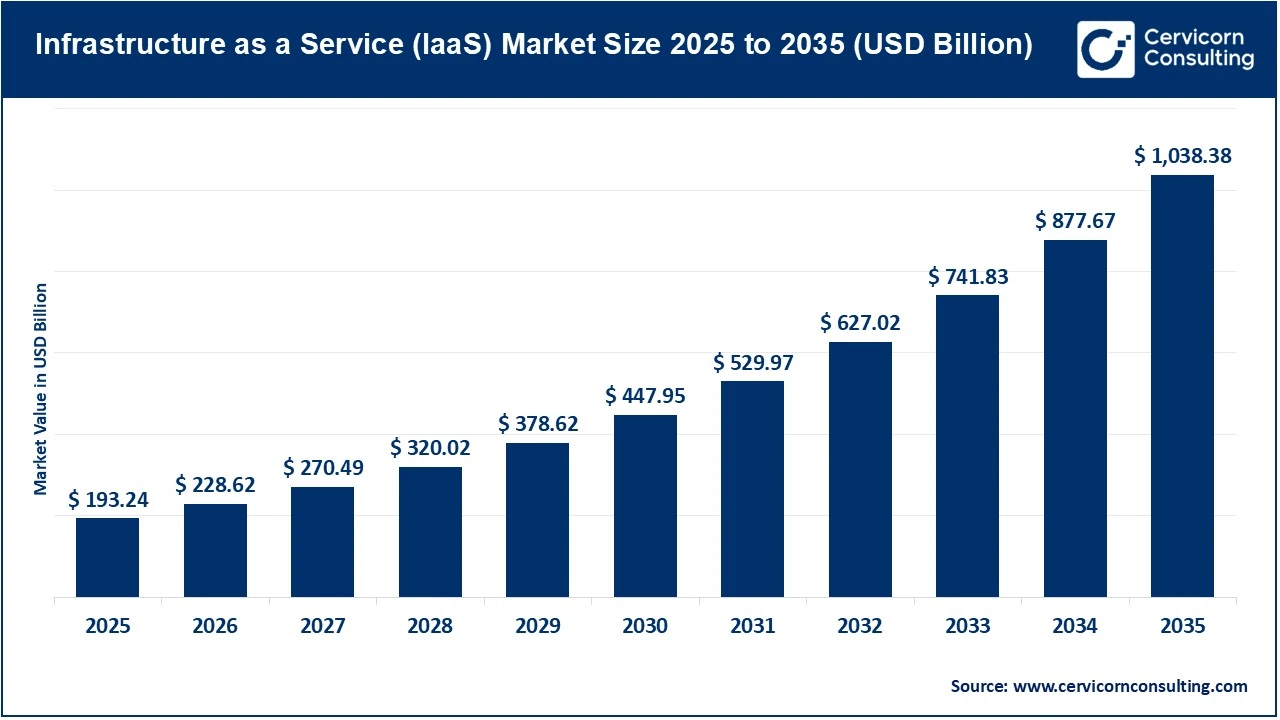
The increasing demand for scalable, cost-optimised solutions is a major driver of market growth. Organizations are increasingly shifting away from rigid capital expenditure (CapEx) models toward more flexible operational expenditure (OpEx) models. By utilizing IaaS, organizations can align their infrastructure spending to actual use, eliminating "shelfware" and idle capacity prevalent in traditional data centres. In 2024, companies shifted towards the IaaS model, reducing their total cost of ownership (TCO) by an average of 30% over three years by eliminating hardware maintenance and adopting automated resource management tools.
Report Highlights
- By Region, North America dominates the regional segment, capturing around 42% share, driven by strong hyperscale cloud investments and major providers like Amazon Web Services, Microsoft Azure, and Google Cloud.
- By Service, the computing dominates the market, with 42% share, due to high demand for virtual machines and scalable compute resources.
- By Service, the networking is the fastest-growing segment, with nearly 20% share, driven by adoption of software-defined networking solutions.
- By Deployment, the hybrid dominates the segment, accounting for 41% share, due to flexibility and enterprise security needs.
- By Deployment, the public cloud is the fastest-growing segment, with 37% share, supported by cost efficiency and scalability.
- By Industry, the IT & Telecom dominates the market, with 24% share, driven by heavy cloud usage for data and application workloads.
- By Industry, the healthcare is the fastest-growing segment, with at 10% share, due to rapid digital health adoption and cloud-based medical data systems.
Integration of AI and machine learning technologies in the Infrastructure as a Service (IaaS) market
The integration of artificial intelligence (AI) and machine learning (ML) services has emerged as a major trend in the Infrastructure as a Service (IaaS) market. As enterprises increasingly invest in training and deploying large language models (LLMs) and other AI-driven applications, IaaS providers have become essential by offering access to advanced, high-performance computing infrastructure. In 2025, nearly 40% of new IaaS growth resulted from specialized AI compute, especially based on advanced GPU and TPU architectures. This trend extends beyond providing hardware for AI to using AI to manage the infrastructure itself, as providers are implementing predictive analytics to anticipate hardware failures and optimize energy consumption in real time.
Top 5 Trends and Technologies
- Virtualization Technology: Improves server utilization by up to 80%, enabling providers to maximize infrastructure efficiency while reducing hardware dependency and deployment costs.
- Containerized Infrastructure: Reduces application deployment time by nearly 70% by enabling lightweight, portable workloads that run consistently across multiple cloud environments.
- AI-Driven Infrastructure Automation: Cuts infrastructure management effort by up to 30% through automated resource allocation, predictive maintenance, and intelligent workload balancing.
- Edge Computing Integration: Reduces latency by 40 to 50% by processing data closer to end users, supporting faster response times for IoT, real-time analytics, and 5G applications.
- GPU-Accelerated Cloud Infrastructure: Delivers up to 20x faster processing for AI and machine learning workloads, enabling high-performance computing for complex, data-intensive applications.
How does IaaS work?
Infrastructure as a Service (IaaS) delivers virtualized computing resources, including servers, storage, and networking, over the internet. Cloud service providers host and manage the underlying infrastructure in their data centres, while users access and configure these resources via web-based dashboards or APIs.
This model enables businesses to scale infrastructure up or down based on demand and pay only for the resources they use. By eliminating the need to purchase and maintain physical hardware, IaaS reduces operational costs, improves flexibility, and enables faster deployment of applications and services.
What are the future trends in Infrastructure as a Service (IaaS)?
IaaS is evolving to meet the growing demand for scalable, cost-effective, and high-performance cloud solutions. Several emerging trends are set to shape the market's future.
- AI-driven automation: IaaS providers are integrating more AI and automation to manage resources, improve performance, and reduce manual effort. Predictive analytics will help businesses adjust their infrastructure more quickly, while AI as a service (AIaaS) will continue to grow as a cloud service model.
- Edge computing growth: As demand for faster, real-time applications rises, IaaS will expand to process data closer to users. This will be especially useful for IoT, live analytics, and 5G-powered applications.
- Eco-friendly cloud infrastructure: With a stronger focus on sustainability, IaaS providers are building energy-efficient data centres, working towards carbon-neutral operations, and using AI to make workloads more efficient.
These advancements are making IaaS infrastructure more intelligent, efficient, and flexible, thereby strengthening its role in the future of cloud computing.
Report Scope
| Area of Focus |
Details |
| Market Size in 2026 |
USD 228.62 Billion |
| Market Size in 2035 |
USD 1,038.38 Billion |
| CAGR 2026 to 2035 |
18.30% |
| Dominant Region |
North America |
| Fastest Growing Region |
Asia-Pacific |
| Key Segments |
Service, Deployment, Industry, Region |
| Key Companies |
Amazon Web Services (AWS), Microsoft Azure, Google Cloud Platform, IBM Cloud, Oracle Cloud Infrastructure, Alibaba Cloud, Tencent Cloud, VMware, Rackspace Technology, DigitalOcean, Hewlett Packard Enterprise (HPE), Cisco Systems, Huawei Cloud, OVHcloud, Akamai Connected Cloud |
Recent Major Milestones
1. Recent Corporate Expansion and Technological Development
Rapid corporate expansion and ongoing technological innovation continue to be major drivers of growth in the infrastructure-as-a-service (IaaS) market. For example, in late 2024, leading hyperscalers' cloud providers announced the general availability of "Next-Gen Quantum-Ready" IaaS instances. These enable enterprises to experiment with quantum algorithms on virtualized hardware to bridge the gap between classical computing and "quantum leap" capabilities. At the same time, the top three cloud providers increased their R&D investments by nearly 50%, with a focus on developing quantum-classical hybrid architectures. This reflects the industry's commitment to preparing cloud infrastructure for the next generation of computational innovation.
2. National Government Initiatives and Digital Infrastructure Policies
Government-led digital infrastructure initiatives are increasingly shaping the global IaaS market. In 2025, the European Sovereign Cloud Initiative marked a significant milestone toward reducing dependence on foreign cloud providers. This multi-billion-dollar programme was designed to support the development of domestic cloud infrastructure aligned with stringent data privacy, security, and sovereignty standards. The initiative aims to migrate 20% of the European Union’s public-sector workloads to sovereign cloud environments by 2030. As a result, global hyperscalers are heavily invested in locally hosted cloud regions to meet evolving national security and data residency requirements.
3. Strategic Global Partnerships and Capital Investments
The strategic partnerships between major IaaS providers and telecommunications companies mark a significant milestone in the market. In 2026, the integration of cloud infrastructure with 5G networks will be known as "telco-cloud." This development enables the rollout of ultra-low-latency services across many large metropolitan areas. Moreover, more than USD 50 billion in capital has been raised for these partnerships over the last 18 months, primarily to deploy micro-data centers at the base of cell towers. This milestone represents the full convergence of the cloud-based network, creating an integrated fabric for the next generation of mobile and IoT applications.
4. Sustainability and Green Cloud Infrastructure
The industry's achievement of sustainability marks another major milestone in the market. In 2024, a leading IaaS provider launched the first 100% carbon-neutral data center region, powered solely by on-site hydrogen fuel cells and solar arrays. This milestone underscores the industry's need to reduce its environmental footprint, as data centers currently consume a substantial share of electricity. Between 2025 and 2026, more than 60% of new IaaS infrastructure is deployed, including Green Service Level Agreements (SLAs) that guarantee the use of renewable energy sources. This trend reflects the market’s rapid transition towards sustainable and energy-efficient cloud infrastructure.
Infrastructure as a Service (IaaS) Market Regional Analysis
The IaaS Market is segmented by region, including North America, Europe, Asia-Pacific, and LAMEA. Here is a brief overview of each region:
Asia-Pacific IaaS Market: Driven by Digital Transformation Initiatives Driving Rapid Growth
The Asia-Pacific infrastructure as a service market size was valued at USD 52.17 billion in 2025 and is projected to hit around USD 280.36 billion by 2035. The Asia-Pacific region is witnessing the fastest growth in the global Infrastructure-as-a-Service (IaaS) market, driven primarily by government-backed digital transformation programmes and the rapid migration of small and medium-sized enterprises (SMEs) to cloud platforms. Countries such as China and India, along with ASEAN bloc nations, are heavily investing in infrastructure for a mobile-first population and expanding fintech ecosystems. This growth is not about capacity but rather a fundamental shift towards digital-native business models that do not require the traditional stages of IT development.
China: Leading the Global Transition to Sovereign Cloud Ecosystems
China's IaaS market is strongly characterized by its separation from the global provider market, driven by a government-led mandate for digital sovereignty.
- Domestic providers such as Alibaba Cloud, Huawei Cloud, and Tencent Cloud hold over 75% of the market share, underscoring strong local dominance in the IaaS market.
- Government initiatives are promoting sovereign cloud infrastructure to strengthen data security and reduce dependence on foreign hardware and cloud providers.
- Rising investments in GPU-intensive IaaS infrastructure are supporting the growth of LLM development and industrial automation.
- The market is expected to grow at a double-digit CAGR, supported by the expansion of cloud-based services under the Digital China strategy.
India: Accelerating Digital Transformation via Cloud-Native Ecosystems
India is emerging as the fastest-growing IaaS market, driven by its large mobile-first population and a rapidly expanding startup ecosystem that increasingly adopts cloud infrastructure.
- The Digital India initiative is a major growth driver, building national digital infrastructure that supports large-scale biometric systems and digital payment platforms.
- Small and medium-sized businesses (SMBs) are accelerating IaaS adoption to scale operations to enterprise levels without significant capital investment.
- India’s growing startup ecosystem, especially its unicorn companies, relies heavily on cloud-native infrastructure, making IaaS a critical foundation for the digital economy.
- High price sensitivity in the market is driving adoption of hybrid cloud models to balance performance with operational costs.
North America IaaS Market: Driven by Advanced Cloud Infrastructure and Enterprise Innovation
The North America infrastructure as a service market size was estimated at USD 81.16 billion in 2025 and is forecasted to grow around USD 436.12 billion by 2035.
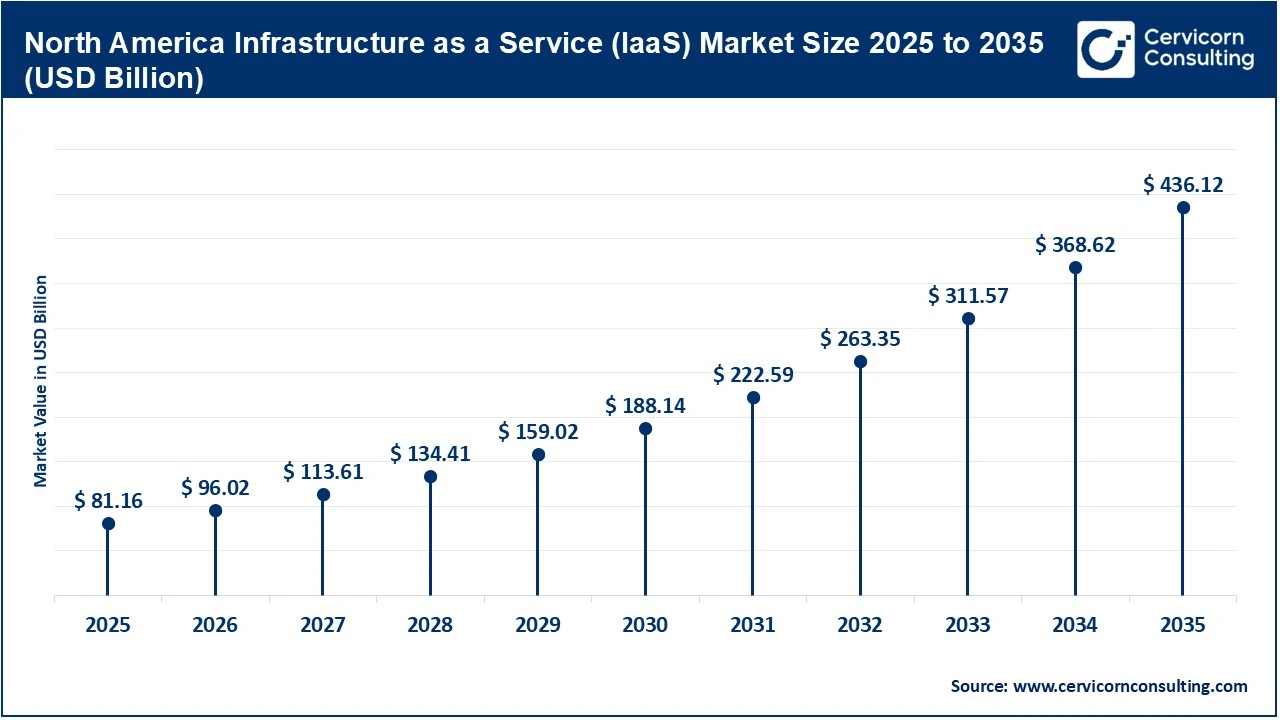
The North American region holds the highest share, driven by the strong presence of technology-focused Fortune 500 companies and the rapid adoption of generative AI. The region's major growth is the shift from generalized cloud adoption to dedicated, AI-ready infrastructure, with significant investments in new GPU-optimized data centers designed to support artificial intelligence and machine learning workloads. Technology hubs such as Northern Virginia and Texas are emerging as major centers for this infrastructure expansion. As a result, the industry is supported by multi-billion-dollar infrastructure expansions by leading providers such as Amazon Web Services (AWS), Microsoft Azure, and Google Cloud.
United States: Sustaining Global Leadership through Hyperscale Innovation
The United States remains the largest developed IaaS market globally, supported by the presence of the largest hyperscale cloud providers and a growing shift towards AI-optimized infrastructure.
- The “Big Three” providers, Amazon Web Services, Microsoft Azure, and Google Cloud, continue to dominate the IaaS market while shifting from basic compute services to higher-margin, specialized offerings.
- The rise of Generative AI is driving demand for specialized GPU clusters and optimized storage infrastructure to support large-scale model training.
- Investments are increasingly focused on Local Zones and edge infrastructure to reduce latency and support emerging 5G and IoT applications.
Canada: Strengthening Infrastructure through Data Sovereignty and Security
Canada’s IaaS market features a leading secure data hub for U.S.-based and international enterprises, supported by strong data security standards and reliable cloud infrastructure.
- Compliance requirements under the Personal Information Protection and Electronic Documents Act (PIPEDA) are driving greater investment in localized IaaS infrastructure across Canada.
- Canadian enterprises are increasingly adopting multi-cloud strategies to reduce vendor lock-in and strengthen disaster recovery.
- Federal and provincial agencies are accelerating the migration of citizen-focused services to secure, locally hosted IaaS platforms.
- Canada is emerging as a low-risk infrastructure hub for U.S.-based firms seeking to diversify operations while remaining within the North American trade region.
Europe IaaS Market: Driven by Data Sovereignty and Multi-Cloud Strategy Integration
The Europe infrastructure as a service market size is expanding from USD 46.38 billion in 2025 to USD 249.21 billion by 2035. Europe's IaaS market is evolving rapidly, driven by strict data governance laws and growing demand across the region for digital sovereignty. The implementation of regulatory frameworks, such as the GDPR, and the creation of projects like Gaia-X have forced cloud providers to establish localized solutions to ensure data remains within specific legal jurisdictions, increasing demand for the adoption of “Sovereign Clouds." Additionally, initiatives such as the European Union’s European Green Deal are encouraging data centre operators to adopt carbon-neutral practices by 2030.
United Kingdom: Pioneering Cloud Adoption in Fintech and Public Services
The United Kingdom market is leading in cloud migration across the public sector and the fintech industry, supported by robust digital regulatory frameworks and growing adoption of cloud-based services.
- London-based financial institutions are increasingly adopting IaaS to support regulatory compliance, enhance reporting capabilities, and enable high-frequency transaction processing.
- The Cloud First policy has increased the secure migration of legacy government data and applications to IaaS environments.
- UK enterprises are driving hybrid cloud adoption, using IaaS to modernize infrastructure and securely connect sensitive on-premise systems with scalable public cloud resources.
Germany: Bridging Industry 4.0 with Secure Cloud Frameworks
Germany’s IaaS market is strongly driven by its manufacturing sector and the country’s emphasis on data privacy, supported by regulations such as the GDPR and initiatives like Gaia-X.
- The European Commission is promoting federated cloud infrastructures to foster innovation while aligning with Europe’s principles of openness and digital sovereignty.
- Industry 4.0 sectors, particularly automotive and machinery, are among the leading adopters of IaaS to enable Industrial IoT and enhance supply chain visibility.
- There is a growing emphasis on cloud federation models to strengthen the European public cloud market by leveraging existing infrastructure capacity.
- The shift towards edge computing is accelerating, with forecasts indicating that a significant share of processing workloads will move closer to the network edge to support real-time manufacturing needs.
Infrastructure as a Service (IaaS) Market Share, By Region, 2025 (%)
| Region |
Revenue Share, 2025 (%) |
| North America |
42% |
| Asia Pacific |
27% |
| Europe |
24% |
| LAMEA |
7% |
LAMEA Infrastructure as a Service Market: Driven Infrastructure Modernization & Economic Diversification
The LAMEA infrastructure as a service market was valued at USD 13.53 billion in 2025 and is anticipated to reach around USD 72.69 billion by 2035. The LAMEA region is seeing rapid growth in IaaS adoption as governments increasingly focus on economic diversification and digital modernization. Many countries in the region are investing in cloud infrastructure to reduce dependence on traditional sectors such as oil, gas, and mining, while expanding their digital service capabilities. The Middle East, in particular, is benefiting from projects such as Saudi Arabia’s Vision 2030, which is attracting significant investment in cloud-based smart cities. In Latin America, countries such as Brazil have stimulated the regional cloud-native fintech and e-commerce services industry. Meanwhile, in Africa, cloud providers are expanding operations in countries such as South Africa to support digital transformation initiatives and build infrastructure for the region’s growing young population.
Brazil: Leading the Latin American Wave of Cloud Infrastructure
Brazil is the largest IaaS market in Latin America and serves as a major entry point for global cloud providers seeking to capture opportunities in the expanding South American digital economy.
- The retail sector’s shift towards digital-first models is driving sustained demand for scalable IaaS infrastructure, particularly during peak online traffic periods.
- Brazil’s robust fintech ecosystem, led by Nubank, relies on cloud-native infrastructure to enable rapid service deployment and operational agility.
- Major hyperscalers are expanding their São Paulo cloud regions to establish low-latency infrastructure hubs for the South American market.
- Government initiatives to improve internet penetration are increasing the adoption of cloud-hosted public services across the region.
United Arab Emirates: Architecting the Future of Smart City Infrastructure
The United Arab Emirates is emerging as a global leader in AI and smart city development, with IaaS serving as the foundational infrastructure for achieving the goals of Vision 2030.
- IaaS is playing a key role in smart city initiatives in Dubai and Abu Dhabi, supporting applications such as traffic management and utility optimization.
- The establishment of national AI organizations such as G42 highlights the shift toward high-capacity local IaaS infrastructure to support strategic national priorities.
- Economic diversification strategies focused on technology are driving large-scale government subsidies and investments in cloud infrastructure development.
Infrastructure as a Service (IaaS) Market Segmental Analysis
The Infrastructure as a Service (IaaS) market is segmented into service, deployment, industry, and region.
Service Analysis
The computing segment is the dominant service in the IaaS market, primarily because it provides cloud infrastructure. These infrastructures deliver the virtual machines, storage, and processing power that support each digital application and enterprise workload. Since the early stages of cloud adoption, computing capacity has remained the primary driver of infrastructure migration, enabling organizations to move legacy systems and cloud-native applications into scalable virtual environments. This shift helps businesses reduce capital expenditure while improving operational flexibility and scalability, allowing them to respond more quickly to market demands and optimize resource allocation.
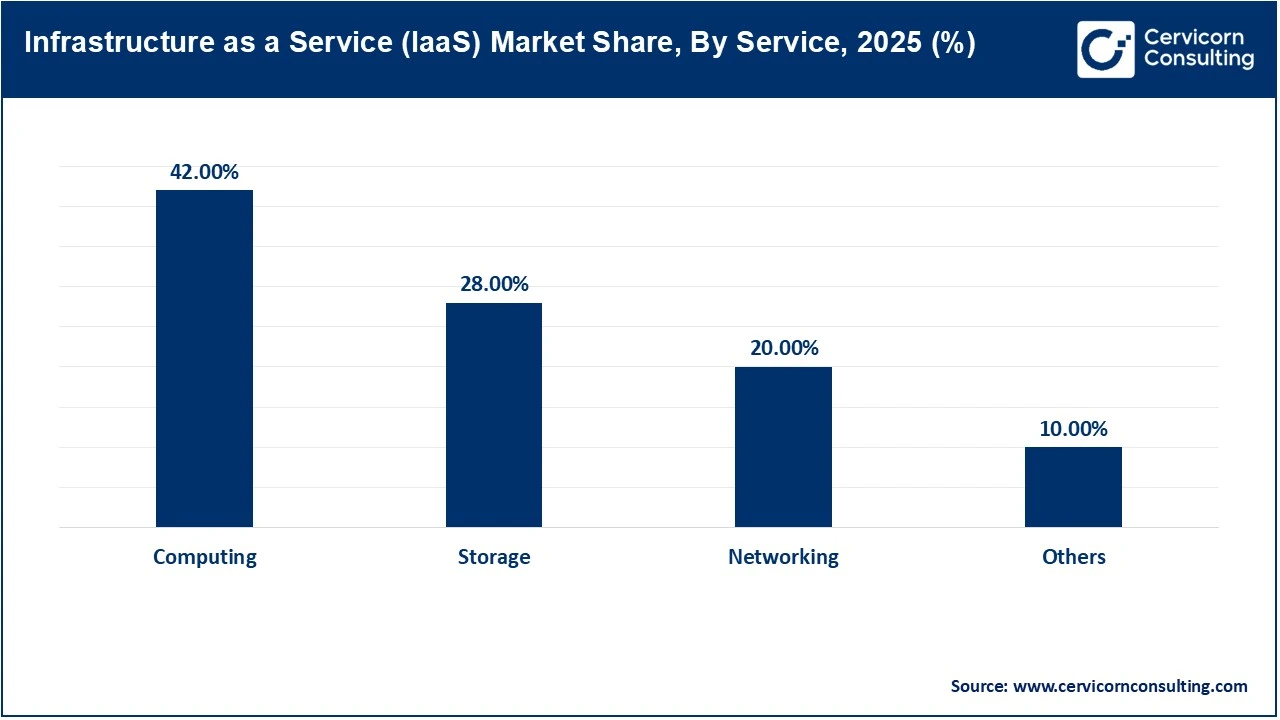
The networking services segment is expected to experience the fastest growth in the market due to rapid adoption of distributed computing and integration of 5G technologies. These services have increased the need for advanced, low-latency connectivity solutions that can efficiently manage data traffic between cloud environments and edge devices. As companies increasingly use multiple cloud services and combine different cloud types, connecting these systems has become more complex, driving a greater need for advanced technologies such as software-defined networking (SDN) and content delivery networks (CDNs).
Deployment Analysis
The hybrid deployment segment is dominant in the market because it provides a strategic balance for large-scale enterprises and highly regulated industries. To meet security, compliance, and data sovereignty requirements, organizations in fields like banking, government, and healthcare need cloud infrastructure that is both scalable and flexible, while maintaining strict control over sensitive data. This model has become a preferred approach for digital transformation, especially for enterprises with legacy infrastructure and regulatory obligations that make a complete shift to public cloud environments challenging.
Infrastructure as a Service (IaaS) Market Share, By Deployment, 2025 (%)
| Deployment |
Revenue Share, 2025 (%) |
| Hybrid |
41% |
| Public |
37% |
| Private |
22% |
Public cloud deployment is the fastest-growing segment of the market, mainly due to its low entry barriers, rapid scalability, and easy access to advanced technologies such as artificial intelligence and machine learning without upfront investment. The rapid adoption of public clouds is driven by digital-native startups built 100% in the cloud, as well as by traditional enterprises adopting the "cloud-first" approach for all new application development projects. In addition, major hyperscalers are constantly competing on pricing and the proliferation of managed service offerings.
Industry Analysis
The IT and Telecom segment holds the largest share of the IaaS market because these industries are the earliest adopters of the IaaS model. Both sectors require extensive computing and storage capabilities to support large-scale communication networks and digital operations. In particular, telecommunications providers are increasingly transitioning to Telco-Cloud architectures, where network functions are virtualized and managed through cloud infrastructure, reinforcing the segment’s leading position in the market.
Infrastructure as a Service (IaaS) Market Share, By Industry, 2025 (%)
| Industry |
Revenue Share, 2025 (%) |
| IT & Telecom |
24% |
| BFSI |
19% |
| Retail & E-commerce |
15% |
| Manufacturing |
12% |
| Healthcare |
10% |
| Education |
8% |
| Others |
12% |
The healthcare sector is the fastest-growing segment of the market due to the rapid digitization of healthcare services, including electronic health records (EHRs), telehealth platforms, and AI-driven diagnostics. The healthcare sector is adopting the IaaS model to process large volumes of genomic data, such as medical images, which require specialized high-performance computing resources. This ongoing transformation is essential for interoperability among healthcare providers and for the adoption of enhanced security protocols that enable compliant sharing of patients' data in a cloud ecosystem.
Infrastructure as a Service (IaaS) Market Top Companies
Recent Developments
- In April 2025, Google Cloud introduced enhanced AI-optimized cloud infrastructure and expanded TPU capabilities to improve enterprise AI workload performance and scalability.
- In February 2025, Microsoft Azure partnered with leading AI chip providers to expand high-performance cloud infrastructure for enterprise AI model training and deployment.
- In January 2025, Amazon Web Services introduced new AI infrastructure enhancements, expanding GPU-based cloud capabilities to support rising enterprise demand for generative AI workloads.
Market Segmentation
By Service
- Computing
- Storage
- Networking
- Others
By Deployment
By Solution
- Managed Hosting
- Disaster Recovery as a Service
- Storage as a Service
- Colocation
- Network Management
- Content Delivery
- High Performance Computing as a Service
- Others
By End-User
By Industry
- IT & Telecom
- BFSI
- Retail & E-commerce
- Manufacturing
- Healthcare
- Education
- Others
By Region
- North America
- APAC
- Europe
- LAMEA