Industrial Fasteners Market Size and Growth 2026 to 2035
The global industrial fasteners market size was estimated at USD 104.75 billion in 2025 and is expected to be worth around USD 158.61 billion by 2035, exhibiting a compound annual growth rate (CAGR) of 4.24% over the forecast period from 2026 to 2035.
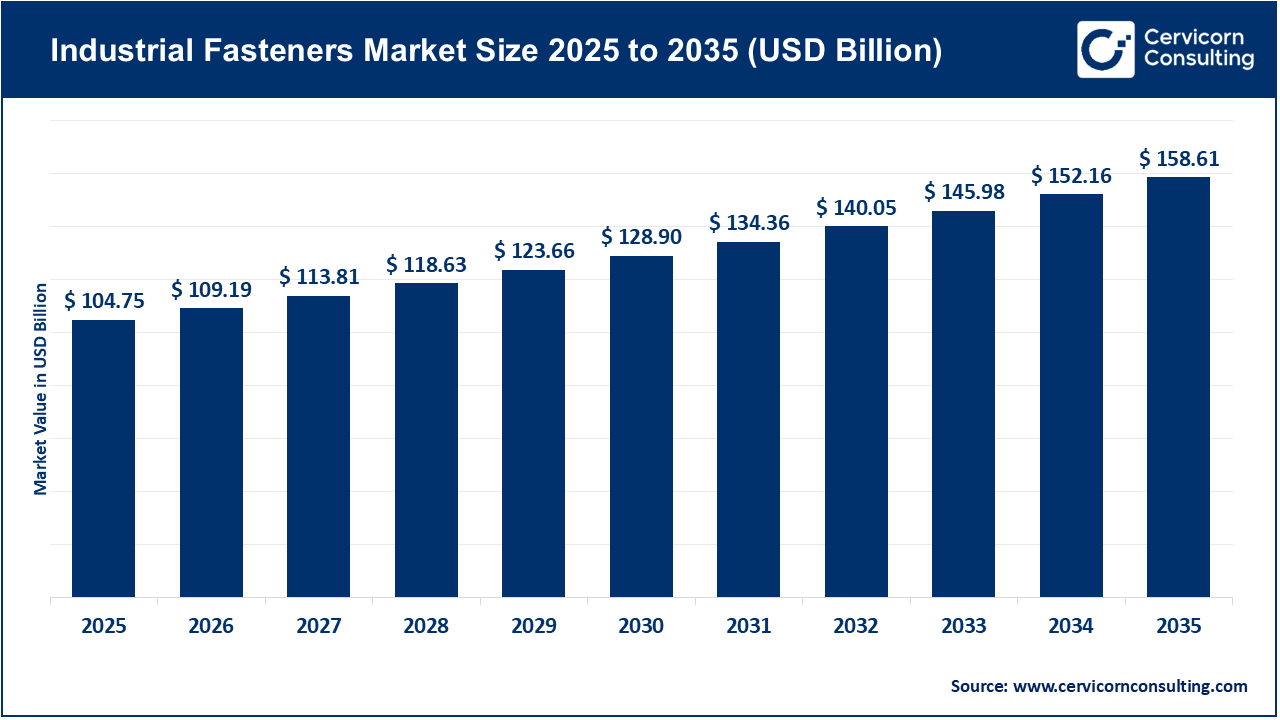
The industrial fasteners market continues to grow steadily worldwide, driven by increasing demand from key end-use industries such as construction, automotive, aerospace, industrial machinery, and electronics. This growth is further fueled by the need for high-performance fastening solutions that offer superior durability, precision, and corrosion resistance, which have become essential in modern manufacturing and large-scale infrastructure projects. At the same time, major investments in infrastructure development and the modernization of production facilities are creating additional opportunities for advanced fastener technologies.
Additionally, as industrial applications grow more complex—mainly due to electric vehicle manufacturing, aerospace design, and the construction of next-generation structures—companies are increasingly utilizing these specialized fasteners. Moreover, due to the demand for custom fasteners, many manufacturers are offering tailored fastening solutions, especially in the U.S., where automotive and aerospace sectors are robust. Finally, the emergence of Industry 4.0 remains a vital aspect of the industry, enabling the adoption of smart, sensor-based fasteners that provide complete traceability, reduce machine downtime, and enhance productivity across the entire manufacturing system.
Report Highlights
- Asia Pacific dominates the industrial fasteners market with around 42% share, driven by strong manufacturing activity, expanding automotive production, and rapid infrastructure development in countries such as China, India, Japan, and South Korea.
- Bolts represent the largest fastener type with around 32% share, primarily used in structural construction, heavy machinery, and automotive chassis assemblies.
- Direct sales dominate the distribution channel with nearly 65% share, as large manufacturers and OEMs prefer direct procurement contracts to ensure consistent quality and supply.
- Automotive remains the largest application segment with about 25% market share, supported by global vehicle production and the increasing use of specialized fasteners in electric vehicles.
- Building & construction accounts for around 21% of total demand, fueled by rising global infrastructure investments including bridges, highways, commercial buildings, and industrial facilities.
- Aerospace-grade fasteners represent a smaller but high-value segment with around 9% share, as aircraft manufacturing requires precision-engineered fasteners made from titanium and superalloys.
- Renewable energy applications are emerging as one of the fastest-growing segments, driven by the expansion of wind and solar energy projects that require thousands of corrosion-resistant structural fasteners.
Industry 4.0 and Smart Fastening Solutions Accelerate Operational Efficiency
The industrial fasteners market is undergoing a transformation driven by Industry 4.0 technology. The use of intelligent fasteners with embedded sensors enables manufacturers to monitor load conditions, torque levels, and joint performance during assembly and operation. These smart fastening solutions will boost manufacturing efficiency and enhance equipment reliability by preventing mechanical failures, optimizing maintenance schedules, and supporting predictive maintenance. As automation and digitalization expand across global industries, intelligent fasteners will become increasingly vital components of high-performance production facilities and cutting-edge machinery.
Manufacturing Output Growth in Major Industrial Economies Supporting Industrial Fasteners Demand
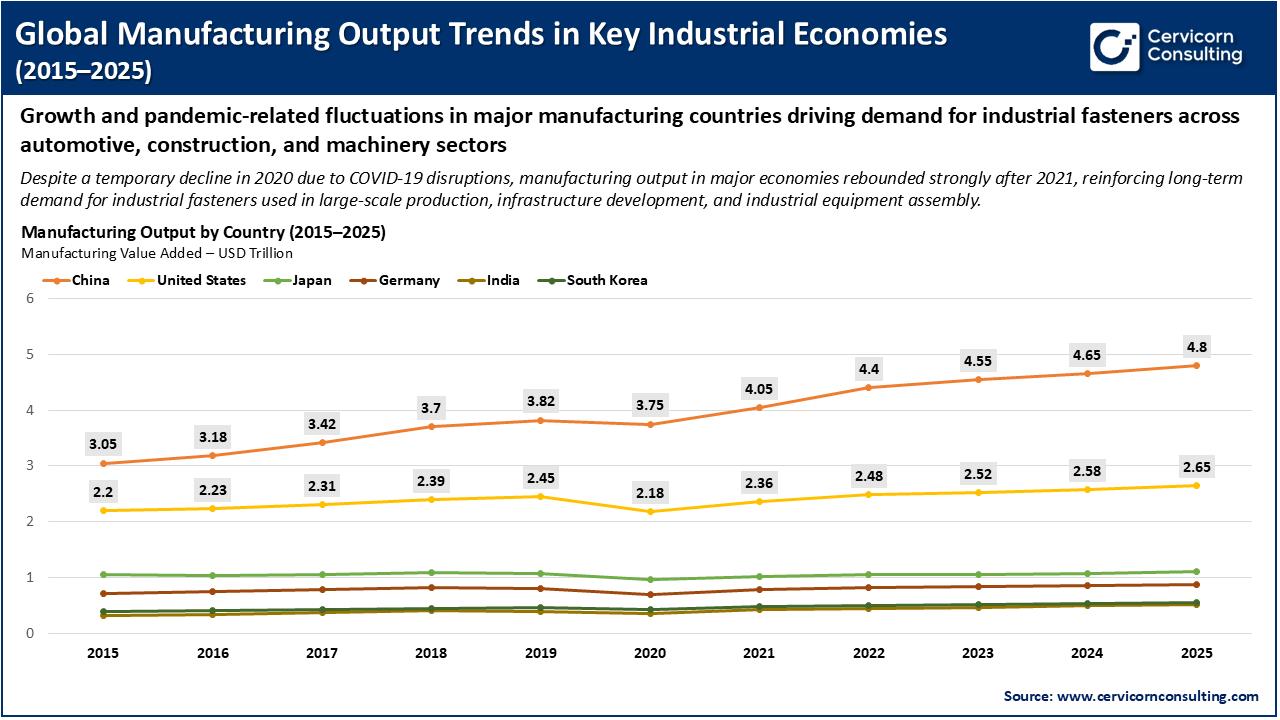
The steady growth of manufacturing output among major global economies from 2015 to 2025 is evident, although a temporary decline occurred in 2020 as a result of COVID-19 disruptions. China continues to hold a leading position, with output rising from USD 3.05 trillion in 2015 to an estimated USD 4.8 trillion by 2025. This growth is attributed to its robust industrial base and strong export orientation. The United States also demonstrates consistent expansion, reaching around USD 2.65 trillion by 2025, supported by advancements in manufacturing and increased infrastructure investment. Japan and Germany experience stable but slower growth, while India and South Korea are gradually expanding, mainly due to ongoing industrialization and the growth of electronics manufacturing. The recovery in manufacturing output after 2020 indicates a strengthening of industrial activity worldwide. This trend is expected to drive higher demand for industrial fasteners, particularly in sectors such as automotive, machinery, construction, and heavy equipment manufacturing.
Industrial Fasteners Market Key Applications with Statistics
Industrial fasteners are widely used to join, secure, and assemble mechanical components across industries such as automotive, construction, aerospace, machinery, and electronics. The growth of these industries is directly increasing the demand for high-performance fastening solutions worldwide.
Application-Wise Industrial Fasteners Market Insights
1. Automotive Industry – Largest Application
The automotive industry represents the largest consumption segment of industrial fasteners due to the large number of components used in vehicles.
- A single passenger vehicle can contain 3,000–5,000 individual fasteners, including bolts, nuts, screws, clips, and rivets.
- Passenger vehicles account for nearly 68% of fastener demand within the automotive segment.
- The transition toward electric vehicles (EVs) is increasing the use of lightweight aluminum and specialty fasteners for battery packs and electronics systems.
2. Construction & Infrastructure – Fastest Growing Application
Construction is one of the fastest-growing application areas for industrial fasteners due to massive infrastructure investments worldwide.
- The global construction sector is projected to grow at around 5.5% annually, directly increasing demand for structural fasteners.
- Fasteners are extensively used in steel structures, bridges, railways, highways, and residential buildings.
- Large infrastructure modernization projects in developing economies are accelerating demand for heavy-duty bolts and anchors.
3. Aerospace & Defense – High-Performance Fasteners
The aerospace industry requires extremely high-precision and high-strength fasteners capable of withstanding extreme pressure, temperature, and vibration.
- Commercial aircraft contain over 1 million fasteners connecting fuselage, wings, and internal systems.
- Aerospace fasteners are typically made from titanium, superalloys, and stainless steel to ensure durability and corrosion resistance.
- Growth in aircraft production and defense spending is increasing demand for specialized fasteners.
4. Energy Sector (Wind, Solar, Oil & Gas)
Industrial fasteners are critical in energy infrastructure because they secure heavy structures exposed to harsh environments.
- The renewable energy sector is projected to grow around 8% annually, supporting demand for corrosion-resistant fasteners.
- Wind turbines alone require thousands of high-strength bolts for towers, nacelles, and blades.
Recent Major Milestones
1. Electric Vehicle (EV) Driven Fastener Innovations Promotes Evolving Automotive Segment
The rapid rise of electric vehicles is transforming fastener design and engineering across the automotive industry. Unlike traditional combustion-engine cars, EVs require fasteners that can support lightweight construction, battery-pack integrity, heat management, and high-voltage safety. As automakers push for improved driving range and efficiency, they increasingly rely on custom, high-grade, corrosion-resistant fasteners that work seamlessly with aluminum, composites, and other lightweight materials used in EV platforms.
These custom designed fasteners will create a strong structural component with a lower total weight that is absolutely necessary for optimizing battery performance and energy consumption. As global EV production expands, these advancements are becoming central to automotive design, enabling safer, more efficient, and more reliable next-generation vehicles. In essence, the evolution of the EV market is directly accelerating innovation in fastening technology, reshaping the automotive segment in the process.
2. High-Performance Aerospace Fasteners Gain Momentum with Increased Air Travel & Space Activity
The increase in global air travel and the rapid growth of commercial and government space programs are driving strong demand for high-performance aerospace fasteners. Modern aircraft, satellites, and launch systems require components that can endure extreme temperatures, vibration, pressure changes, and strict safety standards. As manufacturing activity accelerates in both commercial aviation and defense, aerospace-grade fasteners engineered for superior strength, precision, and reliability are becoming essential.
Additionally, in 2025, there was a notable rise in the use of precision-engineered titanium alloy aerospace fasteners, mainly due to growth in commercial aviation and private space flights. Manufacturers also invested significantly in producing lightweight aircraft components, enabling modularity in new aircraft designs and supporting the construction of reusable space vehicle parts. This category of fasteners is in high demand because of their ability to withstand high tensile forces, withstand high temperatures, and ensure long-term durability; consequently, aerospace fasteners have become one of the fastest-growing segments in the market.
3. Sustainability Becomes a Core Industry Priority with Low-Carbon Fastener Production
Sustainability is rapidly becoming a key focus in the industrial fasteners market as manufacturers respond to growing environmental expectations and stricter global regulations. With large-scale construction, automotive manufacturing, and industrial machinery sectors all aiming to reduce their carbon footprints, fastener producers are adopting low-carbon manufacturing methods, energy-efficient processes, and more sustainable raw materials.
As infrastructure projects grow and next-generation mobility solutions advance, the demand for environmentally responsible fasteners continues to increase. Manufacturers are increasingly investing in cleaner production technologies, including advanced metal processing, automated precision systems, and lifecycle-optimized product designs that minimise environmental impact.
4. Fastener Manufacturers Accelerate Adoption of Smart, IoT-Enabled Fasteners
Fastener manufacturers are quickly adopting smart, IoT-enabled fastening technologies as industries move toward greater automation, precision, and predictive maintenance. These advanced fasteners incorporate sensors that can monitor preload, torque, vibration, and joint integrity in real time, offering capabilities that are becoming increasingly important in automotive manufacturing, industrial machinery, aerospace assembly, and heavy equipment production. As Industry 4.0 adoption accelerates, smart fasteners help companies improve traceability, reduce assembly errors, and minimize downtime by detecting faults before they cause equipment failure. This transition aligns closely with the broader industrial shift toward connected, data-driven production environments, which are key to scaling modern manufacturing efficiently.
Industrial Fasteners Market Regional Analysis
The industrial fasteners market is segmented by region into North America, Europe, Asia-Pacific, and LAMEA. Here is a brief overview of each region:
Why does Asia-Pacific dominates the industrial fasteners market?

The Asia-Pacific industrial fasteners market size was valued at USD 44 billion in 2025 and is expected to reach around USD 66.62 billion by 2035. The Asia-Pacific region has emerged as both the largest and fastest-growing market, driven by rapid manufacturing expansion, strong infrastructure development, and the presence of major automotive and electronics production hubs. Moreover, countries such as China, India, South Korea, and Vietnam continue to invest heavily in construction, automotive manufacturing, and machinery production sectors that depend heavily on high-performance fastening solutions. As industrialization advances and export-focused manufacturing grows across emerging Asian economies, the region not only maintains its leadership but also sustains some of the fastest growth rates in the global fasteners market, fueled by increasing demand for customized, high-precision, and application-specific fastener products.
China to Remain the Global Manufacturing Hub for Industrial Fasteners
- China dominates the industrial fasteners market in Asia-Pacific due to its massive industrial ecosystem and export-driven manufacturing sector.
- China produces over 6-7 million metric tons of fasteners annually, accounting for nearly 35-40% of global production.
- The country has more than 10,000 fastener manufacturing enterprises, supplying bolts, screws, nuts, and specialty fasteners to automotive, construction, and electronics industries.
- China’s automotive sector produces over 30 million vehicles annually, creating massive demand for high-strength and corrosion-resistant fasteners used in engines, chassis, and body assemblies.
- The government is also pushing domestic manufacturers toward high-performance fasteners for aerospace, railways, and renewable energy sectors, which is encouraging investments in advanced materials such as titanium and alloy steel.
- However, environmental regulations and rising steel prices are pushing Chinese fastener manufacturers to adopt more efficient production technologies and higher-value products.
India to Emerge as a High-Growth Market for Industrial Fasteners
- India is becoming one of the fastest-growing industrial fastener markets due to expanding automotive production and infrastructure development.
- India’s fastener market is growing at 6-7% annually, supported by rapid expansion of the automotive and construction sectors.
- The country manufactures over 25 million vehicles annually, generating large demand for structural and automotive-grade fasteners.
- Major fastener manufacturing clusters exist in Ludhiana, Pune, Chennai, and Rajkot, supplying both domestic OEMs and export markets.
- Government initiatives such as Production Linked Incentive (PLI) schemes and infrastructure investment programs are increasing demand for heavy-duty fasteners used in railways, bridges, and renewable energy installations.
- India is also becoming a key export hub for precision fasteners used in automotive and industrial machinery.
What are the driving factors of North America industrial fasteners market?
The North America industrial fasteners market size was estimated at USD 26.19 billion in 2025 and is projected to hit around USD 39.65 billion by 2035. The North America industrial fasteners market continues to grow steadily, supported by a robust manufacturing base and high-value demand from the automotive and aerospace sectors. Additionally, automotive and aerospace programs remain key drivers, as both industries require high-strength, application-specific fasteners capable of meeting strict safety, durability, and performance standards. Simultaneously, increased adoption of digital traceability systems, corrosion-resistant coatings, and engineered fastening solutions highlights the region’s commitment to technological progress and quality enhancement. With the United States leading in demand and Canada and Mexico strengthening their roles in automotive and aerospace supply chains, North America continues to reinforce its position as a technologically advanced and innovation-driven fasteners market.
United States to Lead Aerospace and Automotive Fastener Demand
- The United States dominates the North American industrial fasteners market due to its large aerospace, defense, and automotive industries.
- The U.S. accounts for over 75% of the regional industrial fasteners market.
- The aerospace sector consumes a large volume of precision-engineered fasteners made from titanium, stainless steel, and superalloys.
- The country produces approximately 10-11 million vehicles annually, driving demand for high-strength bolts, nuts, and threaded fasteners used in automotive assemblies.
- Major manufacturers are investing in automation, robotic manufacturing, and digital supply chain systems to improve production efficiency and quality control.
- The growth of renewable energy installations and infrastructure modernization projects is also creating additional demand for heavy-duty industrial fasteners.
Why does Europe continue to grow in the industrial fasteners market?
The Europe industrial fasteners market size was accounted for USD 22 billion in 2025 and is forecasted to grow around USD 33.31 billion by 2035. The Europe industrial fasteners market continues to grow, driven by the region’s long-standing engineering excellence, a robust manufacturing base, and an increasing shift toward sustainability. Europe’s rich industrial heritage, especially in Germany, Italy, and France, supports high standards for precision, quality, and safety, leading to the adoption of high-strength, corrosion-resistant, and lightweight fastening solutions for next-generation EVs, aircraft, and renewable energy infrastructure. Additionally, there is rising demand for specialty and high-strength fasteners as the region emphasises sustainable building practices, lighter vehicles, and wind farm projects. The market's stability is further reinforced by regulations offering incentives for energy-efficient infrastructure and environmentally friendly manufacturing.
Germany to Lead Industrial Fastener Production in Europe
- Germany is one of the largest industrial fastener producers in Europe, supported by its strong engineering and automotive sectors.
- Germany produces millions of tons of industrial fasteners annually, supplying major automotive OEMs and machinery manufacturers.
- The country is home to several leading fastener manufacturers and engineering firms that specialize in high-strength, corrosion-resistant, and lightweight fastening solutions.
- Germany’s automotive industry produces approximately 4 million vehicles per year, driving large-scale demand for structural fasteners.
- Additionally, the shift toward electric vehicles and advanced manufacturing technologies is increasing demand for specialized fastening systems compatible with aluminum and composite materials.
Italy and France to Strengthen Demand from Aerospace and Machinery Industries
- Italy and France are also significant markets for industrial fasteners in Europe.
- Italy has a strong presence in industrial machinery and manufacturing equipment, which requires precision fasteners for assembly and maintenance.
- France’s aerospace sector, supported by companies such as Airbus, creates high demand for titanium and aerospace-grade fasteners.
- The increasing emphasis on renewable energy infrastructure and rail transport systems is also driving demand for heavy-duty structural fasteners across the region.
Industrial Fasteners Market Share, By Region, 2025 (%)
| Region |
Revenue Share, 2025 (%) |
| Asia-Pacific |
42% |
| North America |
25% |
| Europe |
21% |
| LAMEA |
12% |
LAMEA Industrial Fasteners Market: Driven by Infrastructure and Energy Projects
The LAMEA industrial fasteners market was valued at USD 12.57 billion in 2025 and is anticipated to reach around USD 19.03 billion by 2035. The LAMEA industrial fasteners market is growing steadily as large-scale infrastructure and energy projects across Latin America, the Middle East, and Africa create strong demand for durable, high-performance fastening solutions. In the Middle East and Africa, ongoing megaprojects-from skyscrapers and industrial complexes to renewable energy installations-continue to increase consumption of fasteners designed for structural integrity and harsh environmental conditions. As governments focus on economic diversification, expanding energy capacity, and accelerating urban development, the need for reliable fastening systems remains essential for supporting safe, long-lasting infrastructure across the LAMEA region.
Brazil to Lead Industrial Fastener Demand in Latin America
- Brazil is the largest industrial fastener market in Latin America due to its strong automotive and construction sectors.
- Brazil produces over 2 million vehicles annually, generating steady demand for automotive fasteners.
- The country also has a well-established manufacturing base for steel fasteners used in heavy machinery and industrial equipment.
Middle East to Drive Demand Through Mega Infrastructure Projects
- The Middle East is witnessing strong growth in industrial fastener demand due to large-scale construction and energy projects.
- Countries such as Saudi Arabia and the UAE are investing billions of dollars in smart cities, transportation networks, and renewable energy installations.
- Mega projects such as NEOM and large-scale oil & gas facilities require high-performance fasteners capable of operating in extreme environmental conditions.
Industrial Fasteners Market Segmental Analysis
The industrial fasteners market is segmented into raw material, product type, fastener type, distribution channel, application, and geography.
Raw Material Analysis
Metallic fasteners hold the largest market share due to their exceptional strength, durability, and ability to withstand high loads, making them the preferred choice for demanding applications across construction, automotive, aerospace, and industrial machinery. Their dominance is reinforced by the fact that metal fasteners accounted for nearly 86% of the market share in 2025, largely because industries rely on their reliability, heat resistance, and long service life in both structural and high-performance environments.
Industrial Fasteners Market Share, By Raw Material, 2025 (%)
| Raw Material Segment |
Revenue Share, 2025 (%) |
| Metal Fasteners |
86% |
| Plastic Fasteners |
14% |
Plastic fasteners represent the fastest-growing segment, driven by their lightweight nature, corrosion resistance, and increasing use in electronics, automotive interiors, and consumer appliances.
Product Type Analysis
Externally threaded fasteners hold the largest market share as they are widely used across construction, automotive, industrial machinery, and heavy-equipment applications due to their high strength, versatility, and ability to create secure, load-bearing joints.
Global Industrial Fasteners Market, By Product Type, 2025 (%)
| Product Type |
Revenue Share, 2025 (%) |
| Externally Threaded Fasteners |
45% |
| Internally Threaded Fasteners |
22% |
| Non-threaded Fasteners |
18% |
| Aerospace Grade Fasteners |
15% |
However, aerospace-grade fasteners represent one of the fastest-growing segments, driven by rising global aircraft production, increased air-travel demand, and expanding commercial and defense aerospace programs. Their growth is reinforced by forecasts showing that aerospace-grade fasteners supported by strict performance requirements, lightweight material usage, and the need for exceptional durability and reliability in safety-critical environments.
Fastener Type Analysis
Bolts hold the largest market share within the industrial fasteners category because they are essential for creating strong, load-bearing joints across construction, automotive, machinery, and heavy-equipment applications. Their ability to provide secure, high-strength connections makes them indispensable in structural assemblies, which is why bolts consistently rank among the most widely used and in-demand fastener types globally.

Screws represent one of the fastest-growing fastener segments, driven by their versatility, ease of installation, and expanding use in electronics, consumer goods, automotive interiors, and lightweight manufacturing. This momentum is supported by overall market trends highlighting growth in screw fastener demand, particularly as industries adopt more specialized and customizable fastening solutions to support evolving design and engineering needs.
Application Analysis
Automotive fasteners dominate the market because the automotive industry depends heavily on high-strength, durable, and precisely engineered fastening components used throughout vehicle assembly, from engines and chassis structures to interior systems.
Industrial Fasteners Market, By Application, 2025 (%)
| Application |
Revenue Share, 2025 (%) |
| Automotive |
25% |
| Building & Construction |
21% |
| Industrial Machinery |
16% |
| Aerospace |
9% |
| Home Appliances |
8% |
| Motors & Pumps |
6% |
| Renewable Energy |
5% |
| Furniture |
4% |
| Plumbing Products |
3% |
| Lawn & Garden Equipment |
1% |
| Other Industrial Applications |
2% |
The renewable energy sector is expected to be the fastest-growing segment. The rapid growth of wind energy, new solar power installations, and the increasing demand for renewable energy storage products will all play a significant role in boosting the demand for high-strength, corrosion-resistant, and weather-resistant industrial fasteners.
Industrial Fasteners Market Top Companies
Recent Developments by Major Companies
Illinois Tool Works (ITW)
- Expanded its portfolio of high-performance automotive and industrial fasteners to support lightweight vehicle manufacturing and EV platforms.
- Invested in automation and smart manufacturing technologies to improve production efficiency and product consistency.
Stanley Black & Decker
- Strengthened its industrial fasteners and engineered fastening solutions business through product innovation and supply chain optimization.
- Focused on expanding its presence in construction and infrastructure projects across North America and Europe.
Hilti Group
- Introduced advanced anchor and fastening systems designed for high-load construction and infrastructure applications.
- Increased investment in digital construction tools and fastening technologies to support Building Information Modeling (BIM).
Würth Group
- Expanded its global distribution network, particularly in Asia-Pacific and emerging markets, to support growing industrial demand.
- Enhanced its online and digital procurement platforms to improve customer access and supply chain efficiency.
Howmet Aerospace
- Focused on the development of aerospace-grade and lightweight fasteners for commercial aviation and defense applications.
- Increased R&D investments to meet stringent safety, performance, and sustainability standards in aerospace manufacturing.
Market Segmentation
By Raw Material
- Metal Fasteners
- Plastic Fasteners
By Product Type
- Externally Threaded Fasteners
- Internally Threaded Fasteners
- Non-threaded Fasteners
- Aerospace Grade Fasteners
By Fastener Type
- Bolts
- Screws
- Nuts
- Washers
- Rivets
- Others
By Distribution Channel
- Direct Sales
- OEM Sales
- Contract Manufacturing Supply
- Indirect Sales
- Distributors
- Wholesalers
- Retail hardware stores
- E-commerce platforms
By Application
- Automotive
- Aerospace
- Building & Construction
- Industrial Machinery
- Home Appliances
- Plumbing Products
- Furniture
- Renewable Energy
- Motors & Pumps
- Lawn & Garden Equipment
- Others
By Geography
- North America
- APAC
- Europe
- LAMEA