India Diagnostics Services Market Size and Forecast 2026 to 2035
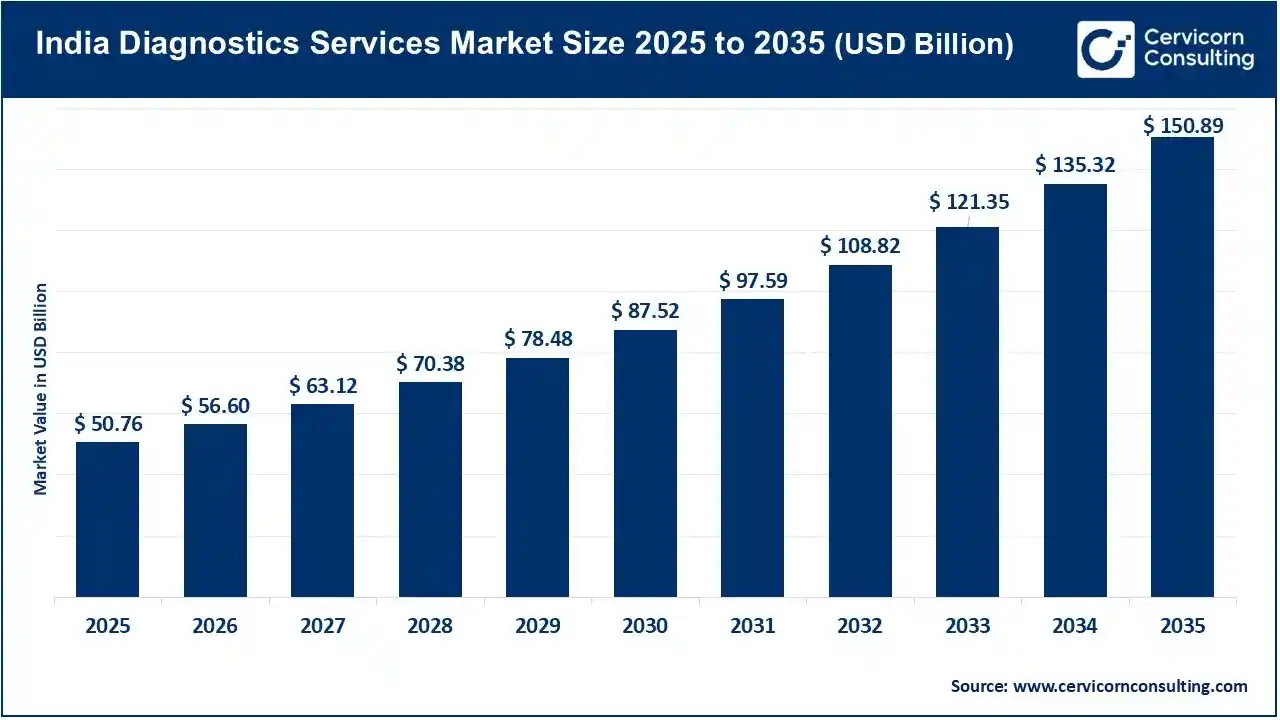
The India diagnostics services market size was valued at USD 50.76 billion in 2025 and is projected to exceed around USD 150.89 billion by 2035, growing at a CAGR of 11.5% during the forecast period of 2026-2035.
- Base Year Market Size (2025): $50.76 billion
- Current Year Market Size (2026): $56.60 billion
- Estimated Year Market Size (2035): $150.89 billion
- Forecast Period CAGR (2026-2035): 11.5%
Report Highlights
- By service type: The pathology testing segment dominated the market in 2025 (revenue share 52%), due to a surge in testing volumes, continuous health screenings, and chronic disease monitoring.
- By test type: The clinical chemistry segment was dominant in the market in 2025 (revenue share 32%), driven by expansive use in regular health assessments and monitoring of diabetes, kidney disorders, and metabolic concerns.
- By application: The infectious disease diagnosis segment registered dominance in the market in 2025 (revenue share 28%), as the globe experiences a consistent need to diagnose and monitor communicable diseases.
- By service provider: The independent diagnostic laboratories segment dominated the market in 2025 (revenue share 35%), mainly supported by India's highly isolated diagnostics ecosystem and the prominent presence of standalone facilities.
What is a Glimpse of Popular Diagnostic Services Used in India in 2026?
The India diagnostics services market primarily consists of diverse medical tests, procedures, and assessments that support identifying, monitoring, and controlling diseases, injuries, or health issues. Recent developments in the market have been driven by expanding health awareness and lifestyle concerns, which boost demand for regular blood work and full-body checkups. Often used in vitro diagnostics in Indian labs highlight the analysis of Complete blood counts (CBC), blood glucose/A1C tests for diabetes, lipid profiles for cholesterol, liver and kidney function tests, urinalysis for tract infections, etc. Moreover, gradual trends in diagnostic services foster radiology and diagnostic imaging to observe internal body anatomy. Ongoing advances and upcoming innovations are looking to advance specialised and molecular diagnostics, like RT-PCR and microbiological culture tests, to target genetics, pathogens, and targeted therapies.
Diagnostic Testing Costs and Patient Expenditure in India
- Average diagnostic expenditure: According to the National Sample Survey (NSS) 75th Round data for 2017–2018, average diagnostic expenditure per hospitalization case in India was approximately ₹2,000–₹2,100, compared with ₹73–₹83 for non-hospitalization cases.
- Rural–urban diagnostic cost differences: Average diagnostic expenditure per hospitalization case was ₹1,889 in rural areas and ₹2,441 in urban areas. For non-hospitalization cases, the respective averages were ₹65 and ₹92.
- Diagnostic expenditure in outpatient care: Average out-of-pocket expenditure on diagnostic tests was ₹36 in government settings, ₹167 in for-profit settings, and ₹211 in not-for-profit settings for outpatient care.
- Share of healthcare out-of-pocket expenditure: NSS 71st Round data indicated that diagnostics accounted for 10% of total out-of-pocket healthcare expenditure, including 11% in outpatient care and 9.6% in inpatient care.
- Regional variation in diagnostic expenditure: Average non-hospitalization diagnostic expenditure was ₹70–₹80 in North India, ₹55–₹65 in South India, and ₹80–₹90 in East and West India. Average hospitalization diagnostic expenditure ranged from ₹1,400–₹1,500 in East India, including Northeast India, to ₹2,600–₹2,700 in North India.
- Government support for affordable diagnostics: Under India's Free Diagnostics Service Initiative, recommended diagnostic test coverage extends from 14 tests at Sub-Centres to 134 tests at District Hospitals, aiming to improve access and reduce patients' out-of-pocket expenditure.
State-Wise Diagnostic Services Accessibility Statistics in India
| State/Union Territory |
Number of NABL-Accredited Medical Laboratories |
| Maharashtra |
292 |
| West Bengal |
216 |
| Tamil Nadu |
200 |
| Delhi |
186 |
| Uttar Pradesh |
179 |
| Karnataka |
164 |
| Gujarat |
135 |
| Telangana |
133 |
| Kerala |
98 |
Key Trends
- AI Solutions & Breakthroughs: As a recent major activity, Dr. Lal PathLabs have placed deep learning-based AI modules for early detection. Alongside this, prominent innovations, including AI Steth, have been broadening the record of heart sounds and translating them into visual patterns to determine rheumatic heart disease and cardiac anomalies.
- Elevation in Tailored Approaches: Leading Indian firms, such as Metropolis Healthcare, are strengthening a focus on genomics centers, genomic profiling, and biomarker-driven tests to push precision oncology and rare disease trajectories.
- Home-Based Testing and Consolidations: As the Indian population is highly demanding remote diagnostics measures, India declared the Ayushman Bharat Digital Mission (ABDM), and labs are stepping into Tier-2 and Tier-3 cities to record a growth in demand for routine and specific testing.
Briefing on Cancer Diagnosed In 2025 and Its Influence on Prospective Developments
The Indian diagnostics services market is growing rapidly, as the Indian Council of Medical Research (ICMR) and National Cancer Registry Programme estimated that India recorded nearly 1.57 million new cancer cases in 2025. India has roughly 300,000 laboratories, with nearly 900 million tests per year. According to ICMR, by 2030-2040, India's estimated volume of diagnoses is expected to rise to 2.08 to 2.5 million. Hence, this leads to immersive and robust healthcare policies to broaden localized screening networks, point-of-care diagnostics, and expand the National Programme for Prevention and Control of Cancer, Diabetes, Cardiovascular Diseases and Stroke (NPCDCS). These forecasted cases will foster investments in oncology care models, digital health records, and subsidizing targeted/immunotherapy drugs to reduce out-of-pocket healthcare expenses.
What are the Highlighted Challenges in the India Diagnostics Services Market?
- Lack of Specialized Experts: Day by day, the diagnostic services sector in India is facing a prominent shortage of well-trained and professional pathologists, microbiologists, and certified lab technicians. This eventually results in delayed reporting and reliance on manual workflows.
- Variation in Cost-Effectiveness and Insurance: Specifically, private diagnostic tests are limited by verified pricing, which makes them expensive for low-income groups. In addition, many health insurance plans omit outpatient diagnostics, which gives unprotection against routine testing costs for patients.
- Logistical and Process Obstacles: India’s broader patient population often needs to travel to a physical lab to submit samples and return to collect paper or digital records, which results in a major hurdle for patients to deliver these things to physicians.
Segmentation Analysis
Service Type Analysis
Pathology Testing: The pathology testing segment accounted for a dominant share of 52% in 2025, due to surging testing volumes and higher demand for routine health screenings. To overcome gradually rising chronic disease prevalences, India’s leaders are bolstering integration of AI-powered tools into pathology management system (PMS) dashboards to address suspicious regions of interest (ROI) in histopathology and cytology.
Among many advanced testing, the preventive and wellness testing segment reported a steady expansion in 2025, supported by a huge transition in consumer behavior, age groups, economics, and technological advancements. Specific concerns in the Indian population are pushing evolutions in gender-specific annual checkups and specialized screenings that include diabetes, cardiovascular markers, fatty liver disease, and vitamin D/B12 deficiencies.
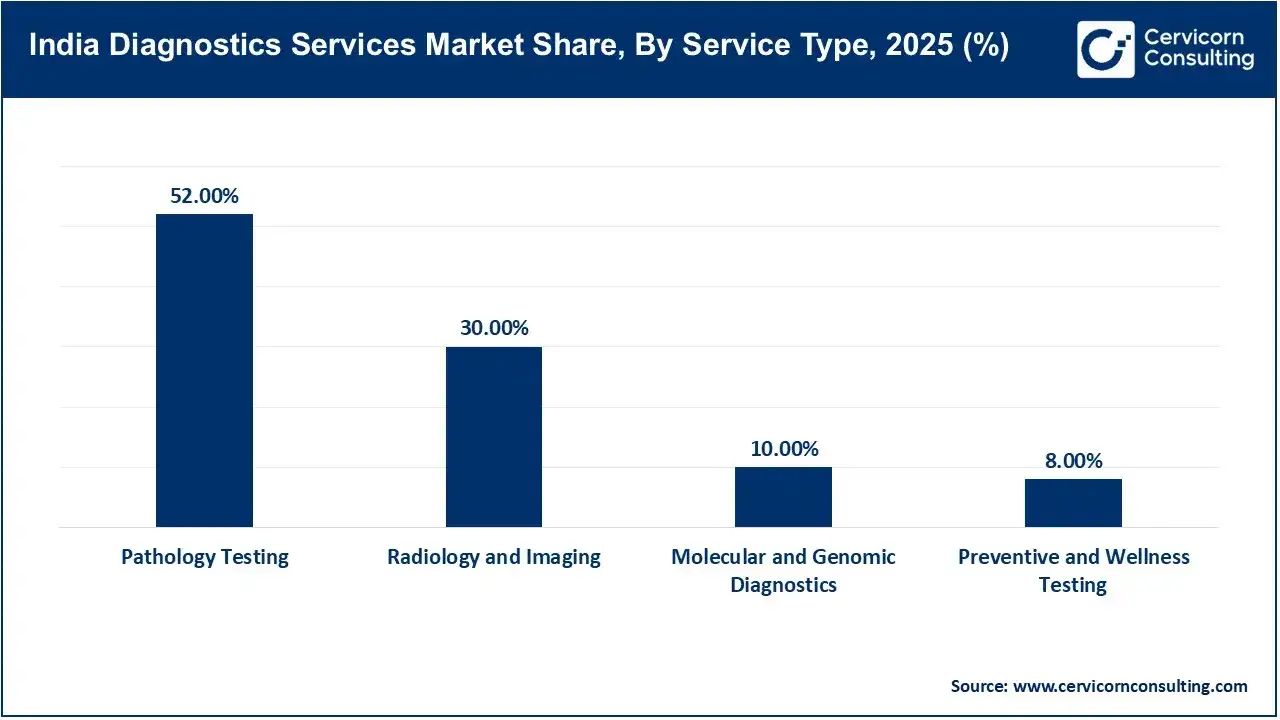
Molecular and Genomic Diagnostics: The molecular and genomic diagnostics segment is forecasted to witness rapid expansion during 2026-2035, mainly led by accelerating demand for tailored medicine, genetic testing, and advanced disease detection. A well-recognized growth in cancer and rare blood disorders instances forces care that combines DNA and RNA sequencing to guide targeted therapies and immunotherapies.
Test Type Analysis
Clinical Chemistry: The clinical chemistry segment accounted for the largest share of the India diagnostics market in 2025, because of advancing routine health examinations and the surge in the diagnosis of diabetes, kidney disorders, and metabolic issues. The dominance is further driven by the presence of cost-effective, premium reagents and diagnostics equipment, with the progression of decentralized testing and feasible benchtop analysers, especially across primary care facilities and emergency care.
The immunology and serology segment is anticipated to grow at a lucrative rate in the coming years, powered by epidemiological advances, technological breakthroughs, and robust government health policies. Recently, scientists at IIT Roorkee executed an ultra-large, high-diversity single-domain antibody library to expedite the detection of targets in developing pathogens and autoimmune disorders.
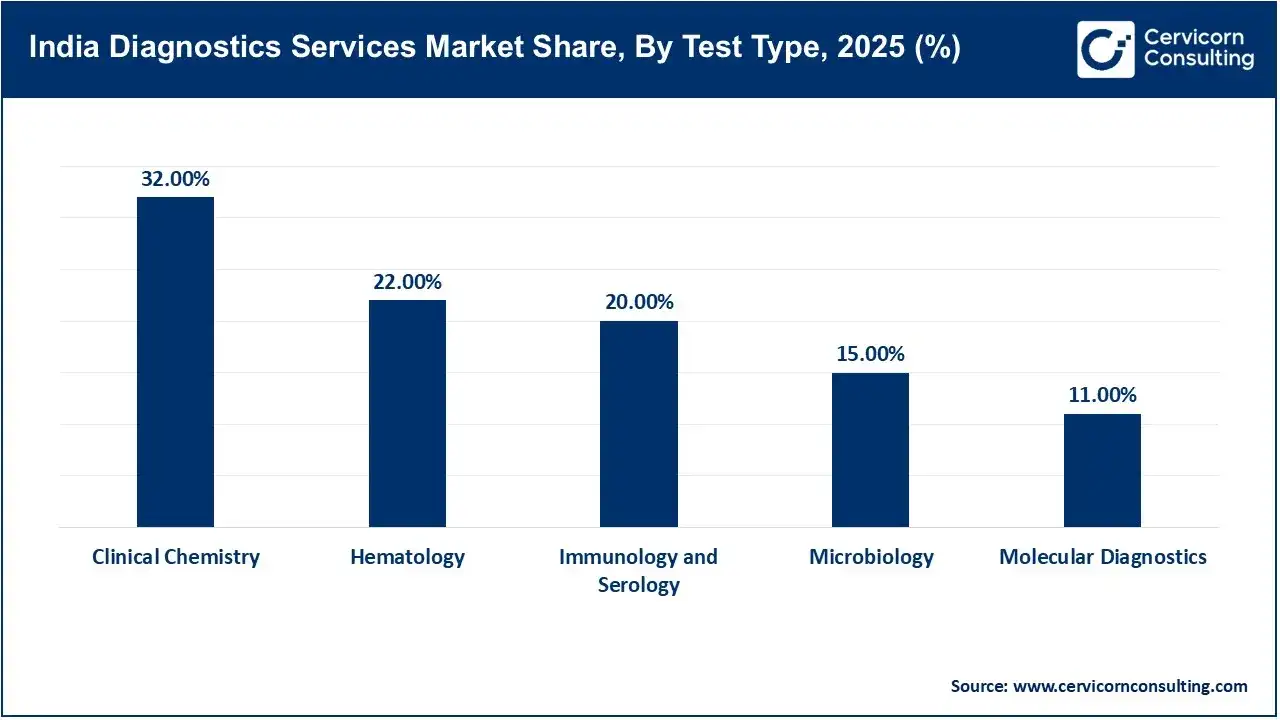
Molecular Diagnostics: The molecular diagnostics segment is expected to expand rapidly during 2026-2035, because of enhancements in genetic analysis, infectious disease detection, and precision medicine. As of now, India is broadly shifting towards domestic manufacturing of indigenous diagnostic and quality-control kits that consistently scale under the ‘Make in India’ approach, led by CDSCO and the Molecular Diagnostics Laboratory.
Application Analysis
Infectious Disease Diagnosis: The infectious disease diagnosis segment captured a major share of 28% in 2025, fueled by increased diversity in infections and persistent requirement of detection and monitoring of communicable diseases. According to ICMR, there were out of nearly 4.5 lakh patients, approximately 11.1% were found positive on tests for active pathogens. India has over 2 million new TB cases per year, resulting in advances in AI-enabled sputum analysis paired with telemedicine, with 95% sensitivity for TB detection.
Among several diagnostic test types, the diabetes and metabolic disorder monitoring segment is considered to grow steadily because of massive growth in lipid and cholesterol abnormalities. According to Lancet studies, India is projected to have nearly 98 million patients with type-2 diabetes by 2030. The particular use of real-time CGM devices is moving towards core metabolic health, pre-diabetes tracking, and non-diabetic wellness monitoring.
India Diagnostics Services Market Share, By Application, 2025 (%)
| Application |
Revenue Share, 2025 (%) |
| Infectious Disease Diagnosis |
28% |
| Diabetes and Metabolic Disorder Monitoring |
24% |
| Cardiovascular Disease Diagnosis |
15% |
| Oncology Diagnostics |
12% |
| Preventive Health Screening |
21% |
Oncology Diagnostics: The oncology diagnostics segment is expected to be the fastest-growing in the upcoming years, propelled by rising cancer screening, early-detection initiatives, and demand for modern diagnostic technology. However, India’s Department of Health Research (DHR) is reinforcing regional DIAMOnDS oncopathology labs to verify high-precision diagnostic and prognostic testing, prominently for lung and breast cancer.
Service Provider Analysis
Independent Diagnostic Laboratories: The independent diagnostic laboratories segment dominated with an 35% share of the India diagnostics services market in 2025, due to a well-isolated diagnostics area and a hub of standalone facilities. Along with consolidations, they are promoting upgradation in molecular diagnostics, oncology, rare disease testing, and pharmacogenomics to rival reference labs.
The specialized diagnostic centers segment is projected to grow at a lucrative rate during the forecasted period, driven by widespread adoption of technological advances, like unified AI with imaging hardware for chest X-ray screening, stroke triage, and breast cancer detection. Especially, Mahajan Imaging & Labs and Neuberg Diagnostics collaborated to develop a connected diagnostic setting for radiology, nuclear medicine, pathology, and genomics across seven North Indian states.
India Diagnostics Services Market Share, By Service Provider, 2025 (%)
| Service Provider |
Revenue Share, 2025 (%) |
| Independent Diagnostic Laboratories |
35% |
| Organized Diagnostic Chains |
28% |
| Hospital-Based Laboratories |
30% |
| Specialized Diagnostic Centers |
7% |
Organized Diagnostic Chains: The organized diagnostic chains segment is estimated to witness rapid expansion in the market, driven by ongoing alliances, progression of standardized testing, and investments in advanced laboratory infrastructure. Several leading chains are seeking hub-and-spoke laboratory models and franchise collection setups in non-urban and smaller tier-2/tier-3 cities.
Key Players
- October 2026: Thyrocare Technologies Limited introduced its new diagnostic laboratory in Madurai, Tamil Nadu, to empower access to explore quality and cost-effectiveness across the area.
- September 2026: The Viral Research and Diagnosis Laboratories (VRDL) Scheme, with up to Rs. 1.55 crore in non-recurring financial assistance, appealed to medical colleges, hospitals, and research institutions in India to pioneer Medical College & Research Institute Level Viral Research and Diagnosis Laboratories (MCL-VRDLs).
- August 2026: Tata Capital Healthcare Fund III invested nearly $30 million in a funding round in Tenet Diagnostics, a rapidly expanding unified diagnostics platform to cover growing demand for quality diagnostic services across India.
- May 2026: Credent Connect N Care unveiled India's first IoT solution for diagnostic logistics to deliver uniform, simultaneous real-time temperature monitoring and GPS shipment tracking.
Segments Covered
By Service Type
- Pathology Testing
- Radiology and Imaging
- Molecular and Genomic Diagnostics
- Preventive and Wellness Testing
By Test Type
- Clinical Chemistry
- Hematology
- Immunology and Serology
- Microbiology
- Molecular Diagnostics
By Application
- Infectious Disease Diagnosis
- Diabetes and Metabolic Disorder Monitoring
- Cardiovascular Disease Diagnosis
- Oncology Diagnostics
- Preventive Health Screening
By Service Provider
- Independent Diagnostic Laboratories
- Organized Diagnostic Chains
- Hospital-Based Laboratories
- Specialized Diagnostic Centers
