Hybrid Mesh Firewall Market Size and Growth Factors
The global hybrid mesh firewall market size reached USD 16.24 billion in 2025 and is expected to reach around USD 40.19 billion by 2035, exhibiting a compound annual growth rate (CAGR) of 9.5% over the forecast period 2026 to 2035.
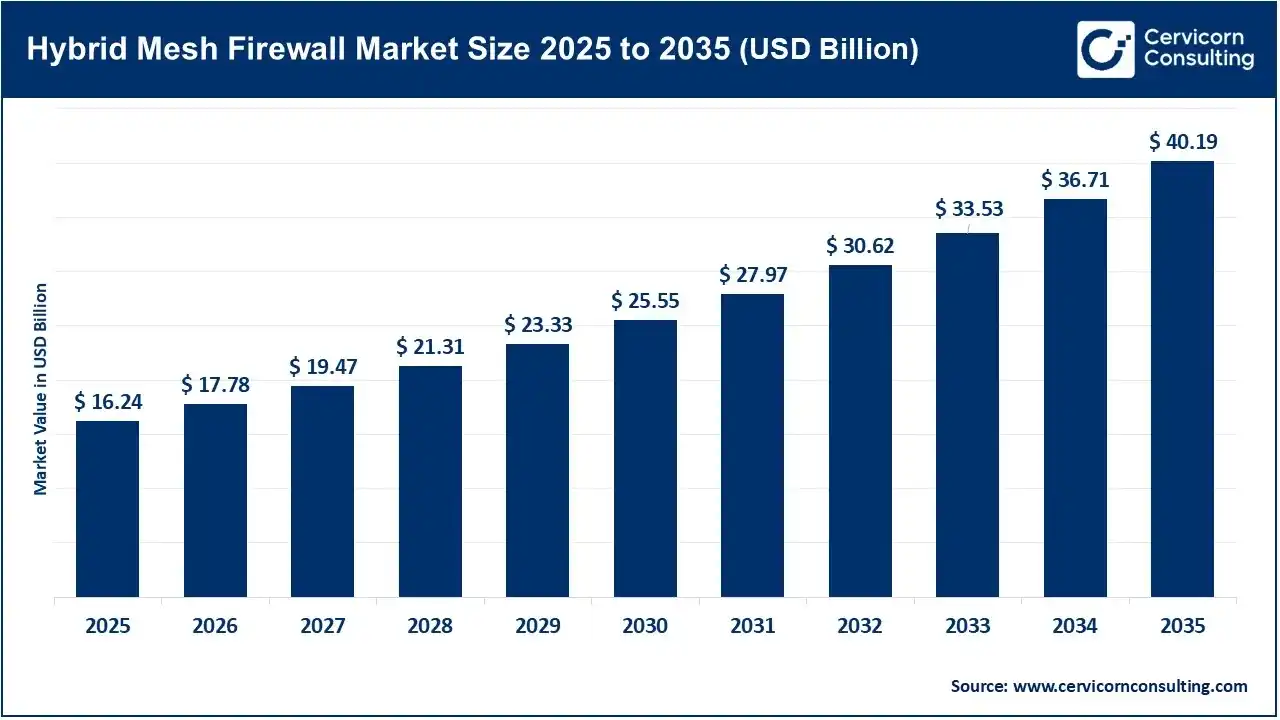
The expansion of hybrid and multi-cloud infrastructures is a major driver of the hybrid mesh firewall market, as organizations increasingly need consistent security policies across on-premises data centers, public clouds, private clouds, branches, and remote users. Gartner states that hybrid mesh firewalls provide unified cloud-based management across hardware, virtual, and cloud deployments, addressing the growing complexity of distributed networks. The increasing security burden of hybrid work is also supporting adoption; 51% of surveyed organizations identified protecting hybrid workforces as a key security challenge, while 47% reported concerns regarding cloud vulnerabilities. Additionally, Check Point's 2025 Cloud Security Report found that 65% of organizations experienced a cloud-security incident during the preceding year, highlighting the need for security controls that operate consistently across fragmented environments.
The adoption of Zero Trust, micro segmentation, AI workloads, and centralized security management is further accelerating HMF deployment. Enterprises increasingly require unified policy enforcement and visibility across north-south and east-west traffic, particularly as AI infrastructure creates more interconnected workloads and data flows. Dell’Oro reported in 2026 that enterprises are increasingly adopting micro segmentation to contain lateral movement within hybrid-cloud and private-AI environments, with micro segmentation expected to expand at a 21% five-year CAGR through 2030; the research also identifies Hybrid Mesh Firewall platforms as complementary technologies for securing north-south traffic. Gartner similarly identifies centralized unified management and advanced automation as important factors driving migration toward HMF solutions. These developments, combined with growing demand for cloud-native security, automated threat prevention, and simplified management of distributed firewall infrastructure, are strengthening the market's growth prospects.
Report Highlights
- North America held the largest regional share at 36.8%, supported by mature enterprise cybersecurity infrastructure, hybrid-cloud adoption, and strong demand for centralized security management.
- Hardware Firewall dominated the deployment-type segment with an estimated 29.4% share, reflecting its extensive installed base across enterprise networks and data centers.
- Hybrid Cloud led the network-environment segment with approximately 27.8% share, supported by organizations operating simultaneously across on-premises and cloud infrastructure.
- Network Security accounted for the largest security-function share at approximately 24.7%, reflecting continued demand for traffic inspection, access control, and network protection.
- Large Enterprises dominated by organization size, representing approximately 68.4% of the market, due to complex distributed infrastructure, larger cybersecurity budgets, and extensive hybrid environments.
- IT & Telecommunications represented the leading industry vertical with approximately 22.6% share, supported by extensive network infrastructure, cloud workloads, and high connectivity requirements.
What is Hybrid Mesh Firewall?
A Hybrid Mesh Firewall (HMF) is a distributed network-security architecture that combines physical, virtual, cloud-native, and Firewall-as-a-Service (FWaaS) firewalls under a unified management and policy framework. Instead of relying on a single perimeter firewall, HMF extends consistent security controls across on-premises data centers, public and private clouds, branches, edge environments, and distributed workloads, enabling centralized policy enforcement, threat prevention, segmentation, and visibility across hybrid and multi-cloud infrastructures.
Recent Milestones
| Date |
Company |
Recent Milestone |
| September 2026 |
Palo Alto Networks |
Named a Leader in the 2026 Gartner Magic Quadrant for Hybrid Mesh Firewall for the second consecutive time, while expanding its platform toward AI runtime and quantum-safe security. |
| September 2026 |
Fortinet |
Recognized as a Leader in Gartner's 2026 Hybrid Mesh Firewall Magic Quadrant, with FortiGate spanning physical, virtual, cloud-native, and as-a-service deployments. |
| September 2026 |
Check Point |
Named a Leader in the 2026 Gartner Magic Quadrant for Hybrid Mesh Firewall following the launch of its AI Network Firewall. |
| June 2026 |
Check Point & Illumio |
Expanded their partnership to integrate Illumio Segmentation with Check Point's Hybrid Mesh Firewall capabilities for hybrid and multi-cloud environments. |
| March 2026 |
Gartner |
Published its Market Overview for Hybrid Mesh Firewall, highlighting growing demand for centralized unified management and advanced automation as hybrid networks expand. |
| June 2025 |
Cisco |
Expanded its Hybrid Mesh Firewall with Secure Firewall 6100/200 Series, additional enforcement points, expanded segmentation, and Mesh Policy Engine for multi-vendor policy management.Announced its position as a Leader |
| August 2025 |
Palo Alto Networks |
Announced its position as a Leader in the inaugural 2025 Gartner Magic Quadrant for Hybrid Mesh Firewalls, with Strata Cloud Manager providing unified management across multiple firewall form factors. |
Hybrid Mesh Firewall Market Dynamics
Market Drivers
1. Expansion of Hybrid and Multi-Cloud Infrastructure
The rapid adoption of hybrid and multi-cloud architectures is increasing demand for security platforms capable of enforcing consistent policies across distributed environments. A 2025 Cloud Security Alliance study found that 82% of organizations operate hybrid infrastructure, while 63% use more than one cloud provider, creating fragmented security environments that traditional perimeter firewalls struggle to manage. Hybrid mesh firewalls address this gap through centralized policy orchestration across physical, virtual, and cloud deployments, making them increasingly relevant as enterprises distribute applications and workloads across multiple environments.
2. Growing Adoption of Zero Trust and Microsegmentation
The shift toward Zero Trust and workload-level segmentation is strengthening demand for hybrid mesh firewall platforms. Dell’Oro reports that the microsegmentation market is expected to expand at a 21% five-year CAGR through 2030, driven partly by the need to contain lateral movement across hybrid-cloud and private-AI infrastructures. Hybrid mesh firewalls complement microsegmentation by controlling north-south traffic while coordinated segmentation addresses east-west traffic, creating broader security coverage for distributed workloads, users, applications, and AI infrastructure.
Market Restraints
1. Integration Complexity and Security Tool Sprawl
Integration with existing security infrastructure remains a major restraint because enterprises frequently operate heterogeneous combinations of legacy firewalls, cloud-native controls, identity platforms, and security tools. A 2025 Cloud Security Alliance survey found that only 13% of organizations prioritize tool consolidation, while 59% identify insecure identities and risky permissions as their leading cloud-security risk. Connecting different enforcement points and management systems can require extensive configuration, migration work, and interoperability testing, increasing deployment complexity and potentially delaying HMF adoption.
2. Shortage of Specialized Cybersecurity Expertise
Limited availability of professionals capable of managing distributed cloud, network, Zero Trust, and firewall environments can restrict HMF deployment, particularly for organizations with smaller security teams. The Cloud Security Alliance's 2025 research identified lack of expertise as the top challenge to securing cloud infrastructure. Hybrid mesh environments require skills spanning network security, cloud architecture, identity management, automation, and policy orchestration, increasing the operational burden for organizations that lack specialized personnel and potentially encouraging them to delay complex deployments or rely on managed security services.
Market Opportunities
1. AI Workload and Agentic Infrastructure Security
The rapid deployment of AI workloads creates an emerging opportunity for hybrid mesh firewall vendors to secure new traffic patterns, workloads, APIs, and autonomous agents across distributed environments. The 2025 Cloud Security Alliance study found that more than half of organizations were deploying AI, while 34% of organizations with AI workloads had already experienced an AI-related breach. HMF platforms can capitalize on this environment by integrating AI-aware inspection, automated policy enforcement, segmentation, and centralized visibility across AI infrastructure and conventional enterprise networks.
2. Unified Management and Security Consolidation
The demand to reduce fragmented security operations creates an opportunity for vendors that can consolidate multiple firewall form factors and enforcement points through a single management plane. Gartner's 2026 market overview identifies centralized unified management and advanced automation as important factors behind customer migration toward HMF solutions. Meanwhile, an Aviatrix 2025 survey found that 81% of respondents expected multi-cloud networking capabilities to simplify or accelerate hybrid/multicloud adoption. This supports opportunities for HMF platforms that combine centralized policy management, automation, cloud integration, and security visibility.
Market Challenges
1. Securing Encrypted and High-Volume Traffic Without Performance Loss
Increasing encryption and traffic volumes create a technical challenge for HMF platforms because security inspection must occur without introducing significant latency or reducing application performance. Cisco's 2026 firewalling research highlights the continuing need for firewalls to inspect encrypted traffic without slowing business operations, while AI introduces additional workloads and traffic patterns that require visibility and control. Vendors therefore face pressure to improve processing efficiency, hardware acceleration, cloud scalability, and intelligent inspection while maintaining consistent protection across geographically distributed environments.
2. Maintaining Consistent Policies Across Diverse Environments
Ensuring consistent security policies across data centers, branches, cloud platforms, virtual machines, containers, and third-party security controls remains a significant challenge. Gartner notes that HMF solutions are designed to provide unified cloud-based management across hardware, virtual, and cloud deployments, but heterogeneous environments can still create interoperability and policy-mapping issues. The challenge becomes more complex when organizations use multiple cloud providers and legacy infrastructure simultaneously, requiring vendors to support diverse APIs, enforcement mechanisms, identity systems, and automation workflows without creating additional operational complexity.
Hybrid Mesh Firewall Market Regional Analysis
North America Hybrid Mesh Firewall Market: Driven by Hybrid-Cloud Expansion, Multicloud Adoption, Cybersecurity Modernization, Zero Trust, and Centralized Security Management
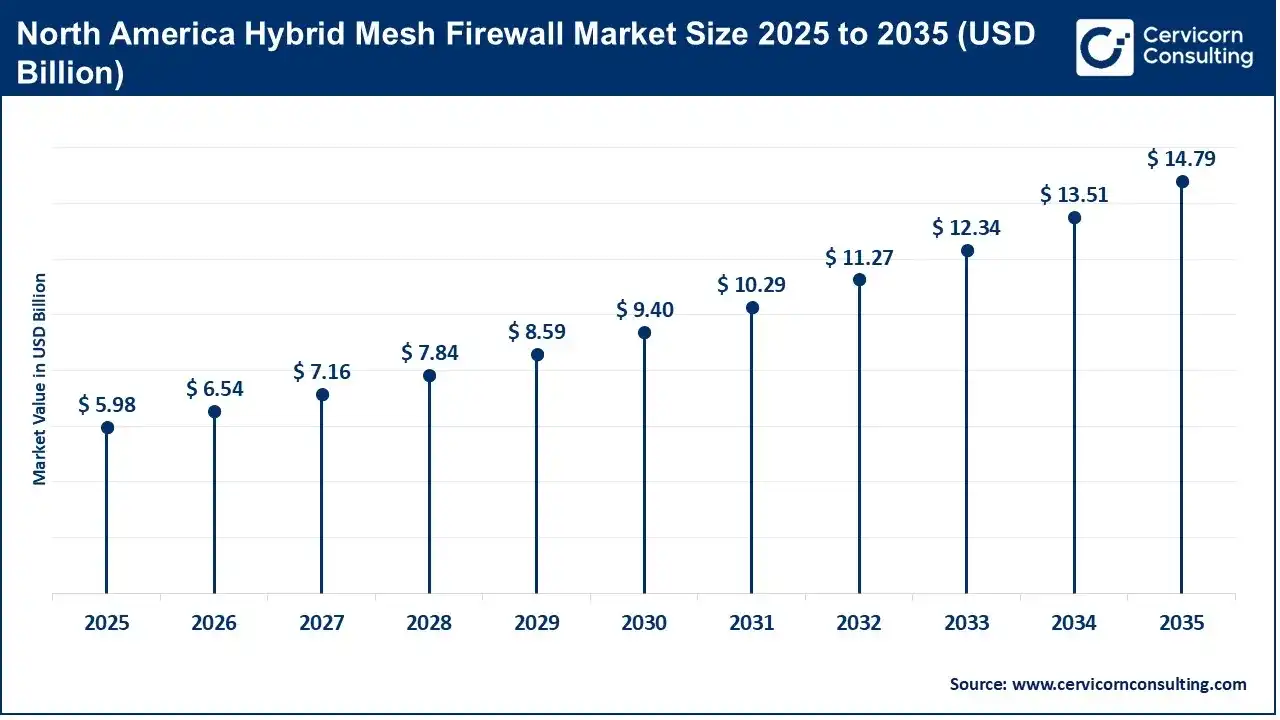
The North America hybrid mesh firewall market size was valued at USD 5.98 billion in 2025 and is expected to hit around USD 14.79 billion by 2035. North America is a highly developed and technologically mature market, supported by extensive cloud adoption, large enterprise IT infrastructures, cybersecurity investments, and the rapid expansion of hybrid and multicloud architectures. The region has a strong concentration of organizations operating distributed data centers, branch networks, cloud workloads, and remote-access environments, creating demand for unified security controls across multiple enforcement points. Gartner identifies centralized management, multicloud support, distributed enforcement, orchestration, and advanced threat detection as key capabilities of HMF platforms. The United States represents the principal demand center, while Canada is also expanding cybersecurity and cloud-security investments.
United States: Hybrid-Cloud Adoption, Multicloud Infrastructure, AI Workloads, and Enterprise Security Modernization Drive Market Demand
- The United States remains the primary North American market because enterprises increasingly operate hybrid and multicloud infrastructures, creating demand for centralized firewall management across physical, virtual, and cloud environments.
- Gartner's 2026 HMF research emphasizes that hybrid mesh firewalls provide centralized cloud management across hardware, virtual, and cloud-native deployments, directly addressing the security requirements of distributed U.S. enterprise environments.
- Globally, 82% of organizations maintain some form of hybrid infrastructure and 63% use more than one cloud provider, indicating the infrastructure complexity that North American enterprises must increasingly secure.
Canada: Cloud Adoption, Cybersecurity Upgrades, Digital Infrastructure Expansion, and Rising Cyber Threats Support Market Growth
- Canada's cloud adoption reached 48.5% of enterprises in 2023, creating an expanding installed base of cloud-connected infrastructure requiring stronger distributed network-security controls.
- In Q2 2025, 19.8% of Canadian businesses and organizations planned new or additional cybersecurity actions during the following 12 months, demonstrating continued investment in cybersecurity modernization.
Asia-Pacific (APAC) Hybrid Mesh Firewall Market: Driven by Rapid Cloud Adoption, Digital Transformation, Multicloud Expansion, Zero Trust, and Intensifying Cybersecurity Requirements
The Asia-Pacific hybrid mesh firewall market size was estimated at USD 3.80 billion in 2025 and is projected to grow around USD 9.40 billion by 2035. Asia-Pacific is a rapidly developing market, supported by accelerated digital transformation, expanding cloud infrastructure, growing AI adoption, and increasing cybersecurity requirements across enterprises and governments. Organizations across China, India, Japan, South Korea, Singapore, and Australia are increasingly operating distributed IT environments that combine on-premises infrastructure, private clouds, public clouds, branches, and edge locations. IDC estimates that enterprises in Asia-Pacific will invest USD 44.4 billion in cybersecurity in 2025, with spending expected to reach USD 60.6 billion by 2028, highlighting the region's increasing security investment. Cloud adoption is particularly important because hybrid architectures require consistent policy enforcement and visibility across multiple environments.
China: Large Digital Infrastructure, Cloud Expansion, Regulatory Requirements, and Enterprise Security Modernization Drive Market Demand
- China represents one of the region's largest cybersecurity markets, supported by extensive enterprise digitization, large-scale cloud infrastructure, telecommunications networks, and government-led digital transformation.
- The country's cybersecurity environment is increasingly influenced by data-security and data-sovereignty requirements, encouraging organizations to strengthen locally controlled security infrastructure and centralized security management.
India: Rapid Cloud Adoption, Digitalization, AI Expansion, and Rising Cybersecurity Investment Support Market Growth
India's information-security spending is forecast to reach USD 3.34 billion in 2025, representing 16.4% growth from the previous year, with network-security spending reaching USD 448 million.
Public-cloud spending in India is forecast to increase 28.1% in 2026, reaching USD 17.5 billion, driven by AI-ready infrastructure, application modernization, digital sovereignty, and consumption-based IT models.
Europe Hybrid Mesh Firewall Market: Driven by Cloud Adoption, NIS2 Compliance, Zero Trust Security, Cybersecurity Investment, and Distributed Enterprise Infrastructure
The Europe hybrid mesh firewall market size was accounted for USD 4.40 billion in 2025 and is forecasted to surpass around USD 10.89 billion by 2035. Europe represents a significant and increasingly security-focused market, supported by accelerating cloud adoption, stricter cybersecurity regulation, digital transformation, and the growing complexity of enterprise IT environments. In 2025, 52.7% of EU enterprises used paid cloud services, up 7.4 percentage points from 2023, while 65.5% of those enterprises used security software. European organizations are also increasing cybersecurity investment: ENISA reported that information security represented 9% of IT budgets, with median cybersecurity spending reaching EUR 1.5 million in its 2025 study. The implementation of NIS2, DORA, and other cybersecurity frameworks is further encouraging organizations to strengthen centralized security, segmentation, threat prevention, and distributed network protection.
Germany: Industrial Digitalization, Cloud Transformation, Critical Infrastructure Protection, and NIS2 Compliance Drive Market Demand
- Germany remains one of Europe's major cybersecurity and enterprise-technology markets, supported by its large manufacturing, automotive, financial-services, telecommunications, and critical-infrastructure sectors.
- Germany's enterprises are increasingly adopting cloud-based infrastructure, creating demand for security architectures capable of protecting workloads distributed between traditional data centers and cloud environments.
United Kingdom: Cybersecurity Investment, Cloud Adoption, Public-Sector Modernization, and Critical Infrastructure Protection Support HMF Demand
- The UK has a mature cybersecurity ecosystem and continues to increase investment in network, cloud, and infrastructure protection as enterprises modernize distributed IT environments.
- UK public procurement of cybersecurity products and services reached 967 contracts worth GBP 1.507 billion in 2025, representing a 62% increase in contract value compared with 2024.
Hybrid Mesh Firewall Market Share, By Region, 2025 (%)
| Region |
Revenue Share, 2025 (%) |
| North America |
36.8% |
| Europe |
27.1% |
| Asia-Pacific |
23.4% |
| LAMEA |
12.7% |
LAMEA (Latin America, Middle East & Africa) Hybrid Mesh Firewall Market: Driven by Cloud Transformation, Cybersecurity Modernization, Digital Infrastructure Investment, Regulatory Requirements, and Distributed IT Environments
The LAMEA hybrid mesh firewall market was valued at USD 2.06 billion in 2025 and is anticipated to reach around USD 5.10 billion by 2035. LAMEA is an emerging and increasingly important market, supported by accelerating cloud adoption, digital transformation, cybersecurity modernization, and expansion of distributed enterprise infrastructure. The Middle East is particularly active, with governments and enterprises investing heavily in cloud computing, AI, critical infrastructure, and digital services, while Latin America and Africa are progressing toward more mature hybrid and cloud-based environments. Gartner projects MENA information-security spending to increase 14% in 2025, with security software accounting for nearly 45% of total spending, highlighting strong demand for software-defined and cloud-integrated security.
Middle East: Cloud Transformation, National Digitalization, AI Investment, and Critical Infrastructure Protection Drive HMF Demand
- Saudi Arabia is a major regional cybersecurity market, with cybersecurity spending reaching SAR 15.2 billion in 2024, increasing 14% year over year. Private-sector organizations accounted for 68% of spending, demonstrating broad enterprise demand for security solutions.
- Saudi government spending on cloud computing increased 42% in 2025, while spending on AI and emerging technologies increased 20%, creating additional security requirements across distributed digital infrastructure.
- In Saudi Arabia, 89% of surveyed organizations prioritize cybersecurity investment, while 77% prioritize XaaS and cloud-based platforms, supporting demand for centralized security architectures across hybrid environments.
Latin America: Cloud Adoption, Digital Transformation, Financial Services Modernization, and Cybersecurity Investment Support Market Development
- Brazil represents an important LAMEA security market because of its large financial-services, telecommunications, retail, manufacturing, and government technology ecosystems.
- The increasing migration of enterprise workloads toward cloud and hybrid infrastructure is creating demand for security platforms capable of protecting distributed applications and network environments.
Hybrid Mesh Firewall Market Segmental Analysis
Deployment Type Analysis
Hardware firewalls are expected to remain the dominating deployment segment because enterprises continue to operate established data centers, branch networks, and high-throughput network environments requiring dedicated security appliances. Physical firewalls provide predictable performance, centralized perimeter control, and specialized processing for intensive inspection workloads. Their established presence within enterprise infrastructure also supports continued integration into hybrid mesh architectures, where physical enforcement points operate alongside virtual and cloud-based security controls rather than being immediately replaced.
Hybrid Mesh Firewall Market Share, By Deployment Type, 2025 (%)
| Deployment Type |
Revenue Share, 2025 (%) |
| Hardware Firewall |
29.4% |
| Virtual Firewall |
19.7% |
| Cloud-Native Firewall |
18.6% |
| Firewall-as-a-Service (FWaaS) |
14.8% |
| Containerized Firewall |
7.1% |
| Agent-Based Firewall / Microsegmentation |
10.4% |
Cloud-native firewalls are expected to be the fastest-growing deployment segment as enterprises increasingly move applications, workloads, APIs, and databases into cloud environments. These firewalls can be deployed closer to cloud workloads and dynamically adapt to changing infrastructure requirements. Their ability to integrate with cloud-native networking, automation, orchestration, and identity controls makes them particularly relevant to distributed architectures. Increasing multi-cloud adoption further supports demand for flexible cloud-native enforcement points that can maintain consistent security policies across changing environments.
Network Environment Analysis
Hybrid cloud is expected to remain the dominating network environment because many organizations continue operating a combination of on-premises infrastructure and cloud workloads. Hybrid architectures require consistent security policies across different infrastructure types, making centralized firewall management increasingly important. HMF architectures can connect traditional network-security controls with cloud-based enforcement while providing visibility across distributed environments. The continued modernization of legacy infrastructure without complete migration to cloud environments is expected to sustain strong demand for hybrid-cloud firewall capabilities.
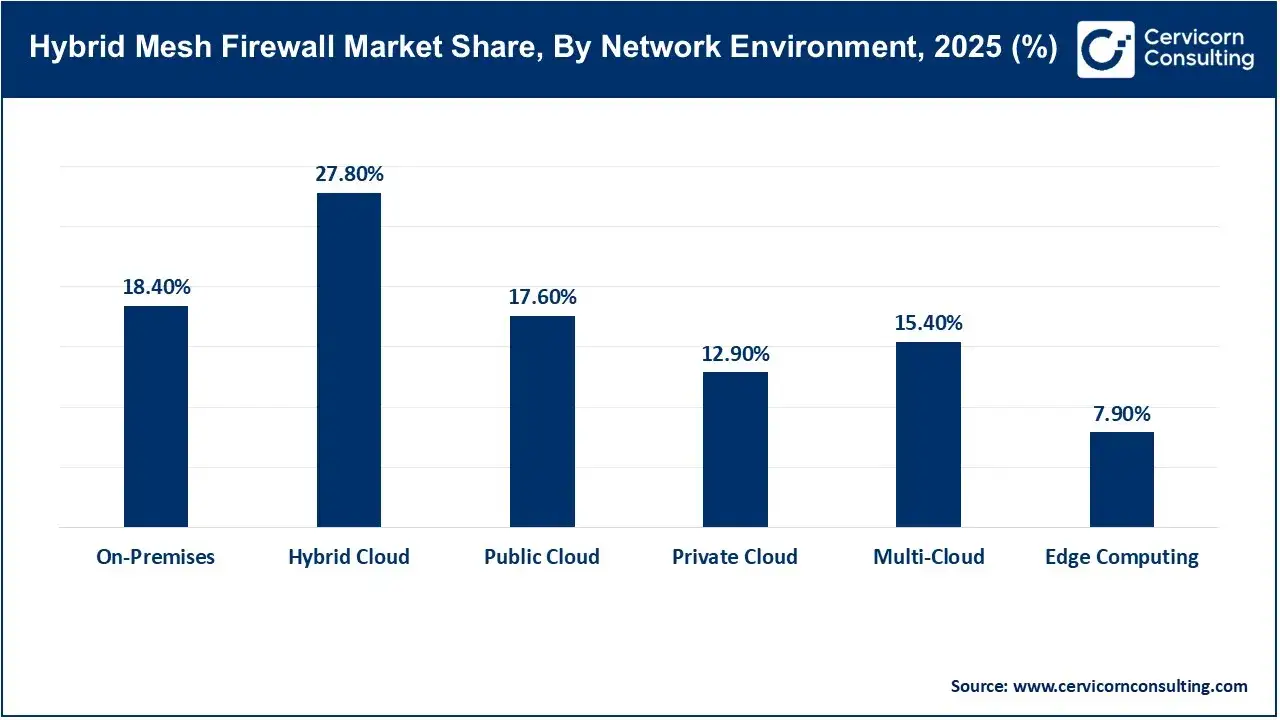
Multi-cloud is expected to be the fastest-growing network environment as organizations increasingly distribute applications and workloads across multiple cloud platforms to support flexibility, resilience, scalability, and specialized services. This creates challenges around policy consistency, traffic visibility, identity controls, and security monitoring. Hybrid mesh firewall architectures can provide a unified security layer across different cloud environments, reducing fragmented enforcement. Growing cloud workload distribution and increasing requirements for centralized governance are expected to accelerate multi-cloud HMF adoption.
Security Function Analysis
Network security is expected to remain the dominating security function because traffic inspection, access control, segmentation, application identification, and perimeter protection continue to represent fundamental firewall requirements. Organizations deploying hybrid mesh architectures still require protection for conventional network traffic alongside cloud and distributed workloads. Network security capabilities also provide the foundation for integrating additional functions such as threat prevention, encrypted traffic inspection, application controls, and segmentation, making this segment central to comprehensive security architectures.
Hybrid Mesh Firewall Market, By Security Function, 2025 (%)
| Security Function |
Revenue Share, 2025 (%) |
| Network Security |
24.7% |
| Application Security |
12.8% |
| Threat Prevention |
17.3% |
| Intrusion Prevention |
10.9% |
| SSL/TLS Inspection |
8.6% |
| Zero Trust Network Access |
8.1% |
| Network & Microsegmentation |
13.9% |
| Others |
3.7% |
Network and microsegmentation is expected to be the fastest-growing security-function segment as organizations increasingly seek to control east-west traffic and limit lateral movement between workloads. Traditional perimeter protection is insufficient when applications, users, workloads, and services operate across distributed environments. Microsegmentation enables organizations to establish granular security policies around workloads and network zones. Its increasing relevance to Zero Trust architectures, hybrid-cloud infrastructure, and emerging AI environments is expected to support strong adoption within HMF deployments.
Organization Size Analysis
Large enterprises are expected to dominate the market because they typically operate complex combinations of data centers, branches, private infrastructure, public clouds, remote users, and distributed applications. Such organizations require centralized policy management and security visibility across numerous enforcement points. Their larger cybersecurity budgets and more complex compliance requirements also support investment in advanced firewall architectures. The need to consolidate security management while maintaining protection across geographically dispersed infrastructure makes large enterprises an important customer base for hybrid mesh firewall solutions.
Hybrid Mesh Firewall Market, By Organization Size, 2025 (%)
| Organization Size |
Revenue Share, 2025 (%) |
| Small and Medium-Sized Enterprises (SMEs) |
31.6% |
| Large Enterprises |
68.4% |
SMEs are expected to represent the fastest-growing organization-size segment as cloud-delivered security reduces the infrastructure and operational requirements associated with traditional firewall deployments. Subscription-based security services and centralized management can provide smaller organizations with advanced protection without requiring large dedicated security teams. Increasing digitalization, remote connectivity, cloud adoption, and exposure to cyber threats are encouraging SMEs to strengthen network security. The ability to deploy scalable security capabilities without substantial hardware investment further supports their adoption of HMF solutions.
Industry Vertical Analysis
IT and telecommunications is expected to remain the dominating industry vertical because these organizations operate extensive network infrastructure, cloud environments, data centers, applications, and highly distributed connectivity. Their business models depend heavily on network availability and secure data transmission, creating substantial requirements for continuous traffic inspection and centralized security management. Increasing workload distribution and infrastructure complexity further increase the need to coordinate security controls across physical, virtual, cloud, and edge environments, supporting sustained HMF adoption across the sector.
Hybrid Mesh Firewall Market, By Industry Vertical, 2025 (%)
| Industry Vertical |
Revenue Share, 2025 (%) |
| BFSI |
15.8% |
| IT & Telecommunications |
22.6% |
| Healthcare |
10.7% |
| Government & Defense |
10.4% |
| Retail & E-commerce |
9.3% |
| Manufacturing |
10.8% |
| Energy & Utilities |
7.1% |
| Transportation & Logistics |
5.6% |
| Others |
7.7% |
BFSI is expected to be the fastest-growing industry vertical because financial institutions are rapidly expanding digital banking, cloud applications, APIs, online payment services, and distributed technology environments. These developments increase the number of interconnected systems requiring granular access controls and continuous monitoring. Strict regulatory requirements and the sensitivity of financial information further encourage investment in advanced network-security architectures. Hybrid mesh firewalls can support centralized policy enforcement across legacy systems, cloud workloads, branches, and digital services, making them increasingly relevant to modern financial infrastructure.
Top Companies
Segments Covered
By Deployment Type
- Hardware Firewall
- Virtual Firewall
- Cloud-Native Firewall
- Firewall-as-a-Service (FWaaS)
- Containerized Firewall
- Agent-Based Firewall / Microsegmentation
By Network Environment
- On-Premises
- Hybrid Cloud
- Public Cloud
- Private Cloud
- Multi-Cloud
- Edge Computing
By Security Function
- Network Security
- Application Security
- Threat Prevention
- Intrusion Prevention
- SSL/TLS Inspection
- Zero Trust Network Access
- Network & Microsegmentation
- Others
By Organization Size
- Small and Medium-Sized Enterprises (SMEs)
- Large Enterprises
By Industry Vertical
- BFSI
- IT & Telecommunications
- Healthcare
- Government & Defense
- Retail & E-commerce
- Manufacturing
- Energy & Utilities
- Transportation & Logistics
- Others
By Geography
- North America
- Europe
- Asia-Pacific
- LAMEA