Humanoid Robot Battery Market Size and Growth 2026 to 2035
The global humanoid robot battery market size was valued at USD 15.20 million in 2025 and is projected to grow from USD 26.18 million in 2026 to nearly USD 3,355.33 million by 2035, registering a CAGR of 71.5% over the forecast period 2026 to 2035. The market is growing due to rising demand for advanced robotics, automation, and high-performance battery technologies.
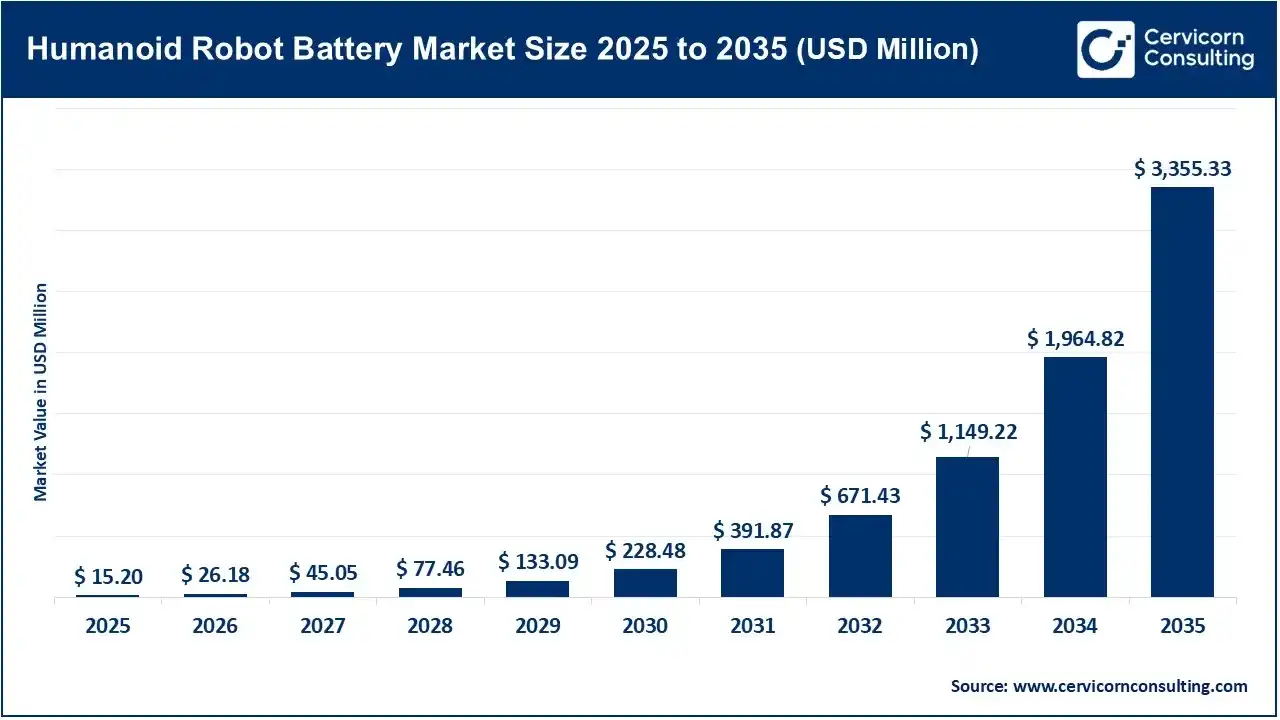
With the growing use of humanoid robots in manufacturing, logistics, healthcare, and service applications, the market for humanoid robot batteries is growing. Batteries that offer high energy density, lightweight construction, high power output, extended runtime, quick charging, and safety in confined spaces are necessary for these robots. Advanced lithium-ion battery and all-solid-state batteries are among the specialized battery technologies that are in high demand due to the increasing development of AI-powered and physically intelligent robots.
On 24 June 2026, CATL announced a strategic cooperation with Galbot, with the Galbot S1 humanoid robot becoming the first heavy-duty humanoid robot operating in regular production powered by CATL batteries. CATL stated that the robot can support up to eight hours of continuous operation and has been deployed on its intelligent production lines for material handling and picking tasks.
Report Highlights
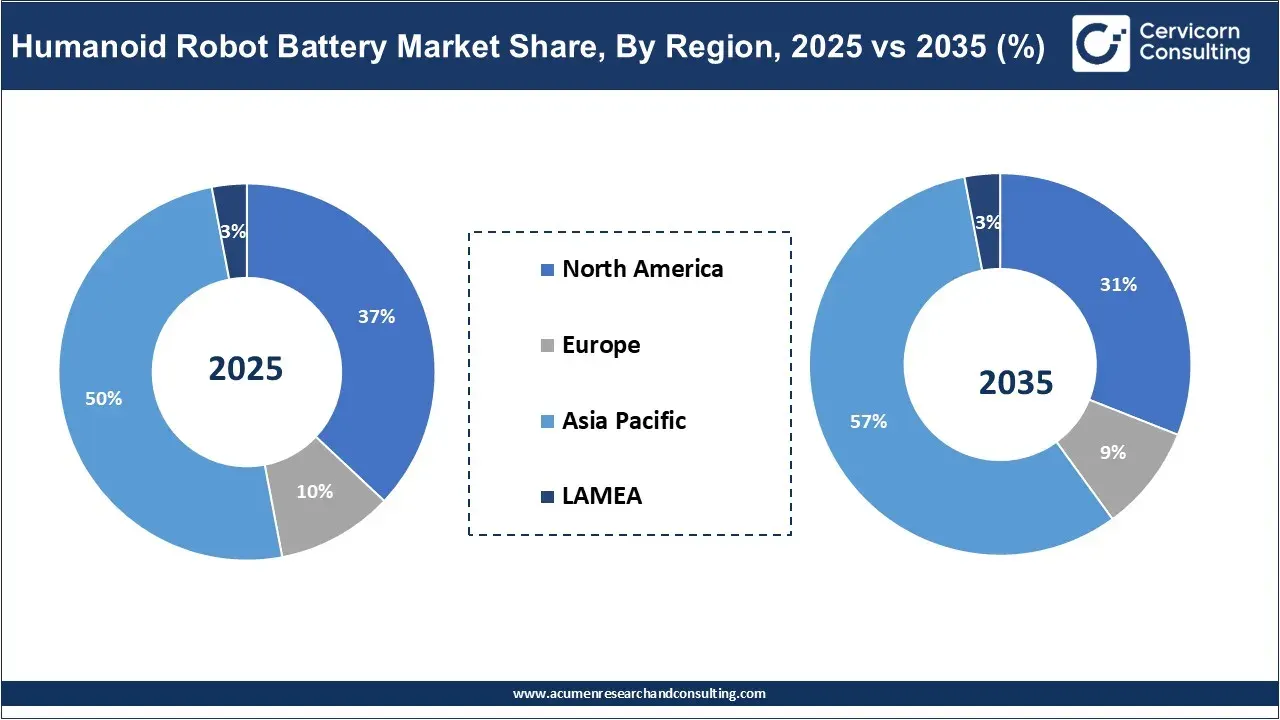
- By region, Asia-Pacific dominated with a 50% market share in 2025 and is projected to reach 57% by 2035, supported by strong battery manufacturing, robotics development, factory automation, and established electronics supply chains.
- By region, North America was the second-largest regional segment with a 37% market share in 2025, driven by investments in humanoid robotics, artificial intelligence, industrial automation, and advanced robotic systems.
- By battery, high-nickel NMC/NCA dominated with a 72% market share in 2025, supported by high energy density, strong power output, established manufacturing infrastructure, and compatibility with compact humanoid robot battery systems.
- By battery, solid-state/semi-solid-state batteries are projected to increase from 5% in 2025 to 30% by 2035, driven by demand for higher energy density, improved safety, lightweight designs, and longer operating durations.
- By cell form factor, cylindrical cells dominated with a 42% market share in 2025, benefiting from standardized designs, mechanical durability, scalability, and mature production infrastructure.
- By cell form factor, pouch cells ranked second with a 38% market share in 2025, supported by their lightweight construction, flexible packaging, and efficient use of constrained space within humanoid robots.
- By battery capacity, the 1–2.5 kWh segment dominated with a 58% market share in 2025, reflecting its balance between operating time, battery weight, portability, and energy requirements across humanoid robot applications.
- By battery capacity, the 2.5–5 kWh segment is projected to increase from 24% in 2025 to 38% by 2035, driven by demand for longer operating cycles and higher power capabilities in industrial and logistics applications.
- By battery components, battery cells dominated with a 68% market share in 2025, as cell chemistry and design directly influence energy density, power output, runtime, charging efficiency, and overall robot performance.
- By battery components, battery management systems held the second-largest share at 12% in 2025, supported by increasing requirements for real-time monitoring, temperature control, charging optimization, and battery safety.
- By application, industrial/manufacturing dominated with a 42% market share in 2025, driven by increasing humanoid robot use for material handling, picking, assembly, inspection, and other repetitive industrial tasks.
- By application, logistics & warehousing held the second-largest share at 28% in 2025, supported by growing automation of material movement, picking, sorting, and warehouse operations requiring longer robotic operating cycles.
Recent Trends
- High-energy-density batteries: Battery manufacturers are focusing on high-energy-density solutions to provide longer runtime while maintaining a lightweight design.
- Fast-charging technology: Growing demand for continuous robot operation is encouraging the development of batteries with faster charging capabilities.
- Lightweight battery designs: Manufacturers are developing compact and lightweight battery systems to improve humanoid robot mobility, balance, and efficiency.
- Solid-state battery development: Advancements in solid-state batteries are gaining attention due to their potential to offer higher energy density, improved safety, and longer battery life.
- Battery thermal management: Efficient thermal management is becoming increasingly important to maintain battery performance and safety during intensive robotic operations.
- Longer operational cycles: Humanoid robot developers are seeking battery solutions that can support extended working periods across industrial and commercial applications.
- Smart battery management: Integration of advanced battery management systems is enabling better monitoring of battery health, charging, temperature, and overall performance.
Market Dynamics
Key Driver
Rising Adoption of Humanoid Robots
The demand for advanced battery solutions is being driven by the increasing use of humanoid robots in a variety of industries, including manufacturing, logistics, healthcare, retail, and hospitality. Batteries with high energy density, extended operating time, quick charging, and dependable power output are becoming more necessary as robots are built to perform intricate and continuous tasks. The demand for effective and small battery technologies is being further supported by the growth of AI-powered robotics and automation.
- On 25 February 2025, Samsung SDI, Hyundai Motor, and Kia announced a collaboration to develop high-performance batteries specifically for robots, focusing on improving energy density, output, and usage time. The companies are developing battery technologies optimized for the limited space available in robots, supporting the growing demand for specialized battery solutions.
Market Restraint
High Battery Costs
The humanoid robot batteries market may be constrained by the high cost of cutting-edge battery technologies, especially for manufacturers creating robotic systems that are cost-sensitive. High-performance batteries with higher energy density, quick charging times, improved safety, and sophisticated thermal control frequently call for complex materials and production techniques, raising the total cost of production. The adoption of advanced battery solutions may be constrained by these financial factors, particularly for smaller robotics firms and early-stage developers.
- On 12 March 2025, Panasonic Energy announced plans to strengthen its battery technology development and production capabilities, including advancements in next-generation battery technologies. Such developments require significant investment in research, manufacturing infrastructure, and specialized materials, highlighting the cost considerations associated with producing advanced battery systems.
Market Opportunity
Development of Next-Generation Batteries
The humanoid robot batteries market has a lot of potential due to the growing development of next-generation battery technologies. Humanoid robots can operate for longer periods of time, be more mobile, and be more efficient thanks to developments in solid-state batteries, high-energy-density cells, fast-changing technologies, and lightweight battery systems. Growing investments in commercial humanoid robots and AI-powered robotics are also giving battery manufacturers the chance to create customized solutions that meet the high-power needs of humanoid robots.
On 17 January 2025, LG Energy Solution announced a collaboration with Bear Robotics to develop battery solutions for service robots. The partnership focuses on developing customized battery technologies for robotic applications, demonstrating the opportunity for battery manufacturers to create application-specific solutions as the robotics industry expands.
Regional Analysis
Asia-Pacific Leads Humanoid Robot Battery Innovation Through Robotics Manufacturing and Battery Ecosystems
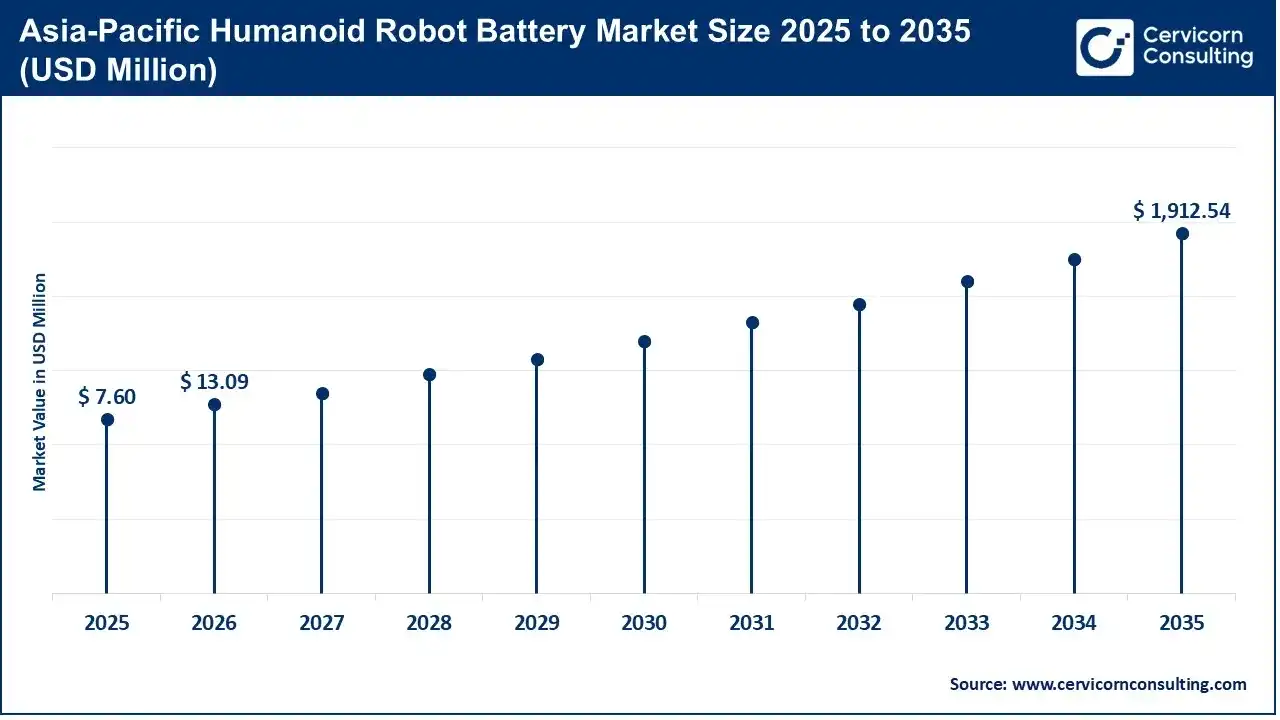
The Asia Pacific humanoid robot battery market size was valued at USD 7.60 million in 2025 and is expected to reach USD 1,912.54 million by 2035. Asia-Pacific region is expected to maintain its dominance, encouraged by advances in battery technology, factory automation, and the development of humanoid robots. By investing in automation, sophisticated manufacturing, and artificial intelligence, China, Japan, and South Korea are bolstering their robotics ecosystems. Regional expansion is also aided by the existence of significant battery producers and an established electronics supply chain. Demand for customized battery solutions is also being driven by the growing use of humanoid robots in commercial and industrial settings.
- China: Expanding industrial automation across factories, warehouses, and logistics facilities is creating potential commercial applications for humanoid robots and consequently increasing requirements for reliable onboard power systems.
- Japan: Japan's established leadership in industrial robotics and factory automation provides a strong ecosystem for integrating humanoid robots into manufacturing and service environments.
- South Korea: Strong semiconductor, electronics, automotive, and battery industries provide a diversified technology base for humanoid robot battery development and system integration.
North America Expands Humanoid Robot Battery Demand Through AI, Automation, and Robotics Investment
The North America humanoid robot battery market size was estimated at USD 5.62 million in 2025 and is projected to reach USD 1,040.15 million by 2035. North America was the second-largest regional segment, propelled by growing investments in humanoid robotics, cutting-edge AI technologies, industry-wide automation, and the existence of well-known robotics and tech firms. Humanoid robot development for commercial and industrial uses is expanding in the area. Adoption of improved battery solutions is also being aided by growing research efforts and the need for high-performance robotic systems.
- United States: The presence of major battery, semiconductor, automotive, and electronics companies provides access to technologies needed for next-generation robotic power systems.
- Canada: Investments in artificial intelligence, advanced manufacturing, and robotics are supporting the development of automation technologies that could expand humanoid robot applications.
Segmental Analysis
Battery Chemistry Analysis
High-Nickel NMC/NCA dominated the battery chemistry segment with a market share of 72% in 2025, motivated by their high energy density, robust power output, extended operational life, well-established production infrastructure, and compatibility with battery systems for small humanoid robots. Battery manufacturers can deliver significant energy in comparatively small battery packs because of these chemistries. Their acceptance in existing humanoid robot platforms is further supported by their well-established supply channels and technological maturity.
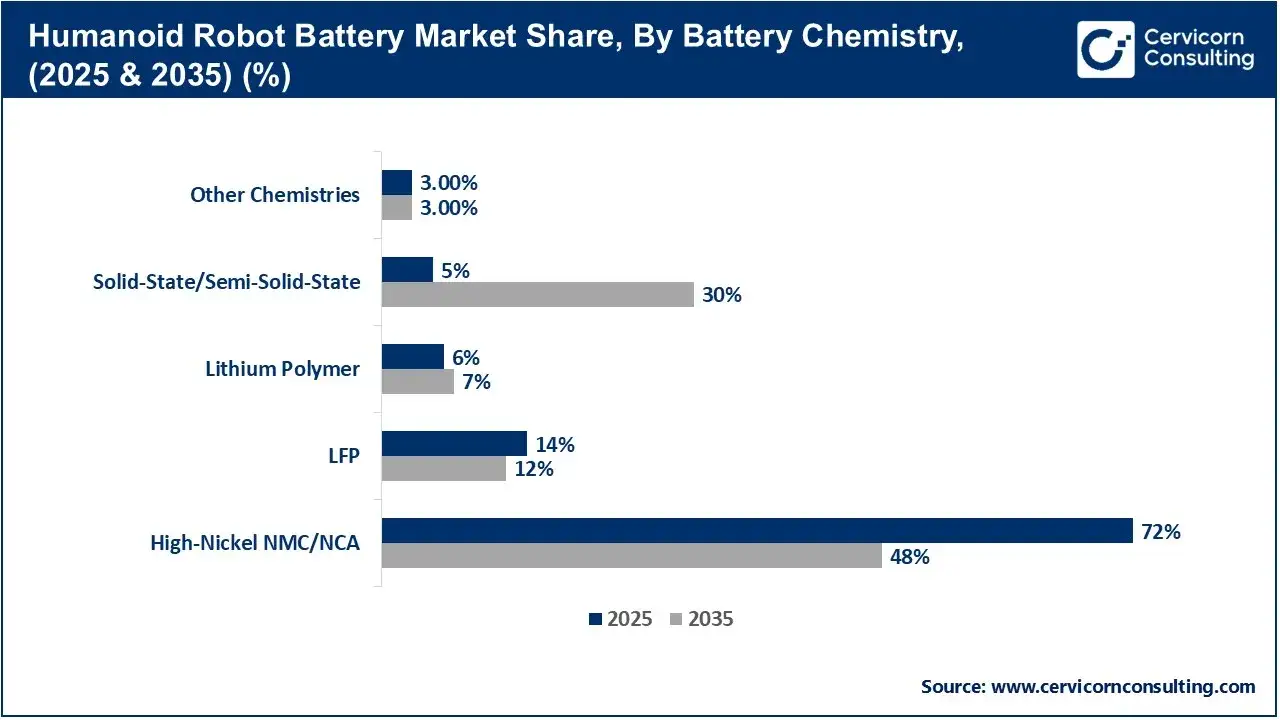
Solid-state/semi-solid-state batteries are growing rapidly, with their market share projected to increase from 5% in 2025 to 30% by 2035, motivated by their promise for next-generation humanoid robots' smaller designs, increased energy density, enhanced safety, and extended operational durations. Improvements in solid-state battery manufacturing and performance are being accelerated by increased research and development efforts. Further prospects for these technologies are anticipated due to the growing need for lightweight and high-performance power systems.
Cell Form Factor Analysis
Cylindrical cells dominated the cell form factor segment with a market share of 42% in 2025, motivated by their well-known use in cutting-edge battery applications, mechanical durability, scalability, dependable performance, and established production environment. Manufacturers are able to efficiently create cells and incorporate them into various battery pack configurations because of their standardized designs. Additionally, their well-established production infrastructure ensures a steady supply for new robotic applications.
Humanoid Robot Battery Market Share, By Cell form Factor, 2025 (%)
| Cell form Factor |
Revenue Share, 2025 (%) |
Revenue Share, 2035 (%) |
| Cylindrical |
42% |
36% |
| Pouch |
38% |
44% |
| Prismatic |
20% |
20% |
Pouch cells were the second-largest cell form factor with a market share of 38% in 2025, motivated by their adaptable packaging, lightweight design, effective use of available space, and compatibility with small humanoid robot designs. Manufacturers can maximize battery placement inside the robot's constrained interior area thanks to its adaptable form factor. The use of pouch cells is being further supported by the growing emphasis on minimizing robot weight while preserving enough energy capacity.
Battery Capacity Analysis
The 1–2.5 kWh segment dominated the battery capacity category with a market share of 58% in 2025, motivated by the way it strikes a compromise between battery weight, operating time, portability, and adaptability for modern humanoid robot applications. Numerous industrial, research, and service-oriented robotic systems can meet their energy needs within this capacity range. The creation of lightweight humanoid platforms is further aided by its comparatively small size.
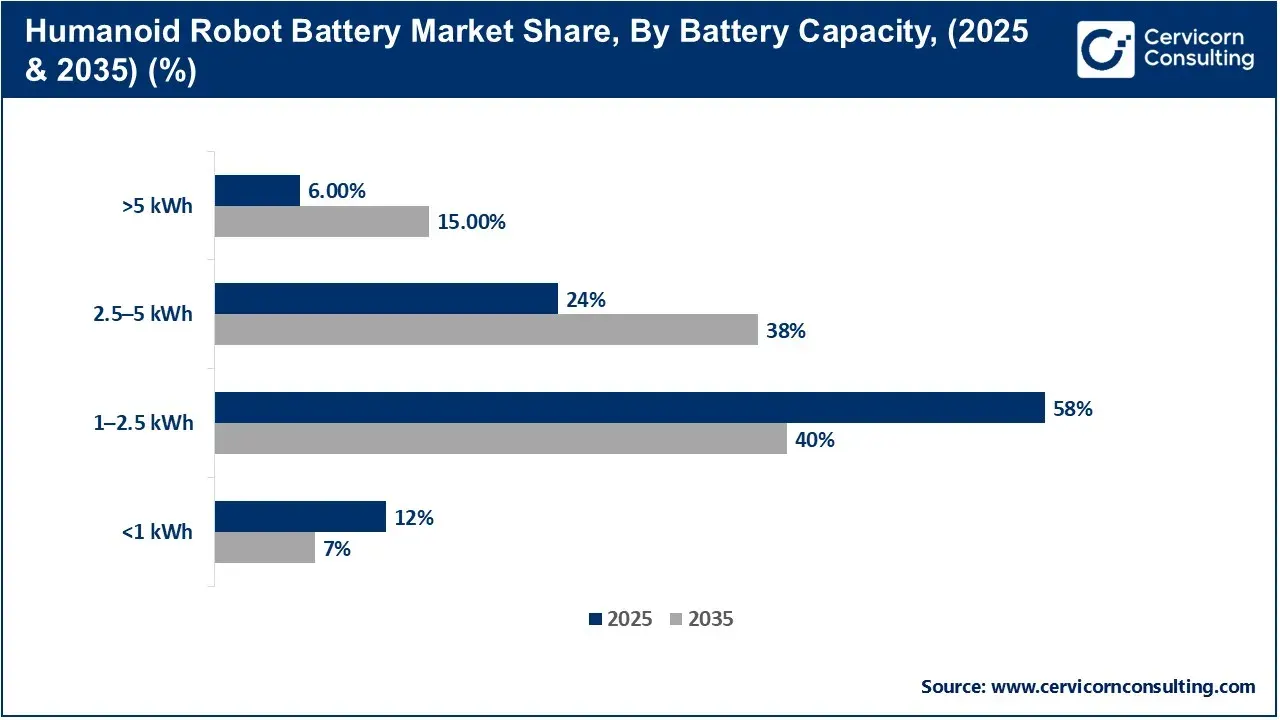
The 2.5–5 kWh segment is growing rapidly, with its market share projected to increase from 24% in 2025 to 38% by 2035, fueled by the growing need for robotic systems with greater power, longer operating times, and energy-intensive industrial and logistical applications. Humanoid robots may be able to accomplish more activities in between charging cycles with higher-capacity batteries. Manufacturers are also able to enhance capacity while controlling battery weight and size because of developments in energy density.
Battery Components Analysis
Battery cells dominated the battery component segment with a market share of 68% in 2025, motivated by their crucial function in determining battery energy density, power output, runtime, charging efficiency, and overall efficiency of humanoid robots. The operational capabilities of humanoid robots can be directly improved by advancements in cell chemistry and design. Continued innovation in this market is being supported by rising demand for customized cells with enhanced energy and power characteristics.
Battery management systems were the second-largest component segment with a market share of 12% in 2025, driven by growing demands for battery performance improvement, safety, temperature control, charge management, and battery monitoring. Cutting-edge BMS technologies can enhance operational dependability and preserve battery health. Real-time battery monitoring and intelligent energy management are becoming more crucial as humanoid robots advance in sophistication.
Application Analysis
Industrial/manufacturing dominated the application segment with a market share of 42% in 2025, motivated by the growing use of humanoid robots for repetitive industrial activities including picking, material handling, assembly, and inspection. Automation is being used more and more in manufacturing settings to support labor-intensive processes and increase operational efficiency. The need for dependable and durable robotic battery systems is rising due to the expanding development of smart industries.
Logistics & warehousing was the second-largest application segment with a market share of 28% in 2025, driven by the expanding usage of humanoid robots for material moving, picking, and sorting, as well as the need for adaptable robotic systems and increased warehouse automation. In settings built around human workers and current workflows, humanoid robots are capable of carrying out a variety of jobs. The demand for effective, high-capacity battery solutions is also being driven by the requirement for longer operational cycles and less charging downtime.
Government Initiatives
- In March 2025, the UK Government Office for Science published a rapid technology assessment on humanoid robots, examining their development, opportunities, challenges, and potential applications. The assessment supports greater understanding of humanoid robotics and its future technology requirements, including advanced power and battery systems.
- In April 2025, South Korea launched the K-Humanoid Alliance to strengthen the country's humanoid robotics industry through government support, collaboration between companies and universities, and the development of AI and robotic technologies. The initiative is expected to support demand for supporting technologies such as high-performance battery systems.
- In June 2026, China's Ministry of Industry and Information Technology and the State-owned Assets Supervision and Administration Commission launched a 2026 program for real-world training and deployment of humanoid robots and embodied intelligence. The program focuses on manufacturing, logistics, healthcare, services, emergency response, and other applications, encouraging wider deployment of humanoid robots and supporting demand for reliable battery technologies.
- In May 2026, South Korea announced an investment program through 2030 to develop core technologies for AI-based humanoid robots, involving universities and local technology companies. The initiative includes development of advanced robot platforms and mass-producible humanoid robot models, supporting the broader ecosystem for components and power technologies.
Recent Developments
- In January 2025, Saft signed an agreement with Enchanted Tools to supply customized lithium-ion battery packs for its Mirokaï humanoid robots. The battery packs are designed to support extended operation while fitting into the robot’s compact battery housing. The batteries use Saft’s high-energy, fast-charging cells and include thermal management for charging and discharging cycles. The development highlights the growing need for customized battery systems designed specifically for humanoid robots.
- In July 2025, Figure AI introduced its F.03 battery, an internally developed battery system for its humanoid robots. The company integrated the battery directly into the robot’s torso and focused on improving energy density, safety, compactness, and charging performance. The system includes a custom battery management system and active cooling to support fast charging. Figure AI also designed the battery for high-volume manufacturing as it scales production of its humanoid robots.
- In January 2026, LG Energy Solution identified robotics as a new application area for its battery business and stated that it already supplies cylindrical batteries to six global robotics companies. The company is expanding opportunities for battery applications beyond electric vehicles and energy storage systems. Its focus on next-generation robotic applications highlights the increasing demand for compact and high-performance batteries for humanoid and other advanced robots.
- In March 2026, Samsung SDI unveiled a pouch-type all-solid-state battery sample under development for physical AI applications such as humanoid robots. The company presented the technology at InterBattery 2026 as part of its next-generation battery portfolio. The development focuses on advanced battery technology that can meet the energy and safety requirements of emerging robotic platforms. It demonstrates growing interest in solid-state batteries as a potential solution for future humanoid robot power systems.
Top Companies
Segments Covered
By Battery Chemistry
- High-Nickel NMC/NCA
- LFP
- Lithium Polymer
- Solid-State/Semi-Solid-State
- Others
By Cell Form Factor
- Cylindrical
- Pouch
- Prismatic
By Battery Capacity
- <1 kWh
- 1–2.5 kWh
- 2.5–5 kWh
- > 5 kWh
By Battery Component
- Battery Cells
- Battery Management System
- Thermal Management System
- Battery Pack Housing & Structural Components
- Other Components
By Application
- Industrial/Manufacturing
- Logistics & Warehousing
- Healthcare & Caregiving
- Retail & Hospitality
- Domestic/Personal
- Research & Education
- Other Applications
By Region
- North America
- Europe
- Asia-Pacific
- Latin America
- Middle East & Africa