Human Augmentation Market Size and Growth 2026 to 2035
The human augmentation market size was valued at USD 325.76 billion in 2025 and is expected to be worth around USD 1,425.81 billion by 2035, exhibiting at a compound annual growth rate (CAGR) of 16.1% over the forecast period from 2026 to 2035. The market’s growth is driven by the rising demand for healthcare applications such as advanced prosthetics, bionic eyes and gait training.
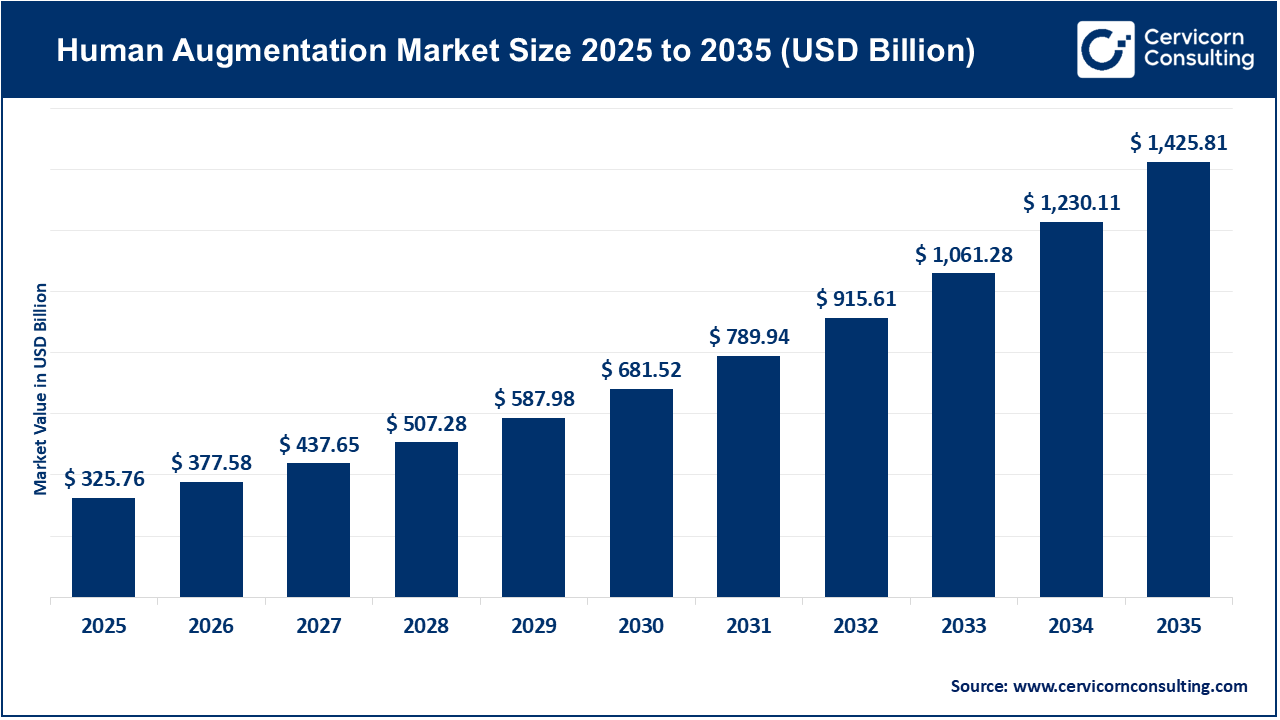
Report Highlights
- North America held the largest share of 45.7% in 2025, while the U.S. acted as the largest contributor to the market.
- Asia Pacific is seen to register the fastest rate of growth during the forecast period, whereas China, Japan and India to hold a significant share of the industry.
- By product, the wearable devices segment held the largest share of 33% in 2025 owing to the improved focus on situational awareness.
- By product, the Augmented Reality devices segment is seen to grow at the fastest rate during the forecast period due to its capability to combine technologies to assist people with disabilities.
- By functionality, the body-worn segment dominated the market with the largest share 59% owing to its potential in multiple fields including neuroscience and robotics.
- By functionality, the non body-worn segment is seen to grow at the fastest rate during the forecast period owing to the overall advancements in brain-computer interfaces.
- By technology, the AI integration segment led the market with the largest share 55% owing to its significant property of offering personalized services in augmentation products.
- By technology, the biohacking & bio-augmentation segment is expected to grow at the fastest rate during the forecast period owing to the rising demand for accessible advanced medical-grade technologies.
- By end-use, the healthcare segment dominated the market in 2025 due to growing demand for healthcare trackers.
- By end-use, the commercial segment is expected to grow at the fastest rate during the forecast period with the growing automation in warehouses.
Human Augmentation Market Insights
The human augmentation market encompasses technologies designed to enhance, restore, or extend human physical, sensory, and cognitive capabilities through integrated hardware, software, and biological systems. These solutions include wearable devices, exoskeletons, augmented and virtual reality systems, biometric platforms, intelligent virtual assistants, and neural interface technologies that enable closer interaction between humans and machines.
As digital and biological systems become more interconnected, human augmentation is positioned as a foundational pillar of next-generation human–machine collaboration. The market is expected to witness continued innovation across neural interfaces, smart wearables, and intelligent robotics, gradually shifting augmentation from specialized use cases toward everyday human enhancement.
Human Augmentation Market Future Outlook & Recent Trends
- Artificial Intelligence’s Potential: Artificial intelligence is now embedded inside augmentation hardware to interpret signals, predict user intent, and personalize device behavior. This makes augmented systems more intuitive and responsive over time.
- Emergence of AR/VR Devices: Augmented and mixed-reality headsets are becoming mainstream human-computer interfaces for work, training, and collaboration. Spatial computing allows digital content to appear naturally within physical environments.
- Industrial Workforce Augmentation: Manufacturing and logistics firms are using exosuits and smart glasses to boost productivity and worker safety. Augmented instructions help reduce errors and downtime.
- Smarter Exoskeletons: Exoskeletons are shifting toward lightweight, AI-assisted systems that adapt to user movement in real time. This improves comfort, usability, and adoption in healthcare and industrial settings.
- Sensory Enhancement Technologies: Wearables are increasingly enhancing vision, hearing, and environmental awareness. Haptic feedback and multisensory input are improving how users perceive and interact with digital environments.
Market Dynamics
Driver
Rising Adoption of Augmentation in Healthcare & Rehabilitation
The growing burden of neurological disorders, mobility impairments, and age-related physical decline is driving strong adoption of human augmentation technologies in healthcare. Wearable exoskeletons, robotic rehabilitation devices, and brain–computer interface systems are increasingly used to help patients regain movement and independence. For instance, neural implant systems enabling paralyzed individuals to control digital devices using brain signals demonstrate how augmentation is moving into real clinical environments.
Similarly, hospitals and rehabilitation centers are deploying robotic exosuits that assist with gait training and post-stroke recovery, improving therapy efficiency and outcomes. This expanding medical utilization continues to push investment and innovation across the human augmentation ecosystem.
Restraint
High Cost and Complex Integration
Despite rapid technological progress, high development costs and system complexity remain key restraints. Advanced sensors, AI processors, custom robotics, and implantable components significantly increase product pricing, limiting affordability for smaller healthcare facilities and individual consumers. In addition, integrating augmentation systems with existing hospital IT infrastructure, electronic health records, and industrial software platforms can be technically challenging. These barriers slow large-scale deployment, particularly in cost-sensitive regions and small enterprises.
Opportunity
Expansion of Augmented Workforces in Industry and Enterprise
Industrial digitization and labor shortages are creating strong opportunities for workforce augmentation. Manufacturing plants, warehouses, and logistics hubs are adopting exoskeletons and AR smart glasses to enhance worker strength, accuracy, and situational awareness. For example, AI-powered exosuits that provide real-time lifting assistance are reducing musculoskeletal injuries among warehouse workers.
Meanwhile, AR headsets are enabling technicians to view digital instructions overlaid on physical equipment, improving maintenance speed and reducing errors. As enterprises focus on productivity and worker safety, augmented workforce solutions are expected to become a core operational tool.
Human Augmentation Market Regional Analysis
Why does North America hold the largest share of the human augmentation market?
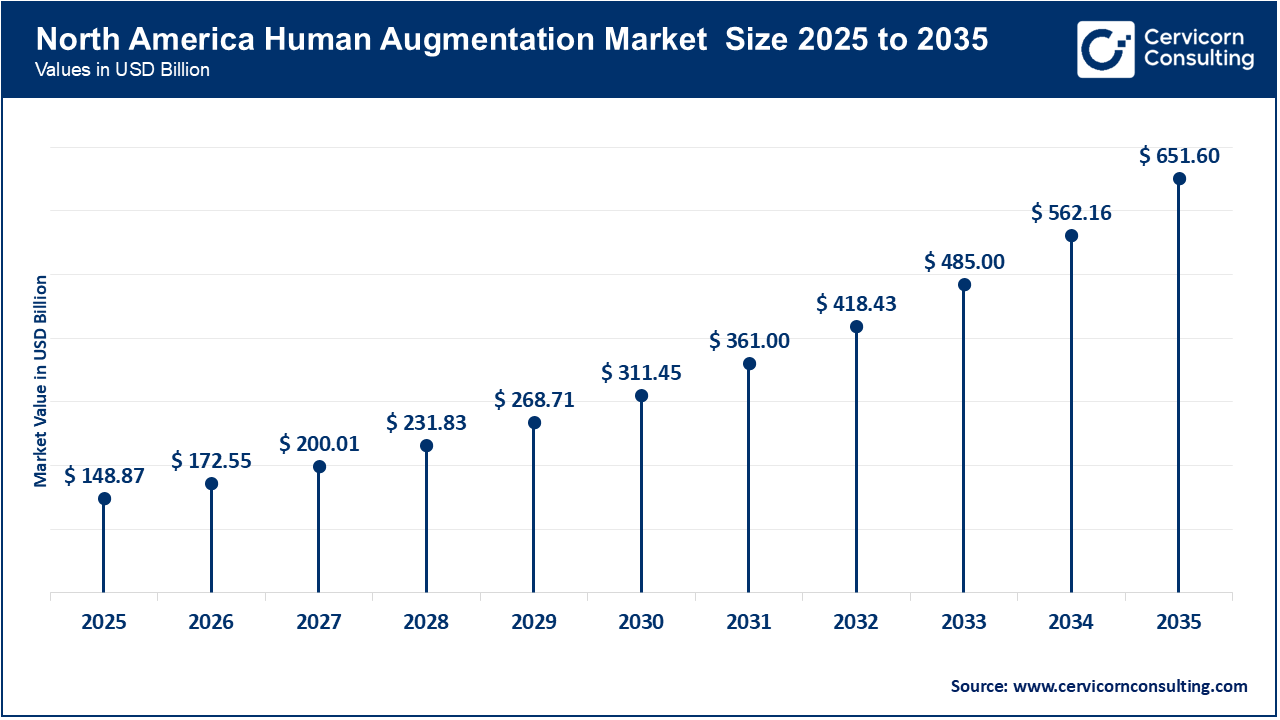
North America dominated the human augmentation landscape because the region sits at the intersection of advanced digital infrastructure, world-leading AI and robotics innovation, strong defense and healthcare spending, and early technology adoption culture. The ecosystem enables rapid transition from research to commercialization, allowing augmentation technologies to scale faster than in any other region. Rather than relying on a single growth pillar, North America benefits from multi-sector demand, healthcare, defense, industrial automation, consumer electronics, and enterprise productivity, creating sustained and diversified revenue streams for augmentation technologies.
Top Companies in North America for Human Augmentation Breakthroughs:
| Company |
Augmentation Focus |
Recent Breakthrough |
| Apple Inc. |
AR/VR & Wearables |
Apple launched Vision Pro, a mixed-reality headset blending AR/VR with spatial computing for professional and immersive experiences. |
| Microsoft Corporation |
AR/VR & AI Integration |
HoloLens mixed reality headset used in enterprise, healthcare, and industrial training. |
| Google LLC |
Wearable/AR & AI |
Google is expanding AI-centric wearable tech and AR capabilities and adding cognitive enhancements via software and cloud AI services. |
| Meta Platforms |
VR Immersion |
Meta Quest line of VR headsets and Ray-Ban Stories AR glasses under Reality Labs. |
| ReWalk Robotics |
Wearable Exoskeletons |
FDA-cleared exoskeletons enabling standing and walking for people with mobility impairments. |
| Neuralink Corp |
Brain-Computer Interfaces |
Implantable BCIs enabling direct neural control of devices; first human implants reported. |
Unites States Contribution & Potential in Human Augmentation Market
The United States stands at the center of global human augmentation innovation, driven by a combination of breakthrough technologies, deep engineering expertise, world-class research institutions, corporate leadership, and supportive government and clinical environments. U.S. contributions span neural interfaces, wearable robotics, augmented reality systems, and advanced biomedical devices, each with significant real-world milestones. U.S. companies like Neuralink have successfully performed multiple human device implantations. These implants connect directly with the brain to enable people with paralysis to control computers or assistive devices using neural activity.
The U.S. Department of Defense has sponsored augmentation projects that explore enhanced situational awareness, adaptive support suits, and sensory fusion systems for soldier safety and performance. Universities such as MIT, Stanford, Johns Hopkins, and Carnegie Mellon host flagship labs built around cognitive computing, robotics, neural engineering, and multisensory systems.
What are the rising trends of Asia-Pacific in the human augmentation market?
Asia Pacific is becoming one of the most active regions for real-world deployment of human augmentation technologies, particularly in robotics-assisted mobility, wearable health devices, smart prosthetics, and industrial exoskeletons. The region’s momentum is being shaped by aging populations, large-scale manufacturing ecosystems, and strong government-backed technology programs.
Rather than being driven by speculative growth narratives, Asia Pacific’s performance is visible through hospital adoption, factory deployment, and national robotics strategies across major economies.
Country-Level Potential in Asia Pacific Human Augmentation Market
- Japan has the strongest potential in healthcare and eldercare augmentation, driven by a very high aging population and long-standing national emphasis on robotics, positioning the country to lead global deployment of exoskeleton-based rehabilitation, assistive mobility robots, and smart caregiving systems.
- China offers the largest potential for mass-scale manufacturing and commercialization of augmentation devices, supported by its dominance in electronics production, sensors, and industrial robotics, enabling rapid scaling of smart prosthetics, wearable exosuits, and AI-powered rehabilitation equipment.
- South Korea holds strong potential as a core technology and component innovation hub, leveraging leadership in semiconductors, displays, and advanced sensors to supply high-performance hardware platforms for AR wearables, smart prosthetics, and compact medical augmentation devices.
- India presents high potential for cost-efficient healthcare augmentation adoption, supported by a large patient population, expanding digital health infrastructure, and rising domestic development of affordable prosthetics, wearable monitoring systems, and rehabilitation devices.
- Singapore has strong potential as a regional testbed and commercialization gateway, using its advanced healthcare system and innovation-friendly regulations to pilot next-generation augmentation technologies.
- Taiwan contributes significant potential in precision electronics and sensor manufacturing, strengthening supply chains for wearable and implantable augmentation hardware.
Human Augmentation Market Segmental Analysis
Product Analysis
“What Made Wearable Devices the Largest Product Segment in Human Augmentation Market?”
Wearable devices dominated the human augmentation landscape in 2025 due to their mass adoption, affordability, and expanding healthcare and productivity applications. Smartwatches, fitness trackers, smart rings, and smart glasses continuously collect physiological, motion, and environmental data, enabling real-time health insights and performance optimization. AI-enabled wearables now offer predictive alerts for cardiac irregularities, sleep disorders, and fatigue, transforming wearables from passive trackers into active health companions.
- Recent product launches such as AI-powered smart rings and next-generation smart glasses with integrated assistants highlight how wearables are evolving into core human-machine interfaces rather than simple accessories.
Human Augmentation Market Revenue Share, By Product, 2025 (%)
| Product |
Revenue Share, 2025 (%) |
| Wearable Devices |
33% |
| Augmented Reality Devices |
22% |
| Virtual Reality Devices |
18% |
| Exoskeletons |
14% |
| Biometric Systems |
8% |
| Intelligent Virtual Assistants |
5% |
Augmented reality (AR) devices segment is witnessing the fastest growth as enterprises increasingly deploy AR smart glasses for training, remote assistance, and workflow visualization. AR overlays digital instructions, diagrams, and real-time data directly into a user’s field of view, significantly improving accuracy and reducing task completion time. In healthcare, surgeons use AR for pre-operative planning and image-guided procedures, while manufacturers use AR for equipment maintenance and assembly.
Functionality Analysis
“The Body-worn Segment Led the Human Augmentation Market in 2025 with the Largest Share”
Body-worn augmentation dominated the human augmentation market in 2025 because of the widespread use of wearable health monitors, smart clothing, exoskeletons, and AR/VR headsets. These devices provide continuous, real-time interaction between humans and technology, offering direct physical or sensory enhancement. Healthcare monitoring, fitness optimization, and workplace safety applications drive strong adoption. The familiarity of wearable form factors and their non-invasive nature further support dominance across consumer and enterprise markets.
Human Augmentation Market Revenue Share, By Functionality, 2025 (%)
| Functionality |
Revenue Share, 2025 (%) |
| Body-worn |
59% |
| Non Body-worn |
41% |
Non body-worn augmentation is the fastest-growing segment, driven by advances in implantable devices and brain-computer interfaces (BCIs). These technologies enable direct communication between the brain and external systems, allowing users to control computers, prosthetics, or wheelchairs using neural signals.
Technology Analysis
“AI Integration Segment Held the Largest Segment for Year 2025 in Human Augmentation Market”
AI integration dominated the human augmentation market because nearly all modern augmentation systems rely on machine learning for perception, prediction, and personalization. AI analyzes biometric signals, movement patterns, and contextual data to adapt device behavior in real time. For example, AI-powered exoskeletons adjust support based on user posture, while smart wearables predict health risks before symptoms appear. AI has become the core intelligence layer enabling augmentation technologies to function autonomously and intelligently.
Human Augmentation Market Share, By Technology, 2025 (%)
| Technology |
Revenue Share, 2025 (%) |
| AI Integration |
55% |
| Quantum Computing Augmentation |
15% |
| Biohacking & Bio-augmentation |
30% |
Quantum computing augmentation is an emerging area focused on using quantum processors to solve complex optimization and simulation problems that classical computers struggle with. In the future, quantum-enhanced computing could accelerate drug discovery, genetic analysis, and neural network training, indirectly strengthening human augmentation systems.
End-use Analysis
“The Healthcare Segment Dominated the Human Augmentation Market, Predicted to Stay Ahead”
Healthcare dominated in 2025 due to extensive use of augmentation in rehabilitation, diagnostics, remote monitoring, and surgery. AI-enabled prosthetics, robotic exoskeletons, smart implants, and wearable health sensors are transforming patient care. Hospitals increasingly rely on augmentation to reduce clinician workload, improve surgical precision, and support aging populations, making healthcare the largest revenue-generating end-use sector.
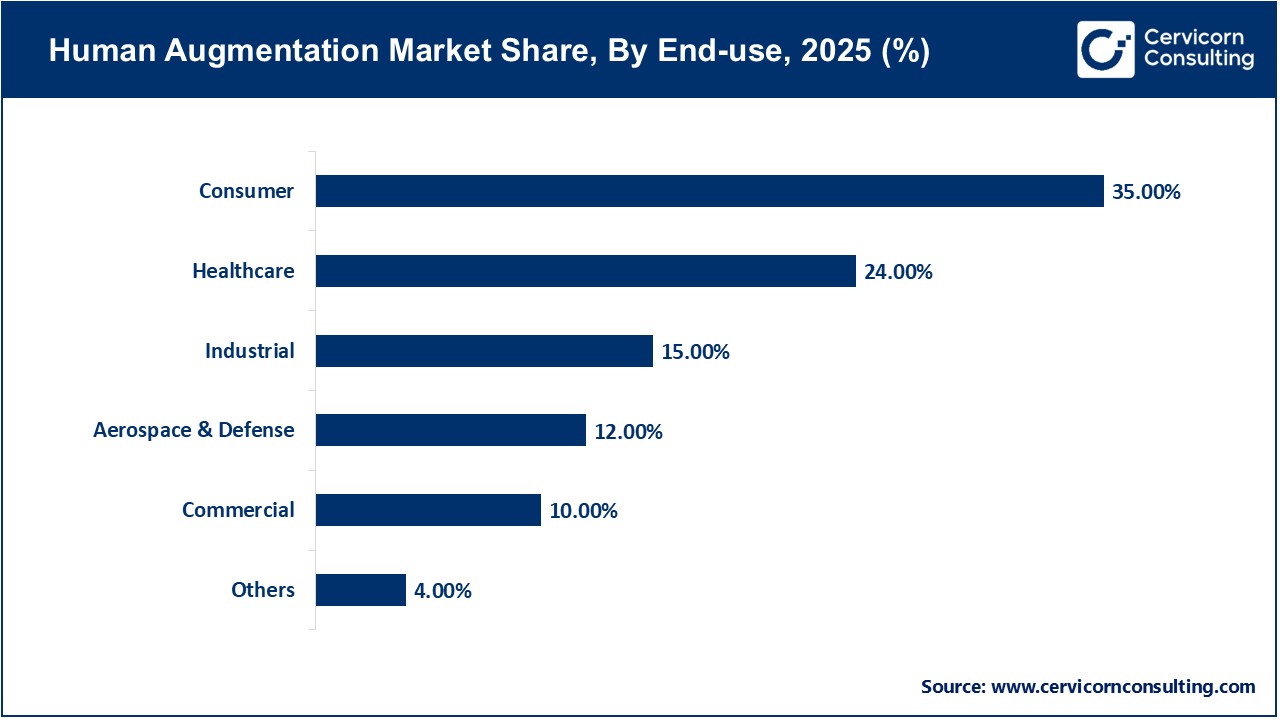
The commercial segment is expanding rapidly as organizations deploy human augmentation to improve workforce productivity, safety, and customer experience. Retailers use AR for virtual try-ons, manufacturers use smart glasses for remote assistance, and logistics firms deploy wearables for worker tracking and navigation.
Human Augmentation Market Top Players & Their Roles
| Company |
Significance in Human Augmentation Market |
| Neuralink |
A leading neurotechnology firm developing implantable brain-computer interfaces (BCIs) that allow neural signals to control computers and devices, pushing the frontier of cognitive augmentation. |
| Paradromics |
Advanced high-data-rate brain-computer interface developer aiming to restore communication and movement for fully motor-impaired individuals using fully implantable neural systems. |
| Ekso Bionics |
Pioneer in powered exoskeletons for medical rehabilitation and industrial augmentation, enabling people with mobility impairments to stand and walk and assisting workers with heavy tasks. |
| Samsung Electronics |
Major technology provider integrating smart wearable devices and biometric sensors, enhancing human performance through real-time physiological feedback and AR/VR interfaces. |
| Google Aphabet |
Drives AI-enhanced augmentation through AI, machine learning, and AR/VR innovations; involved in XR ecosystem development and next-gen human-technology interfaces. |
| Vuzix Corporation |
Specializes in AR smart glasses and wearable display tech for enterprise, industrial, and healthcare augmentation, providing visual overlay information and hands-free interfaces. |
| Open Bionics |
Innovator in 3D-printed bionic prosthetic arms, offering affordable and functional prosthetics with myoelectric control that empower amputees. |
Human Augmentation Market Recent News
- In January 2024, Neuralink successfully implanted its first brain-computer interface (BCI) device in a human patient, marking a major milestone in neural augmentation. The implant enables users to control a computer cursor using only brain signals. This achievement demonstrates the feasibility of direct brain-to-device communication for people with paralysis.
- In 2024, Apple officially launched the Vision Pro headset, introducing spatial computing for immersive digital interaction. The device allows users to blend digital content with the physical world using eye tracking, hand gestures, and voice control. Vision Pro represents a major step forward in perception and interaction-based human augmentation.
- In January 2025, Wearable Devices Ltd. and RayNeo showcased AR glasses controlled through a neural wristband at CES. The system allows users to interact with digital content using subtle finger and hand gestures. This demonstrates a new class of touch-free human-computer interaction.
Market Segmentation
By Product
- Wearable Devices
- Bodywear
- Footwear
- Wristwear
- Eyewear
- Others
- Augmented Reality Devices
- Virtual Reality Devices
- Exoskeletons
- Biometric Systems
- Single-Factor Authentication
- Multi-Factor Authentication
- Intelligent Virtual Assistants
By Functionality
By Technology
- AI Integration
- Quantum Computing Augmentation
- Biohacking & Bio-augmentation
By End-use
- Consumer
- Commercial
- Healthcare
- Aerospace & Defense
- Industrial
- Others
By Region
- North America
- Europe
- Asia Pacific
- Latin America
- Middle East and Africa