GLP-1 Agonists Market Overview and Forecast 2026–2035
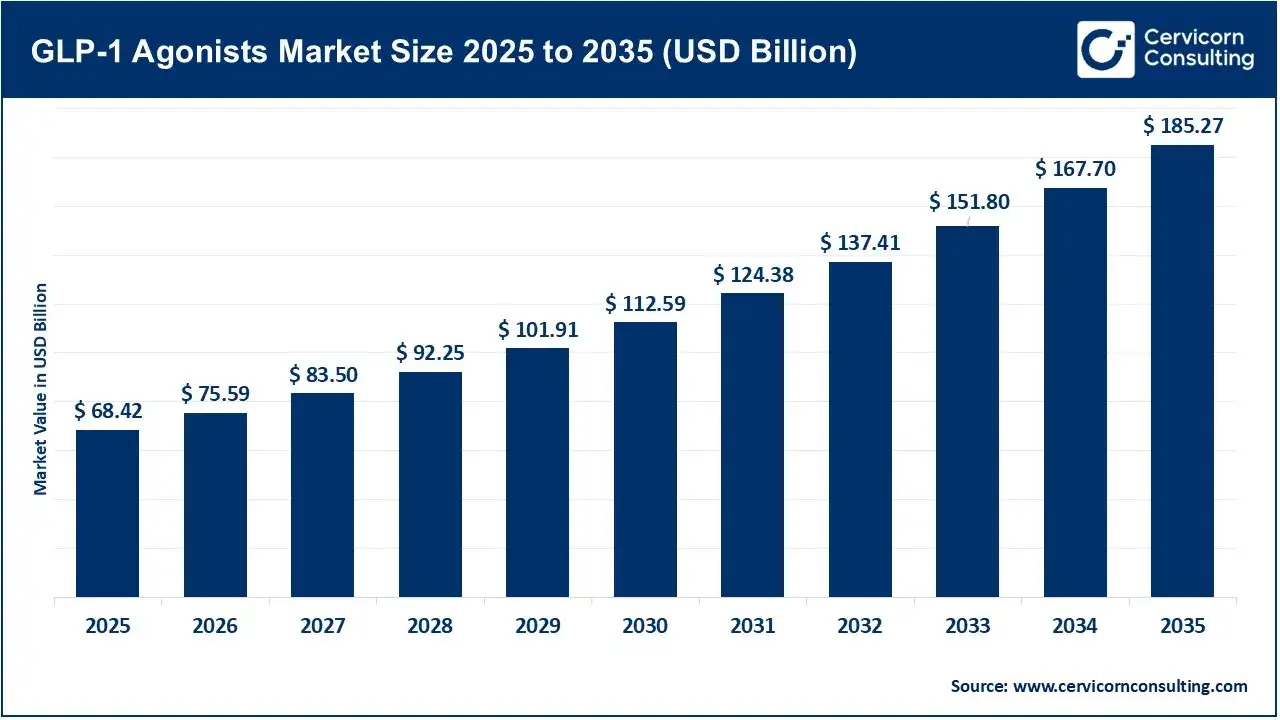
The global GLP-1 agonists market size was valued at USD 68.42 billion in 2025 and is expected to exceed around USD 185.27 billion by 2035, growing at a CAGR of 10.5% during the forecast period of 2026-2035. Key drivers are a rise in applications, including obesity and cardiovascular care, along with growing chronic disease cases and massive novelty in drug formulations. Day by day, the global market is seeking powerful needle-free alternatives, small-molecule options, and combination therapeutics.
Report Highlights
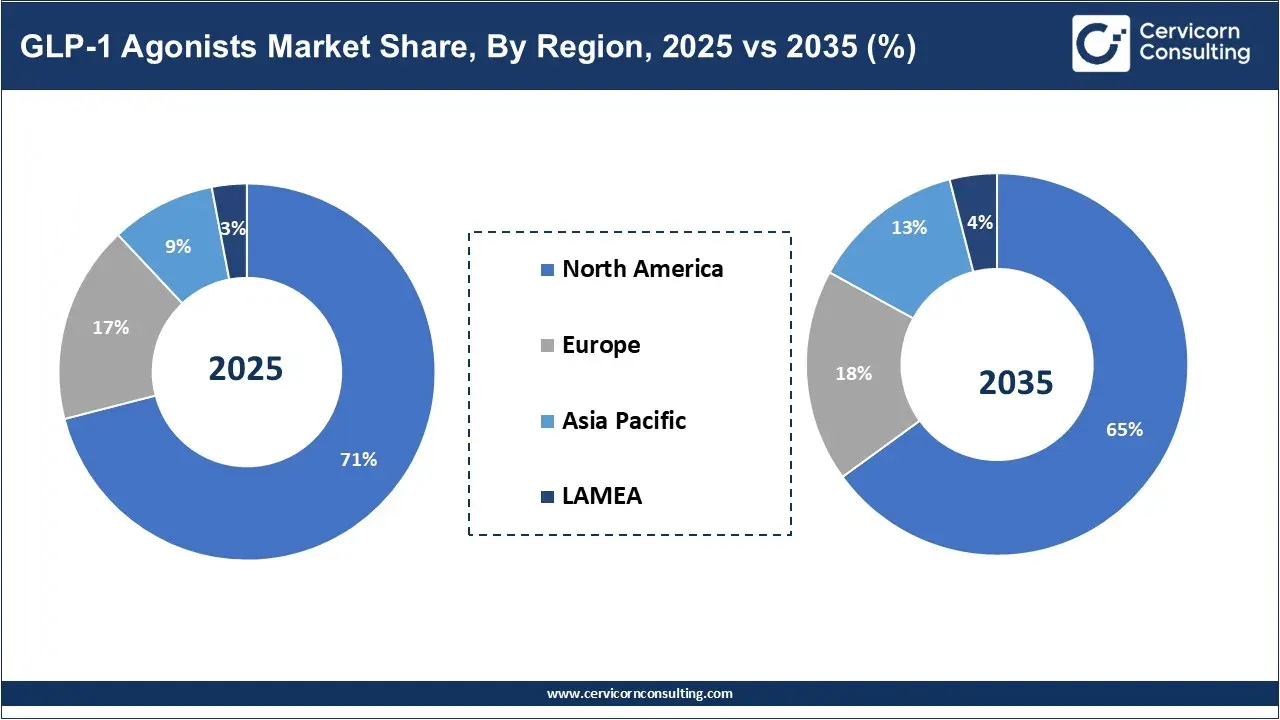
- By region, North America dominated the market in 2025 with revenue share of 71%, driven by the inclusion of cardiometabolic outcome-based guidelines and growth in commercial & public policy shifts.
- By drug type, Semaglutide registered dominance in the market in 2025 with revenue share of 53%, fueled by its broader benefits, such as blood sugar control, substantial weight loss, and greater kidney health support.
- By application, type 2 diabetes led the market in 2025 with revenue share of 80%, propelled by highly modifying lifestyles, increasing stress-related issues, and a rising shift towards dual metabolic advantages.
- By route of administration, the injectable was led the market in 2025 accounted revenue share of 69% because of its exceptional bioavailability, potency, and less frequent dosing schedules.
- By distribution channel, retail pharmacies dominated the market with revenue share of 42% in 2025, due to the presence of affordable drugs, generic therapeutics, and growing shifts toward omnichannel and telesurgery.
GLP-1 Agonists Market Size & Forecast
- Base Year Market Size (2025): $68.42 billion
- Current Year Market Size (2026): $75.59 billion
- Estimated Year Market Size (2035): $185.27 billion
- Forecast Period CAGR (2026-2035): 10.5%
What are the Focused Areas of the GLP-1 Agonists Market?
It is defined as a category of prescription drugs that act like the natural GLP-1 hormone in the body and support managing Type 2 diabetes and assist in severe weight control. However, the eventual progression of the market is fueled by expanding oral and long-acting formulations, advanced insurance and Medicare coverage, and broader global demand for obesity and diabetes treatments. Nowadays, the industry is aiming at obesity and weight management, lowering cardiovascular risk, and controlling chronic kidney disease (CKD). Besides this, many clinical studies and real-world applications are seeking to manage heart failure, obstructive sleep apnea, peripheral artery disease, and osteoarthritis.
Ongoing Research Initiatives
- At the ASCO 2026 meeting, the University of Pennsylvania showcased a real-world assessment of over 100,000 women, indicating that those taking GLP-1 receptor agonists had a reduced risk of emerging breast cancer.
- At the American Diabetes Association (ADA) 2026 sessions, preclinical and nonhuman primate data for the first-in-class nonpeptide GLP-1RA RV-8451 represented stronger weight loss fueled by selective fat reduction and lean muscle preservation.
- Certain ongoing research efforts are pushing meta-analysis of randomized controlled trials that reflected superior weight loss with triple- and dual-agonists, such as retatrutide and CagriSema, compared with traditional GLP-1 options.
- At ADA 2026 in JAMA, a study explored data based on dual glucagon/GLP-1 receptor agonist mazdutide, which addressed prominent glycemic and weight-loss effects in adults with moderate-to-severe obesity.
- On the other side, a Phase 3 clinical protocol examined NA-931, an oral small-molecule quadruple receptor agonist that targets IGF-1, GLP-1, GIP, and glucagon receptors both individually and paired with oral semaglutide.
Market Dynamics
Growth Drivers
- Strengthening Clinical Indications: The emergence of regulatory approvals and new regulations has fixed GLP-1 usage for long-term chronic weight management, CVD risk reduction, and metabolic health instead of only type 2 diabetes.
- Growth in Oral Formulations: Day by day, market players are unveiling and accelerating uptake of oral GLP-1 therapies, like Wegovy pill and Eli Lilly’s small-molecule oral pill Foundayo, which have eliminated needle-phobia and dietary restrictions.
- Enhancing Cost-Effectiveness: The globe is looking for solutions in minimal list and self-pay prices, along with implementation of generic and biosimilar/off-patent entries and significantly broadened patient access and cash-pay channel volume.
Market Restraints
- Restricted Payer Reimbursement: Across the globe, several public and private insurance programs are still limiting or do not widely cover GLP-1 therapies, especially for chronic weight management beyond key type 2 diabetes indications.
- Bottlenecks in Production & Supply: Broader execution of intricate peptide synthesis, cold-chain logistics for injectables, and specialised fill-finish requirements, resulting in a lack of periodic global supply and failure to meet production capacity.
- Inferior Long-Term Adherence: The GLP-1 agonists market is facing some adherence-related concerns, such as gastrointestinal intolerance, the psychological or physical stress of chronic injections, and high out-of-pocket renewals, which often lead to frequent treatment uncertainty.
Key Opportunities
- Prolonged Duration of Injectables: In 2026, the industry is promoting many monthly dosing alternatives, including Amgen’s MariTide and Pfizer’s danuglipron, which focus on replacing weekly injections with more feasible dosing schedules.
- Inclining Towards Generics: As the globe is going through patent expirations for semaglutide, specifically in international markets like Canada, Brazil, India, and China, this fuels affordable domestic and generic options, bringing interventions accessible at minimal cost.
- Promoting DTC Access: Ongoing transformative approaches also cover list price adaptations and strengthening digital or direct-to-consumer care models that revolutionize patient out-of-pocket costs and commercial capacity.
Market Challenges
- Barriers in Production Volume: Across the market, manufacturing of complex large-scale peptide and cold-chain or injection distribution needs still covers a limited portion of the global population with clinical focus.
- Arising Rivalry Among True & Fake: In this era, numerous non-FDA-cleared compounded mimicking products and counterfeit versions are massively marketed through weight-loss clinics, medical spas, and telehealth platforms, which elevates safety and sterility issues.
GLP-1 Agonists Market Regional Analysis
How did North America Dominate the Market in 2025?
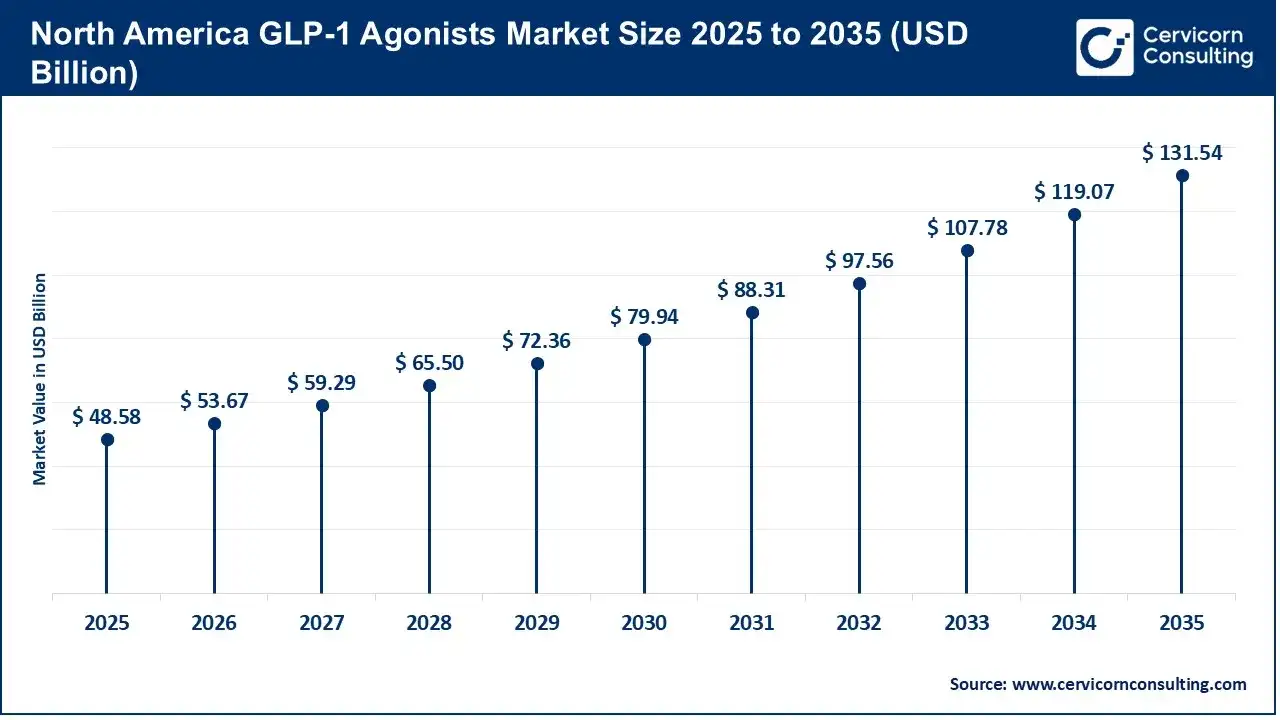
The North America GLP-1 agonists market size was valued at USD 48.58 billion in 2025 and is forecasted to reach around USD 131.54 billion by 2035. North America held a dominant share of the market in 2025, driven by the presence of modern healthcare systems, advanced payer and coverage progression, and a shift towards innovative digital solutions. In terms of recent transformations, the Obesity Canada 2025 pharmacotherapy update underlined six approved agents for adult obesity management, which include liraglutide, naltrexone/bupropion, orlistat, semaglutide, tirzepatide, and setmelanotide. On the other hand, several research and regulatory advances have enabled the treatment of youth-onset type 2 diabetes and obesity employing dual agonists.
United States Market
- As a major contributor, the U.S. market has encouraged major obesity trials, multi-receptor agonists, oral small-molecule formulations, and broadening uses, including chronic kidney disease and reduced cancer risk. Recent research efforts by NYU Grossman School of Medicine showcased that they have tracked nearly 170,000 patients administered GLP-1 receptor agonists, showing a 7% lower incidence of obesity-related cancers.
Which Region is Considered to be the Fastest-Growing in the Market?
The Asia-Pacific GLP-1 agonists market size was accounted for USD 6.16 billion in 2025 and is predicted to hit around USD 16.67 billion by 2035. Asia Pacific is expected to grow at a rapid rate in the upcoming years, propelled by rising diabetes & obesity cases, surging focus on local production, and a vast shift towards biosimilars and generic candidates. As per recent evaluations, China will have roughly 130 million diabetes cases and nearly 98 million in India by 2030. Gradually, China’s industry is spurring pipelines that emphasise convenient oral therapies, including Phase 2 trials of HDM1002, DA-302168S, and HRS-7535.
India Market
- India is experiencing the fastest growth in the market, as it has various kinds of demographic changes and a rise in chronic illness. Moreover, based on the National Family Health Survey (NFHS-5/NFHS-6 data), nearly 27.3% to 30.7% of adult women and 23% to 27.3% of adult men in India are living with overweight or obesity. To address this growing indication, the Indian market is bolstering generic drugs and advancing dual GIP/GLP-1 receptor agonists, such as Mounjaro and Yurpeak, as prominent entities for both type 2 diabetes and chronic weight management.
Increasing Cases & Notable Regulatory Progress: Impel Europe
The Europe GLP-1 agonists market size was estimated at USD 11.63 billion in 2025 and is expected to surpass around USD 31.50 billion by 2035. Europe is expected to expand significantly, as it is going through a massive rise in diabetes cases and novel drug launches. According to the International Diabetes Federation, across the European region, nearly 66 million adults have diabetes, and it also represents 31,000 new cases of type 1 diabetes diagnosed per year among children and adolescents. Alongside this, the European Commission marketing authorisation for once-daily oral semaglutide tablets has converted traditional injectable-only franchises into accessible pill alternatives, which reduce patient stress.
UK Market
- UK is considered to be a highly reshaping industry; recently, the MHRA granted Eli Lilly's small-molecule oral GLP-1 receptor agonist Foundayo (orforglipron), which makes the UK the first nation in Europe to use it for weight management and type 2 diabetes. Besides this, MHRA also authorised higher-strength weekly semaglutide injections (7.2 mg) to offer substantially increased efficacy for patients who stabilized on the standard 2.4 mg weekly dose.
GLP-1 Agonists Market Segmentation Analysis
Drug Type Analysis
Semaglutide: The Semaglutide segment held a major share of the market in 2025, driven by its broader advantages, such as regulating blood sugar, decreasing appetite, and supporting long-term health. Along with advanced applications and a move into oral solutions, this drug expanded into combination therapies, like CagriSema (cagrilintide + semaglutide), which pivoted the overall competition towards higher-efficacy multi-target treatments.
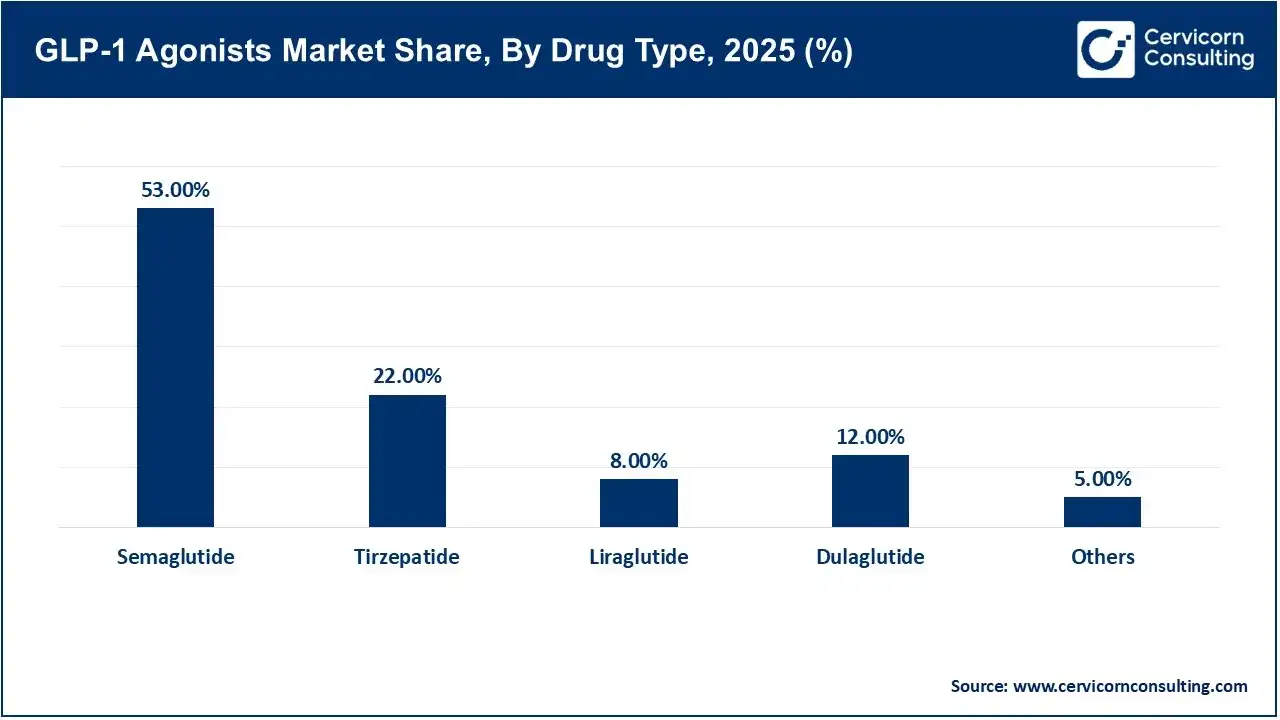
Tirzepatide: The Tirzepatide segment is projected to witness rapid expansion during the forecast period, supported by its higher clinical effectiveness, broadened regulatory approvals, and vast global demand. Recently, at ACR Convergence 2026, a study with well-assessed combined real-world and clinical outcomes showed tirzepatide's cardiometabolic and risk-reduction benefits in patients with psoriatic arthritis and obesity.
Application Analysis
Type 2 Diabetes: The type 2 diabetes segment accounted for the largest share of the market in 2025, propelled by many lifestyle factors, genetic history, and higher insulin resistance. According to some studies, type 2 diabetes take average time from diagnosis to starting GLP-1 therapy has declined by about one month, with nearly half of new T2D patients beginning therapy within the first month of diagnosis.
GLP-1 Agonists Market Share, By Application, 2025 (%)
| Application |
Revenue Share, 2025 (%) |
| Type 2 Diabetes |
80% |
| Obesity and Weight Management |
14% |
| Cardiovascular Risk Reduction |
3% |
| Metabolic Disorders |
2% |
| Others |
1% |
Obesity and Weight Management: The obesity and weight management segment is anticipated to expand at the fastest rate in the upcoming years, supported by surging obesity rates, rising awareness regarding novel treatments, and broader regulatory approvals for new areas. Specifically, recent rollouts from Eli Lilly include triple agonists that target GLP-1, GIP, and glucagon receptors via late-stage Phase 3 trials, which demonstrated significant weight loss.
Route of Administration Analysis
Injectable: The injectable segment registered dominance in the GLP-1 agonists market in 2025 (revenue share 69%), driven by its higher bioavailability, reliability, and robust patient adherence to once-weekly regimens. Continuous innovations are pushing the use of hydrogels, microneedles, and nanocarrier systems to reduce gastrointestinal side effects and boost patient preference via specialised preclinical and early clinical engineering.
Oral: The oral segment is projected to expand fastest in the predicted timeframe, due to its vast patient convenience, expanding new-to-category entities, and minimal barriers, with strengthened pipelines. Recently unveiled products, IBI3032 and IBI3042, show once-daily to once-weekly oral dosing, along with multi-agonist small molecules, reflecting dedicated Phase 1 and preclinical data at the 2026 American Diabetes Association sessions.
Distribution Channel Analysis
Retail Pharmacies: The retail pharmacies segment held a major share of the market in 2025, supported by their feasible refills and expanded offerings, such as patient counselling and medication management. In 2025, diverse digital platforms and services reinforced virtual prescribing, patient support, and introductory cash-pay pricing models for injections and developing oral formulations.
GLP-1 Agonists Market Share, By Distribution Channel, 2025 (%)
| Distribution Channel |
Revenue Share, 2025 (%) |
| Hospital Pharmacies |
32% |
| Retail Pharmacies |
42% |
| Online Pharmacies |
11% |
| Specialty Pharmacies |
15% |
Online Pharmacies: The online pharmacies segment is projected to be the fastest-growing during 2026-2035 because of increasing drug prices, accelerating approaches in direct-to-consumer and expansive home delivery, digital prescription management, and consumer-centred marketing. Ongoing developments encompass heavy use of compounded semaglutide and tirzepatide, while certain online platforms are partnering with 503A and 503B compounding facilities and providing alternative vial-and-syringe configurations or tailored formulations.
Key Companies
What are the Upcoming Pipelines of the GLP-1 Agonists Market?
| Company |
Product & Brief |
Goal |
| Eli Lilly |
Orforglipron, an oral, small-molecule GLP-1 receptor agonist |
Slated for launch in early-to-mid 2027 and stepping towards regulatory filing in global markets. |
| Eli Lilly |
Retatrutide, triple-agonist that targets GLP-1, GIP, and glucagon receptors |
Following the conclusion of Phase III trial outcomes, the firm scheduled Biologics License Application (BLA) submissions for Q1 2027. |
| Amgen |
Maritide, once-monthly injectable antibody-peptide conjugate that aims at GLP-1 and GIP receptors |
Going through pivotal Phase III trials with regulatory and landmark focus targets projected around 2027–2028. |
| Boehringer Ingelheim/Zealand Pharma |
Survodutide, a dual GLP-1 and glucagon receptor agonist |
In 2027, it will indicate major late-stage clinical investigations and potential availability. |
| Altimmune |
Pemvidutide, a dual GLP-1 and glucagon receptor agonist |
The player is expanding its clinical growth and shifting towards probable key turning points and outcomes in 2027. |
| Novo Nordisk |
Oral Wegovy/Oral Semaglutide, an oral formulation |
Along with its launches, the firm is seeking the beginning of commercial availability and regional rollouts through the first half of 2027. |
Segments Covered
By Drug Type
- Semaglutide
- Tirzepatide
- Liraglutide
- Dulaglutide
- Other GLP-1 Receptor Agonists
By Application
- Type 2 Diabetes
- Obesity and Weight Management
- Cardiovascular Risk Reduction
- Metabolic Disorders
- Other Applications
By Route of Administration
By Distribution Channel
- Hospital Pharmacies
- Retail Pharmacies
- Online Pharmacies
- Specialty Pharmacies
By Region
- North America
- Europe
- Asia-Pacific
- Latin America
- Middle East and Africa
