Data Center Solutions Market Size and Growth Outlook 2026 to 2035
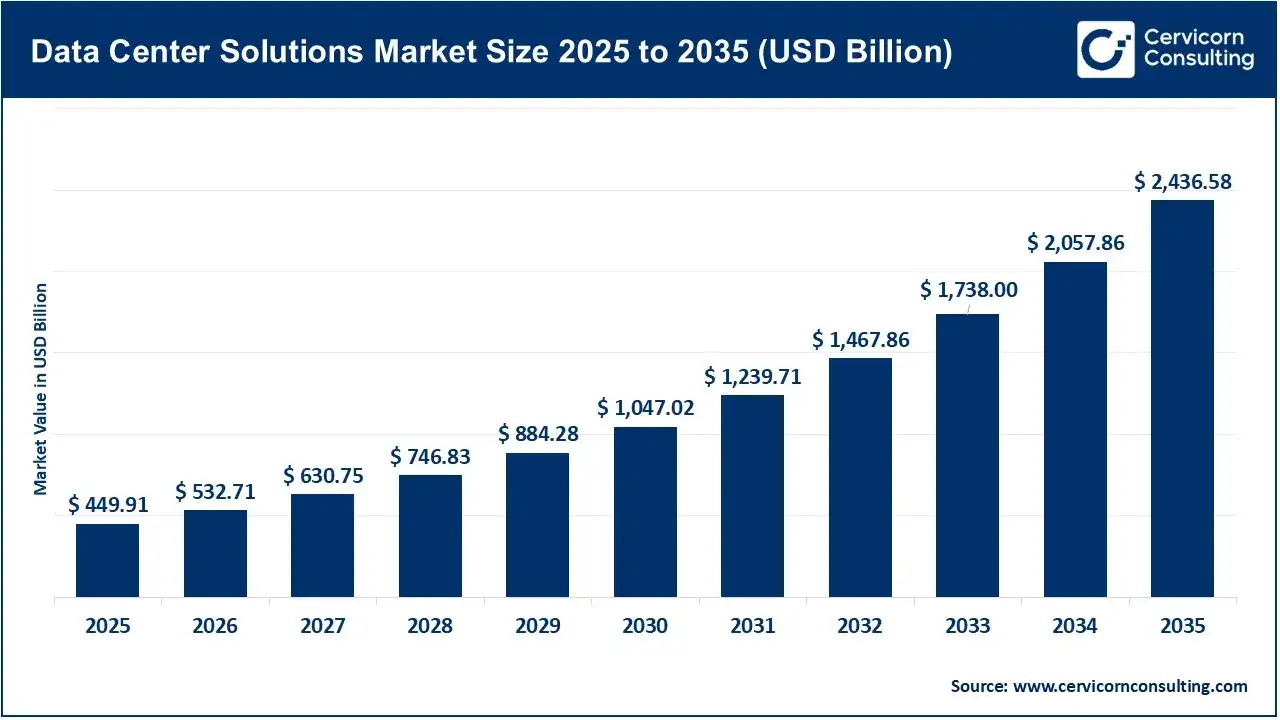
The global data center solutions market size was valued at USD 449.91 billion in 2025 and is projected to grow from USD 532.71 billion in 2026 to nearly USD 2,436.58 billion by 2035, registering a CAGR of 18.4% over the forecast period 2026 to 2035. The data center solutions market is expanding because of the rising demand for digital services, cloud computing, artificial intelligence, and big data analytics. In order to handle growing data volumes and support vital business applications, organizations are increasingly implementing sophisticated data center infrastructure. Demand for effective computing, storage, networking, power, and cooling solutions is also being driven by the increasing use of hyperscale data centers and edge data centers. Further bolstering market expansion is the emphasis on automation, energy efficiency, and dependable data center operations.
In February 2026, Vertiv and Netweb Technologies announced a partnership to jointly design and validate cutting-edge liquid-cooled rack solutions for Indian AI data centers. To support high-density AI workloads, the solutions integrate Vertiv's liquid-cooling and power infrastructure with Netweb's high-performance GPU computing platforms. The development underscores the increasing need for integrated power, cooling, and computing solutions as data center infrastructure requirements rise due to AI workloads.
Data Center Solutions Market Size and Forecast
- Base Year Market Size (2025): $449.91 billion
- Current Year Market Size (2026): $532.71 billion
- Estimated Year Market Size (2035): $2,436.58 billion
- Forecast Period CAGR (2026-2035): 18.40%
Key Takeaways
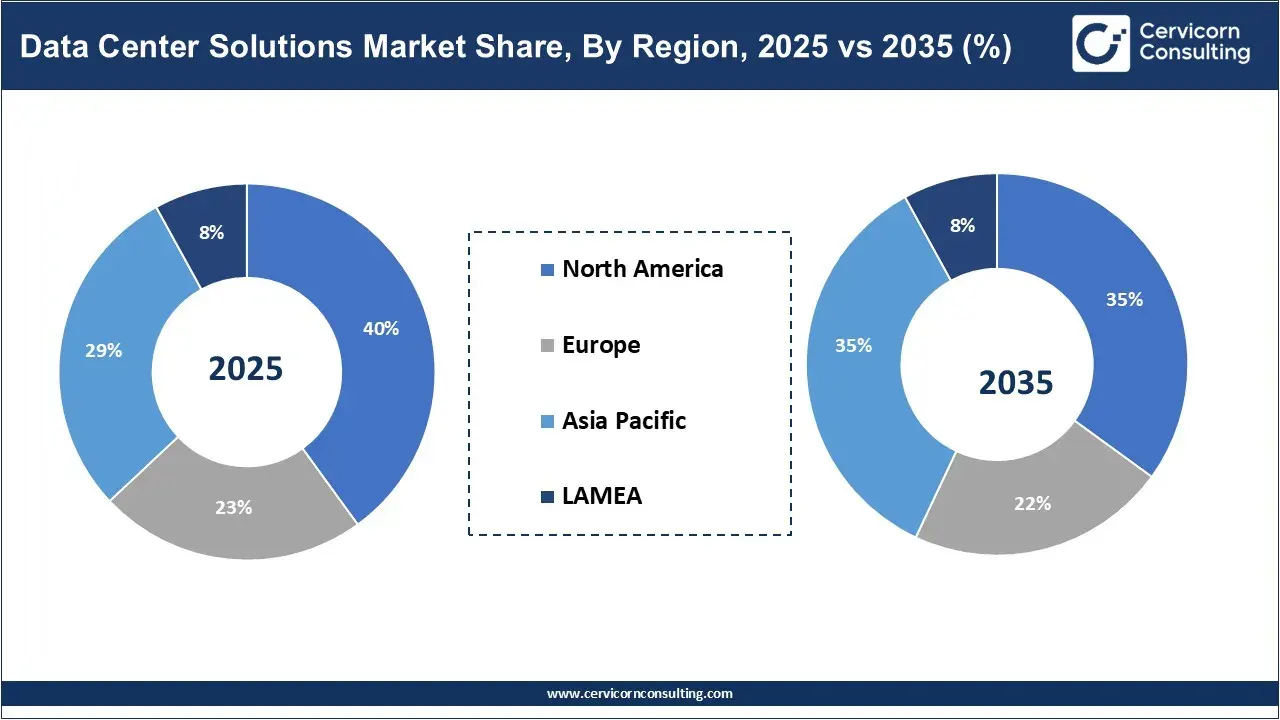
- By region, North America dominated the market in 2025 (revenue share 40%), supported by strong cloud adoption, advanced digital infrastructure, and the presence of major data center operators.
- By region, Asia Pacific is expected to grow at the fastest rate, driven by rapid digital transformation, rising cloud adoption, increasing internet consumption, and growing AI workloads.
- By infrastructure, IT and networking infrastructure dominated the market in 2025 (revenue share 40%), owing to the growing demand for servers, storage, networking, and computing capabilities.
- By infrastructure, mechanical and cooling infrastructure is expected to grow at the fastest rate, driven by increasing AI workloads, higher power densities, and the growing adoption of advanced cooling technologies.
- By power infrastructure, critical power systems dominated the market in 2025, supported by the need for reliable and continuous power supply for data center operations.
- By power infrastructure, power storage systems are expected to grow at the fastest rate, driven by rising power requirements, backup power needs, and increasing focus on reliable data center operations.
- By mechanical & cooling infrastructure, air-cooled systems dominated the market in 2025 (revenue share 22%), owing to their widespread adoption across conventional data center environments.
- By mechanical & cooling infrastructure, liquid cooling systems are expected to grow at the fastest rate, driven by increasing AI workloads, GPU deployment, and higher rack densities.
- By IT & networking infrastructure, servers dominated the market in 2025 (revenue share 32%), supported by their essential role in cloud computing, data processing, application hosting, and enterprise workloads.
- By IT & networking infrastructure, GPU and AI accelerators are expected to grow at the fastest rate, driven by increasing demand for artificial intelligence, machine learning, and high-performance computing.
- By physical infrastructure, racks and enclosures dominated the market in 2025 (revenue share 22%), owing to their essential role in housing servers, networking equipment, power systems, and other data center components.
- By physical infrastructure, monitoring and measurement systems are expected to grow at the fastest rate, driven by increasing demand for real-time infrastructure monitoring, automation, energy efficiency, and operational visibility.
- By data center size, large data centers dominated the market in 2025 (revenue share 65%), supported by the expansion of hyperscale cloud platforms, large enterprises, and AI infrastructure.
- By data center size, small and medium-sized data centers are expected to grow at the fastest rate, driven by increasing demand for edge computing, localized processing, and scalable regional infrastructure.
- By end user, IT and telecommunications dominated the market in 2025 (revenue share 33%), owing to the extensive use of data centers for cloud computing, networking, storage, digital services, and large-scale data processing.
- By end user, BFSI is expected to grow at the fastest rate, driven by increasing adoption of digital banking, cloud platforms, online financial services, and data-intensive applications.
Major Trends
- AI-Ready Data Centers: Growing AI and machine learning workloads are increasing demand for high-density computing infrastructure, advanced power systems, and specialized cooling solutions.
- Liquid Cooling Adoption: Data center operators are increasingly adopting liquid cooling to manage the higher heat generated by GPUs and other high-performance computing systems.
- Edge Data Center Expansion: The growing need for low-latency data processing is encouraging the deployment of edge data centers closer to end users and connected devices.
- Energy-Efficient Infrastructure: Increasing energy consumption and sustainability goals are driving demand for energy-efficient power, cooling, and facility-management solutions.
- Data Center Automation: Operators are adopting AI, automation, and intelligent monitoring tools to optimize workloads, predict equipment issues, improve resource utilization, and reduce operational costs.
- Modular Data Centers: Modular and prefabricated data center solutions are gaining attention because they enable faster deployment, flexible capacity expansion, and efficient infrastructure management.
Market Dynamics
Driver – Rising Adoption of AI and High-Density Computing
The demand for sophisticated data center solutions is being driven by the increasing use of artificial intelligence, machine learning, cloud computing, and high-performance computing. More processing power, dependable power infrastructure, sophisticated cooling, and effective networking solutions are all necessary for increasingly complex workloads. Scalable and high-performance infrastructure is becoming more and more necessary as hyperscale and AI-focused data centers grow.
- In February 2026, Vertiv and Netweb Technologies announced a collaboration to develop and validate liquid-cooled rack solutions for AI data centers in India. The solutions combine high-performance GPU computing with advanced liquid cooling and power infrastructure to address the growing power and thermal requirements of AI workloads. The development highlights the increasing demand for integrated data center solutions designed for high-density computing.
Restraint – High Infrastructure and Energy Costs
Market expansion may be hampered by the high capital costs associated with building and modernizing data centers, especially for businesses with limited funding. Additionally, data centers need a lot of electricity, cooling systems, backup power, and ongoing maintenance, all of which can raise operating costs. Operators are facing more financial strain due to the growing energy needs of high-density computing and AI workloads.
- In 2026, Schneider Electric highlighted the increasing power and cooling challenges associated with AI-ready data centers. The company is developing advanced power management and cooling solutions to help operators manage higher rack densities and energy requirements. This demonstrates how rising infrastructure complexity and energy consumption are becoming important cost considerations for data center operators.
Opportunity – Growth of Liquid Cooling and Energy-Efficient Infrastructure
Liquid cooling, advanced power management, modular infrastructure, and energy-efficient data center solutions are all benefiting greatly from the growing use of AI and high-performance computing. Higher thermal densities produced by sophisticated processors can be better managed by liquid cooling than by conventional cooling techniques. It is anticipated that increased emphasis on lowering energy usage and boosting operational effectiveness will promote the continued use of these technologies.
- In 2026, Vertiv is expanding its portfolio of liquid-cooling and power solutions to support high-density AI data center deployments. Its focus on advanced cooling architectures and power infrastructure reflects the industry's shift toward solutions capable of supporting increasingly dense computing environments. These developments are creating opportunities for data center solution providers as AI workloads continue to increase infrastructure requirements.
Regional Analysis
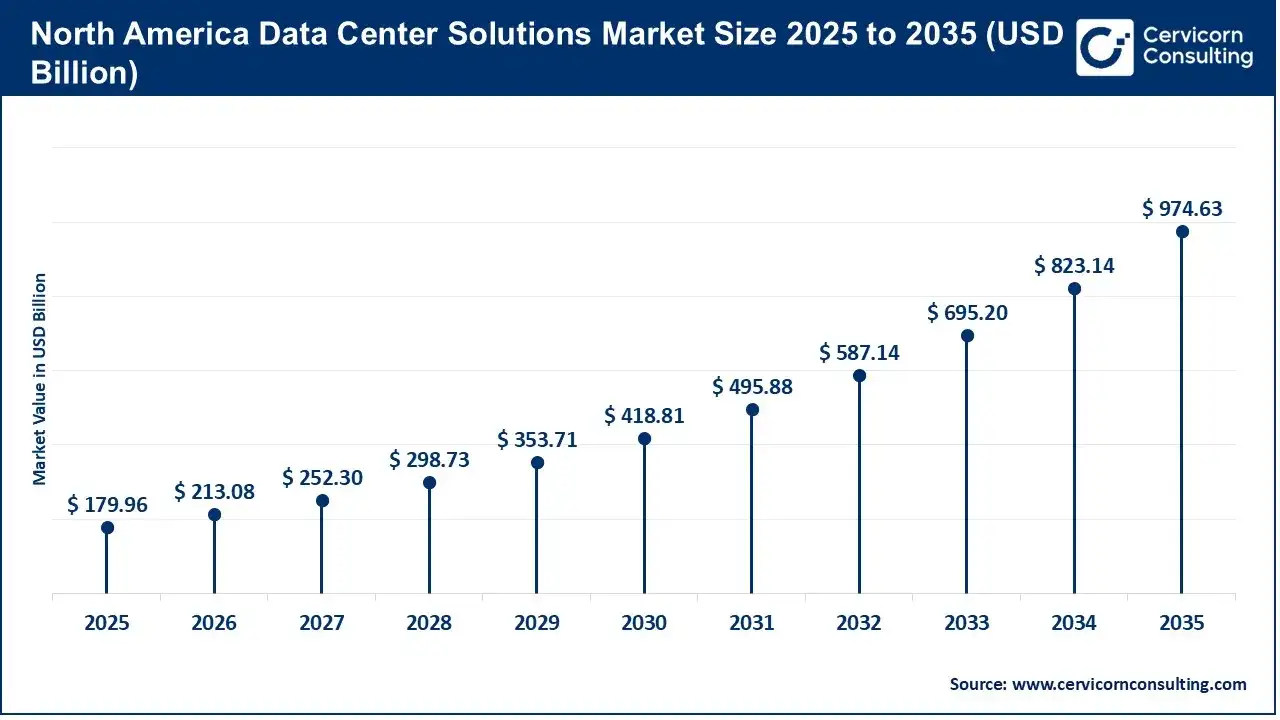
The North America data center solutions market size was valued at USD 179.96 billion in 2025 and is projected to reach USD 974.63 billion by 2035. North America is expected to continue its dominance in the market because of the existence of significant cloud service providers, tech firms, and operators of hyperscale data centers. Significant infrastructure investment is being driven throughout the region by the strong adoption of AI, cloud computing, and advanced digital services. Regional market leadership is further supported by the availability of cutting-edge technology, well-established data center ecosystems, and ongoing enterprise digitization.
The Asia-Pacific data center solutions market size was estimated at USD 130.47 billion in 2025 and is expected to hit USD 706.61 billion by 2035. Asia Pacific is expected to be the fastest-growing region, propelled by the quickening pace of digital transformation, rising cloud adoption, rising internet consumption, and increasing AI workloads. To meet the growing demand for digital services and localized computing capability, nations in the region are investing in new data center infrastructure. Regional growth is being accelerated by the development of hyperscale and edge data centers as well as rising expenditures in AI technology.
Segmental Analysis
Infrastructure Analysis
IT and networking infrastructure is expected to dominate the data center solutions market because the fundamental components of data center operations are servers, storage, networking hardware, and other technologies. The demand for dependable and scalable IT infrastructure is rising due to the quick expansion of cloud computing, digital services, AI workloads, and corporate applications. In order to handle increasing data volumes and high-performance workloads, data center operators are also improving networking and computing capabilities.
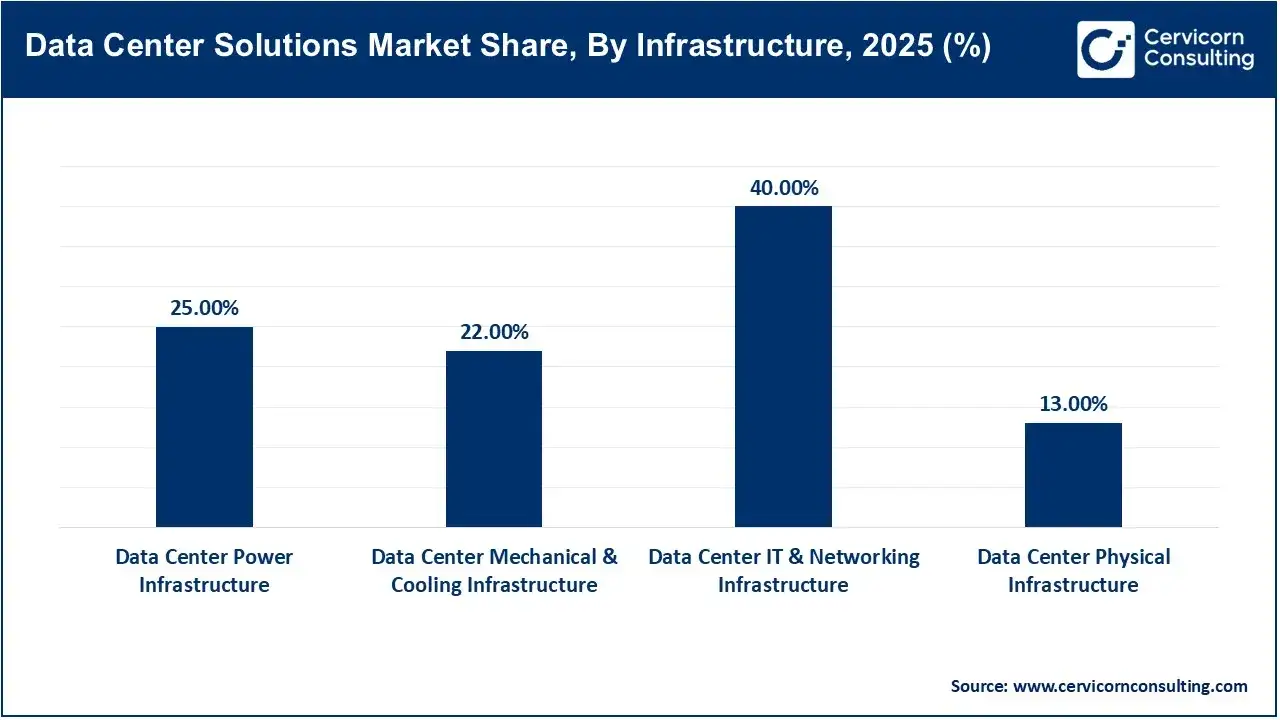
Mechanical and cooling infrastructure is expected to be the fastest-growing segment, motivated by high-performance computing systems and AI's growing power density. The demand for effective cooling technologies rises as a result of the significantly higher heat levels produced by advanced computing workloads. The segment is expanding due to the increasing use of energy-efficient cooling solutions, liquid cooling, and sophisticated thermal management systems.
Power Infrastructure Analysis
Critical power systems are expected to dominate the power infrastructure segment because of their crucial role in ensuring dependable and continuous data center operations. For servers, networking hardware, storage systems, and vital applications to function, data centers need constant power. Operators are being encouraged to invest in strong power infrastructure due to growing concerns about power reliability and rising computing demands.
Data Center Solutions Market Share, By Power Infrastructure, 2025 (%)
| Power Infrastructure |
Revenue Share, 2025 (%) |
| Critical Power Systems |
19% |
| Power Distribution |
18% |
| Backup Power Systems |
12% |
| UPS Systems |
17% |
| Generators |
11% |
| Power Storage Systems |
7% |
| Power Monitoring & Management |
8% |
| Cabling Infrastructure |
8% |
Power storage systems are expected to be the fastest-growing segment, since they are extensively used in traditional data center settings. Adoption is still supported by their well-established infrastructure, operational familiarity, and suitability for typical computing workloads. Due to the ease of installation and upkeep, air cooling is also used in many data centers today.
Mechanical & Cooling Infrastructure Analysis
Air-cooled systems are expected to dominate the mechanical and cooling infrastructure segment because they are widely deployed across conventional data center environments. Their established infrastructure, operational familiarity, and suitability for standard computing workloads continue to support adoption. Many existing data centers also rely on air cooling because of its relatively straightforward installation and maintenance requirements.
Liquid cooling systems are expected to be the fastest-growing segment because AI, GPUs, and high-performance computing have growing thermal requirements. An efficient method of controlling the heat produced by high-density computing environments is liquid cooling. Data center operators are being encouraged to implement advanced liquid-cooling solutions by the increasing deployment of AI servers and the trend toward higher rack densities.
IT & Networking Infrastructure Analysis
Servers are expected to dominate the IT and networking infrastructure segment due to the fact that they are essential to cloud computing, data processing, application hosting, and enterprise workloads. The demand for more powerful and scalable server systems is being driven by the ongoing expansion of digital services and data generation. In order to accommodate AI, analytics, virtualization, and other demanding workloads, data center operators are also modernizing server infrastructure.
Data Center Solutions Market Share, By IT & Networking Infrastructure, 2025 (%)
| IT & Networking Infrastructure |
Revenue Share, 2025 (%) |
| Servers |
32% |
| Storage Systems |
16% |
| Networking Equipment |
15% |
| GPU & AI Accelerators |
22% |
| Hyperconverged Infrastructure |
6% |
| High-Speed Interconnects |
5% |
| Others |
4% |
GPU and AI accelerators are expected to be the fastest-growing segment as businesses' workloads for machine learning and artificial intelligence grow quickly. The high-performance computing power needed to train and run sophisticated AI models is provided by these specialized processors. Adoption is being accelerated by the growth of AI-focused data centers and rising demand for generative AI applications.
Physical Infrastructure Analysis
Racks and enclosures are expected to dominate the physical infrastructure segment because they offer the fundamental structure needed to house servers, networking hardware, power systems, and other components of data centers. Demand is being supported by growing data center deployments and the requirement for scalable, safe, and well-organized equipment installation. In order to meet increased equipment density and sophisticated cooling needs, modern rack designs are also changing.
Monitoring and measurement systems are expected to be the fastest-growing segment as data center operators pay more attention to equipment performance, energy efficiency, and operational visibility. Operators can monitor temperature, cooling efficiency, power consumption, and infrastructure conditions in real time thanks to advanced monitoring technologies. Demand for these systems is being increased by the growing use of automation and intelligent data center management.
Data Center Size Analysis
Large data centers are expected to dominate the market because of the ongoing growth of big businesses, AI infrastructure, and hyperscale cloud platforms. To accommodate massive digital workloads, these facilities need substantial infrastructure for computing, storage, networking, power, and cooling. Large-scale data center facilities are being developed and expanded in response to the growing demand for cloud services and AI computing.
Data Center Solutions Market Share, By Data Center Size, 2025 (%)
| Data Center Size |
Revenue Share, 2025 (%) |
| Small & Medium-Sized Data Centers |
35% |
| Large Data Centers |
65% |
Small and medium-sized data centers are expected to be the fastest-growing segment as the need for scalable and localized computing infrastructure grows. The need for smaller facilities near users and data sources is being driven by the growth of edge computing, regional cloud services, and enterprise digitalization. Adoption is further boosted by their adaptability and capacity to meet particular business or regional needs.
End User Analysis
IT and telecommunications are expected to dominate the end-user segment because cloud computing, networking, storage, digital services, and large-scale data processing are all heavily dependent on data centers. Advanced infrastructure is in high demand due to the ongoing expansion of cloud platforms, telecom networks, and internet services. IT and telecom companies' investments are being further supported by rising data traffic and digital transformation.
BFSI is expected to be the fastest-growing end-user segment because cloud platforms, data-intensive apps, online financial services, and digital banking are becoming more widely used. To handle sensitive data and crucial transactions, financial institutions need data center infrastructure that is safe, dependable, scalable, and highly available. Demand is also being supported by rising investments in digital financial services, cybersecurity, and regulatory compliance.
Government Insights
- In July 2025, The U.S. Department of Energy announced the selection of federal sites for potential AI data center and energy infrastructure development. The initiative aims to accelerate the deployment of AI infrastructure while connecting data center growth with reliable energy generation and grid capacity. This is expected to support demand for advanced data center power, cooling, networking, and infrastructure solutions.
- In 2025, The U.S. Department of Energy continued to promote energy-efficient data center technologies through programs focused on reducing infrastructure energy consumption and improving cooling and operational efficiency. These initiatives encourage data center operators to adopt efficient power, cooling, and facility-management solutions.
- In 2025, India's Ministry of Electronics and Information Technology supported State Data Center infrastructure through financial and technical assistance, helping states establish and operate secure and reliable digital infrastructure. Such government-backed data infrastructure programs support demand for computing, storage, networking, power, cooling, and data center management solutions.
- In 2026, The U.S. Department of Energy supported the expansion of AI infrastructure while addressing the growing electricity requirements of data centers. Its data center resource initiatives focus on reliable energy supply and infrastructure development, creating opportunities for efficient power and cooling technologies used in modern data centers.
Recent Developments
- In September 2026, Qualcomm and Amazon announced a long-term partnership to develop and supply custom AI data-center chips and related technologies. The collaboration also includes advanced optical connectivity solutions designed to support the increasing bandwidth requirements of AI infrastructure. This development highlights the growing demand for specialized computing and networking solutions in AI-focused data centers.
- In August 2026, Cisco expanded its collaboration with NVIDIA to strengthen AI data center infrastructure through high-density liquid- and air-cooled AI servers. The development focuses on supporting different AI architectures and increasing computing capacity for AI workloads. It also reflects the growing importance of advanced networking, cooling, and server infrastructure in modern data centers.
- In August 2026, NVIDIA announced an investment and infrastructure agreement with SB Energy to support a large-scale AI data center project in Ohio. The project is expected to significantly expand AI computing capacity and includes major investments in power infrastructure. The development demonstrates the increasing integration of advanced computing, power, and data center infrastructure to support AI growth.
- In September 2026, Oracle expanded its AI data center infrastructure as demand for cloud and AI computing accelerated. The company brought additional data center capacity online and continued expanding large-scale infrastructure to support AI workloads. This development highlights the rapid expansion of hyperscale data center capacity and the growing need for power, cooling, networking, and computing solutions.
Top Companies
Segments Covered
By Infrastructure
- Data Center Power Infrastructure
- Data Center Mechanical & Cooling Infrastructure
- Data Center IT & Networking Infrastructure
- Data Center Physical Infrastructure
By Power Infrastructure
- Critical Power Systems
- Power Distribution
- Backup Power Systems
- UPS Systems
- Generators
- Power Storage Systems
- Power Monitoring & Management
- Cabling Infrastructure
By Mechanical & Cooling Infrastructure
- Air-Cooled Systems
- Liquid Cooling Systems
- Chillers
- Cooling Towers
- Economizers
- Heat Pumps
- Cooling Distribution Units
- Rear-Door Heat Exchangers
- Others
By IT & Networking Infrastructure
- Servers
- Storage Systems
- Networking Equipment
- GPU & AI Accelerators
- Hyperconverged Infrastructure
- High-Speed Interconnects
- Others
By Physical Infrastructure
- Racks & Enclosures
- Cabling & Connectivity
- Physical Security Systems
- Fire Detection & Suppression
- Building Management Systems
- Monitoring & Measurement Systems
- Others
By Data Center Size
- Small & Medium-Sized Data Centers
- Large Data Centers
By End User
- IT & Telecommunications
- BFSI
- Government & Defense
- Healthcare & Life Sciences
- Energy & Utilities
- Manufacturing
- Retail & E-commerce
- Media & Entertainment
- Education
- Others
By Region
- North America
- Europe
- Asia Pacific
- Middle East & Africa
- Latin America
