Data Center Processor Market Size, Growth, Forecast 2026 to 2035
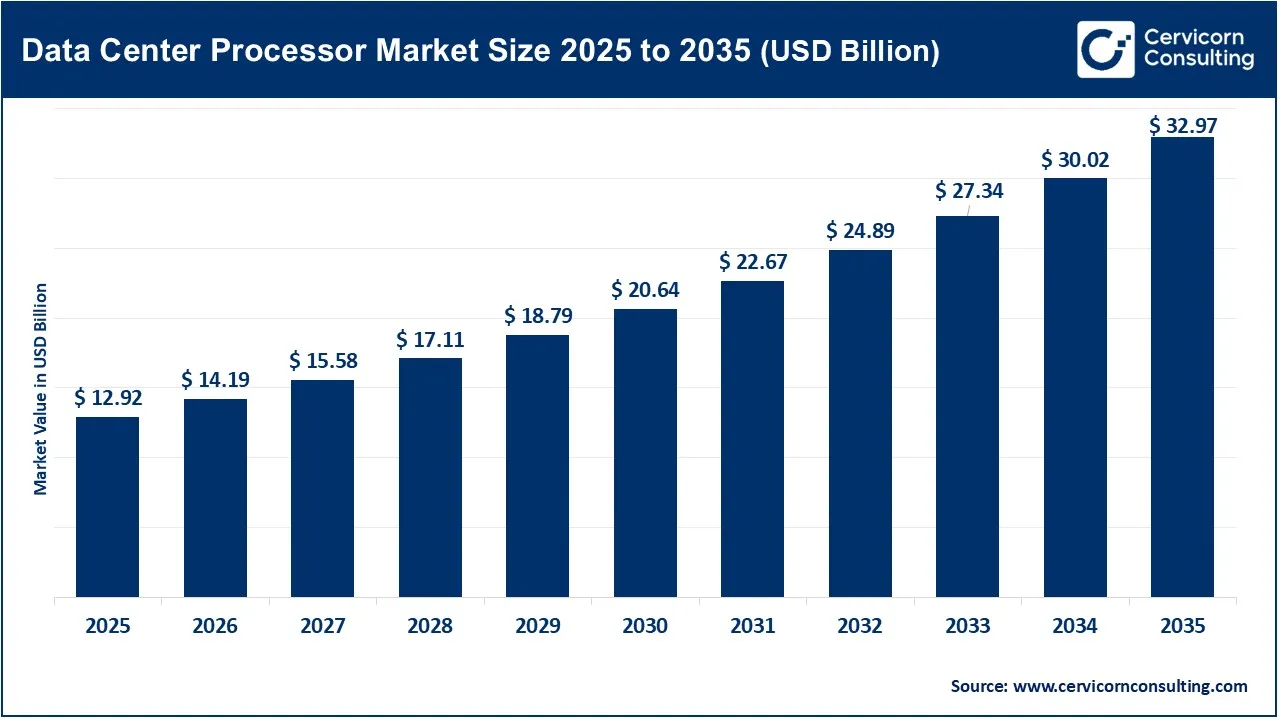
The global data center processor market size was valued at USD 12.92 billion in 2025 and is projected to reach USD 32.97 billion by 2035; expanding at a compound annual growth rate (CAGR) of 9.8% during the forecast period from 2026 to 2035.
Report Highlights
- By region: North America dominated the market in 2025, supported by hyperscale cloud operators, advanced data center infrastructure, and strong demand for AI computing.
- By processor type: Central processing units (CPUs) dominated the market in 2025, supported by their widespread use in general-purpose computing, server management, virtualization, and enterprise workloads.
- By data center type: Hyperscale data centers dominated the market in 2025, driven by large-scale cloud infrastructure and substantial processor deployment by major cloud service providers.
- By application: Artificial intelligence and machine learning dominated the market in 2025, reflecting growing demand for processor-intensive model training and inference.
- By end-use industry: IT and telecommunications dominated the market in 2025, supported by cloud platforms, digital services, enterprise computing, and large-scale data processing.
Data Center Processor Market Overview
A data center processor is a computing element that performs instructions, manipulates data or speeds up a data center workload. When it comes to server performance, processors are at the core, influencing everything from an application's speed and a data center's efficiency to its energy requirements.
CPU-led general-purpose server market historically centered on these chips. The primary processors evolved to run operating systems, applications, virtual environments, databases and general server workloads. They are so flexible that they are hard to replace for most general-purpose workloads. But specialized processing chips have stepped in as operators have begun to run AI training, large inference, encryption, network virtualization and other intense workloads.
Recent Trends
AI Workloads Are Changing Processor Selection
- AI infrastructure has elevated processor architecture to a more prominent role in data-center design. Training models can draw on large amounts of co-processor parallelism, need fast communication between accelerators, and require large amounts of memory bandwidth. Inference has a different set of constraints: model size, latency, throughput, and the total number of in-flight requests.
Custom Silicon Is Now a Strategic Choice
- Big cloud and tech firms are increasingly finding reasons to build or deploy processor hardware optimized for their services. Custom silicon can be designed for specific AI models, cloud workloads, networking tasks, or power budget. For large-scale use, this could provide more optimization of performance, operating expenses, and hardware road maps.
Performance per Watt Is Gaining Focus
- Energy availability is now coming into focus for data center growth. Greater density in computing is likely to boost both power draw and cooling needs, particularly for facilities designed around high-performance computing. Processer capabilities are now weighed in with the power needed to achieve them.
Heterogeneous Computing Is Becoming More Common
- CPUs handle heterogenous work, GPUs accelerate AI workloads, and DPUs offload some of the networking and security tasks. FPGAs and ASICs are also available for those workloads that can benefit from programmable or application-specific hardware.
Data Center Processor Market Dynamics
Growth Drivers
Expansion of AI Computing Infrastructure
- Training and deploying AI models requires substantial computing capacity. Data center operators are investing in servers and processor platforms that can support parallel computation, high memory bandwidth, and intensive data movement. This demand is creating opportunities for GPUs and other accelerators while also supporting CPUs that coordinate workloads and manage the surrounding infrastructure.
Continued Growth in Cloud Services
- Cloud providers need processors to support virtual machines, databases, storage services, business applications, and digital platforms. As customer workloads grow, providers must expand capacity while maintaining performance and utilization. This creates recurring demand for server processors and encourages hardware upgrades as older systems become less efficient or fail to meet workload requirements.
Increasing Volume and Complexity of Data Processing
- Organizations are generating and processing data across analytics platforms, connected devices, digital services, and business applications. These workloads require computing resources that can manage transactions, analyze information, and support real-time decisions. Processor demand benefits from this expansion, although the hardware mix varies according to the complexity and timing requirements of each application.
Market Restraints
High Infrastructure and Deployment Costs
- Advanced processors can carry substantial acquisition costs, particularly when deployed in systems that also require specialized memory, high-speed networking, and enhanced cooling. Smaller operators may find it difficult to justify these investments without predictable workloads or sufficient utilization. The total cost of deployment can therefore limit adoption even when the technology offers clear performance advantages.
Power and Cooling Constraints
- More powerful processors can increase electricity consumption and heat generation, especially in densely packed AI systems. Data center operators may need to upgrade power distribution, cooling equipment, or facility infrastructure before deploying additional capacity. In locations where power is expensive or difficult to secure, these constraints can delay projects and influence which processor configurations are commercially viable.
Software Compatibility and Migration Challenges
- Moving applications to a different processor architecture can require software changes, testing, and performance tuning. Some applications depend on established instruction sets, libraries, or specialized development tools. These dependencies can make hardware transitions expensive and time-consuming. Organizations may continue using familiar processor platforms even when alternatives appear attractive on paper.
Market Opportunities
Growth in Specialized AI Processors
- AI workloads are creating opportunities for processors designed around specific model architectures, inference requirements, and computing environments. Cloud providers and hardware developers can target workloads where general-purpose solutions may not deliver the desired combination of performance, cost, and energy efficiency. Commercial success will depend on software support, practical performance, and the ability to deploy these processors at scale.
Adoption of Edge and Distributed Computing
- Businesses increasingly need to process information closer to where it is generated, particularly in industrial facilities, telecommunications networks, retail environments, and connected infrastructure. Edge and micro data centers can support these requirements by reducing dependence on distant centralized facilities. This creates opportunities for processors that balance computing capability with limited space, power, and cooling capacity.
Demand for More Efficient Data Center Infrastructure
- Energy efficiency has become an important design consideration for operators expanding their computing capacity. Processors that improve workload throughput relative to power consumption may help reduce operating costs and make better use of available infrastructure. Opportunities extend beyond the processor itself to system design, workload scheduling, memory optimization, and hardware-software co-design.
Market Challenges
Rapidly Changing Technology Requirements
- Processor development cycles must keep pace with changes in AI models, software frameworks, memory technologies, and server architectures. Hardware designed around current workloads may not deliver the same advantages as applications evolve. Manufacturers face the challenge of improving performance without creating products that become difficult to support or uneconomical before their expected service life ends.
Dependence on Software Ecosystems
- A processor's commercial value depends partly on whether developers can use it effectively. Libraries, compilers, frameworks, debugging tools, and optimized applications can influence adoption as much as hardware specifications. New entrants may struggle to gain traction if customers need to rewrite applications or train staff to use unfamiliar tools. Building a dependable software ecosystem requires time and sustained investment.
Supply Chain and Capacity Planning
- Advanced processors rely on complex manufacturing, packaging, memory, and component supply chains. Demand can rise quickly when large operators expand infrastructure, placing pressure on production capacity and delivery schedules. Data center operators must plan purchases around availability, deployment timelines, and the useful life of existing equipment. Supply uncertainty can complicate investment decisions and delay capacity additions.
Regional Analysis
North America Data Center Processor Market
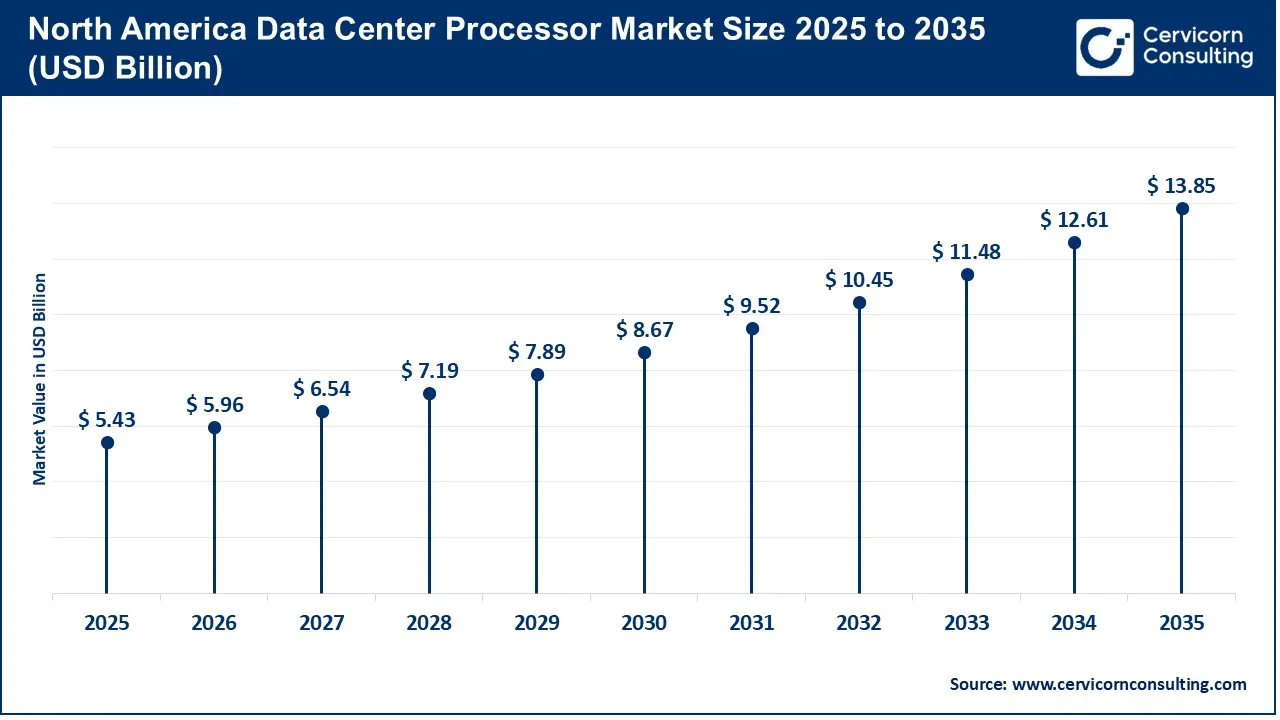
The North America data center processor market size was valued at USD 5.43 billion in 2025 and is expected to surpass USD 13.85 billion by 2035. North America hosts a significant cloud infrastructure and enterprise computing, technology providers, and AI activity, which drives the demand for new processors. Availability of a rich ecosystem of software offerings in the market supports adoption of different processor architectures.
The landscape isn't the same throughout the region. Hyperscale and accelerated computing plays a major role in some markets, while enterprise modernization, colocation and general-purpose cloud workloads are just as relevant in others. Available power, time to build and infrastructure costs can all influence how quickly new capacity is added to the mix.
Asia-Pacific Data Center Processor Market
The Asia-Pacific data center processor market size was estimated at USD 3.75 billion in 2025 and is expected to reach USD 9.56 billion by 2035. Asia-Pacific is projected to be the fastest growing regional market in this period, driven by rising cloud adoption, digital services, increased spending on AI, a growing data center footprint, and new and expanding demand from large technology and telecom companies. This region is also host to key semiconductor manufacturing and electronics supply chain capability.
Individual markets vary in their growth rate and processor needs. Countries that are building hyperscale data centers and AI infrastructure will have different needs than those that require more enterprise computing, telecom, and digital public infrastructure. Power availability, jurisdictional and regulatory requirements, semiconductor manufacturing capacity, and technical skill levels will all shape the deployment timeline.
Top Countries: Patent and Innovation Analysis
| Country |
Innovation focus |
Relevance to the market |
| United States |
Server CPUs, GPUs, AI accelerators, processor architecture, and data center systems |
A major hub for processor design, cloud infrastructure, AI computing, and software development. |
| China |
Domestic processor development, AI chips, server systems, and semiconductor capabilities |
Investment in locally developed computing platforms and efforts to strengthen domestic semiconductor supply. |
| Taiwan |
Semiconductor foundry services, advanced packaging, and chip manufacturing |
A key part of the global supply chain for advanced processors and related components. |
| South Korea |
Memory technologies, semiconductor manufacturing, and computing components |
Supports the semiconductor and memory ecosystem required by high-performance computing systems. |
| Japan |
Semiconductor materials, manufacturing equipment, electronic components, and specialized computing technologies |
Contributes essential materials, equipment, and components used in processor manufacturing. |
Data Center Processor Market Segmentation Analysis
Processor Type Analysis
CPUs: CPUs dominated the data center processor market in 2025. Their broad instruction-handling capabilities make them suitable for operating systems, enterprise applications, virtualization, databases, cloud services, and general server management. Even as accelerators become more important, CPUs remain central to coordinating workloads and supporting applications that do not require highly specialized processing.
GPUs: GPUs are expected to be the fastest-growing processor type from 2026 to 2035. Their parallel-processing capabilities make them useful for AI training, selected inference workloads, scientific computing, and other operations involving large numbers of simultaneous calculations. Demand will depend on AI infrastructure investment, software compatibility, memory capacity, and the economics of deploying accelerated systems.
Data Center Type Analysis
Hyperscale Data Centers: Hyperscale data centers drove the market in 2025. Their huge server counts and demand for processing power across cloud, AI, storage and digital services all generate significant processor demand. They can also enable deployment of niche processors if the associated efficiency benefits outweigh the costs.
Enterprise Data Centers: Data center workloads will include all of an enterprise's internal applications, business databases, private cloud, security, and other applications. The proliferation of standard computers means most applications will run on CPUs – specifically in the form of standard, proven CPUs. The direction of processor refreshes depends on modernization strategies, applications, virtualization, and the mix of in-house versus public cloud.
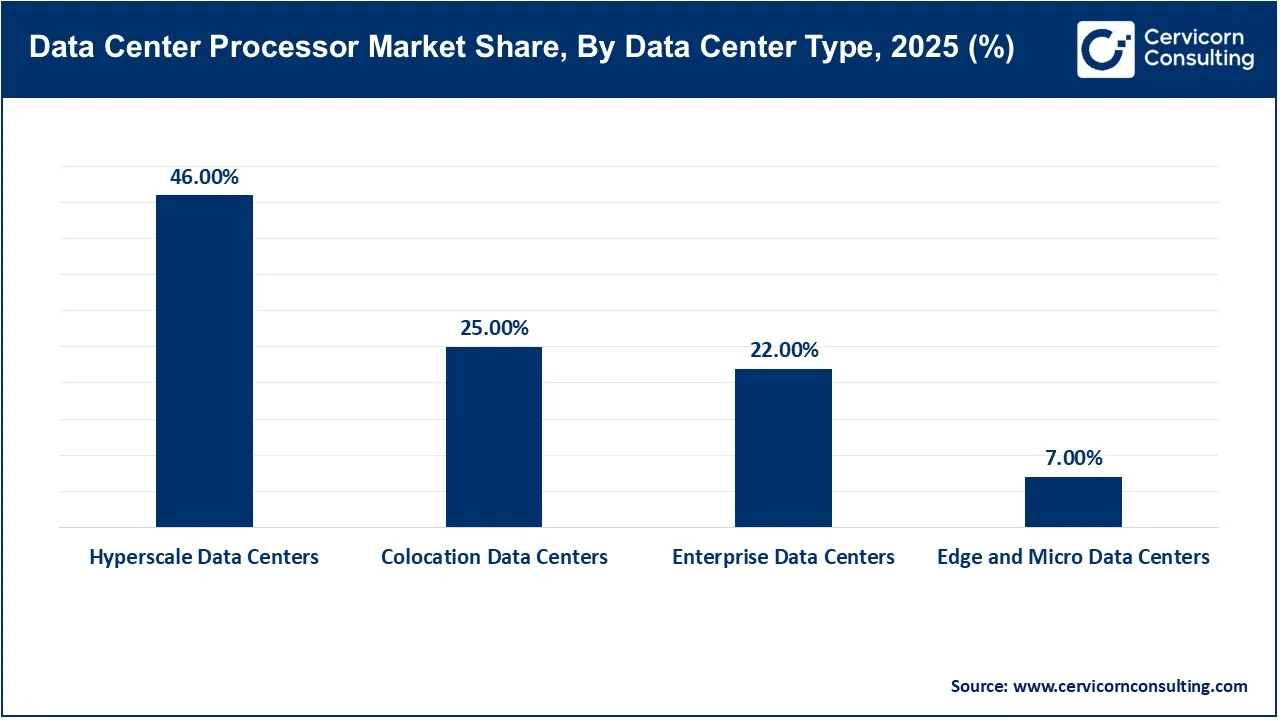
Edge and Micro Data Centers: Edge and micro data centers will see the highest CAGR among the data center types in the forecast period (2026-2035). Edge data centers have gained importance as they place computing closer to devices, users or operational environments and enable applications with low latency or localized data processing needs. Their processor needs may be driven more by space, power, cooling and reliability constraints than by the size of centralized data centers.
Application Analysis
AI and Machine Learning: AI and machine learning dominated the data center processor market by application in 2025, according to the selected market segmentation. These workloads use processors for model training, inference, data preparation, and related computational tasks. The hardware mix depends on model complexity, latency targets, workload volume, and the economics of running AI services.
Cloud Computing and Virtualization: Cloud computing and virtualization rely on processors to run virtual machines, containers, hosted applications, and shared infrastructure services. CPUs remain important because they support a wide range of general-purpose workloads. Demand is influenced by cloud adoption, server utilization, workload consolidation, and the need to deliver reliable performance to multiple customers.
High-Performance Computing: High-performance computing is expected to be the fastest-growing application from 2026 to 2035. HPC supports workloads that require substantial computational capacity, including scientific modeling, engineering simulations, advanced research, and complex numerical analysis. Depending on the task, these systems may combine CPUs with GPUs or other accelerators to handle demanding calculations.
End-Use Industry Analysis
IT and Telecommunications: IT and telecommunications dominated the market in 2025. Cloud platforms, hosting providers, communication networks, digital services, and enterprise IT infrastructure depend on large volumes of computing capacity. Processor demand reflects both routine workloads and the growing use of accelerated computing in cloud and network environments.
Banking, Financial Services, and Insurance (BFSI): Financial institutions use data center processors for transaction processing, risk analysis, fraud detection, customer platforms, data management, and regulatory reporting. Their requirements often emphasize reliability, security, predictable performance, and the ability to process large volumes of transactions. Procurement decisions also reflect compliance obligations and the cost of migrating critical systems.
Healthcare and Life Sciences: Healthcare and life sciences are expected to be the fastest-growing end-use industry from 2026 to 2035. Medical imaging, computational biology, genomic analysis, drug discovery, research computing, and AI-assisted workflows can require significant processing resources. Adoption will depend on data governance, privacy requirements, integration with clinical systems, and the practical value of computational tools in research and care delivery.
Competitive Landscape
- Intel participates in the market through its server CPU portfolio and related data center technologies. Its position is linked to the established x86 software ecosystem and the continued need for general-purpose computing. Customers evaluate processor performance alongside platform compatibility, power consumption, availability, and total system cost.
- AMD competes in server CPUs and accelerated computing. Its data center portfolio serves general-purpose server workloads and systems requiring high computing throughput. Adoption depends on performance across relevant applications, platform support, product availability, and the economics of upgrading existing infrastructure.
- NVIDIA is a major supplier of GPUs and accelerated computing platforms used in AI and high-performance computing. Its broader platform approach includes processors, networking, systems, and software. This integration can be important to customers building large AI clusters, although cost, power requirements, supply availability, and workload suitability remain central purchasing considerations.
- Broadcom operates across semiconductor technologies that include networking and custom silicon. Its relevance to data center processor infrastructure is particularly associated with specialized designs and connectivity technologies used in large-scale systems. Its role differs from that of vendors focused primarily on general-purpose server CPUs.
- Marvell supplies semiconductor technologies for data infrastructure, including networking, storage, and custom computing applications. Its participation reflects the importance of moving data efficiently between processors, memory, storage, and network systems. The value of these technologies depends on integration with the wider infrastruacture.
- Ampere Computing focuses on Arm-based server processors for cloud and data center workloads. Alternative processor architectures can appeal to operators seeking different performance and power characteristics. Adoption depends on software compatibility, application performance, platform availability, and the total cost of running workloads.
Recent Developments
- AMD introduced its Helion rack-scale platform on October 12, 2026, targeting infrastructure requirements for agentic AI workloads. The platform combines AMD EPYC CPUs and Instinct GPUs in configurable rack designs, with options for different computing and cooling requirements. AMD plans to make the platform available through ecosystem partners in November 2026.
- Microsoft announced its Maia 300 custom AI chip in October 2026, advancing its effort to develop in-house silicon for AI infrastructure. The processor is intended to support inference workloads across Microsoft's AI services, with production planned for 2027.
Segments Covered
By Processor Type
- Central Processing Units (CPUs)
- Graphics Processing Units (GPUs)
- Application-Specific Integrated Circuits (ASICs) and AI Accelerators
- Field-Programmable Gate Arrays (FPGAs)
- Data Processing Units (DPUs) and Other Processors
By Data Center Type
- Hyperscale Data Centers
- Colocation Data Centers
- Enterprise Data Centers
- Edge and Micro Data Centers
By Application
- Artificial Intelligence and Machine Learning
- Cloud Computing and Virtualization
- High-Performance Computing (HPC)
- Data Analytics and Database Processing
- Networking, Security, and Other Applications
By End-Use Industry
- IT and Telecommunications
- Banking, Financial Services, and Insurance (BFSI)
- Healthcare and Life Sciences
- Retail and E-commerce
- Government and Public Sector
- Media, Entertainment
- Other
By Region
- North America
- Europe
- Asia-Pacific
- Latin America
- Middle East and Africa