Data Center Energy Storage Systems Market Size and Growth Outlook 2026 to 2035
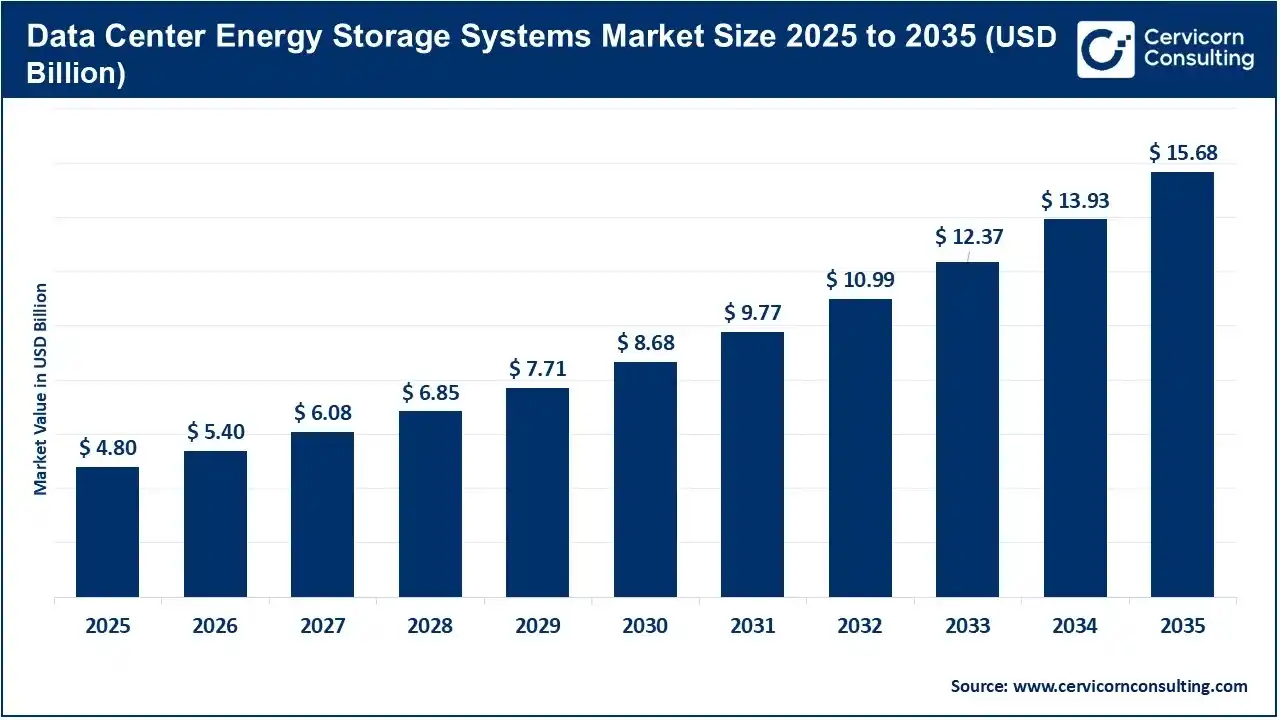
The global data center energy storage systems market size was valued at USD 4.80 billion in 2025 and is projected to grow from USD 5.40 billion in 2026 to nearly USD 15.68 billion by 2035, registering a CAGR of 12.6% over the 2026 to 2035 period. The data center energy storage systems market is expanding to support cloud computing, AI workloads, and expanding digital services. Data centers need dependable, consistent, and efficient power. The use of battery energy storage systems for backup power, peak-load control, power quality, integration of renewable energy sources, and increased grid reliability is growing. The market is expanding due to the increased emphasis on energy efficiency and environmentally friendly data center operations.
- In April 2026, Vertiv announced a collaboration with CPower to help data centers use battery energy storage and other on-site energy resources more effectively. The initiative aims to improve power resilience, support grid services, and help data centers manage increasing electricity requirements.
Report Highlights
- By region, North America dominated the market in 2025, supported by strong hyperscale infrastructure, AI investment, and rising power demand.
- By region, Asia Pacific is expected to grow at the fastest rate, driven by expanding data centers, cloud adoption, AI deployment, and digitalization.
- By storage technology, lithium-ion batteries dominated the market in 2025, owing to their high energy density, fast response, and established supply chain.
- By storage technology, flow batteries and sodium-ion batteries are expected to grow at the fastest rate, driven by demand for longer-duration storage, improved safety, and alternative technologies.
- By system type, BESS and UPS energy storage dominated the market in 2025, supported by their role in backup power and uninterrupted operations.
- By system type, BESS is expected to grow at the fastest rate, driven by rising power demand, scalability, and renewable energy integration.
- By capacity, the 1–10 MW segment dominated the market in 2025, owing to its suitability for medium- and large-scale data centers.
- By application, UPS & backup power dominated the market in 2025, supported by the need for uninterrupted and reliable electricity.
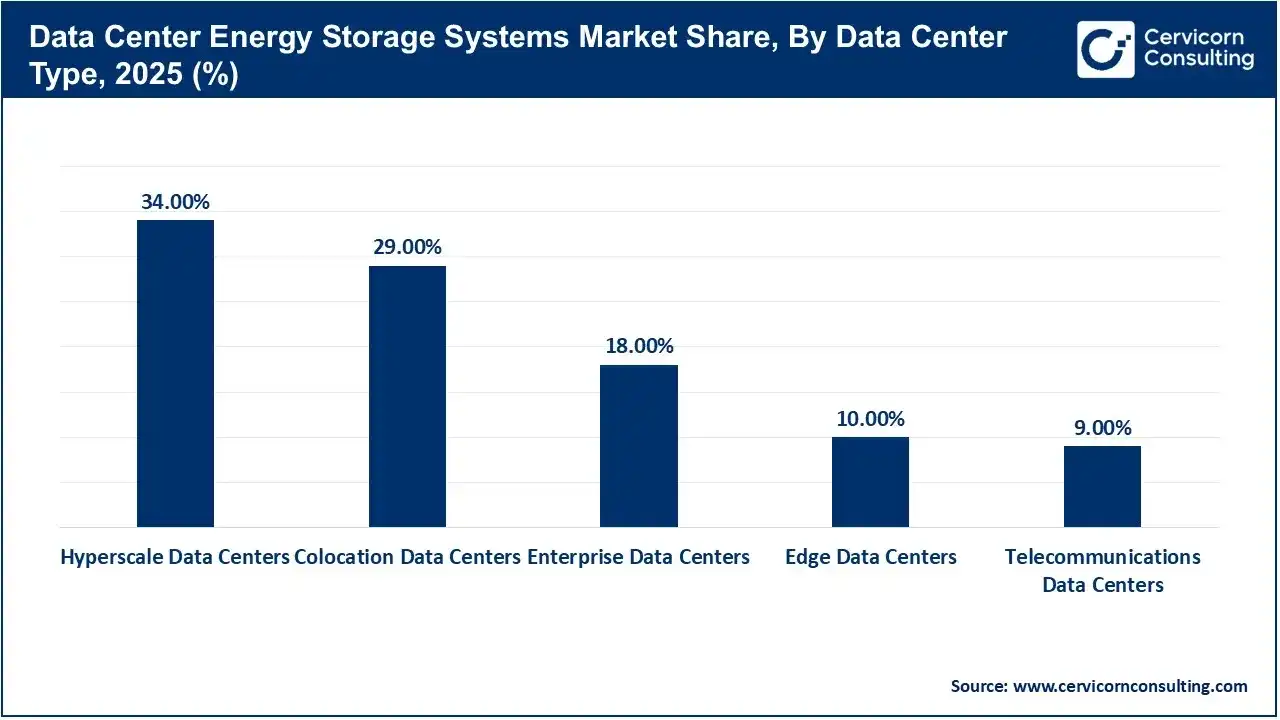
- By data center type, hyperscale data centers dominated the market in 2025, owing to their large computing requirements and high power consumption.
- By data center type, edge data centers are expected to grow at the fastest rate, driven by demand for low-latency computing and localized data processing.
- By end-use vertical, IT & telecommunications dominated the market in 2025, supported by growing demand for reliable power across digital infrastructure.
- By end-use vertical, AI and cloud infrastructure are expected to grow at the fastest rate, driven by expanding AI workloads, cloud adoption, and computing requirements.
Recent Trends
- Growing Demand for Backup Power: Increasing need for uninterrupted power supply is driving energy storage adoption in data centers.
- Integration of Renewable Energy: Data centers are increasingly combining energy storage with solar and other renewable power sources.
- Rise of Lithium-Ion Batteries: Lithium-ion technologies are gaining adoption due to their high energy density and fast response.
- AI-Driven Energy Management: AI and smart energy management systems are being used to optimize storage, power consumption, and grid interaction.
- Shift Toward Sustainable Data Centers: Growing focus on reducing emissions is encouraging the use of battery storage and renewable energy.
- Grid Stability and Peak Management: Energy storage is increasingly used to manage peak demand and support grid stability.
- Adoption of Modular Storage Systems: Modular and scalable battery systems are gaining popularity as data centers expand their power requirements.
Government Initiatives
| Country |
Government initiative / policy |
Relevance to data center energy storage |
| United States |
Department of Energy Grid Resilience and Innovation Partnerships (GRIP) and data-center power initiatives |
Supports battery storage, grid flexibility, backup power, and other technologies needed to manage rapidly increasing data-center electricity demand. |
| India |
National framework for Energy Storage Systems and BESS deployment |
Expands the domestic storage ecosystem that can support reliable power, renewable integration, peak-load management, and backup requirements for data centers. |
| China |
National Green Computing Facility program and Green Data Center standards |
Encourages data centers to integrate storage, renewable energy, efficient power infrastructure, and flexible load-management technologies. |
| Singapore |
Green Data Centre Roadmap |
Creates demand for energy-efficiency, renewable-energy, and hybrid power solutions, including storage for constrained grid capacity and cleaner data-center operations. |
| Japan |
Watt-Bit Collaboration Public-Private Advisory Council |
Supports coordinated power infrastructure planning around data centers and creates opportunities for flexible energy resources and storage as electricity demand rises. |
| Canada |
Federal support for sovereign AI and data-center infrastructure |
Expansion of AI and data-center capacity increases the need for reliable power, grid infrastructure, backup systems, and energy-storage solutions. |
| European Union |
Data Centre Energy Efficiency Package and EU energy-storage policies |
Greater transparency and efficiency requirements encourage renewable integration, grid flexibility, storage deployment, and more efficient power management at data centers. |
Market Dynamics
Driver: Rising Demand for Uninterrupted and High-Quality Power
Data centers are using more electricity as a result of the growing use of AI, cloud computing, and high performance computing. Energy storage devices support uninterrupted power, manage abrupt load fluctuations, and offer backup during grid outages. Additionally, they lessen reliance on conventional backup systems and promote improved power-quality control. Operators are searching more and more for flexible storage options that can react fast to shifting electrical needs as data centers get bigger and more power-intensive.
Restraint: High Upfront Cost of Energy Storage Deployment
The deployment of energy storage systems in data centers may be constrained by the high initial cost of batteries and related equipment. Battery systems, power conversion equipment, cooling, safety infrastructure, installation, and maintenance are among the costs. Before constructing large-scale storage, data center owners could also need to enhance their electrical infrastructure, which would raise the project's total cost. Storage projects may also be more challenging to execute due to intricate grid connections, scarce power supplies, and protracted infrastructure development schedules.
- In 2026, Electroflow Technologies is developing battery technology aimed at meeting the increasing energy-storage requirements of data centers and power networks. The company's activities highlight the growing need for additional battery capacity and investment as electricity requirements from data centers continue to increase.
Opportunity: Increasing Integration of Renewable Energy and Long-Duration Storage
Opportunities for energy storage systems to cooperate with renewable energy sources are being created by the increased emphasis on lessening the environmental effect of data centers. Electricity produced by solar and wind power plants can be stored in batteries and made available when renewable energy sources are less abundant. Data centers can enhance energy flexibility and manage prolonged periods of high electricity consumption with the use of long-duration storage. Thus, the integration of energy storage, renewable energy, and data center infrastructure is becoming a significant prospect for meeting future electricity requirements.
- In 2025, Redwood Materials expanded its energy-storage activities through Redwood Energy, focusing on battery-based solutions for large-scale power requirements. The company's initiatives demonstrate how battery technologies can be used to support growing electricity demand from applications such as data centers.
Regional Analysis
North America Data Center Energy Storage Systems Market Leadership
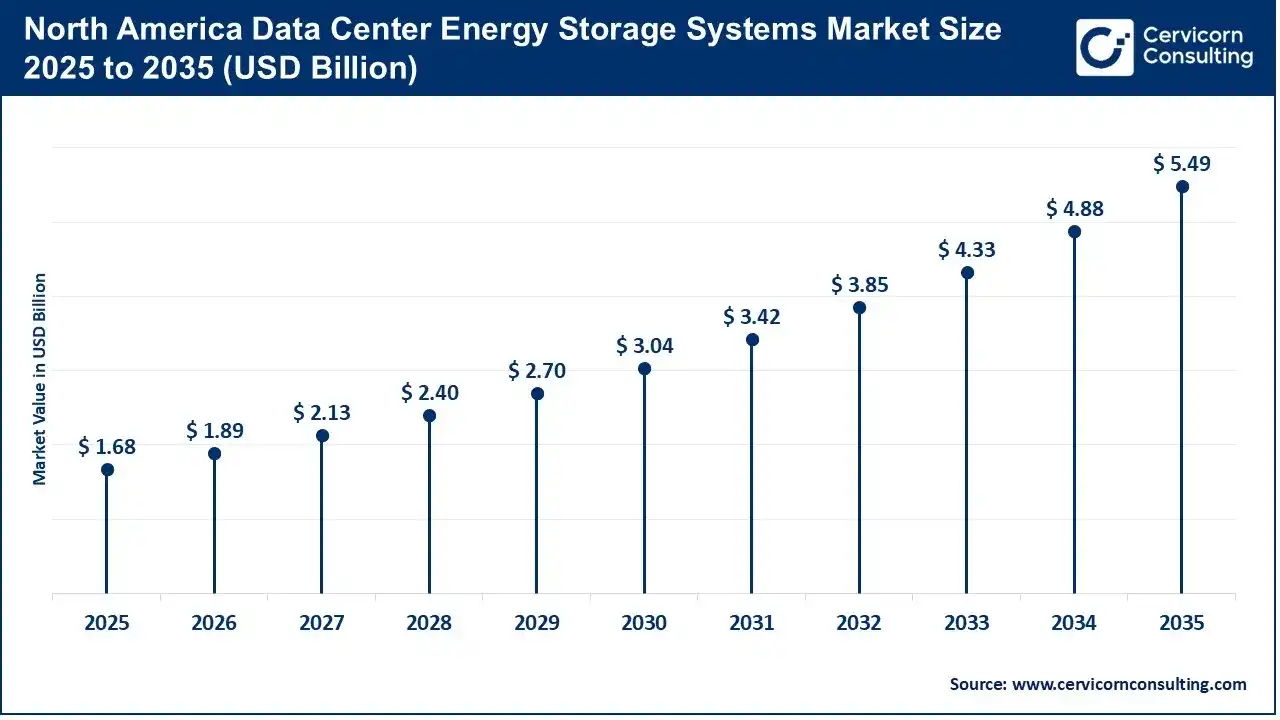
The North America data center energy storage systems market size was valued at USD 1.68 billion in 2025 and is projected to reach USD 5.49 billion by 2035. North America dominated the market in 2025, fueled by robust cloud and hyperscale infrastructure, quick AI investment, rising data center power consumption, and the requirement for dependable energy systems. Major cloud and technology service providers are well-represented in the area. Data center operators are also being encouraged to investigate onsite energy storage due to growing grid restrictions. The integration of storage systems is being further supported by the growing use of renewable energy.
Asia Pacific Data Center Energy Storage Systems Market Growth
The Asia-Pacific data center energy storage systems market size was estimated at USD 1.58 billion in 2025 and is expected to surpass USD 5.17 billion by 2035. Asia Pacific is growing rapidly, driven by rapid digitalization, significant investment in power and energy infrastructure, expanding data center infrastructure, and rising cloud and AI use. The demand for new computer facilities is rising due to an increase in digital services and internet usage. Investment in edge and hyperscale data centers is also being drawn to countries in the region. More prospects for energy storage systems are anticipated due to rising electricity demands and the integration of renewable energy sources.
Data Center Energy Storage Systems Market Share, By Region, 2025 (%)
| Region |
Revenue Share, 2025 (%) |
| North America |
35% |
| Europe |
22% |
| Asia-Pacific |
33% |
| LAMEA |
10% |
Country-Level Data Center Energy Storage Systems Analysis
- United States: U.S. data center electricity use increased 14% from 2023 to 2024, with the Department of Energy estimating that data centers could reach 11.8% of national electricity consumption by 2030. Rising AI and accelerated-computing loads are increasing requirements for battery storage, backup systems, power-quality management, and onsite energy resources.
- Canada: The Canadian government announced support for a $725 million Cohere AI infrastructure project, including up to $240 million in federal investment, alongside a broader initiative exploring up to 6 GW of additional data center capacity and more than $100 billion in potential investment. The expansion is strengthening the need for reliable and flexible energy infrastructure.
- China: Computing facilities consumed 166 billion kWh of electricity in 2024, representing approximately 1.7% of total national electricity consumption. By December 2025, China had 306 national green computing facilities, while its 2025 green data-center criteria explicitly encouraged the use of energy storage, hydrogen, and renewable energy to improve load flexibility.
- India: India's data center capacity reached approximately 1,575 MW in 2026, compared with about 375 MW in 2020. The country also plans 43,220 MWh of battery energy storage systems and 57 GW of pumped-storage projects by 2031-32, creating a broader energy-storage ecosystem for energy-intensive data center and AI infrastructure.
- Japan: METI and Japan's Ministry of Internal Affairs and Communications identified the rapid expansion of data centers as a key infrastructure issue and launched a public-private "watt-bit" coordination framework in 2025. Japan's electricity demand is expected to increase as new data centers and semiconductor factories are developed, strengthening the need to coordinate grid expansion, reliable power, and flexible energy resources.
Segmental Analysis
Storage Technology Analysis
Lithium-ion batteries dominated the data center energy storage systems market in 2025, motivated by their high energy density, quick reaction time, well-established supply chain, and appropriateness for vital backup applications. They are appropriate for data centers where space efficiency is crucial due to their small size. Their popularity is also being aided by ongoing advancements in thermal safety and battery management. The need for dependable lithium-ion storage is rising due to the expanding use of cloud computing and artificial intelligence.
Data Center Energy Storage Systems Market Share, By Storage Technology, 2025 (%)
| Storage Technology |
Revenue Share, 2025 (%) |
| Lithium-Ion Batteries |
63% |
| Lead-Acid Batteries |
17% |
| Flow Batteries |
6% |
| Sodium-Ion Batteries |
4% |
| Flywheel Energy Storage |
5% |
| Supercapacitors / Ultracapacitors |
3% |
| Others |
2% |
Flow batteries and sodium-ion batteries are expected to grow rapidly from 2026 to 2035, driven by the growing need for alternate battery technologies, enhanced safety, and longer-duration storage. Applications needing frequent cycling and prolonged discharge can use flow batteries. As data center operators look for a variety of possibly affordable storage choices, sodium-ion technology is becoming more and more popular. Their uptake is anticipated to be aided by growing interest in next-generation energy storage.
System Type Analysis
BESS and UPS energy storage dominated the data center energy storage systems market in 2025, motivated by the requirement for dependable operation of vital IT infrastructure, backup capacity, and continuous electricity. UPS systems offer instant defense against power fluctuations and outages. BESS technologies provide more flexibility for integrating renewable energy sources and managing peak loads. Their significance in contemporary data centers is growing due to their capacity to accommodate various power-management needs.
Data Center Energy Storage Systems Market Share, By System Type, 2025 (%)
| System Type |
Revenue Share, 2025 (%) |
| Battery Energy Storage Systems (BESS) |
38% |
| Uninterruptible Power Supply (UPS) Energy Storage |
42% |
| Hybrid Energy Storage Systems |
10% |
| Flywheel-Based Energy Storage |
7% |
| Thermal / Other Energy Storage Systems |
3% |
BESS is growing rapidly, driven by the need for scalable storage, peak-load management, renewable energy integration, and growing data center power requirements. When data centers have more computer power, these systems can be expanded. Additionally, BESS can enhance energy efficiency and assist with demand management. Large-scale battery storage is anticipated to become more in demand as investment in AI-focused data centers increases.
Capacity Analysis
The 1–10 MW segment dominated the data center energy storage systems market in 2025, motivated by the increasing need for dependable backup power and its applicability for medium- and large-scale data centers. The infrastructural needs and storage capacity are balanced by this capacity range. Facilities that are gradually increasing their computing capability can use it. Demand for this market is anticipated to be sustained by growing cloud and enterprise data center deployment.
Data Center Energy Storage Systems Market Share, By Capacity, 2025 (%)
| Capacity |
Revenue Share, 2025 (%) |
| Up to 100 kW |
18% |
| 101 kW–1 MW |
27% |
| 1–10 MW |
35% |
| Above 10 MW |
20% |
The above 10 MW segment is growing rapidly, driven by the growing need for electricity in hyperscale and AI-focused data centers. Higher-capacity power infrastructure is becoming necessary due to large-scale AI workloads. Additionally, these storage systems can offer more power flexibility and assist in controlling peak demand. This market is anticipated to be further supported by the growth of sizable data center complexes.
Application Analysis
UPS and backup power dominated the data center energy storage systems market in 2025, motivated by the requirement for continuous power, operational continuity, and protection of power quality. During grid disruptions, energy storage helps safeguard vital computers and networking hardware. When additional generation systems are turned on, it can offer instant backup power. Reliable backup solutions are becoming ever more crucial as our reliance on digital services grows.
AI load management and renewable energy integration are growing rapidly, driven by the expanding use of renewable energy, growing AI workloads, and rising electricity usage. Energy storage can assist in controlling variations in the demand for electricity associated with AI. Additionally, it has the capacity to store renewable energy for usage in the event that generation is not possible. It is anticipated that stricter sustainability regulations would promote these uses even more.
Data Center Type Analysis
Hyperscale data centers dominated the data center energy storage systems market in 2025, driven by their large-scale processing needs, high electricity usage, and growing deployment of cloud infrastructure and artificial intelligence. For these facilities to continue operating continuously, extremely dependable power systems are needed. Additionally, their high electrical consumption increases the need for sophisticated storage options. This market is anticipated to be supported by significant cloud and technology businesses' ongoing investment.
Edge data centers are growing rapidly in the market, driven by the growing need for distributed digital services, IoT applications, low-latency computing, and localized data processing. These smaller facilities can continue to run dependably in areas with different grid conditions with the aid of energy storage. Localized computer infrastructure is becoming more and more necessary as telecommunications and connected devices grow. More storage options are anticipated as distributed data centers are deployed more widely.
End Use Vertical Analysis
IT and telecommunications dominated the data center energy storage systems market in 2025, driven by the ongoing need for dependable electricity for digital infrastructure, networking, cloud, and communications. For these facilities to continue providing essential services, power must be continuous. Energy storage lessens the effects of power-quality problems and grid disruptions. Demand from this market is anticipated to be sustained by rising data traffic and the use of digital services.
AI and cloud infrastructure are growing rapidly, driven by growing AI workloads, cloud adoption, growing processing demands, and escalating electricity usage in data centers. High-performance computer systems are necessary for AI workloads, which can greatly raise power consumption. Energy storage can increase electricity dependability and assist operators in controlling these fluctuating loads. Energy storage systems are anticipated to benefit greatly from ongoing investments in AI infrastructure.
Recent Developments
- In September 2026, Wärtsilä and TGES announced plans to evaluate power solutions for Japan's growing AI-driven data center sector. The collaboration will examine energy solutions that can support increasing electricity requirements from data centers while improving power reliability and flexibility. The development reflects the growing need for advanced energy infrastructure alongside expanding AI computing capacity.
- In September 2026, Firmus and Gunvor Group entered into a long-term energy agreement to support AI data center development in South Australia. The arrangement includes new renewable generation and battery storage to provide more reliable power for planned AI infrastructure. The project demonstrates how large-scale storage is increasingly being developed alongside renewable generation to meet the power needs of energy-intensive data centers.
Top Companies
Segments Covered
By Storage Technology
- Lithium-Ion Batteries
- Lead-Acid Batteries
- Flow Batteries
- Vanadium Redox Flow
- Zinc-Bromine
- Others
- Sodium-Ion Batteries
- Flywheel Energy Storage
- Supercapacitors / Ultracapacitors
- Other Emerging Technologies
By System Type
- Battery Energy Storage Systems (BESS)
- Uninterruptible Power Supply (UPS) Energy Storage
- Hybrid Energy Storage Systems
- Flywheel-Based Energy Storage
- Thermal / Other Energy Storage Systems
By Capacity
- Up to 100 kW
- 101 kW–1 MW
- 1–10 MW
- Above 10 MW
By Application
- UPS & Backup Power
- Peak Shaving & Load Shifting
- Renewable Energy Integration
- Grid Stabilization & Frequency Regulation
- Demand Response
- AI Load Management
- Microgrid Support
- Energy Arbitrage
- Black Start / Grid-Forming Support
By Data Center Type
- Hyperscale Data Centers
- Colocation Data Centers
- Enterprise Data Centers
- Edge Data Centers
- Telecommunications Data Centers
By End-Use Vertical
- IT & Telecommunications
- BFSI
- Healthcare & Life Sciences
- Government & Defense
- Manufacturing
- Retail & E-commerce
- Media & Entertainment
- Energy & Utilities
- Education & Research
- Others
By Region
- North America
- Europe
- Asia Pacific
- Latin America
- Middle East & Africa