Data Center Colocation Market Size and Forecast 2026 to 2035
The global data center colocation market size was valued at USD 84.10 billion in 2025 and is projected to grow from USD 95.78 billion in 2026 to nearly USD 308.76 billion by 2035, registering a CAGR of 13.90% over the forecast period 2026 to 2035. The market is growing due to rising demand for scalable infrastructure, cloud services, and reliable data storage.
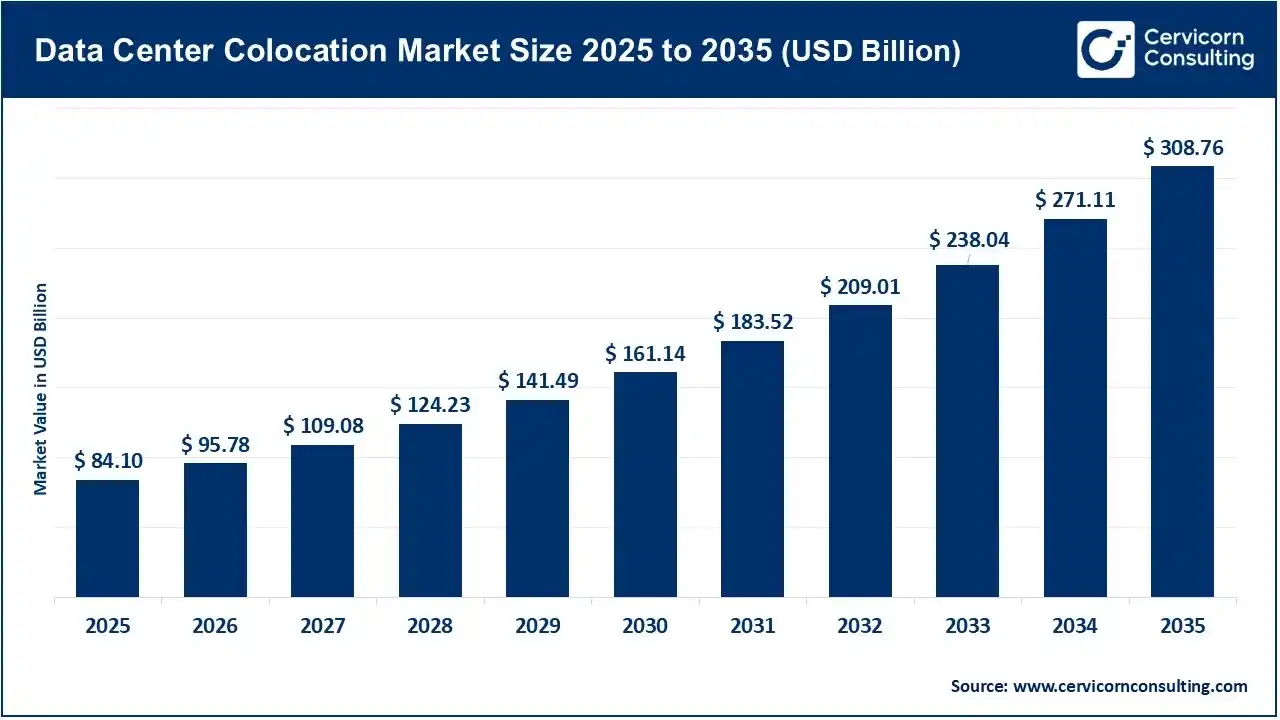
The data center colocation market is expanding as companies look for dependable and adaptable infrastructure that doesn't require the large sums of money needed to construct and run their own facilities. The demand for expertly managed data center space is rising due to growing workloads from cloud computing, artificial intelligence, digital services, and corporate applications. Additionally, by providing access to power, cooling, connectivity, security, and operational support, colocation providers enable businesses to scale their IT infrastructure in response to evolving needs.
In June 2025, Equinix expanded its data center presence in Australia with new capacity designed to support growing demand for digital infrastructure, cloud connectivity, and AI-related workloads. The development reflects how colocation providers are increasing capacity and connectivity to serve enterprises with growing infrastructure requirements.
Report Highlights
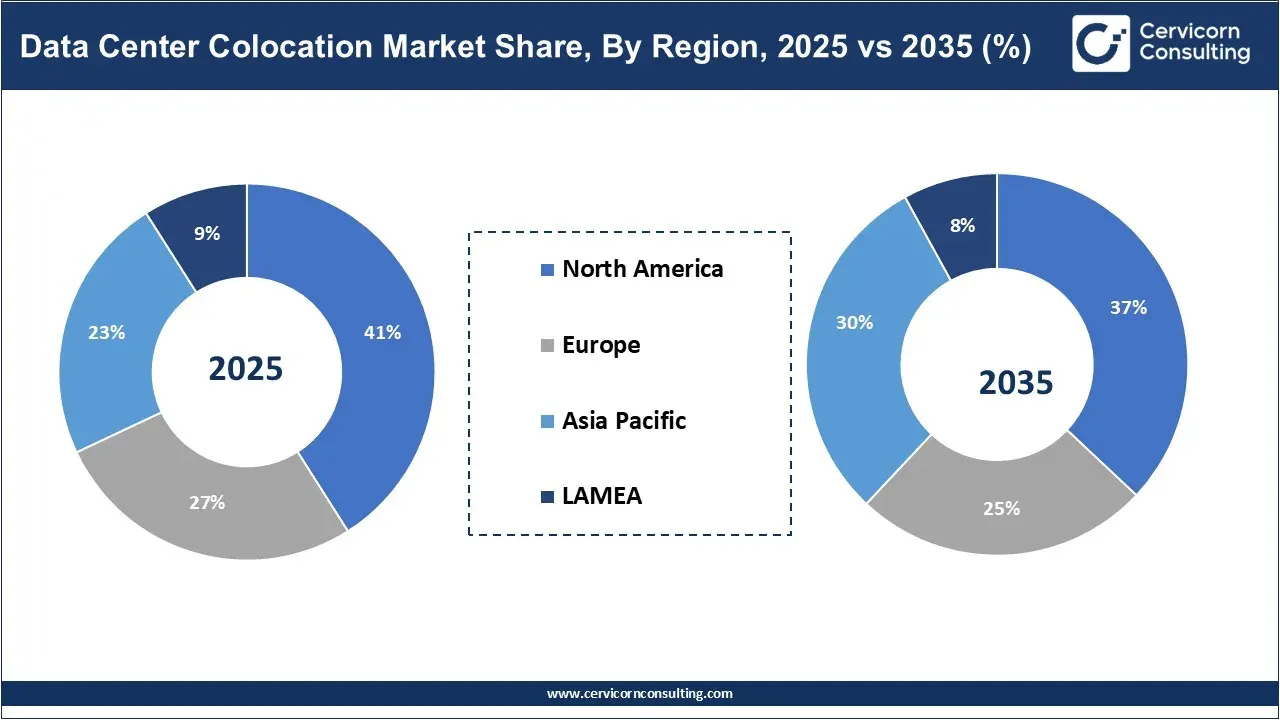
- By region, North America led the market and generated revenue share of 41% in 2025, driven by strong cloud adoption, mature digital infrastructure, and major data center investments.
- By region, Asia Pacific is expected to grow rapidly from 2026 to 2035, supported by digitalization, cloud adoption, AI investments, and data center expansion.
- By colocation type, retail colocation garnered highest revenue share 73% in 2025, driven by enterprise demand for flexible and reliable infrastructure.
- By colocation type, hybrid/hyperscale colocation is expected to grow rapidly from 2026 to 2035, driven by AI workloads, cloud adoption, and scalable infrastructure needs.
- By service type, traditional colocation led the market in 2025 with revenue share of 67%, supported by demand for secure space, power, cooling, and connectivity.
- By service type, managed colocation is expected to grow rapidly from 2026 to 2035, driven by demand for managed IT operations and infrastructure support.
- By power capacity, 5–10 MW led the market in 2025, driven by demand from enterprise and cloud workloads.
- By power capacity, above 20 MW is expected to grow rapidly from 2026 to 2035, driven by hyperscale facilities and AI infrastructure.
- By workload type, general-purpose IT and cloud computing led the market in 2025, supported by enterprise digitalization and cloud migration.
- By workload type, AI and HPC workloads are expected to grow rapidly from 2026 to 2035, driven by generative AI and high-performance computing.
- By enterprise size, large enterprises led the market in 2025, driven by extensive IT infrastructure and data requirements.
- By enterprise size, SMEs are expected to grow rapidly from 2026 to 2035, supported by digital adoption and demand for scalable infrastructure.
- By end user, enterprises led the market in 2025, driven by increasing use of cloud applications and third-party infrastructure.
- By end user, hyperscalers are expected to grow rapidly from 2026 to 2035, driven by cloud expansion, AI services, and large-scale computing needs.
- By industry vertical, IT and telecom led the market in 2025, supported by cloud services, connectivity, and data processing requirements.
- By industry vertical, manufacturing and healthcare & life sciences are expected to grow rapidly from 2026 to 2035, driven by digitalization, AI adoption, and rising data volumes.
- By deployment model, carrier-neutral and multi-tenant colocation led the market in 2025, driven by flexible connectivity and shared infrastructure.
- By deployment model, edge and modular colocation are expected to grow rapidly from 2026 to 2035, supported by low-latency applications and distributed computing.
- By data center size, large data centers led the market in 2025, driven by demand for scalable computing and storage capacity.
- By data center size, hyperscale/mega data centers are expected to grow rapidly from 2026 to 2035, driven by cloud expansion, AI workloads, and hyperscaler investments.
Major Trends
- Growing Demand for AI-Ready Data Centers: The increasing use of artificial intelligence and high-performance computing is driving demand for colocation facilities with higher power density, advanced cooling, and scalable infrastructure.
- Expansion of Hyperscale Colocation Facilities: Colocation providers are expanding large-scale facilities to support cloud platforms, enterprise workloads, and rapidly growing digital services.
- Shift Toward Liquid Cooling: The rise of high-density computing is encouraging data center operators to adopt liquid cooling technologies that can manage greater heat generation more efficiently.
- Increasing Demand for Interconnection Services: Businesses are seeking direct connections to cloud providers, telecom networks, and digital platforms, making interconnection an important part of modern colocation facilities.
- Renewable Energy Integration: Colocation operators are increasingly incorporating renewable energy and energy-efficient technologies to reduce environmental impact and meet sustainability objectives.
- Edge Data Center Expansion: The growth of IoT, real-time applications, and low-latency services is encouraging the deployment of smaller colocation facilities closer to end users and business locations.
- Greater Focus on Data Center Security: Rising cybersecurity risks and stricter data protection requirements are increasing demand for colocation facilities with advanced physical and digital security measures.
Market Dynamics
Growth Drivers
- Capital Efficiency: Colocation allows organizations to avoid much of the upfront investment associated with constructing, powering, cooling, and maintaining dedicated data centers. Customers can lease rack, cage, or dedicated capacity according to their requirements, making colocation attractive for enterprises seeking predictable infrastructure costs while maintaining control over their IT equipment.
- Hybrid Cloud Adoption: Increasing use of hybrid and multi-cloud environments is driving demand for facilities that connect enterprise infrastructure with multiple cloud and network providers. Colocation centers can provide direct connectivity to cloud platforms, carriers, and internet exchanges, enabling organizations to build flexible architectures while reducing dependence on a single infrastructure environment.
- Enterprise Outsourcing: Enterprises are increasingly outsourcing physical data center operations to specialized infrastructure providers to focus internal resources on applications, cybersecurity, analytics, and business functions. Colocation providers can manage power, cooling, physical security, maintenance, and facility operations, supporting organizations that require resilient infrastructure without operating their own facilities.
Market Restraints
- High Power Costs: Electricity represents a significant operating expense for data center operators, particularly as AI and high-density computing increase power consumption per rack. Rising electricity prices can increase colocation operating costs and place pressure on pricing, margins, and long-term customer contracts, particularly in markets with constrained or expensive power supplies.
- Limited Power Availability: Grid connection constraints and insufficient electricity infrastructure can limit the ability of colocation providers to expand capacity in major data center markets. Increasing demand from AI and cloud workloads is intensifying competition for available power, potentially extending project timelines and restricting the development of new colocation capacity.
- Land Constraints: Availability of suitable land near major connectivity hubs and electricity infrastructure can constrain new colocation developments. Operators require sites with sufficient power availability, fiber connectivity, cooling potential, security, and regulatory suitability. Competition for strategically located properties can increase development costs and complicate expansion in established data center markets.
Key Opportunities
- AI-Ready Colocation: Increasing demand for GPU-intensive infrastructure is creating opportunities for colocation providers to offer high-density environments with liquid cooling, high-capacity power systems, and advanced network connectivity. AI-ready facilities can attract customers that require specialized infrastructure but prefer to avoid the capital and operational complexity of developing dedicated AI data centers.
- Edge Colocation: Growth in real-time applications, 5G, IoT, content delivery, autonomous systems, and distributed computing is creating opportunities for smaller colocation facilities closer to users and data sources. Edge colocation can reduce latency and support localized processing while providing enterprises with professionally managed infrastructure outside major hyperscale data center hubs.
- Renewable-Powered Facilities: Increasing corporate sustainability commitments are creating opportunities for colocation providers to differentiate facilities through renewable electricity procurement, power purchase agreements, energy-efficient infrastructure, and improved power usage effectiveness. Customers increasingly seeking lower-carbon digital infrastructure can create demand for colocation facilities capable of providing transparent and renewable-based energy solutions.
Market Challenges
- Power Density Management: Increasing AI rack densities are challenging traditional colocation infrastructure because conventional air cooling and power distribution systems may not support the requirements of high-performance computing. Providers must invest in liquid cooling, advanced power delivery, monitoring systems, and facility upgrades while maintaining reliability for existing customers operating conventional IT equipment.
- Customer Security: Colocation providers host infrastructure belonging to multiple organizations within shared facilities, creating stringent requirements for physical security, access control, network protection, and compliance. Providers must maintain secure environments while allowing customers sufficient access to their equipment, making security management and regulatory compliance increasingly important as workloads become more sensitive.
- Infrastructure Scalability: Colocation operators must balance rapid customer demand with long development timelines for power, buildings, cooling systems, and network infrastructure. AI customers can require significantly larger power allocations than conventional workloads, making capacity planning more complex and increasing the risk of mismatches between available infrastructure and changing customer requirements.
Regional Analysis
North America dominated the data center colocation market
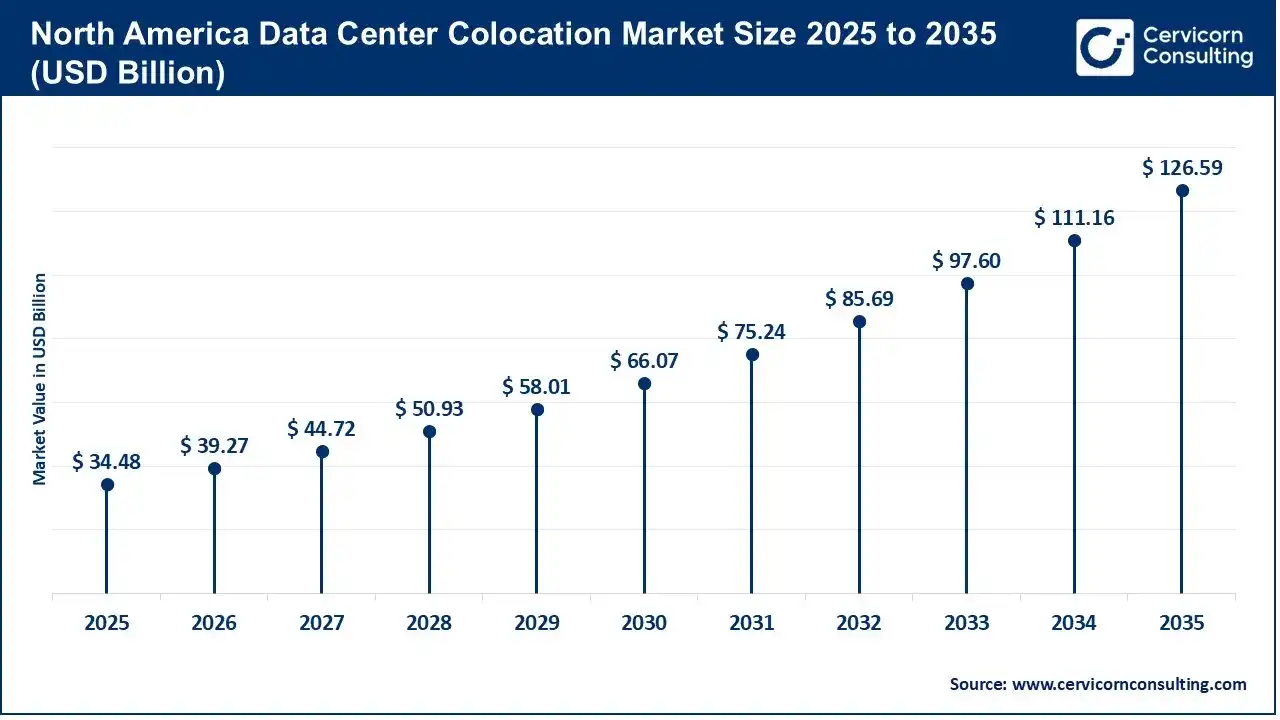
The North America data center colocation market size was valued at USD 34.48 billion in 2025 and is expected to hit USD 126.59 billion by 2035. North America dominated the market in 2025, propelled by its extensive digital infrastructure, robust cloud usage, established data center ecosystem, and the presence of significant hyperscalers, IT firms, and colocation providers. The area features a well-established network of communication infrastructure and data centers. Colocation adoption is still supported by the high demand for cloud, enterprise IT, and AI services. The regional market is being further strengthened by ongoing investments in large-scale facilities.
Asia Pacific is growing rapidly in the data center colocation market
The Asia Pacific data center colocation market size was estimated at USD 19.34 billion in 2025 and is projected to reach USD 71.01 billion by 2035. Asia Pacific is growing rapidly in the market from 2026 to 2035, driven by growing internet traffic, expanding cloud acceptance, rapid digitization, AI investments, and growing data center building in nations including China, Japan, Singapore, Australia, and India. Large amounts of data are being produced by expanding digital economies, necessitating infrastructure at the local and regional levels. Both public and private organizations are making investments in the capacity and connectivity of data centers. Regional demand is anticipated to increase due to the growing use of cloud services and AI.
Segmental Analysis
Colocation Type Analysis
Retail colocation segment dominated the data center colocation market in 2025, driven by a high demand from businesses looking for shared facilities, dependable connectivity, flexible infrastructure, and less initial investment than constructing dedicated data centers. Customers can rent smaller spaces and power in retail establishments based on their needs. For businesses that require secure infrastructure without overseeing an entire data center location, this solution is especially appropriate. Its acceptance is further strengthened by the availability of managed support and customizable setups.
Data Center Colocation Market Share, By Colocation Type, 2025 (%)
| Colocation Type |
Revenue Share, 2025 (%) |
| Retail Colocation |
73% |
| Wholesale Colocation |
27% |
Hybrid/Hyperscale colocation is growing rapidly from 2026 to 2035, driven by the demand for highly scalable power and infrastructure capacity, growing AI workloads, cloud adoption, and large-scale computing requirements. Rapidly growing processing and storage needs can be met by hyperscale systems. Businesses can also integrate shared and cloud-based resources with specialized infrastructure using hybrid models. Demand for these models is anticipated to rise further as AI-ready facilities expand.
Service Type Analysis
Traditional colocation dominated the data center colocation market in 2025, driven by businesses' and other organizations' ongoing need for safe data center space, dependable electricity, cooling, connection, and physical infrastructure. For the purpose of hosting vital IT equipment, many companies still rely on traditional colocation. Widespread adoption is supported by its well-established operating model and predictable infrastructure requirements. Demand is also influenced by growing worries about infrastructure dependability and data security.
Data Center Colocation Market Share, By Service Type, 2025 (%)
| Service Type |
Revenue Share, 2025 (%) |
| Traditional Colocation |
67% |
| Managed Colocation |
33% |
Managed colocation is growing rapidly, driven by the growing need for technical assistance, infrastructure monitoring, managed IT operations, and streamlined data center management. Companies are increasingly contracting with specialized vendors to handle basic infrastructure tasks. This strategy can help businesses concentrate on their main tasks while lowering operational complexity. As IT infrastructures become more dispersed and technically complicated, demand is also rising.
Power Capacity Analysis
5–10 MW power capacity dominated the data center colocation market in 2025, driven by the need for medium-to-large facilities that can handle expanding digital workloads, cloud services, and business applications. Scalability and infrastructure requirements are balanced by this capacity range. It supports dependable power and cooling systems and can serve several consumers. The need for facilities within this capacity range is being maintained by ongoing enterprise digitization.
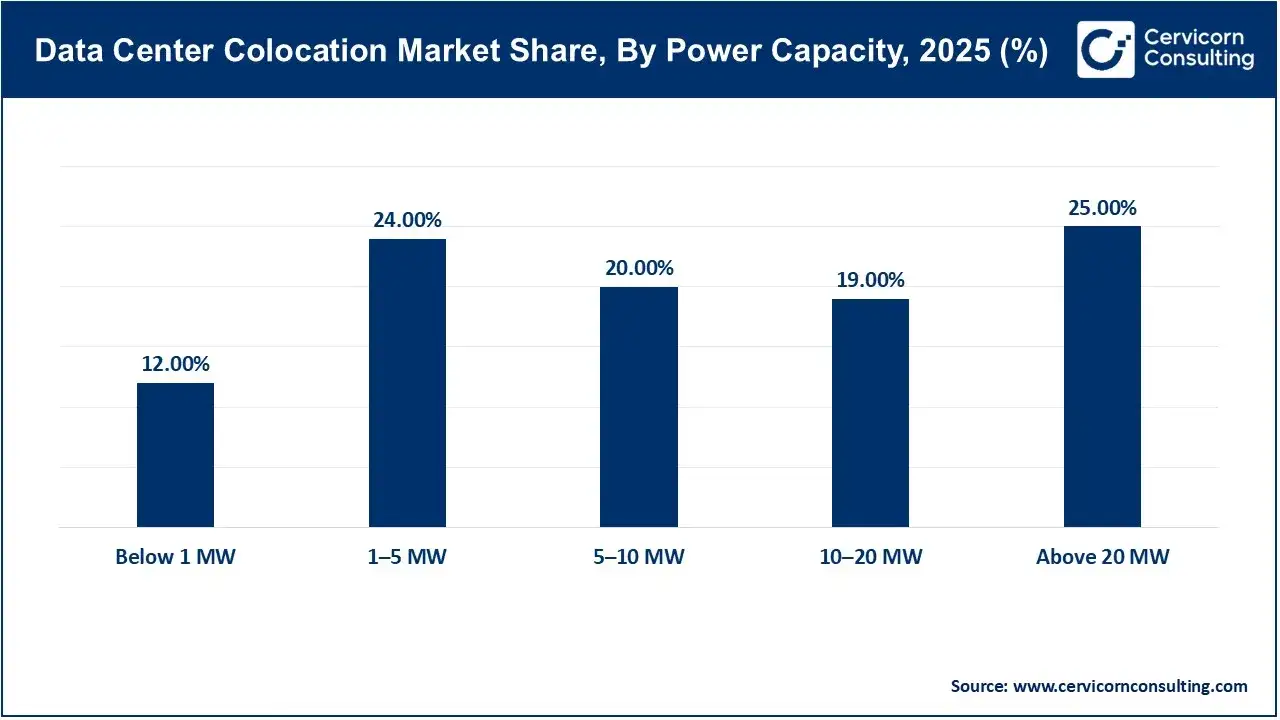
Above 20 MW power capacity is growing rapidly in the market from 2026 to 2035, propelled by high-density computing, AI infrastructure, hyperscale cloud expansion, and growing demands for large-scale data processing. Compared to many traditional applications, AI and advanced computing workloads require substantially more power availability. Additionally, as customer demands rise, large power campuses enable operators to increase capacity. This trend is being supported by increasing investments made by cloud and technology corporations.
Workload Type Analysis
General-purpose IT and cloud computing workloads dominated the data center colocation market in 2025, is fueled by business apps, cloud migration, pervasive enterprise digitization, and growing reliance on remotely hosted IT infrastructure. A wide spectrum of enterprise computing and storage needs are covered by these workloads. Their robust demand is being supported by the ongoing movement of business applications to cloud and hybrid environments. For dependable infrastructure to support regular digital operations, organizations also depend on colocation facilities.
AI and HPC workloads are growing rapidly in the market from 2026 to 2035, driven by the growing use of advanced analytics, machine learning, generative AI, and computationally demanding applications that call for high-density infrastructure. Strong CPUs, increased power availability, and sophisticated cooling systems are necessary for these workloads. In order to meet these needs, colocation providers are progressively creating customized facilities. The demand for high-performance infrastructure is anticipated to rise as AI services spread across industries.
Enterprise Size Analysis
Large enterprises dominated the data center colocation market in 2025, driven by their expanding usage of cloud and hybrid IT systems, massive data volumes, cybersecurity issues, and substantial IT infrastructure requirements. Big businesses frequently run intricate digital ecosystems that call for extremely dependable infrastructure. They can increase their capacity through colocation without having to fully own the physical buildings. Adoption is also aided by their requirement for safe infrastructure and business continuity.
Data Center Colocation Market Share, By Enterprise Size, 2025 (%)
| Enterprise Size |
Revenue Share, 2025 (%) |
| Large Enterprises |
36% |
| Small & Medium-Sized Enterprises (SMEs) |
64% |
Small and medium-sized enterprises are growing rapidly, driven by the demand for affordable and scalable IT solutions, growing digital adoption, and constrained internal infrastructure capabilities. SMEs can access enterprise-grade facilities through colocation without having to make significant infrastructure investments. Additionally, when activities expand, smaller enterprises can increase their IT resources thanks to flexible capacity. SMEs are being encouraged to embrace colocation services by growing cloud use and digital business models.
End User Analysis
Enterprises dominated the data center colocation market in 2025, driven by an increasing reliance on third-party facilities for IT operations, secure data storage, cloud apps, and business-critical digital infrastructure. Reliable infrastructure is becoming more and more necessary for businesses to support remote applications and massive amounts of business data. Colocation can increase operational resilience and connection. Growing demands for business continuity, security, and compliance also contribute to demand.
Hyperscalers are growing rapidly in the data center colocation market from 2026 to 2035, driven by the need for large-scale processing and storage capacity, growing cloud platforms, AI applications, and rising data consumption. To serve quickly growing digital services, hyperscalers need significant quantities of power and space. They don't have to rely solely on self-built facilities thanks to colocation, which gives them access to infrastructure and key locations. Their infrastructure needs are rising due to the expansion of AI and cloud workloads.
Industry Vertical Analysis
IT and telecom dominated the data center colocation market in 2025, driven by the need for large amounts of data processing, cloud services, network infrastructure, digital connection, and the ongoing expansion of internet-based services. These sectors rely significantly on dependable networking and computer infrastructure. Cloud-based apps and growing data traffic are driving up demand for scalable and safe infrastructures. The demand for colocation is further supported by the ongoing growth of digital communication services.
Data Center Colocation Market Share, By Industry Vertical, 2025 (%)
| Industry Vertical |
Revenue Share, 2025 (%) |
| IT & Telecom |
32% |
| BFSI |
20% |
| Government & Public Sector |
8% |
| Healthcare & Life Sciences |
10% |
| Retail & E-commerce |
6% |
| Media & Entertainment |
6% |
| Education |
5% |
| Others |
13% |
Manufacturing and healthcare & life sciences are growing rapidly, driven by the deployment of AI, connected systems, electronic health data, sophisticated analytics, industrial digitalization, and growing needs for secure data infrastructure. Data-driven production systems and networked equipment are being used by manufacturers more and more. Additionally, the amount of sensitive digital data generated by healthcare institutions is increasing. The need for dependable, safe, and scalable computing environments is rising as a result of these advancements.
Deployment Model Analysis
Carrier-neutral and multi-tenant deployment models dominated the data center colocation market in 2025, driven by economic benefits for a wide range of clients, shared infrastructure, flexible connectivity options, and access to multiple network providers. Customers can choose from a variety of connectivity providers according to their needs thanks to carrier-neutral facilities. By accommodating multiple clients in one location, multi-tenant settings also enhance infrastructure utilization. Businesses and service providers find the models appealing because of these benefits.
Edge and modular colocation are growing rapidly, driven by the growing need for real-time services, IoT applications, low-latency processing, and flexible infrastructure near end users. Applications that require quick data processing can be supported by edge facilities. Additionally, capacity may be extended and deployed more effectively with modular designs. The demand for these deployment strategies is increasing due to the expansion of dispersed digital services and linked devices.
Data Center Size Analysis
Large data centers dominated the data center colocation market in 2025, driven by the need for significant processing power, dependable infrastructure, and scalable data storage from corporations, cloud providers, and digital companies. Large facilities have a lot of electricity and cooling capacity and can accommodate several clients. As workloads rise, they also present chances for infrastructure growth. The need for huge facilities is still being supported by growing cloud use and enterprise digitalization.
Hyperscale/mega data centers are growing rapidly over the forecast period from 2026 to 2035, propelled by increased demands for high-density computing capacity, hyperscaler investments, AI workloads, and emerging cloud ecosystems. These facilities are built to accommodate enormous amounts of storage and processing power. Larger, more power-intensive facilities are being developed as the need for AI infrastructure grows. Hyperscale capacity requirements are anticipated to be further supported by the growth of global cloud services.
Government Initiatives
- In September 2026, the Government of India held a CEO roundtable focused on improving the ease of doing business for the data center sector. The discussions emphasized reliable power availability, ready-to-use land, and streamlined approvals to accelerate new data center investments. These measures are expected to support faster development of large-scale digital infrastructure.
- In August 2026, the Government of India highlighted measures supporting sustainable growth of data centers through energy-efficient and clean-energy approaches. The government also recognized the increasing infrastructure requirements created by AI and high-performance computing workloads. The focus is expected to encourage more sustainable data center development across India.
- In March 2026, the Government of India reported continued expansion of the country's data center infrastructure and highlighted the need for adequate electricity and water resources. The government also noted the use of advanced cooling technologies to improve resource efficiency. These initiatives highlight the importance of resource-efficient infrastructure as data center capacity expands.
- In December 2025, Singapore's EDB and IMDA launched the second Data Centre Call for Application to support sustainable data center growth. The initiative also encourages green energy pathways and stronger infrastructure resilience for future digital and AI requirements. The program is intended to support responsible expansion while managing energy and environmental considerations.
Recent Developments
- In July 2026, HCLTech announced a strategic investment of up to ₹3,500 crore to establish AI data centers in India, with the potential to scale capacity significantly. The initiative is aimed at supporting growing demand for AI-led services and high-performance computing infrastructure.
- In June 2026, Digital Realty announced transactions to expand its data center development capacity and strengthen its colocation and connectivity portfolio. The company also secured a large powered land site in the Kansas City metropolitan area to support future hyperscale development.
- In April 2026, Equinix launched its fourth International Business Exchange data center in Mumbai, designed to support AI, cloud, and high-performance workloads. The facility includes liquid-cooling capabilities and is intended to address growing demand for interconnected digital infrastructure in India.
- In April 2026, Digital Realty announced plans for nearly S$7 billion of total investment in Singapore, including new data center developments and infrastructure aimed at strengthening the country's position as an AI infrastructure hub in Asia-Pacific.
- In February 2026, STT GDC India announced the launch of its fourth data center in Chennai as part of a multi-campus expansion. The new facility is designed as an AI-ready data center, strengthening the company's colocation infrastructure in the Indian market.
Key Companies
Segments Covered
By Colocation Type
- Retail Colocation
- Wholesale Colocation
- Others
- Hybrid Colocation
- Hyperscale Colocation
- Edge Colocation
By Service Type
- Traditional Colocation
- Managed Colocation
- Others
- Cloud On-Ramp Connectivity
- Interconnection Services
- Remote Hands
- Network Services
- Security Services
- Infrastructure Management
- Monitoring & Management
- Disaster Recovery & Backup Services
By Power Capacity
- Below 1 MW
- 1–5 MW
- 5–10 MW
- 10–20 MW
- Above 20 MW
By Workload Type
- General-Purpose IT
- Cloud Computing
- High-Performance Computing (HPC)
- Artificial Intelligence & Machine Learning
- Generative AI
- Big Data & Analytics
- Enterprise Applications
- Edge Computing
- Disaster Recovery
- Content Delivery
By Enterprise Size
- Large Enterprises
- Small & Medium-Sized Enterprises (SMEs)
By End User
- Enterprises
- Hyperscalers
- Cloud Service Providers
- Managed Service Providers
- Content & Digital Service Providers
- Telecom Operators
- Internet Service Providers
- Government Organizations
- Research Institutions
By Industry Vertical
- IT & Telecom
- BFSI
- Government & Public Sector
- Healthcare & Life Sciences
- Retail & E-commerce
- Manufacturing
- Energy & Utilities
- Media & Entertainment
- Education
- Transportation & Logistics
- Others
By Deployment Model
- Carrier-Neutral
- Carrier-Owned
- Multi-Tenant
- Dedicated/Private Suites
- Modular Colocation
- Edge Colocation
By Region
- North America
- Europe
- Asia Pacific
- Latin America
- Middle East & Africa
