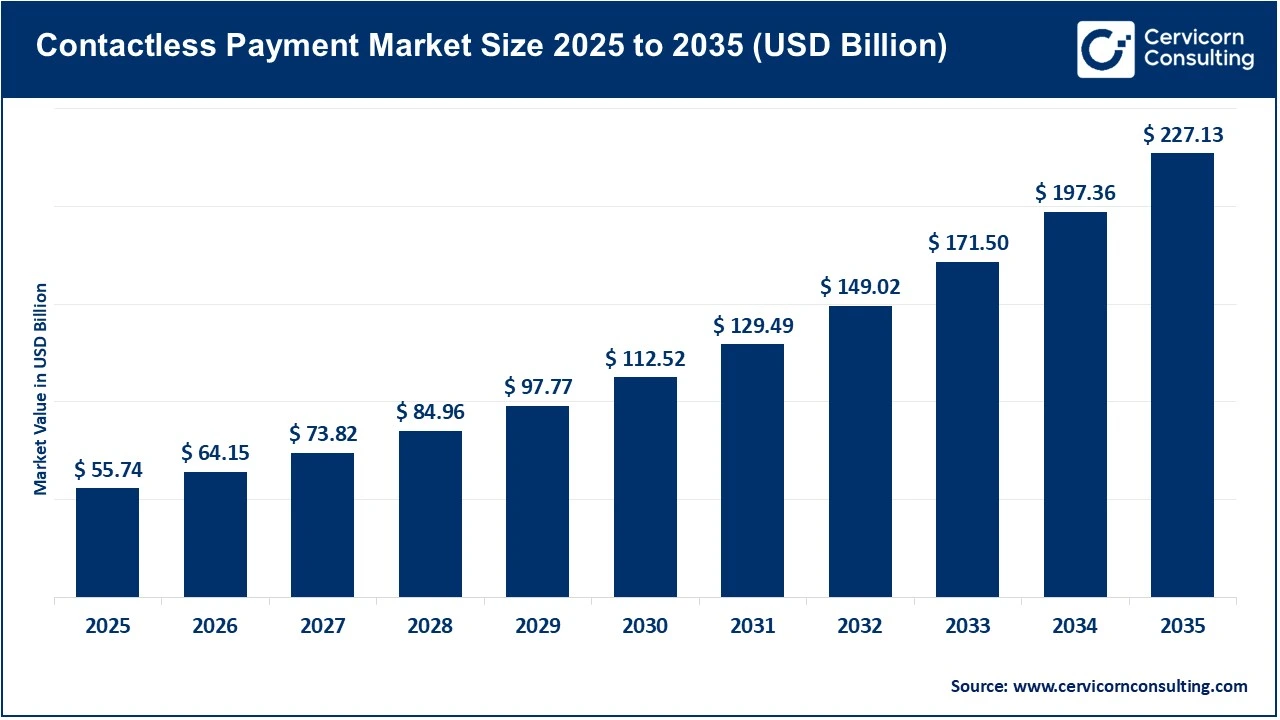
The global contactless payment market size was estimated at USD 55.74 billion in 2025 and is expected to be worth around USD 227.13 billion by 2035, exhibiting a compound annual growth rate (CAGR) of 15.1% over the forecast period from 2026 to 2035. The contactless payment market is primarily driven by the rapid shift towards digital and cashless transactions, supported by strong consumer adoption and infrastructure expansion. Globally, around 86% of consumers used contactless payments as of 2025, highlighting widespread acceptance, while 23% of all card spending in 2024 was contactless, amounting to trillions of dollars in transactions. The increasing penetration of smartphones and connected devices is another major growth factor, with about 94% of smartphones now NFC-enabled, and 81% of payment cards expected to be contactless by 2026. Additionally, the expansion of digital wallets and mobile payments, projected to reach 5.6 billion users globally, is accelerating usage, as consumers prefer faster, more convenient payment experiences. Governments and financial institutions are also promoting cashless ecosystems, further strengthening adoption, particularly in emerging markets such as India and Southeast Asia.
Another key growth factor is the increasing demand for speed, security, and hygiene in transactions, especially after the COVID-19 pandemic, which significantly accelerated contactless adoption worldwide. Technological advancements such as NFC, wearable payments, and tap-to-phone solutions are making contactless payments more accessible to both consumers and merchants; for example, Tap-to-Phone adoption has surged by over 200% year-over-year in some regions. On the merchant side, adoption is also rising, with over 75% of global retailers expected to support NFC payments by 2025, improving accessibility across retail and transportation sectors. Furthermore, the increasing demand for seamless checkout experiences and the improved customer satisfaction reported by 83% of small businesses adopting contactless payments continue to drive market expansion. Together, these factors are creating a strong ecosystem that supports the sustained growth of contactless payment solutions worldwide.
Report Highlights
- By Region, North America leads with 31% share, supported by advanced digital infrastructure, strong fintech ecosystem, and widespread mobile wallet adoption.
- By Region, Asia-Pacific follows with 27% share and is the fastest-growing region, driven by mobile-first ecosystems and rapid QR-based payment adoption.
- By Device Type, contactless cards dominate the market, accounting for 52% share, driven by high issuance by banks and strong global acceptance infrastructure.
- By Technology, NFC (Near Field Communication) dominates with 68% share, owing to its fast, secure, and seamless integration across cards and smartphones.
- By Component, hardware accounts for the highest share of 46%, supported by large-scale deployment of POS terminals and NFC-enabled infrastructure.
- By Transaction Type, POS transactions dominate with 55% share, driven by high-frequency usage in retail stores and transportation systems.
- By End-User, retail holds the largest share of 38%, due to high transaction volumes and widespread merchant adoption of contactless payments.
Growing Demand for Biometric Contactless Smart Cards Driving Market Growth
The rising demand for biometric contactless smart cards is significantly accelerating the growth of the contactless payment market by enhancing security and user convenience. Unlike traditional contactless cards that rely solely on PINs or transaction limits, biometric cards integrate fingerprint authentication directly into the card, reducing fraud risk while enabling higher-value transactions without additional verification steps. This is particularly important as payment fraud and data breaches continue to rise globally, prompting banks and financial institutions to adopt more secure authentication technologies. At the same time, consumers increasingly prioritise seamless, fast payment experiences, and biometric cards eliminate the need to remember PINs or carry additional devices. The combination of strong security, regulatory support for multi-factor authentication, and a premium user experience is encouraging widespread adoption by banks, especially in regions like Europe and Asia-Pacific, thereby driving overall market expansion.
Key Factors
- Over 70% of consumers express willingness to use biometric authentication for payments due to enhanced security
- Biometric payment card pilots have shown up to 90% reduction in card-present fraud risks
- More than 20 major banks globally have already launched or tested biometric contactless cards
- The number of biometric payment cards in circulation is expected to cross 1 billion units by the early 2030s
- Biometric authentication can reduce transaction time by 20–30% compared to PIN-based verification
- Around 60% of payment fraud is linked to lost or stolen cards, which biometrics directly addresses
- Regulatory frameworks (like strong customer authentication in Europe) are increasing demand for multi-factor secure payment solutions
Number of Contactless Payment Transactions by Country (2019–2025, Billions)
| Country |
2019 |
2020 |
2021 |
2022 |
2023 |
2024 |
2025 |
| United Kingdom |
8.6 |
10.0 |
13.0 |
15.0 |
18.3 |
21.0 |
24.0 |
| Australia |
3.2 |
4.0 |
4.5 |
5.0 |
5.5 |
6.2 |
7.0 |
| Canada |
2.2 |
3.0 |
4.0 |
5.0 |
5.5 |
6.5 |
7.5 |
| United States |
4.7 |
8.1 |
11.1 |
14.4 |
16.0 |
18.5 |
21.5 |
| France |
2.8 |
4.0 |
5.5 |
7.0 |
8.0 |
9.2 |
10.5 |
| Germany |
1.2 |
2.5 |
4.0 |
5.5 |
6.0 |
7.2 |
8.5 |
| China |
5.0 |
6.5 |
8.0 |
9.5 |
10.5 |
12.0 |
13.5 |
| Japan |
1.5 |
2.0 |
3.0 |
4.0 |
5.0 |
6.0 |
7.2 |
The data indicates a strong and consistent rise in contactless payment transactions across all countries from 2019 to 2025, reflecting the global shift toward digital and cashless economies. Developed markets such as the United Kingdom and the United States show the highest transaction volumes, driven by mature payment infrastructure and widespread adoption of tap-to-pay technologies. Meanwhile, countries like Germany and Japan demonstrate accelerated growth, highlighting rising consumer acceptance and infrastructure expansion. Asia, led by China, continues to scale steadily, driven by mobile-first ecosystems. Overall, the upward trend is supported by growing smartphone penetration, expanding POS networks, and increasing preference for fast, secure, and convenient payment methods worldwide.
Recent Major Milestones
1. Removal of Contactless Payment Limits (UK Financial Conduct Authority)
A major milestone is the Financial Conduct Authority’s decision in 2026 to remove the GBP 100 contactless payment limit, allowing banks to set their own transaction thresholds. This move significantly expands the use of contactless payments beyond small-value purchases to everyday high-value transactions such as groceries, fuel, and retail shopping. By eliminating friction at checkout and reducing the need for PIN entry, it is accelerating consumer adoption and increasing transaction frequency. This regulatory shift is driving market growth by normalising contactless payments as a primary payment method, encouraging merchants to upgrade infrastructure, and enabling higher transaction volumes across the ecosystem.
2. Tap-to-Pay Expansion on Smartphones (Apple Tap to Pay on iPhone)
Another key milestone is Apple's global expansion of Tap-to-Pay technology through its “Tap to Pay on iPhone” feature, which allows merchants to accept contactless payments without dedicated POS hardware. This innovation lowers entry barriers for small and micro businesses by eliminating the need for expensive terminals, effectively turning smartphones into payment acceptance devices. It is driving market growth by rapidly increasing merchant acceptance points, especially in developing and informal economies, and accelerating the shift toward software-based payment infrastructure, which is more scalable and cost-efficient.
3. Launch of Biometric Contactless Payment Systems (UAE Government Initiative)
A significant milestone is the UAE Government's rollout of biometric contactless payment systems, enabling payments via facial and palm recognition without cards or mobile devices. This development marks a major leap in payment authentication, combining convenience with advanced security. It is driving market growth by addressing fraud concerns, enabling seamless user experiences, and encouraging adoption across high-traffic sectors such as retail and transportation. These innovations are also setting global benchmarks, prompting other countries and financial institutions to invest in next-generation contactless technologies.
4. Global Expansion of Contactless Transit Payments (Mastercard & Transport Authorities)
The widespread integration of contactless payments into public transportation systems, led by companies like Mastercard in collaboration with global transit authorities, marks another major milestone. Many major cities have implemented tap-to-ride systems, making contactless cards and mobile wallets the default payment methods for daily commuting. This is driving market growth by embedding contactless payments into routine consumer behavior, increasing transaction volumes, and expanding use cases beyond retail. The transit sector acts as a high-frequency touchpoint, accelerating habitual usage and strengthening the overall payment ecosystem.
The contactless payment market is segmented by region into North America, Europe, Asia-Pacific, Latin America, and LAMEA. Here is a brief overview of each region:
North America Contactless Payment Market: Driven by Advanced Digital Infrastructure and Strong Fintech Ecosystem
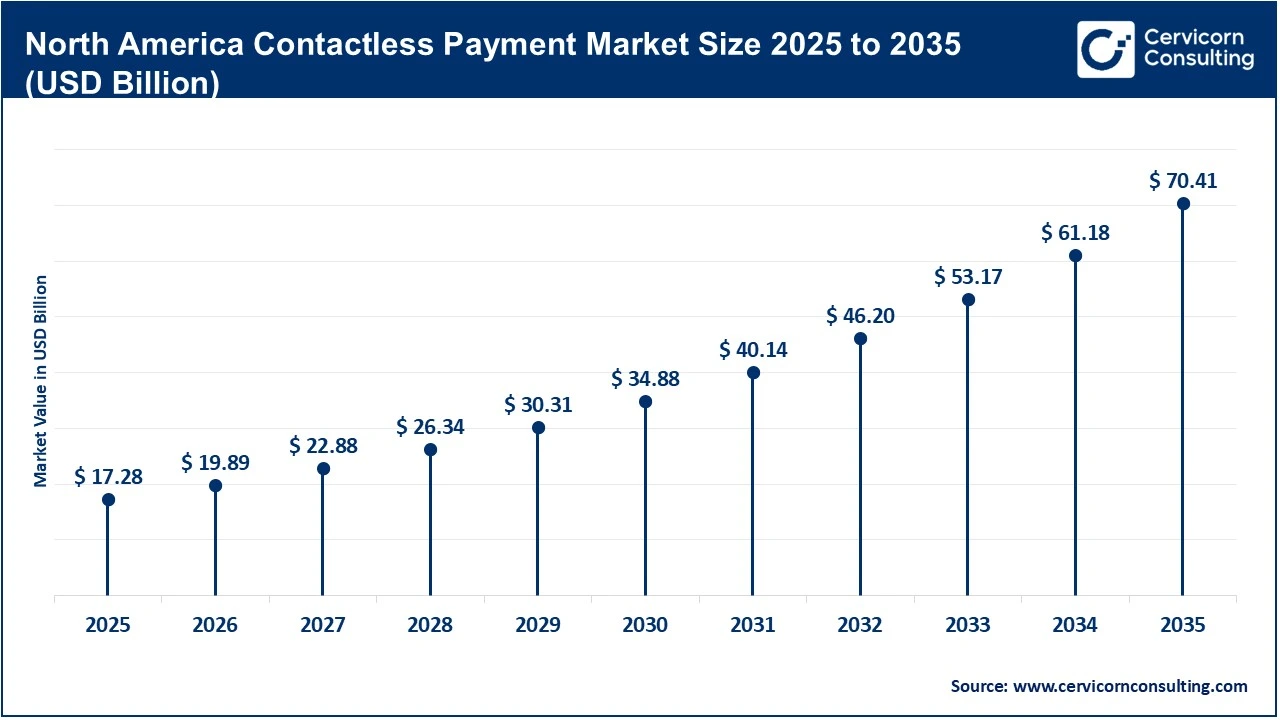
The North America contactless payment market size was valued at USD 17.28 billion in 2025 and is expected to surpass around USD 70.41 billion by 2035.
The North America market is highly developed, supported by strong financial infrastructure and rapid technological adoption. Consumers widely use contactless cards and mobile wallets, while merchants have extensively upgraded POS systems to accept tap-to-pay transactions. The presence of major payment networks and fintech innovators accelerates product development and adoption. Additionally, the region benefits from high consumer trust in digital payments, strong cybersecurity frameworks, and continuous innovation in payment solutions, making it one of the most mature and stable markets globally.
United States: High smartphone penetration, strong fintech innovation, and rapid adoption of mobile wallets and tap-to-phone payment solutions drive market growth.
- Over 60% consumers regularly use contactless payments for everyday transactions nationwide
- Tap-to-phone adoption increased by more than 200% across small merchants recently
- Over 70% of retailers support contactless payments through upgraded POS infrastructure
Canada: Widespread issuance of contactless cards, strong banking infrastructure, and high consumer preference for tap-and-pay transactions accelerate adoption.
- Over 80% of in-store card payments are completed using contactless methods
- Nearly 90% of payment cards issued are enabled with contactless technology
- Public transit systems process over 75% payments via contactless tap-and-pay systems
Asia-Pacific (APAC) Contactless Payment Market: Fastest Growth Driven by Mobile-First Ecosystems
The Asia-Pacific contactless payment market size was estimated at USD 15.05 billion in 2025 and is forecasted to grow around USD 61.33 billion by 2035. Asia-Pacific is the fastest-growing region, driven by large populations, rapid digitalisation, and high smartphone penetration. The region’s mobile-first approach has enabled widespread adoption of QR code and app-based payments, especially in countries such as China and India. Government initiatives promoting cashless economies and financial inclusion are further accelerating adoption. The rapid expansion of e-commerce, combined with increasing urbanization and digital literacy, is significantly boosting transaction volumes and strengthening the region’s position as a key growth engine for the global market.
China: Dominance of super apps like Alipay and WeChat Pay, along with QR ecosystem, drives massive contactless payment usage.
- Platforms like Alipay and WeChat Pay account for over 90% mobile payment transactions
- Over 80% of urban consumers actively use mobile payments for daily purchases
- QR-based payments accepted by over 90% of small and medium merchants
India: Rapid growth of UPI ecosystem, government cashless initiatives, and widespread QR-based payments drive strong market expansion.
- Platforms like PhonePe and Paytm process billions of transactions monthly
- UPI records over 10 billion transactions monthly across banking ecosystem platforms
- Smartphone penetration exceeded 70%, driving rapid adoption of digital payment solutions
Europe Contactless Payment Market: Dominated by Card-Based Payments and Regulatory Support
The Europe contactless payment market size reached at USD 16.16 billion in 2025 and is projected to hit around USD 65.87 billion by 2035. Europe is a mature contactless payment market with widespread infrastructure and strong regulatory backing. The region has achieved high adoption rates due to early deployment of NFC-enabled terminals and strong banking penetration. Consumers frequently use contactless payments for low- and mid-value transactions, particularly in retail and transportation sectors. Regulatory frameworks promoting secure digital transactions and standardized payment systems further support growth. Europe’s well-established financial ecosystem and high consumer trust continue to drive steady and sustained market expansion.
United Kingdom: Removal of contactless limits, high card usage frequency, and extensive retail and transit acceptance drive widespread market expansion.
- Over 60% of all card transactions are completed using contactless payments
- Contactless transaction limits increased, enabling higher-value payments above previous thresholds
- More than 90% of retail merchants accept contactless payments across the country
Germany & France: Increasing digitalization, rising mobile wallet adoption, and expanding NFC-enabled POS infrastructure are key drivers of market growth.
- Mobile wallet adoption grew by over 25% annually across major European markets
- Over 75% of POS terminals are now equipped with NFC-enabled contactless technology
- Digital payment usage increased significantly post-pandemic across urban population segments
Contactless Payment Market Share, By Region, 2025 (%)
| Region |
Revenue Share, 2025 (%) |
| North America |
31% |
| Europe |
29% |
| Asia-Pacific |
27% |
| LAMEA |
13% |
LAMEA Contactless Payment Market: Emerging Growth Driven by Financial Inclusion and Fintech Expansion
The LAMEA contactless payment market was valued at USD 7.25 billion in 2025 and is anticipated to reach around USD 29.53 billion by 2035. Latin America is an emerging contactless payments market, growing steadily as financial inclusion and digital transformation expand. Countries such as Brazil and Mexico are adopting contactless cards and mobile wallets at an increasing pace. Fintech innovation and supportive government initiatives are driving the transition from cash to digital payments. Despite persistent infrastructure gaps, rising smartphone penetration, expanding merchant acceptance, and growing e-commerce activity are contributing to gradual but consistent market development.
The Middle East and Africa region is witnessing growing adoption of contactless payments, supported by government-led digital initiatives and infrastructure development. Gulf countries are investing heavily in advanced payment technologies and smart city projects, promoting widespread adoption. In Africa, mobile money platforms are expanding financial access and enabling digital transactions even in underserved regions.
Brazil: Growing fintech ecosystem, increasing POS terminal deployment, and rising digital wallet adoption are key drivers of contactless payment growth.
- Contactless payments grew by over 40% annually across major urban regions
- More than 70% of POS terminals now support contactless payment acceptance
- Digital wallet usage increased significantly with millions of active monthly users
United Arab Emirates: Smart city initiatives, high digital adoption, and advanced biometric payment innovations are driving the rapid expansion of contactless payments.
- Over 90% of transactions in retail are conducted using digital payment methods
- Contactless payments account for more than 70% of card transactions nationwide
- High smartphone penetration exceeding 90% supports widespread mobile payment adoption
The contactless payment market is segmented into device type, technology, component, transaction type, end-user, and geography.
Device Type Analysis
Contactless cards dominate the market due to their widespread issuance by banks and seamless compatibility with existing payment infrastructure. They are preferred for everyday transactions because they do not require internet connectivity or smartphones, making them accessible to a broader population. In mature markets, most debit and credit cards are now contactless-enabled by default, ensuring their continued dominance. Their reliability, familiarity, and strong merchant acceptance across retail and transit environments further reinforce their leading position.
Contactless Payment Market Share, By Device Type, 2025 (%)
| Device Type |
Revenue Share, 2025 (%) |
| Contactless Cards |
52% |
| Smartphones |
32% |
| Wearable Devices |
10% |
| Other Devices |
6% |
Smartphones are the fastest-growing segment as mobile wallets and app-based payments gain rapid global traction. The proliferation of NFC-enabled devices and platforms such as Apple Pay and Google Pay is reshaping consumer payment behaviour. Smartphones offer added benefits such as biometric authentication, transaction tracking, and integration with loyalty programmes. Growth is especially strong in emerging markets, where mobile-first ecosystems are expanding, making smartphones a key driver of the shift towards fully digital, contactless transactions.
Technology Analysis
NFC dominates the contactless payment market due to its fast, secure, and seamless transaction capabilities. It enables tap-and-go payments with encrypted communication, making it highly reliable for consumers and merchants alike. NFC is widely integrated into payment cards, smartphones, and POS terminals, particularly in developed regions with advanced infrastructure. Strong support from financial institutions and global payment networks has made it the backbone of most contactless transactions, ensuring its continued dominance in the technology segment.
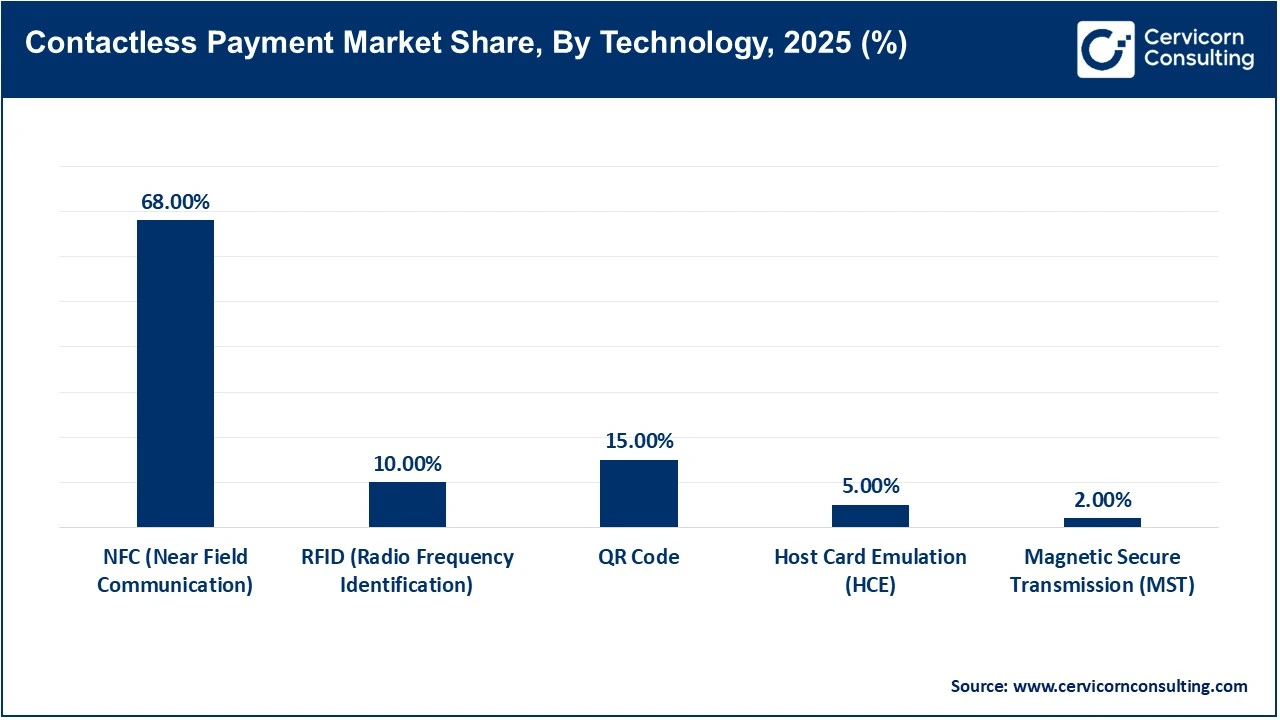
QR code technology is the fastest-growing segment, driven by its affordability and ease of deployment. It does not require specialized hardware like NFC terminals, making it ideal for small merchants and developing economies. Platforms such as Paytm and PhonePe have accelerated adoption through simple scan-and-pay solutions. Its scalability and low cost are enabling rapid expansion across both urban and rural markets, positioning QR codes as a key growth driver.
Component Analysis
Hardware remains the dominant segment, forming the essential infrastructure for contactless payments, including POS terminals, NFC chips, and payment cards. The ongoing expansion of contactless-enabled terminals across the retail, transportation, and hospitality sectors sustains strong demand. Additionally, the ongoing upgrade of legacy payment systems to NFC-compatible devices reinforces hardware's dominance. Since all contactless transactions depend on physical infrastructure, this segment continues to play a foundational and leading role in the market
Contactless Payment Market, By Component, 2025 (%)
| Component |
Revenue Share, 2025 (%) |
| Hardware |
46% |
| Software / Solutions |
34% |
| Services |
20% |
Software and solutions are growing fastest, driven by rising demand for digital payment platforms and cloud-based processing systems. Businesses are adopting scalable, API-driven solutions that enable seamless integration and real-time transactions. Innovations such as tap-to-phone and mobile POS systems are reducing reliance on hardware and accelerating software adoption. This shift towards digital-first payment ecosystems is enabling faster deployment, lower costs, and improved flexibility, making software a critical growth driver in the contactless payment market.
Transaction Type Analysis
POS transactions dominate the market, as contactless payments are most widely used in physical retail environments. Supermarkets, restaurants, and transit systems rely heavily on tap-and-go functionality to speed up checkout and improve the customer experience. The high frequency of in-store purchases and the widespread availability of contactless-enabled terminals contribute to this segment’s leadership. The ability to reduce transaction time and enhance convenience ensures that POS transactions remain the primary use case for contactless payments.
Contactless Payment Market, By Transaction Type, 2025 (%)
| Transaction Type |
Revenue Share, 2025 (%) |
| Point-of-Sale (POS) Transactions |
55% |
| In-App / Online Transactions |
20% |
| Peer-to-Peer (P2P) Payments |
17% |
| Bill Payments |
8% |
P2P payments are the fastest-growing segment, driven by the rising popularity of instant digital money transfers. Apps like Venmo and Google Pay enable seamless peer-to-peer transactions, especially among younger users. The convenience of splitting bills, sending money instantly, and integrating social features is driving adoption. As real-time payment systems expand globally, P2P transactions are becoming a key contributor to overall contactless payment growth.
End-User Analysis
Retail dominates the contactless payment market due to the sheer volume and frequency of daily transactions. From grocery stores to large retail chains, businesses are increasingly adopting contactless solutions to enhance the customer experience and reduce checkout times. High transaction throughput and the need for efficient payment systems make contactless technology essential in this sector. The widespread acceptance of tap-and-pay across retail environments ensures its continued dominance in the end-user segment.
Contactless Payment Market, By End-User, 2025 (%)
| End-User |
Revenue Share, 2025 (%) |
| BFSI |
19% |
| Retail |
38% |
| Transportation & Logistics |
16% |
| Healthcare |
8% |
| Hospitality |
9% |
| Others |
10% |
Transportation and logistics are the fastest-growing segment, driven by the rapid adoption of contactless ticketing systems. Public transit networks worldwide are implementing tap-to-ride solutions, allowing commuters to pay quickly with cards or smartphones. This high-frequency usage encourages habitual adoption and increases transaction volumes. Integrating contactless payments into daily commuting not only improves efficiency but also drives long-term growth by embedding the technology in routine consumer behaviour.
Recent Developments
- In April 2025, Visa offered Apple a USD 100 million deal to secure the Apple Card partnership, aiming to strengthen its position in the contactless and digital payments ecosystem by expanding its role in mobile-first transactions.
- In May 2025, PayPal launched tap-to-pay functionality for iPhone users in Germany, enabling NFC-based in-store contactless payments and expanding its presence in physical retail transactions.
- In December 2025, Apple expanded its “Tap to Pay on iPhone” feature to Hong Kong, allowing merchants to accept contactless payments without additional hardware, significantly reducing barriers for small businesses.
Market Segmentation
By Device Type
- Contactless Cards
- Smartphones
- Wearable Devices
- Other Devices
By Technology
- NFC (Near Field Communication)
- RFID (Radio Frequency Identification)
- QR Code
- Host Card Emulation (HCE)
- Magnetic Secure Transmission (MST)
By Component
- Hardware
- Software / Solutions
- Services
By Transaction Type
- Point-of-Sale (POS) Transactions
- In-App / Online Transactions
- Peer-to-Peer (P2P) Payments
- Bill Payments
By End-User
- BFSI
- Retail
- Transportation & Logistics
- Healthcare
- Hospitality
- Others
By Geography
- North America
- Europe
- Asia-Pacific
- LAMEA