China Humanoid Robot Market Size and Forecast 2026 to 2035
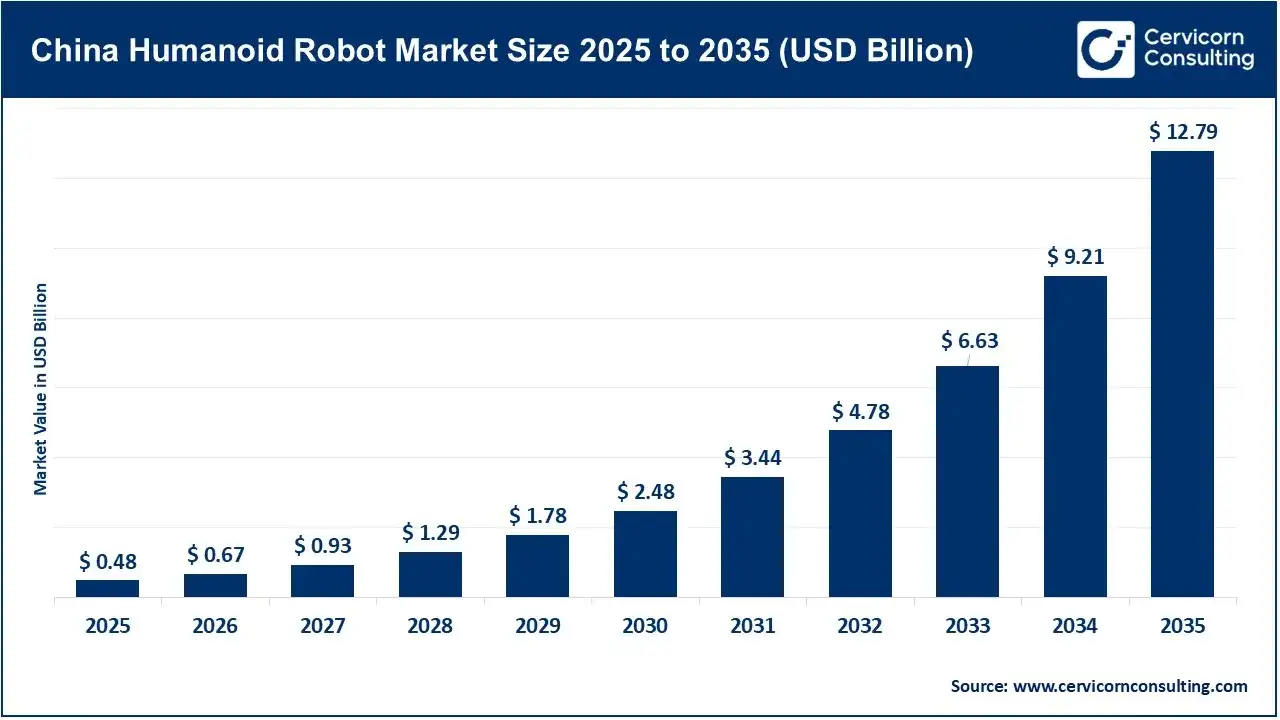
The China humanoid robot market size was valued at $0.48 billion in 2025. The market is expected to reach $12.79 billion by 2035, growing at a CAGR of 38.86% during the forecast period of 2026-2035. The China humanoid robot market expansion is mainly fueled by rising state support, government investment, an extensive local supply chain, and distinct technological breakthroughs. In addition, many robotics players are rivalling each other, while lowering average prices, making entities highly accessible for pilot deployments and industrial testing.
- Base Year Market Size (2025): $0.48 billion
- Current Year Market Size (2026): $0.67 billion
- Estimated Year Market Size (2035): $12.79 billion
- Forecast Period CAGR (2026-2035): 38.86%
Report Highlights
- By region, East China led the market in 2025, supported by robust collaborative networks and vast electric vehicle (EV) and manufacturing supply chains.
- By component, hardware dominated the market in 2025 with revenue share of 72%, due to outstanding government strategies and high-density manufacturing clusters.
- By mobility type, bipedal humanoid robots registered highest revenue share of 78% in 2025, driven by resolved labour shortages, directing human-centric infrastructure, and expediting industrial and military automation.
- By application, manufacturing and industrial automation has captured revenue highest share of 40% in 2025, powered by ongoing robust national strategies and notable growth in smart production hubs.
- By technology, artificial intelligence and machine learning led the market in 2025 with revenue share of 30%, propelled by their key role in advancing real-edge computing and broader dependency on neural networks and foundation models.
What are Key Advances in the China Humanoid Robot Market?
The market explores a machine that resembles the human body in shape and function, with a head, torso, two arms, and two legs. However, the Chinese industry is mainly driven by stronger government policy support, workforce shortages, huge upfront investment, and rapid breakthroughs in artificial intelligence. Gradual efforts are pushing the run of second-phase trials for 6G communication networks, coupled with massive spending on hyperscale data centers. Another progression approach is the development of specific robot training centers by national governments and industrial parks.
Major Efforts Taken
- In the starting of 2026, China published its 15th Five-Year Plan with a focus on robotics as a core of its modern industrial system, coupled with a rotation of its AI research towards physical applications with robots as main catalysts for economic progression.
- The Ministry of Industry and Information Technology (MIIT) and the State-owned Assets Supervision and Administration Commission (SASAC) revealed a joint directive that mandates local governments and state-owned enterprises (SOEs) to bring more than 10,000 humanoid robots into commercial use by the end of 2026.
- The People's Government of Beijing Municipality, China Media Group (CMG), the World Robot Cooperation Organization, and the RoboCup Asia-Pacific Confederation collaboratively conducted the World Humanoid Robot Games, where global researchers and pioneers met to study humanoid physical competencies and joint intelligence.
- With an emphasis on future development, several eminent local producers, like UBTech, Unitree, and Leju Robot, are generating substantial revenue by selling robots to government-led training centers and pushing collection and reselling of the training data back to the developers, reflecting early tech-subvention models.
China Humanoid Robot Market Statistics
China Humanoid Robot Manufacturing and Production Analysis
- AgiBot reached its 10,000th humanoid robot production milestone in March 2026, demonstrating the increasing scalability of domestic humanoid robot manufacturing.
- AgiBot subsequently reported cumulative production of 15,000 robots in June 2026, highlighting the rapid expansion of its manufacturing operations.
- China is targeting more than 100,000 humanoid robot production units in 2026, although this should be treated as an industry ambition rather than verified actual output.
- TrendForce projected approximately 94% year-over-year growth in China's humanoid robot production in 2026, indicating accelerating commercialization and manufacturing scale-up.
Manufacturer-wise Manufacturing and Production Developments
| Manufacturer |
Headquarters |
Key humanoid robot platforms |
Manufacturing and production developments |
| AgiBot |
Shanghai, China |
A2, X1, G1-series alternatives |
Reached its 10,000th humanoid robot production milestone in March 2026 and reported cumulative production of 15,000 units by June 2026. Expanding standardized manufacturing and commercial deployment. |
| Unitree Robotics |
Hangzhou, China |
G1, H1 |
Expanding humanoid robot manufacturing through standardized hardware, proprietary actuators, integrated components, and cost-efficient production processes. |
| UBTECH Robotics |
Shanghai, China |
Walker S, Walker S1 |
Scaling industrial humanoid robot manufacturing, with emphasis on automotive production, factory logistics, and industrial automation partnerships. |
| Fourier Intelligence |
Shenzhen, China |
GR-1, GR-2 |
Developing humanoid manufacturing capabilities by combining robotics hardware, motion control, rehabilitation technologies, and embodied AI. |
| Leju Robotics |
Shenzhen, China |
KUAVO |
Expanding humanoid robot development and manufacturing through domestic supply-chain partnerships, AI integration, and industrial applications. |
| EngineAI |
Shenzhen, China |
PM01, SE01 |
Developing commercial humanoid robot platforms and strengthening manufacturing capabilities for mobility, industrial applications, and scalable production. |
| Galbot |
Beijing, China |
Galbot G1 |
Focusing on embodied AI-enabled robots for industrial and warehouse applications, with investments in manipulation capabilities and commercial deployment. |
| Kepler Robotics |
Shenzhen, China |
K2 |
Developing industrial humanoid robots for manufacturing, logistics, material handling, and repetitive operational tasks. |
Government Policies and Humanoid Robotics Development Initiatives
- China released its first national standard system covering humanoid robots and embodied AI in March 2026, establishing technical guidelines across the industrial chain and robot lifecycle.
- The national standardization framework covers six major areas: basic commonality, intelligent computing, limbs and components, complete machines and systems, applications, and safety and ethics.
- More than 120 research institutions, enterprises, and industry users participated in developing the national standardization framework.
- China's Ministry of Industry and Information Technology is promoting standardization to improve product compatibility, technical reliability, manufacturing quality, and commercial deployment.
- Humanoid robotics and embodied intelligence are identified as strategic technology development priorities under China's 2026–2030 development planning.
- Shanghai's Embodied Intelligence Industry Development Action Plan 2025–2028 focuses on AI algorithms, intelligent computing, robotics manufacturing, and commercial applications.
- Provincial governments are supporting robotics development through research funding, industrial parks, manufacturing incentives, and technology commercialization programs.
- Government-backed robotics initiatives are encouraging collaboration between manufacturers, universities, component suppliers, and industrial customers.
- China's national robotics initiatives are increasingly emphasizing real-world deployment, industrial training, and the development of commercially useful embodied AI systems.
Market Dynamics
Growth Drivers
- Strengthening Industrial Policy: With a national priority, Central and local governments are offering direct funding, infrastructure support, and production subsidies to reduce expenses and speed up commercialization.
- Rise in Ageing Population & Lack of Staff: Day by day, China is experiencing a booming burden of elderly and disabled population, along with facing shrinkage of logistics workforce pool, driving growth of automation and humanoids in the China humanoid robot market.
- Broadening Supply Chain Solutions: Continuous developments demand the use of huge, highly efficient production settings, specifically across EV and consumer electronics supply chains to manufacture actuators, joints, and structural frames at scale.
Restraints
- Restricted Practical Utility: Well-manufactured humanoid units are transferred to research labs, universities, exhibitions, and government data centers instead of running exact industrial or commercial jobs.
- Ambiguous Business Models: Several Chinese startups and players are experiencing larger net losses, as explicit, profitable business cases outside of controlled representations are still unverified.
- Rigorous Listing Criteria: Across China, regulators have elevated financial and operational barriers for embodied AI and humanoid startups seeking to list publicly on Hong Kong and mainland exchanges.
Key Opportunities
- Encouraging Factory Scale-Up: China’s local production is predicted to exceed 50,000 units, where eminent cities have implemented intense local goals that emphasize repetitive ‘in-between’ tasks, including moving bins, loading machines, and pulling parts.
- Allowance of AI-Directed Advances: In the China humanoid robot market, major companies are seeking a significant intelligence leap by mid-to-end of 2027, enabling robots to perform excellent recognition, projection, and action in unknown circumstances.
- Boosting Commercialization: Numerous Chinese firms are slating initial commercial deliveries of humanoids, such as Iron in the first half of 2027 for showrooms, visitor welcoming, guiding tours, and site patrols.
Market Challenges
- Need for Manual Intervention: Day by day, industrial clients are demanding 95% to 99% uptime, but current humanoid robots frequently exhaust or necessitate human involvement after just 30 to 90 minutes.
- Battery Life Risks: There are limitations for standard lithium-ion batteries, which are active for 1 to 4 hours; thus, consistent multi-shift factory work is difficult without advanced charging infrastructure.
- Shortage of Human Talent & Pace: Eventually, advancing humanoid robots run physical tasks at nearly 20% of a human's speed, and fine-motor control for complex manipulation remains uncoordinated.
China Humanoid Robot Market Segmentation Analysis
Component Analysis
Hardware: The hardware segment held a dominant share of the market in 2025, fueled by surging production integration and broader local sourcing of physical parts. Across China, automotive and EV supply chains were massively repurposed for humanoid production, where 3D LiDAR, cameras, high-strength permanent magnet rare-earth materials, and battery packs transitioned directly into bipedal and industrial humanoid chassis.
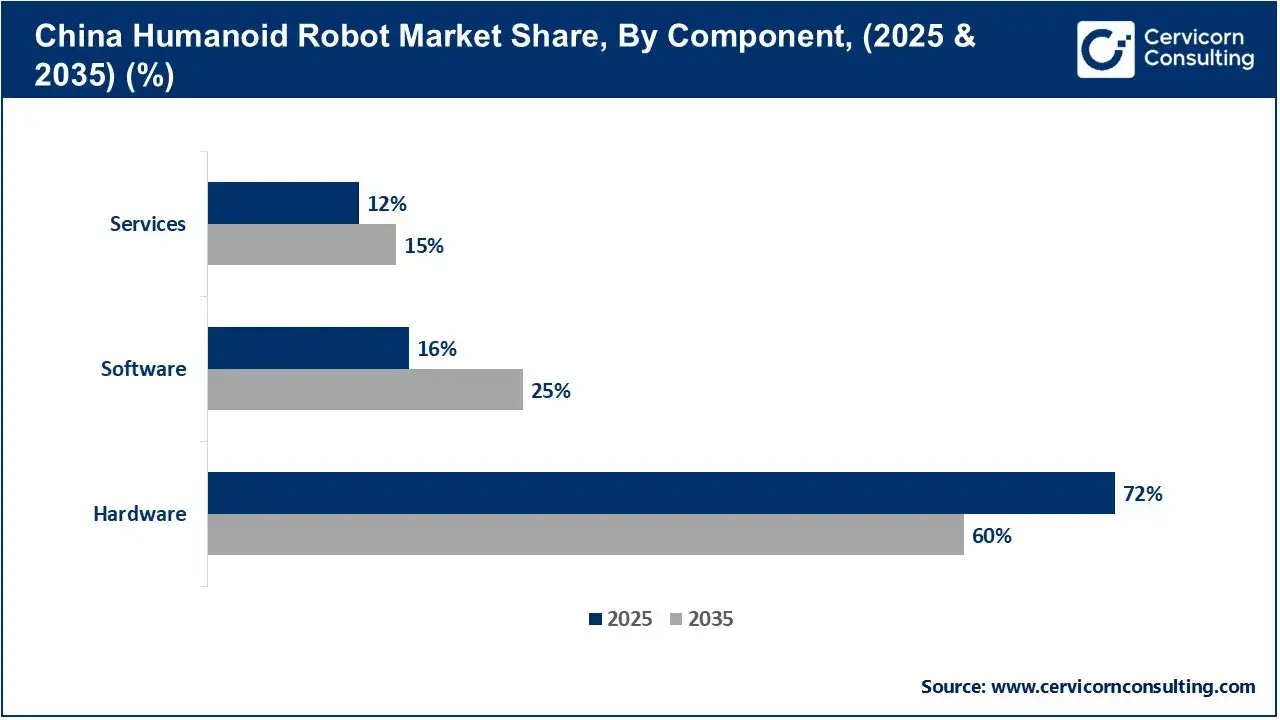
Software: The software segment is expected to be the fastest-growing in the predicted timeframe, supported by the presence of open-source software ecosystems and focused government mandates. The use of software & data pipelines obtained from China's massive electric vehicle (EV) and industrial automation sectors allows rapid data feedback loops, motion planning optimization, and fleet-learning capabilities. Recently, at ICRA 2026, Agilink demonstrated modern contact control software that decouples movement from physical interaction.
Mobility Type Analysis
Bipedal Humanoid Robots: The bipedal humanoid robots segment captured a major share of the China humanoid robot market in 2025 and is projected to witness rapid expansion due to their impressive human-like form factor, the lack of workforce, and emerging strategic trajectories by the government. With a goal of consumer-friendly pricing, Noetix Robotics introduced its 94-cm Bumi humanoid at 9,998 yuan (~$1,380), whereas Unitree rolled out entry-level bipedal models, such as the R1 starting around $5,500 to $6,000.
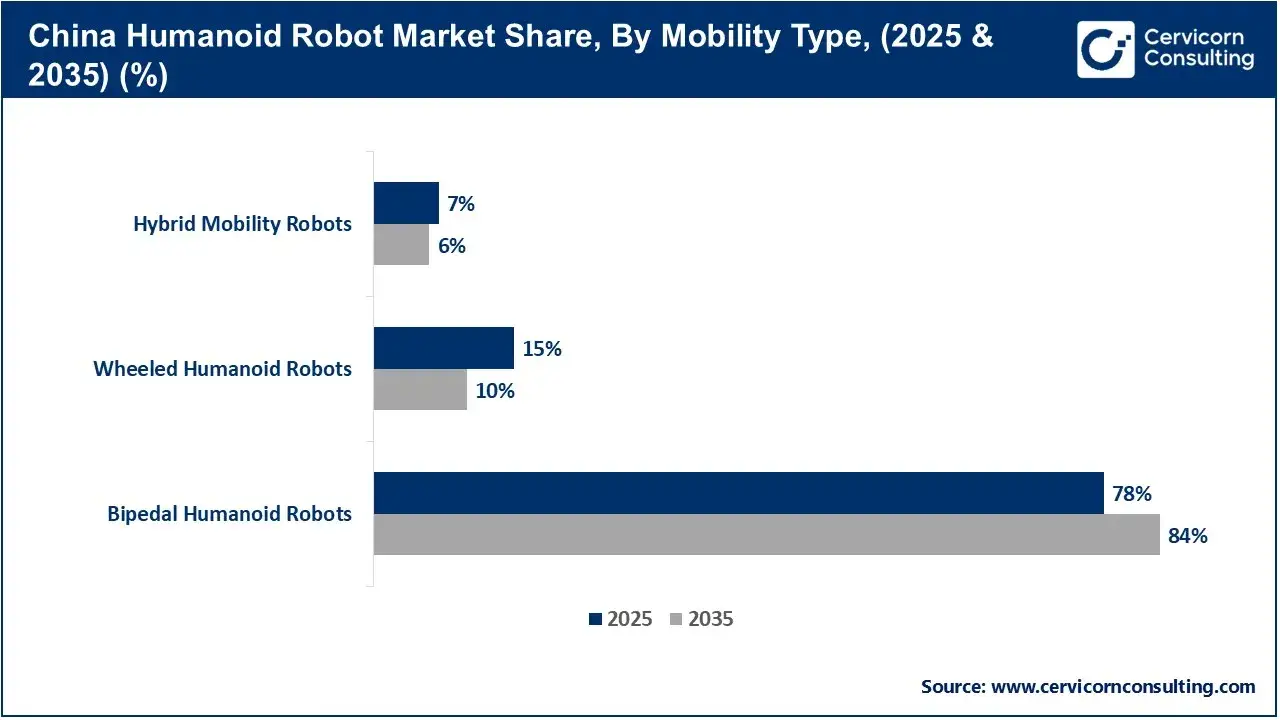
Hybrid Mobility Robots: The hybrid mobility robots segment is predicted to grow significantly in the coming years, propelled by their higher operational efficiency and load-bearing flexibility. Recently, the Aviation Industry Corporation of China (AVIC) at the 2026 WRC showcased AVIC Electro-Hydraulic Humanoid, a 1.8-meter robot that leverages a hybrid electric-and-hydraulic drive system derived from aero-engine technology.
Application Analysis
Manufacturing and Industrial Automation: The manufacturing and industrial automation segment held the largest share of the market in 2025, motivated by a well-established electric vehicle (EV) supply chain, synchronized state support, and quickly reducing production expenses. As China registers dominance in local production, Beijing’s Robot+ initiative and AI + Manufacturing blueprints aim at higher robot density, local component robustness, and promised humanoid pilot lines.
China Humanoid Robot Market Share, By Application, 2025 (%)
| Application |
Revenue Share, 2025 (%) |
| Manufacturing and Industrial Automation |
40% |
| Logistics and Warehousing |
16% |
| Healthcare and Elderly Care |
8% |
| Education and Research |
25% |
| Personal Assistance and Services |
11% |
Logistics and Warehousing: The logistics and warehousing segment is anticipated to expand at the fastest rate during 2026-2035, driven by emerging nation initiatives and ongoing strong alliances among e-commerce and delivery. The widespread adoption of humanoid robots eliminates challenges in sorting facilities and smart warehouses. With increased efforts in AI-assisted approaches, China’s largest EV player BYD, is booming its internal humanoid fleet from 1,500 units in 2025 to 20,000 units in 2026 to unify robotic handling directly into parts logistics and assembly lines.
Technology Analysis
Artificial Intelligence and Machine Learning: The artificial intelligence and machine learning segment accounted for a major share of the market in 2025 because of massive growth in computing infrastructure and growing large-scale data collection. According to Cervicorn experts, Chinese companies are looking for deep learning, reinforcement learning, and real-time sensor fusion, while robots employ domestic foundation models to understand settings and make autonomous decisions.
China Humanoid Robot Market Share, By Technology, 2025 (%)
| Technology |
Revenue Share, 2025 (%) |
| Artificial Intelligence and Machine Learning |
30% |
| Computer Vision and Perception |
22% |
| Natural Language Processing |
12% |
| Motion Control and Navigation |
24% |
| Human-Robot Interaction |
12% |
Computer Vision and Perception: The computer vision and perception segment is estimated to be the fastest-growing in the upcoming years, fueled by continuous progression of embodied intelligence, closed-loop systems and direct perception control (DPC). Innovative solutions are integrating LiDAR, satellite positioning, high-definition stereo vision systems, and Inertial Measurement Units (IMUs) with real-time mapping to manage dynamic terrain, slopes, and obstacles. Also, explored consolidated camera vision with microelectronic pressure sensors and a seven-axis mobile wrist, enabling robots to find, approach from any angle, and control fragile or soft unfamiliar objects on the first try.
China Humanoid Robot Market Regional Analysis
How did East China Dominate the Market in 2025?
East China led with a dominant share of the market in 2025, supported by the existence of tech giants, startups, and advanced electronics supply chains. At the World Artificial Intelligence Conference (WAIC 2025), over 60 humanoid robots were demonstrated in Shanghai, which underlined real-world physical and AI interactions. On the other hand, Zhejiang cemented its status as a high-tech hub, with Hangzhou-based robotics leaders forcing rapid enhancements in bipedal locomotion, dynamic stability, and neural-driven motion control.
Which Region is Expected to Expand Rapidly in the Market During 2026-2035?
East China and South China are projected to grow at a rapid rate during the forecast period, propelled by rising industrial and municipal pilot programs and faster growth of hardware prototyping. In the case of East China, the Shanghai-based National and Local Co-Built Humanoid Robotics Innovation Center initiated the Humanoid Robot Kylin Training Ground, China's first heterogeneous humanoid robot training facility. Besides this, coordinated AI-scheduled climbing and humanoid or logistics robots boosted high-speed warehouse sorting and multi-level vertical item-picking in Guangzhou.
Latest Launches
- October 2026: China rolled out the world's first large-scale robot theme park in the southern city of Zhuhai, representing more than 300 humanoid robots.
- October 2026: Hangzhou-based Unitree Robotics launched Unitree H2-X (‘Guardian’), a 170-cm, 65-kg humanoid for security and rescue scenarios, with high-agility physical moves.
- October 2026: RoboParty unveiled RP1, a full-stack open-source humanoid robot for robotics research and embodied AI development, with access to both hardware and software.
- September 2026: Chinese electric vehicle maker XPeng announced an automated production line to produce advanced general-purpose humanoid robots.
Leading Players
Segments Covered
By Component
- Hardware
- Software
- Services
By Mobility Type
- Bipedal Humanoid Robots
- Wheeled Humanoid Robots
- Hybrid Mobility Robots
By Application
- Manufacturing and Industrial Automation
- Logistics and Warehousing
- Healthcare and Elderly Care
- Education and Research
- Personal Assistance and Services
By Technology
- Artificial Intelligence and Machine Learning
- Computer Vision and Perception
- Natural Language Processing
- Motion Control and Navigation
- Human-Robot Interaction
By Region (China)
- East China
- South China
- North China
- Central China
- Southwest and Northeast China
