
Content
Rise of Physical AI: Market Growth, Global Landscape, and Future Outlook


Physical AI Market Overview
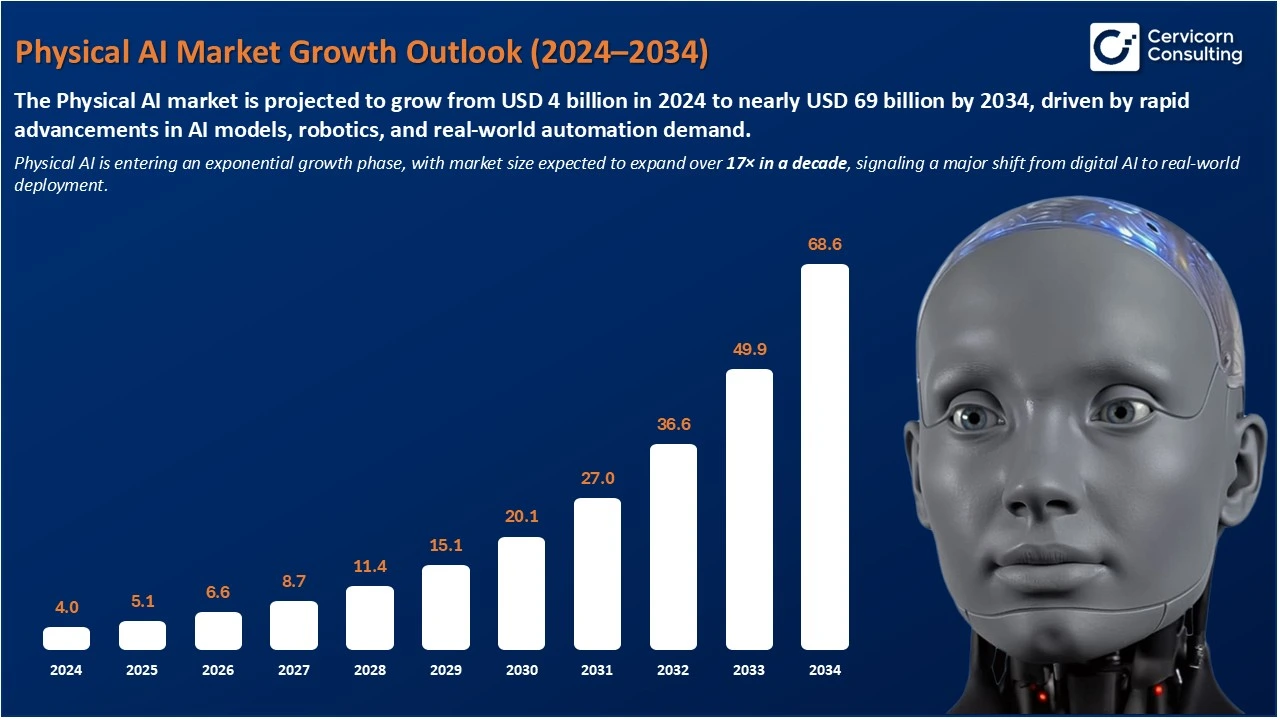
The physical AI market is set to grow rapidly, with the market size expected to increase from about USD 5.13 billion in 2025 to nearly USD 68.54 billion by 2034, at a CAGR of over 33%. This growth is mainly due to the shift of AI from digital platforms to physical systems capable of sensing, reasoning, and acting in real time. Key drivers include advances in AI models, hardware development, and rising demand for real-world applications.
Over the past decade, artificial intelligence has primarily operated in the cloud, supporting tasks such as text processing, image generation, and remote prediction. This dynamic is shifting as physical AI intelligence embedded in machines that interact directly with the physical environment emerges as a key trend for the late 2020s. Physical AI systems face operational challenges distinct from those of software-based AI, including managing timing, balancing, safety, and real-time unpredictability. For example, while a language model can pause without consequence, a surgical robot or autonomous vehicle must respond instantly to changing conditions. Recent industry developments reflect this transition. NVIDIA's physical AI division reported over USD 6 billion in revenue for fiscal year 2026. Although this represents less than 3% of the company's total revenue, the division's rapid growth is attracting increased investor attention.
What is Physical AI?
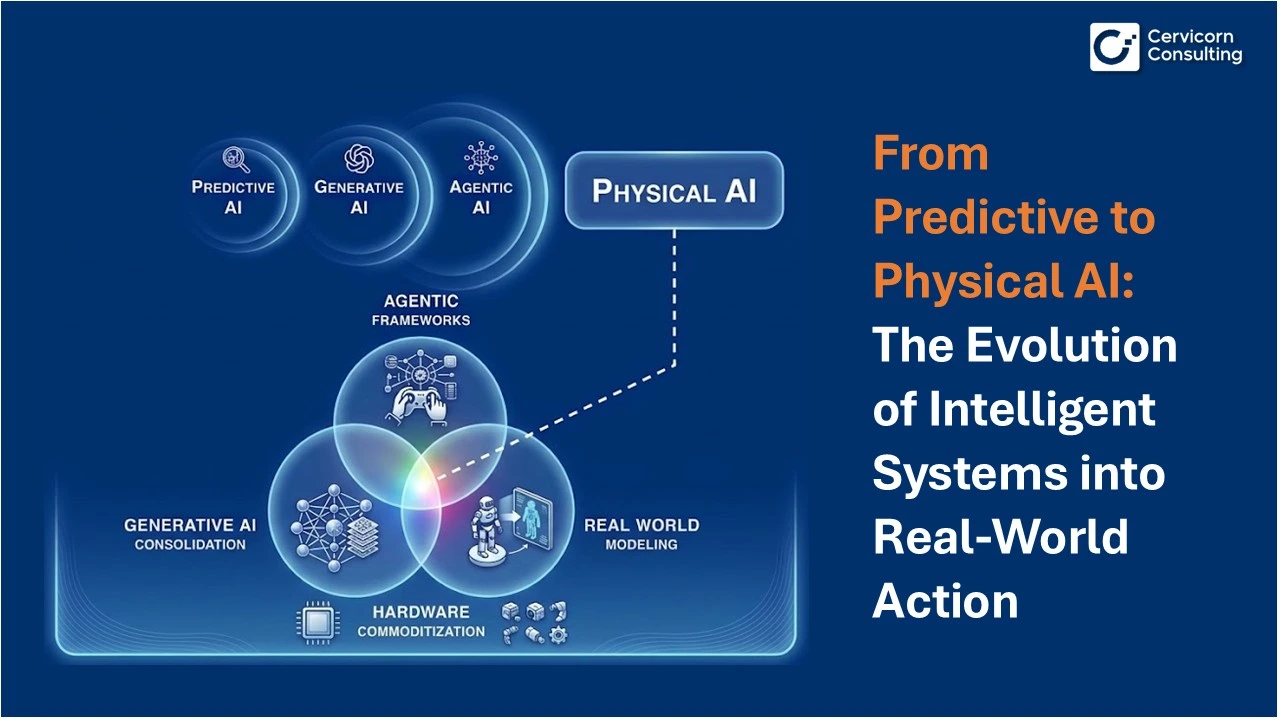
Physical AI refers to artificial intelligence systems that are embedded in machines capable of sensing, reasoning, and taking autonomous action in the real physical world, as opposed to digital AI, which operates purely in software environments like text generation, image recognition, or data analysis. The term was popularized by NVIDIA CEO Jensen Huang at CES 2025, where he described physical AI as the next frontier of machine intelligence: "AI that understands and interacts with the physical world."
Transform your decisions with in-depth analysis, purchase this premium research report@ https://www.cervicornconsulting.com/buy-now/2741
Six Forces Driving the Physical AI Wave
A convergence of hardware breakthroughs, software maturity, and urgent industrial demand has fostered ideal conditions for the Physical AI market to thrive.
| 01 | Vision-Language-Action (VLA) Models | Multimodal foundation models now enable robots to process camera feeds, natural language instructions, and sensory data to plan and execute complex actions — removing the need for pre-programmed scripts. Investment in VLA research exceeded USD 3.8 billion in 2025, nearly tripling the 2023 level. As of early 2026, leading models show zero-shot generalization to new environments that was impossible just two years ago. |
| 02 | Edge AI & On-Device Processing | On-device deployment accounts for 51.7% of the market as low-latency, high-reliability processing becomes essential for surgical robots, autonomous vehicles, and industrial systems. NVIDIA's new Jetson T4000 module offers 4× greater energy efficiency than previous generations, enabling more advanced intelligence at the edge. |
| 03 | Synthetic Data & Simulation Environments | Training physical AI robots requires large, diverse datasets. Digital twin platforms and simulation environments like NVIDIA Omniverse and Cosmos now generate synthetic training data at scale — dramatically reducing real-world testing costs, enhancing safety, and accelerating deployment cycles. Synopsys launched the Electronics Digital Twin Platform in March 2026 specifically to support physical AI systems. |
| 04 | Labor Shortages & Industrial Automation Demand | Chronic labor shortages in manufacturing, logistics, and elder care are pushing companies to speed up automation. 67% of large manufacturers were either testing or using at least one physical AI platform solution as of early 2026. AI-powered robots provide up to 40% greater operational efficiency than traditional automation systems. |
| 05 | Rapid Humanoid Robot Cost Reduction | Manufacturing costs for humanoid robots dropped 40% from 2023 to 2024 alone — faster than the previously forecasted 15–20% annual decline. Goldman Sachs estimates this could accelerate factory applications by 1 year and consumer applications by 2–4 years compared to earlier forecasts. The Unitree R1 now sells for USD 5,900, indicating a progression toward mass-market pricing. |
| 06 | Government Investment & Strategic Policy | China's "Made in China 2025," Japan's Society 5.0, South Korea's national robotics initiative, and the US White House AI Action Plan (July 2025) are all directing public funds into the sector. China has allocated a USD 1.4 billion robotics fund and registered nearly 5,700 humanoid robot patents from 2020–2025 — about four times the number in the US. |
Recent Developments and Investments Transforming the Physical AI Market
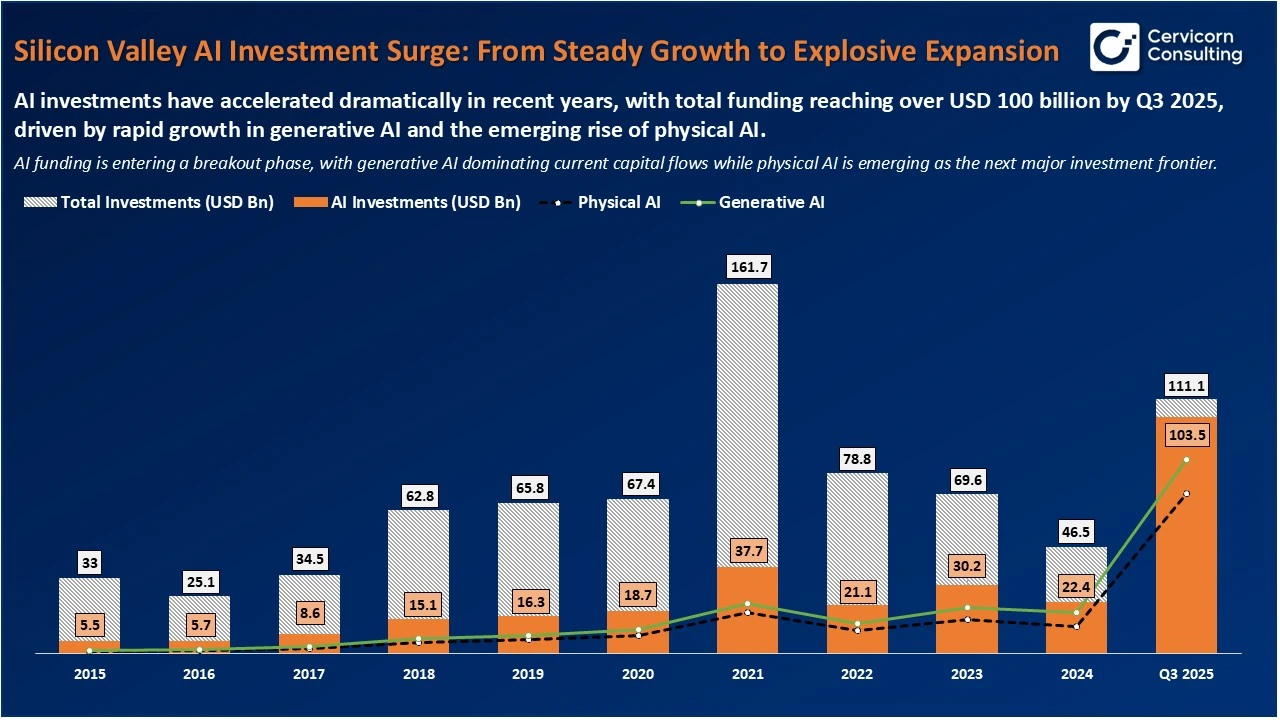
AI investment has expanded steadily over the past decade, with notable acceleration in 2021 and a renewed increase by the third quarter of 2025, when funding exceeded USD 100 billion. Generative AI has accounted for much of this recent growth, but current data suggests that investor attention is beginning to shift toward physical AI. This trend indicates a move beyond software-based intelligence, as capital increasingly targets real-world applications and the deployment of embodied systems. The transition from digital to physical AI may reshape priorities for both investors and technology developers.
Physical AI vs Traditional AI: Key Differences
| Dimension | Traditional / Digital AI | Physical AI |
| Operating Environment | Digital environments including text, images, code, and structured data | Real-world physical environments such as factories, roads, warehouses, and hospitals |
| Primary Output | Text generation, predictions, recommendations, and classifications | Physical motion, object manipulation, navigation, and autonomous actions |
| Latency Tolerance | Seconds to minutes are acceptable depending on workload complexity | Milliseconds are required for real-time decision-making and response |
| Key Hardware | GPUs, CPUs, cloud servers, and large-scale data center infrastructure | Actuators, sensors, edge AI chips, batteries, and robotics processors |
| Failure Consequence | Incorrect output, hallucination, or poor prediction quality | Physical harm, equipment damage, safety risks, or operational failure |
| Training Data Source | Internet text, images, audio, video, and enterprise datasets | Robot teleoperation data, physical simulations, motion capture, and sensor feedback |
| Leading Companies | OpenAI, Anthropic PBC, Google LLC | NVIDIA Corporation, Tesla, Inc., Boston Dynamics, Inc., Unitree Robotics |
Future of Physical AI: Outlook by 2030
- Global robotic installations to reach over 8 million units by 2030, the current installed base of 4.3 million robots will nearly double by the end of the decade as adoption surges in manufacturing, logistics and healthcare.
- Humanoid robot shipments to soar 1.2 million units by 2030, up from just 25,000 in 2025, the shift from pilots to mass deployment of humanoids is on the horizon.
- Edge AI chip shipments to exceed 9.5 billion units by 2030, the compute core for physical AI, these chips are crucial for autonomous robots, smart industrial systems and intelligent devices.
- Warehouse automation penetration to reach over 63% by 2030, picking robots will become standard in logistics from 24% penetration in 2025.
- Robotics density in manufacturing to jump to 290 robots per 10,000 workers by 2030, industrial automation will deepen, up from 162 in 2024.
- Delivery robot fleets to exceed 850,000 units by 2030, retail, food delivery and urban logistics will drive this growth from 110,000 units in 2025.
- Physical AI startups to secure over $60 billion in annual investments by 2028, capital inflow into the sector will accelerate from $24 billion in 2025.
- AI-driven physical automation in 35% of global industrial workflows by 2030, this marks a significant jump from just 12% in 2025.
Recent Developments in Physical AI Market
Jan 2026: Boston Dynamics × Google DeepMind × Hyundai
Boston Dynamics partnered with Google DeepMind to integrate Gemini Robotics AI foundation models with its electric Atlas humanoid robot. The collaboration deployed Atlas fleets to Hyundai Motor Group and Google DeepMind facilities, marking a milestone in humanoid commercialization through complementary mobility and AI model expertise.
Mar 2026: NEURA Robotics × Qualcomm
NEURA Robotics and Qualcomm Technologies collaborated to advance physical AI and cognitive robotics platforms enhancing high-level cognition, real-time control, and safe human-robot interaction in industrial, service, and household settings. NEURA also revealed a Porsche-designed Gen 3 humanoid at CES, featuring NVIDIA's Jetson Thor compute.
Mar 2025: Google DeepMind: Gemini Robotics Models
DeepMind introduced Gemini Robotics and Gemini Robotics-ER, two new AI models focused on robotics that enable robots to perform vision-language-action tasks and adapt to new physical challenges without specific training. These models can understand natural language commands in an environmental context and carry out skilled manipulation tasks similar to human dexterity.
Mar 2026: Synopsys: Electronics Digital Twin Platform
Synopsys launched the Electronics Digital Twin (eDT) Platform, an open solution accelerating the creation, management, deployment, and use of electronics digital twins for software-defined products and physical AI systems. This directly addresses the simulation bottleneck that has historically slowed robot training pipelines.
Q4 2025: Robotics Investment Surge: +300% in Q4 2025
Robotics investments surged 300% in Q4 2025 as humanoid robots achieved production milestones. Dexterity raised USD 95 million at a USD 1.65 billion valuation in March 2025 for physical AI robot development. Sensi.AI raised USD 45 million in October 2025 for AI-driven care intelligence targeting the aging population. Figure AI's investors now include NVIDIA, OpenAI, Microsoft, and Amazon founder Jeff Bezos.
Physical AI Cost Benchmarking (Average Cost Structure by System)
| Cost Component | Share of Total Deployment Cost | Typical Cost Range (USD) | Key Function |
| Sensors & Vision Systems | 20%–25% | $8,000 – $35,000 | Cameras, LiDAR, radar, depth sensing, environmental mapping |
| Edge AI Processors / Compute Units | 15%–20% | $6,000 – $28,000 | Real-time inference, decision-making, local compute |
| Actuators & Motion Control Systems | 22%–28% | $10,000 – $45,000 | Motors, servos, robotic movement execution |
| Battery & Power Management Systems | 10%–15% | $4,000 – $18,000 | Power supply, charging, energy efficiency |
| Connectivity & Communication Modules | 4%–8% | $2,000 – $9,000 | 5G, Wi-Fi, industrial IoT communication |
| Simulation & Digital Twin Software | 6%–10% | $3,500 – $15,000 | Training, testing, virtual optimization |
| AI Model Training & Data Engineering | 7%–12% | $5,000 – $25,000 | Dataset creation, reinforcement learning, motion modeling |
| Safety & Compliance Systems | 3%–6% | $2,000 – $10,000 | Collision avoidance, regulatory compliance, emergency systems |
| Safety & Compliance Systems | 3%–6% | $2,000 – $10,000 | Collision avoidance, regulatory compliance, emergency systems |
| Integration & Deployment Services | 8%–14% | $4,500 – $22,000 | Collision avoidance, regulatory compliance, emergency systems |
Global Landscape of Physical AI
United States
The United States leads the Physical AI market in innovation, AI intelligence, and capital investment, making it the core driver of technological advancement in the sector. It is home to leading companies such as NVIDIA, Tesla, and Boston Dynamics, which are developing advanced AI models, robotics platforms, and simulation ecosystems. While the U.S. does not match China in deployment scale, it dominates the software and intelligence layer, which ultimately powers global Physical AI systems.
- The United States has invested over USD 7 billion annually in robotics and AI development in recent years, leading global private-sector funding.
- The U.S. AI robotics market is projected to grow from approximately USD 7 billion in 2022 to over USD 38 billion by 2031, reflecting strong expansion.
- Despite technological leadership, robots currently account for only about 3% of the U.S. workforce, indicating lower deployment compared to Asia.
- Major AI companies like NVIDIA generated tens of billions in revenue driven by AI demand in 2025, signaling strong market momentum.
- The country leads in foundation models, simulation platforms, and autonomous systems, which form the core intelligence of Physical AI.
Japan
Japan’s leadership in Physical AI is rooted in long-term investment in precision robotics and dependable system integration, especially in manufacturing and healthcare. The sector’s maturity is evident in the broad adoption of advanced robotics across these industries. Ongoing demographic shifts, notably an aging population, are accelerating the need for automation in healthcare and service sectors, where reliable solutions are essential. Unlike markets focused on rapid expansion, Japan prioritizes accuracy, safety, and consistent performance, which meets the demands of critical, high-stakes applications.
- Japan consistently ranks among the top global producers and exporters of industrial robots, supplying a large portion of the world market.
- The country has one of the highest adoption rates of robotics in manufacturing, driven by labor shortages and demographic shifts.
- Healthcare robotics in Japan is growing rapidly due to its aging population, which is one of the oldest globally.
- Government initiatives under Society 5.0 are promoting integration of AI and robotics into everyday life.
- Japan’s robotics industry has decades of operational data, giving it a strong advantage in reliability and deployment quality.
South Korea
South Korea demonstrates a high degree of automation and has integrated robotics extensively across its industrial sectors. With one of the highest robot densities globally, robots form a significant component of the national workforce. The emphasis on efficiency and productivity has accelerated the adoption of Physical AI solutions at scale, suggesting that South Korea is prioritizing practical implementation over development alone.
- South Korea has one of the highest robot densities globally, with robots widely deployed across manufacturing industries.
- More than 10% of the workforce is supported by robotic systems, significantly higher than many Western economies.
- The government has implemented national robotics strategies to accelerate automation and AI integration.
- The country’s strong semiconductor and electronics industries support the development of advanced robotics hardware.
- South Korea’s manufacturing sector heavily relies on automation, making it a real-world testing ground for Physical AI deployment.
Germany
Germany maintains a strong position in the European Physical AI market, supported by its established capabilities in industrial engineering, automation, and ongoing Industry 4.0 initiatives. Physical AI technologies are integrated into advanced manufacturing systems, with an emphasis on quality, operational efficiency, and regulatory compliance. German firms typically prioritize precision, reliability, and sustained performance over rapid expansion. This approach has resulted in solutions that are widely adopted across global industries, particularly where long-term operational stability is critical.
- Germany is home to major industrial automation companies like Siemens and KUKA, which are leaders in robotics integration.
- Europe’s Physical AI market is projected to reach approximately USD 15–16 billion by 2034, with Germany as a central contributor.
- The country is a pioneer of Industry 4.0, integrating AI into smart factories and production systems.
- German manufacturing relies heavily on automation, particularly in automotive and engineering sectors.
- Strict regulatory frameworks ensure high standards for safety and ethical AI deployment.
India
India represents a high-potential market for Physical AI, supported by expanding demand and a strong talent pool. Although the country has not yet established global leadership in robotics hardware or deployment, adoption of AI-driven automation is accelerating across logistics, manufacturing, and services. Factors such as a large population, improved digital infrastructure, and sensitivity to costs are likely to drive demand for scalable, affordable Physical AI solutions. Current trends suggest that India may transition from primarily consuming these technologies to playing a more active role in global Physical AI innovation.
- India’s AI market is growing rapidly, supported by a large pool of skilled engineers and developers.
- The country is witnessing increasing adoption of automation in logistics, e-commerce, and manufacturing sectors.
- Government initiatives are promoting AI adoption and digital transformation across industries.
- India’s startup ecosystem is expanding, with a rising number of AI and robotics-focused companies.
- The combination of scale and cost sensitivity creates strong demand for affordable Physical AI solutions.
What Comes Next: A Roadmap to 2035
Physical AI remains in the early stages of what could become the most economically transformative technology cycle of the 21st century. Here's an overview of its trajectory.
2026: Commercial Pilots Scale to Fleets
The industry shifts from demonstrating individual units to deploying multi-robot fleets in controlled industrial environments. Tesla starts mass production of Optimus. The costs of humanoid robots decrease by about 40% each year. VLA models achieve commercial readiness for manipulation tasks. Cloud-based AI experiences the fastest growth at a 38.6% CAGR, driven by the increasing importance of fleet management and model updates as essential infrastructure.
2027–2028: Robot Foundation Models Cross the Scaling Threshold
The IEEE Robotics' 2025 survey forecasts that by 2027, the parameter scales of robot foundation models will increase from billions to hundreds of billions. This growth will allow robots to perform most structured physical tasks using only language instructions, similar to GPT-4's advancement but applied to embodied agents. Additionally, the software sector for humanoid robots is expected to expand at a compound annual growth rate of 54.7% through 2034.
2029–2031: Cross-Industry Horizontal Deployment
Physical AI systems now extend beyond manufacturing and logistics into areas such as elder care, precision agriculture, household support, and retail. Robotics-as-a-Service (RaaS) models enable small and medium-sized enterprises (SMEs) to access robotics without the need for heavy capital investment in robot fleets. Autonomous vehicle fleets are expanding from thousands to hundreds of thousands. The worldwide Physical AI market is nearing USD 400–500 billion.
2033–2035: A USD 960 Billion Market — The Humanoid Economy
Investment banks project the global humanoid market could hit USD 5 trillion in the coming decades, potentially doubling the size of the automotive industry. Goldman Sachs estimates the humanoid market will reach USD 38 billion by 2035 as a standalone segment. Overall, physical AI is expected to approach USD 960 billion by 2033, with USD 82 billion attributed to software platforms alone by 2035. At this scale, physical AI is set to become foundational infrastructure rather than just a niche technology.
Conclusion
Physical AI Is Transitioning from Innovation to Infrastructure
Physical AI is no longer just a future idea; it is quickly becoming a commercially viable and strategically essential technology. The market shows clear progress, as evidenced by revenue growth, expanded deployment, and faster innovation cycles. The convergence of foundation models, edge computing, simulation platforms, and industrial needs is shortening development times and accelerating real-world adoption at an unmatched pace. Consequently, Physical AI is shifting from experimental projects to fundamental operational systems in various industries.
1. For Investors
The Physical AI ecosystem features a multi-layered investment landscape, with value distributed across hardware, software, and infrastructure platforms. Platform-focused companies like NVIDIA are strategically positioned to capture a larger share of value due to their roles in compute, simulation, and AI model development. Simultaneously, application-layer players, including humanoid robotics firms such as Figure AI and Agility Robotics, present higher growth opportunities but carry greater execution risk. In the short term, capital efficiency and revenue visibility are greatest in industrial automation, logistics, and healthcare, while consumer-oriented applications are expected to take longer to mature.
2. For Enterprises
Enterprise adoption of Physical AI is entering an early scaling phase, with more organizations actively piloting or deploying solutions across operations. Early adopters are gaining structural advantages, especially in warehousing, inspection, and process automation, where performance improves over time through data-driven learning. The rise of Robotics-as-a-Service (RaaS) models is lowering capital expenditure barriers, allowing broader adoption among mid-market organizations. The strategic focus for enterprises is shifting from assessment to action—specifically, how to integrate, scale, and operationalize Physical AI within existing systems.
3. For Builders
The barrier to entry in Physical AI development is declining due to the growing availability of open models, development frameworks, and compute platforms. Ecosystems led by NVIDIA, Google DeepMind, and Hugging Face are accelerating innovation and cutting down time-to-market. However, the main challenge is shifting toward the simulation and data infrastructure layer. Capabilities such as digital twins, synthetic data generation, and real-world training environments are becoming essential enablers for scalable deployment. Consequently, the most promising opportunities are not only in building intelligent systems but also in developing the infrastructure that supports training, orchestration, and lifecycle management at scale.
Secure your competitive edge with the full market roadmap, reach out to our analysts here: +91 8983225533 | sales@cervicornconsulting.com