
Content
Japan's Robotics Industry: A Multi-Billion Transformation Already Underway


Japan's Robotics Industry Overview
From Yamanashi factory floors to Osaka hospital wards, Japan is not experimenting with robotics. It is deploying it at scale, backed by sovereign capital, demographic urgency, and a manufacturing heritage.
Japan produces 38% of the world's robots. Its five largest robotics manufacturers together account for more than 40% of global industrial robot shipments. Its automotive sector installed approximately 13,000 new AI-integrated industrial robots in 2024 alone, an 11% year-over-year increase and the highest single-year figure since 2020. Robotics purchase orders hit a record JPY 324.5 billion in Q1 2025, a 14.2% gain over the same quarter the prior year. These are not forecasts. They are confirmed order figures from manufacturers already operating in production mode.
Japan has already done its experiments on robotics, the integration of machine learning with robotic hardware, sensors, and real-time control systems that operate in the physical world, has found no more natural home than Japan. The country's combination of demographic pressure, engineering depth, and sovereign capital commitment has created an environment where this technology is being stress-tested, refined, and scaled simultaneously. For investors, supply chain partners, and technology innovators evaluating where the robotics holds opportunity is most concentrated and most accelerated, Japan is the single most important market to understand right now.
Explore comprehensive Japan robotics industry intelligence. Request for research need@ sales@cervicornconsulting.com OR +91 8983225533
Japan's Robot Production Numbers Tell Their Own Story
The Japan Robot Association, which collects data directly from member manufacturers, has now recorded seven consecutive quarters of growth in both order volume and value. Here is what that looks like quarter by quarter.
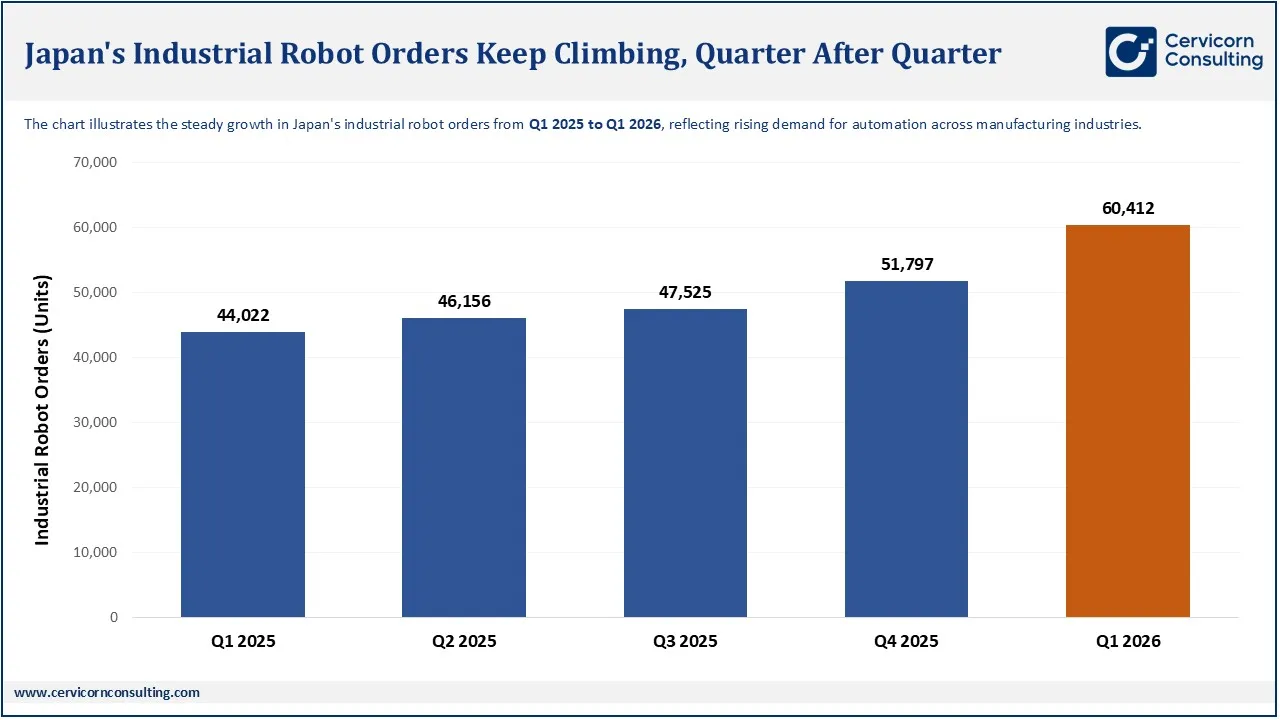
Exports are doing even more of the heavy lifting than domestic demand. In Q1 2026 alone, export value rose 35.4 percent year on year to 199.8 billion yen, with export volume climbing 29.3 percent to 44,630 units. That means roughly three out of every four robots Japan produced in that quarter left the country. This is a manufacturing base that is still being called on by the rest of the world, not one that is being replaced by it.
Who Actually Builds Japan's Robots?
Five companies, often called the Big Five, still dominate domestic output and account for a combined share of over 40 percent of global industrial robot shipments.
| Company | Notable Scale and Market Presence |
| Fanuc | Installed base of approximately 500,000 industrial robots worldwide, with its headquarters manufacturing facility capable of producing up to 6,000 robot units per month. |
| Yaskawa Electric (Motoman) | Installed base of over 400,000 robots globally and expanding production capacity through a new 800,000-square-foot manufacturing facility in Wisconsin, U.S. |
| Kawasaki Heavy Industries | Has installed more than 110,000 industrial robots worldwide and is recognized as one of Japan's pioneering industrial robot manufacturers since the 1960s. |
| Denso | Installed base of over 100,000 compact industrial robots, primarily serving precision manufacturing and automotive assembly applications. |
| Mitsubishi Electric | Operates a well-established Factory Automation Systems Division, supplying advanced industrial robots, automation equipment, and control systems to manufacturers worldwide. |
Fanuc alone is worth pausing on. Its headquarters factory can produce 25,000 CNC units and robot controllers per month, 150,000 servo motors per month, and 84,000 servo amplifiers per month, largely using its own robots to build more robots. That kind of self-reinforcing automation loop is a big part of why Japanese manufacturers have kept their production costs competitive even as wages and energy costs rose at home.
Both Fanuc and Yaskawa are also placing new bets outside Japan. Yaskawa is building an 800,000 square foot facility in Wisconsin for high volume robot production, while Fanuc recently completed a 650,000 square foot expansion in Michigan, backed by a 110 million dollar investment, bringing its total North American commitment past 250 million dollars. These are not small hedges, they tell you Japanese manufacturers expect sustained demand growth in North America and are not willing to serve it purely through exports anymore.
Where Do All These Robots Actually Go?
Japan exports close to 2.1 billion dollars worth of robots annually, and around 60 percent of everything Japanese manufacturers build leaves the country. The destination mix varies by company. Fanuc ships about a third of its output to China, with the United States and Europe close behind. Kawasaki sends nearly half its production domestically, with the United States next.
Yaskawa splits fairly evenly between Japan, China, and the Americas. That spread matters for anyone assessing supply chain risk, since no single manufacturer depends too heavily on one export market, even as trade tensions between the United States and China continue to reshape global sourcing decisions.
Why Is Tokyo Pouring Billions Into Robotics Right Now?
Japan's government has stopped treating robotics as an industrial nice to have and started treating it as core national infrastructure, on par with energy security or chip manufacturing.
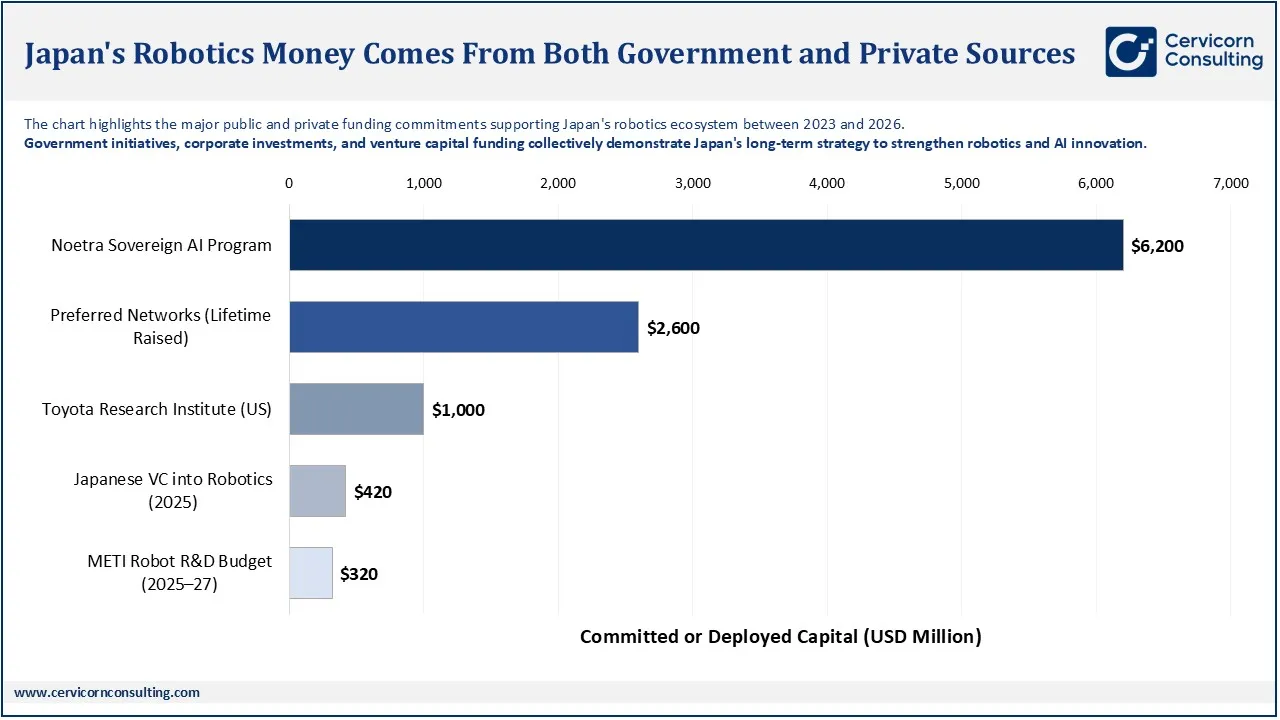
Japan's Ministry of Economy, Trade and Industry has committed up to 1 trillion yen, or about 6.2 billion dollars, over five years to the project, with an initial tranche of 387.3 billion yen flowing in fiscal year 2026 alone. The stated goal is 10 million AI equipped robots deployed across 18 sectors by 2040, including food manufacturing, restaurants, and medical care.
That sits inside a much larger 14 year national growth strategy targeting 370 trillion yen, roughly 2.3 trillion dollars, in combined public and private investment across 17 strategic sectors, physical AI among them. METI has also quadrupled its overall AI spending commitment to about 8 billion dollars, the third highest national AI budget behind only the United States and China, with roughly 2.5 billion dollars of that figure earmarked specifically for physical AI and robotics rather than software models.
As experts at Cervicorn Consulting kept on analysing the industry, we found:
- METI allocated 48 billion yen, close to 320 million dollars, for robot research and development across the 2025 to 2027 fiscal cycle.
- Japan's updated National Robot Strategy targets doubling the number of robots deployed in the service sector by 2028 and building a certified robot integrator workforce of 50,000 professionals, addressing a very practical bottleneck, since robots are useless without people trained to install and maintain them.
- The Cabinet Office's Moonshot Research and Development Program has also set a formal 2050 goal for AI robots that can learn autonomously and work directly alongside humans, funding long horizon research at universities and at RIKEN, Japan's national research institute.
Private Capital Is Finally Catching Up
For decades, Japan's robotics investment ran almost entirely through corporate research budgets rather than venture funding. Fanuc, Yaskawa, Sony, and Toyota together still spend more than 2 billion dollars a year on automation research, a scale few startups anywhere could match on their own.
That is starting to change. Japanese venture funds deployed approximately 420 million dollars into robotics startups in 2025, up sharply from 280 million dollars in 2023. SoftBank Vision Fund has invested more than 4 billion dollars into robotics companies globally, not limited to Japan. Preferred Networks, a deep learning and robotics company, has raised 2.6 billion dollars over its lifetime from backers including Toyota and NTT.
Toyota has gone a step further by building its own dedicated research arm, the Toyota Research Institute, with a 1 billion dollar commitment to applied AI and robotics research based in the United States. Corporate venture arms including Sony Innovation Fund, Panasonic Ventures, and NEC Capital Solutions have all made meaningful robotics bets in the past two years as well.
What's Actually Driving This Urgency?
Japan's population peaked in 2010 and has been declining since, and current projections point to a fall of roughly 45% by the year 2100. The working age population between 15 and 64 is expected to shrink by 12 million people between 2020 and 2040. By 2030, close to 30 percent of the population will be over 65. Right now, Japan already has around 1.2 million unfilled jobs across manufacturing, logistics, healthcare, and food service.
For a country facing that kind of demographic math, robots are not a productivity upgrade, they are close to the only available substitute for a shrinking labor pool. That distinction matters enormously for investors and stakeholders, because it means Japanese demand for automation is structurally locked in for decades, regardless of short term economic cycles, in a way that is much harder to say about many other national robotics pushes happening around the world right now.
We are here to support your strategic data needs. Please submit your inquiries here: sales@cervicornconsulting.com OR +91 8983225533