
Content
The Iran War 2026: A Shockwave Across Every Industry on Earth


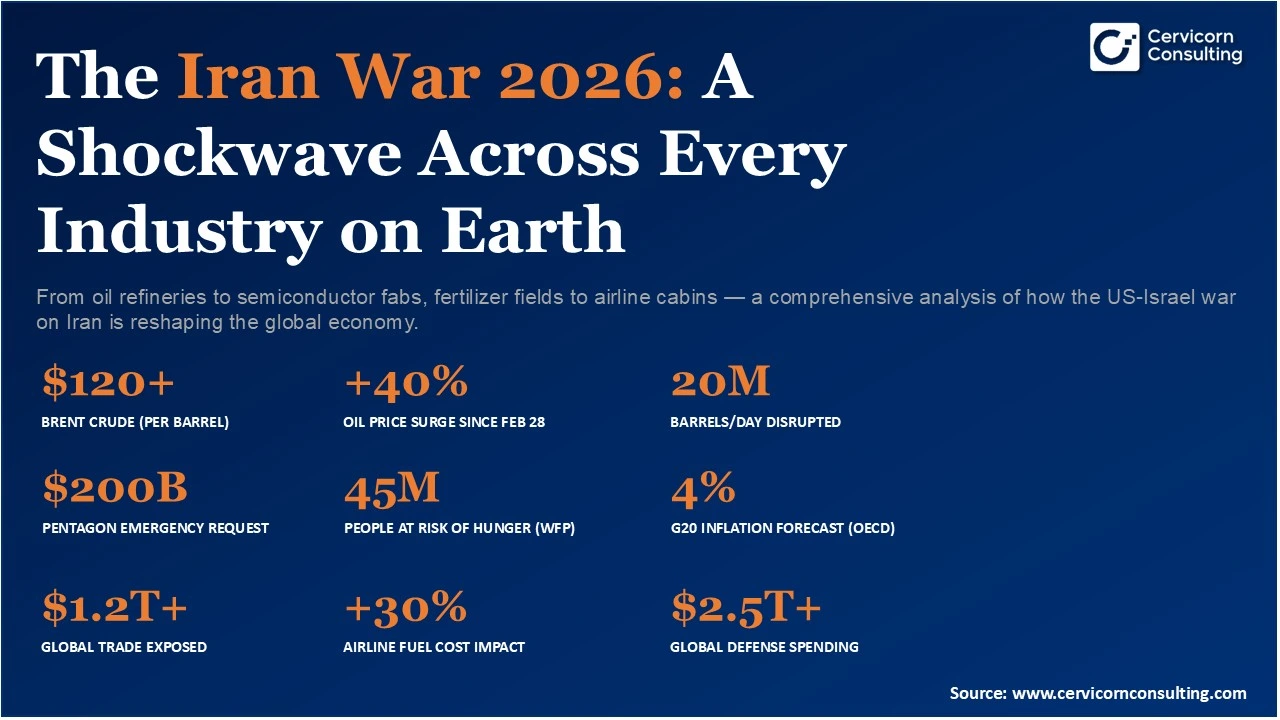
From oil refineries to semiconductor fabs, fertilizer fields to airline cabins — a comprehensive analysis of how the US-Israel war on Iran is reshaping the global economy.
How the War Began — and Why It Matters to Everyone
On February 28, 2026, the United States and Israel launched Operation Epic Fury, a surprise attack involving air and missile strikes on Iran's nuclear sites, command centres, and military assets. During the initial strikes, Supreme Leader Ali Khamenei was killed. Iran retaliated immediately with ballistic missiles and drones targeting Israel, US military bases across the Gulf, and energy infrastructure in Saudi Arabia, UAE, Bahrain, Kuwait, and Qatar.
The conflict has now lasted 27 days, with no signs of a ceasefire. Negotiations are debated — Trump says talks are happening, while Iran denies this. The war has quickly expanded from a regional conflict into what the International Energy Agency (IEA) describes as "the greatest global energy and food security challenge in history."
"This war is a catastrophe for the world's economies. There is no strategy, no clear objective, and worst of all — no exit strategy."
— Boris Pistorius, German Defense Minister, March 2026
The core chokepoint is the Strait of Hormuz — a narrow waterway between Iran and Oman through which about 20 million barrels of oil and one-fifth of global LNG flow daily. Iran has effectively closed it, causing a supply chain crisis comparable to the 1970s oil embargo.
Industry Impact Overview
The war's economic shockwave extends beyond oil. It spreads into agriculture, aviation, shipping, semiconductors, healthcare, construction, finance, and consumer goods. Here is the at-a-glance impact map:
| Industry | Impact and Details | Indications |
| Energy & Oil | - Brent crude surged from USD 72 to over USD 120/barrel. -LNG prices up 60%. -Qatar declared force majeure on all gas exports. -Gulf production down 10M+ barrels/day. |
Critical |
| Aviation | - 7 Gulf nations closed their airspace. - Emirates and Qatar Airways are near-fully grounded. - Global air freight capacity down 9%. - Jet fuel costs doubled. |
Critical |
| Shipping & Logistics | - The Strait of Hormuz is nearly closed to commercial traffic. - 16 attacks on vessels. - Ships rerouting via the Cape of Good Hope. - Marine insurance war-risk premiums have surged dramatically. |
Critical |
| Agriculture & Food | - Gulf supplies 33% of global fertilizer exports. - Urea prices could double. - Spring planting season threatened. - 45M people are at risk of acute hunger globally. |
Critical |
| Semiconductors & Tech | - Qatar's helium (critical for chip fabs) was disrupted. - Air freight down 9%. - European chip buyers are paying premium costs. - Delivery delays hit automotive and AI data centres. |
Severe |
| Healthcare & Pharma | - Helium shortages affect MRI machines and medical equipment. - Supply chain disruptions for medicines entering Gulf states. - Humanitarian crisis feared in Qatar and Kuwait. |
Severe |
| Financial Markets | - S&P 500 fell ~4.5% (3–20 March). -Dow Jones dropped 400+ points. -Inflation forecasts revised sharply upward globally. -Rate cut expectations shelved in the EU and Japan. |
Severe |
| Consumer Goods & Retail | - GCC food prices up 40–120%. - US Postal Service added 8% fuel surcharge. - US gas at USD 3.41/gallon, rising. - Household purchasing power is eroding across all geographies. |
Severe |
| Automotive | - EV battery and semiconductor supplies are stranded in the Gulf. -German supplier ZF is paying premium air freight. -European automakers are drawing down chip inventories. |
Moderate |
| Tourism & Hospitality | - Gulf tourism effectively halted. - Airfare hikes by Qantas, SAS, IndiGo, and Air India. - Thailand could see growth halved if conflict persists for 3+ months. |
Severe |
| Cloud & Digital Infrastructure | - Microsoft Azure and AWS are investigating latency spikes at Middle East nodes after strikes on Dubai and Doha data hubs. - BRI-linked internet cables at risk. |
Moderate |
In-Depth Analysis: Industry-by-Industry
1. Energy & Oil — The Epicentre
The Strait of Hormuz, which normally transmits about 20% of the world's petroleum and accounts for a quarter of seaborne oil trade daily, has effectively been shut down. As a result, Brent crude prices jumped from USD 72 per barrel on February 27 to over USD 120 by mid-March, marking a rise of over 40%. LNG prices have increased by nearly 60%. Qatar announced force majeure on all LNG exports following Iranian drone attacks that damaged its South Pars gasfield. Additionally, Saudi Aramco's large Ras Tanura refinery was closed. By March 12, Gulf oil producers collectively reduced output by more than 10 million barrels per day, representing the largest supply disruption in the history of the oil market.
The IEA convened an emergency session and coordinated a release of member nations' strategic petroleum reserves. The US authorised drawdowns from the Strategic Petroleum Reserve (SPR). Saudi Aramco is diverting remaining exports via the East-West pipeline to Yanbu on the Red Sea, but its capacity covers only a fraction of normal volumes. QatarEnergy has halted production and declared force majeure on all contracts. Abu Dhabi's ADNOC (Abu Dhabi National Oil Company) is rerouting through Fujairah. The Philippines declared a "national energy emergency." Sri Lanka raised LPG prices by 8%, and fuel prices similarly.
Oxford Economics warns that if oil averages USD 140 per barrel for two months, parts of the global economy will enter recession. The Council on Foreign Relations projects that a prolonged Hormuz closure could push prices toward USD 170 per barrel. Even if the war ends soon, damaged refinery infrastructure may take months to restore, prolonging price pressures. The energy transition is accelerating — many governments are now fast-tracking renewable energy projects to reduce dependence on Gulf hydrocarbons.
2. Aviation — Global Air Travel in Freefall
Bahrain, Iraq, Israel, Kuwait, Qatar, Syria, and the UAE have all shut their airspace. Together, these airports account for about 15% of worldwide air traffic. Emirates Airlines and Qatar Airways are nearly non-operational. Several airlines, including Qantas, SAS, Air New Zealand, IndiGo, and Air India, have raised ticket prices, citing higher jet fuel costs. The conflict has more than doubled jet fuel prices. Thousands of travellers have been stranded worldwide, with repatriation efforts described as the largest since COVID-19. Global air freight capacity has decreased by roughly 9%.
Emirates has suspended most of its routes. Qatar Airways has nearly stopped operations. IATA is coordinating rerouting procedures through Africa and Asia, avoiding the Middle East entirely. The European Aviation Safety Agency (EASA) has issued no-fly zone advisories across the Persian Gulf corridor. Cargo carriers like DSV are rerouting via longer trans-Pacific routes, reducing payloads to carry extra fuel. IndiGo and Air India have implemented temporary fuel surcharges on all international flights.
The Asian Development Bank warns that increasing jet fuel prices will impact tourism and overall consumer spending. Each month of airport closures results in tens of billions in lost revenue and higher fuel expenses for the global aviation sector. Additionally, there is a structural shift in Asia-Europe air freight routes through Africa, which adds 2–4 hours to flight times and has a lasting impact on the baseline cost of air cargo.
3. Shipping & Maritime Logistics — The Chokepoint Crisis
Marine traffic through the Strait of Hormuz has nearly come to a halt. By March 12, the UK Maritime Trade Operations (UKMTO) documented 16 attacks on commercial ships since hostilities began. Approximately 20,000 seafarers remain stranded in the area. An Indian tanker captain reported witnessing "projectiles and naval services in action" along with visible damage on coastlines. Insurance coverage for war risks has been either cancelled or increased to high premiums across the region. Ships are now anchoring at the strait's edge instead of risking passage. Rerouting via the Cape of Good Hope extends transit times by 2–3 weeks and incurs substantial fuel costs.
The G7 foreign ministers' meeting in France is focusing on "reopening maritime and trade routes" as a primary diplomatic goal. NATO is exploring escorted convoy options. The US Navy's 5th Fleet, based in Bahrain, was hit by Iranian missiles but continues to operate in a limited way. Major shipping companies like Maersk, MSC, and CMA CGM have halted Gulf services and rerouted their ships. The UK's P&I Club has paused war-risk coverage for the Persian Gulf area. Meanwhile, India's government is collaborating with shipowners to find alternative crude oil routes from West Africa and the US.
Over 80% of global trade is transported by sea. When the Strait stays closed for a week, the ongoing costs of global shipping increase. Freight rates on Asia-Europe routes are already climbing sharply. Developing countries—especially in Africa—are suffering the most, with Djibouti's finance minister warning of "severe economic consequences" for Africa. According to World Bank data, if this disruption continues, it could reduce global GDP growth by 0.5–1% each year.
4. Agriculture & Food Security — A Looming Hunger Crisis
The Gulf region accounts for around one-third of global fertilizer exports, with Saudi Arabia leading as the world's top urea exporter and Oman ranking fourth. These countries also supply about 45% of the world's sulfur, essential for fertilizer and industrial chemicals. The closure of the Strait has halted these exports, which, according to the Fertilizer Institute, involve about 50% of global urea and sulfur shipments. Experts warn that nitrogen fertilizer prices could nearly double from 2024 levels, and phosphate prices may increase by 50%. This disruption happens during the vital spring planting season in the Northern Hemisphere. Additionally, the WFP estimates that 45 million people worldwide now face an increased risk of acute hunger.
The American Farm Bureau directly warned President Trump about the potential for severe downstream impacts on US food prices. The WFP is reallocating emergency food aid to Sudan, Somalia, and Ethiopia, which are the most vulnerable. India and Brazil, both heavily reliant on Gulf fertilizer, are urgently seeking urea from Canada, Russia, and Eastern Europe at higher costs. Australia eased diesel fuel quality standards on March 24 to conserve supplies. Mercy Corps issued a global warning about the "first major crisis of the post-aid era." The OECD has reduced growth forecasts and increased G20 inflation projections to 4%.
Reduced fertilizer use during spring planting will lead to smaller harvests of staple crops like wheat, rice, and maize by Q3/Q4 2026. A Breakingviews analyst warned that the food supply shock could be even more severe than the impact of Russia's invasion of Ukraine in 2022. Countries in Africa and South Asia are at the greatest risk, with many already in or near famine conditions before the conflict started.
5. Semiconductors & Technology — The Helium Bottleneck
Qatar ranks as the world's second-largest helium producer, contributing roughly one-third of the global supply. Helium plays a critical role in semiconductor manufacturing, primarily as a coolant in cleanrooms for chip production. On March 2, Iranian drones targeted Qatar's gas facilities, causing a disruption in helium output. Middle Eastern countries collectively account for about one-third of the world’s helium supply. Due to a 9% reduction in air freight capacity and disrupted cargo routes, chips manufactured in Asia are being shipped more slowly and at higher costs to Europe and the Americas. European semiconductor buyers are relying on backup inventories and facing increased expenses. German automotive parts supplier ZF has confirmed rising costs linked to sustaining semiconductor supply chains.
Major semiconductor fabs like TSMC in Taiwan and Samsung in South Korea are actively monitoring helium supplies and some are creating buffer stocks. DSV, a global logistics provider, has reported a 9% reduction in air freight capacity. Kinaxis, a supply chain software company, noted delivery delays of several days for semiconductor shipments to Europe. Cloud service providers Microsoft Azure and AWS are investigating latency spikes at their Middle Eastern infrastructure nodes. The US CHIPS Act's emergency measures are under review to expedite local helium sourcing. Additionally, Intel and ASML have informed their boards about the situation, classifying it as a "strategic supply risk."
A prolonged helium shortage may cause widespread disruptions across various technology supply chains, including consumer electronics and AI server production. Sameera Fazili, a former Biden economic adviser, emphasised that' limited helium supply will impact Taiwan's ability to manufacture semiconductors, which we all saw in 2021 can affect the supply of nearly every good, from cars to dishwashers." This situation is especially challenging now, as hyperscalers are already demanding record volumes of chips for AI infrastructure.
6. Financial Markets & Monetary Policy — Inflation Trap
Between March 3 and March 20, the S&P 500 declined about 4.55%, from 6,816 to 6,506. During this period, the Dow Jones dropped over 400 points early in the conflict. A Financial Times investigation uncovered a suspicious USD 580 million wager on declining oil prices placed just 15 minutes before Trump's announcement to halt energy strikes, prompting insider trading probes. The OECD significantly increased its G20 inflation forecast to an average of 4% for 2026 and lowered global growth projections from 3.3% to 2.9%. Economists in Chile, Poland, and across Asia are reducing expectations for rate cuts, as oil inflation's effects spread through their import-dependent economies.
The US Federal Reserve is maintaining its interest rates but has increased its inflation forecasts, facing a tough situation with inflation already above the 2% target. Meanwhile, the European Central Bank has postponed planned rate reductions due to recession concerns. The Bank of Japan is tightening its monetary policy as eurozone inflation is expected to exceed 4% year-on-year. Major financial institutions like Goldman Sachs, Morgan Stanley, and Morningstar have updated their global economic outlooks. The IMF is holding an urgent meeting to assess the impact on low-income countries. Additionally, gold prices are soaring, with India's market quickly moving from a discount to the London price to a premium within just a few days.
Euronews economists warned that markets are "underestimating" the long-term risk. The worst-case scenario, according to the Middle East Council on Global Affairs, is "an economic slump combined with an interest rate hike to curb inflation" a combination that could trigger asset bubble bursting and a debt crisis reminiscent of 2008. Oxford Economics' Global Economic Model shows that oil at USD 140 per barrel for two months pushes parts of the world economy into a mild recession.
7. Healthcare — Invisible but Real
Helium is crucial not only for chip production but also for MRI and NMR medical imaging devices. Hospitals worldwide reliant on stable helium supplies are experiencing rising costs and possible shortages. In the Gulf region, Iranian attacks on desalination plants in Kuwait and Qatar—which supply 99% of their drinking water—have triggered a humanitarian crisis, putting pressure on healthcare systems. Iran has suffered over 1,900 deaths and more than 20,000 injuries, overloading regional medical facilities. Additionally, medicines and medical supplies dependent on air freight through the Gulf are experiencing delays.
The WHO and Red Crescent are coordinating emergency medical supplies bypassing the Gulf region. Médecins Sans Frontières has dispatched teams to Iran and neighbouring Gulf countries. Hospitals in Kuwait and Qatar are functioning under emergency protocols. Airfreight medical shipments are prioritised on alternative routes, though volumes and capacity remain limited. Additionally, the UN Human Rights Council convened an urgent session to address the strikes against civilian infrastructure, including hospitals, in Iran.
If helium supply disruptions persist for months, elective MRI and other medical imaging procedures worldwide will be delayed. In less developed countries, disruptions to healthcare infrastructure due to rising supply costs could lead to long-term public health challenges. Additionally, damage to the Gulf desalination plant, if not repaired promptly, poses a risk of severe public health emergencies in Kuwait and Qatar.
Impact on India — Highly Vulnerable, Urgently Responding
India is one of the most vulnerable non-combatant economies. It depends significantly on Middle Eastern crude, importing more than 40% of its oil from the region, and on Gulf fertilizer exports. Rising energy prices are directly driving inflation, weakening the rupee, and posing a threat to economic growth. The government has termed this a "strategic economic emergency" situation.
India's Key Exposures & Actions
- Petroleum: India is urgently seeking alternatives from West Africa and the US amid rising spot prices.
- Fertilizers: As one of the world's major urea importers, India is negotiating emergency shipments from Canada and Russia.
- Aviation: Airlines like IndiGo and Air India have announced fare increases; suspension of Gulf routes is impacting millions of Indian diaspora workers.
- Rupee: The rupee has depreciated against the dollar due to rising import costs and declining risk appetite.
- RBI: The Reserve Bank of India is reassessing its rate guidance, with inflation projections significantly revised upward.
- Seafarers: About 20,000 seafarers, including an Indian tanker captain, remain stranded in the conflict zone.
Conclusion
This Is Not a Regional Crisis. It Is a Structural Shock to the World Economy.
The 2026 Iran War is unprecedented due to its location — at the critical junction of the world's key energy, food, and logistics routes. The Strait of Hormuz is more than just an oil passage; it is the lifeline of the global economy. As the World Economic Forum clearly states, the conflict initially affects oil, gas, shipping, and aviation, leading to broader issues such as inflation, rising industrial costs, and food security concerns, which then threaten trade routes, investment, and political stability. Prolonged fighting risks embedding these disruptions into lasting structural changes. Every industry worldwide now has supply chains, energy costs, food sources, shipping lanes, or financial risks passing through this conflict zone. No nation will remain unaffected in 2026. The only way to prevent the worst outcomes is rapid diplomacy, but currently, a significant gap exists between Washington's demands and Tehran's conditions. Time is running out, and oil prices are rising.
"The only way to avoid grave economic consequences is to end the war as soon as possible."
— Al Jazeera, Oil & Gas Analysis, March 23, 2026
To understand how these trends will specifically impact your market share, reach out to our analysts here: +91 8983225533 | sales@cervicornconsulting.com