
Content
India’s Data Center Market: Capacity Expansion, Key Hubs, and Future Trends


India’s Data Center Market Insight
The Indian data center market is currently undergoing a major transformation from an emerging support sector to a core part of the nation’s digital economy. This transformation is driven by rapid cloud adoption, the enactment of the Digital Personal Data Protection (DPDP) Act, and the growing demands of Artificial Intelligence (AI) and 5G, which are expected to see unprecedented growth through 2034. The recent report from Cervicorn Consulting provides a comprehensive analysis of the market, outlining its statistical trends, geographic focus in hubs like Mumbai and Chennai, and unclear financial paths for both capital and operational expenditures.
The India data centre market size was valued at USD 6.41 billion in 2025 and is expected to hit around USD 14.21 billion by 2034, growing at a CAGR of 9.24% from 2025 to 2034.
1. Introduction
India is now at the epicenter of a global digital revolution. With the world’s second largest internet user base, demand for secure, scalable and robust data storage and processing capabilities has reached a tipping point. The Indian data center market has transitioned from a component of real estate development to an infrastructure asset class of significant sophistication with multi-billion dollar investments from global hyperscalers and institutional investors.
The convergence of various structural catalysts from the democratization of mobile data to the mandatory localization of sensitive data generated a "perfect storm" for capacity expansion. Where capacity was previously limited to a few captive and small third-party units in India, international hyperscalers have now emerged to develop massive campuses with hundreds of Megawatts (MW) of IT load. This is further enhanced through global factors favoring a transition towards higher power densities and cooling setups needed for AI-driven workloads.
2. The Indian Data Center Ecosystem: Current Scenario and Growth Trajectory
The Indian data center ecosystem is described by massive growth in both physical capacity and overall market capitalization. By 2024, the industry will have pivoted from consistent growth to exponential acceleration.
2.1 Statistical Overview of Market Size and Capacity
The primary measurement of the data center growth is IT load capacity, Megawatts (MW). Research indicates India’s total data center capacity is expected to more than double in just 5 years. From an estimated 900 MW in early 2023, the market is now projected to exceed 3,000 MW by 2030.
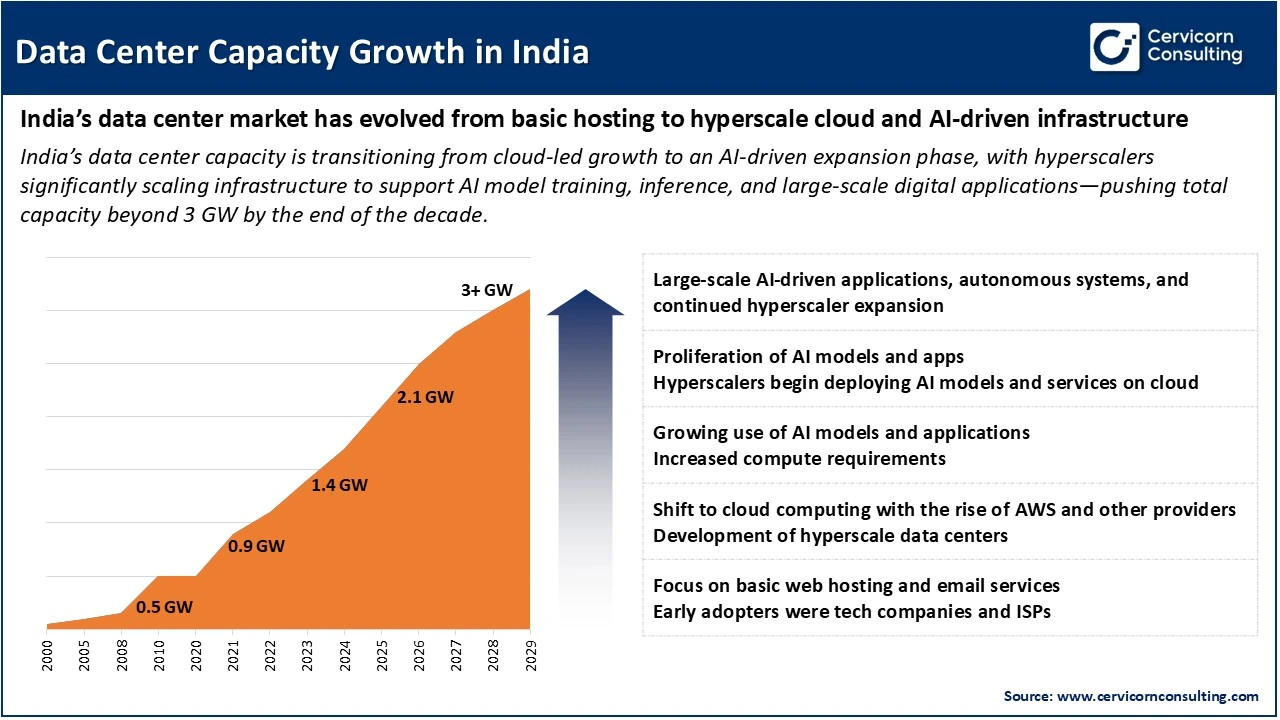
This growth trajectory is evident in the market's financial valuation. The Indian data center market is expected to grow at a CAGR of approximately 10%. The total market is projected to reach billions of dollars by the end of the decade. This growth is both in scale and quality. Newer facilities are built to international Tier-III and Tier-IV standards that guarantee 99.98% to 99.99% uptime.
2.2 Geography and Emerging Data Center Markets
Overall, the Indian market is geographically centred, although the "Tier-2 pivot" is beginning to emerge. The dominant player is clearly Mumbai. Mumbai accounts for nearly 45% of the country’s total capacity. It has traditionally led India's data center sector partly because of its coastal location where numerous subsea fiber-optic cables land, enabling more reliable power plans in the metro.
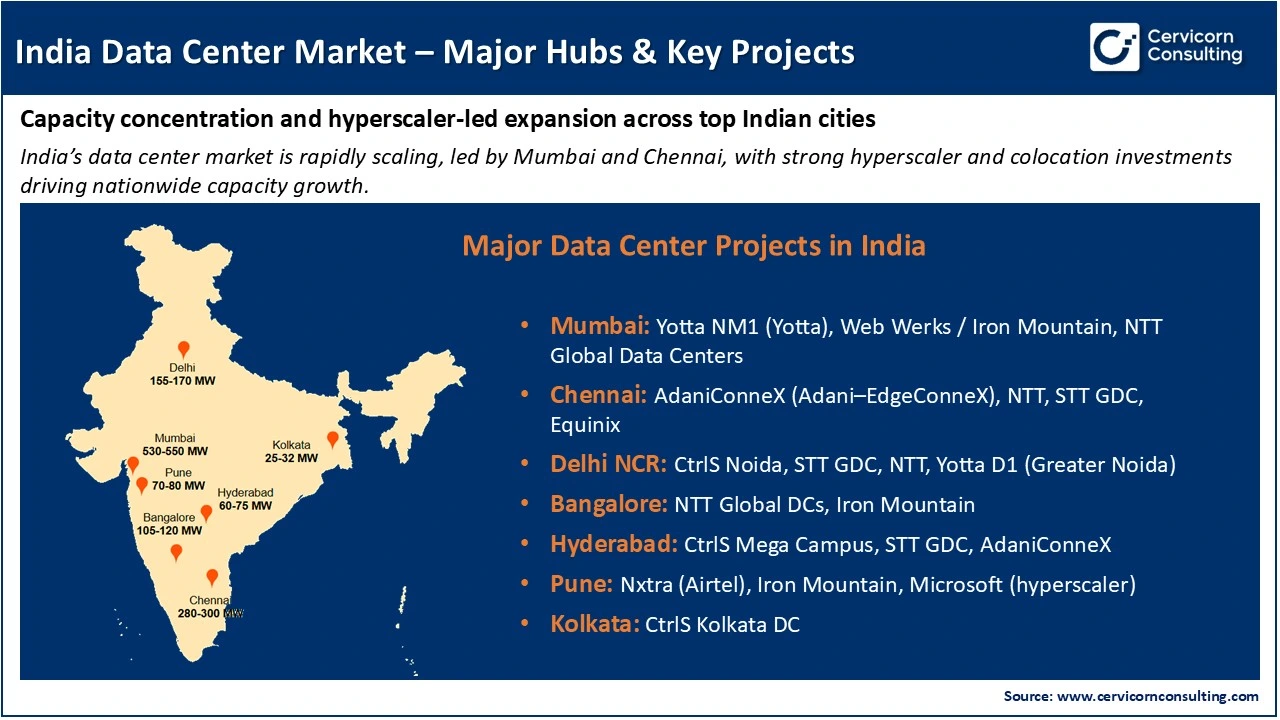
The second-largest hub is Chennai, which has leveraged its position in the emerging Southeast Asia markets and serves as the secondary cable landing station. The NCR region has also established itself as a key hub for government services. Meanwhile, Bangalore has distinguished itself as the center of the domestic technology industry.
Table 1: Regional Capacity and Market Share (2024)
| Region | Share of Capacity (%) | Primary growth drivers |
| Mumbai | 45% | Subsea cable landings, financial hub, power stability |
| Chennai | 15% | Proximity to Asia, SaaS industry, coastal connectivity |
| Delhi/NCR | 12% | Government data projects, enterprise base |
| Bangalore | 10% | IT/ITES capital, R&D centers, cloud adoption |
| Hyderabad | 8% | Supportive state policy, emerging tech ecosystem |
| Others (Pune, Kolkata) | 10% | Edge computing, disaster recovery sites |
The emergence of Hyderabad and Pune as key players is increasingly recognized. Many operators are starting to view these cities as options for disaster recovery (DR) solutions and to reduce latency for users outside of the primary metro centers.
2.3 Demand Drivers: Cloud Adoption and Data Localization
The demand for data center space in India is underpinned by three main pillars:
- Hyperscale Cloud Adoption: Global CSPs like AWS, Microsoft Azure, and Google Cloud are massively expanding into India and building numerous "regions." As Indian enterprises transition from on-premises legacy systems to hybrid or multi-cloud environments, there are significant opportunities for wholesale colocation.
- Data Localization and the DPDP Act: The Digital Personal Data Protection (DPDP) Act has significant implications for data storage locations. By highlighting and mandating digital sovereignty, and requiring that certain classes of data remain stored behind national borders, the DPDP Act has forced many global firms to localize their data processing activities, but now also includes a mandatory requirement for domestic data center capacity.
- The AI and 5G Convergence: The 5G rollout enables high-bandwidth and low-latency applications, such as autonomous systems and IoT. Simultaneously, the global race in AI applications demands high-density computing. Modern Indian data centers are being designed for 30-60 kW per rack instead of the traditional 5-10 kW to support AI workloads for GPU.
3. Financial Dynamics: Costs and Capital Expenditure
The data center industry is very capital intensive, with substantial initial capital expenditure and lengthy development periods. Understanding financial dynamics is essential when evaluating new projects.
3.1 Construction Cost and Infrastructure Cost Breakdown
Building a data center in India includes engineering expertise and high quality components. The cost of a Tier-III data centre in India is typically USD 6-9 million per Megawatt (MW). Costs are broken down into a few main components.
Table 2: Capex Breakdown for a Hyperscale Data Center
| Component | Percentage of Total Capex | Key Elements |
| MEP (Mechanical, Electrical, Plumbing) | 50% - 60% | UPS systems, chillers, generators, switchgears |
| IT & Networking Infrastructure | 15% - 20% | Racks, cabling, meet-me-room |
| Shell & Core (Construction) | 10% - 15% | The building structure, fire suppression, security |
| Land Acquisition | 5% - 10% | Significantly different values by City (Mumbai vs. Tier-2) |
| Soft Costs & Contingency | 5% | Design, permits, legal fees |
Overall, MEP (Mechanical, Electrical, and Plumbing) is the largest individual expense because operators must invest in redundant power and cooling systems to meet high availability requirements in a tropical country like India.
3.2 Operational Expenditure and Energy Consumption Models
Operational Expenditure (Opex) is largely made up from energy. Power usually accounts for 60% to 70% of the total lifetime cost of a data center. This makes the Power Usage Effectiveness (PUE) ratio, which measures how much energy the data center consumes, a key performance indicator (KPI).
In India, a PUE of less than 1.4 is nearly impossible due to high ambient temperatures; therefore, to accommodate this, many operators are now focusing on the following:
- Liquid Cooling: Direct-to-chip cooling or immersion cooling for high density AI racks.
- Green Energy Procurement: Many operators are pursuing "Open Access" policies to procure renewable energy from solar or wind farms, which generally provides a stable long-term tariff compared to the state grids.
3.3 Comparative Metrics of Real Estate and Power Tariffs
The overall financial appeal of the location depends on land costs and power tariffs. Mumbai has the best connectivity in the world, but land costs are among the highest globally, and some states, especially Uttar Pradesh, have subsidized land and power tariffs to attract investments.
Table 3: Comparative Cost Metrics by Hub (Indicative)
| City | Land Cost Index | Avg Industrial Power Tariff, INR/kWh | Connectivity |
| Mumbai | Very High | 8.0 - 9.0 | Excellent |
| Chennai | Medium | 7.0 - 7.5 | High |
| Noida (NCR) | Medium-Low | 6.5 - 7.0 | High |
| Hyderabad | Medium | 7.0 - 7.5 | Medium-High |
| Bangalore | High | 7.5 - 8.0 | High |
4. Investment Landscape and Corporate Engagement
The Indian data center industry has attracted international capital, evolving from small local operators to large joint ventures and platform-level investments.
4.1 Key market players and capacity growth strategies
The market is saturated with a mix of international experts and diverse Indian conglomerates. These companies are not constructing single facilities but are developing multi-hundred MW campuses.
Table 4: Key players alongside the approximate investment/expansion commitments
| Company | Estimated Current Capacity | Announced Investment/Expansion Plans |
| STT GDC India | ~300+ MW | Expanding in all major metros, emphasis on sustainability |
| NTT Data | ~200+ MW | Large campuses in Mumbai and Chennai, USD 2 Bn+ commitment (Anonymous, n.d.) |
| CtrlS Datacenter | ~150+ MW | Emphasizing Rated-4 and expand into Tier-2 cities |
| AdaniConneX | ~50 MW (Scaling) | JV of Adani and EdgeConneX, targeting 1 GW capacity (Anonymous, n.d.) |
The AdaniConneX initiative, a joint venture between India's Adani Group and EdgeConneX, has one of the more ambitious plans to build a 1 GW green data center platform in the next decade.
Likewise, NTT has invested significant capital to preserve its first-mover advantage in colocation marketplace.
4.2 Foreign Direct Investment Trends and Institutional Funding
Foreign Direct Investment (FDI) in the sector has grown significantly in recent years as investors seek higher-yield infrastructure assets. Other major global private equity firms are now entering the Indian market through platform deals; for example, Blackstone launched "Lumina CloudInfra" to establish a new dedicated data center platform in India.
Institutional investors have also been drawn to the relatively steady returns from long-term leases (typically 10-15 years) with hyperscalers, resulting in more predictable cashflows.
The government of India's decision to allow 100% FDI under the automatic route has facilitated the entry of foreign institutional funds.
4.3 Strategic Partnerships and Joint Venture Transactions
The Joint Venture (JV) model has become a popular way for global operators to enter markets. A JV provides access to local real estate giants that own land assets and can quickly mobilize to handle the often complex land acquisitions and local approval processes.
- Hiranandani Group (Yotta Data Services) - This group has taken advantage of their existing land bank and launched hyperscale parks.
- Reliance Industries - Partner with Brookfield and Digital Realty to develop a pan-India data center platform.
- Digital Edge - Entering India by establishing partnerships to develop high-density facilities.
These Joint Ventures create the combined effect of global technical expertise and local operational, significantly reducing the time to market for additional capacity.
5. Government Frameworks and Policy Direction
The tremendous growth of the data center sector is not just accidental, but the result of targeted policy decisions aimed at establishing India as the next global digital hub.
5.1 National Data Center Policy and Infrastructure Status
A significant regulatory milestone in the Indian data center industry was the grant of "Infrastructure Status" by the Ministry of Finance. This designation enabled operators to obtain long-term, low-interest loans from banks and financial institutions and to raise funds through External Commercial Borrowings (ECBs) to improve project IRRs.
The draft National Data center Policy will further attract investment in this sector by:
- Creating "Data Center Zones", with land pre-approved and with guaranteed power
- Provided a single-window clearance process
- Standardizing building codes and safety regulations specific to data center buildings
5.2 State Level Incentives and Fiscal Incentive Programs
In India's federal structure, states are competing to be the destination for data center investments. States such as Maharashtra, Uttar Pradesh, Tamil Nadu and Telangana have issued dedicated Data Center Policies with various incentives:
Table 5: Summary of State-Level Incentives
| State | Key Incentives |
| Uttar Pradesh | Capital subsidy based on investment, electricity duty waiver on generation for 10 years, and land subsidy |
| Maharashtra | Stamp duty exemption, electricity duty waiver, dedicated additional FSI (floor space index) |
| Tamil Nadu | Electricity tax exemption, subsidized training for specialized personnel |
| Telangana | Dual power grid connectivity, dedicated "Data Center Parks" with plug-and-play infrastructure |
These fiscal supports will be necessary given the high upfront Capex costs in the Indian data center market which will continue to incentivize global investment competition.
5.3 Regulatory Drivers of Digital India and Data Protection Laws
Beyond this, the larger "Digital India" mission, developed through UPI (Unified Payments Interface), Aadhar, digitization of land records and more recently, digital public infrastructure demands secure and high-available storage services by modern data centers.
In addition, the Digital Personal Data Protection (DPDP) Act is a structural demand driver as it requires that personal data of Indian citizens be processed and stored according to certain standards of security (and sometimes localized) providing a "captive market" for domestic data center operators. If global demand remains unchanged, domestic data storage demand will be ensured through regulation.
6. Conclusion
The Indian data center market has reached a critical stage in its growth journey. From a capacity of less than 1 GW, it is rapidly evolving into a multi-gigawatt powerhouse, built on a unique combination of people, regulatory government focus on data infrastructure as a strategic national asset, and a surge of global institutional capital. The separation of AI-ready infrastructure from green energy is not a passing trend but a permanent operational necessity. While challenges remain (e.g., high land costs in Mumbai, insufficient specialized workforce, etc.), the overall sentiment is extremely bullish. When it comes to investors, the focus shifts from "real estate metrics" to "interconnection-dense" and "AI-capable" facilities. For policymakers, the focus should be on finalising and implementing the National Data Center Policy to ensure growth and competitiveness nationwide.
In short, India is not just participating in the global race for digital infrastructure; it is leading the way. As the frontier for digital infrastructure expands, the Indian data center market offers one of the most significant investment and development opportunities of the decade.
To understand more details, reach out to our analysts here: +91 8983225533 | sales@cervicornconsulting.com