
Content
Will Enterprise AI Define the Next Global Investment Boom?


Enterprise AI Market Insights for Investors
Enterprise AI has hit an inflection point, where infrastructure ownership, capital and monetization strategies have become more important than pure technological experimentation. Global spending on AI will be above the market’s total estimated size of a 44% year-over-year increase; with more than half dedicated to AI infrastructure, cloud, semiconductors, and enterprise deployment.
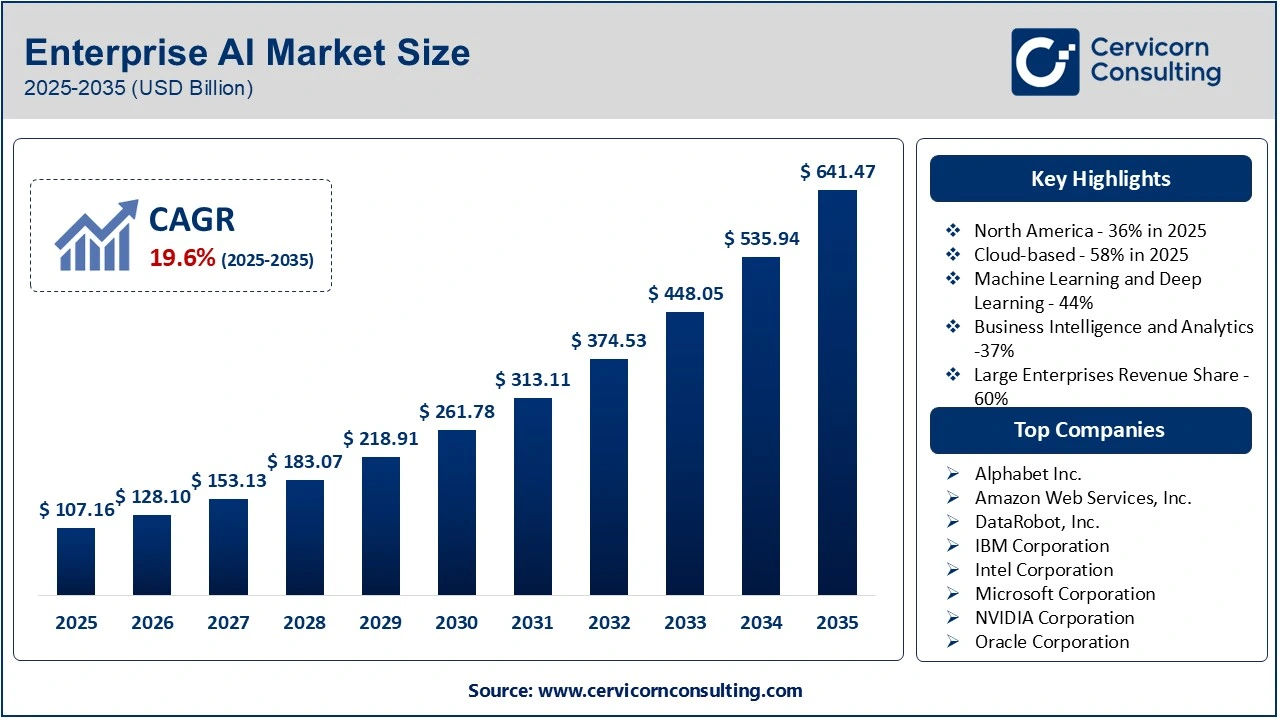
"At the same time, the enterprise AI market size was estimated at $107.16 billion in 2025, and is projected to be greater than roughly $641.47 billion by 2035, exhibiting a CAGR of 19.6% between 2026 and 2035."
Similar trends are playing out within enterprise finance. Enterprise AI is increasingly contributing directly to revenue instead of being relegated to research projects. Recently, Salesforce announced that Agentforce had achieved more than $1.2 billion in annual recurring revenue-a growth rate of 205% YoY, while Microsoft shared that the number of enterprises building custom Copilot agents on Azure had grown threefold in just nine months.
The numbers speak to a fundamental paradigm shift; AI is no longer fighting for share in an innovation budget, but is a top contender for significant capital allocations. This investment spree is also happening in health, financial services, manufacturing, retail and life sciences-companies are investing AI dollars to boost productivity, automate complex tasks and generate brand new sources of revenue.
The United States and China Are Playing Two Different Games
Since 2024, American startups have pulled in around $380 billion in AI focused venture capital, a number no other country comes close to matching. Private AI investment in the U.S. touched $109.1 billion in 2024 alone, nearly twelve times what China put into its own private sector during the same year. Layer on top of that the capital expenditure of the big technology companies, which crossed $400 billion in 2025 for AI infrastructure alone, and you get a sense of why American cloud providers still set the pace for enterprise AI adoption worldwide. The Stargate initiative, a $500 billion, five-year plan to build out AI infrastructure inside the US, is the clearest signal yet that this is being treated as a national industrial project rather than a corporate one.
China is not trying to outspend the U.S. dollar for dollar. Its approach leans on state direction and speed of deployment instead. The country invested close to ¥890 billion, around $125 billion, in AI in 2026, with government funding making up 39% of that figure. Beijing, Shenzhen and Shanghai together account for 71 percent of all domestic AI investment, and companies like Alibaba and Tencent have poured billions into their own R&D even as they work around limited access to the most advanced chips. Chinese firms have instead doubled down on open source models and cost efficient deployment, a strategy that is winning them market share across parts of Asia, Africa and Latin America where budgets are tighter than in Silicon Valley.
Europe has taken a third path entirely, choosing regulation and coordinated public investment over a pure spending race. The EU's Invest AI programme is deploying €200 billion toward nineteen shared AI supercomputing facilities across the continent, and the EU AI Act continues to shape how enterprise software gets built and sold well beyond Europe's own borders, since global vendors tend to build compliance in once rather than maintain separate versions for separate markets.
“A recent tie up between Cohere and Aleph Alpha, valued near $20 billion, shows European and Canadian AI labs banding together to create an alternative to the two dominant technology stacks coming out of Washington and Beijing.”
Get Full Access of Report | Immediate Delivery@ https://www.cervicornconsulting.com/buy-now/2692
Who Are the Companies Actually Running Enterprise AI Deployments?
This is where the numbers get genuinely interesting, because the platforms enterprises are paying for today look very different from what was being demoed at conferences just two years ago.
- Salesforce has turned Agentforce into a real business line rather than a feature bolted onto its CRM. The company reported more than $1 billion in Agentforce annual recurring revenue, with combined AI and data revenue reaching $3.4 billion and growing over 200 percent year over year. It has closed tens of thousands of Agentforce deals, and more than half of that revenue now comes from existing customers expanding their usage rather than new logos, which is usually the clearest sign that a product actually works in production.
- Microsoft's approach has been to fold AI directly into tools people already use every day. More than 120,000 organizations now run production workloads on Azure AI Studio, and the number of businesses building custom Copilot agents on top of Azure OpenAI Service has tripled in the past nine months. Healthcare providers, banks and public sector bodies have started deploying specialised agents for tasks like clinical summarisation, often keeping the data entirely within their own network rather than sending it out to a shared cloud.
- Google has quietly built a large enterprise base of its own. Gemini for Workspace now counts around 18 million paid enterprise users, up from 12 million at the start of the year, putting real pressure on Microsoft's dominance in office productivity tools. SAP has taken a different route by building its Joule assistant directly into the ERP systems that already run supply chains and finance departments for thousands of large companies, while ServiceNow and Oracle have carved out their own agent platforms aimed at IT service management and back office automation respectively.
Underneath a lot of this activity sits a smaller set of model providers whose technology actually powers these platforms. OpenAI remains the strongest standalone enterprise assistant on the market. Anthropic's models increasingly show up as the reasoning engine inside other companies' products rather than being sold directly, a pattern that is quietly reshaping how the industry buys AI: fewer businesses are choosing one giant platform and more are stitching together the best model for each specific workflow.
Enterprise AI Adoption by Top Industries
Enterprise AI adoption is no longer concentrated within the technology sector. Organizations across healthcare, financial services, manufacturing, retail, telecommunications, and life sciences are deploying AI to automate business processes, improve operational efficiency, strengthen customer engagement, and accelerate decision-making.
While the United States continues to lead enterprise AI deployments, countries including China, India, Germany, Japan, the United Kingdom, Singapore, and Canada are rapidly scaling AI adoption through government initiatives, digital transformation strategies, and enterprise investments.
| Industry | Primary AI Applications | Leading Adopting Countries | Major Enterprise Platforms |
| Healthcare & Life Sciences | Clinical documentation, diagnostics, drug discovery, medical imaging, patient support | United States, China, United Kingdom, Germany, India | Microsoft Copilot, Google Cloud AI, NVIDIA, Oracle Health AI |
| Banking & Financial Services | Fraud detection, AML, credit scoring, customer service, risk modeling | United States, United Kingdom, Singapore, India, China | Microsoft, Salesforce, IBM, Oracle, SAS |
| Manufacturing | Predictive maintenance, quality inspection, digital twins, production optimization | Germany, Japan, United States, South Korea, China | Siemens, SAP Joule, Microsoft, AWS |
| Retail & E-commerce | Personalized recommendations, inventory forecasting, pricing optimization, customer support | United States, China, India, United Kingdom | Salesforce Agentforce, Google Gemini, Microsoft Copilot |
| Telecommunications | Network optimization, predictive maintenance, AI-powered customer service | China, South Korea, United States, Japan | Google Cloud AI, Microsoft Azure AI, IBM Watson |
| Government & Public Sector | Citizen services, document automation, cybersecurity, smart governance | United States, Singapore, UAE, India, Estonia | Microsoft Azure AI, Oracle, Google Cloud |
| Automotive | Autonomous driving, predictive maintenance, smart manufacturing | Germany, Japan, China, United States | NVIDIA, Microsoft, SAP, AWS |
| Energy & Utilities | Grid optimization, predictive maintenance, energy forecasting | United States, Canada, Germany, Saudi Arabia | Microsoft Azure AI, IBM, Google Cloud |
What Are the Top Enterprise AI Platforms Available for Indian Businesses?
India deserves its own section here because it has become one of the fastest growing enterprise AI markets anywhere, even though its overall spending is still a fraction of what the U.S. or China commits. For a business based in India, the choice of platform usually comes down to three broad camps.
The homegrown IT services giants have built their own branded platforms rather than simply reselling foreign technology. Infosys runs Topaz, recently paired with a new agentic services layer built in partnership with OpenAI. TCS has its Cognix platform anchored in its deep managed services base.
- Wipro created ai360, backed by a $1 billion investment and training all 250,000 of its employees on AI fundamentals. HCLTech built its own AI Force platform and went a step further by taking a direct equity stake in Sarvam AI, one of the country's leading foundation model startups, tying its enterprise sales network directly to a domestic AI company.
Global platforms already familiar to enterprises everywhere have a strong footprint in India too. Microsoft 365 Copilot crossed 300,000 combined seats across just TCS, Infosys and Wipro by mid 2026, one of the largest single enterprise AI rollouts recorded anywhere in the world. Salesforce, SAP, Oracle and Google Cloud all run India specific versions of their enterprise AI products, often localised for banking, retail and manufacturing clients who make up the bulk of large enterprise spending in the country.
Then there is the sovereign layer, which matters more in India than in most other markets because of the sheer number of languages a customer facing system has to handle. Krutrim, founded by Ola's Bhavish Aggarwal, became India's first AI unicorn and now runs a developer platform with more than 25,000 users, alongside its own assistant that works across thirteen Indian languages.
Sarvam AI, trained entirely on domestic compute, released 30 billion and 105 billion parameter models earlier this year built specifically for India's 22 official languages. For businesses that need AI systems to work fluently in Hindi, Tamil, Bengali or Telugu, these companies have effectively become the default option, something no US or European vendor can currently match.
Challenges and Governance
Despite swift enterprise AI adoption rates, businesses are struggling to overcome hurdles to the broad deployment of this technology. Data privacy, cybersecurity, model hallucinations, the need for strong governance, and legacy enterprise system integration are among the key obstacles. And without demonstrating value beyond a pilot project, businesses must implement robust governance models.
In major markets around the globe, regulations regarding the use of AI are rapidly taking shape. Most notably, the EU’s AI Act is leading the pack with the first legally binding global framework for AI. The EU regulation focuses on high-risk AI system classification, transparency, human oversight, and regulatory compliance. In the United States, various regulatory agencies such as the FDA, SEC and NIST are creating new AI governance guidelines.
Many governments in countries such as Singapore, Japan, India, and the U.K. are forging models that balance the pursuit of innovation with accountability. Businesses that are succeeding with AI are embracing a responsible approach with an emphasis on transparency and fairness, including explanations, human oversight, monitoring of models, cybersecurity standards, and quality of data in compliance with globally recognized guidelines like ISO/IEC 42001.
It has been recognized that as enterprises build this functionality in support of their most critical tasks, Responsible AI becomes not just an issue of regulatory compliance but a strategic capability for any successful enterprise.
Where This Actually Leaves Businesses Choosing a Platform Today
Pick a platform based on where your business already lives rather than which vendor has the loudest headlines. A company built around Microsoft 365 will usually get more value from Copilot than from switching its entire stack to a new provider. A business running on Salesforce will find Agentforce integrates faster than anything built from scratch. And for companies operating in linguistically diverse markets like India, sovereign platforms built for local languages are starting to outperform global generalists on the exact tasks that matter most day to day.
Looking ahead, competitive advantage will be determined less by access to AI models and more by an organization's ability to integrate AI across business functions, scale trusted deployments, and generate sustainable financial returns. As enterprise AI adoption matures, recurring revenue, operational efficiency, and ecosystem strength are likely to become the primary indicators of market leadership, defining the next wave of global investment and digital transformation.
Get Full Access of Report | Immediate Delivery@ https://www.cervicornconsulting.com/buy-now/2692
We are here to support your strategic data needs. Please submit your inquiries here: sales@cervicornconsulting.com | +91 8983225533