Automated EV Battery Swapping Market Size and Growth Factors 2026 to 2035
The global automated EV battery swapping market size was valued at USD 992.88 million in 2025 and is projected to grow from USD 1,297.40 million in 2026 to nearly USD 13,697.37 million by 2035, registering a compound annual growth rate (CAGR) of 29.9% over the forecast period 2026 to 2035.
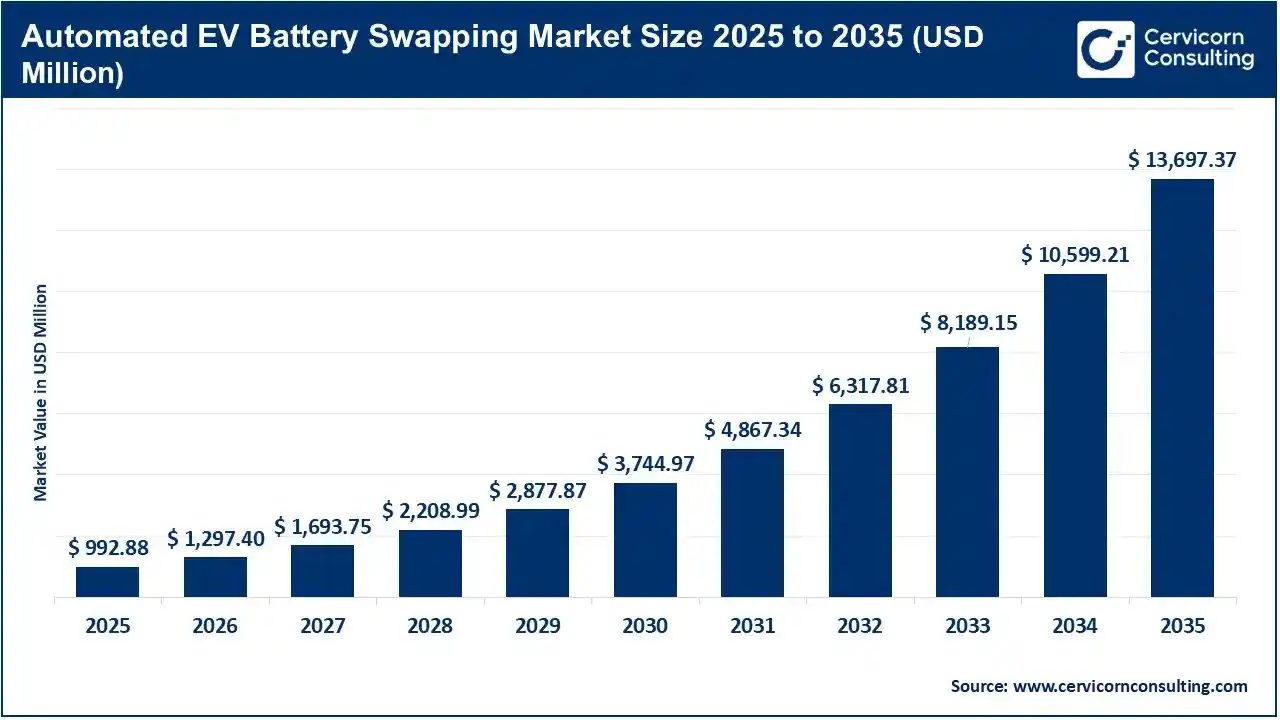
The automated EV battery swapping market is growing as fleet managers and owners of electric vehicles search for quicker ways to refuel their vehicles. Automated swapping systems cut down on the waiting time associated with traditional charging by removing depleted batteries and replacing them with fully charged ones using robotics and intelligent software. Faster energy solutions are in high demand due to the increasing use of electric two-wheelers, three-wheelers, passenger cars, and commercial fleets. Standardized battery designs connected swapping stations, battery-as-a-service models, and investments in EV infrastructure are all contributing to the market's expansion.
In March 2026, InfinityX Innovations received support from India’s Technology Development Board and Department of Science & Technology to commercialize and expand its automated battery-swapping technology. The company is developing IoT-enabled swapping stations that can automatically replace depleted EV batteries, particularly for commercial and last-mile mobility applications. Its technology is designed to minimize vehicle waiting time and improve the operational efficiency of EV fleets.
Market Valuation & CAGR
- Base Year Market Size (2025): $992.88 Million
- Current Year Market Size (2026): $1,297.40 Million
- Forecast Year Market Size (2035): $13,697.37 Million
- CAGR (2026 To 2035): 29.9%
- Leading Region: Asia Pacific led the market
Report Highlights
- By region, Asia Pacific led the market in 2025, supported by strong EV adoption, expanding swapping infrastructure, and a growing electric mobility ecosystem.
- By service type, subscription-based services led the market in 2025, supported by predictable costs, convenient access, and growing adoption among EV and fleet users.
- By vehicle type, passenger cars led the market in 2025, supported by rising passenger EV adoption and demand for faster battery replenishment.
- By automation level, fully automated battery swapping led the market in 2025, supported by faster battery replacement, reduced manual intervention, and improved station efficiency.
- By network model, closed/fleet-dedicated networks led the market in 2025, supported by growing commercial fleet adoption and the need for controlled, reliable battery access.
Recent Trends
- Automated battery replacement: Robotic swapping systems are making battery replacement quicker and reducing manual effort.
- Smart swapping technology: AI, sensors, and connected systems are improving the accuracy and efficiency of battery swapping stations.
- Battery-as-a-Service: Flexible subscription and rental models are allowing EV users to access charged batteries without purchasing them.
- Commercial fleet adoption: Delivery and logistics operators are using battery swapping to reduce vehicle downtime and improve fleet utilization.
- Battery standardization: The development of standardized and modular batteries is helping improve compatibility across EVs and swapping stations.
- Connected swapping stations: IoT-enabled stations are supporting real-time battery monitoring, inventory management, and station operations.
- Growth in two- and three-wheelers: Increasing use of electric two- and three-wheelers for urban transportation and delivery is creating demand for quick battery replacement.
Market Dynamics
Driver- Rising Demand for Faster EV Energy Solutions
Automated battery swapping systems are in high demand due to the growing popularity of electric vehicles. EV users require quicker solutions to replenish vehicle power without having to wait for traditional charging, particularly business fleet and delivery operators. In order to minimize downtime and enable continuous vehicle operations, automated switching stations can swiftly swap out depleted batteries for charged ones. Convenient and effective energy replenishment is becoming more and more necessary as electric mobility grows in metropolitan areas. The market is expanding because to rising investments in smart switching networks and EV infrastructure.
- In March 2026, the company received support from India’s Technology Development Board to commercialize and scale its automated, IoT-enabled battery swapping stations for EVs. The system is designed to complete battery replacement in under 40 seconds and uses modular battery architecture to support multiple vehicle platforms, strengthening the development of faster and more scalable EV swapping infrastructure.
Restraint- High Infrastructure and Compatibility Costs
High infrastructure costs, battery standardization, and compatibility with various vehicle models are obstacles facing the automated EV battery swapping market. It is challenging to create swapping networks that are universally compatible because different manufacturers frequently use batteries with different sizes, designs, capacities, and connection systems. Investments in robotics, software, battery inventory, and maintenance are also necessary for automated stations. Market adoption may also be impacted by issues with battery ownership, safety, deterioration, and a lack of swapping infrastructure.
- In September 2026, Isuzu Motors began a battery-swapping trial for electric trucks in Thailand in partnership with V. Cargo and Home Product Center. The initiative is testing whether battery swapping can reduce vehicle downtime for logistics operations, with a dedicated swapping station installed at V. Cargo’s distribution centre. The trial is expected to help Isuzu evaluate the operational challenges and commercial potential of battery-swapping technology for electric trucks.
Opportunity- Growing Demand for Faster EV Energy Solutions
Automated battery swapping is becoming more feasible as electric mobility grows, especially in commercial fleets, delivery services, electric two-wheelers, three-wheelers, and logistics vehicles where downtime reduction is crucial. Battery-as-a-Service models can make energy access more flexible while lowering the initial cost of battery ownership. Robotics, IoT, and battery management system developments can enhance station operations, battery monitoring, and swapping efficiency even more. Larger and more standardized swapping networks can also be developed through collaborations between automakers, battery manufacturers, fleet operators, and infrastructure providers.
- In May 2026, CATL launched a standardized battery-swapping system for light electric trucks in partnership with logistics company DST in China's Greater Bay Area. The fully automated system is designed to complete a battery exchange in about two minutes and is being deployed for logistics operations. The initiative demonstrates how standardized and automated swapping technology can be extended beyond two- and three-wheelers into commercial electric vehicles.
Challenge: High Infrastructure Cost
The automated EV battery swapping market faces challenges related to battery standardization, high infrastructure costs, interoperability, battery ownership models, and safety requirements. Different EV manufacturers often use varying battery dimensions, chemistries, connectors, cooling systems, and battery-management architectures, making it difficult to establish universally compatible swapping networks. In addition, automated swapping stations require substantial upfront investment in robotic equipment, battery inventory, charging infrastructure, land, and grid connections.
Regional Analysis
Asia-Pacific dominated the automated EV battery swapping market
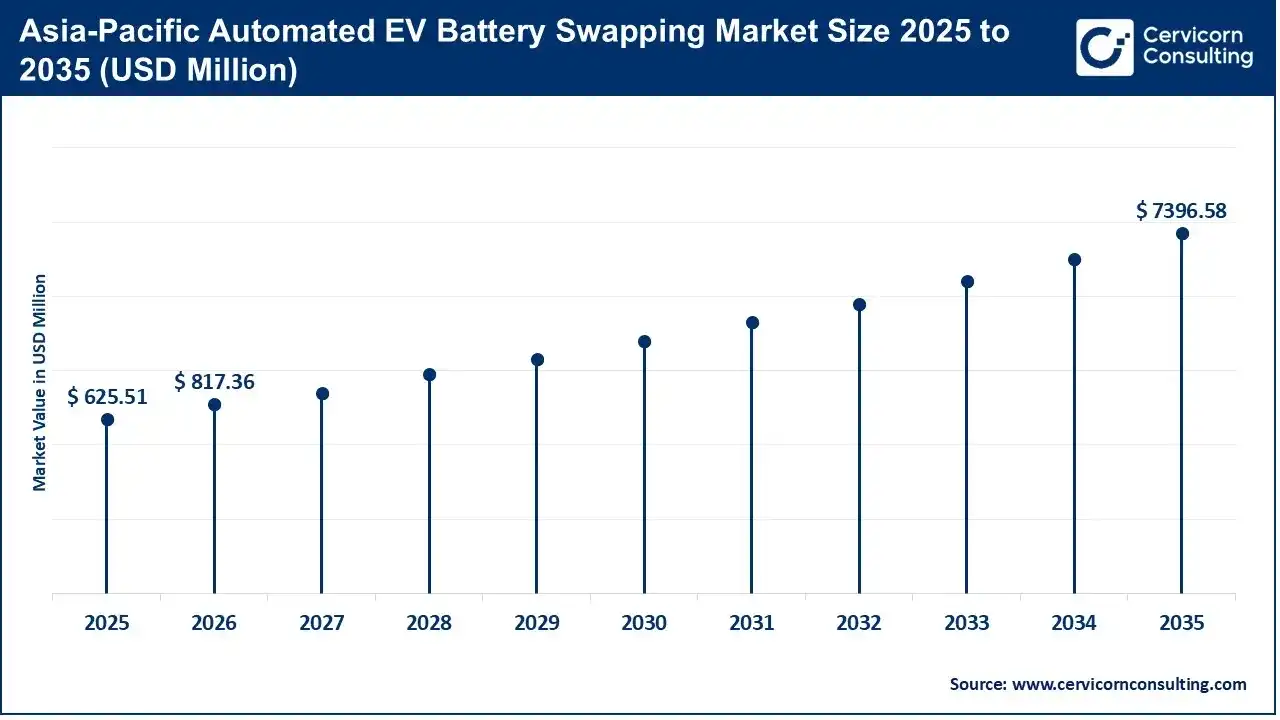
The Asia-Pacific automated EV battery swapping market size was valued at USD 625.51 million in 2025 and is projected to reach USD 7,396.58 million by 2035, driven by the presence of well-established EV and battery manufacturing ecosystems, growing infrastructure for battery swapping, and high EV adoption. The region is getting stronger thanks to government support for electric mobility and rising investments in automated swapping networks. The market is expanding due to the growing use of electric two-wheelers, three-wheelers, passenger cars, and commercial fleets. The region's expanding capacity to produce batteries is contributing to the development of a more robust supply chain for swapping operators. Automated swapping solutions are anticipated to be used more frequently due to growing urban mobility demands and the growth of commercial EV fleets. Major battery and electric vehicle manufacturers are also promoting infrastructure growth and technological advancement.
North America is growing rapidly in the global automated EV battery swapping market
The North America automated EV battery swapping market size was estimated at USD 129.07 million in 2025 and is expected to surpass USD 2,739.47 million by 2035, driven by growing interest in battery-as-a-service models, rising EV adoption, and growing demand for shorter vehicle downtime. More opportunities are being created by the electrification of commercial fleets and developments in automated swapping technology. Swapping network development is also being aided by increasing investments in EV infrastructure. Faster energy replenishment is becoming more and more necessary as fleet-based transportation and electric delivery vehicles become more common. Collaborations between fleet managers, automakers, and technology companies can help the market grow even more. The use of swapping solutions is also being encouraged by the growing interest in practical substitutes for traditional charging.
Segmental Analysis
Service Type Analysis
Subscription-based services dominated the automated EV battery swapping market with a market share of 42.0% in 2025, motivated by the ease of recurring payment models and reliable access to battery-swapping services. Without requiring individual battery ownership, subscription plans can make it simpler for users to switch networks. Fleet operators and commercial users are increasingly adopting them, which is helping the market. For regular users, the model offers more cost predictability and may promote sustained customer engagement. Subscription-based access is becoming more feasible across multiple locations due to the growth of linked swapping networks.
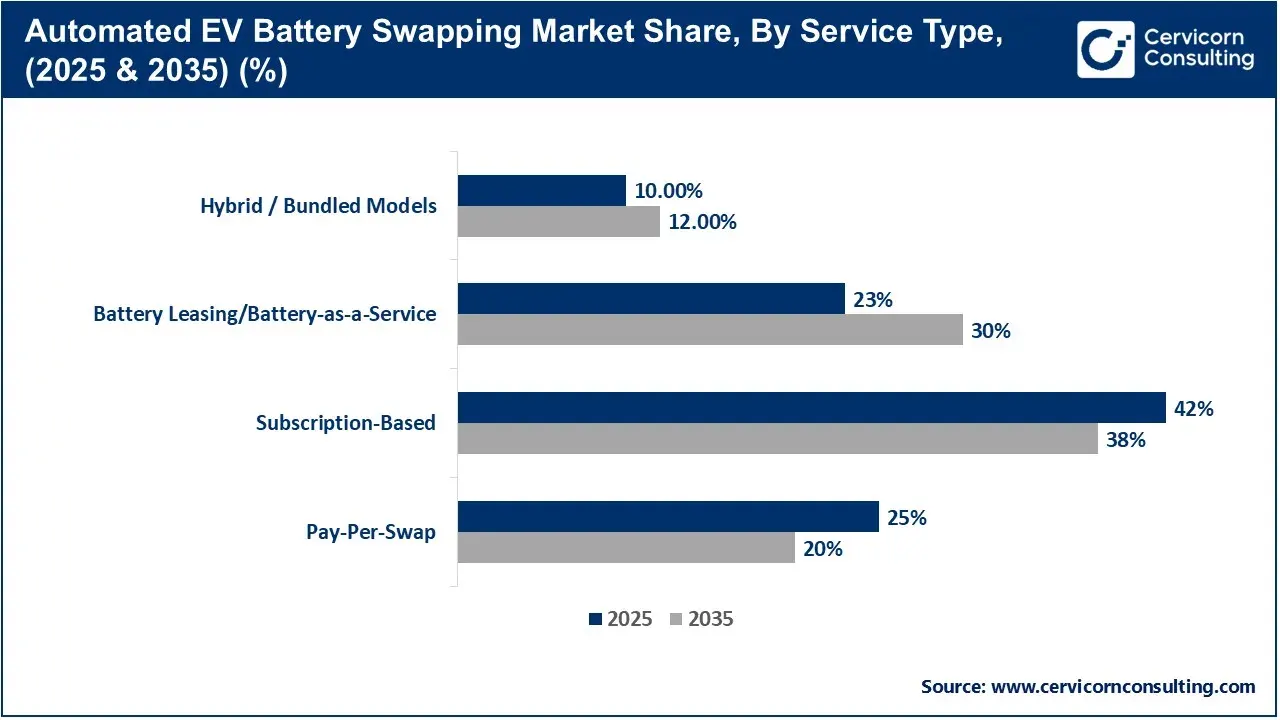
Battery leasing/battery-as-a-service is growing rapidly in the automated EV battery swapping market, with its market share expected to increase from 23.0% in 2025 to 30.0% by 2035, driven by a decrease in the initial cost of EVs and a growing demand for flexible battery ownership models. With this model, users can exchange depleted batteries for charged ones and access battery capacity as a service. Opportunities are also being created by the growing adoption of EVs by fleet operators and commercial users. Adoption of EVs can be more financially flexible for users if the cost of the battery is kept apart from vehicle ownership. Service providers are being encouraged to increase their battery-as-a-service offerings due to the growing interest in usage-based mobility models.
Vehicle Type Analysis
Passenger cars dominated the automated EV battery swapping market with a market share of 48.0% in 2025, driven by the growing demand for quicker energy replenishment and the rising adoption of passenger EVs. Battery swapping can increase vehicle availability for users and decrease charging downtime. The market is being further supported by growing EV infrastructure and technological advancements in automated swapping systems. Rapid battery replacement is becoming more and more necessary as consumer interest in convenient EV energy solutions grows. Additionally, improvements in automated station technology and battery standardization may make swapping more feasible for passenger cars.
Buses are growing rapidly in the automated EV battery swapping market, with their market share expected to increase from 5.0% in 2025 to 7.0% by 2035, motivated by the desire to reduce operational downtime and the growing electrification of public transportation. Electric busses can quickly resume operation without requiring long charging times thanks to automated swapping. Demand is also being supported by fleet-based operations and infrastructure improvements for electric public transportation. For public transportation operators, quick battery replacement is especially important due to the high daily vehicle utilization. The segment's growth may be further aided by the construction of specialized swapping facilities at depots and transit hubs.
Automation Level Analysis
Fully automated battery swapping dominated the automated EV battery swapping market with a market share of 65.0% in 2025, motivated by its capacity to decrease manual intervention, expedite battery replacement, and enhance operational effectiveness. Additionally, automated systems can enhance station utilization and provide consistent battery handling. The market is being strengthened by rising investments in robotics, sensors, software, and linked battery-management technologies. While lowering reliance on human intervention during battery replacement, automated operations can increase service consistency. Operators are also enhancing station performance and battery tracking through integration with digital monitoring and battery-management platforms.
Semi-automated battery swapping is growing rapidly in the automated EV battery swapping market, with a market share of 35.0% in 2025, driven by the growing need for quicker battery replacement while keeping operational flexibility and automation in check. When compared to fully automated stations, these systems can lower manual labor, increase swapping efficiency, and provide operators with a more convenient choice. The need for semi-automated solutions is growing as commercial fleets and urban mobility operators adopt them more frequently. Additionally, deployment across a broader range of swapping facilities can be supported by the ability to integrate automated functions without requiring fully robotic infrastructure. Open/Public Network.
Network Model Analysis
Closed/fleet-dedicated networks dominated the automated EV battery swapping market with a market share of 45.0% in 2025, driven by high demand from delivery services, commercial fleets, and other EV applications with high utilization. Operators can manage battery availability and optimize swapping infrastructure based on fleet requirements thanks to dedicated networks. This model is further supported by the need to reduce vehicle downtime and preserve consistent fleet operations. To maximize infrastructure utilization, fleet operators can plan swapping locations around predetermined routes and operating schedules. More demand for specialized swapping networks is anticipated as electric logistics, delivery, and mobility fleets expand. Additionally, operators may have more control over fleet energy needs, station capacity, and battery inventory with dedicated infrastructure.
Open/public network is the fastest-growing segment in the automated EV battery swapping market, motivated by the growing demand for widely available infrastructure for battery swapping among various EV users and fleet operators. Access to swapping stations is made possible by public networks, which enhances convenience and promotes wider EV adoption. The need for readily available swapping facilities is growing due to the growth of commercial EV fleets, delivery services, and urban mobility. The growth of open/public networks across various locations can be further supported by the development of standardized batteries and interoperable swapping systems.
Government Initiative
- In January 2025, Ministry of Power, Government of India issued the Guidelines for Installation and Operation of Battery Swapping and Battery Charging Stations. The guidelines specifically promote battery swapping as an alternative method of powering EVs, encourage Battery-as-a-Service models, and provide a framework for developing a nationwide battery-swapping ecosystem.
- In September 2025, Ministry of Heavy Industries, Government of India issued the Operational Guidelines for Deployment of EV Public Charging Stations under the PM E-DRIVE Scheme. The broader charging-infrastructure programme includes battery-swapping stations and battery-charging stations, with dedicated support for their upstream infrastructure.
- In December 2025, Ministry of Heavy Industries, Government of India confirmed that PM E-DRIVE provides capital-subsidy support for battery-swapping stations and battery-charging stations. Battery-swapping and charging stations deployed at any location are eligible for support toward upstream infrastructure, helping facilitate the expansion of swapping infrastructure.
- In March 2026, Technology Development Board and Department of Science & Technology, Government of India provided financial assistance to InfinityX Innovations Private Limited for its Automated Battery Swapping Stations for Electric Vehicles project. The government-backed project supports commercialization and scale-up of automated, IoT-enabled swapping stations, including technology designed for rapid battery replacement.
Recent Developments
- In March 2026, InfinityX Innovations received financial support from India’s Technology Development Board and Department of Science & Technology to commercialize and scale its automated, IoT-enabled EV battery-swapping stations. The technology is designed for rapid battery replacement, particularly for commercial fleets and last-mile mobility.
- In June 2026, CATL announced plans to develop more than 30 battery-swapping stations for electric trucks across Europe by 2035 in partnership with Octopus Energy. The initiative is focused on supporting electric heavy-duty transport and expanding battery-swapping infrastructure beyond China.
- In July 2026, SUN Mobility demonstrated a modular multi-battery swapping solution integrated with Tata Motors’ 12-metre Starbus EV platform. The system allows multiple battery packs to be exchanged simultaneously, extending swapping technology into electric public transportation.
- In August 2026, Indofast Energy partnered with GLIDA to expand battery-swapping infrastructure across India. The companies announced plans to establish more than 100 swapping stations across 50 locations, combining battery swapping with existing EV charging sites to support fleet and delivery users.
Key Companies
Segments Covered
By Service Type
- Pay-Per-Swap
- Subscription-Based
- Battery Leasing/Battery-as-a-Service
- Hybrid / Bundled Models
By Vehicle Type
- Two-Wheelers
- Three-Wheelers
- Passenger Cars
- Light Commercial Vehicles
- Medium & Heavy Commercial Vehicles
- Buses
By Automation Level
- Fully Automated Battery Swapping
- Semi-Automated Battery Swapping
By Network Model
- Open/Public Network
- Closed/Fleet-Dedicated Network
- Semi-Open Network
By Region
- North America
- Europe
- Asia-Pacific
- Latin America
- Middle East & Africa