Aluminium Foil Market Size and Growth 2026 to 2035
The global aluminium foil market size was valued at USD 30.38 billion in 2025 and is expected to be worth around USD 51.28 billion by 2035, exhibiting a compound annual growth rate (CAGR) of 5.4% over the forecast period from 2026 to 2035. The aluminium foil market is significantly driven by global shift towards sustainability and the systematic replacement of single-use plastics. Governments and international regulatory bodies, such as the Basel Convention, are increasingly limiting the trade of plastics that support the complexities of global society to reduce plastic waste. These initiatives encourage manufacturers to identify 100% recyclable alternatives without compromising barrier performance. Aluminium foil offers a material that can be recycled indefinitely without losing quality and uses only 5% of the energy required to recycle Aluminium compared to primary production standards. The rising global demand for alternative packaging to plastic is expected to grow by 4.2%, directly benefiting the foil industry as food and beverage brands shift to metallic laminates over plastic wrappers.
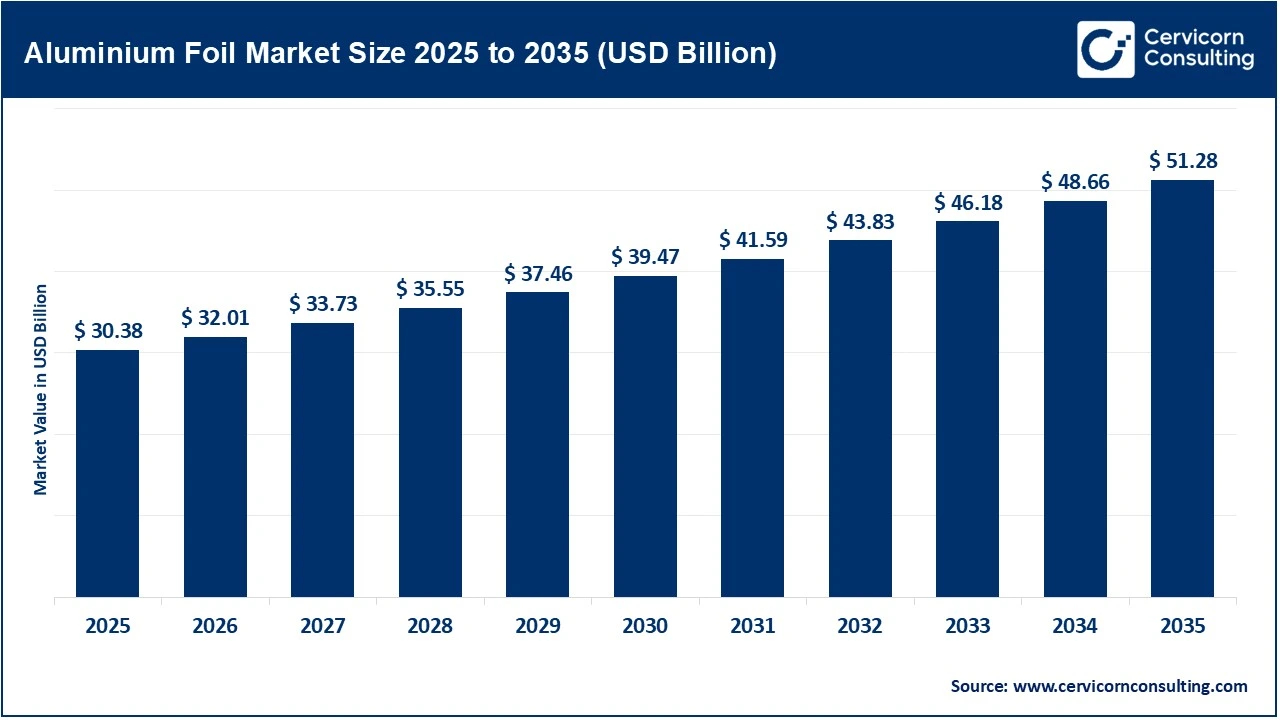
The booming "ready-to-eat" and convenience food markets serve as another key growth drivers for the industry. Aluminium foil's superior barrier properties extend the shelf life of perishable products without the need for refrigeration, which is important for global supply chains and reducing food waste. Additionally, the increasing consumption of pharmaceuticals, particularly for chronic disease treatment devices that require blister packs, sustains demand for pharma-grade foil. This sector is projected to grow by 6% annually because foil remains the gold standard for protecting sensitive biologics from environmental degradation, ensuring efficacy and safety across different climates.
Report Highlights
- By Region, the Asia-Pacific dominates the regional segment, capturing 54% share of the global aluminium foil market, mainly due to large-scale production in China and rising consumption in food and pharmaceutical sectors.
- By product, the wrapper foils dominate the market with 26% revenue share, mainly because of their extensive use in food wrapping and flexible packaging applications.
- By product, the container foils are the fastest-growing segment with 22% share, driven by increasing demand for ready-to-eat meals and food delivery packaging.
- By end use, the packaging dominates the market, accounting for 68% revenue share, primarily due to high demand for safe, lightweight, and high-barrier food and pharmaceutical packaging.
- By end use, the industrial is the fastest-growing segment with revenue share of 32%, due to rising applications in insulation, electronics, and automotive sectors.
Growth of Sustainable and Environmentally Friendly Packaging
The shift toward "Green Aluminium," produced from renewable energy sources with low carbon footprints, is a significant trend transforming the aluminium market. Consumer goods companies increasingly require foil suppliers to provide carbon intensity certificates to meet Environmental, Social, and Governance (ESG) goals. Major producers aim to cut carbon emissions by 30% by 2030, with low-carbon foil prices expected to be 5-10% higher than standard foil. This demand for low-carbon options is also driven by recent mandates requiring recycled content, aimed at reducing reliance on virgin materials and promoting circularity in packaging.
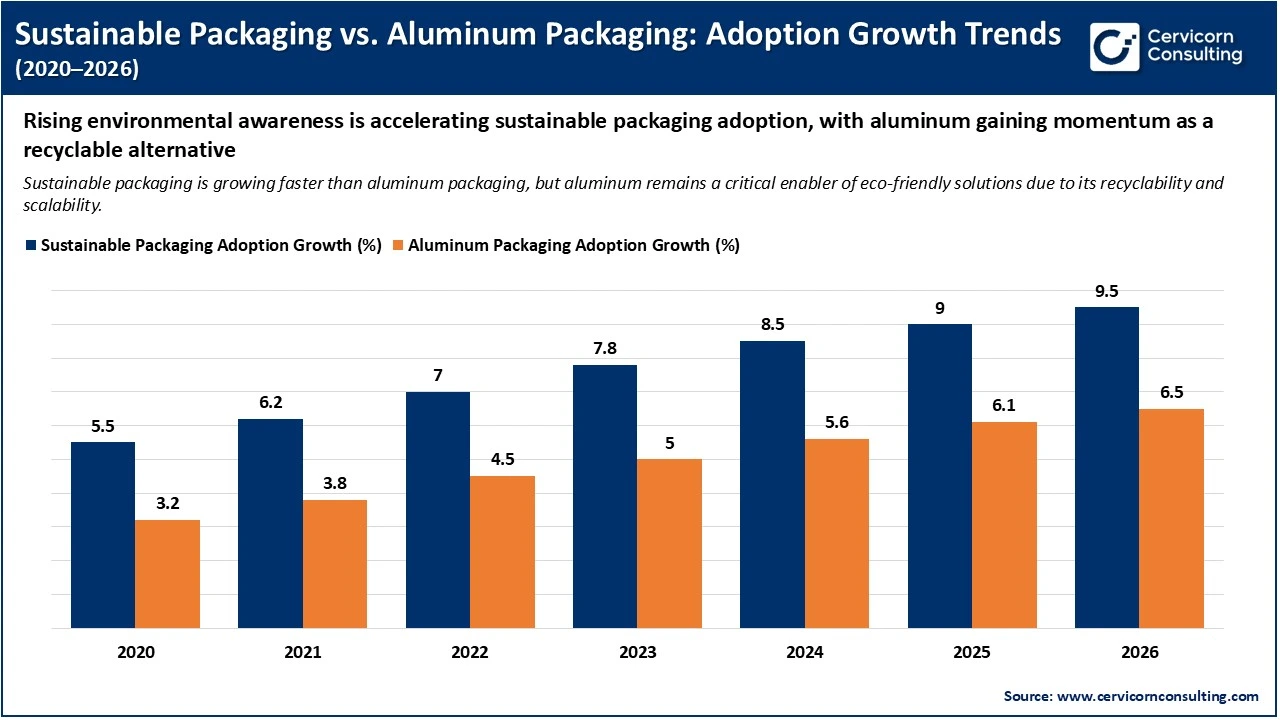
The chart shows a steady increase in adoption for both sustainable and aluminum packaging over time. Sustainable packaging is growing at a faster pace, driven by environmental concerns and regulatory pressure. Meanwhile, aluminum packaging continues to rise consistently due to its recyclability and durability, making it a key material in the transition toward more eco-friendly packaging solutions.
Key Points of Product Segment & Type Performance
- Standard Household Foil: includes household standard foil types, or “heavy-duty” that still serves the consumer market. Growth remains steady at 3.8% in 2024, primarily supported by the increased rate of food preparation and storage at home.
- Pharmaceutical Foil (Blister Packs): this segment is in high demand due to the preservation of medical supplies. The valuation will increase by an additional USD 2 billion by 2027.
- Battery Cathode Foil: representing the high-tech frontier, this type is nearly 99.9% pure and is experiencing a 20% annual demand increase due to the global shift to electric mobility.
- Industrial Fin Stock: industrial fins continue to grow driven by green building mandates and the expansion of the electric grid.
Top 5 Trends and Technologies
- Shift toward Sustainable & Recyclable Aluminium Foil: Over 75% of Aluminium produced globally remains in use, driven by its unlimited recyclability and alignment with circular economy goals.
- Growth in Battery Foil for Electric Vehicles (EVs): Demand for battery-grade Aluminium foil is rapidly increasing, with China alone consuming over 300,000 tonnes annually for EV batteries.
- Ultra-Thin Foil Technology Development: Manufacturers are creating thinner yet high-strength foils (<6 microns) to decrease material use and costs while maintaining barrier performance.
- Smart & Functional Packaging Integration: Incorporating QR codes and track-and-trace technologies on foil-based packaging enhances transparency and supply chain efficiency.
- Green Manufacturing & Low-Carbon Aluminium Production: Companies are investing in renewable energy, with some aiming for net-zero emissions by 2050 in Aluminium production.
What Are the Latest Advances in Aluminium Foil Technology?
Aluminium foil technology has recently advanced in terms of purity, reduced thickness (downgauging), and recyclability. Some of the advancements are:
- Ultra-thin battery foils: Success at 99.9% purity with foils of 9-12 microns was achieved, and this is critical for increasing the energy density of lithium-ion cells in the normal operating range of lithium-ion cells.
- Carbon-coated foils: Development of specialized carbon-based coatings reduced internal resistance by 15% in battery applications, enhancing performance and longevity.
- AI sorting capabilities: The use of robotic sorters, with artificial intelligence capabilities, has increased the ability to recover additional Aluminium foil from municipal waste streams by 25%.
Report Scope
| Area of Focus |
Details |
| Market Size in 2026 |
USD 32.01 Billion |
| Market Size in 2035 |
USD 51.28 Billion |
| Market CAGR from 2026-2035 |
5.4% |
| Dominant Region |
Asia-Pacific |
| Key Segments |
Product, End-use, Region |
| Key Companies |
Amcor plc, Hindalco Industries Limited, Novelis Inc., Alcoa Corporation, UACJ Foil Corporation, Assan Aluminyum, Constantia Flexibles, Eurofoil Luxembourg S.A., ACM Carcano S.p.A., Laminazione Sottile S.p.A., Shanghai Metal Corporation, Xiamen Xiashun Aluminium Foil Co., Ltd., Huawei Aluminium Co., Ltd., Jindal Aluminium Limited, Ess Dee Aluminium Ltd |
Recent Major Milestones
1. Corporate Capacity Expansion and Infrastructure Expenditures
Novelis has announced a multi-million dollar investment to expand its North American rolling mills, aiming to serve the high-end foil market in packaging and industrial sectors. This expansion is expected to boost regional foil supply by 20% by 2025. Besides meeting rising demand, it provides a vital buffer against recent logistics disruptions affecting foil supply. The infrastructure investments are part of a broader USD 3.4 billion capital expenditure plan to upgrade production facilities, addressing the growing need for lightweight and sustainable Aluminium in automotive and packaging industries.
2. Government Programs on Circular Economy and Sustainability
Government policies significantly influence the aluminium foil market, especially in fostering sustainability. For instance, legislation from the European Union has raised collection and recycling targets for Aluminium packaging and introduced a structured waste management strategy across member states. This EU law has led to a 5% rise in the collection rate of thin-gauge foil in urban areas, as local municipalities invest in advanced eddy-current separators to recover Aluminium from mixed waste.
3. Strategic Mergers and Global Acquisitions in the Market
The aluminium foil market is experiencing increased consolidation through strategic mergers and acquisitions. Companies are actively merging with specialized foil converters to boost their technical capabilities for high-barrier packaging. For instance, several specialized foil converters have been acquired by a global packaging firm to support the production needs of complex pharmaceutical clients. These corporate strategies are driven by a desire to expand "low-carbon" foil production and secure contracts with multinational food and beverage brands. M&A activity in the foil sector has grown by 15% annually, indicating that the market is maturing and converging around high-value, specialized applications.
4. Deployment of High-Efficiency Rolling Technologies
Industry 4.0 technologies are increasingly used in the Aluminium foil industry to enhance precision in foil rolling, especially for gauges aimed at innovative applications. Advanced monitoring tools now facilitate the processing of high-purity bauxite-derived materials, reducing scrap and increasing yield. These innovations enable manufacturers to produce thinner, stronger foils that maintain high barrier qualities with less raw material. Given rising energy costs and stricter environmental standards, adopting these new rolling technologies offers significant benefits.
Aluminium Foil Market Regional Analysis
The aluminium foil market is segmented into various regions, including North America, Europe, Asia-Pacific, and LAMEA. Here is a brief overview of each region:
Why does Asia-Pacific dominates in the aluminium foil market?
The Asia-Pacific aluminium foil market size was valued at USD 16.41 billion in 2025 and is projected to surpass around USD 27.69 billion by 2035.
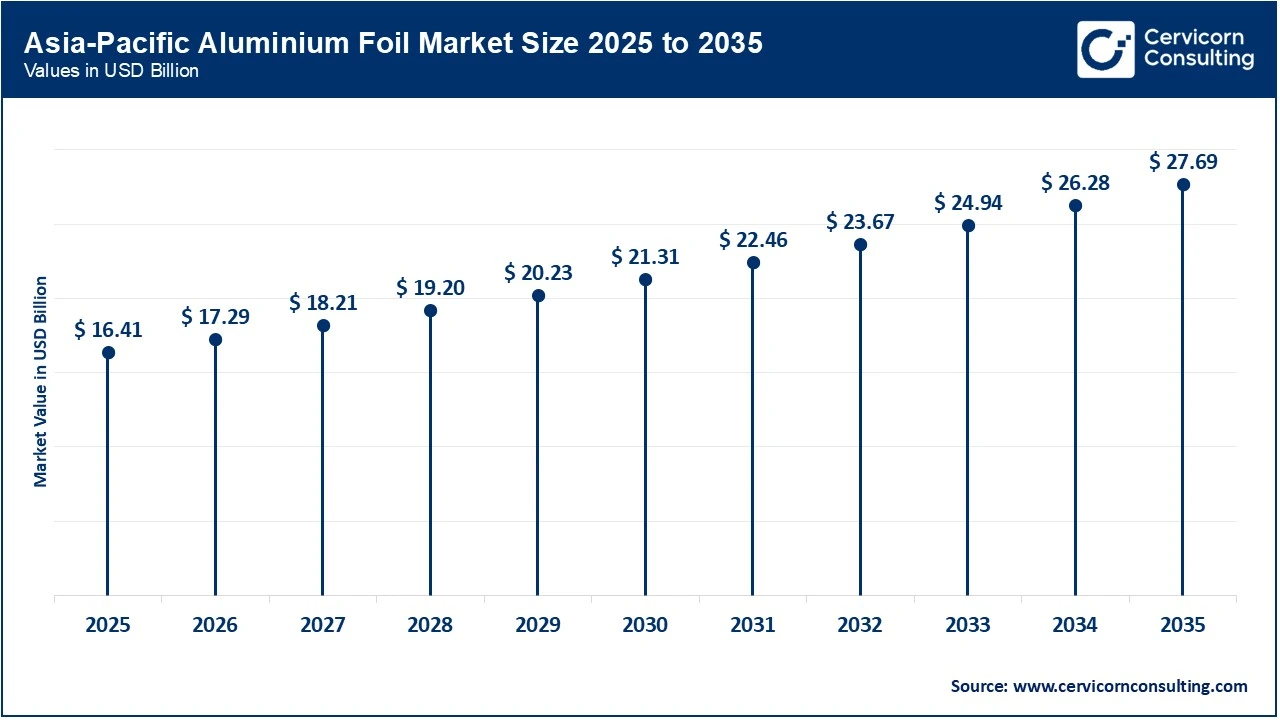
The Asia Pacific is a dominant region of the market, mainly driven by rapid urbanization and the expansion of organized retail across major economies such as China, India, and Southeast Asia. The increasing adoption of food delivery applications, along with the modernization of the food service industry, has significantly boosted the demand for Aluminium foil containers, which are widely used to maintain temperature and hygiene. In India, Aluminium foil consumption is increasing at a rate of 7% annually as pharmaceutical exports are served with blister packaging made of high-gauge Aluminium foil. Additionally, the Chinese government’s push for "Green Packaging" is shifting away from non-recyclable, arbitrary packaging materials toward sustainable Aluminium-based solutions.
China to Lead Global Production through Industrial Scaling
China continues to the largest producer and consumer of aluminium foil in the world, supported by its fully integrated supply chains and strong economies of scale. Under the "14th Five-Year Plan," the country continues to improve high-end manufacturing, encouraging producers to shift from low-margin household foil to high-tech battery foils.
- Production Capacity: China is responsible for approximately 60% of global Aluminium foil production capacity.
- EV Market Influence: Domestic demand for battery foil is surging, with China being the world's largest EV market consuming over 300,000 tonnes annually of battery-grade foil.
- Export Dominance: China continues to be the largest exporter of foil to Southeast Asia and the Middle East, despite trade tensions and anti-dumping duties in some markets.
India to Witness Surge in Pharmaceutical and FMCG Foil Demand
India is emerging as a critical growth in the market, driven by pharmaceutical sector and rapidly expanding middle class. In “Pharmacy of the World,” India is experiencing rising demand for High-barrier pharmaceutical packaging, supported by increasing aligning with international FDA standards.
- Pharmaceutical Growth: The Indian pharmaceutical packaging market is expected to reach USD 15 billion by 2027, with Aluminium blister foil being a focal area of consumption.
- FMCG Growth: The move in rural India from loose goods to packaged goods is increasing the uptake of small-format foil laminates.
- Infrastructure Investment: New government incentives for “Make in India” are prompting global foil makers to establish localized production capabilities.
Japan to Lead Development of Precision Foils for High-Tech Electronics and Energy Storage
Japan continues to lead in aluminium foil market, particularly in high-precision and high-performance applications.
- Electronic Capacitors: Japan holds a very strong position of the global market for high-purity etched foil used in electrolytic capacitors.
- Quality Standards: Japanese industrial standards (JIS) for foil are among the highest in the world, allowing for a premium in Japanese exports.
North America Aluminium Foil Market: Driven by Prescription Demand and Sustainable Packaging Regulations
The North America aluminium foil market size was estimated at USD 4.56 billion in 2025 and is projected to garner around USD 7.69 billion by 2035. The North American market is mainly driven by a well-established healthcare sector and high consumer demand for "ready-to-eat" (RTE) meals. The aging population in the United States has also increased demand for blister packaging, which heavily depends on high-gauge aluminium foil to protect against moisture and light. Additionally, the FDA has implemented further regulations regarding food safety, and corporate mandates for sustainable packaging are encouraging manufacturers to shift to high-purity recyclables and easily recyclable foil products.
United States to Emphasize High-Barrier Sustainable Packaging Innovation
The U.S. market is shifting towards high-performance sustainable flexible packaging, and focus toward lower food waste and improving shelf life.
- Sustainability Goals: Major U.S. retailers are demanding a 20% reduction in the use of plastics, sparking increased interest in Aluminium-based stand-up pouches.
- Aseptic Packaging: The U.S. aseptic packaging market is expanding at a CAGR of 6.5% based on shelf-stable dairy and plant-based milks.
- R&D Center of Gravity: The U.S. is still the center for "smart" foil technologies, including integrated features for anti-counterfeiting in the spirits and tobacco products.
Canada to Expand Demand to Capacity in Frozen and Processed Food Packaging
Canada has a demand for Aluminium foil that is increasingly closely aligned with the country's significant food processing industry, primarily in the frozen food and bakery categories.
- Frozen Food Demand: Canada is one of the largest per capita consumers of frozen meals globally, contributing to continued demand for foil lidding and containers.
- Environmental Initiatives: Canadian provinces are implementing Extended Producer Responsibility (EPR) programs that favor materials with high scrap value like Aluminium.
What are the driving factors of Europe aluminium foil market?
The Europe aluminium foil market size was reached at USD 6.68 billion in 2025 and is forecasted to attain around USD 11.28 billion by 2035. Europe leads in recycling and sustainable innovation in the market, driven by strong environmental regulations and initiatives like the European Green Deal. Leading European companies are increasingly shifting from multi-material laminates to mono-material aluminium solutions to ensure 100% recyclability. Additionally, there is a growing focus on high-value foil products with eco-certifications, especially in sectors such as organic food and premium beauty creams that cater to environmentally-conscious consumers.
Germany to Dominate Advanced Manufacturing and Automotive Foil Segments
Germany is the core of the European foil market, which focuses on "Industry 4.0" and the dominance of the automotive sector is a key driver of the foil opportunities for high-performance applications.
- Automotive Integration: German automotive manufacturers lead the transition to EVs in global markets, creating a natural, localized supply chain for battery foils in Europe.
- Circular Economy Leadership: Germany has companies developing "wash-off" glues for facilitating the perfect separation of foil from plastics during recycling.
Aluminium Foil Market Share, By Region, 2025 (%)
| Region |
Revenue Share, 2025 (%) |
| Asia Pacific |
54% |
| Europe |
22% |
| North America |
15% |
| LAMEA |
9% |
LAMEA Aluminium Foil Market: Driven by Growing Retail Infrastructure and Consumer Goods
The LAMEA aluminium foil market was valued at USD 2.73 billion in 2025 and is anticipated to reach around USD 4.62 billion by 2035. The LAMEA region (Latin America, Middle East, and Africa) is an emerging frontier market for aluminium foil, supported by the expansion of modern retail infrastructure, especially supermarkets and hypermarkets. In countries like Kuwait and Brazil, the growth of cold chain logistics is aiding the use of aluminium foil-based insulation and packaging to keep food stable in hot climates. Although the market is smaller than in other regions, it still presents significant growth opportunities in construction and HVAC applications, where aluminium foil is used for insulation and radiant barriers.
Brazil to Leverage Growth in Beverage and Personal Care Consumption
Brazil is the largest market in Latin America and is growing due to the massive beverage industry (beer and soft drinks) and the personal care industry.
- Beverage Cans and Lids: Brazil is one of the highest Aluminium can recycling rates in the world near up to 98%, this supports the concept of a circular economy for it being foil-based lidding and labels.
- Cosmetics Industry: Brazil's cosmetics market is the fourth highest globally, thus fueling demand for foil tubes and laminates for higher-end skin-care products.
- Agribusiness Synergy: As a major global supplier of proteins, Brazil uses many foil-based flexible packaging products for its meat export business.
UAE to Emerge as a Strategic Hub for Aluminium Downstream Processing
- Production Expansion: The UAE has increased downstream Aluminium processing capacity by about 25% over the last five years.
- Strategic Location: The logistics support of Dubai's infrastructure provides foil producers based in the UAE easy access to serve markets in Africa, Europe, and South Asia.
- Energy Advantage: The availability of competitive energy prices allows mills to sustain high production rates for energy-intensive, thin-gauge foil.
Aluminium Foil Market Segmental Analysis
The Aluminium foil market is segmented into product, end-use, and region.
Product Analysis
Wrapper foils continue to dominate the product segment in the Aluminium foil market due to their integration into global household and retail consumption. Wrapper foils are primarily used for food preservation. As a flexible product, aluminium foil provides an unparalleled 100% barrier system to light, oxygen, and moisture, ensuring product freshness and safety. Additionally, they serve as a cost-effective alternative to other flexible packaging materials, making them a preferred choice across both developed and emerging markets.
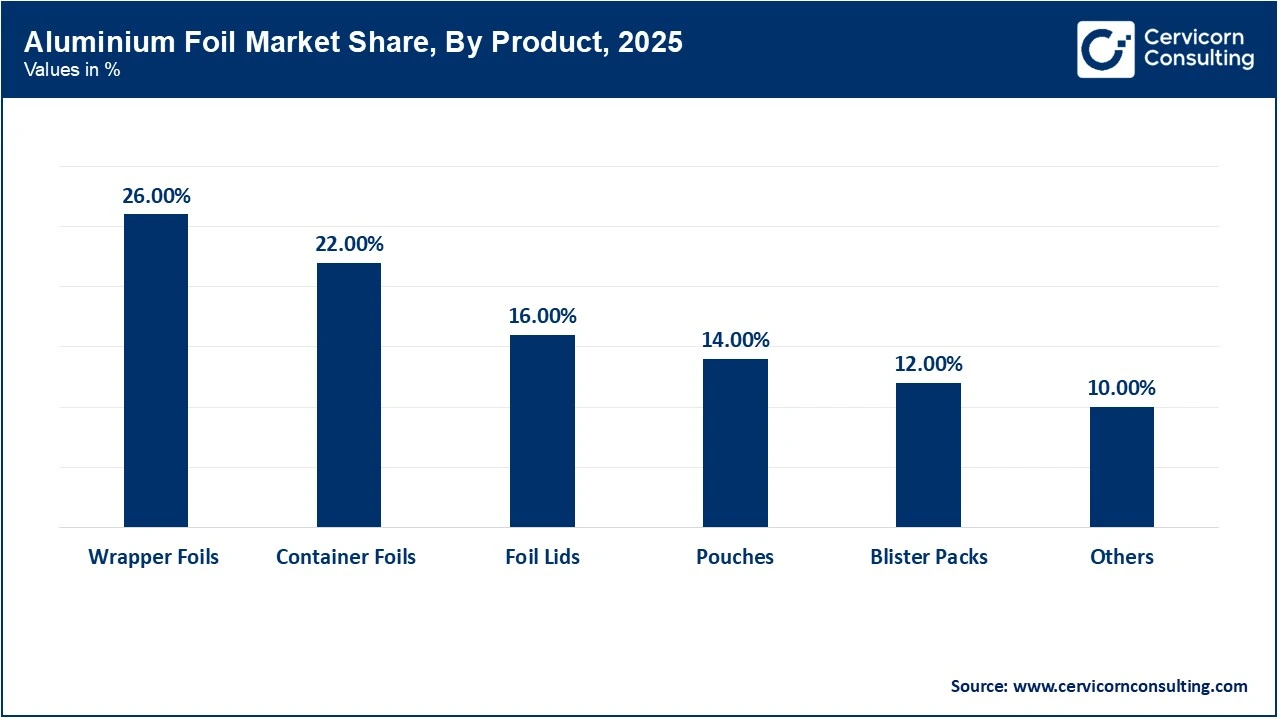
Container foils represent the fastest-growing product segment due to the rapid expansion of the global food delivery and "ready-to-eat" meal markets. Container foils also have relative advantages over plastic alternatives, particularly in terms of better heat stability. Allowing consumers to take an aluminium container directly from the freezer into the oven or grill, which is practical for the modern food service provider. In addition, the growth in this market segment is supported globally as certain countries tighten regulatory frameworks that eliminate single-use plastics (SUP) and reduce plastic waste pollution over biological ecosystems.
End-use Analysis
The packaging sector is the dominant end-use segment in the market because it is an essential protector for the food and pharmaceutical industries, providing clear assurances in critical delivery of function and efficacy. For example, in pharmaceuticals, Aluminium foil is a vital part of blister packing, which creates a sterile and stable environment for sensitive medications. The growing demand for high-value packaging mainly results from expanding healthcare infrastructures focused on extending product shelf life and minimising waste.
Aluminium Foil Market Share, By End-use, 2025 (%)
| End-use |
Revenue Share, 2025 (%) |
| Packaging |
68% |
| Industrial |
32% |
The industrial segment is the fastest-growing end-use category in the market, primarily driven by advances in energy and automotive technologies. The rapid rise of the electric vehicle market and the global shift towards green energy have significantly boosted the demand for high-purity Aluminium foil. It plays a major role as a component in lithium-ion batteries, serving as the cathode current collector for efficient energy storage. Besides the automobile industry, the industrial segment is also driven by high-efficiency heat exchangers in HVAC systems and the miniaturization of electronics for 5G infrastructure.
Aluminium Foil Market Top Companies
Recent Developments by Major Companies
- In June 2024, Amcor plc partnered with Moët & Chandon to launch ESSENTIELLE, a plastic-free Aluminium foil solution made from Aluminium and paper, reducing carbon footprint and enhancing sustainability.
- In February 2024, Hindalco Industries Limited acquired a 26% stake in Ayana Renewable Power to secure green energy supply for Aluminium production, supporting sustainable foil manufacturing.
- In May 2024, UACJ Foil Corporation introduced high-durability and corrosion-resistant Aluminium foils for industrial and packaging applications.
Market Segmentation
By Product
- Wrapper Foils
- Container Foils
- Foil Lids
- Pouches
- Blister Packs
- Others
By End-use
- Packaging
- Food & Beverage
- Pharmaceutical
- Tobacco
- Others
- Industrial
By Region
- North America
- APAC
- Europe
- LAMEA