AI-Powered Digital Twin Market Size and Growth Outlook 2026 to 2035
The global AI-powered digital twin market size was valued at USD 32.50 billion in 2025 and is projected to grow from USD 42.34 billion in 2026 to nearly USD 457.78 billion by 2035, registering a CAGR of 30.2% over the forecast period 2026 to 2035. The AI-powered digital twin market is growing due to the increasing adoption of AI, real-time simulation, and predictive analytics across industries.
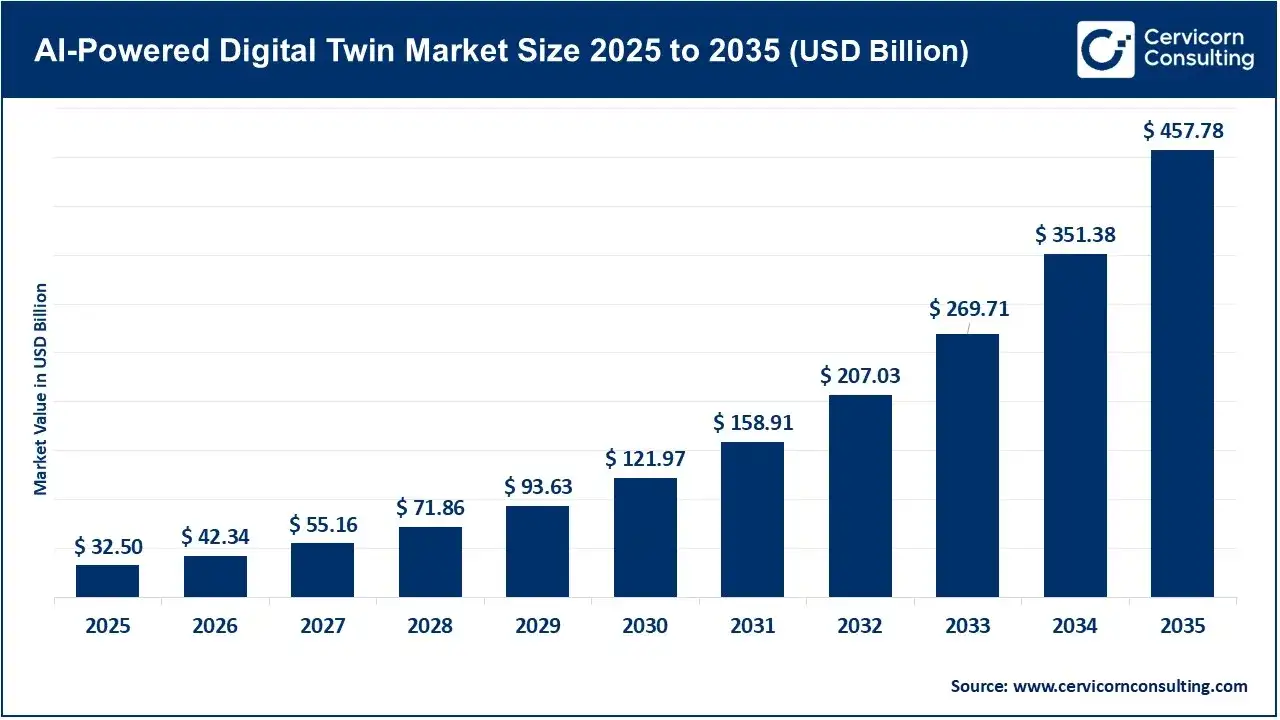
As companies use AI, IoT, real-time data analytics, and predictive modeling to build intelligent virtual representations of physical assets and processes, the market for AI-powered digital twins is growing. In the manufacturing, healthcare, energy, automotive, and other industries, these technologies help businesses track performance, anticipate breakdowns, streamline processes, and enhance decision-making.
- In February 2026, Tata Consulting Engineers (TCE) launched its Cognitive Digital Twin and Industrial AI platform, built using NVIDIA accelerated computing and Omniverse technologies. The platform creates AI-driven, real-time digital twins for manufacturing, energy, and infrastructure, helping companies simulate and optimize physical assets before making changes in the real world.
Report Highlights
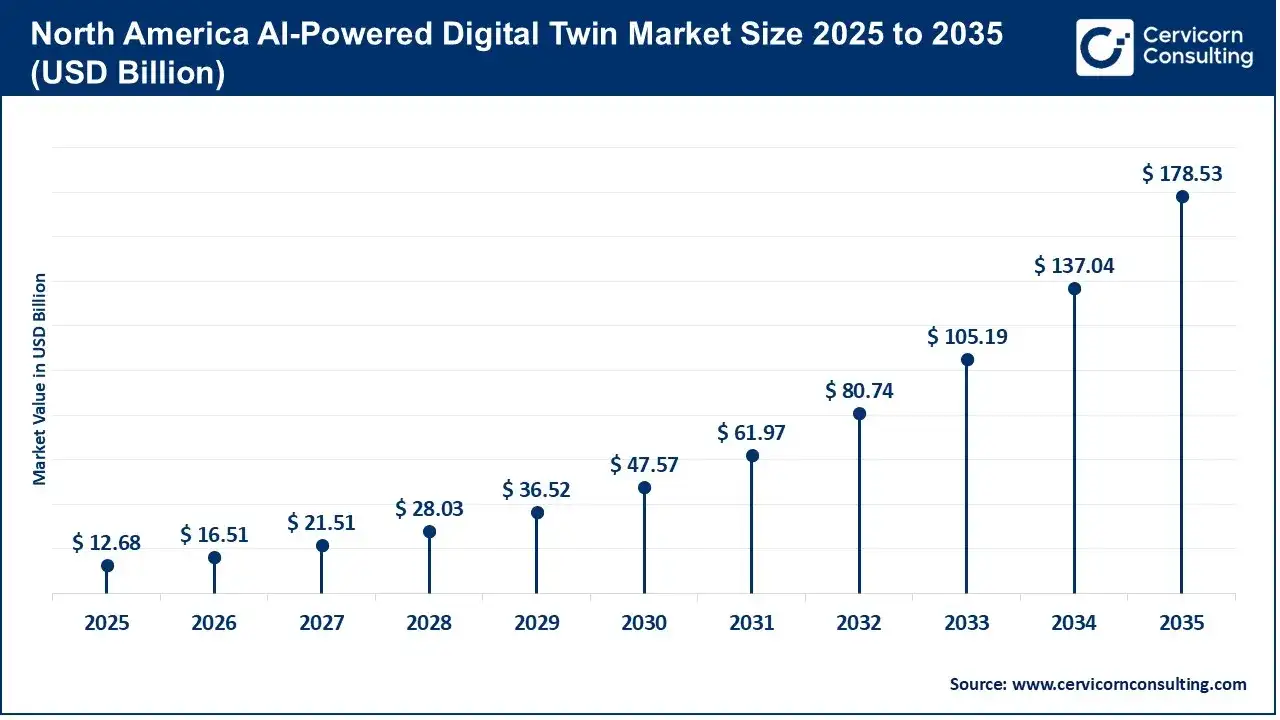
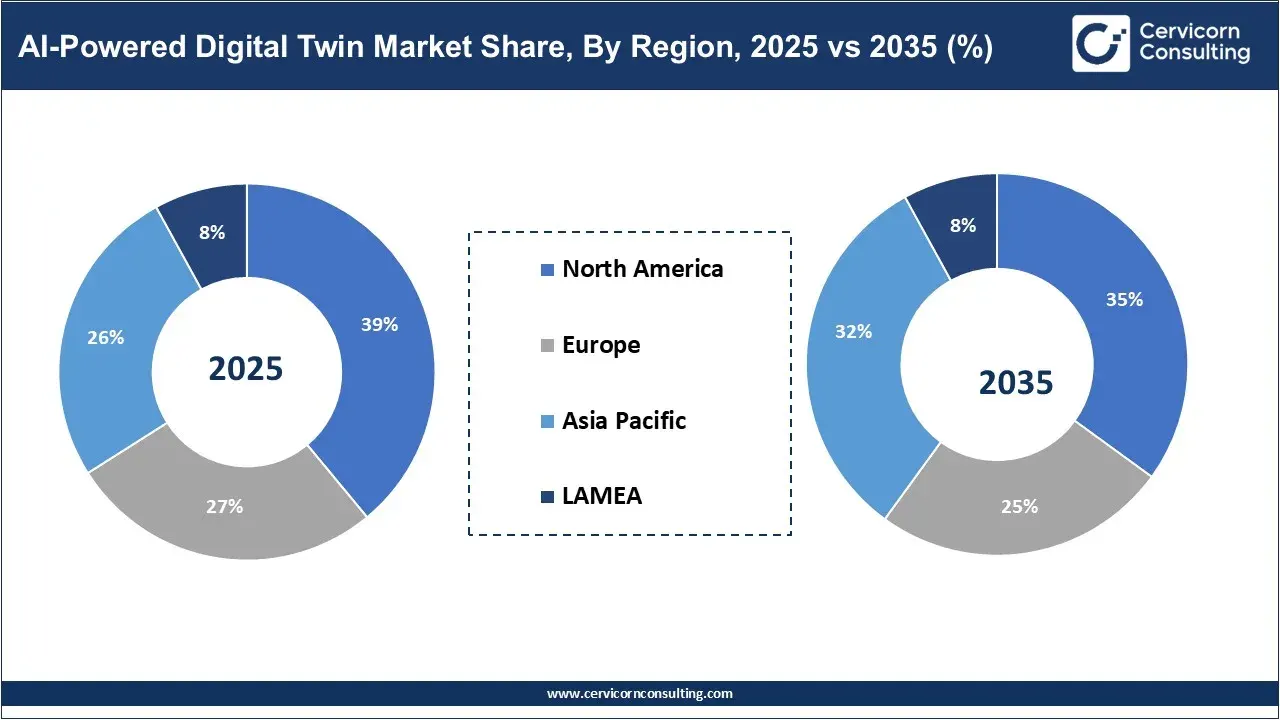
- By region, North America dominated the market in 2025 with revenue share of 39%, supported by strong adoption of AI, IoT, and digital technologies.
- By region, Asia Pacific is expected to register the fastest growth, driven by rapid industrialization and increasing investments in AI and IoT technologies.
- By type, system digital twin dominated the market in 2025 (revenue share 30%), supported by its use in monitoring complex assets and systems.
- By type, process digital twin is expected to register the fastest growth, driven by rising demand for process optimization and automation.
- By component, software/solution dominated the market in 2025 (revenue share 64%), supported by growing demand for digital twin platforms and analytics.
- By component, services are expected to register the fastest growth, driven by increasing demand for implementation and integration services.
- By deployment mode, On-premises dominated the market in 2025 (revenue share 44%), supported by data security and infrastructure control requirements.
- By deployment mode, cloud-based is expected to register the fastest growth, driven by scalability, flexibility, and real-time data access.
- By application, predictive maintenance dominated the market in 2025 (revenue share 24%), supported by demand for equipment monitoring and failure prediction.
- By application, process & business optimization is expected to register the fastest growth, driven by rising demand for operational and resource optimization.
- By industry vertical, manufacturing & industrial automation dominated the market in 2025 (revenue share 32%), supported by growing adoption of smart manufacturing.
- By industry vertical, healthcare & pharmaceuticals is expected to register the fastest growth, driven by the increasing use of digital twins in healthcare and drug development.
Key Trends
- Generative AI Integration: AI is making digital twins more intelligent by improving simulations, analysis, and decision-making.
- Predictive Maintenance: Digital twins help predict equipment failures and reduce downtime by continuously monitoring asset performance.
- Cloud-Based Platforms: Cloud technology enables easier data sharing, scalability, and remote access to digital twin platforms.
- IoT Integration: Connected sensors provide real-time data, helping digital twins remain continuously updated with the latest operational information.
- Edge Computing: Edge technology enables faster real-time data processing and responses by processing data closer to connected assets and devices.
- Autonomous Operations: AI-powered digital twins are increasingly supporting automated decision-making and operational processes.
- Industry Expansion: Adoption is growing across manufacturing, healthcare, energy, automotive, infrastructure, and other industries.
Market Dynamics
How Is the Growing Demand for Operational Efficiency Accelerating AI-Powered Digital Twin Adoption?
The increasing need for operational efficiency, real-time monitoring, and predictive maintenance is driving the market for AI-powered digital twins. Digital twins with AI capabilities can continuously evaluate sensor and operational data to identify irregularities, anticipate equipment breakdowns, and enhance asset performance. The market is expanding due to the growing use of connected industrial systems and smart manufacturing.
- In April 2026, Wipro announced a strategic partnership with Kongsberg Digital to deploy next-generation AI-powered digital twin solutions for the energy and utilities sector. The collaboration combines AI, engineering models, real-time operational data, and automation to improve asset reliability, efficiency, safety, and operational resilience.
Could Implementation Complexity and IT/OT Integration Challenges Limit Market Growth?
Complex implementation, difficult IT/OT integration, and issues with data quality are limiting the market. Implementing digital twins can be expensive and may require specialized knowledge to integrate them with operational technologies, corporate platforms, sensors, and legacy equipment. Large-scale adoption may also be hindered by cybersecurity concerns, interoperability challenges, and inconsistent data.
- In January 2026, Tech Mahindra announced a partnership with CS TECH Ai to deliver geospatial AI and digital twin solutions for enterprises and public-sector organizations. The collaboration focuses on integrating digital twins with existing infrastructure and legacy systems, highlighting the technical complexity involved in implementing these solutions across large operational environments.
How Will Generative AI, Cloud, and Edge Computing Expand Digital Twin Opportunities?
Intelligent automation, cloud and edge computing, and generative AI are creating significant opportunities in the market. By enabling real-time simulation, predictive analytics, autonomous decision-making, and continuous optimization, these technologies can increase the capabilities and adaptability of digital twins. AI-powered digital twin providers are gaining new opportunities through expanding applications in telecommunications, manufacturing, energy, automotive, and infrastructure.
- In June 2026, KDDI announced a collaboration with NVIDIA, Keysight Technologies, and Samsung Research America to develop a high-fidelity RAN Digital Twin for the 6G era. The platform is designed to support AI-driven network optimization, autonomous operations, and safe evaluation of AI algorithms, demonstrating the potential for digital twins beyond traditional Segmental Insights
Regional Analysis
North America AI-Powered Digital Twin Market: Technology Leadership and Digital Transformation
The North America region dominated the market, supported by widespread adoption of advanced analytics, cloud computing, IoT, and artificial intelligence technologies. The region's strong market position is attributed to the presence of major technology companies, industrial organizations, and digital solution providers. Significant investments in digital transformation, smart manufacturing, and advanced infrastructure are further supporting the adoption of AI-powered digital twins across industries.
Asia Pacific AI-Powered Digital Twin Market: Rapid Industrialization and Smart Manufacturing Growth
The Asia Pacific region is expected to be the fastest-growing region, driven by smart manufacturing initiatives, rapid industrialization, and increasing investments in IoT and AI technologies. Countries across the region are accelerating the digital transformation of transportation, energy, infrastructure, and manufacturing industries. The increasing adoption of Industry 4.0 technologies and government support for industrial digitalization are expected to create significant growth opportunities for digital twin providers.
Segmentation Analysis
Type Analysis
The system digital twin segment dominated the AI-powered digital twin market, supported by its ability to create comprehensive virtual representations of connected devices, assets, and functional systems. Organizations can use system digital twins to monitor complex operations, analyze data in real time, identify performance issues, and improve system efficiency. Their growing adoption across manufacturing, energy, transportation, and infrastructure is further strengthening demand for system-level digital twin solutions.
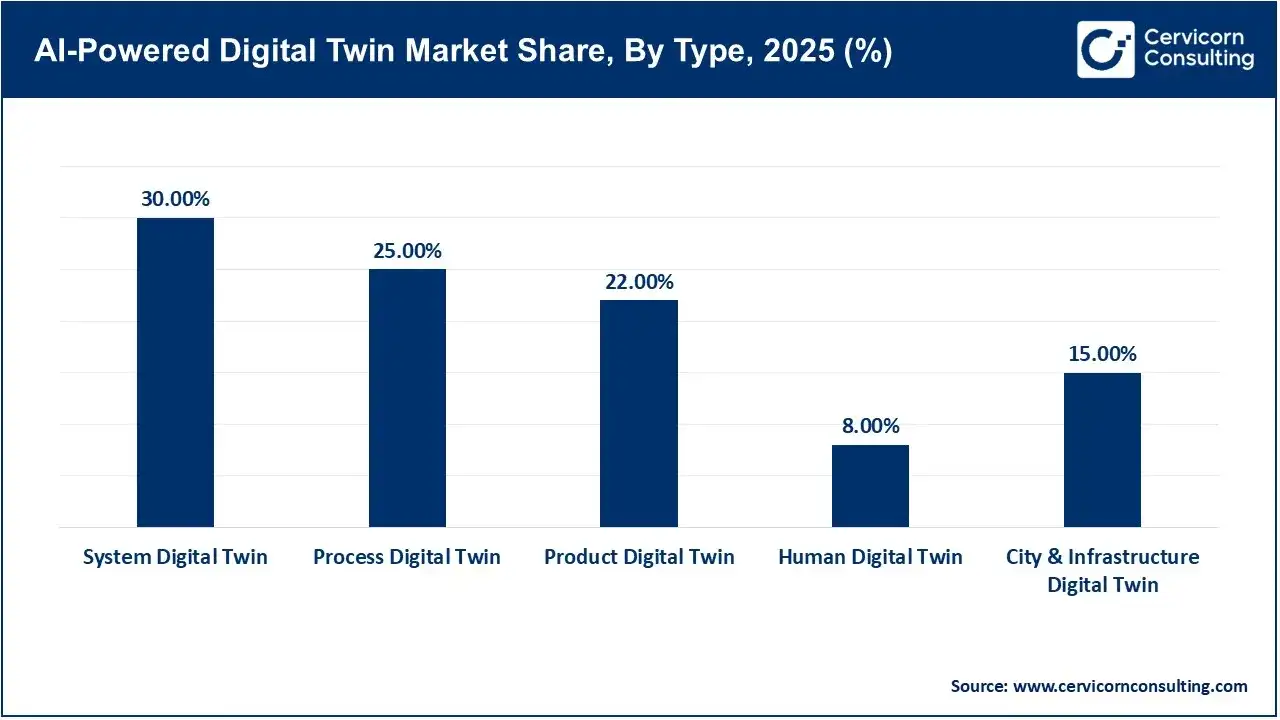
The process digital twin segment is expected to be the fastest-growing segment, driven by the growing need to improve operational performance, production processes, and workflows. AI-powered process twins can identify inefficiencies, analyze operational data in real time, and support predictive decision-making. The increasing use of automation, smart manufacturing, and data-driven process optimization is creating significant opportunities for process digital twin providers.
Component Analysis
The software/solution segment dominated the AI-powered digital twin market, as businesses increasingly require sophisticated platforms for creating, managing, visualizing, and analyzing digital representations of physical assets and processes. Digital twin software is increasingly incorporating AI, machine learning, IoT connectivity, and real-time analytics to enhance monitoring and decision-making. The growing adoption of digital transformation technologies across businesses is further supporting demand for digital twin solutions.
The services segment is expected to be the fastest-growing segment, driven by increasing demand for technical support, implementation, integration, consulting, and maintenance services. Organizations often require specialized expertise to integrate digital twins with operational technologies, IoT infrastructure, and existing enterprise systems. The growing complexity of deployments and the need for customized digital twin applications are expected to create additional opportunities for service providers.
Deployment Mode Analysis
The On-premises segment dominated the AI-powered digital twin market, supported by companies' need for greater control over infrastructure, data, security, and system integration. Large corporations operating critical industrial and manufacturing environments often favor on-premises deployment to manage sensitive operational data and maintain direct control over their digital twin infrastructure. The need for specialized and secure solutions continues to support adoption in data-intensive industries.
AI-Powered Digital Twin Market Share, By Deployment Mode, 2025 (%)
| Deployment Mode |
Revenue Share, 2025 (%) |
| On-Premises |
44% |
| Cloud-Based |
38% |
| Hybrid |
18% |
The cloud-based segment is expected to be the fastest-growing segment, driven by the accessibility, flexibility, and scalability offered by cloud platforms. Cloud deployment enables enterprises to connect digital twins across multiple locations, process large volumes of real-time data, and reduce the need for extensive physical infrastructure. The growing adoption of cloud computing, IoT, and AI technologies is accelerating the transition toward cloud-based digital twin solutions.
Application Analysis
The predictive maintenance segment dominated the AI-powered digital twin market, as digital twins enable businesses to monitor asset performance and identify potential equipment problems before they occur. AI and machine learning can analyze operational data to detect abnormal conditions and support timely maintenance decisions. Predictive maintenance applications are becoming increasingly important due to the growing emphasis on reducing equipment downtime, maintenance costs, and operational disruptions.
AI-Powered Digital Twin Market Share, By Application, 2025 (%)
| Application |
Revenue Share, 2025 (%) |
| Predictive Maintenance |
24% |
| Product Design & Development |
18% |
| Performance Monitoring & Optimization |
20% |
| Business Optimization |
12% |
| Remote Monitoring & Control |
11% |
| Supply Chain Optimization |
10% |
| Others |
5% |
The process & business optimization segment is expected to be the fastest-growing segment, driven by the increasing use of AI-powered digital twins to improve business decision-making, resource utilization, and operational efficiency. Digital twins can simulate different scenarios, identify process bottlenecks, and evaluate potential changes before implementation. The growing demand for data-driven optimization across enterprise and industrial operations is creating strong growth opportunities in this application area.
Industry Vertical Analysis
The manufacturing & industrial automation segment dominated the AI-powered digital twin market, supported by the extensive use of digital twins for process improvement, equipment optimization, production monitoring, and predictive maintenance. Manufacturers are increasingly integrating AI, IoT, robotics, and automation technologies to improve productivity and operational efficiency. The expanding adoption of Industry 4.0 technologies and smart factories is further strengthening demand for AI-powered digital twin solutions.
AI-Powered Digital Twin Market Share, By Industry Vertical, 2025 (%)
| Industry Vertical |
Revenue Share, 2025 (%) |
| Manufacturing & Industrial Automation |
32% |
| Healthcare & Pharmaceuticals |
12% |
| Automotive & Transportation |
16% |
| Aerospace & Defense |
10% |
| Energy & Utilities |
17% |
| Retail & E-Commerce |
5% |
| Others |
8% |
The healthcare & pharmaceuticals segment is expected to be the fastest-growing segment, driven by the growing use of digital twins for drug development, clinical research, personalized healthcare, and healthcare system optimization. AI-enabled digital twins can support the simulation and analysis of complex biological and medical processes, enabling more informed decision-making. Growing digitalization and the increasing use of AI in pharmaceutical research and healthcare are expected to create significant market expansion opportunities.
Recent Developments
- In September 2026, PELF Infotech launched a dedicated Digital Twin and Engineering Intelligence Practice integrating AI/ML, multi-physics simulation, engineering analytics, and high-performance computing. The offering is designed to help manufacturers virtually validate products and processes and make better engineering decisions before physical implementation.
- In September 2026, Dassault Systèmes announced a strategic collaboration with Kyndryl in India to combine virtual twin technologies with IT infrastructure services. The partnership will support project planning, asset management, sustainability, and operational efficiency across infrastructure, manufacturing, retail, and pharmaceutical industries.
- In January 2026, Siemens launched its Digital Twin Composer, combining Siemens' digital twin technology with NVIDIA Omniverse libraries and real-time engineering data. The solution is designed to support simulation, engineering, and industrial AI applications.
Government Initiatives
- In February 2025, the Government of India and the ITU signed a Letter of Intent through the Department of Telecommunications to investigate AI-driven digital twins, virtual worlds, and future-ready infrastructure design. The partnership includes knowledge exchange, digital twin pilot projects, sandbox environments, international standards, and privacy-preserving technologies.
- In May 2026, ITU, UNICC, and Digital Dubai continued their global program through the second Citiverse Assembly under the Global Initiative on AI, Digital Twins, and Virtual Worlds. The initiative brings together governments, technology companies, cities, and academic institutions to develop secure and interoperable AI-enabled digital twin ecosystems for urban and public-service applications.
- In October 2025, the Department of Telecommunications and IIIT Hyderabad signed a Memorandum of Understanding covering research in AI-driven telecom networks, digital twin technologies, IoT, and smart cities. The initiative uses advanced digital technologies to support the development of intelligent and connected infrastructure while encouraging innovation and research in urban infrastructure and next-generation communication technologies. Government-backed partnerships such as this can support the development and implementation of digital twin applications in smart-city environments.
Top Companies
Segments Covered
By Type
- System Digital Twin
- Process Digital Twin
- Product Digital Twin
- Human Digital Twin
- City & Infrastructure Digital Twin
By Component
- Software/Solution
- Services
By Deployment Mode
- On-Premises
- Cloud-Based
- Hybrid
By Application
- Predictive Maintenance
- Product Design & Development
- Performance Monitoring & Optimization
- Business Optimization
- Remote Monitoring & Control
- Supply Chain Optimization
- Others
By Industry Vertical
- Manufacturing & Industrial Automation
- Healthcare & Pharmaceuticals
- Automotive & Transportation
- Aerospace & Defense
- Energy & Utilities
- Retail & E-Commerce
- Others
By Region
- North America
- Asia Pacific
- Europe
- Middle East & Africa
- South & Central America
