AI in Networks Market Size and Growth 2026 to 2035
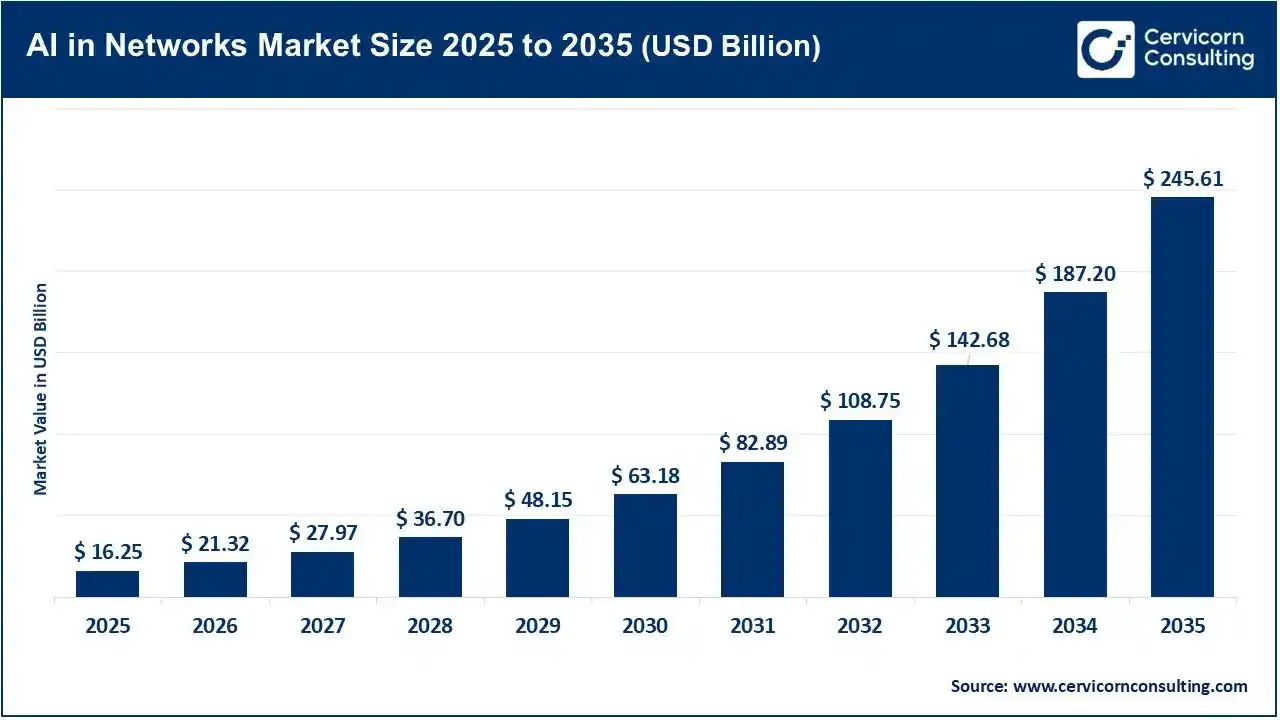
The global AI in networks market size was valued at USD 16.25 billion in 2025 and is projected to exceed USD 245.61 billion by 2035, registering a CAGR of 31.2% over the forecast period 2026 to 2035. The market is growing due to the increasing adoption of AI-driven network automation, rising demand for real-time network optimization, and the need for faster, more reliable, and secure connectivity.
Key Takeaways
- By region, North America dominated the market in 2025 with revenue share of 42%, supported by strong AI investments and advanced network infrastructure.
- By region, Asia Pacific is expected to grow at the fastest CAGR, driven by 5G expansion, digitalization, and rising AI investments.
- By deployment mode, cloud-based deployment held the largest share of 58% in 2025, owing to its scalability and flexibility.
- By deployment mode, on-premise deployment is expected to grow strongly due to increasing security, privacy, and control requirements.
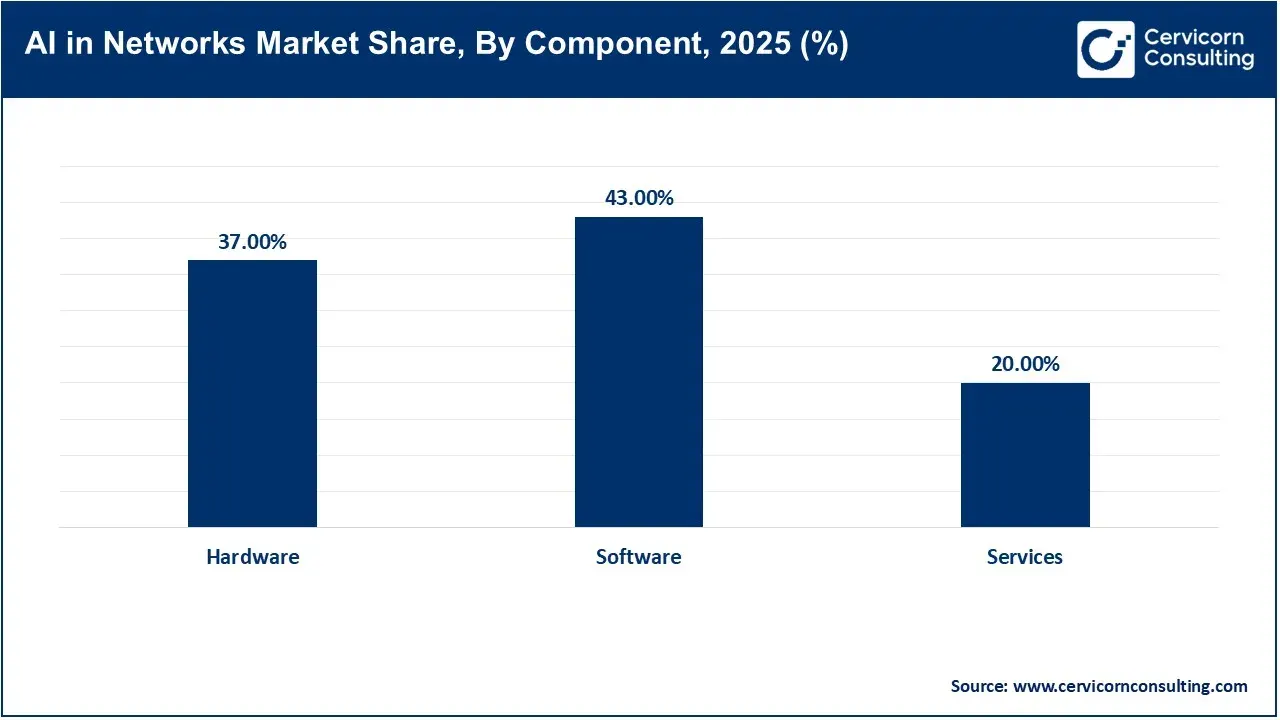
- By component, software held the largest share in 2025 (Revenue Share 43%), driven by growing adoption of AI-based network automation and optimization.
- By component, services are expected to grow strongly due to rising demand for implementation, integration, and technical support.
- By technology, machine learning segment accounted for a revenue share of 28% in 2025, supported by its widespread use in network optimization and predictive analytics.
- By technology, generative AI is expected to grow fastest as AI agents gain adoption in network management and troubleshooting.
- By application, network optimization has generated highest revenue share of 30% in 2025, driven by the need for better network performance and resource management.
- By application, network predictive maintenance is expected to grow strongly as businesses seek to reduce downtime and network failures.
- By end use, telecommunications segment has garnered revenue share of 30% in 2025, supported by 5G expansion and rising network complexity.
- By end use, data centers are expected to grow fastest due to increasing AI workloads and demand for high-speed networking.
Market Overview
The AI in networks market is growing rapidly as businesses and telecom operators adopt AI to automate network management, optimize performance, detect issues, and strengthen security. The rising use of 5G, cloud computing, IoT, edge computing, and AI-driven applications is further increasing demand for intelligent and automated network solutions. AI helps network providers predict failures, manage traffic efficiently, and reduce operational expenses while improving reliability. The growing complexity of modern networks and increasing data volumes are also encouraging organizations to adopt AI-powered networking technologies.
- On 10 February 2026, Cisco announced its new Silicon One G300 networking chip and AI-focused networking systems designed to support large-scale AI workloads in data centers. The technology can speed up AI job completion times by up to 28%, according to the company, demonstrating how networking infrastructure is changing to satisfy the increasing needs of AI applications.
Recent Trends
- Move toward autonomous networks: Networks are using AI to monitor, optimize, and fix problems with less human intervention.
- Growing use of AI agents: AI agents are being used by network operators more and more to manage performance, troubleshoot, and perform routine network tasks.
- AI-powered network security: AI is becoming more crucial for spotting anomalous activity, spotting dangers, and strengthening network security.
- Rising AI data center demand: Faster, higher-capacity networking infrastructure is becoming more and more necessary due to the rapid growth of AI workloads.
- Predictive network management: AI is being used by businesses to control traffic, minimize network outages, and detect possible problems early.
- Shift toward AI-native infrastructure: Network providers are developing networks that can make decisions and react automatically, going beyond simple AI-assisted tools.
Market Dynamics
Driver
The demand for AI-based networking solutions is being driven by the expanding use of 5G, cloud computing, IoT, and connected devices. AI assists network operators in managing traffic, allocating resources, anticipating failures, and enhancing network performance as networks grow more complex and data traffic increases. Businesses are being further motivated to incorporate AI into network management by the need to lower operating costs while preserving dependable connectivity.
- On 15 July 2026, Nokia announced its AI-native RAN platform for 5G and 5G-Advanced networks, highlighting the industry's move toward AI-powered network infrastructure. Nokia said the platform is designed to improve network capacity and economics through software-based AI capabilities, supporting the growing need for intelligent and efficient networks.
Restraint
Significant obstacles to market expansion continue to be high implementation costs and integration difficulties. The total cost of adoption may increase if organizations need to invest in qualified personnel, upgrade their current infrastructure, and implement new AI hardware and software. Implementing AI can also be more difficult due to compatibility issues with legacy systems, data privacy issues, and cybersecurity threats, especially for businesses with extensive and well-established networks.
- HPE's integration of Juniper Networks after its acquisition demonstrates the difficulties of incorporating AI into current networking infrastructure. To integrate Juniper's AI-driven networking technologies with HPE's current portfolio, HPE announced expanded AI-native networking capabilities on December 3, 2025. The advancement shows how big tech firms are spending money on infrastructure integration to create more sophisticated AI-driven networks.
Opportunity
There are many opportunities for market participants due to the growing demand for intelligent and automated network operations. AI can help operators increase productivity and dependability by supporting intelligent traffic management, self-healing networks, predictive maintenance, and real-time resource allocation. For networking firms and telecom providers, the growth of AI data centers, edge computing, and AI-driven connectivity services is also creating new opportunities.
- On 2 June 2026, Cisco introduced Cisco Cloud Control, a platform designed to allow humans and AI agents to manage, monitor, and protect critical IT infrastructure. The company is using an agentic AI approach to automate network and infrastructure operations, demonstrating the growing commercial opportunity for AI-powered network management.
Key Technological Shifts
- From traditional to AI-native networks: To enable networks to learn, adapt, and make decisions in real time, artificial intelligence (AI) is evolving from an external tool to a component of the network's core architecture.
- From automation to autonomous operations: Networks are moving away from rule-based automation and toward AI-driven systems that can recognize issues, make choices, and fix problems with little assistance from humans.
- Rise of agentic networking: Networks are moving away from rule-based automation and toward AI-driven systems that can recognize issues, make choices, and find solutions with little assistance from humans.
- Digital twins for network management: AI and graph-based analytics are being used in conjunction with digital twins to generate virtual network representations that assist operators in anticipating errors, testing modifications, and streamlining processes before implementing them on live systems.
Regulatory Framework
- AI governance, cybersecurity, data protection, and telecom network security are the focal points of the emerging regulatory framework for the AI in networks market. While NIS2 tightens cybersecurity and resilience standards for network and information systems, the EU AI Act in the EU creates a risk-based framework for AI systems. Modernizing connectivity laws and enhancing the security and resilience of digital networks are further goals of the EU's 2026-proposed Digital Networks Act.
- In general, regulations are placing more emphasis on AI transparency, cybersecurity, data protection, risk management, and network resilience. This can increase businesses' compliance requirements while simultaneously promoting the creation of more secure and reliable AI-enabled networks.
Regional Analysis
How Is North America Strengthening Its Leadership in AI-Driven Networking?
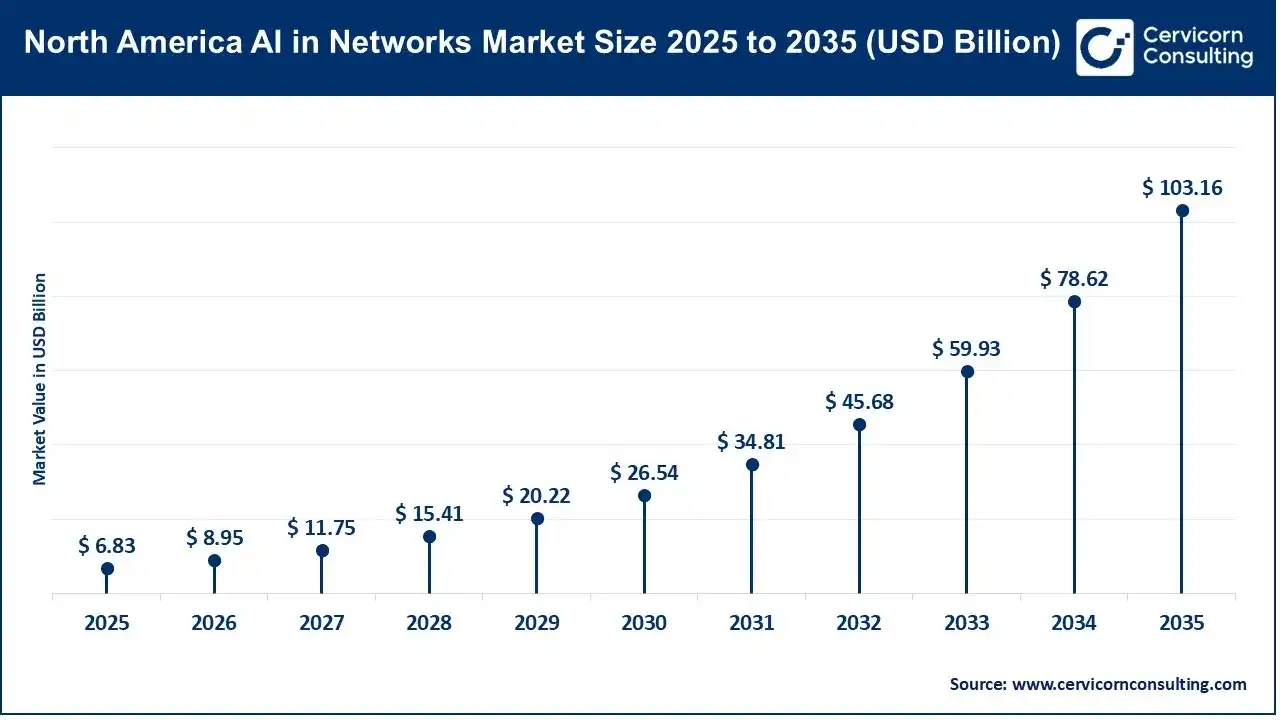
The North America AI in networks market size was valued at USD 6.83 billion in 2025 and is projected to exceed USD 103.16 billion by 2035. North America held the largest revenue share, backed by significant investments in data centers, cloud infrastructure, AI technology, and cutting-edge networking solutions. Major technology, cloud, telecom, and networking companies are also well-represented in the area. Its dominant position is further supported by early adoption of AI-driven infrastructure and ongoing investment in AI workloads.
How Is Asia Pacific Building the Infrastructure for AI-Driven Networks?
The Asia-Pacific AI in networks market size was estimated at USD 4.71 billion in 2025 and is projected to surpass USD 71.23 billion by 2035. Asia Pacific is expected to register strong growth during the forecast period because of the quick rollout of 5G, growing digital infrastructure, increased investments in data centers, and growing uptake of AI technologies. The region's nations are making significant investments in cloud computing, connected technologies, and AI infrastructure. The demand for intelligent networking systems is anticipated to rise further as more businesses adopt digital solutions.
Top 5 Countries in the AI in Networks Market
| Country |
Key Factors Supporting Market Position |
| United States |
Strong AI ecosystem, advanced cloud and data center infrastructure, high enterprise AI adoption, and presence of leading networking and technology companies. |
| China |
Rapid 5G deployment, large-scale digital infrastructure, strong government support for AI, and expanding data center and cloud investments. |
| Japan |
Advanced telecommunications infrastructure, early adoption of AI and automation, and investments in 5G, edge computing, and intelligent networking. |
| South Korea |
Extensive 5G infrastructure, strong semiconductor and telecommunications industries, and growing investments in AI-enabled network technologies. |
| Germany |
Strong industrial base, Industry 4.0 adoption, investments in AI and connected infrastructure, and growing demand for intelligent enterprise networks. |
Segmental Analysis
Deployment Mode Analysis
The cloud-based segment held the largest revenue share in the AI in networks market in 2025, motivated by its adaptability, scalability, and capacity to facilitate AI-powered network management without requiring substantial physical infrastructure. Cloud platforms enable enterprises to more effectively deploy and scale AI capabilities as network requirements evolve. Additionally, they facilitate centralized management and monitoring in dispersed network environments, which increases their uptake by businesses and telecom providers.
AI in Networks Market Share, By Deployment Mode, 2025 (%)
| Deployment Mode |
Revenue Share, 2025 (%) |
| Cloud-Based |
58% |
| On-Premise |
42% |
The on-premises segment is expected to register strong growth during the forecast period as businesses look for more control over system performance, network infrastructure, data security, and privacy. For businesses managing sensitive data and mission-critical tasks, on-premises deployment is especially appropriate. Increasing worries about compliance and data sovereignty are also motivating some companies to keep AI networking capabilities in their own infrastructure.
Component Analysis
The software segment held the largest revenue share in the AI in networks market in 2025, supported by the growing need for cybersecurity, automation, monitoring, network optimization, and predictive management solutions driven by AI. Networks can analyze vast amounts of operational data and make decisions more quickly thanks to software. The segment's position is being further strengthened by the increasing use of AI-driven network management platforms.
The services segment is expected to register strong growth during the forecast period because the deployment of AI-based networking solutions necessitates implementation, integration, consulting, maintenance, and technical support. To integrate AI tools with their current network infrastructure, many businesses also need specialized knowledge. As a result, there is an increasing need for managed and professional services due to the growing complexity of AI-enabled networks.
Technology Analysis
The machine learning segment held the largest revenue share in the AI in networks market in 2025 because of its extensive application in automated decision-making, anomaly detection, traffic analysis, network optimization, and predictive maintenance. Machine learning can help operators adapt to changing conditions by spotting patterns in vast amounts of network data. Strong demand is still supported by its well-established use in enterprise and telecom networks.
AI in Networks Market Share, By Technology, 2025 (%)
| Technology |
Revenue Share, 2025 (%) |
| Machine Learning |
28% |
| Natural Language Processing |
18% |
| Computer Vision |
16% |
| Deep Learning |
26% |
| Others |
12% |
The generative AI segment is expected to register strong growth during the forecast period as network operators investigate AI agents and intelligent tools for operational decision-making, network configuration, and automated troubleshooting more and more. Generative AI can help engineers solve problems faster and streamline interactions with intricate network systems. It is anticipated that the creation of AI-native and autonomous networks will open up new possibilities for this technology.
Application Analysis
The network optimization segment held the largest revenue share in the AI in networks market in 2025, motivated by the need to enhance network performance, effectively manage traffic, and maximize resource utilization. AI is able to continuously assess network conditions and modify resources in response to demand. This aids operators in maintaining constant service quality, lowering congestion, and enhancing connectivity.
AI in Networks Market Share, By Application, 2025 (%)
| Application |
Revenue Share, 2025 (%) |
| Network Optimization |
30% |
| Network Cybersecurity |
25% |
| Network Predictive Maintenance |
19% |
| Network Troubleshooting |
16% |
| Others |
10% |
The network predictive maintenance segment is expected to register strong growth during the forecast period as businesses employ AI more frequently to spot possible problems before they happen. Network operators can take remedial action before disruptions impact users and services thanks to predictive capabilities. The strategy can also lower maintenance costs, increase equipment utilization, and minimize unscheduled downtime.
End Use Analysis
The telecommunications segment held the largest revenue share in the AI in networks market in 2025, supported by the expansion of 5G, the growing complexity of telecom networks, the increase in data traffic, and the growing need for automated network operations. AI is being used by telecom companies to improve customer experiences, detect errors, optimize network resources, and strengthen security. It is anticipated that the segment's demand will be maintained as connected services continue to develop.
AI in Networks Market Share, By End Use, 2025 (%)
| End Use |
Revenue Share, 2025 (%) |
| Telecommunications |
30% |
| BFSI |
12% |
| Healthcare |
9% |
| Government & Defense |
10% |
| Media & Entertainment |
6% |
| Retail & E-Commerce |
8% |
| Data Centers |
20% |
| Others |
5% |
The data centers segment is expected to register strong growth during the forecast period as the need for high-speed, low-latency, intelligent networking infrastructure increases due to the quick growth of AI workloads. Networks that can handle massive volumes of data between computing systems and storage resources are necessary for AI applications. Thus, growing investments in AI-focused data centers are generating substantial opportunities for AI networking technologies.
Recent Developments
- In August 2026, Cisco announced an expanded Secure AI Factory with NVIDIA and Supermicro, adding high-density AI computing systems and Cisco AI networking to support large-scale AI workloads, including training and edge inference.
- In September 2026, HPE raised its financial outlook following strong demand for AI-related servers and networking equipment while expanding its AI infrastructure collaboration with Oracle using HPE Juniper Networking technologies.
- In February 2026, Cisco announced new AgenticOps capabilities across networking, security, and observability to enable more automated and intelligent IT operations.
Top Companies
Segment Covered
By Deployment Mode
By Component
- Hardware
- Software
- Services
By Technology
- Machine Learning
- Natural Language Processing
- Computer Vision
- Deep Learning
- Others
By Application
- Network Optimization
- Network Cybersecurity
- Network Predictive Maintenance
- Network Troubleshooting
- Others
By End Use
- Telecommunications
- BFSI
- Healthcare
- Government & Defense
- Media & Entertainment
- Retail & E-Commerce
- Data Centers
- Others
By Region
- North America
- Europe
- Asia Pacific
- Latin America
- Middle East & Africa