3D Cell Culture Market Size, Growth Outlook 2026 to 2035
The global 3D cell culture market size was valued at USD 1.27 billion in 2025 and is projected to exceed around USD 4.18 billion by 2035, exhibiting a compound annual growth rate (CAGR) of 12.7% over the forecast period from 2026 to 2035.
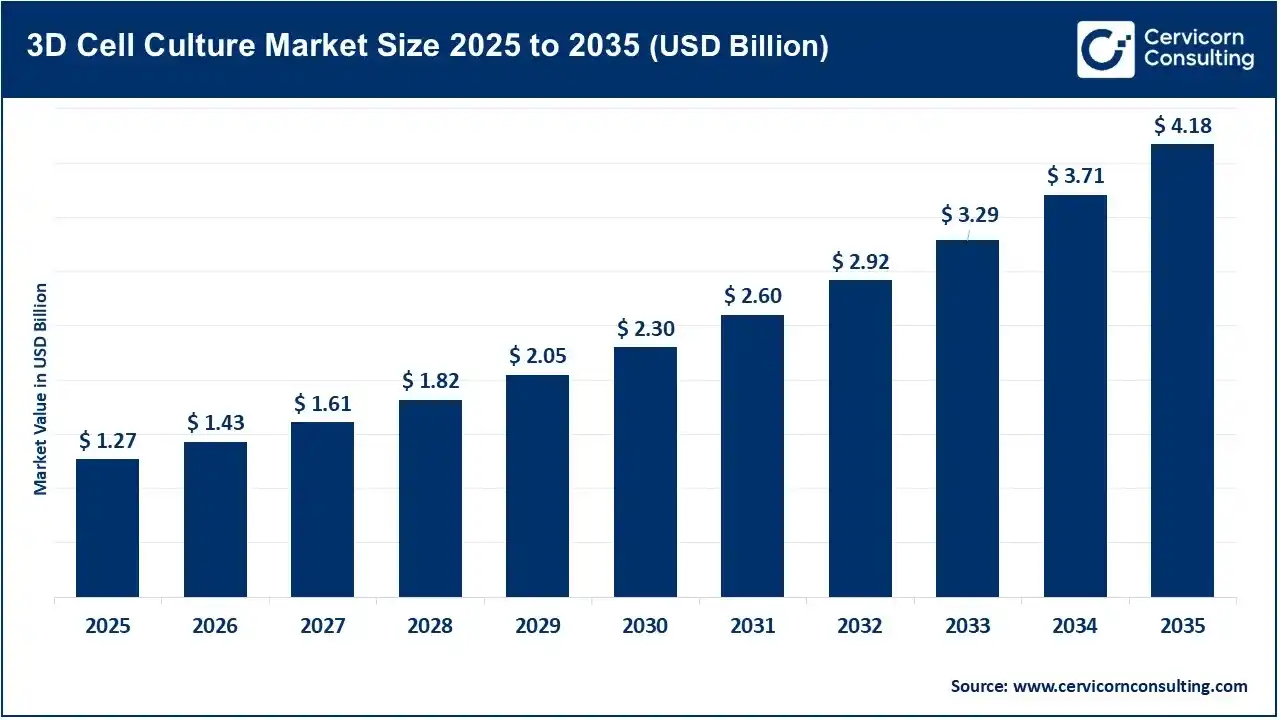
The growing need for more predictive preclinical models is a major driver of the 3D cell culture market because conventional 2D cultures often fail to reproduce tissue architecture, cell–cell interactions, and physiological microenvironments. According to the NIH National Center for Advancing Translational Sciences (NCATS), approximately 90% of drug candidates that show promise in laboratory and animal studies ultimately fail in human clinical trials, highlighting the need for models with better human relevance. 3D spheroids, organoids, and tissue models can better reproduce human tissue structure and therefore support drug efficacy, toxicity, pharmacokinetic, and disease-modeling studies.
Rising adoption of organoids, organ-on-chip systems, and stem-cell-derived 3D models is another important growth factor, particularly in personalized medicine, oncology, regenerative medicine, and drug discovery. A 2024 bibliometric study analyzed 13,143 organoid-related publications from 4,125 institutions across 86 countries, demonstrating the substantial expansion of research activity surrounding organoid technologies. In addition, concerns regarding the cost, ethical considerations, and limited human predictability of animal testing are encouraging development of alternatives; one 2024 review estimates that around 100 million animals are used annually worldwide for scientific testing. Regulatory developments are also supporting advanced in-vitro models: the FDA Modernization Act 2.0 has encouraged the use of alternative preclinical approaches, including higher-complexity 3D models.
Report Highlights
- North America remained the leading regional market, accounting for 46.4% of global revenue in 2025, supported by advanced healthcare infrastructure, pharmaceutical R&D, biotechnology companies, and established research capabilities.
- Scaffold-Based 3D Cell Cultures dominated the product segment with a 48.9% market share, supported by their structural support, established protocols, and extensive use in tissue engineering and biomedical research.
- Cancer & Stem Cell Research represented the largest application segment with a 39.7% market share, supported by increasing cancer research, stem-cell studies, tumor modeling, and demand for physiologically relevant cellular environments.
- Pharmaceutical & Biotechnology Companies dominated the end-user segment with a 46.9% market share, reflecting extensive utilization of 3D cultures in drug discovery, toxicity testing, disease modeling, and translational research.
What is 3D Cell Culture?
3D cell culture is a scientific method where cells are cultivated in a three-dimensional setting, rather than on a flat 2D surface. This approach enables the formation of structures like spheroids, organoids, and tissue-like assemblies that better mimic the architecture, cell–cell and extracellular matrix interactions, and physiological functions of human tissues. These models are increasingly employed in drug discovery, toxicity assessments, disease modeling, cancer studies, regenerative medicine, and personalized therapies, as they offer more relevant biological insights compared to traditional 2D cultures.
3D Cell Culture Market Recent Milestones
| Year |
Organization |
Recent Milestone |
Market Relevance |
| 2024 |
MIMETAS |
Launched OrganoReady Colon Organoid, a ready-to-use adult-stem-cell-derived 3D colon model. |
Supports standardized, scalable organoid adoption for drug discovery and high-throughput testing. |
| 2025 |
Merck KGaA & Promega |
Announced collaboration to develop 3D cell-culture assays with real-time cellular activity monitoring. |
Integrates 3D models with advanced assay technologies for more practical screening workflows. |
| 2025 |
Scientific research community |
Development of a fully vascularized and immunocompetent human skin organoid was reported. |
Expands 3D models toward more physiologically complex tissue and immune-response studies. |
| 2025 |
Drug-discovery research |
Nature Reviews Drug Discovery highlighted growing use of human organoids as 3D platforms for drug discovery, including efficacy and toxicity applications. |
Reinforces the transition toward human-relevant models in pharmaceutical R&D. |
| 2026 |
Fujifilm Cellular Dynamics |
Opened a 175,000-square-foot facility in Madison, Wisconsin, expanding iPSC-based research products and services. |
Increases availability of standardized human-cell inputs used in organoid and complex 3D culture workflows. |
| 2026 |
Auxilium Biotechnologies |
Reported successful 3D bioprinting of structures containing human liver, kidney, and cartilage cells aboard the ISS. |
Demonstrates advances in spatially controlled tissue engineering and expands the technological scope of 3D cell culture. |
3D Cell Culture Market Dynamics
Market Drivers
1. Growing adoption in drug discovery and disease modeling
The ability of 3D cultures to reproduce tissue architecture, cellular heterogeneity, and physiological interactions is increasing their use in pharmaceutical research, toxicity assessment, cancer studies, and precision medicine. Research activity demonstrates this momentum: a global bibliometric study identified 16,158 organoid publications through 2024, with 11,747 papers published between 2019 and 2024, representing 72.7% of the total. Increasing research output is supporting demand for 3D culture platforms, media, scaffolds, organoids, and automated screening technologies.
2. Increasing demand for human-relevant experimental models
Pharmaceutical and biotechnology researchers are increasingly seeking models that can capture human-specific responses more effectively than conventional cell lines. Patient-derived organoids can preserve important characteristics of the original tissue and enable assessment of individual drug responses, creating applications in oncology and personalized medicine. A global analysis of human-organoid research identified 8,591 original publications, with research output increasing by almost 70-fold since 2009, demonstrating rapidly expanding scientific interest and supporting broader commercialization of 3D culture technologies.
Market Restraints
1. High operating costs and specialized requirements
3D cell culture generally requires specialized matrices, growth factors, cell sources, equipment, skilled personnel, and more complex handling procedures than conventional 2D culture. Patient-derived organoids are particularly expensive because of specialized expertise and labor-intensive workflows. A 2025 study also highlighted that basement-membrane matrices face batch-to-batch variability, xenogeneic origin, cost, and complexity, encouraging researchers to investigate lower-cost alternatives such as alginate-based systems and conditioned media.
2. Limited reproducibility and standardization
Variations in extracellular-matrix composition, cell sourcing, culture conditions, and self-organization can produce differences in organoid morphology and biological responses, restricting consistent adoption across laboratories. Recent research identifies reproducibility as a major barrier because even small changes in culture conditions can affect organoid size, structure, and function. Standardization remains particularly important for pharmaceutical screening, where consistent results across batches and laboratories are essential for reliable compound evaluation and regulatory acceptance.
Market Opportunities
1. Expansion of automated and high-throughput 3D culture platforms
Automation, microfluidics, robotics, artificial intelligence, and advanced imaging can transform 3D culture from labor-intensive laboratory procedures into scalable screening platforms. Recent research demonstrates the potential for substantial throughput improvements: one reported droplet-based platform generated 100–1,000 uniform organoid precursors in under 10 minutes, while another 25-mL system produced approximately 25 times more liver organoid precursors than a comparable high-density microwell array. Such advances create opportunities for pharmaceutical screening and industrial-scale organoid production.
2. Growth of personalized medicine and patient-derived models
Patient-derived 3D cultures provide opportunities to evaluate disease biology and individual therapeutic responses using cells originating from specific patients. This is particularly relevant to oncology, where tumor heterogeneity can make conventional models less representative of individual disease. A 2025 study reported that brain-tumor organoids were used to screen five different drugs over a 40-day period, demonstrating the potential of patient-derived models for functional precision medicine and personalized treatment research.
Market Challenges
1. Difficulty reproducing complete human tissue complexity
Current 3D models can reproduce selected structural and functional characteristics of organs but generally remain simplified representations of native tissues. Many organoids lack complete vascular, immune, stromal, and mechanical components, while some remain developmentally immature. These limitations can affect their ability to accurately predict human responses, particularly for complex diseases and therapeutic testing. Consequently, integrating multiple cell types, vascular networks, immune components, and controlled microenvironments remains a major technical challenge for the market.
2. Scalability and regulatory translation
Moving from laboratory-scale experiments to standardized industrial or clinical production remains difficult because conventional workflows involve manual handling, variable biological materials, and limited throughput. The manufacturing challenge becomes substantial when large quantities are required; a typical organoid may contain 10⁴–10⁶ cells, whereas a human solid organ can contain 10–300 billion cells. Developing reproducible manufacturing, quality-control procedures, standardized analytical methods, and regulatory frameworks is therefore essential for broader commercial and clinical adoption.
3D Cell Culture Market Regional Analysis
The 3D cell culture market is segmented by region into North America, Europe, Asia-Pacific, Latin America, and LAMEA. Here is a brief overview of each region:
North America 3D Cell Culture Market: Advanced Biomedical Research, Pharmaceutical R&D, Organoid Adoption, Alternative Testing, and Strong Biotechnology Infrastructure
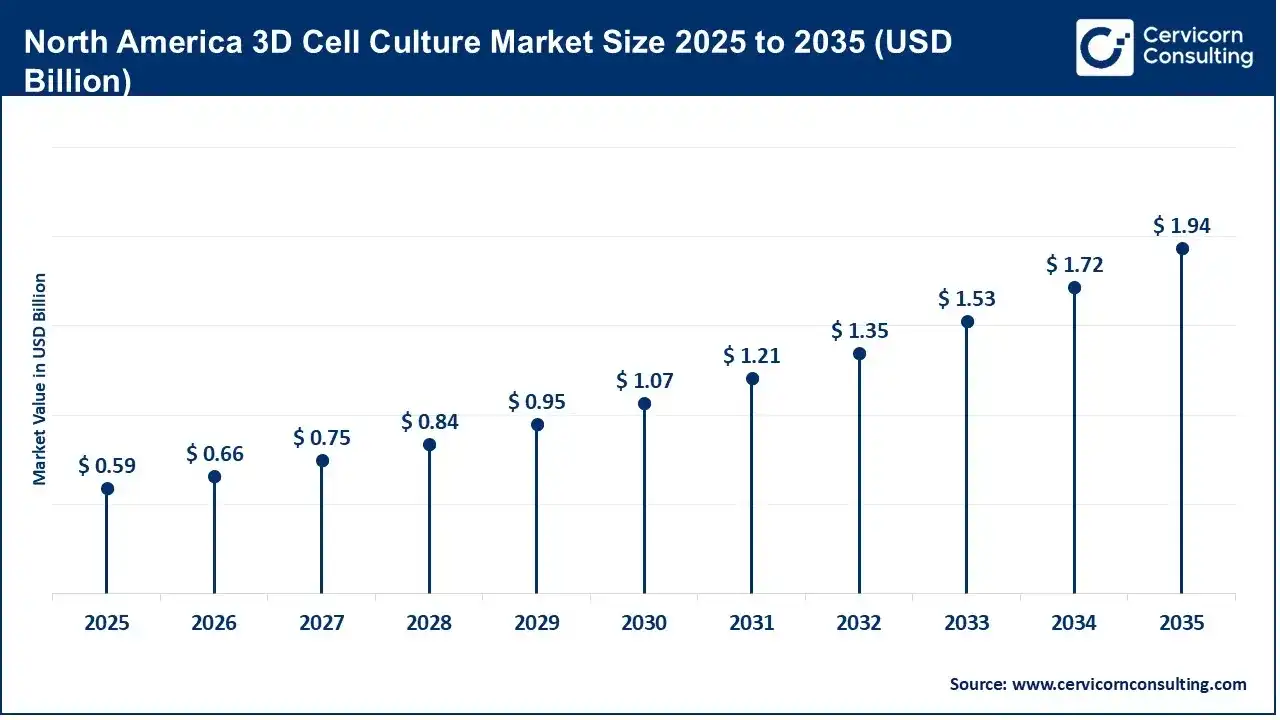
The North America 3D cell culture market size was valued at USD 0.59 billion in 2025 and is expected to hit around USD 1.94 billion by 2035. North America is a leading region, supported by advanced biomedical research infrastructure, strong pharmaceutical and biotechnology activity, extensive academic research, and increasing adoption of organoids and other human-relevant models. The United States dominates regional activity, while Canada contributes through growing academic and biotechnology research. The region also benefits from regulatory momentum toward alternative testing methods. In April 2025, the FDA announced initiatives to incorporate organoids, organ-on-chip systems, and other New Approach Methodologies (NAMs) into drug-safety evaluation, creating additional opportunities for 3D cell culture technologies.
United States: Pharmaceutical R&D, Organoid Research, FDA Support, and Alternative Testing Drive Market Development
- The United States accounted for 43% of publications in a global bibliometric analysis of human-organoid research, demonstrating its strong position in organoid-related scientific activity.
- The FDA's 2025 roadmap specifically promotes human-based laboratory models, including organoids and organ-on-chip systems, as potential alternatives or complements to animal testing.
- In 2026, the FDA reported that more than 90% of drugs considered safe in animal testing fail in humans, reinforcing the need for more predictive human-relevant preclinical approaches.
Canada: Expanding Organoid Research, Academic Collaboration, and Biotechnology Development Support Market Growth
- Canada represented 4% of publications in a global bibliometric analysis of human-organoid research, demonstrating an established research base in organoid and advanced cell-model technologies.
- Canadian universities and biotechnology organizations are increasingly applying organoids and 3D models to cancer research, developmental biology, regenerative medicine, and drug-response studies.
Asia-Pacific (APAC) 3D Cell Culture Market: Expanding Biomedical Research, Pharmaceutical R&D, Organoid Adoption, Regenerative Medicine, and Human-Relevant Testing
The Asia-Pacific 3D cell culture market size was estimated at USD 0.26 billion in 2025 and is forecasted to grow to USD 0.86 billion by 2035. Asia-Pacific is an increasingly important region, supported by expanding biotechnology infrastructure, pharmaceutical R&D, stem-cell research, regenerative medicine, and growing adoption of organoids and microphysiological systems. China, Japan, India, and South Korea represent major research and commercial centers, while Australia and Southeast Asian economies are developing their capabilities. Research activity is accelerating across the region: China accounted for 11% of global organoid research publications, while its publication volume has been increasing at approximately twice the global average, with Japan following China in publication output and South Korea showing particularly strong upward momentum.
China: Expanding Biotechnology Infrastructure, Cancer Research, Organoids, and Regenerative Medicine Drive Market Demand
- China represents the largest country market within Asia-Pacific according to several industry assessments, supported by its expanding biotechnology sector, pharmaceutical manufacturing capabilities, and substantial biomedical research infrastructure.
- Chinese researchers contributed approximately 11% of global organoid research publications, making China the third-largest contributor globally in the referenced literature analysis.
- Rapid expansion of stem-cell research infrastructure and investment in organoids, microfluidics, and bioprinting is increasing demand for advanced 3D culture platforms.
India: Growing Pharmaceutical Industry, Biotechnology Investment, Academic Research, and Alternative Testing Support Market Expansion
- India's pharmaceutical and biotechnology industries are creating increasing demand for 3D models across drug discovery, toxicity testing, cancer research, and regenerative medicine.
- India is developing a dedicated ecosystem for 3D cell culture, organoids, and organ-on-chip technologies, although adoption remains concentrated among leading research institutions and biotechnology organizations.
- Government-backed biotechnology initiatives and growing industry–academia collaboration are supporting infrastructure development and technology commercialization.
Europe 3D Cell Culture Market: Strong Pharmaceutical R&D, Organoid Research, Regenerative Medicine, Alternative Testing, and Advanced Biomedical Infrastructure
The Europe 3D cell culture market size was accounted for USD 0.31 billion in 2025 and is expected to surpass USD 1.01 billion by 2035. Europe is a major region in the market, supported by a strong pharmaceutical industry, advanced academic research, regenerative-medicine programs, and increasing interest in human-relevant alternatives to conventional animal testing. Germany, the United Kingdom, the Netherlands, France, Switzerland, and Italy are important research and innovation centers. The European Research Area (ERA) accounted for 31% of global organoid research publications, making it the second-largest regional contributor, while Germany, the Netherlands, and the UK recorded the highest publication volumes within Europe.
Germany: Pharmaceutical R&D, Organoid Research, Biotechnology, and Regenerative Medicine Drive Market Demand
- Germany accounted for approximately 8.4% of global organoid publications, representing one of the largest national contributions to organoid research worldwide.
- The country's pharmaceutical industry invested EUR 10.7 billion in R&D in 2024, supporting demand for advanced preclinical models and drug-development technologies.
- Germany has more than 650 pharmaceutical companies, creating a broad potential customer base for 3D cell culture products, organoids, scaffolds, and analytical platforms.
United Kingdom: Strong Biomedical Research, Pharmaceutical Innovation, Organoids, and Translational Medicine Support Adoption
- The UK contributed approximately 7.8% of global organoid publications, placing it among the world's leading national research contributors.
- UK research institutions have significant expertise in organoids, stem-cell biology, cancer research, and regenerative medicine, supporting demand for advanced 3D culture technologies.
- The country is home to approximately 340 life-sciences R&D companies, supporting collaboration between pharmaceutical companies, biotechnology firms, universities, and research institutes.
3D Cell Culture Market Share, By Region, 2025 (%)
| Region |
Revenue Share, 2025 (%) |
| North America |
46.4% |
| Europe |
24.1% |
| Asia-Pacific |
20.6% |
| LAMEA |
8.9% |
LAMEA 3D Cell Culture Market: Emerging Biomedical Research, Cancer Studies, Biotechnology Investment, Regenerative Medicine, and Personalized Healthcare Support Market Development
The LAMEA 3D cell culture market was valued at USD 0.11 billion in 2025 and is anticipated to reach around USD 0.37 billion by 2035. LAMEA represents an emerging market, supported by increasing biomedical research, pharmaceutical development, cancer research, regenerative medicine, and investments in biotechnology infrastructure. Brazil, Argentina, Saudi Arabia, the UAE, and South Africa are important markets, while adoption remains concentrated in major universities, hospitals, biotechnology companies, and research centers. The region has significant long-term potential because 3D models can support locally relevant disease research and precision medicine. However, limited research funding, specialized infrastructure, skilled personnel, and access to advanced equipment continue to constrain adoption, particularly across parts of Africa.
Brazil: Expanding Biomedical Research, Pharmaceutical Development, Cancer Studies, and Biotechnology Infrastructure Drive Adoption
- Brazil represents an important Latin American market, with 3D cell culture applications concentrated in drug development and cancer research.
- Growing research into organoids, spheroids, tissue engineering, and stem-cell technologies is supporting demand for advanced cell-culture platforms.
- Brazil's established university and biomedical research network provides opportunities for collaborations between academic institutions, pharmaceutical companies, and biotechnology organizations.
Saudi Arabia: Government-Led Biotechnology Investment, Regenerative Medicine, and Personalized Healthcare Strengthen Market Development
- Saudi Arabia is emerging as an important Middle Eastern market for advanced cell and organoid technologies, supported by investments in biotechnology and healthcare research.
- Research and industry assessments identify Saudi Arabia as a leading country within the Middle East and Africa organoid ecosystem, with government initiatives and research collaborations supporting adoption.
- Regenerative medicine and organoid research are being explored for chronic diseases, cancer, metabolic disorders, and cellular therapies.
3D Cell Culture Market Segmental Analysis
The 3D cell culture market is segmented into product, application, end user, and geography.
Product Analysis
Scaffold-based 3D cell cultures dominate due to their ability to provide structural support and extracellular-matrix-like environments that promote cell adhesion, proliferation, differentiation, and organization. Hydrogels and solid scaffolds are widely used in tissue engineering, cancer research, stem-cell studies, and drug testing. Their established protocols, broad compatibility with different cell types, and relatively mature commercialization have supported widespread laboratory adoption. Increasing development of biomimetic scaffolds with tunable mechanical and biochemical properties is further strengthening demand across research and pharmaceutical applications.
3D Cell Culture Market Share, By Product, 2025 (%)
| Product |
Revenue Share, 2025 (%) |
| Scaffold-Based 3D Cell Cultures |
48.9% |
| Scaffold-Free 3D Cell Cultures |
28.6% |
| Microfluidics-Based 3D Cell Cultures |
13.7% |
| Magnetic & Bioprinted 3D Cell Cultures |
8.8% |
Scaffold-free 3D cell cultures are experiencing rapid adoption because they allow cells to self-aggregate into spheroids and organoids without introducing an external structural material that could alter cellular behavior. These systems are increasingly attractive for cancer research, drug screening, toxicity testing, and personalized medicine. Advances in low-attachment plates, hanging-drop methods, and automated spheroid formation are improving scalability and reproducibility. Their ability to generate physiologically relevant cellular structures while simplifying downstream analysis is supporting broader integration into high-throughput pharmaceutical research workflows.
Application Analysis
Cancer and stem cell research represents the leading application because 3D models can reproduce important characteristics of tumor microenvironments and stem-cell niches that are difficult to replicate in conventional monolayer cultures. Tumor spheroids and organoids are increasingly used to investigate tumor growth, invasion, cellular heterogeneity, and therapeutic responses. Stem-cell-derived 3D models are also supporting developmental biology and disease research. The growing global cancer burden further reinforces demand; the World Health Organization estimates that cancer caused nearly 10 million deaths in 2022, sustaining extensive research activity.
3D Cell Culture Market, By Application, 2025 (%)
| Application |
Revenue Share, 2025 (%) |
| Cancer & Stem Cell Research |
39.7% |
| Drug Discovery & Toxicology Testing |
30.8% |
| Tissue Engineering & Regenerative Medicine |
24.1% |
| Others |
5.4% |
Drug discovery and toxicology testing is among the fastest-expanding applications as pharmaceutical companies increasingly seek human-relevant models for evaluating drug efficacy and safety. 3D cultures can capture cellular interactions, drug penetration, metabolism, and toxicity responses more effectively than many traditional 2D systems. Regulatory momentum is also encouraging alternative testing approaches. In the US, the FDA Modernization Act 2.0, enacted in 2022, removed the statutory requirement that new drugs be tested on animals before human trials, supporting continued development of advanced non-animal methods including organoids and other human-cell-based models.
End User Analysis
Pharmaceutical and biotechnology companies represent the dominant end-user group because they use 3D cell cultures across drug discovery, target validation, toxicity assessment, disease modeling, and translational research. These companies increasingly integrate organoids, spheroids, and other complex cellular models into preclinical workflows to obtain more biologically relevant information before advancing candidates. The expanding pharmaceutical R&D pipeline supports this demand; the FDA's Center for Drug Evaluation and Research approved 50 novel drugs in 2024, illustrating the continuing scale of pharmaceutical development activity requiring sophisticated preclinical testing approaches.
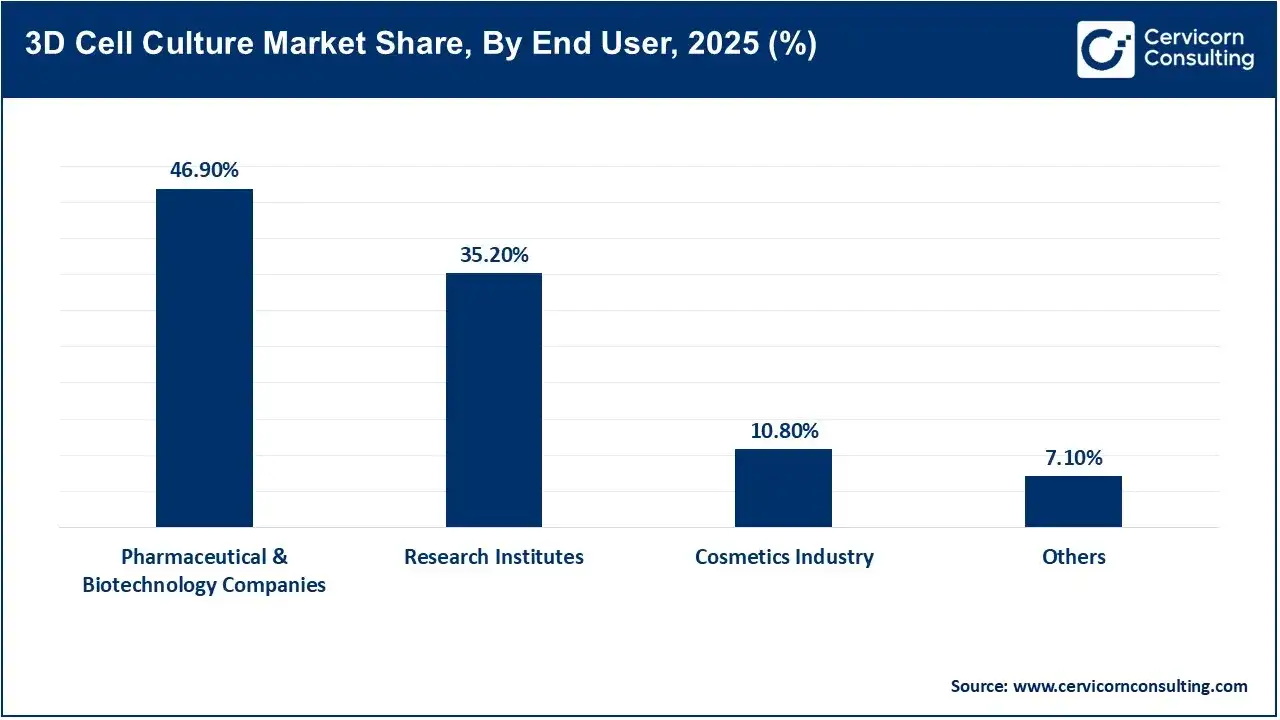
Research institutes are expected to experience strong growth as academic laboratories increasingly adopt organoids, spheroids, bioprinting, microfluidics, and advanced biomaterials for disease modeling and fundamental biological research. Government grants and collaborations with pharmaceutical companies are helping researchers establish sophisticated 3D culture capabilities. The expansion of scientific activity is evident in publication trends: a 2024 bibliometric analysis identified 8,591 original human-organoid research publications, with research output increasing dramatically over the period analyzed. This expanding research base is creating demand for specialized culture media, scaffolds, instruments, and analytical technologies.
3D Cell Culture Market Top Companies
Market Segmentation
By Product
- Scaffold-Based 3D Cell Cultures
- Hydrogels
- Solid Scaffolds
- Scaffold-Free 3D Cell Cultures
- Low-Attachment Plates
- Microfluidics
- Bioprinted
- Microfluidics-Based 3D Cell Cultures
- Magnetic & Bioprinted 3D Cell Cultures
By Application
- Cancer & Stem Cell Research
- Drug Discovery & Toxicology Testing
- Tissue Engineering & Regenerative Medicine
- Others
By End User
- Pharmaceutical & Biotechnology Companies
- Research Institutes
- Cosmetics Industry
- Others
By Geography
- North America
- Europe
- Asia-Pacific
- LAMEA