x86 PC CPU Market Size, Growth, Forecast 2026 To 2035
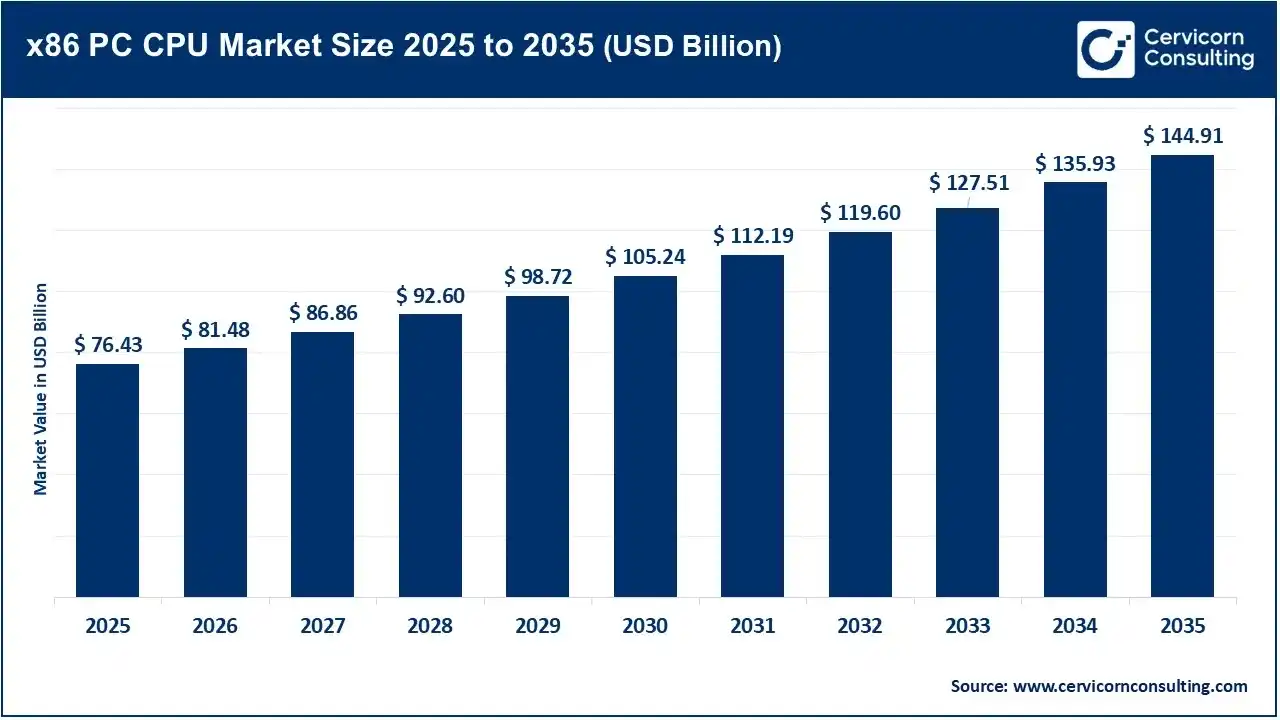
The global x86 PC CPU market size reached USD 76.43 billion in 2025 and is expected to reach around USD 144.91 billion by 2035, exhibiting a compound annual growth rate (CAGR) of 6.6% over the forecast period 2026 to 2035. The x86 PC CPU market is driven by the replacement of aging PCs, Windows 11 migration, AI-enabled computing, gaming demand, and rising requirements for higher processing performance.
The Windows 10 end-of-support cycle has accelerated enterprise and consumer hardware refreshes, contributing to a 9.1% increase in worldwide PC shipments during 2025, exceeding 270 million units. AI PCs are becoming an increasingly important catalyst, with Gartner estimating 77.8 million AI PCs shipped in 2025, representing 31% of total PC shipments, compared with 15.6% in 2024. The integration of NPUs alongside CPUs is encouraging upgrades for local AI inference, productivity applications, content creation, and enhanced security.
Gaming, professional workloads, hybrid work, and demand for energy-efficient high-performance laptops are further supporting x86 CPU adoption, particularly across premium and business devices. Competition between Intel and AMD is also encouraging faster product innovation, with manufacturers increasing core counts, improving integrated graphics, and introducing dedicated AI acceleration capabilities. In Q2 2026, AMD accounted for 30.3% of client x86 CPU shipments, including 34.9% of desktop CPUs and 28.9% of mobile CPUs, demonstrating intensifying competition in the PC processor market. Meanwhile, Gartner expects AI PCs to reach 54.7% of worldwide PC shipments in 2026, reinforcing the transition toward processors capable of handling AI workloads locally.
Report Highlights
- Asia-Pacific represents the largest regional opportunity with an estimated 36.8% market share, supported by large PC user populations, expanding enterprise digitization, electronics manufacturing ecosystems, and accelerating AI-PC adoption.
- Mobile/Laptop CPUs dominate the processor-type segment with an estimated 68.4% market share, supported by strong demand for portable, energy-efficient computing devices.
- Mid-Range CPUs lead the performance-tier segment with approximately 43.5% share, offering the strongest balance of affordability, performance, power efficiency, and mainstream usability.
- 5–8 Core processors dominate by core count, accounting for an estimated 51.7% market share, reflecting their suitability for everyday productivity, multitasking, gaming, and commercial applications.
- Consumer Computing dominates application demand with approximately 42.8% share, supported by widespread PC usage for productivity, education, entertainment, communication, and personal computing.
What is an x86 PC CPU?
An x86 PC CPU is a central processing unit designed for personal computers that uses the x86 instruction-set architecture, historically developed by Intel and widely adopted by Intel and AMD. These processors execute operating-system and application instructions and power desktops, laptops, workstations, gaming PCs, and other Windows-based computers. Modern x86 CPUs increasingly integrate multiple performance and efficiency cores, graphics capabilities, and dedicated AI acceleration such as NPUs, supporting demanding workloads including gaming, content creation, productivity, and on-device AI.
Recent Milestones
| Year |
Market |
Recent Milestone |
| Oct. 2024 |
Intel & AMD |
Intel and AMD launched the x86 Ecosystem Advisory Group to strengthen the x86 ecosystem and coordinate architectural development. |
| 2025 |
AMD |
AMD's x86 client CPU share reached 29.2% in Q4 2025, its highest level at that time, gaining 4.6 percentage points year-over-year. |
| 2025 |
Intel |
Intel delivered its first Core Ultra Series 3 processors using its advanced 18A manufacturing process, targeting consumer and enterprise notebooks. |
| Mar. 2026 |
Intel |
Intel introduced Core Ultra 200S Plus desktop processors, adding more cores and up to a 900 MHz die-to-die frequency increase over previous models. |
| Q1 2026 |
AMD |
AMD's x86 client CPU unit share increased to 29.6%, compared with 24.1% in Q1 2025. |
| Q2 2026 |
AMD |
AMD reached 34.9% of desktop x86 CPU shipments and 28.9% of mobile CPU shipments, highlighting its growing competitive position. |
| Q2 2026 |
Market |
Total x86 and Arm CPU shipments increased by more than 10% sequentially, although desktop CPU shipments faced significant pressure from elevated component costs. |
X86 PC CPU Market Dynamics
Market Drivers
1. Growing adoption of AI-enabled PCs
The integration of NPUs and AI acceleration into x86 processors is creating a major upgrade cycle as users increasingly demand local AI capabilities. Counterpoint projects AI-advanced PCs to represent approximately 59% of global PC shipments in 2026, compared with around 39% in 2025. Local AI processing also offers advantages in latency, privacy, and reduced dependence on cloud computing, encouraging enterprises and consumers to adopt newer x86 processors with dedicated AI acceleration capabilities.
2. Expansion of notebook and premium PC demand
Rising requirements for productivity, gaming, content creation, and hybrid work are increasing demand for higher-performance x86 processors, particularly in notebooks. India's PC market illustrates this trend, with notebook shipments increasing 44.8% year-over-year to 3.5 million units in Q1 2026, supported by consumer demand and education procurement. Premium notebook shipments had also increased 49% in Q1 2025, indicating stronger consumer and commercial preference for higher-performance computing devices.
Market Restraints
1. Increasing component and system costs
Higher memory and GPU prices are making complete PC upgrades more expensive, discouraging consumers from purchasing new systems even when CPU performance improves. AI infrastructure is absorbing substantial semiconductor and memory capacity, contributing to supply constraints for consumer components. In Q2 2026, global desktop CPU shipments declined by more than 20% year-over-year, demonstrating how elevated system costs can directly weaken demand for desktop processors and gaming PCs.
2. Competition from Arm-based processors
x86 CPU vendors face increasing competitive pressure from Arm-based processors that emphasize power efficiency, battery life, and integrated computing capabilities. Arm reached a 15.3% share of the client CPU market in Q2 2026, its highest level reported, driven by growing adoption across PCs and notebooks. Increasing software compatibility and OEM support could gradually reduce x86's dominance, particularly in thin-and-light laptops where energy efficiency and battery endurance are major purchasing considerations.
Market Opportunities
1. Local AI and enterprise computing
The transition toward locally processed AI workloads creates significant opportunities for x86 CPU manufacturers to differentiate through stronger NPUs, CPU-GPU-NPU integration, and optimized AI software ecosystems. Gartner research indicates that the proportion of AI-enabled business PCs could reach 60% by 2027, up from 20% in 2024. Enterprise applications involving analytics, collaboration, cybersecurity, and content generation can therefore stimulate replacement demand for processors capable of efficiently executing AI workloads on-device.
2. Emerging-market PC penetration
Developing markets provide opportunities as education, digital services, remote work, and improving broadband access increase PC adoption beyond established markets. India's PC market grew 31.9% year-over-year in Q1 2026, reaching 4.4 million units, while notebook shipments expanded 45%. Government-led education procurement and demand from tier-two and tier-three cities are creating additional opportunities for affordable x86 notebooks and entry-to-mid-range processors, particularly where consumers prioritize performance, durability, and value.
Market Challenges
1. Intense competition between major CPU vendors
Competition between Intel and AMD is forcing continuous investment in process technology, architecture, AI acceleration, energy efficiency, and pricing. AMD's x86 client share reached 30.7% in Q2 2026, demonstrating the shifting competitive balance and increasing pressure on incumbent vendors. At the same time, manufacturers must maintain strong performance improvements while controlling processor costs, platform expenses, and development investments, making product differentiation increasingly difficult across mainstream PC segments.
2. Supply-chain constraints from AI infrastructure
Rapid expansion of AI infrastructure is competing with consumer electronics for advanced semiconductor manufacturing, memory, and other critical components. This creates challenges for x86 PC CPU manufacturers and OEMs by increasing input costs and complicating inventory planning. The impact is already visible in desktop computing, where Q2 2026 desktop CPU shipments fell more than 20% year-over-year, with elevated memory prices and GPU shortages contributing to weaker demand for complete desktop systems.
Regional Analysis
The x86 PC CPU market is segmented by region into North America, Europe, Asia-Pacific, Latin America, and LAMEA. Here is a brief overview of each region:
Asia-Pacific (APAC) X86 PC CPU Market: Driven by Rapid PC Adoption, Enterprise Digitization, Education Deployments, AI PC Demand, and Expanding Consumer Computing
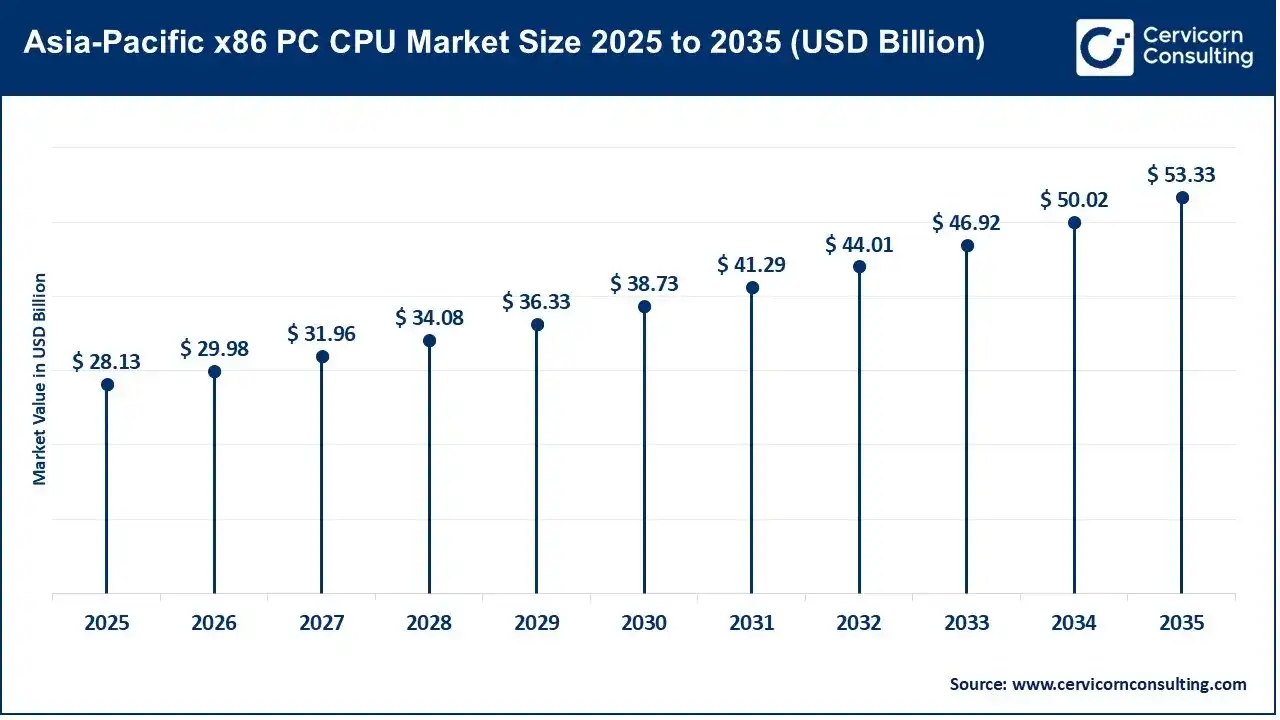
Asia-Pacific is a major and increasingly dynamic region, supported by expanding PC adoption, enterprise digitalization, large-scale education deployments, rising disposable incomes, and growing demand for AI-enabled computing. China, India, Japan, South Korea, and Southeast Asian economies represent important demand centers, while the region also benefits from its extensive electronics manufacturing and PC supply-chain ecosystem. The broader Asia-Pacific traditional PC market reached 106.6 million units in 2025, increasing 11.6% year over year, with commercial PC shipments growing particularly strongly. However, component shortages and higher memory costs are creating near-term pressure on PC procurement and processor demand.
China: Large PC User Base, Enterprise Procurement, Domestic Technology Development, and AI Computing Drive Market Demand
- China's traditional PC market reached 42.1 million units in 2025, representing 6% year-over-year growth, supported by commercial demand and consumer purchases.
- Desktop shipments, including desktop workstations, increased 35% year over year in Q4 2025, reaching approximately 4.0 million units, reflecting strong enterprise and government procurement.
- China's expanding AI ecosystem and growing investment in domestic semiconductor capabilities are creating opportunities for advanced x86 processors designed for AI-assisted productivity, professional computing, and enterprise workloads.
India: Rapid PC Adoption, Enterprise Digitalization, Education Procurement, and AI Notebook Demand Support Market Expansion
- India's PC market reached a record 15.9 million units in 2025, increasing 10.2% year over year, demonstrating strong underlying demand for notebooks, desktops, and workstations.
- In Q1 2026, India's PC shipments increased 31.1% year over year to four million units, while notebook shipments grew 55.4%, strengthening demand for mobile x86 processors.
Japan: Enterprise Replacement Cycles, Education Demand, and Premium Computing Support x86 CPU Adoption
- Japan remains an important mature PC market where replacement of aging systems continues to support demand for newer x86 processors, particularly in commercial and professional environments.
- Large-scale education deployments have contributed to PC demand across Japan, alongside enterprise migration toward newer operating systems and hardware platforms.
North America X86 PC CPU Market: Driven by Enterprise PC Refresh Cycles, AI PC Adoption, Gaming Demand, and Advanced Computing Requirements
North America represents a leading region, owing to its strong technology ecosystem, high PC penetration, established enterprise computing infrastructure, and presence of major processor and PC manufacturers. The region benefits from continuous corporate hardware replacement, growing adoption of AI-enabled PCs, expanding gaming and content-creation communities, and strong demand for premium computing devices. Enterprises are increasingly upgrading hardware to support AI applications, cybersecurity, data-intensive workloads, and modern productivity platforms. Meanwhile, consumers are showing greater interest in high-performance laptops and desktops capable of handling gaming, creative applications, and on-device AI. Strong semiconductor research capabilities, extensive distribution networks, and early adoption of emerging computing technologies continue to reinforce North America's importance in the global x86 PC CPU market.
United States: Enterprise PC Refresh, AI-Enabled Computing, Gaming Ecosystem, and High-Performance Device Demand Drive Market Growth
- The U.S. accounted for approximately 70% of North American PC shipments, making it the region’s primary demand center for x86 processors.
- AI-capable PCs are expected to represent a rapidly increasing proportion of commercial PC deployments as enterprises upgrade hardware for local AI workloads.
Canada: Enterprise Digitization, AI Adoption, Gaming Demand, and Expanding Advanced Computing Infrastructure Support Market Expansion
- Canada has more than 90% household internet access, supporting widespread adoption of connected PCs, notebooks, and digitally enabled computing devices.
- The Canadian federal government has committed more than CAD 2 billion through its Canadian Sovereign AI Compute Strategy to strengthen domestic AI computing capacity, indirectly supporting demand for advanced processors and computing infrastructure.
Europe X86 PC CPU Market: Driven by Windows 11 Replacement Cycles, Enterprise Digitalization, AI PC Adoption, Premium Computing Demand, and Sustainability Priorities
Europe represents a mature and technologically advanced market, supported by established enterprise IT infrastructure, high PC penetration, strong commercial computing demand, and widespread adoption of Windows-based systems. The region benefited from the Windows 10 end-of-support cycle, which encouraged businesses and consumers to replace incompatible or aging devices. In Q2 2025, the broader EMEA PC market increased 5.3% year over year, reflecting improving replacement demand and stronger seasonal activity. AI-enabled PCs are also gaining traction as European businesses increasingly seek on-device AI capabilities, enhanced cybersecurity, productivity improvements, and longer device lifecycles.
Germany: Strong Enterprise Base, AI PC Adoption, and Industrial Digitalization Support x86 CPU Demand
- Germany is one of Europe's largest PC markets, supported by its extensive industrial, automotive, financial, healthcare, and professional-services sectors that require reliable commercial computing infrastructure.
- Demand for AI-enabled notebooks is increasing, with Germany consistently ranking among the strongest European markets for AI PC distribution and adoption.
United Kingdom: Enterprise Upgrades, AI Computing, Gaming, and Refurbishment Trends Drive Market Development
- The UK has a highly developed business computing ecosystem, with financial services, professional services, government, education, and technology companies generating consistent demand for commercial PCs and notebooks.
- The country's refurbished PC market is expanding rapidly; refurbished PC unit sales through distribution across Europe's five largest markets increased 7% year over year in Q4 2025, while UK volumes approximately doubled.
X86 PC CPU Market Share, By Region, 2025 (%)
| Region |
Revenue Share, 2025 (%) |
| Asia-Pacific |
36.8% |
| North America |
31.4% |
| Europe |
20.2% |
| Latin America |
11.6% |
LAMEA (Latin America, Middle East & Africa) X86 PC CPU Market: Driven by Digital Transformation, Government Technology Programs, Expanding PC Adoption, AI Infrastructure Development, and Enterprise Modernization
LAMEA represents an emerging opportunity, supported by increasing digitalization, government-led technology initiatives, expanding enterprise IT infrastructure, education computerization, and rising consumer demand for notebooks and desktops. The region remains comparatively underpenetrated, creating substantial headroom for PC adoption as businesses and households increasingly require computing devices for productivity, education, e-commerce, financial services, and digital communications. IDC data indicates that MEA PC shipments increased from 12.2 million units in 2020 to 13.7 million units in 2024, while Latin America's PC shipments per 1,000 people were substantially higher than MEA, highlighting significant differences in regional maturity. AI development, smart-city projects, and enterprise modernization are also creating opportunities for newer x86 processors with AI acceleration capabilities.
Latin America: Expanding Digitalization, Enterprise Modernization, Education Demand, and Consumer PC Adoption Support Market Growth
- Brazil and Mexico remain the principal PC markets in Latin America, supported by large consumer populations, expanding enterprise IT spending, education requirements, and growing digital services adoption.
- Latin America recorded approximately 30.3 notebook shipments per 1,000 people, substantially above the MEA level, indicating comparatively stronger PC penetration and established demand for computing devices.
Middle East: Government Digital Transformation, AI Investment, Smart Cities, and Premium Computing Drive Demand
- The United Arab Emirates and Saudi Arabia are important growth markets as government digital-transformation programs, smart-city initiatives, and enterprise technology investments increase demand for modern computing infrastructure.
- The UAE, Saudi Arabia, and Israel are among the largest desktop PC consumers in the Middle East, while the UAE also functions as a major regional technology-import and distribution hub.
Segmental Analysis
The x86 PC CPU market is segmented into processor type, performance tier, core count, application, and geography.
Processor Type Analysis
Mobile and laptop CPUs dominate the processor-type segment because notebooks have become the preferred computing platform for mobility, remote work, education, entertainment, and professional productivity. OEMs increasingly prioritize thin, lightweight, energy-efficient systems with strong performance and integrated graphics, supporting broader adoption of mobile x86 processors. Improvements in battery efficiency, thermal management, connectivity, and AI acceleration are further strengthening laptop platforms. The established enterprise notebook ecosystem and frequent corporate device refreshes also provide sustained demand for mobile processors.
X86 PC CPU Market Share, By Processor Type, 2025 (%)
| Processor Type |
Revenue Share, 2025 (%) |
| Desktop CPUs |
31.6% |
| Mobile/Laptop CPUs |
68.4% |
Mobile and laptop CPUs are also expected to remain the fastest-growing processor category as consumers and organizations increasingly replace traditional desktops with portable computing devices. Demand is particularly strong for premium notebooks, gaming laptops, AI-enabled PCs, and business systems requiring longer battery life and responsive multitasking. Manufacturers are focusing on heterogeneous architectures, integrated graphics, and dedicated AI acceleration to differentiate products. Increasing availability of high-performance mobile processors across mainstream price categories is further expanding the addressable customer base.
Performance Tier Analysis
Mid-range processors dominate because they offer the strongest balance between price, performance, power consumption, and compatibility. They adequately support office productivity, web applications, multimedia, multitasking, casual gaming, and everyday content creation without the premium cost associated with enthusiast hardware. OEMs also favor this tier because it enables competitive system pricing while maintaining attractive performance specifications. The broad applicability of mid-range CPUs across consumer notebooks, mainstream desktops, commercial PCs, and educational systems makes this category particularly resilient across different user groups.
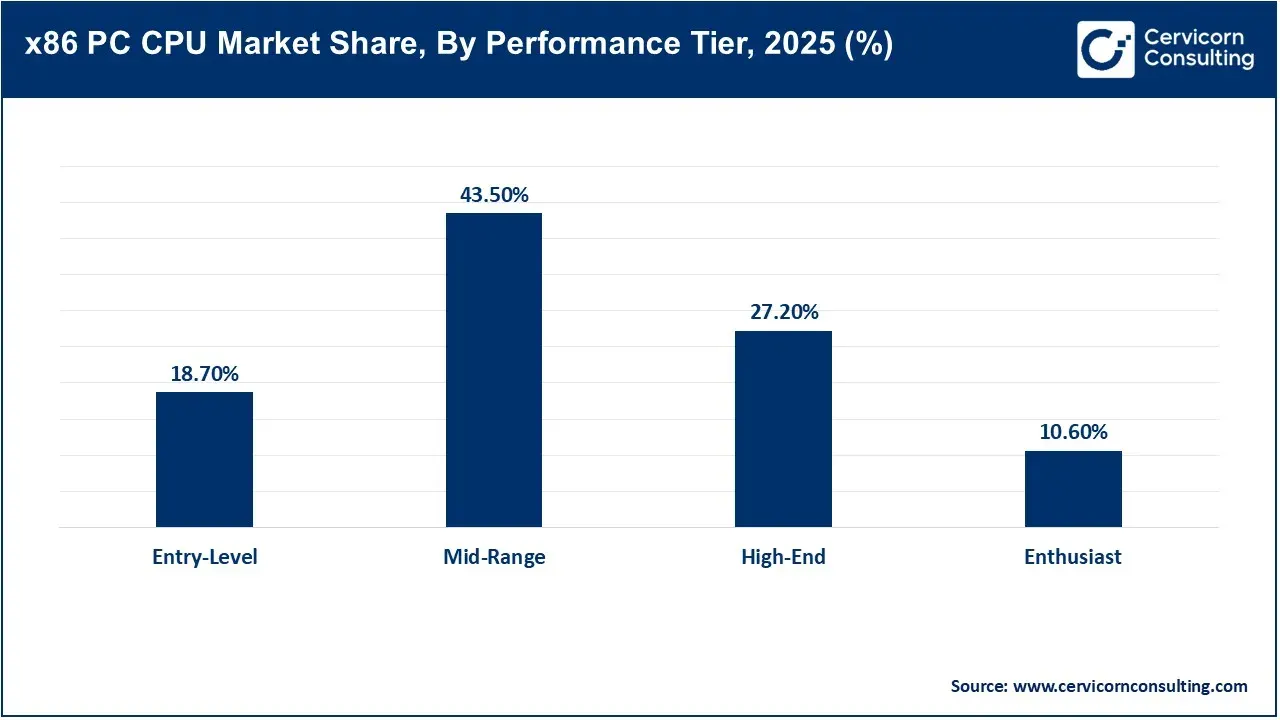
High-end processors are experiencing the strongest growth as users increasingly demand greater computing performance for gaming, content creation, software development, AI-assisted applications, and professional workloads. Modern applications are becoming more computationally intensive, encouraging customers to prioritize additional processing capacity and advanced platform capabilities. High-end CPUs also benefit from premium gaming desktops and creator-oriented laptops where users are more willing to pay for performance improvements. Continued development of higher-performance architectures, advanced caching technologies, and integrated AI capabilities is strengthening demand within this segment.
Core Count Analysis
The 5–8 core segment dominates because it provides an effective performance-to-cost balance for the majority of mainstream computing workloads. These processors can efficiently handle multitasking, productivity software, web browsing, streaming, moderate gaming, and professional applications while maintaining manageable power consumption. OEMs frequently use this configuration in mainstream desktops and notebooks because it supports competitive system pricing without sacrificing responsiveness. The segment also benefits from broad software compatibility and sufficient processing capacity for typical consumers, businesses, students, and home users.
X86 PC CPU Market, By Core Count, 2025 (%)
| Core Count |
Revenue Share, 2025 (%) |
| Up to 4 Cores |
14.8% |
| 5–8 Cores |
51.7% |
| 9–16 Cores |
27.4% |
| Above 16 Cores |
6.1% |
The 9–16 core category is growing rapidly as increasingly demanding applications require greater parallel processing capability. Gaming, video production, 3D rendering, software development, engineering applications, data analysis, and AI-enabled workloads are encouraging users to adopt processors with additional cores. Improvements in operating-system scheduling and application optimization are helping users take greater advantage of multi-core architectures. Enthusiast desktops and high-performance creator systems are particularly important demand sources, while the increasing availability of multi-core processors in premium laptops is gradually broadening the segment's market presence.
Application Analysis
Consumer computing remains the dominant application because x86 processors continue to power a broad range of everyday activities, including productivity, browsing, entertainment, communication, education, and personal content creation. The enormous installed base of desktops and notebooks provides manufacturers with a substantial replacement opportunity as older devices become less capable of supporting modern applications. Consumers are also increasingly seeking systems that combine general-purpose performance with gaming, multimedia, and AI functionality, allowing mainstream x86 processors to address multiple workloads within a single device.
X86 PC CPU Market, By Application, 2025 (%)
| Application |
Revenue Share, 2025 (%) |
| Gaming |
25.6% |
| Content Creation |
12.4% |
| Business & Enterprise |
14.1% |
| Workstations |
5.1% |
Gaming is the fastest-growing application segment as increasingly sophisticated games require greater CPU performance, improved multitasking, and stronger interaction with graphics hardware. Competitive gaming, game streaming, content creation, virtual reality, and high-refresh-rate displays are encouraging enthusiasts to upgrade processors more frequently. CPU manufacturers are responding with specialized gaming technologies, larger caches, higher boost performance, and architectures designed to reduce latency. Growing demand for premium gaming desktops and laptops is creating additional opportunities for high-performance x86 processors, particularly among enthusiasts and professional gaming users.
X86 PC CPU Market Top Companies
Segments Covered
By Processor Type
- Desktop CPUs
- Mobile/Laptop CPUs
By Performance Tier
- Entry-Level
- Mid-Range
- High-End
- Enthusiast
By Core Count
- Up to 4 Cores
- 5–8 Cores
- 9–16 Cores
- Above 16 Cores
By Application
- Consumer Computing
- Gaming
- Content Creation
- Business & Enterprise
- Workstations
By Geography
- North America
- Europe
- Asia-Pacific
- LAMEA