Threat Intelligence Market Size and Growth 2026 to 2035
The global threat intelligence market size reached USD 13.42 billion in 2025 and is expected to grow to around USD 53.29 billion by 2035, exhibiting a compound annual growth rate (CAGR) of about 14.8% over the forecast period from 2026 to 2035. The threat intelligence market plays a vital role in strengthening modern cybersecurity frameworks as organizations across industries confront an increasingly complex and persistent threat landscape. By acquiring, analysing, and providing contextualized data from various internal and external sources, threat intelligence solutions enable organizations to identify emerging cyber threats, understand attacker behaviours, and proactively reduce their overall security risk. These capabilities support faster incident response, better risk management, and more informed security decisions across enterprise and government sectors.
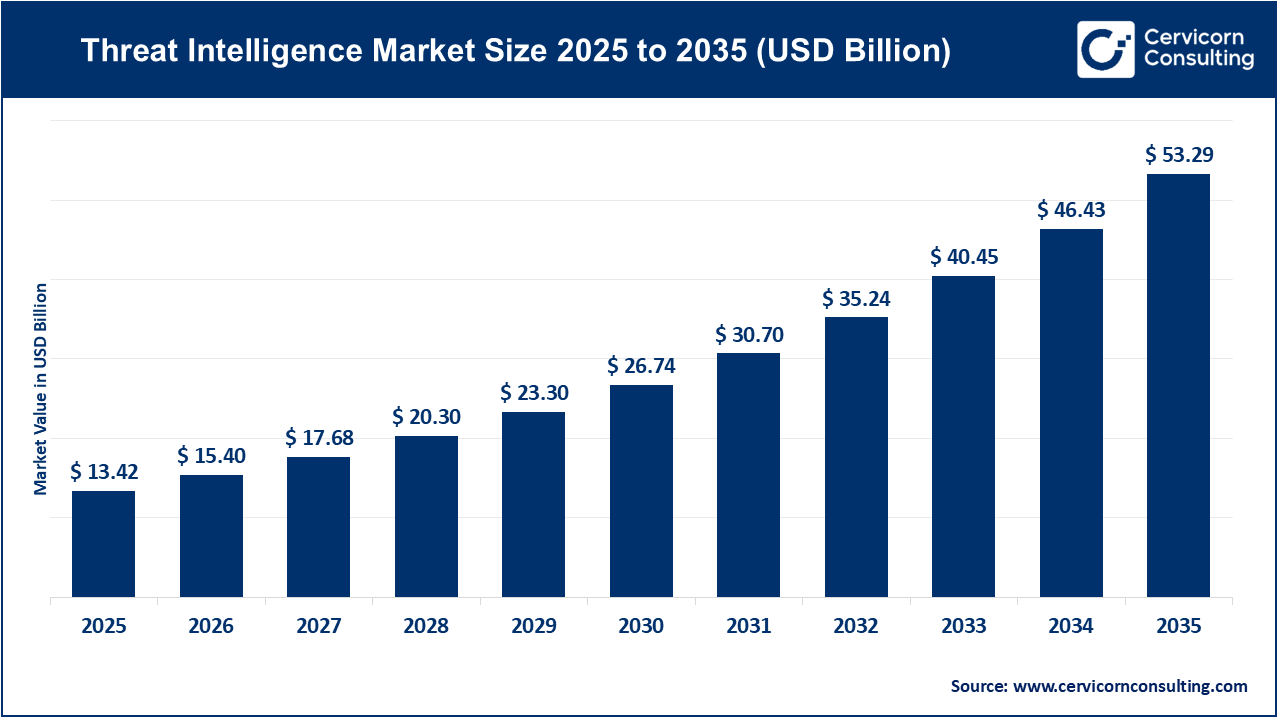
As digital transformation accelerates in cloud computing, IoT, remote work, and critical infrastructure, organizations face greater exposure to sophisticated cyber adversaries. With rising global investments in cybersecurity solutions, businesses and government agencies are heavily investing in big data and nanotechnology tools to enhance their security infrastructure. This provides them with visibility into both their internal networks and external ecosystems, offering real-time insights into threats that could impact their operations.
Report Highlights
- North America leads the threat intelligence market with about 38% share, driven by strong cybersecurity infrastructure and major security vendors.
- Solutions dominate the offering segment with nearly 65% share, due to rising demand for automated threat detection platforms.
- Strategic threat intelligence holds around 29% share, supported by growing demand for long-term cyber risk analysis.
- On-premises deployment accounts for about 59% share, as organizations prefer greater control over sensitive security data.
- Large enterprises represent nearly 72% share, due to complex IT environments and higher cyberattack exposure.
- IT & Telecommunications leads end-user adoption with around 29% share, driven by the need to secure large digital networks.
AI-Driven, Proactive, and Intelligence-Led Security Accelerates Threat Intelligence Adoption
Global organizations are increasingly adopting threat intelligence solutions thanks to innovative technologies such as artificial intelligence (AI), machine learning (ML), and advances in big data analytics that make accessing and sharing threat intelligence easier than ever. AI-enabled threat intelligence platforms allow organizations to automate the correlation of indicators of compromise (IoCs), perform predictive analysis of attacker behavior, and identify previously unknown threats more quickly. Organizations can reduce dwell time, enhance incident response, and lessen business impacts by shifting security policies from reactive protection to proactive threat anticipation.
As enterprises place greater emphasis on cyber resilience, regulatory compliance, and the safeguarding of digital assets, threat intelligence is becoming a key pillar of modern cybersecurity strategies. Its ability to provide valuable data for decision-making, support automation of security processes, and improve operations within security operations centers (SOCs) positions the threat intelligence market for sustained growth throughout the forecast period.
Global Adoption Trends in Threat Intelligence Solutions
Threat intelligence has become a core capability within modern cybersecurity frameworks as organizations increasingly shift from reactive security to proactive and intelligence-driven threat detection. Rising cyberattacks, ransomware incidents, and geopolitical cyber conflicts are pushing enterprises to integrate threat intelligence platforms with security operations centers (SOCs), SIEM systems, and incident response tools. These solutions help organizations identify emerging threats, understand attacker behavior, and prioritize vulnerabilities before they can be exploited.
Enterprise Adoption of Threat Intelligence
Threat intelligence adoption has grown rapidly across enterprises as cyber risks become more sophisticated and frequent. Organizations are increasingly collecting external threat feeds, dark web intelligence, and real-time attack indicators to strengthen their cybersecurity posture.
- Approximately 72% of organizations globally use some form of threat intelligence to identify and mitigate cyber threats.
- Nearly 43% of security leaders use threat intelligence for strategic planning and investment decisions, indicating its growing importance beyond operational security.
- Large enterprises account for about 67% of threat intelligence deployments, as they operate complex IT environments that require advanced monitoring capabilities.
These figures demonstrate that threat intelligence is increasingly viewed as a strategic cybersecurity capability rather than only a technical tool.
Operational Benefits and Performance Impact
Threat intelligence solutions significantly enhance an organization’s ability to detect and respond to cyber threats by providing contextual insights about attackers, vulnerabilities, and malicious infrastructure.
- Integrating advanced threat intelligence feeds can deliver up to 25% improvement in malicious and phishing threat detection rates.
- Around 80% of organizations consider threat intelligence essential for identifying emerging cyber threats before they impact business operations.
- Security teams using intelligence-driven platforms report faster incident response times and improved threat prioritization, reducing the overall risk of breaches.
These operational improvements make threat intelligence a critical component of modern security architectures and automated cyber defense systems.
Cyber Threat Landscape Driving Adoption
The growing complexity and scale of cyber threats are major factors accelerating the adoption of threat intelligence solutions across industries.
- 83% of organizations reported experiencing at least one insider attack in a year, highlighting the need for advanced monitoring and threat detection capabilities.
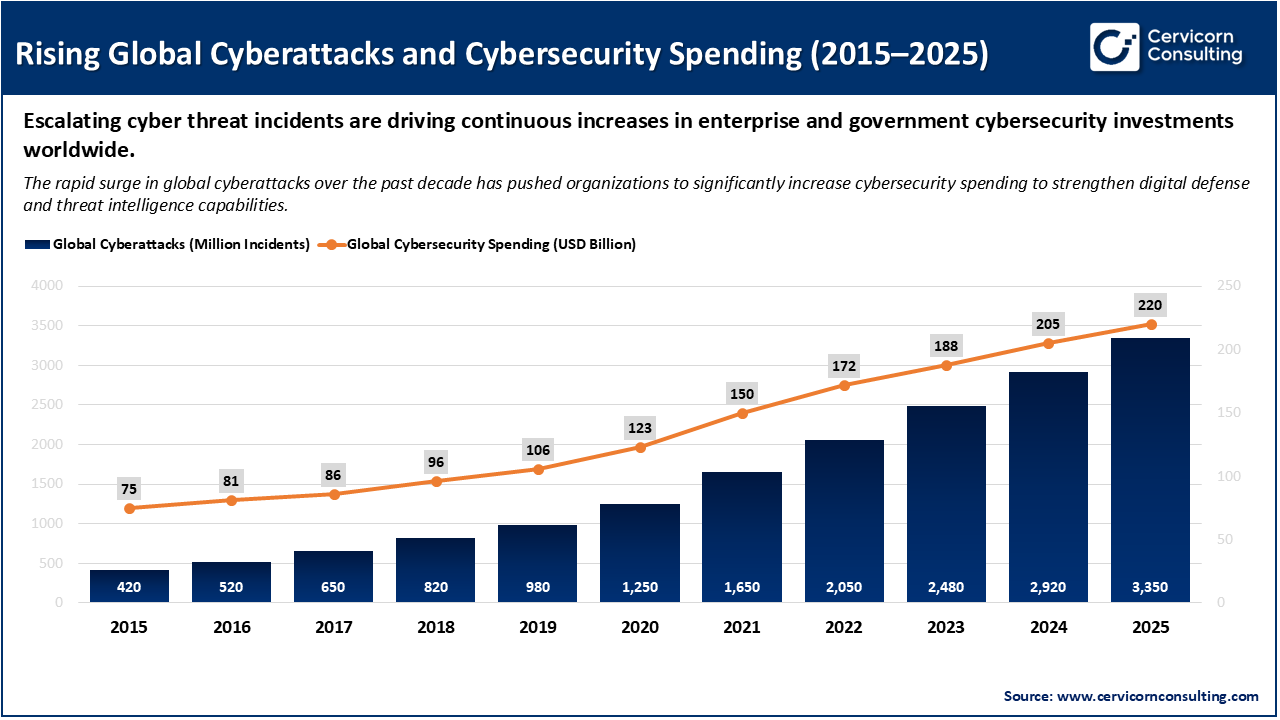
- In 2025, ransomware attacks reached record levels with 7,458 reported incidents globally, showing the rapid expansion of organized cybercrime groups.
The rising frequency of cyber incidents is pushing organizations to implement predictive security strategies based on threat intelligence data.
Recent Major Milestones
1. Proactive Cyber Defense and Intelligence-Led Security Drive Threat Intelligence Adoption
The growing focus on proactive cyber defense is greatly boosting the adoption of threat intelligence solutions across businesses, governments, and critical infrastructure operators. Modern cybersecurity tactics increasingly depend on intelligence-led security models that combine threat data from various sources, including open-source intelligence (OSINT), dark web monitoring, endpoint telemetry, and network traffic analysis. Threat intelligence platforms (TIPs) also facilitate threat correlation, attacker profiling, and early detection of malicious activity within complex digital environments in real time.
Organizations can enhance decision-making, reduce breach impacts, and accelerate response times by integrating threat intelligence into security operations centers (SOCs). This intelligence-driven approach supports current security frameworks that demand rapid visibility into emerging risks, such as continuous risk assessment and zero-trust. As cyber threats grow more persistent and sophisticated, threat intelligence is expected to become a fundamental part of next-generation cybersecurity strategies.
2. Rise of Advanced Persistent Threats (APTs) and Ransomware Accelerates Market Growth
The rapid rise of advanced persistent threats (APTs), ransomware attacks, and nation-state-sponsored cyber operations is driving increased adoption of threat intelligence. These sophisticated threats often bypass traditional security measures, making it necessary to gain deeper visibility into attacker behaviours, tactics, techniques, and procedures (TTPs). Threat intelligence solutions help organizations detect stealthy threats, identify attack patterns, and disrupt campaigns before they cause significant damage.
By 2025, more organisations will adopt automated threat intelligence platforms integrated with SIEM, SOAR, and EDR tools to prevent ransomware attacks and targeted intrusions. As attackers employ more evasive techniques and ransomware attacks escalate due to supply-chain vulnerabilities, threat intelligence will remain vital for organisations aiming for scalable, adaptive, and resilient cybersecurity.
3. Data Privacy, Regulatory Pressure, and Risk Visibility Shape Threat Intelligence Architectures
As regulatory scrutiny increases across data protection, critical infrastructure security, and cyber resilience, organizations are prioritizing threat intelligence to ensure compliance and risk management. Threat intelligence platforms provide real-time data and actionable insights about current risk exposure and threat actor behaviours. Organizations can use this information to assess their security investments based on real-world risk scenarios.
Threat intelligence is increasingly integrated into sectors such as government, healthcare, energy, and finance to meet legal obligations for risk management, operational resilience, and breach reporting. Consequently, threat intelligence is now considered a crucial strategic asset for enhancing visibility, accountability, and preparedness, especially as compliance requirements across industries continue to expand.
4. AI-Driven Analytics and Automation Strengthen Real-Time Threat Intelligence Capabilities
The integration of artificial intelligence and machine learning into threat intelligence platforms is revolutionising how cyber threats are detected and analyzed. AI-powered systems can handle large amounts of threat data in real time, automatically detect anomalies, and link indicators of compromise (IoCs) across different environments. This greatly decreases analysts' workload while enhancing detection accuracy.
Moreover, organizations are shifting from reactive incident responses to proactive threat prediction by using automated threat enrichment, attacker attribution, and predictive risk assessment. AI-enhanced threat intelligence marks a pivotal moment in the evolution of modern security operations, driving faster, more accurate, and scalable cybersecurity efforts.
Report Scope
| Area of Focus |
Details |
| Market Size in 2026 |
USD 15.40 Billion |
| Market Size in 2035 |
USD 53.29 Billion |
| CAGR 2026 to 2035 |
14.80% |
| Dominant Region |
North America |
| Fastest Growing Region |
Asia-Pacific |
| Key Segments |
Offering, Type, Deployment Mode, Organization Size, End User, Region |
| Key Companies |
Palo Alto Networks, Inc., FireEye, Inc. (Trellix), IBM Corporation, Cisco Systems, Inc., CrowdStrike Holdings, Inc., Check Point Software Technologies Ltd., Fortinet, Inc., Rapid7, Inc., Splunk Inc., McAfee Corp., Trend Micro Inc., Darktrace Ltd., Proofpoint, Inc., Microsoft Corporation |
Threat Intelligence Market Regional Analysis
The threat intelligence market is segmented by region into North America, Europe, Asia-Pacific, and LAMEA. Here is a brief overview of each region:
Why does North America dominates in the threat intelligence market?
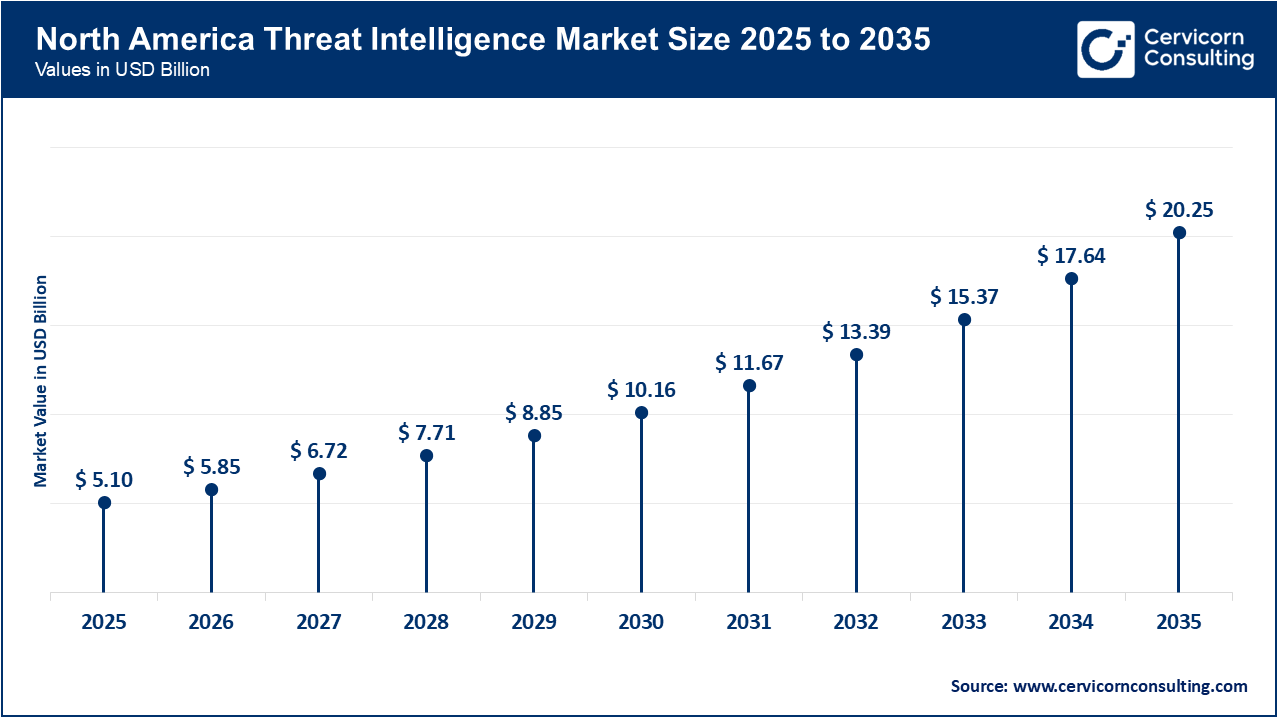
The North America threat intelligence market size was valued at USD 5.10 billion in 2025 and is expected to hit around USD 20.25 billion by 2035. North America dominates the market, accounting for 38% in 2025, supported by early adoption of advanced threat intelligence solutions, stringent regulatory compliance requirements, and high cybersecurity spending. The United States leads regional growth, driven by corporate, government, and defense investments in AI-enabled threat detection, real-time monitoring, and managed security services.
The region benefits from close collaboration between cybersecurity vendors, enterprises, and government agencies, enabling rapid innovation in predictive analytics, automated threat response, and network monitoring platforms.
United States to Lead Regional Cyber Threat Intelligence Adoption
The United States represents the largest contributor to the North American threat intelligence market, supported by high cybersecurity spending and increasing threat complexity.
- The U.S. accounts for over 80% of the regional cybersecurity spending, with enterprises investing heavily in threat intelligence solutions.
- The country reported over 3,000 publicly disclosed cyber incidents annually, including ransomware attacks targeting hospitals, financial institutions, and government agencies.
- Federal initiatives such as zero-trust security frameworks and increased cyber defense budgets are encouraging organizations to deploy advanced threat intelligence platforms.
- Leading companies such as CrowdStrike, IBM Security, Palo Alto Networks, and FireEye (now Trellix) are headquartered in the U.S., strengthening the innovation ecosystem.
Canada to Strengthen Cybersecurity Infrastructure
Canada is witnessing steady growth in the threat intelligence market as organizations strengthen cyber defense strategies.
- Canada’s cybersecurity market is growing at over 10% annually, driven by increasing cyberattacks on financial services and public infrastructure.
- Government initiatives such as the National Cyber Security Strategy are promoting threat intelligence sharing between government agencies and private organizations.
Why is Asia-Pacific fastest-growing region for the threat intelligence market?
The Asia-Pacific threat intelligence market size was accounted for USD 4.03 billion in 2025 and is forecasted to hit around USD 15.99 billion by 2035. The Asia-Pacific region is the fastest-growing market, accounting for 30% of global threat intelligence revenue in 2025. Growth is driven by rapid digital transformation across defense, government, and critical infrastructure sectors, as well as rising cyber threats and increasing cybersecurity budgets in countries like China, India, Japan, South Korea, and Australia.
Organizations are adopting advanced threat intelligence platforms, managed security services, and AI-powered cybersecurity tools to defend against sophisticated cyberattacks, data breaches, and espionage. The region’s focus on developing indigenous cybersecurity capacities, along with widespread adoption of both cloud-based and on-premises threat intelligence solutions, continues to fuel rapid market growth.
China to Act as a Major Cybersecurity Investment Hub
China represents one of the largest cybersecurity markets in Asia-Pacific due to its massive digital economy and growing cyber risk exposure.
- China’s cybersecurity spending exceeded USD 12 billion in 2025, with a large share dedicated to threat intelligence and network security.
- The country has experienced a rising number of APT attacks targeting manufacturing, telecommunications, and government systems.
- The Chinese government has strengthened cybersecurity regulations under the Cybersecurity Law and Data Security Law, pushing enterprises to adopt threat monitoring and intelligence platforms.
India to Emerge as a High-Growth Market for Threat Intelligence
India’s threat intelligence market is expanding rapidly due to increased digitization, fintech growth, and cloud adoption.
- India records over 1.5 million cyberattack attempts annually, making it one of the most targeted countries in Asia.
- The banking and financial services sector (BFSI) is the largest adopter of threat intelligence solutions to combat fraud, phishing, and ransomware.
- Government initiatives such as Digital India and the National Cyber Security Policy are encouraging organizations to implement advanced cyber threat monitoring systems.
Japan and South Korea to Focus on Critical Infrastructure Protection
Both Japan and South Korea are investing heavily in threat intelligence solutions to secure industrial systems and national infrastructure.
- Japan’s cybersecurity spending is projected to exceed USD 5 billion by 2030, driven by threats targeting manufacturing and smart infrastructure.
- South Korea has one of the most advanced digital infrastructures, making telecom networks and financial systems frequent targets of cyber espionage.
What are the driving factors of Europe threat intelligence market?
The Europe threat intelligence market size was estimated at USD 2.95 billion in 2025 and is projected to surpass around USD 11.72 billion by 2035. Europe holds 22% of the market in 2025, supported by strict cybersecurity regulations such as GDPR, NIS Directive, and increasing demand for AI-powered threat intelligence solutions. Countries including Germany, the U.K., France, and the Netherlands are investing in automated threat monitoring, security analytics, and advanced incident response platforms to protect critical infrastructure and enterprise networks. The region’s focus on compliance, interoperability, and cross-border cyber defense efforts drives steady market growth.
United Kingdom to Lead Cyber Threat Intelligence Adoption
The United Kingdom is one of the largest cybersecurity markets in Europe due to its strong financial services sector and high cyber risk exposure.
- The UK cybersecurity market surpassed USD 12 billion in 2025, with threat intelligence platforms playing a key role in financial security.
- The National Cyber Security Centre (NCSC) actively promotes threat intelligence sharing between government agencies and private organizations.
Germany to Strengthen Industrial Cybersecurity
Germany’s threat intelligence market is driven by the country’s large industrial and manufacturing base.
- Germany is a leader in Industry 4.0 technologies, making industrial control systems increasingly vulnerable to cyber threats.
- The government’s IT Security Act 2.0 mandates stronger cybersecurity measures for critical infrastructure operators.
Threat Intelligence Market Share, By Region, 2025 (%)
| Region |
Revenue Share, 2025 (%) |
| North America |
38% |
| Asia-Pacific |
30% |
| Europe |
22% |
| LAMEA |
10% |
LAMEA Threat Intelligence Market: Driven by Cybersecurity Modernization and Critical Infrastructure Protection
The LAMEA threat intelligence market was valued at USD 1.34 billion in 2025 and is anticipated to grow USD 5.33 billion by 2035. LAMEA accounts for 10% of the global market in 2025, with growth driven by rising cyber threats, digital transformation, and government-led cybersecurity modernization efforts across Latin America, the Middle East, and Africa. Organizations are adopting threat intelligence platforms to safeguard public infrastructure, financial systems, and energy grids from ransomware, phishing, and advanced persistent threats.
Brazil to Lead Threat Intelligence Adoption in Latin America
Brazil represents the largest cybersecurity market in Latin America.
- Brazil accounts for over 40% of cybersecurity spending in Latin America.
- The country records hundreds of thousands of cyberattack attempts annually, particularly targeting banking and e-commerce sectors.
United Arab Emirates to Drive Cybersecurity Innovation in the Middle East
The UAE is becoming a regional cybersecurity hub due to its rapid digital transformation.
- Government initiatives such as the UAE Cybersecurity Strategy are promoting investments in threat intelligence platforms.
- The country’s smart city projects and digital banking sector require advanced cyber defense systems.
Threat Intelligence Market Segmental Analysis
The threat intelligence market is segmented into offering, type, deployment mode, organization size, end user, and geography.
Offering Analysis
Solutions hold the largest market share in threat intelligence because they are essential for helping organizations detect, analyze, and respond to cyber threats. These solutions include threat intelligence platforms, SIEM/EDR integrations, vulnerability management systems, and automated alerting tools. Enterprises and government agencies depend on solutions to gather threat data, offer actionable insights, and enhance security operations center (SOC) efficiency.
Global Threat Intelligence Market Share, By Offering, 2025 (%)
| Offering |
Revenue Share, 2025 (%) |
| Solutions |
65% |
| Services |
35% |
Services are the fastest-growing segment, driven by higher demand for managed threat intelligence, incident response, consulting, and training. Organizations outsource intelligence analysis and threat monitoring to gain expertise, lower operational costs, and quickly implement top-tier security practices. Growth is sped up by the shortage of skilled cybersecurity professionals and the increasing complexity of cyber threats.
Type Analysis
Technical intelligence dominates the market by providing detailed information about malware signatures, IoCs (Indicators of Compromise), vulnerabilities, TTPs (tactics, techniques, and procedures), and active threat campaigns. It is essential for SOCs, vulnerability management teams, and incident responders to protect enterprise networks effectively.
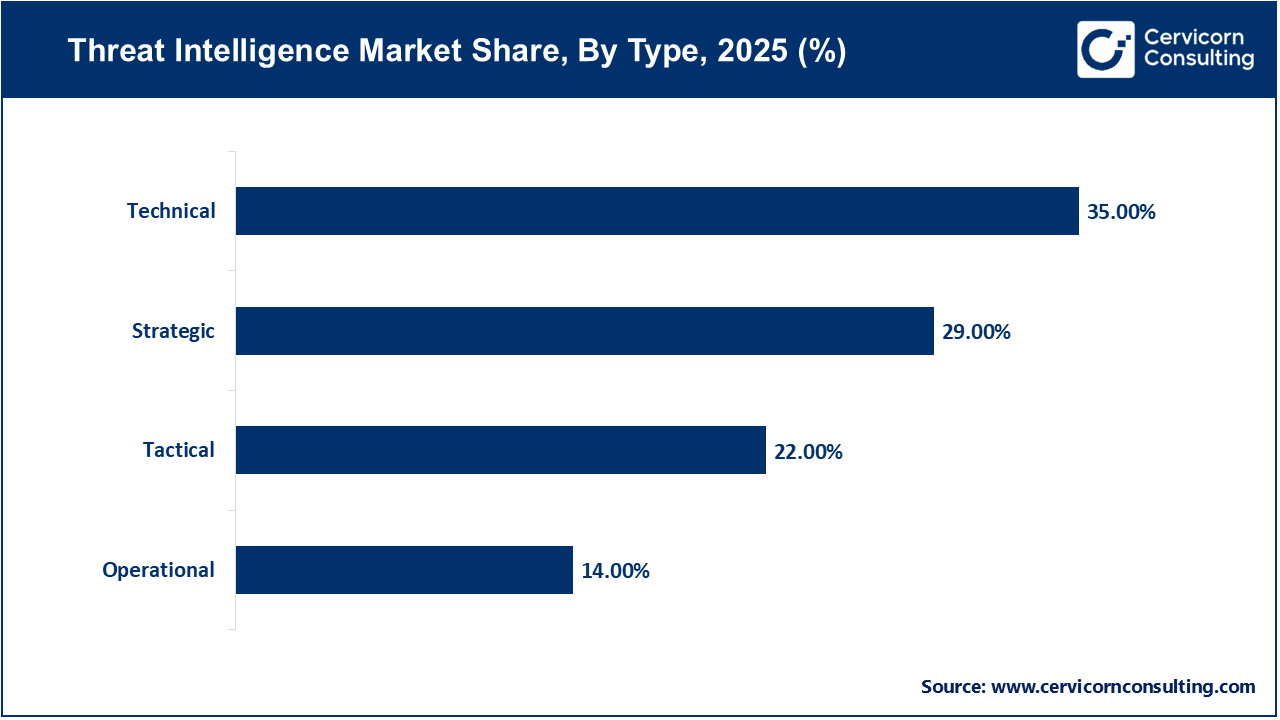
Strategic intelligence is the fastest-growing segment, driven by the demand for executive-level insights, geopolitical threat analysis, and risk forecasting. Organizations increasingly need intelligence that informs strategic decision-making, supports regulatory compliance, and aligns cybersecurity initiatives with business goals.
Deployment Mode Analysis
On-premises deployment holds the largest share due to security, compliance, and data sovereignty requirements, especially in government, BFSI, and critical infrastructure sectors. On-premises platforms enable organizations to maintain full control over sensitive threat intelligence data and integrate with existing internal security systems.
Threat Intelligence Market, By Deployment Mode, 2025 (%)
| Deployment Mode |
Revenue Share, 2025 (%) |
| Cloud-based |
41% |
| On-premises |
59% |
Cloud-based deployment is the fastest-growing segment, benefiting from scalability, lower upfront costs, and real-time threat intelligence updates. Organizations adopting cloud-native SOC platforms and hybrid security architectures increasingly prefer cloud delivery models for continuous monitoring, collaboration, and global threat feed integration.
Organization Size Analysis
Large enterprises hold the biggest share due to their wide attack surfaces, regulatory requirements, and the need for enterprise-wide cybersecurity programs. These organizations invest heavily in strategic and technical threat intelligence solutions to safeguard mission-critical systems, customer data, and intellectual property.
Threat Intelligence Market, By Organization Size, 2025 (%)
| Organization Size |
Revenue Share, 2025 (%) |
| Large Enterprises |
72% |
| Small & Medium-sized Enterprises (SMEs) |
28% |
Small and medium-sized enterprises (SMEs) represent the fastest-growing segment, as they increasingly adopt managed threat intelligence services and cloud-based solutions to tackle cybersecurity skills gaps, limited budgets, and evolving threat landscapes. Growth is further supported by government initiatives and cybersecurity frameworks aimed at SMEs.
End User Analysis
IT & Telecommunications hold the largest share, driven by escalating cyberattacks, regulatory mandates, and the need for proactive threat detection. Organizations in these sectors increasingly deploy both strategic and technical intelligence solutions to safeguard sensitive data, ensure business continuity, and maintain customer trust.
Threat Intelligence Market, By End User, 2025 (%)
| End User |
Revenue Share, 2025 (%) |
| IT & Telecommunications |
29% |
| BFSI |
17% |
| Retails & E-commerce |
7% |
| Healthcare |
8% |
| Manufacturing |
9% |
| Government & Public Sectors |
23% |
| Others |
7% |
Government and public sectors are the fastest-growing end users, reflecting high adoption of threat intelligence to safeguard national infrastructure, defense networks, and critical services. These entities require advanced intelligence to protect against cyber espionage, APTs, and ransomware campaigns.
Threat Intelligence Market Top Companies
Recent Developments by Major Companies
Palo Alto Networks, Inc.
- Expanded threat intelligence solutions with AI-driven cloud security platforms for enterprise and government cybersecurity.
- Launched automated threat detection and response systems to support real-time network protection.
FireEye, Inc. (Trellix)
- Strengthened threat intelligence offerings for advanced persistent threat (APT) detection and incident response.
- Partnered with regional governments to deploy managed threat intelligence services for critical infrastructure.
IBM Corporation
- Enhanced AI-powered threat intelligence platforms integrating security analytics, endpoint protection, and cloud security solutions.
- Invested in predictive cybersecurity frameworks to support large-scale enterprise and defense networks.
CrowdStrike Holdings, Inc.
- Expanded Falcon platform capabilities for real-time threat detection, cloud-native intelligence, and automated response.
- Strengthened global threat research operations to counter emerging malware, ransomware, and state-sponsored attacks.
Market Segmentation
By Offering
- Solutions
- Services
- Professional Services
- Managed Services
By Type
- Strategic
- Tactical
- Operational
- Technical
By Deployment Mode
By Organization Size
- Large Enterprises
- Small & Medium-sized Enterprises (SMEs)
By End User
- IT & Telecommunications
- BFSI
- Retails & E-commerce
- Healthcare
- Manufacturing
- Government & Public Sectors
- Others
By Geography
- North America
- Europe
- Asia-Pacific
- LAMEA